

What do you think?

A Bunch of Pretty Things I Did Not Buy
A witty, gracious, and charmingly illustrated anti-consumer manifesto
Like most people, Sarah Lazarovic covets beautiful things. But rather than giving in to her impulse to spend and acquire, Sarah spent a year painting the objects she wanted to buy instead.
Based on a visual essay that was first published on The Hairpin, A Bunch of Pretty Things I Did Not Buy is a beautiful and witty take on the growing “slow shopping” movement. Sarah is a well-known blogger and illustrator, and she writes brilliantly without preaching or guilt-tripping. Whether she’s trying to justify the purchase of yet another particleboard IKEA home furnishing, debating the pros and cons of leg warmers or calculating the per-day usage cost of big-ticket items, Sarah’s poignant musings will resonate with any reader who’s ever been susceptible to an impulse buy.
Like most people, Sarah Lazarovic covets beautiful things. But rather than giving in to her impulse to spend and acquire, Sarah spent a year painting the objects she wanted to buy instead.
Based on a visual essay that was first published on The Hairpin, A Bunch of Pretty Things I Did Not Buy is a beautiful and witty take on the growing “slow shopping” movement. Sarah is a well-known blogger and illustrator, and she writes brilliantly without preaching or guilt-tripping. Whether she’s trying to justify the purchase of yet another particleboard IKEA home furnishing, debating the pros and cons of leg warmers or calculating the per-day usage cost of big-ticket items, Sarah’s poignant musings will resonate with any reader who’s ever been susceptible to an impulse buy.
192 pages, Hardcover
First published October 28, 2014
Ratings & Reviews
Friends & Following
Create a free account to discover what your friends think of this book!
Community Reviews
Displaying 1 - 30 of 111 reviews

October 30, 2014
A graphic novel on the author's journey to stop meaningless purchases. She said that the average person buys 68 items of clothing per year. WHAT?! That's like a whole new closet. I just bought a 3 pack of new socks. Does this count as one item, three or six items?
One year I made a New Year's resolution that I wouldn't buy any new clothes. The ladies at work were absolutely fascinated with this and asked about my progress all year long. I did find a nice consignment store, which still felt like a cheat. But I'm not a person who cares about a big wardrobe anyway. There are two women with endless clothing, and strangely it is rendered meaningless. They might have a nice sweater, but they won't wear it again for several months. And I wouldn't remember what they wore two days ago.
Now, the truth be told, I currently can't fit into a large section of my wardrobe due to a cookie and book reading disease. I am a minimalist based on the few things I'm actually wearing, but I won't get rid of the rest of it, because, you know, I'll get back into fighting shape again someday...
The point is, how much junk does a person need? Not that much. The author points out to buy quality clothing, ethically made (if possible). Even expensive clothing can still made in sweatshops. Buy a piece of clothing that will last beyond a few wears. Think twice! Three times!
One year I made a New Year's resolution that I wouldn't buy any new clothes. The ladies at work were absolutely fascinated with this and asked about my progress all year long. I did find a nice consignment store, which still felt like a cheat. But I'm not a person who cares about a big wardrobe anyway. There are two women with endless clothing, and strangely it is rendered meaningless. They might have a nice sweater, but they won't wear it again for several months. And I wouldn't remember what they wore two days ago.
Now, the truth be told, I currently can't fit into a large section of my wardrobe due to a cookie and book reading disease. I am a minimalist based on the few things I'm actually wearing, but I won't get rid of the rest of it, because, you know, I'll get back into fighting shape again someday...
The point is, how much junk does a person need? Not that much. The author points out to buy quality clothing, ethically made (if possible). Even expensive clothing can still made in sweatshops. Buy a piece of clothing that will last beyond a few wears. Think twice! Three times!

November 25, 2014
Food Rules! for Clothes! And stuff! Maira Kalman-esque illustrations! The irony of owning a book about not owning stuff! But it makes me want to not buy stuff AND get rid of stuff and it's also lovely and I'm not getting rid of it. So siiiiigh. Alas.

April 20, 2015
A cute book about consumerism. (Bet that sentence has never been said before..). This book was essentially a short, quick read with great illustrations, sending an overall anti-waste (or shop responsibly) message. I found it to be quirky and humorous.

December 14, 2014
I received this book as part of Bookreporter.com's Holiday Cheer Contest. It had not really crossed my radar prior to that, beyond noting that the author has a blog of the same name, which was catchy enough to make me remember to check it out some day. In the time of my life when I'm trying to minimize, and clear through decades of accumulations (not just mine, but the objects of sentiment and delight and, to be honest, also the crap I inherited from dearly departeds), the idea of "not buying" occupies a great part of my mind. But I also enjoy pretties, mostly in the form of art, so love to look. Even though I knew nothing about Sarah Lazarovic or the year she spent painting things she coveted instead of buying them, I was interested enough by the title to enter the contest -- and look! I got my own pretty thing I did not buy!
I love seeing how people use their art, and what they depict. For me, that was the biggest joy of the book. The stories were nice to read, but not particularly insightful. It was the whole journey-- seeing how Sarah faced her shopping demons and converted them to something more benign, that intrigued me. The way she places words on the page reminds me of an artist from the 1960's, whose name I can't recall and I am too lazy to google. But it was familiar, even though, through her words, I realized that the author is a generation younger than I am, and that the world she depicts as the norm was just burgeoning when I was the same age. However, she still did come up with some truthful observations, my favorite being:
Still, I think the book, short though it is, would have been enhanced with more of a reference early on as to why the author wrote it. It's on her web page, though:
As for me, I'm still trying to reduce buying, and increase my art. My biggest problem? I keep coveting art supplies and other people's art!
Thank you book reporter.com for sending this book my way. The orange of the cover is much friendlier in person than the orange on my computer screen.
I love seeing how people use their art, and what they depict. For me, that was the biggest joy of the book. The stories were nice to read, but not particularly insightful. It was the whole journey-- seeing how Sarah faced her shopping demons and converted them to something more benign, that intrigued me. The way she places words on the page reminds me of an artist from the 1960's, whose name I can't recall and I am too lazy to google. But it was familiar, even though, through her words, I realized that the author is a generation younger than I am, and that the world she depicts as the norm was just burgeoning when I was the same age. However, she still did come up with some truthful observations, my favorite being:
Unless you're born with outsize character and unfathomable beauty, you spend at least 67% of your adolescence fretting about what you look like. You spend the rest of the time eating Doritos and ogling teen pop stars with remarkably good skin. (I'm older than Doritos, but they did battle out Fritos as a party food when I was in high school.)
Still, I think the book, short though it is, would have been enhanced with more of a reference early on as to why the author wrote it. It's on her web page, though:
A Bunch of Pretty is a shop for not shopping. The name of this shop comes from my forthcoming book, A Bunch of Pretty Things I Did Not Buy. The title essay is about a year I spent painting the things I coveted, instead of buying them.
In the course of writing the book I spent a lot of time researching how and why we shop, the meaning of quality and the paucity of good quality stuff to buy. I also ate a lot of sandwiches. I really like sandwiches.
A Bunch of Pretty is my rotating collection of handmade things.
As for me, I'm still trying to reduce buying, and increase my art. My biggest problem? I keep coveting art supplies and other people's art!
Thank you book reporter.com for sending this book my way. The orange of the cover is much friendlier in person than the orange on my computer screen.

December 1, 2019
Its hilariously relatable. I love the illustrations and everything about it! I used to be shopperholic and now I can laugh about it, how much things I have througout my life that ended up given away to other people. But for me, it is a good deed, giving away things to people that would actually benefited the stuff I don't use anymore or never use at all.
February 23, 2017
I picked this book up because I'm into minimalism and trying to reject consumerism. This book was cute and tried to have an anti consumerist message, but ultimately it is still obvious the author still finds her self image in the possessions she owns considering how much she writes about so many specific items she adores. I felt like the book was well intentioned but missed the mark. Also, I didn't agree with chapter 3 on minimalism, saying it's just a bunch of rich people who can do it because in order to start minimalism you have to have a bunch of expensive items. I myself am middle class and 95% of the items in my closet are less than $50 (my closet is small including just 5 work shirts and 4 work pants, 1 pair of jeans, etc) and many of them have lasted years.

April 18, 2016
Conscious consumerism, minimalism, and the upcycling movement have been popular as of late, and while some authors approach the topic with impractical goals and a kind of classist attitude about "stuff," Lazarovic's approach is realistic, couched in her wonderful illustrations. A Bunch of Pretty Things I Did Not Buy is half-memoir--a funny, confessional journey of fashion and shopping mishaps while growing up--and half-instruction manual on how to become more conscious of how much we buy, and how much we use. It's never preachy. I very much enjoyed Lazarovic's take on shopping and the slow fashion movement.

January 26, 2025
Sweet little book about consumerism.

October 28, 2015
I concur with what others have already stated in their reviews here. It's like reading an illustrated blog post or journal entry. It's actually the illustrations that caught my eye when I found this at the library. It stroked my curiosity as something a tad bit different in presentation, and since it looked like a quick read (indeed I think I spent a total of 20 minutes, including a break to refill my tea) I checked it out. Slightly humorous, a point can be drawn if you like for being more selective in what you buy, but overall nothing searingly substantial should be expected if you check it out — other than it might make you crack a momentary smile.

February 7, 2017
I'm pretty sure I'm not the intended audience for this book. But, I recently read a bit of "Graphic Details" about Jewish female "confessional"/autobiographical graphic artists and Lazarovic was in there. This is the book that led me also to read Lasko-Gross, to get two books by Charlotte Salomon out of the library, and also a book by Aline Kominsky-Crumb that I hadn't heard of. And introduced me to a few other artists I haven't yet checked out and am looking forward to.
"A Bunch of Pretty Things" has its confessional qualities, and is advertised at least in part as a manifesto. I tend to think of manifestos as being a bit more edgy or hard core. This book is a quietly funny and engaging guide to being less obsessively consumeristic. It's gentle, I might even say compassionate, but doesn't shy away from its ideology. It recommends putting thoughtfulness into not only shopping, but how one interacts with interior spaces, problems of waste (Ikea + humans = landfill full of compressed sawdust), selfishness and greed. Thinking about how you are located in terms of class-systems and lifestyle-habits, and what your options are. And also thinking of the full lifecycle of a desired object (who made it, how was it made, what were the working conditions, what was it made with, approximate life expectancy...)
Even though the content wasn't new to me or all that compelling, I appreciated the wonderful, sometimes Kalmanish illustrations and the bits of humor and absurdity.
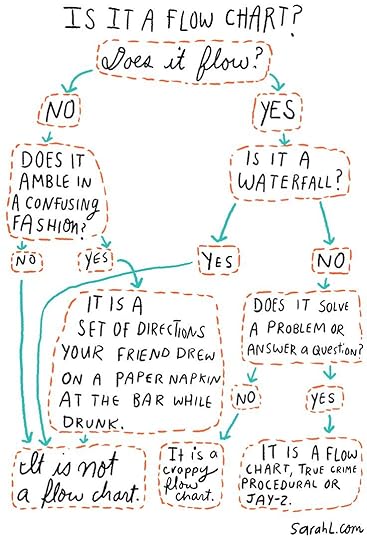
I was trying to find an online image of page 50 in which she draws a pocket knife with a shower cap, toaster oven, pickle and club sandwich. What came up on my search? A Lazarovic flow chart. It'll do.
As GR reviewer C.K. says in their review: (https://www.goodreads.com/review/show...)
"Conscious consumerism, minimalism, and the upcycling movement have been popular as of late, and while some authors approach the topic with impractical goals and a kind of classist attitude about 'stuff,' Lazarovic's approach is realistic, couched in her wonderful illustrations. A Bunch of Pretty Things I Did Not Buy is half-memoir--a funny, confessional journey of fashion and shopping mishaps while growing up--and half-instruction manual on how to become more conscious of how much we buy, and how much we use."
"A Bunch of Pretty Things" has its confessional qualities, and is advertised at least in part as a manifesto. I tend to think of manifestos as being a bit more edgy or hard core. This book is a quietly funny and engaging guide to being less obsessively consumeristic. It's gentle, I might even say compassionate, but doesn't shy away from its ideology. It recommends putting thoughtfulness into not only shopping, but how one interacts with interior spaces, problems of waste (Ikea + humans = landfill full of compressed sawdust), selfishness and greed. Thinking about how you are located in terms of class-systems and lifestyle-habits, and what your options are. And also thinking of the full lifecycle of a desired object (who made it, how was it made, what were the working conditions, what was it made with, approximate life expectancy...)
Even though the content wasn't new to me or all that compelling, I appreciated the wonderful, sometimes Kalmanish illustrations and the bits of humor and absurdity.
I was trying to find an online image of page 50 in which she draws a pocket knife with a shower cap, toaster oven, pickle and club sandwich. What came up on my search? A Lazarovic flow chart. It'll do.
As GR reviewer C.K. says in their review: (https://www.goodreads.com/review/show...)
"Conscious consumerism, minimalism, and the upcycling movement have been popular as of late, and while some authors approach the topic with impractical goals and a kind of classist attitude about 'stuff,' Lazarovic's approach is realistic, couched in her wonderful illustrations. A Bunch of Pretty Things I Did Not Buy is half-memoir--a funny, confessional journey of fashion and shopping mishaps while growing up--and half-instruction manual on how to become more conscious of how much we buy, and how much we use."
October 10, 2019
Lately I’ve been kind of obsessed with consumerism and slow fashion and self improvement in this area. So this adorable graphic novel was right up my alley!


May 11, 2015
I'm not big into shopping. In fact, I normally loathe it, but I ended up reading this largely for three reasons: 1) It received a good rating from a Goodreads friend. 2) I was extremely tired and it looked easy on the brain. 3) I was trapped in a hotel room and it was immediately available for download from my library. Under normal circumstances, it may have only merited two stars in my world, but I gave it three stars because the cute pictures kept my tired brain amused and I liked that it provided advice to help other shopaholics make better considered purchases in the future.

February 2, 2015
This book lacked substance. The illustrations were pretty and it was a light, very quick, read. While the author does reflect on her past, present and future relationship with shopping and material "stuff", she doesn't really delve very deeply into any of the topics and I finished the book without taking much away from it.
Also, checking her blog upon completion, it hasn't been updated since the beginning 2014...
Also, checking her blog upon completion, it hasn't been updated since the beginning 2014...

April 30, 2015
This book is an extremely quick read (20 minutes), but I enjoyed it. It was the equivalent of a fashion magazine/long form article about fashion, minimalism and purchasing quality over quantity. The drawings/paintings are very cute. Sarah and I had the same sense of teenage style and I was laughing throughout her history of clothing choices because I understand the desperate thrift store searches for the perfect mechanic shirt.

October 24, 2017
this has got to be one of my favorite books of this year. I'll make sure to have it lying around the house to vitalize my flagging motivation in the face of everyday consumeristic impulses. Its written just as well as its drawn. The binding is a joy to hold and touch. Cant wait to share it with some friends!

October 30, 2014
As cute as you might expect from the title and packaging. Sweet and satisfying but not terribly deep. Hard candy in book form.

January 9, 2015
I love the idea of an artist's take on anti-consumerism! Simple, whimsical content makes its point.

April 16, 2016
cute illustrations and anti-consumerism, finally combined

November 9, 2021
Somehow I missed Sarah Lazarovic's "Buyerarchy of Needs." For that matter, I didn't know anything about Sarah Lazarovic and even though I just read this within the last week or so I have no idea how I came across the book (which I checked out from the library).
Lazarovic's artwork is charming and just detailed enough that it seems like it's not very detailed; but if you look closely you'll see the talent that goes into it. Her main point is that the earth just can't handle all the crap we buy and then discard; she shows all sorts of lovely things that she likes/liked, but did not buy, including clothing (lots of clothing), housewares, furniture, and probably other things, and then provides a list of "rules" that can help us decide what to buy and avoid the impulse buying that comprises so much of our capitalist system.
The Buyerarchy of Needs is a pyramid. Starting from the bottom it goes: Use what you have (biggest bar); then Borrw; Swap; Thrift; Make; and Buy (the tiny one at the top of the pyramid). I simply enjoyed looking at the book, because she does great graphics and somewhat crazy writing that can get big or small and wanders around on the page a bit, but it's charming. (Oh, I already said "charming"; how about "delightful and appealing"?)
Go get this book at the library. Or borrow one from somebody. She suggests that if you have a copy you don't want, plant a tree over it so it can melt into the ground. (She doesn't say that exactly, but something to that effect.)
I'm so surprised that the average rating is 3.54 -- crazy! I wonder if the people who rated it are just committed capitalists who buy everything they see, like, and can scrape together the money for. Even on Amazon it only gets a 3.9. Well, I'm doing my part to raise the ratings, because it deserves more. It's a slight book, but just the right length.
Lazarovic's artwork is charming and just detailed enough that it seems like it's not very detailed; but if you look closely you'll see the talent that goes into it. Her main point is that the earth just can't handle all the crap we buy and then discard; she shows all sorts of lovely things that she likes/liked, but did not buy, including clothing (lots of clothing), housewares, furniture, and probably other things, and then provides a list of "rules" that can help us decide what to buy and avoid the impulse buying that comprises so much of our capitalist system.
The Buyerarchy of Needs is a pyramid. Starting from the bottom it goes: Use what you have (biggest bar); then Borrw; Swap; Thrift; Make; and Buy (the tiny one at the top of the pyramid). I simply enjoyed looking at the book, because she does great graphics and somewhat crazy writing that can get big or small and wanders around on the page a bit, but it's charming. (Oh, I already said "charming"; how about "delightful and appealing"?)
Go get this book at the library. Or borrow one from somebody. She suggests that if you have a copy you don't want, plant a tree over it so it can melt into the ground. (She doesn't say that exactly, but something to that effect.)
I'm so surprised that the average rating is 3.54 -- crazy! I wonder if the people who rated it are just committed capitalists who buy everything they see, like, and can scrape together the money for. Even on Amazon it only gets a 3.9. Well, I'm doing my part to raise the ratings, because it deserves more. It's a slight book, but just the right length.

May 20, 2016
At first I thought this would be an anti-consumerism manifesto, but it wasn't that - it was more a sensible consuming charmingly drawn book. The reader will breeze through the well-drawn, really, painted, pages, and enjoy the script style. As an art work, it's refreshing and well-executed.
The book examines the author's development as a consumer, from childhood on, and what consuming really means. It's an unending development of finding an identity, perhaps - as expressed through style, home decor and such. The world of school in Florida, with various fashion/style trends, the intense competition among kids with respect to clothes, or "pegging" of types by the clothes they wear, is examined. Finally, the author goes to college - goes through the period of buying insta-furniture at Ikea, and later marries and has kids of her own. The journey that started in childhood, when she had much less, continues even though she's reached adulthood.
The gist or message of the highly entertaining and wise book is to think carefully before snapping up purchases; to consider quality, to not just buy if something's on sale, to stop window shopping on the internet, to consider if you don't already have a garment or item that's very much like the thing you crave, and so forth. It's a wish that we slow down and not simply buy, buy, buy because clothing is so cheap (a dress can be as cheap as 4.99, the price of a latte). She recommends borrowing, and taking a sewing class so that the reader can remodel/tweak what they already have. She mentions the conditions of the sweatshops overseas - but this isn't a book decrying cheap mass-market things (clothing etc) - the sustainability she calls for is achieved through buying carefully, slowly, and first considering if you really need something. She invents a "Buyerarchy of Needs:" At the bottom of the pyramid is "Use what you have", next "Borrow," then "Swap" followed by "Thrift" (i.e. buy @ thrift shops) then "Make" and finally, "Buy." Thus, buy new at a regular store is the "last resort" only after all the other possibilities have been exhausted.
The book was of interest to me because I largely stopped shopping impulsively/consistently, a little over 5 years ago, when I was laid off and it was no longer possible to buy anything other than necessities (nor was a " work wardrobe" really needed anymore).
Once, shopping was practically my only amusement or spare time activity. I would say I shopped daily - even for clothes. The accumulation of clothing actually has "paid off" now that I can't afford to shop all the time - I have enough styles/clothes to probably last me for many years, and I even have been discarding things as they no longer fit (following my weight loss). Of course, there are some things I would want to buy and I should be in a position to buy them at some point, but the random almost compulsive bargain hunting - for no reason other than to get a bargain, shopping for the heck of it, or as an entertainment, not because I actually needed anything - that has ended. Taking a sewing class would be great but it's a moot point since I don't own a sewing machine. Still, necessity is the mother of invention: I think back to my late mom, who was so skilled and inventive as a seamstress and could turn remnants into fashion. The whole idea is to not only look good, but also look like the outfit cost some money. Fashion is about projecting the idea of having money, money at least to buy the outfit. On the other hand, the rise of the "proletarian" or "egalitarian" jeans uniform, since at least the 60s, means not that much fashion is really needed. The difference between now and prior eras is startling with respect to clothing: Where once there was a "social point" of dressing, today dressing down is the default mode; somehow the apparent social leveling effect of everyone being in a jeans/casual wear uniform though hasn't led to actual socioeconomic leveling.
On the other hand, fashion is fun, and can be an art form. At least this is how I view outfits - accessorizing, etc. I must have inherited this liking of putting together outfits to convey an attractive, if not luxe impression, from my mom - who invariably but together an attractive look, complete with hairstyle, makeup, jewelry, even to go food shopping, and always looked good when my dad would get home from work. She presided over the "social life" of the family and I suppose must have felt it important to convey a sophisticated, somehow "moneyed" image via jewelry and so forth (even though we were only middle-class). She was a striver - she never suffered from low self-esteem - also entertaining, making up jokes, constantly singing. Possibly the entire effort (of putting together outfits, sewing, altering clothing, etc) was seen as part of the entire "package" a social message, she was her own "scene" that people actually sought out, she was always very popular, but she also made an effort to be in touch and care about people. Anyway, I am not like her - none of her kids really became like her - she was flamboyant, outrageous in some ways - but in my own way, putting together an outfit effectively, or attractively, I think I've always cared about it and probably always will. So the issue now is, how to continue to have clothes, or some "staple" outfits, now that I'm no longer working etc. I thought this book would be a condemnation of consumerism, and maybe in that way, a "consolation" since I'm no longer much of a consumer (in the past 5 years, I've gone years without buying a single item of clothing or shoes). Actually, the book seems to recognize or acknowledge that people are not going to give up shopping, but that they can think first before they buy (as outlined above). They can consider the quality of a garment (she has a section on evaluating clothing - fabric, seams, buttons, button-holes, lace, trim, size of pockets, and so forth). If an item seems to be a quality garment, and you need it, then you might buy it. A garment should last about 10 years she says - so check and see if buttons are sewn on properly, if seams seem tight and so forth.
The author no longer shops the way she used to - and the book is about her journey from "mindless consumerism" - of having been a mall rat, to buying only things she needs, and thinking before buying. Also, buy things that last (quality). It's a struggle to not buy, she says, but we should think about what we're doing, since the world is filling up with so much cheap junk.
The book examines the author's development as a consumer, from childhood on, and what consuming really means. It's an unending development of finding an identity, perhaps - as expressed through style, home decor and such. The world of school in Florida, with various fashion/style trends, the intense competition among kids with respect to clothes, or "pegging" of types by the clothes they wear, is examined. Finally, the author goes to college - goes through the period of buying insta-furniture at Ikea, and later marries and has kids of her own. The journey that started in childhood, when she had much less, continues even though she's reached adulthood.
The gist or message of the highly entertaining and wise book is to think carefully before snapping up purchases; to consider quality, to not just buy if something's on sale, to stop window shopping on the internet, to consider if you don't already have a garment or item that's very much like the thing you crave, and so forth. It's a wish that we slow down and not simply buy, buy, buy because clothing is so cheap (a dress can be as cheap as 4.99, the price of a latte). She recommends borrowing, and taking a sewing class so that the reader can remodel/tweak what they already have. She mentions the conditions of the sweatshops overseas - but this isn't a book decrying cheap mass-market things (clothing etc) - the sustainability she calls for is achieved through buying carefully, slowly, and first considering if you really need something. She invents a "Buyerarchy of Needs:" At the bottom of the pyramid is "Use what you have", next "Borrow," then "Swap" followed by "Thrift" (i.e. buy @ thrift shops) then "Make" and finally, "Buy." Thus, buy new at a regular store is the "last resort" only after all the other possibilities have been exhausted.
The book was of interest to me because I largely stopped shopping impulsively/consistently, a little over 5 years ago, when I was laid off and it was no longer possible to buy anything other than necessities (nor was a " work wardrobe" really needed anymore).
Once, shopping was practically my only amusement or spare time activity. I would say I shopped daily - even for clothes. The accumulation of clothing actually has "paid off" now that I can't afford to shop all the time - I have enough styles/clothes to probably last me for many years, and I even have been discarding things as they no longer fit (following my weight loss). Of course, there are some things I would want to buy and I should be in a position to buy them at some point, but the random almost compulsive bargain hunting - for no reason other than to get a bargain, shopping for the heck of it, or as an entertainment, not because I actually needed anything - that has ended. Taking a sewing class would be great but it's a moot point since I don't own a sewing machine. Still, necessity is the mother of invention: I think back to my late mom, who was so skilled and inventive as a seamstress and could turn remnants into fashion. The whole idea is to not only look good, but also look like the outfit cost some money. Fashion is about projecting the idea of having money, money at least to buy the outfit. On the other hand, the rise of the "proletarian" or "egalitarian" jeans uniform, since at least the 60s, means not that much fashion is really needed. The difference between now and prior eras is startling with respect to clothing: Where once there was a "social point" of dressing, today dressing down is the default mode; somehow the apparent social leveling effect of everyone being in a jeans/casual wear uniform though hasn't led to actual socioeconomic leveling.
On the other hand, fashion is fun, and can be an art form. At least this is how I view outfits - accessorizing, etc. I must have inherited this liking of putting together outfits to convey an attractive, if not luxe impression, from my mom - who invariably but together an attractive look, complete with hairstyle, makeup, jewelry, even to go food shopping, and always looked good when my dad would get home from work. She presided over the "social life" of the family and I suppose must have felt it important to convey a sophisticated, somehow "moneyed" image via jewelry and so forth (even though we were only middle-class). She was a striver - she never suffered from low self-esteem - also entertaining, making up jokes, constantly singing. Possibly the entire effort (of putting together outfits, sewing, altering clothing, etc) was seen as part of the entire "package" a social message, she was her own "scene" that people actually sought out, she was always very popular, but she also made an effort to be in touch and care about people. Anyway, I am not like her - none of her kids really became like her - she was flamboyant, outrageous in some ways - but in my own way, putting together an outfit effectively, or attractively, I think I've always cared about it and probably always will. So the issue now is, how to continue to have clothes, or some "staple" outfits, now that I'm no longer working etc. I thought this book would be a condemnation of consumerism, and maybe in that way, a "consolation" since I'm no longer much of a consumer (in the past 5 years, I've gone years without buying a single item of clothing or shoes). Actually, the book seems to recognize or acknowledge that people are not going to give up shopping, but that they can think first before they buy (as outlined above). They can consider the quality of a garment (she has a section on evaluating clothing - fabric, seams, buttons, button-holes, lace, trim, size of pockets, and so forth). If an item seems to be a quality garment, and you need it, then you might buy it. A garment should last about 10 years she says - so check and see if buttons are sewn on properly, if seams seem tight and so forth.
The author no longer shops the way she used to - and the book is about her journey from "mindless consumerism" - of having been a mall rat, to buying only things she needs, and thinking before buying. Also, buy things that last (quality). It's a struggle to not buy, she says, but we should think about what we're doing, since the world is filling up with so much cheap junk.

February 8, 2018
(Nonfiction, Illustrated)
Oh, the irony! One of the books I indulged in buying new this year, rather than obtaining it second hand, or from the library was this one – about material things. It received such glowing comments in the Globe & Mail!
The author illustrated this herself, and I expected (and wanted) a sort of journal of lovely items that she had considered, the circumstances under which she considered them, and the reason she decided not to buy. Since reading this, I have thought that I might just make my own journal of such items (only, with cut and pasted pictures.)
Because this book wasn’t that.
A small (5”x7”, 13cmx19cm) hardback (looking as though it’s missing its [non-existent] dustjacket), A Bunch of Pretty Things is more a treatise on (over)consumerism, and the learning process to minimalism. As Amazon says: “A witty, gracious, and charmingly illustrated anti-consumer manifesto”. I see now that it’s interesting, but not what I wanted at the time.
This is an excellent book for twenty-somethings and thirty-somethings to read through. The teenage angst and lack of thoughtfulness about consumerism throughout the first part of the book may irritate anyone older. The last chapter – Conclusions – includes a guide to recognizing quality and “simple rules for better shopping”, the things the over 60 crowd was taught in school (at least, I was).
3½ stars
Oh, the irony! One of the books I indulged in buying new this year, rather than obtaining it second hand, or from the library was this one – about material things. It received such glowing comments in the Globe & Mail!
The author illustrated this herself, and I expected (and wanted) a sort of journal of lovely items that she had considered, the circumstances under which she considered them, and the reason she decided not to buy. Since reading this, I have thought that I might just make my own journal of such items (only, with cut and pasted pictures.)
Because this book wasn’t that.
A small (5”x7”, 13cmx19cm) hardback (looking as though it’s missing its [non-existent] dustjacket), A Bunch of Pretty Things is more a treatise on (over)consumerism, and the learning process to minimalism. As Amazon says: “A witty, gracious, and charmingly illustrated anti-consumer manifesto”. I see now that it’s interesting, but not what I wanted at the time.
This is an excellent book for twenty-somethings and thirty-somethings to read through. The teenage angst and lack of thoughtfulness about consumerism throughout the first part of the book may irritate anyone older. The last chapter – Conclusions – includes a guide to recognizing quality and “simple rules for better shopping”, the things the over 60 crowd was taught in school (at least, I was).
3½ stars

September 11, 2018
This was a delightful little book, filled with colorful illustrations that admittedly captivated my attention from the cover. I will say though, some of it was a little basic and I wished I had found this book at the start of my minimalism journey. It had great reminders and tidbits of information though; I would definitely recommend it for anyone who is toying with the concepts of minimalism and over-consumerism or if you are simply curious about what those mean. It’s a small book and a quick read, however I found myself pondering “little nuggets” of wisdom from her book throughout the week. Some of her one-liners and illustrations have really resonated with me. One quote in particular that really made me think was this: “Of course, the impulse to beautify one’s space is exacerbated by the voyeurism that bloggy ‘house tours’ and Instagrammed living rooms enable. It’s never been easier to see how the other whole lives.” So to wrap up my review, don’t let the size of this book fool you. It’s small and looks fun (which it is), but it’s packed with real life, useful information.

October 23, 2017
This quirky and fun book (appearance-wise) details the author's struggle to balance the internal desire for consumerism with her mental decision not to shop. Full of good vocabulary and actual research, both personal and professional, it is an entertaining and interesting read. Filled to the brim with drawings, it also serves as a nice artist rendition of many pieces of her style history (and all of the pretty things that she, of course, did not buy).
A cute and quick read, but a lower start rating simply because it didn't make me not want to buy anything. =\ (*I will note, however, that I got this book at a Good Will for 1.88, so I don't feel so guilty about buying a book about not buying anything.*)
A cute and quick read, but a lower start rating simply because it didn't make me not want to buy anything. =\ (*I will note, however, that I got this book at a Good Will for 1.88, so I don't feel so guilty about buying a book about not buying anything.*)

February 12, 2018
Lazarovic's small graphic novel is a contemplation of our relationship to stuff. She doesn't advocate minimalism (which is a nice change), but conscious and deliberate reflection on what we need and what we buy. She recommends that people buy smart, looking for quality and longevity. She also advises that perhaps getting rid of anything you aren't using right this moment forgets that you may very well need that item again, or find a new love for a once neglected object. A proper balance in our lives is one where out stuff has a space, makes us happy, and helps us live our lives. We probably need less than we have right now, but there's no shame in having stuff when we control and consider our buying habits.
December 27, 2022
this book was a lovely little collection visual essays. the flow of the chapters were okay, but the illustrations themselves were certainly the high point of the book. as a person that is already plugged into the "there-are-brutal-ecological-and-social-impacts-of-mass-manufacturing-and-capitalist-consumption" world, the book didn't really teach me anything new. however, i can see how this book would be a pivotal and knowledgeable resource for many other people (like the co-worker that lent me this book and recommended that i read this!). i did find the pieces about buyer's guilt and an object's worth insightful as someone who struggles with these ideas a lot. overall, this is a great mini-memoir/introduction to dealing with consumerism; i just don't think i was the book's target audience.

November 18, 2017
A lovely little book entirely drawn and written manually, I'm impressed for the amount of work and creativity the author put in it, yet the ensemble is a bit messy. But I liked the overall idea of reconsidering our consumerism and having double thoughts before making any new purchase of any kind. Also that we should teach our children about how to make wise purchases, how to check the quality of a garment etc... Cute and useful book
May 23, 2022
Really liked a couple of the drawings. In particular, the buyerarchy of needs and the Venn diagram of what you use where want, need, and buy overlap.
http://longliveirony.com/wp-content/u...
https://thehungryreader.files.wordpre...
http://longliveirony.com/wp-content/u...
https://thehungryreader.files.wordpre...
July 11, 2024
An eye-catching book about consumerism and how to thoughtfully cut down on buying. I especially appreciated her Buyerarchy of Needs chart since my oldest teen has been quite focused on trying to buy everything secondhand. The illustrations are fun although sometimes the size of the cursive is challenging to read.

September 14, 2017
A tiny "coffee table" type book that can be read in about an hour. I'm not fond of the handwritten format, but it's a good sampling of minimalist manifestos and the resistance of over-consumption and hoarding of possessions, mostly clothing and furniture.
Displaying 1 - 30 of 111 reviews