Jump to ratings and reviews
Rate this book

Is Anyone Listening?: What Animals Are Saying to Each Other and to Us

Rate this book
From a leading researcher on dolphin communication, a deep dive into the many ways animal species communicate with their kin, their neighboring species, and us. 


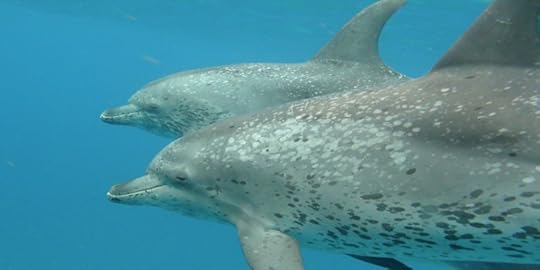
If you could pose one question to a dolphin, what would it be? And what might a dolphin ask you? For forty years, researcher and author Denise L. Herzing has investigated these and related questions of marine mammal communication. With the assistance of a friendly community of Atlantic spotted dolphins in the Bahamas, Herzing studies two-way communication between different dolphin species and between humans and dolphins using a variety of cutting-edge experiments. But the dolphins are not the only ones talking, and in this wide-ranging and accessible book, Herzing explores the astonishing realities of interspecies communication, a skill that humans currently lack.


Is Anyone Listening? connects research on dolphin communication to findings from Jane Goodall on chimpanzees, Dian Fossey on mountain gorillas, Cynthia Moss on African elephants, and others driving today’s exploration of possible animal languages. Although humans have long attempted to crack animal communication codes, only now do we have the advanced machine-learning tools to help. As Herzing reveals, researchers are finding fascinating hints of language in nonhuman species, including linguistic structures, vowel equivalents, and complex repeated sequences. By looking at the many ways animals use and manipulate signals, we see that we’ve only just begun to appreciate the diversity of animal intelligence and the complicated and subtle aspects of animal communication.


Considering dolphins and other nonhuman animals as colleagues instead of research subjects, Herzing asks us to meet animals as both speakers and listeners, as mutually curious beings, and to listen to what they are saying.

232 pages, Hardcover

Published November 14, 2024

12 people are currently reading
162 people want to read

About the author

Denise L. Herzing

4 books6 followers

Ratings & Reviews

What do you think?
Rate this book

Friends & Following

Create a free account to discover what your friends think of this book!

Community Reviews

5 stars
10 (19%)
4 stars
22 (43%)
3 stars
15 (29%)
2 stars
4 (7%)
1 star
0 (0%)
Displaying 1 - 21 of 21 reviews
Profile Image for Nataliya.
989 reviews16.3k followers
December 8, 2024
Apparently it’s much harder than it seems to try to communicate with non-human and non-primate intelligences. Denise Herzing knows that, having worked with dolphins for decades, studying the ways to communicate with them. And it’s not easy, given that we are terrestrial and visual creatures while dolphins are aquatic and mostly acoustic. Another issue is, we set up the tests and studies based on our own conveniences and assumptions, and that may not be the best way to study another species’ culture and communication — human communication standards should not be applied to those very different from us if we are expecting meaningful results. But it seems that with more availability of advanced technology and with the insights of people as passionate and experienced as Herzing we may have a chance to understand dolphin - and perhaps other animals as well - culture.

After all, if we struggle to communicate with the species on our own planet, how can we ever have a chance of someday making any communication work with anything extraterrestrial?

Herzing goes into the details of issues and pitfalls of attempting communication with dolphins, sometimes getting quite technical, which would undoubtedly be interesting to a less casual reader (the frequency charts became a bit too tedious for me). But what I appreciated is the idea that we need to stop trying to dominate the communication attempts with human-centric approach and consider things from the point of view of other species.

Which, of course, can’t help but lead to the question of how can anyone justify keeping these animals in captivity for any reason other than our extreme egocentrism.
“Dolphins belong in the wild. An average spotted dolphin travels at least ten to twenty miles a day, has a large network of friends and family, and invests years, if not decades, in teaching young dolphins how to survive. Dolphins teach their young complex skills, including feeding, babysitting, and negotiating the fine lines of dolphin behavior. A dolphin can only reach its true potential as a healthy, fully actuated individual in the wild. So, then, how can we give dolphins in captivity the ability to live out their lives in dignity with their own kind in a stimulating environment?”

“Taking a dolphin or whale out of its pod is kidnapping by any standard. By displaying dolphins and whales for profit, we teach children (and adults) that it’s okay for these animals to be used as entertainment, for people to hold a dolphin’s dorsal fin and be towed around in the water or demand that dolphins and whales jump and leap on command—or, worse, that it’s okay for people to ride a dolphin or orca in a vulgar display of human dominance.”

3.5 stars overall.

——————

Thanks to NetGalley and University of Chicago Press for providing me with a digital ARC in exchange for an honest review.

——————
Also posted on my blog.
Profile Image for Cav.
911 reviews209 followers
March 26, 2025
"If you could ask a dolphin one question, what would it be? What might a dolphin ask you?"

The topic of animal communication is incredibly interesting. Are humans the only species that can communicate vocally? Do other animals communicate? If they do, then how do other animals communicate?? All are thought-provoking questions. Unfortunately, I did not find this book to be an engaging examination of these questions. "Is Anyone Listening?" fell short of my expectations. More below.

Author Denise L. Herzing is the founder and Research Director of the Wild Dolphin Project, a non-profit that funds the study of the natural behaviors and communication of Atlantic spotted dolphins in the wild.

Denise L. Herzing:
18c90c592ca395a33e2f7402b43e273552a1564b-1600x1200

I have long been interested in animal communication. The subject has appeared in many of the books I've read and many of the lectures I've watched/listened to online. So naturally, I put this one on my list when I came across it. The book's cover shows a dolphin, and dolphins are known to communicate ultrasonically underwater. But what are they saying??

Herzing drops the quote above at the start of the book, and it continues:
"...These questions occurred to me when I first met a spotted dolphin in the wild one humid summer morning in 1985. I swam slowly away from my anchored boat through the gin-clear waters of a shallow sandbank in the Bahamas. The water was calm and peaceful, and there was no land in sight. Two dolphins approached and swam around me, looking directly into my eyes. Exchanging eye contact with a wild creature is like a splash of ice-cold water on your face. I sensed a keen and mutually exploratory awareness. Ten years later, after experiencing strong currents and large sharks, I would have a different type of respect for the ocean, one that wouldn’t allow me to swim out so far alone with such a calmness. But this first experience was different..."

In this short quote, the author lays out the aim of the book:
"This book is also an opportunity to talk about the focus of my current work: using artificial intelligence (AI) tools—like machine-learning software that can help us categorize sounds—to look for language in animal communication. With today’s discussion of bots or AI agents like ChatGPT, the concept of technology mimicking language will no doubt seem familiar.
As a scientist who has worked for over three decades to implement similar systems with wild dolphins, I have collaborated with other people, across research disciplines, to create new communication programs with our unique dataset of dolphin sounds and to determine potential language patterns. In the last few years, I have worked with computer scientist Thad Starner and his team at the Georgia Institute of Technology, and we have been able to identify and analyze dolphin sounds in new ways.9 I argue that we see rules, including grammar, that appear to be very important to the dolphins. We are creating a user interface so that other researchers can use these new tools to explore their recordings of other animals."

In my experience, science books can broadly be delineated into two categories. The first takes complex data and related minutia and distills them into clear, effective communication, that gives the reader more signal and less noise. The other takes the complex data and lists it out in a mechanical fashion, rattling off each point in a virtual never-ending torrent; effectively losing the reader in the process. Sadly I found this book a good example of the latter, and not the former...

The meat and potatoes of the book is the author covering her research on attempting to decode dolphin communication. Sadly, further to my above point, I found the body of the book to be somewhat rambling and arduous. The book seriously lacks narrative continuity and flow. She starts talking about one topic, then jumps to another. One animal species, and then another. One way of collecting the data, and then others. Starts one discussion, then quickly moves to another. UGHHH. The overall finished product left me frustrated.

Now, fault me all you will for my finicky tastes, but there is almost nothing I dislike in my books more than dry long-winded prose that bounces around with little to no regard for literary cohesion. Say whatever you want, but for the love of God, please don't bore me...

********************

The subject material covered here is fascinating. Sadly, I did not particularly enjoy this presentation of it. I found most of the writing here to be long-winded, flat, and dry. My reviews are always heavily weighted towards how readable the book is, and this one missed the mark for me.
There are many other books that cover this material in a more effective, engaging manner.
2.5 stars.
Profile Image for Claudia Magnus .
74 reviews2 followers
October 29, 2024
"I suspect it [the disconnect from considering the consequences of our actions to other species] comes from a deep disconnect with the idea that we are part of nature, not above it, and this disconnect has destructive consequence to the natural world." - Herzing

Rarely ever have I enjoyed a work of non-fiction as much as I have enjoyed Herzing's Is Anyone Listening. Rarely ever have I felt so connected with another species on this planet. I learned so much about the nuances of dolphin culture and communication like for instance the existence of dialects within different dolphin pods. Herzing posed many a question that made me think, that made me talk to my husband and my coworkers. I started to remember the names of some of the dolphins, giggled when Denise accidentally signaled to a dolphin that she was ready to mate and got concerned when the dolphins were suddenly no where to be found. Additionally, other than expected, this book also mentioned many other animals which are highly interesting such as elephants or squid, a species which is often overlooked or labelled 'disgusting'.

However, I also learned, and I loved the repeated inclusions of this statement in the book, that humanity is an egocentric species who values domination and control more than peace and symbiosis. Simply thinking of a human capturing a dolphin (or any being) for their own pleasure is actually rather disgusting. This book helped me understand just how wrong it really is. While I was emotionally aware, Is Anyone Listening has opened my eyes that much more to the obscene abuse of power with which humans approach the natural world.

The book also taught me that humans are impatient; often, when a task seems too difficult, too daunting, they move on. This is why dedicated researchers are such a blessing as they do not simply give up when the results are inconclusive or the technology faulty. Ultimately, it comes down to the fact that WE ASSUME, humans assume; and I am glad that there are people out there who don't just assume but try to know and understand.

Thank you to NetGalley, Denise L. Herzing and the University of Chicago Press for this ARC & thank you Denise + Team for respecting the dolphins' space and natural habitat.
Profile Image for Peter Tillman.
4,064 reviews490 followers
Want to read
June 30, 2025
This one got a nice write-up at Nature: https://www.nature.com/articles/d4158...
Likely paywalled, so here's an excerpt:
"In Is Anyone Listening?, Herzing describes the 40 years of research that followed and discusses how dolphins and other animal species communicate. Her engaging book is peppered with stories that give readers a peek into her life and research philosophy. ...

Surprisingly, some of Herzing’s provocative suggestions aren’t backed up by evidence. Unsubstantiated statements include that there are “rules, including grammar, that appear to be very important to the dolphins” and that animals mimic human words by copying a word’s duration “with an equal duration of one of their burst-pulse sounds”. ...

Overall, I agree with Herzing that if humans are ever able to communicate with other animals, dolphins would be strong candidates. Is Anyone Listening? offers an appealing window into the life of a field biologist devoted to studying the much loved, charismatic dolphin."

So. A nuanced review of an interesting book with some problems. Published November 14, 2024, and our libraries don't yet have a copy. If & when: maybe?
Profile Image for Debbie.
487 reviews16 followers
October 27, 2024
A dense scientific account of research on animal language. Suit someome interested in detailed knowledge in this area. Thank you to author. Thank you to #netgalley and the publisher for an ARC.
Profile Image for kylie.
280 reviews8 followers
October 28, 2024
3.5 stars rounded up to 4 ⭐️

There were a lot of interesting concepts approached, but not discussed as much as I would have hoped. For example, we can set up tests all we want, but if they don't cater to the animal we're testing we may never truly understand their unique intelligence. Maybe the classic "observation only" method is the most organic and accurate way then? Domestication was also touched on and I thought it could have been a fascinating opportunity to talk about the ways people are trying to communicate WITH their pets instead of just at them.

There was also a lot of explaining how dolphin experiments were set up and corrected as they went, and less about the outcome of these trials. As a layperson, it would have been more impactful to see the outcomes in more digestible language rather than frequency charts.

**I received my copy from Netgalley.
Profile Image for Bharath.
957 reviews643 followers
October 6, 2024
This is a very well written and refreshing book about non-human communication. While a substantial part of the focus is on Dolphins where the author Denise is personally involved, there are many examples and discussions about other animals as well.

We are learning more about non-human communication. As Denise says, for long we have evaluated animals against human communication standards, based on our belief of human exceptionalism. Our communication features requirements include - time displacement (ability to talk about the past, present & future), abstract idea transmission, combinatorial signals (recombinant parts of sound to form words), recursiveness (phrases within phrases) and others. Instead, we need a different standard for animal communication evaluation – animals have been far more aware and complex in their communications than we have been willing to give them credit for. Why is the ability to understand animals important? Denise quotes the philosopher Arne Naess who said "Nature has a right to exist for itself". We have shamelessly disavowed animals their rights.

There are excellent examples of how animals behave and communicate, as also understand and reach out to other species besides their own. Denise has many experiences with Dolphins – she was surprised when she was able to guide them to a boat to be photographed. Dolphins have been known to work with fishermen to catch fish. There are many others who have worked with different animals since many years. Jane Goodall and Dian Fossey’s work confirmed that chimps & gorillas are intelligent social animals. Cynthia Moss spent decades with elephants who use low frequency sounds for communication. Elephants in Sri Lanka became restive before the Tsunami struck, leading people up the hills. Dolphin whistles encode a good amount of detail, and especially useful for it as sound travels faster in water. There are also dialects to dolphin and many other animal communications. Monkeys can make predator specific calls, so can some other birds and animals who many times use complex loaded signals. Many animals can guess human intent based on our gaze. Animals have the ability to understand other species’ languages over time, though they communicate in their own way.

New technology is accelerating progress. I was surprised to learn that Neural networks and Machine Learning have been in use to study animal communication since quite long, though limited due to comparatively smaller data sets. There are many other challenges such as the need to isolate sound to individuals, correlate it to situations & behaviours. It is still unclear if animals use languages with grammar rules, but we might soon know.

The key is to treat animals as individuals deserving of respect & love, rather than objects or tools for humans. They deserve at least some of their habitat being left to them. For instance, Dolphins travel 10-20 miles in a day, have large network of friends and family, and teach young dolphins how to survive. They hence belong in the wild or need sanctuaries and it is cruel to isolate them for human gawking.

This is a well-researched and compassionate book which I much recommend. It is packed with interesting facts, learnings from research and the work being done.

Thanks to Netgalley, University of Chicago Press and the author for a free electronic review copy.
Profile Image for J Kromrie.
2,545 reviews47 followers
December 31, 2024
Thanks to the publisher and Netgalley for this eARC.

Denise L. Herzing's "Is Anyone Listening? What Animals Are Saying to Each Other and to Us" is a fascinating exploration into the world of animal communication, offering readers an intimate glimpse into the rich and complex ways animals interact with one another and with humans. Herzing, a renowned marine biologist with decades of experience studying dolphins, brings a wealth of knowledge and passion to this insightful book.

At the heart of the book is Herzing's pioneering research on dolphin communication. She provides a detailed account of her long-term study of a specific pod of wild dolphins in the Bahamas, sharing groundbreaking discoveries about their vocalizations, social behaviors, and interactions. Herzing's writing is accessible and engaging, making complex scientific concepts understandable and intriguing for readers of all backgrounds.

One of the book's standout features is Herzing's ability to draw parallels between animal communication and human language. She delves into the cognitive abilities of various species, from dolphins to birds to primates, highlighting the similarities and differences in how they convey information and emotions. Herzing's reflections on the ethical implications of her work add depth to the narrative, prompting readers to consider the broader significance of understanding and respecting animal communication.

The structure of the book is well-organized, with each chapter focusing on different aspects of animal communication and their implications for human-animal relationships. Herzing's personal anecdotes and firsthand experiences enrich the text, providing a vivid and immersive reading experience. The inclusion of photographs and illustrations further enhances the reader's understanding and appreciation of the subject matter.

Herzing's passion for her work is evident throughout the book, and her commitment to conservation and ethical research practices shines through. She advocates for a deeper connection between humans and animals, emphasizing the importance of listening to and learning from the natural world. Herzing's thoughtful and compassionate approach makes the book not only an informative read but also a call to action for greater empathy and environmental stewardship.

"Is Anyone Listening? What Animals Are Saying to Each Other and to Us" is a captivating and enlightening book that will appeal to anyone interested in animal behavior, communication, and the human-animal bond. Denise L. Herzing's expertise and enthusiasm make this a must-read for both science enthusiasts and those seeking a deeper understanding of the natural world. This book is a testament to the incredible intelligence and complexity of the animal kingdom and a reminder of the importance of listening to the voices of all living beings.
Profile Image for Erin Penn.
Author 4 books23 followers
April 26, 2025
Short book review: If you liked Darwin (the Dolphin) on Seaquest, read this book.

And now a more traditional book review

It's been a while since I read about animal communication and Dr. Herzing provides an accessible account with some interesting new insights into where we are now (2024 publication date).

I loved the central question raised: Is cooperation as important as competition for species survival?

The book is mostly about humans trying to get animals to communicate with us (usually in our own language), because that has been the focus of most communication studies until now. We all know about sign-language and chimps.

But did you know that animals learn the warning calls of other species? Like specific warning calls, not just "be quiet" but "high hunter / bird - so hide in bushes" and "low hunter / snake - so hid in trees". Humans have observed when "the forest goes quiet", but this goes way beyond that. The animals listen to each other. And that has to be a survival trait.

Other things shown in the book for between species communication include high pitch / whine (I surrender, don't hurt me) and low pitch / growl (I'm scared, and will strike out if continued to feel threatened) is nearly universal. We grew up on the planet together. The question arises: did the "language" get chosen because all the species already had it as it involved within the species, or did it evolve BETWEEN the species (if the pig looks at you and grunts, you run - those that didn't listen, didn't reproduce).

Lots of cool questions and some of the science to back it. Overall, the focus is on Dolphins since that is what Herzing studies.

I read it because I honestly think we have to figure out how to communication and UNDERSTAND the other species on the planet if we are ever going to understand other intelligent life in the universe. If we can't figure out to talk to our fellow intelligent Earthlings, how are we going to do space?

(Book checked out from the library - cool story, I asked for it through interlibrary loan, like get it from another state if necessary with extra forms version since we didn't have it - when the librarian processed the request they said, HECK, let's just buy a copy for ourselves. So now my library has the book.)
Profile Image for Casey Pettitt.
150 reviews5 followers
did-not-finish
January 13, 2025
I debated about whether or not to write a review since I didn't finish this book (I did read half the book). But I thought it be prudent for the casual reader to know my impressions of it before they pick it up. In short, it was quite interesting, but a little too academic for my casual interest.

This book was the January 2025 pick for the Planetary Society book club. Why would an organization with a focus in planetary exploration be interested in reading a book about communication with dolphins? Well, the basic premise of the pick was this: how can we ever expect to learn to communicate with extraterrestrials if we can't even communicate with seemingly intelligent species on Earth (other than humans; although I sometimes call into question our ability to communicate with each other).

The book does mention this, but it's major focus is on communication with dolphins. Dr. Herzing has spent her career with dolphins and is clearly an authority on dolphins and communicating with them.

In the first four chapters, which was all I read, I found the content quite interesting and I really learned a lot. However, there were multiple cases where I felt the author was repeating herself. Repetition is certainly a way to help a reader retain knowledge, but it ended up slowing down the flow. I noticed some other reviewers noting the same thing. But ultimately, I found my mind wandering while I read as my interst wasn't being held.

For those interested in marine biology, communication with animals, or other similar scientific areas, this may be a good book. It is filled with research and references and graphs and... well, you get the picture. For a casual reader like myself, it's a little too in the weeds.

For these reasons, I didn't rate the book. I was leaning toward 3 out of 5 stars, but I just feel it would be disingenuous for me to rate a book I didn't finish and one for which I'm probably not the target audience.
Profile Image for Laura.
820 reviews46 followers
July 17, 2025
Out of all the books on animal communication, this one is probably one I enjoyed the most, especially in the early chapters. While the book became more technical in the second half (not by a lot, but I realized I wasn't as interested in that part), I did find Dr. Herzing's approach to be both balanced and bold. She shows a lot of flexibility of thinking, and doesn't reject an anthropomorphised explanations of her field observations off the bat, but she doesn't fall pray to human-centric explanations of communication and behavior either. She displays a healthy dose of self-skepticism, quickly challenging her own conclusions, which is exactly what I would expect from a good scientist. She's therefore somewhere in the middle between popular books on communications written by non-experts who are obsessed with making animals just humans with different anatomies, and the experts who cannot fathom the possibility of complex communication between any other animals except humans. This book focuses primarily on mammal communication, with an emphasis on dolphins, which is where the author has most experience. But it considers communication across a wide spectrum and even discusses briefly how we might approach communication with an alien species. I wish I weren't so busy this month, and I could have slowed down for the more technical explanations. This is my fault, not the author's. Overall, I greatly enjoyed this, and had a soft place in my heart for all the mimetic behaviors described, especially in dolphins. 3.5 stars rounded up.
Profile Image for Elisa.
4,360 reviews44 followers
October 9, 2024
Entertaining and approachable, this book focuses on just one part of animal behavior and shines a light on an aspect that hasn’t been well understood. Not for lack of trying but because we didn’t have the means to prove many of the theories. In a few short years, we have obtained the resources to study this in depth and Herzing shows how modern technology such as AI has changed his work. He has been working with wild dolphins for decades, and it is clear how much he loves and respects every one of them. The language is always clear and easy to understand, and the author uses examples from other animals to illustrate the similarities and differences amongst the ways we all communicate. The huge leaps in technology lately makes the author optimistic as to what’s to come and he shares this enthusiasm with his subjects and the readers.
I chose to read this book and all opinions in this review are my own and completely unbiased. Thank you, NetGalley/University of Chicago Press.
Profile Image for Jenny.
875 reviews37 followers
October 21, 2024
3.5 rounded down. A fascinating look at animal communication and how we, as humans, go about figuring out what animals are saying to each other and to us. A lot of info on dolphins but also some good info about many different animals, from elephants to monkeys. I did feel like there was some repetitive information throughout and I felt like I wanted *more* info from this book. It could have gone a lot deeper and provided more novel information.

Overall an interesting read if you're curious about animal communication, especially from highly intelligent mammals, but definitely a quick read that could have had a lot more info.
Profile Image for Andrea Wenger.
Author 4 books39 followers
November 11, 2024
For forty years, the author has studied dolphin communication, pioneering two-way interactions with Atlantic spotted dolphins. This book explores the astonishing realities of interspecies communication, drawing parallels with other animal research and highlighting the potential for understanding animal languages using advanced technology.

This wonderful book presents animal communication in a new and revealing way. It’s a pleasure to read.

Thanks, NetGalley, for the ARC I received. This is my honest and voluntary review.
Profile Image for Christine.
122 reviews
January 19, 2025
This is a dense, technical book, more so than what I was interested in. Despite that, Herzing is clearly an expert in her field. I appreciate that she focuses on learning how the dolphins she studies interact with each other for the sake of understanding them, not for the sake of how it can benefit humans. She learned the etiquette of dolphin interactions and respected their social structure. The most enjoyable parts to me were the stories about animals interacting with each other or humans.
Profile Image for Josh  J Kuespert.
49 reviews
Read
November 19, 2025
A seriously interesting catalog of animal communication, and the story of forty years of science technique (including using machine learning to identify and analyze language-like structures in dolphin vocalizations), philosophy and experiments with wild dolphins by the author.
Profile Image for Alison.
105 reviews1 follower
January 17, 2025
I found much of this super repetitive and overall the book never really hooked me. Very science-heavy and not quite my kind of science.
Profile Image for Lecy Beth.
1,850 reviews13 followers
January 13, 2026
I'm fascinated by how animals communicate, so I thought this book was interesting. Herzing dives deep into the world of underwater mammals, specifically dolphins, but also includes tidbits about many other animals. I enjoyed this immensely.
Profile Image for Sophie.
52 reviews
December 14, 2024
I thought this was such a fascinating read. The book goes into great detail on animal communication, especially within the dolphin world, but also has the author’s own research experiences which enhance the reading experience. I loved how it also shone a light on other species’ communications, especially chimpanzees. I learnt a lot which is always a huge positive for a non fiction book and would definitely look into buying a physical copy!
Profile Image for Arnold Grot.
228 reviews2 followers
January 4, 2025
The Planetary Society Book Cub chose this book for its January 2025 selection. How to find extraterrestrials? You listen! Dolphins are not aliens. However, establishing communication with this species is analogous to attempting to communicate with an alien civilization. What can we learn from species with whom we share a planet that could help us communicate with an extraterrestrial? I am reading to find out. I look forward to the monthly podcast of The Planetary Society Book Cub in early February.
Will Google Translate become the Universal Translator used by the crew of the Enterprise encountering new aliens? We have a long way to go.
Displaying 1 - 21 of 21 reviews

Can't find what you're looking for?

Get help and learn more about the design.