

What do you think?
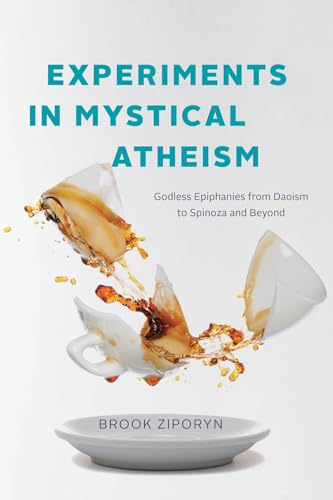
Experiments in Mystical Atheism: Godless Epiphanies from Daoism to Spinoza and Beyond
A new approach to the theism-scientism divide rooted in a deeper form of atheism.
Western philosophy is stuck in an irresolvable conflict between two approaches to the spiritual malaise of our either we need more God (the “turn to religion”) or less religion (the New Atheism). In this book, Brook Ziporyn proposes an alternative that avoids both totalizing theomania and atomizing reductionism. What we need, he argues, is a deeper, more thoroughgoing, even religious rejection of an affirmative atheism without either a creator to provide meaning or finite creatures in need of it—a mystical atheism.
In the legacies of Daoism and Buddhism as well as Spinoza, Nietzsche, and Bataille, Ziporyn discovers a critique of theism that develops into a new, positive sensibility—at once deeply atheist and richly religious. Experiments in Mystical Atheism argues that these “godless epiphanies” hold the key to renewing philosophy today.
Western philosophy is stuck in an irresolvable conflict between two approaches to the spiritual malaise of our either we need more God (the “turn to religion”) or less religion (the New Atheism). In this book, Brook Ziporyn proposes an alternative that avoids both totalizing theomania and atomizing reductionism. What we need, he argues, is a deeper, more thoroughgoing, even religious rejection of an affirmative atheism without either a creator to provide meaning or finite creatures in need of it—a mystical atheism.
In the legacies of Daoism and Buddhism as well as Spinoza, Nietzsche, and Bataille, Ziporyn discovers a critique of theism that develops into a new, positive sensibility—at once deeply atheist and richly religious. Experiments in Mystical Atheism argues that these “godless epiphanies” hold the key to renewing philosophy today.
415 pages, Paperback
Published October 30, 2024
Ratings & Reviews
Friends & Following
Create a free account to discover what your friends think of this book!
Community Reviews
Displaying 1 - 4 of 4 reviews
March 18, 2026
As a preface to this review, I don’t particularly share Brook Ziporyn’s “allergy” towards God. It’s funny, though, because I seem to share almost everything else with Ziporyn as far as intellectual sensibility goes. I like paradox and mysticism, and I reject black and white views of reality. I’m inclined to accept out of sheer instinct that the dualities of human thought must point to a fundamental unity or convergence: of the finite and infinite, absolute and conditioned, pain and bliss, time and eternity, etc.
So while I tended to agree entirely with Ziporyn’s arguments in this book, I demurred only in regards to his refusal to countenance any kind of “Christian atheism,” whether of the Jean Luc Nancy school or the more ancient negative theologies. When I finished the book, I felt something Ziporyn no doubt did not intend: which is that the mysticism he had conveyed could actually enrich a form of “mystical Christianity.” This is because of the way he presents and defines mystical atheism. He describes it beautifully in one passage (p 339):
“Finitude is pain. In trying to escape this pain we had been sustaining it, for pain is rooted in the nature of the putatively finite, the putatively escapable. In realizing that we cannot escape it, we have escaped it. Here our pain reveals quite directly the paradoxical nature of all existence: the convergence of infinity and finitude, the infinitude of finitude and the finitude of the infinite — leaving behind neither one. And that convergence is the heart and soul of atheist mysticism in all its forms.”
Yes, I thunderously agree with Ziporyn here. But I noticed a weird parallel with a certain kind of radical mystical (Lutheran-adjacent) Christianity, as you find, for example, in the astonishing prison letters of Dietrich Bonhoeffer, where he says:
“The Christian, unlike the devotees of the redemption myths, has no last line of escape available from earthly tasks and difficulties into the eternal, but, like Christ himself . . . he must drink the earthly cup to the dregs, and only in his doing so is the crucified and risen Lord with him, and he crucified and risen with Christ. This world must not be prematurely written off; in this the Old and New Testaments are at one.”
I couldn’t help but see this as a striking parallel: in both cases, you have the inescapability of suffering, which is the very condition for escaping suffering (paradoxically)!
Anyway, the book is extremely dense and philosophical; it took me weeks to read through his large chapter on Spinoza’s philosophy. Ziporyn discusses purposivity at great length, attacking the idea that “purpose” is ontologically ultimate. I suppose this is his driving impulse, because he identifies God as the ultimate coincidence of cause and purpose - meaning every single thing that happens is caused by the Will of God, which is fair enough (that is how most people view God). Ziporyn dislikes the idea of God so much because it eliminates chance, contingency, purposelessness, and the idea that ultimately things happen beyond any one’s control.
More rigorously, he argues for what he calls the Great Asymmetry: purpose excludes purposelessness (when made ultimate), but purposelessness does not exclude purpose. He has a long chapter discussing this in the context of Daoism (Ziporyn is an expert on Classical Chinese philosophy), which is very rewarding as it reveals how a non Western culture managed to unite purpose and purposelessness. He argues that purpose results from conflict and finitude: when every purpose is integrated, there is no purpose (another one of Ziporyn’s favourite paradoxes!). This is a very strong argument against the idea of God as a purposeful being, since it means God would be finite - certainly nothing like Aquinas’ “Being Itself.”
I could go on, because the book has accomplished the rare feat of deepening almost every view I have. I think differently now about materialism, nihilism, consciousness, purpose, necessity, rationalism, teleology, mechanism, finitude, pain, love… etc. I see all these ideas as being far more complicated and interconnected with their opposites. That’s what Ziporyn does to you. He shows that you can believe in absolute necessity and absolute freedom at the same time (you have to endure heavy Spinoza exposition to fully appreciate this).
I would also highly recommend the chapter on Nietzsche for anyone interested in Nietzsche, even if you would not think of yourself as “mystical.” This chapter is really mind-blowing in the way it explains the eternal return and the Will to Power. I’ve read so many books on Nietzsche, but this single chapter was the most satisfying interpretation of these two infamous Nietzschean themes I’ve ever encountered.
Now the book also has a bunch of online appendices that you can actually read for free. These appendices literally constitute another whole book, equally profound and informative. I learned more from these about Hegel and Schelling and Kant than I have from other introductions to philosophy. I sometimes think that Brook Ziporyn is preternaturally erudite, but then I think it could just be that he has a background in Chinese language and philosophy, so this allows him to “unlock” key insights about a whole bunch of Western philosophers with one master stroke.
I suppose I should say another thing about style: this book won’t be a bestseller, on account of sentences like this (p 177): “Each This is This and the All and the None. The All is Each This and the None. The None is the All and Each This.” On the other hand, such brain-warping flourishes ought to establish the book, some day, as a certified classic among the community of atheist mystics.
So, I give the book five stars because of its extreme intellectual maturity and uniqueness. It is by far the greatest book on atheism written by an atheist that I’ve read. Whether you believe in God or not, it is bound to challenge and deepen your views.
So while I tended to agree entirely with Ziporyn’s arguments in this book, I demurred only in regards to his refusal to countenance any kind of “Christian atheism,” whether of the Jean Luc Nancy school or the more ancient negative theologies. When I finished the book, I felt something Ziporyn no doubt did not intend: which is that the mysticism he had conveyed could actually enrich a form of “mystical Christianity.” This is because of the way he presents and defines mystical atheism. He describes it beautifully in one passage (p 339):
“Finitude is pain. In trying to escape this pain we had been sustaining it, for pain is rooted in the nature of the putatively finite, the putatively escapable. In realizing that we cannot escape it, we have escaped it. Here our pain reveals quite directly the paradoxical nature of all existence: the convergence of infinity and finitude, the infinitude of finitude and the finitude of the infinite — leaving behind neither one. And that convergence is the heart and soul of atheist mysticism in all its forms.”
Yes, I thunderously agree with Ziporyn here. But I noticed a weird parallel with a certain kind of radical mystical (Lutheran-adjacent) Christianity, as you find, for example, in the astonishing prison letters of Dietrich Bonhoeffer, where he says:
“The Christian, unlike the devotees of the redemption myths, has no last line of escape available from earthly tasks and difficulties into the eternal, but, like Christ himself . . . he must drink the earthly cup to the dregs, and only in his doing so is the crucified and risen Lord with him, and he crucified and risen with Christ. This world must not be prematurely written off; in this the Old and New Testaments are at one.”
I couldn’t help but see this as a striking parallel: in both cases, you have the inescapability of suffering, which is the very condition for escaping suffering (paradoxically)!
Anyway, the book is extremely dense and philosophical; it took me weeks to read through his large chapter on Spinoza’s philosophy. Ziporyn discusses purposivity at great length, attacking the idea that “purpose” is ontologically ultimate. I suppose this is his driving impulse, because he identifies God as the ultimate coincidence of cause and purpose - meaning every single thing that happens is caused by the Will of God, which is fair enough (that is how most people view God). Ziporyn dislikes the idea of God so much because it eliminates chance, contingency, purposelessness, and the idea that ultimately things happen beyond any one’s control.
More rigorously, he argues for what he calls the Great Asymmetry: purpose excludes purposelessness (when made ultimate), but purposelessness does not exclude purpose. He has a long chapter discussing this in the context of Daoism (Ziporyn is an expert on Classical Chinese philosophy), which is very rewarding as it reveals how a non Western culture managed to unite purpose and purposelessness. He argues that purpose results from conflict and finitude: when every purpose is integrated, there is no purpose (another one of Ziporyn’s favourite paradoxes!). This is a very strong argument against the idea of God as a purposeful being, since it means God would be finite - certainly nothing like Aquinas’ “Being Itself.”
I could go on, because the book has accomplished the rare feat of deepening almost every view I have. I think differently now about materialism, nihilism, consciousness, purpose, necessity, rationalism, teleology, mechanism, finitude, pain, love… etc. I see all these ideas as being far more complicated and interconnected with their opposites. That’s what Ziporyn does to you. He shows that you can believe in absolute necessity and absolute freedom at the same time (you have to endure heavy Spinoza exposition to fully appreciate this).
I would also highly recommend the chapter on Nietzsche for anyone interested in Nietzsche, even if you would not think of yourself as “mystical.” This chapter is really mind-blowing in the way it explains the eternal return and the Will to Power. I’ve read so many books on Nietzsche, but this single chapter was the most satisfying interpretation of these two infamous Nietzschean themes I’ve ever encountered.
Now the book also has a bunch of online appendices that you can actually read for free. These appendices literally constitute another whole book, equally profound and informative. I learned more from these about Hegel and Schelling and Kant than I have from other introductions to philosophy. I sometimes think that Brook Ziporyn is preternaturally erudite, but then I think it could just be that he has a background in Chinese language and philosophy, so this allows him to “unlock” key insights about a whole bunch of Western philosophers with one master stroke.
I suppose I should say another thing about style: this book won’t be a bestseller, on account of sentences like this (p 177): “Each This is This and the All and the None. The All is Each This and the None. The None is the All and Each This.” On the other hand, such brain-warping flourishes ought to establish the book, some day, as a certified classic among the community of atheist mystics.
So, I give the book five stars because of its extreme intellectual maturity and uniqueness. It is by far the greatest book on atheism written by an atheist that I’ve read. Whether you believe in God or not, it is bound to challenge and deepen your views.
May 4, 2025
I'd give this book 3.5 stars. In the end, it wasn't quite the book I was hoping it would be -- I had trouble connecting with it, and it got awfully long-winded. Nevertheless, it had enough interesting and sometimes genuinely deep ideas that I decided to round up to 4 stars.
Maybe I should say from the outset, I may not be exactly the target audience for this book. Though I am an atheist, I don't experience revulsion toward the idea of God (I just find it nonsensical and unevidenced). I also don't have a background in religion or the humanities; I'm more of a math and science guy. So what doesn't float my boat may well float yours.
I hope that one of these days, someone who liked and understood the book better than I did will post a review, so that I can experience it from a fresh perspective.
Some deep and interesting ideas in the book:
- The core badness of monotheism is its assertion of ultimate purpose. In reality, (1) there is no such thing as ultimate purpose (at least, I think this is what Ziporyn believes), and (2) it's better for us if we understand that there is no ultimate purpose, because it frees the imagination, making genuine religious/mystical experience possible.
"...rejecting God and all the concomitants of the idea of God is what alone makes possible a particular type of experience of the world, an experience that for some of us is the only thing that makes life worth living, and that I will unhesitatingly call mystical."
- Even most self-professed atheists, especially those in the Western enlightenment mold, still have a worldview that is "saturated with the undetected traces of this idea of God."
For example, when the New Atheists put Reason on a pedestal, imagining that there is a single, unified way of thinking appropriate to all circumstances, they are holding on to an essentially monotheist way of looking at the world.
- One can call an experience "religious" to the extent that it changes how we see the world -- changes the very meaning of facts. For Ziporyn, the prototypical religious experiences are those in which we perceive infinity behind apparently finite things (including ourselves).
- The key idea of monotheism - that the universe was created by a purposive mind - came more from Greece (specifically, Plato) than from Judaism. In fact, it was only under the influence of Plato's ideas that the first verses of Genesis came to be interpreted as they are today.
- "a la Spinoza, we do not desire the Good, but rather we call good whatever we desire, and what we desire is determined simply by what we happen to be. Deep relativism adheres to this vision."
- "The great asymmetry: [a singular] purpose obstructs purposelessness, but purposelessness enables purposes."
- Just as the universe does not have a divine controller, we humans are not ultimately in control of our actions. Our experience of conscious control is a kind of illusory epiphenomenon, bubbling up out of the unconscious and purposeless processes that make us up. God is then a projection of this inaccurate image of ourselves as free-willing agents onto the cosmos.
- "What is involved in the Daoist notion of Dao is what we might call the in-principle unintelligibility of the world. The deep structure of the world is not just unknown by me, nor just unknown by all humans, nor just unknown by all beings: it is, _in principle_, unknowable. We cannot know Dao, but _Dao_ cannot know Dao either." Thus, when it comes to questions about the ultimate nature of reality, there simply are no answers.
- What is valuable about love is that it undermines our sense of control, challenging our usual boundaries as individual persons.
- For Spinoza, individual people and things are not parts of an infinite whole; they are more like expressions or modes of the infinite. I imagine it's a little like how, in string theory, the whole panoply of particles is imagined to be different vibrational modes of one simple kind of string, a string with almost infinite possibilities.
Thus, every apparently finite thing is in some sense shot through with the infinity of possibilities of which it is one expression, so that nothing is merely finite. There is infinity in the finite.
- To Spinoza, mind and matter are two ways of looking at the same reality. This applies to the universe as a whole, and also to us. "Mind does not cause action in the body. Action in the body does not cause thoughts. Rather, thoughts are one way of naming what is, in other contexts, described as actions of the body, and vice versa. Neither is primary; neither is secondary. Neither is the Substance of which the other is an Attribute."
- We all feel a powerful drive to continue existing, to continue being ourselves, and paradoxically, in order to do that we must constantly change and adapt.
- For Spinoza, order exists only relative to minds perceiving it. "Instead, 'order' itself is just an inadequate idea that boils down to saying some arrangements of items are relatively easier to picture and imagine than others for our particular minds. There is no such thing as absolute order..."
- At the end of the book, Ziporyn has some interesting things to say about pain. Pain (like love) is powerful because it points to the permeability of ourselves to the outside world. It is also the sign, and potentially the means, for expanding ourselves beyond our current boundaries.
For these reasons, it plays an important role in traditional rituals and religions, and likewise in mystical atheism, where it reminds us that our finite selves are inextricably connected to infinity.
Issues/problems I had with the book:
- The second half of the book was mostly unhelpful for me. In this part, Ziporyn analyzes the thought of people like Spinoza and Nietzsche, whom he considers exemplars of mystical atheism. Up to a point, I'm interested in what they thought -- but I would have been satisfied with about one tenth of what Ziporyn provides.
The Spinoza chapter in particular felt incredibly long-winded and repetitive; when I didn't understand something the first time, it became increasingly frustrating to hear the same thing in more or less the same words again and again.
Clearly, Spinoza had some interesting things to say. But overall, I find his worldview very difficult to relate to, almost to the point of irrelevance to me. And I find his rationalistic approach, attempting to logically "prove" his points, absurd.
Not being a Spinoza scholar, I don't care that much about what he thought, except insofar as it is interesting, true, or useful _to me_.
- In down to earth terms, what does it feel like to be a mystical atheist? What does this look like, in terms of day-to-day life? What kinds of life-changing experiences does it make possible? Can Ziporyn give concrete examples, either from his own or from other people's lives?
- Ziporyn thinks "metaphysical tale spinning" (of the godless variety) is a good thing. I'm less convinced.
My concern, I think, is the following. People are typically uncomfortable with questions we don't know the answers to, or questions that don't _have_ answers. Into that void, made-up answers tend to rush.
For example, Spinoza had a rich and detailed worldview that he believed in, and there's little doubt in my mind that much of it is nonsense. There are very likely no non-trivial, true things that can be said about reality writ large.
What, then, is the point of metaphysical tale spinning? It may give one a sense of having one's eyes opened to the infinite, but in all likelihood this is mere self-deception; it has nothing to do with how reality actually is. Maybe it's simply a matter of temperament, but I prefer to understand what I can understand, and just leave the rest.
- Ziporyn indicates that a mystical atheist perspective is inconsistent with "activist zeal" ... "all reform of social conditions is saturated with the unbudgeable brute ineradicability of alternate desiderata." There is a grain of truth to this, but I also find it troubling.
There is little doubt in my mind that fascism (a la Trump) is wrong, that some form of social democracy would be a vast improvement, and that the activists fighting for this are worthy of immense admiration and respect.
I don't believe in any ultimate moral truth, and moral issues can certainly be complex, but then again, some things are fairly simple. We have to make practical distinctions between what we consider good and what we consider bad. I think it would be a huge mistake to just float along in mystical atheist bliss, and surrender moral and social questions to bad actors (many of whom claim that they are acting on God's authority).
Maybe I should say from the outset, I may not be exactly the target audience for this book. Though I am an atheist, I don't experience revulsion toward the idea of God (I just find it nonsensical and unevidenced). I also don't have a background in religion or the humanities; I'm more of a math and science guy. So what doesn't float my boat may well float yours.
I hope that one of these days, someone who liked and understood the book better than I did will post a review, so that I can experience it from a fresh perspective.
Some deep and interesting ideas in the book:
- The core badness of monotheism is its assertion of ultimate purpose. In reality, (1) there is no such thing as ultimate purpose (at least, I think this is what Ziporyn believes), and (2) it's better for us if we understand that there is no ultimate purpose, because it frees the imagination, making genuine religious/mystical experience possible.
"...rejecting God and all the concomitants of the idea of God is what alone makes possible a particular type of experience of the world, an experience that for some of us is the only thing that makes life worth living, and that I will unhesitatingly call mystical."
- Even most self-professed atheists, especially those in the Western enlightenment mold, still have a worldview that is "saturated with the undetected traces of this idea of God."
For example, when the New Atheists put Reason on a pedestal, imagining that there is a single, unified way of thinking appropriate to all circumstances, they are holding on to an essentially monotheist way of looking at the world.
- One can call an experience "religious" to the extent that it changes how we see the world -- changes the very meaning of facts. For Ziporyn, the prototypical religious experiences are those in which we perceive infinity behind apparently finite things (including ourselves).
- The key idea of monotheism - that the universe was created by a purposive mind - came more from Greece (specifically, Plato) than from Judaism. In fact, it was only under the influence of Plato's ideas that the first verses of Genesis came to be interpreted as they are today.
- "a la Spinoza, we do not desire the Good, but rather we call good whatever we desire, and what we desire is determined simply by what we happen to be. Deep relativism adheres to this vision."
- "The great asymmetry: [a singular] purpose obstructs purposelessness, but purposelessness enables purposes."
- Just as the universe does not have a divine controller, we humans are not ultimately in control of our actions. Our experience of conscious control is a kind of illusory epiphenomenon, bubbling up out of the unconscious and purposeless processes that make us up. God is then a projection of this inaccurate image of ourselves as free-willing agents onto the cosmos.
- "What is involved in the Daoist notion of Dao is what we might call the in-principle unintelligibility of the world. The deep structure of the world is not just unknown by me, nor just unknown by all humans, nor just unknown by all beings: it is, _in principle_, unknowable. We cannot know Dao, but _Dao_ cannot know Dao either." Thus, when it comes to questions about the ultimate nature of reality, there simply are no answers.
- What is valuable about love is that it undermines our sense of control, challenging our usual boundaries as individual persons.
- For Spinoza, individual people and things are not parts of an infinite whole; they are more like expressions or modes of the infinite. I imagine it's a little like how, in string theory, the whole panoply of particles is imagined to be different vibrational modes of one simple kind of string, a string with almost infinite possibilities.
Thus, every apparently finite thing is in some sense shot through with the infinity of possibilities of which it is one expression, so that nothing is merely finite. There is infinity in the finite.
- To Spinoza, mind and matter are two ways of looking at the same reality. This applies to the universe as a whole, and also to us. "Mind does not cause action in the body. Action in the body does not cause thoughts. Rather, thoughts are one way of naming what is, in other contexts, described as actions of the body, and vice versa. Neither is primary; neither is secondary. Neither is the Substance of which the other is an Attribute."
- We all feel a powerful drive to continue existing, to continue being ourselves, and paradoxically, in order to do that we must constantly change and adapt.
- For Spinoza, order exists only relative to minds perceiving it. "Instead, 'order' itself is just an inadequate idea that boils down to saying some arrangements of items are relatively easier to picture and imagine than others for our particular minds. There is no such thing as absolute order..."
- At the end of the book, Ziporyn has some interesting things to say about pain. Pain (like love) is powerful because it points to the permeability of ourselves to the outside world. It is also the sign, and potentially the means, for expanding ourselves beyond our current boundaries.
For these reasons, it plays an important role in traditional rituals and religions, and likewise in mystical atheism, where it reminds us that our finite selves are inextricably connected to infinity.
Issues/problems I had with the book:
- The second half of the book was mostly unhelpful for me. In this part, Ziporyn analyzes the thought of people like Spinoza and Nietzsche, whom he considers exemplars of mystical atheism. Up to a point, I'm interested in what they thought -- but I would have been satisfied with about one tenth of what Ziporyn provides.
The Spinoza chapter in particular felt incredibly long-winded and repetitive; when I didn't understand something the first time, it became increasingly frustrating to hear the same thing in more or less the same words again and again.
Clearly, Spinoza had some interesting things to say. But overall, I find his worldview very difficult to relate to, almost to the point of irrelevance to me. And I find his rationalistic approach, attempting to logically "prove" his points, absurd.
Not being a Spinoza scholar, I don't care that much about what he thought, except insofar as it is interesting, true, or useful _to me_.
- In down to earth terms, what does it feel like to be a mystical atheist? What does this look like, in terms of day-to-day life? What kinds of life-changing experiences does it make possible? Can Ziporyn give concrete examples, either from his own or from other people's lives?
- Ziporyn thinks "metaphysical tale spinning" (of the godless variety) is a good thing. I'm less convinced.
My concern, I think, is the following. People are typically uncomfortable with questions we don't know the answers to, or questions that don't _have_ answers. Into that void, made-up answers tend to rush.
For example, Spinoza had a rich and detailed worldview that he believed in, and there's little doubt in my mind that much of it is nonsense. There are very likely no non-trivial, true things that can be said about reality writ large.
What, then, is the point of metaphysical tale spinning? It may give one a sense of having one's eyes opened to the infinite, but in all likelihood this is mere self-deception; it has nothing to do with how reality actually is. Maybe it's simply a matter of temperament, but I prefer to understand what I can understand, and just leave the rest.
- Ziporyn indicates that a mystical atheist perspective is inconsistent with "activist zeal" ... "all reform of social conditions is saturated with the unbudgeable brute ineradicability of alternate desiderata." There is a grain of truth to this, but I also find it troubling.
There is little doubt in my mind that fascism (a la Trump) is wrong, that some form of social democracy would be a vast improvement, and that the activists fighting for this are worthy of immense admiration and respect.
I don't believe in any ultimate moral truth, and moral issues can certainly be complex, but then again, some things are fairly simple. We have to make practical distinctions between what we consider good and what we consider bad. I think it would be a huge mistake to just float along in mystical atheist bliss, and surrender moral and social questions to bad actors (many of whom claim that they are acting on God's authority).
September 14, 2025
The Gospel According to Zhuangzi and Spinoza
This behemoth of a book is a broadside against western religion and philosophy as a whole written by a scholar of Taoism and Chinese Buddhism who is well known for his translation of the Zhuangzi and his book “Emptiness and Omnipresence’’ on Tiantai Buddhism (the earliest synthesis of Chinese and Indo-European thought).
Ziporyn’s contention is that with very few exceptions (Nietzsche, Schopenhauer, Bataille and, above all, Spinoza) western thinkers have been fundamentally mistaken about human nature and the nature of ultimate reality, a.k.a. God. He credits Daoism with “the discovery of the opposite of God” and holds the Greeks (rather than the Abrahamic religions) responsible for the blight of monotheism.
His starting point (Part I of the book) is better characterized as nihilism rather than atheism — nihilism as in Nietzsche’s account of himself as “Europe’s first complete nihilist” or Nishitani’s “self-overcoming of nihilism’’. With great gusto Ziporyn rejects teleology (“purposivity”), the idea that life has any meaning beyond life itself, moral realism, free will and our conception of ourselves and of God as disembodied, unitary consciousnesses. All this needs to be jettisoned in order to participate in the Daoist/Spinozist beatific vision of the meaningless fecundity that is the source of all finite meanings, values and perspectives. Like Spinoza, Ziporyn aims to rescue religion from God.
While it is easy to point to the similarities between Spinozism and Daoism, there is a fundamental difference which at first blush would seem to preclude any rapprochement between them. Spinoza’s unwavering commitment to the Principle of Sufficient Reason leads him to conclude that everything is in principle intelligible and that, as a matter of sheer logical necessity, things could not possibly be other than they actually are. Zhuangzi on the other hand says that there is in fact no way that things actually are and that ontological indeterminacy and unintelligibility rule over all. Universal causal determinism may be a staple of common-or-garden atheism but it is a problem for Ziporyn.
The reading of Spinoza that he proposes as a resolution of this problem seems to me to a major contribution to Spinoza scholarship. I won’t attempt to sketch it here as it involves a deep dive into Spinoza’s conception of beatitude and of knowledge of the third kind (in other words, those parts of the Ethics where commentators typically find themselves floundering). If you have read the Ethics but are still at loss to understand how necessity and freedom could in fact be one and the same thing, I strongly recommend studying Chapter 5. And if you haven’t read the Ethics, you couldn’t ask for a better introduction to Spinoza than the Section ``Spinoza in Twelve Steps’’.
All in all, a demanding and very rewarding read for the happy few willing to recognize that their most cherished beliefs are mere beliefs and that this recognition can be profoundly liberating.
This behemoth of a book is a broadside against western religion and philosophy as a whole written by a scholar of Taoism and Chinese Buddhism who is well known for his translation of the Zhuangzi and his book “Emptiness and Omnipresence’’ on Tiantai Buddhism (the earliest synthesis of Chinese and Indo-European thought).
Ziporyn’s contention is that with very few exceptions (Nietzsche, Schopenhauer, Bataille and, above all, Spinoza) western thinkers have been fundamentally mistaken about human nature and the nature of ultimate reality, a.k.a. God. He credits Daoism with “the discovery of the opposite of God” and holds the Greeks (rather than the Abrahamic religions) responsible for the blight of monotheism.
His starting point (Part I of the book) is better characterized as nihilism rather than atheism — nihilism as in Nietzsche’s account of himself as “Europe’s first complete nihilist” or Nishitani’s “self-overcoming of nihilism’’. With great gusto Ziporyn rejects teleology (“purposivity”), the idea that life has any meaning beyond life itself, moral realism, free will and our conception of ourselves and of God as disembodied, unitary consciousnesses. All this needs to be jettisoned in order to participate in the Daoist/Spinozist beatific vision of the meaningless fecundity that is the source of all finite meanings, values and perspectives. Like Spinoza, Ziporyn aims to rescue religion from God.
While it is easy to point to the similarities between Spinozism and Daoism, there is a fundamental difference which at first blush would seem to preclude any rapprochement between them. Spinoza’s unwavering commitment to the Principle of Sufficient Reason leads him to conclude that everything is in principle intelligible and that, as a matter of sheer logical necessity, things could not possibly be other than they actually are. Zhuangzi on the other hand says that there is in fact no way that things actually are and that ontological indeterminacy and unintelligibility rule over all. Universal causal determinism may be a staple of common-or-garden atheism but it is a problem for Ziporyn.
The reading of Spinoza that he proposes as a resolution of this problem seems to me to a major contribution to Spinoza scholarship. I won’t attempt to sketch it here as it involves a deep dive into Spinoza’s conception of beatitude and of knowledge of the third kind (in other words, those parts of the Ethics where commentators typically find themselves floundering). If you have read the Ethics but are still at loss to understand how necessity and freedom could in fact be one and the same thing, I strongly recommend studying Chapter 5. And if you haven’t read the Ethics, you couldn’t ask for a better introduction to Spinoza than the Section ``Spinoza in Twelve Steps’’.
All in all, a demanding and very rewarding read for the happy few willing to recognize that their most cherished beliefs are mere beliefs and that this recognition can be profoundly liberating.

June 9, 2026
mystical atheism who needs it
Spoiler alert in the end, we all need to experience pain and suffering. After reading the whole book, I still don’t know how his view of pain and suffering helps.
Spoiler alert in the end, we all need to experience pain and suffering. After reading the whole book, I still don’t know how his view of pain and suffering helps.
Displaying 1 - 4 of 4 reviews