

What do you think?

The Power of Prions: The Strange and Essential Proteins That Can Cause Alzheimer’s, Parkinson’s, and Other Diseases
The remarkable family of proteins that can make us very ill—but can also be linked to long-term memory, immunity, and the origin of life
Over the last decade, scientists have discovered the importance and widespread presence in the body of a remarkable family of proteins known as prion proteins. Research links various types of prion proteins to neurodegenerative diseases such as Parkinson’s and Alzheimer’s—and this has fueled the search for new drugs that could halt the progression of these terrible disorders. Other discoveries have revealed the essential roles prion proteins play in memory and immunity, and—in an extraordinary finding—the part they may have played in the beginnings of life on our planet. In this engaging and accessible book, Michel Brahic tells the story of these amazing and versatile proteins.
Brahic, a leading researcher on diseases of the central nervous system, first describes the discovery of prions and their role in infection, beginning with early work on the animal disease scrapie and a mysterious human illness in New Guinea, apparently transmitted by cannibalism. Prions were eventually identified and named by Stanley Prusiner in the 1980s. (Brahic tells us Prusiner’s alternate name for prion was “piaf.”) Prion proteins were then revealed as the cause of other illnesses, from “mad cow” disease and its human counterpart, Creutzfeldt-Jakob disease, to such noninfectious brain disorders as Parkinson’s and Alzheimer’s. While the prion proteins responsible for diseases are definitively “bad,” Brahic also explains that these abnormal prions are rare exceptions. Most of the time, prion proteins actually serve “good” and vital functions—and they may even have been present at the origin of life itself.
Over the last decade, scientists have discovered the importance and widespread presence in the body of a remarkable family of proteins known as prion proteins. Research links various types of prion proteins to neurodegenerative diseases such as Parkinson’s and Alzheimer’s—and this has fueled the search for new drugs that could halt the progression of these terrible disorders. Other discoveries have revealed the essential roles prion proteins play in memory and immunity, and—in an extraordinary finding—the part they may have played in the beginnings of life on our planet. In this engaging and accessible book, Michel Brahic tells the story of these amazing and versatile proteins.
Brahic, a leading researcher on diseases of the central nervous system, first describes the discovery of prions and their role in infection, beginning with early work on the animal disease scrapie and a mysterious human illness in New Guinea, apparently transmitted by cannibalism. Prions were eventually identified and named by Stanley Prusiner in the 1980s. (Brahic tells us Prusiner’s alternate name for prion was “piaf.”) Prion proteins were then revealed as the cause of other illnesses, from “mad cow” disease and its human counterpart, Creutzfeldt-Jakob disease, to such noninfectious brain disorders as Parkinson’s and Alzheimer’s. While the prion proteins responsible for diseases are definitively “bad,” Brahic also explains that these abnormal prions are rare exceptions. Most of the time, prion proteins actually serve “good” and vital functions—and they may even have been present at the origin of life itself.
192 pages, Hardcover
Published October 29, 2024
Ratings & Reviews
Friends & Following
Create a free account to discover what your friends think of this book!
Community Reviews
Displaying 1 - 30 of 32 reviews
February 7, 2025
"I was at my laboratory bench one morning in 1980 when a young neurologist walked in and declared that he had identified the agent of scrapie, a mysterious disease that caused behavioral changes, trembling, and eventually death in sheep and goats and left microscopic holes in their brains..."
The Power of Prions was an excellent short book. All too often, science books are not written with science communication in mind. Rather, they are seemingly written by scientists, for scientists. The authors often take a sharp turn right into the weeds early on, and remain there for the duration. Fortunately, this book was a great example of writing science well.
Author Michel Brahic, MD, PhD is Consulting Professor at Stanford University School of Medicine. Dr. Brahic’s long-term interest is the pathogenesis of chronic CNS diseases caused by viruses such as Theiler’s virus, HTLF-1 and Borna virus.
Michel Brahic:

With a well-written intro, Brahic gets the writing here off on a good foot. He uses clear communication throughout, and the effect is engaging writing that doesn't struggle to hold the reader's attention. He drops the quote above at the start of the book, talking about the scientist who discovered the pathogenic misfolded prion proteins. It continues:
Brahic begins by giving the reader some basics of neuroanatomy and neural functioning. He drops this quote later in the book, talking about the incredible complexity of the human brain:
Stanley Pruisner, mentioned above, theorized that small pathogenic organisms existed before prions were officially discovered. These prions are responsible for many diseases. Brahic expands:
But prions are not all "bad." Some are "good":
As the book's subtitle hints at, there are also some lengthy discussions of the mechanisms of action behind Parkinson's, Huntington's, Creutzfeldt–Jakob disease (CJD), Scabies, Alzheimer's, along with other prion-caused protein folding disorders here. IMO, the author did an excellent job of conveying this technical information to the reader in an easily digestable format.
********************
Generally speaking, this was a science book done right. The author did a fantastic job of this one. The information is covered succinctly and effectively, and every chapter ends with a recap. Well done!
An easy 5 star rating for this short but dense book. I would definitely recommend it to anyone interested.
The Power of Prions was an excellent short book. All too often, science books are not written with science communication in mind. Rather, they are seemingly written by scientists, for scientists. The authors often take a sharp turn right into the weeds early on, and remain there for the duration. Fortunately, this book was a great example of writing science well.
Author Michel Brahic, MD, PhD is Consulting Professor at Stanford University School of Medicine. Dr. Brahic’s long-term interest is the pathogenesis of chronic CNS diseases caused by viruses such as Theiler’s virus, HTLF-1 and Borna virus.
Michel Brahic:
With a well-written intro, Brahic gets the writing here off on a good foot. He uses clear communication throughout, and the effect is engaging writing that doesn't struggle to hold the reader's attention. He drops the quote above at the start of the book, talking about the scientist who discovered the pathogenic misfolded prion proteins. It continues:
"...I had known Stanley Prusiner for some years and had been watching the progress of his laboratory in characterizing this highly unusual “microbe.” I had also seen the tremendous amount of skepticism raised by his outlandish claim that it lacked genes, that it was an infectious protein. Stan’s issue that morning was what to call this unique infectious agent. He had two candidates, he said: “piaf” and “prion.” I forget what piaf stood for, but I said that the name was already taken by a very popular French singer. Fine, he said, in any case he preferred prion, a contraction of protein and infection. I agreed. What I did not say was that prions in my native French tongue means “let us pray,” and that if he persisted with his claim of an infectious protein, he would need prayers. As we know, Stan was right, and for the discovery of prions he was awarded the Nobel Prize in 1997."
Brahic begins by giving the reader some basics of neuroanatomy and neural functioning. He drops this quote later in the book, talking about the incredible complexity of the human brain:
"The human brain contains approximately eighty-six billion neurons, which communicate through close to quadrillion (10x15, or one followed by fifteen zeroes) synapses. Those are astronomical numbers. It is difficult, or even impossible, for us to construct a mental image of a quadrillion objects. It is too large. For example, one hundred billion is the number of stars in our galaxy, the Milky Way. The number of synapses in our brain is equivalent to the number of stars in ten thousand Milky Ways!"
Stanley Pruisner, mentioned above, theorized that small pathogenic organisms existed before prions were officially discovered. These prions are responsible for many diseases. Brahic expands:
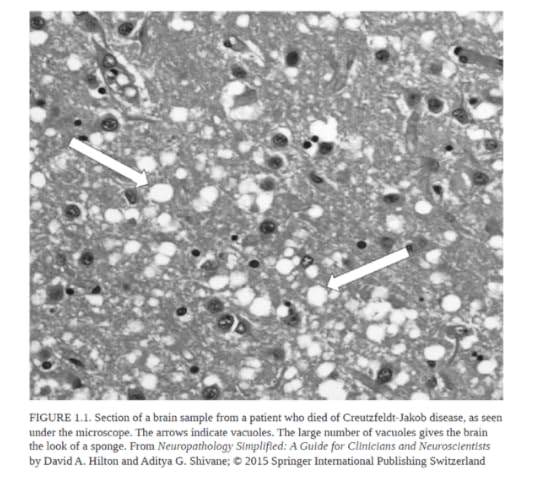
"...Because these diseases all cause millions of tiny holes, called vacuoles, in the brain, they are grouped under the name spongiform encephalopathies—diseases that, under the microscope, give the brain the look of a sponge. All of them are caused by a protein called PrP, short for prion protein."
But prions are not all "bad." Some are "good":
"But there are also “good” prions! An early and most surprising discovery was made at Columbia University in the laboratory of Eric Kandel. This group had been doing pioneering work on the molecular mechanism of memory using a simple model animal, a sea slug named Aplysia. After much work, they concluded that a protein with prion properties, but again different from PrP, was involved in memory storage in this animal. They went on to show that the same protein was involved in memory in the fruit fly and in mice. And there are more and more “good prion” proteins being discovered. It turns out that prion proteins appeared very early, maybe even at the very beginning of the evolution of life on this planet. We will discuss later how they help primitive organisms such as yeast to adapt to changes in their food environment. This field is young, fast-moving, and not devoid of controversy. The nomenclature is not yet settled. Some prefer to use the name prion only for PrP, the protein that causes kuru and the other spongiform encephalopathies. They call the others “prion-like proteins” or “prionoids.” Maybe it is time to resurrect piaf for those! But for the sake of simplicity, I will call all of them “prion proteins” or “prions.”
As the book's subtitle hints at, there are also some lengthy discussions of the mechanisms of action behind Parkinson's, Huntington's, Creutzfeldt–Jakob disease (CJD), Scabies, Alzheimer's, along with other prion-caused protein folding disorders here. IMO, the author did an excellent job of conveying this technical information to the reader in an easily digestable format.
********************
Generally speaking, this was a science book done right. The author did a fantastic job of this one. The information is covered succinctly and effectively, and every chapter ends with a recap. Well done!
An easy 5 star rating for this short but dense book. I would definitely recommend it to anyone interested.

May 24, 2025
Brahic provides a concise and clear summary of the prion field. Naturally, there is some partisanship around the relative importance of prions, and the tantalizing discoveries yet to be made. This is probably oversold (apart from the strange importance of prion-prone biology in the nervous system), and the book may have benefited from a closer look at the biophysical dynamics of prior/prion-like protein, which would have examined what's knows about intrinsically disordered protein, aggregation and disaggregation of proteins, and the relationship between genetic variation associated with prior-like pathology (e.g. the poly-Q stretch in HTT).

June 23, 2025
I wish all popular science books were like this: short, to the point, with a sufficient amount of explanatory detail, summaries of key concepts at the conclusion of each chapter, highlights of especially elegant experiments, and perspectives of how science progresses. It makes it easier to learn and retain.
It's a nice contrast to journalist-written popular science books which typically dwell on human interest stories, too often handwave around the science, and treat a scientist's physical appearance as if it is more interesting than their scientific results.
It's a nice contrast to journalist-written popular science books which typically dwell on human interest stories, too often handwave around the science, and treat a scientist's physical appearance as if it is more interesting than their scientific results.

February 14, 2025
Prions are misfolded proteins that induce misfolding in normal variants of the same protein, leading to cell death (sometimes it doesn't and there are apparently "good" prions!). Proteins can misfold sporadically, or misfold due to genetic mutations, or by exposure to an already misfolded protein, resulting in an abnormal protein structure that can propagate misfolding in other proteins. Prion diseases are fatal and transmissible neurodegenerative diseases affecting humans and animals.
Brahic provides a broad overview of how prions were discovered, the diseases they cause (e.g. scrapie in sheep, chronic wasting disease in deer, bovine spongiform encephalopathy or mad cow disease in cattle, and Kuru and Creutzfeldt–Jakob disease in humans) or are linked to (e.g. Alzheimer's, Parkinson's, ALS), how they function, medical advancements, and new developments in protein biology.
The Power of Prions is a short book about an interesting but complex topic that is written in a clean and engaging manner that is neither too simple or too complex for the general reader.
Brahic provides a broad overview of how prions were discovered, the diseases they cause (e.g. scrapie in sheep, chronic wasting disease in deer, bovine spongiform encephalopathy or mad cow disease in cattle, and Kuru and Creutzfeldt–Jakob disease in humans) or are linked to (e.g. Alzheimer's, Parkinson's, ALS), how they function, medical advancements, and new developments in protein biology.
The Power of Prions is a short book about an interesting but complex topic that is written in a clean and engaging manner that is neither too simple or too complex for the general reader.
May 21, 2026
This was EXACTLY the modern update about prions I was looking for after reading the interesting, but outdated (and somewhat alarmist) Deadly Feasts by Richard Rhodes earlier this year.
I'm fascinated by stuff like this, but I have zero background in science (I went to art school... 😔) and I felt like this book talked about some pretty complex topics in a clear, accessible way.
I feel like Brahic says it best himself, in the epilogue: “This book was written for nonbiologists with an interest in science in general and neuroscience and medicine in particular. It belongs to the genre of “science communication,” an activity that, I am convinced, is extremely important for society. One of its aims was to complement, and possibly amend, the type of science information that we find in the media. News stories tend to focus on remarkable discoveries, often announced as breakthroughs, without much discussion about how results were obtained or, especially in medicine and therapeutics, how statistically significant they are. This has been the case of much misunderstanding, sometimes with harmful consequences, such as vaccine refusal. Therefore, one of my goals was to give a more realistic picture, with some personal examples, of how things happen in the laboratory. How scientists study basic biological questions, such as the mechanisms of memory, of diseases, and the possibilities of future treatments.”
Couldn't agree more with all of that. Chef's kiss.
I'm fascinated by stuff like this, but I have zero background in science (I went to art school... 😔) and I felt like this book talked about some pretty complex topics in a clear, accessible way.
I feel like Brahic says it best himself, in the epilogue: “This book was written for nonbiologists with an interest in science in general and neuroscience and medicine in particular. It belongs to the genre of “science communication,” an activity that, I am convinced, is extremely important for society. One of its aims was to complement, and possibly amend, the type of science information that we find in the media. News stories tend to focus on remarkable discoveries, often announced as breakthroughs, without much discussion about how results were obtained or, especially in medicine and therapeutics, how statistically significant they are. This has been the case of much misunderstanding, sometimes with harmful consequences, such as vaccine refusal. Therefore, one of my goals was to give a more realistic picture, with some personal examples, of how things happen in the laboratory. How scientists study basic biological questions, such as the mechanisms of memory, of diseases, and the possibilities of future treatments.”
Couldn't agree more with all of that. Chef's kiss.
October 29, 2025
This was a pretty perfect popsci book for me! Clear explanations, covers interesting aspects of the topic, not overly detailed or long, mixed with his own life and philosophy as a scientist.
Super interesting topic also. Such interesting proteins. Def recommend this book!
Super interesting topic also. Such interesting proteins. Def recommend this book!
January 26, 2025
This was absolutely delightful.
It lies at the highly satisfactory intersection of rigor and accessibility; it feels like attending a very high-quality talk in a different department. The author is both a research scientist and a professor in this field, and thus unsurprisingly his writing is both highly passionate and carefully communicated.
I would characterize the content as being at the level of a multi-lesson unit for undergrad upperclassmen, or perhaps a module within a first-year seminar for incoming graduate students.
The only audience I would not recommend this to would be people who bristle at content that is presented in a matter of fact manner resembling a classroom lecture or reading a textbook. This isn't the kind of nonfiction with broad-strokes summaries, goofs, asides, and anecdotes (e.g., Mary Roach). Instead, it is pedagogical, straightforward, and detailed in all the right places -- while summarized in the others -- in a way that respects your intellectual abilities and curiosities.
It lies at the highly satisfactory intersection of rigor and accessibility; it feels like attending a very high-quality talk in a different department. The author is both a research scientist and a professor in this field, and thus unsurprisingly his writing is both highly passionate and carefully communicated.
I would characterize the content as being at the level of a multi-lesson unit for undergrad upperclassmen, or perhaps a module within a first-year seminar for incoming graduate students.
The only audience I would not recommend this to would be people who bristle at content that is presented in a matter of fact manner resembling a classroom lecture or reading a textbook. This isn't the kind of nonfiction with broad-strokes summaries, goofs, asides, and anecdotes (e.g., Mary Roach). Instead, it is pedagogical, straightforward, and detailed in all the right places -- while summarized in the others -- in a way that respects your intellectual abilities and curiosities.

July 23, 2026
Very easy read for nonbiologists.

January 30, 2025
Excelente, casi no entendí nada, las mejores frases de este libro son "Eso ya lo deben de saber" y "No vamos a repetir eso aquí" de seguro Brahic da clases.

January 13, 2025
When I started the book I was a bit worried that it would go over my head. Luckily the author does a great job of recapping at the end of each chapter and bringing it all together. It's a complex topic so don't expect to understand everything immediately, but by the end of book I found that most of the topics made a lot more sense to me.
June 30, 2026
One of those books that make you think you’re stupid before you realize that it’s incomprehensible because it’s poorly written.

August 23, 2026
I guess my journey to find a satisfying science communication report on prions continues--and for the life of me I cannot understand why the reports we get are so short and devoid of details. On the surface, Brahic's "The Power of Prions" goes in depth about a lot of biochemical phenomena. But they are the general phenomena of life; true the details are needed to understand the basics of how prions work, but the actual prion activity is glimpsed over way way way way way too quickly. It may be lack of knowledge, this field is after all still very young and puzzling. But we spend half the book on general biochemistry, and the other half (meaning less than 100 pages) on a few general information about prion diseases and useful prions. Even then, we only touched on the very well known prion diseases, such as CJD, scrapie (barely), Alzheimer's and Parkinson's. What about familial syndromes, or the contagious prion disease in deer? Why didn't we talk more about transmissibility? The helpful prion information was indeed something new, as well as the very brief discussion on how many more potential prion pathologies there are. But at the end I was left thinking: "that's it?" At this point I feel like stitching together Wikipedia articles to get more information on each individual pathology and essential process. Also, in the Epilogue Brahic claims he aimed to teach the audience how models are chosen and how discoveries can be made by a good researcher; as a protein biochemist with 14 years of lab experience, I have to warn him that he barely even scratched the surface of that endeavor. I guess I'll have to go find a review to read on my own, popular science books may not offer the level of knowledge I've learned to expects from books on virology or bacterial and genetic illnesses. Maybe the field is too young. I don't know.

August 16, 2025
A thrilling bulletin from the front lines by a leading researcher
In a mere 160 pages, Brahic brilliantly surveys the current state of research on many dreaded neurodegenerative diseases, explaining the discoveries, one after another, that each was an instance of protein misfolding.
You can read this book in a few hours and literally get to the edge of current knowledge starting from an AP biology background. Besides diseases, we get the latest on normal human memory and even the origin of life. Besides the science, we get in a few brushstrokes a survey of new experimental techniques that are revolutionizing this and other areas of biology and medicine.
"PoP" is written in a pure, clear style; every sentence moves the plot along briskly. I learned many things I need to know from this book.
In a mere 160 pages, Brahic brilliantly surveys the current state of research on many dreaded neurodegenerative diseases, explaining the discoveries, one after another, that each was an instance of protein misfolding.
You can read this book in a few hours and literally get to the edge of current knowledge starting from an AP biology background. Besides diseases, we get the latest on normal human memory and even the origin of life. Besides the science, we get in a few brushstrokes a survey of new experimental techniques that are revolutionizing this and other areas of biology and medicine.
"PoP" is written in a pure, clear style; every sentence moves the plot along briskly. I learned many things I need to know from this book.
September 18, 2025
I was around 58 when my thumb started giving me problems. As time passed, I had other symptoms: hand tremors, restless sleep, muscle weakness, cognitive decline, voice spasms, and a stiff, achy right arm and ankle. At 60 I was diagnosed with PARKINSON’S DISEASE. I was on Carbidopa and Pramipexole for two years; they helped a lot but not for long. As the disease progressed, my symptoms worsened. With my neurologist's guidance, I started on PD-5 treatment from U.H.C. (Uinehealth Centre). The treatment worked very effectively; my severe symptoms, especially the tremors, simply vanished. I feel better now than I have ever felt, and I can feel my strength again. Visit Uinehealthcentre. net. My neurologist was very open when looking at alternative medicines and procedures; this PD-5 treatment is a breakthrough

Read
December 13, 2024I’ve heard about prion disease for the first time maybe a year ago and it blew my mind. This audiobook popped up in my library and I was like, 4h? Yes please! But wow it’s very scientific. Maybe too scientific for an audiobook - I had hard time following big chunks of it but it makes nice little summaries at the end of every chapter so in the end it’s possible to somewhat grasp everything. Very interesting subject and good delivery. Just takes a big brain or previous knowledge to truly understand it.
July 20, 2025
Excellent and well-written. As a graduate student and postdoc watching the Alzheimer's field unfolding from a distance, I vividly recall the highly contentious battles between two camps of researchers arguing about whether the disease was caused by amyloid plaques or by tau tangles. The author deserves high praise for explaining in this short book how and why so many neurodegenerative disorders are due to prion proteins.
December 13, 2025
Outstanding!
A very readable journey which chronicles the discovery and advances in the field of Prions. It opens the door to a paradigm shift in our understanding of protein functionality, then points to the importance of Prions in memory and even the beginning of life itself. Cracks are appearing in the tower of the singular supremacy of DNA!
A very readable journey which chronicles the discovery and advances in the field of Prions. It opens the door to a paradigm shift in our understanding of protein functionality, then points to the importance of Prions in memory and even the beginning of life itself. Cracks are appearing in the tower of the singular supremacy of DNA!

August 20, 2025
A fascinating exploration of this topic. At first I was put off by the brevity of the book, but came to appreciate its simplicity and agree with the reviewer that wished other popular science books were also short.
November 22, 2025
AN INTRODUCTION TO PRIONS, GOOD AND BAD
This short book is a very readable introduction to prion proteins and well worth your time. The author, a highly respected scientist, has done the world a real favor.
This short book is a very readable introduction to prion proteins and well worth your time. The author, a highly respected scientist, has done the world a real favor.
April 15, 2026
sci-comm done right, being a biochem major helped me skip through some parts but it was really interesting to know about recent discoveries on prions and how the self-templating mechanism has been a recurring theme in how organisms work at the molecular level

October 25, 2024
This was really outside of my area of expertise. But I found it interesting and learned a lot about how the brain works.


April 22, 2025
I don't know why but I find this subject so fascinating

May 15, 2025
Bit of a niche interest, I suppose, but I thought it was fascinating, and I learned a lot about prions. I appreciated the recaps at the end of each chapter.

June 9, 2025
Young adult non-fiction.

July 23, 2025
Very interesting little read (or rather listen). Brahic is great at making esoteric biological knowledge easily digestible and I am no longer as irrationally afraid of prions

August 30, 2025
Tight.
October 17, 2025
4
Audio
Audio

January 4, 2026
starting my research tomorrow on this exactly so excited 🤗 what luck at mit press

March 8, 2026
Dnf at 75 %.
Displaying 1 - 30 of 32 reviews