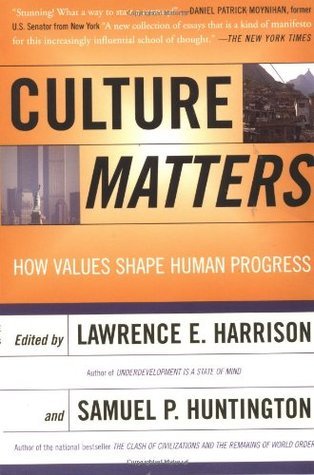
What has been the staying power or follies of this book’s legacy, almost twenty-five years later? When this collection of essays, based on a culture conference, was published in 2000, many ideas on the influences, limits and qualities of culture on development progress and democratic governance were hotly polarizing. Whatever the research consensus today, editors Harrison and Huntington pushed the envelope of an agenda that allowed, 25 years later, a more serious discussion on religion and culture and hopefully disbanded the extremes of cultural relativism and ethno-centric superiority complexes.
The collection of essays is arranged in such a way to allow the contributors to introduce various theories on socio-cultural, economic and political beliefs that could influence a march towards modernity and developmental progress. While the editors claim to allow dissenting voices to comment on fellow book contributors there is a subtle preference for various values that are found most prominently in a Judeo-Christian, protestant leaning, tradition. Readers should note that book editor Harrison’s most recent publication (2017) argues outright for the values housed in the Jewish, Protestant and Confucian cultures.
A few of the questions debated in “Culture Matters” include whether culture can determine a county’s success or whether policies (when enforced) can be the salvation for culture. If politics brings about change, can it be permanent without a following cultural (heart) shift? It would be an obvious self-conceited ethnocentrism if the “Culture Matters” contributors did not attempt to dig beyond culture general and explore a value and attitude typology that make up the ingredients of various cultures. The books summary does conclude with a list of optimal cultural values for development (pg. 277 (Michael Fairbanks) and 299 (Lawrence Harrison). No spoilers in this review.
If success is defined by wealth generation, positive economic growth, equitable development, among other items, then at first glance one might claim that cultures that espouse an everyday duty, responsibility, motive to self-centered wealth, and self-empowerment are important culture ingredients (pg. 12 (David Landes)). Early in the volume, the authors argue that a comparative advantage is not enough to compete in the world of Tom Friedman’s Flat Earth. Instead, a competative advantage, one that includes the values and culturally specific perks (some even ethically ambiguous) in any given society that help any nation compete against its global competitors (pg. 17 (Michael Porter)).
There is a paradox, and a politically frustrating one at that, stemming from the conclusion that Jewish, Protestant or Confucian cultures (and their inherent typologies) have produced the most prosperous development environments. The religion that at least Max Weber described in the protestant work ethic is a self-centered one, motivated not to service but to divining who God’s chosen elect for entry into heaven might be. The typology of the successful culture is paradoxically not aligned with the Protestant (Christian) fruits of the Spirit (Galatians 5:22-26) but instead, the virtues of love, joy, peace, kindness, goodness, gentleness are listed in the “progress resistant” category along with faith-based planning. The missing Spiritual fruits of patience and self-control do play a part in some typologies of progress-accepting cultures (pg. 48-53 (Mariano Grondona).
Religious beliefs, according to the authors, are often found to be maladaptive to progress. While the study of culture continues to experience a practical revival in geo-politics, a condescending attitude towards the religious/faith elements of any culture continues; evidenced in subtle and non-subtle author contributions (incl. pg. 134 (Robert Edgerton).
To square the paradox, theologian, Wayne Grudem and economist, Barry Asmus compiled similar data on Harrison and Huntington’s progressive typology and applied it, albeit in somewhat selective manner, to a more in-depth Biblical teaching on prudent economics and democratic governance in “The Poverty of Nations” (2013). It is an attempt to apply basic values across any culture while respecting faith values. True to a paradox’s nature, even Grudem's analysis comes up short but it's a start.
The ”Culture Matters” contributors attempt to battle their own inherent biases by suggesting conclusions that there is no perfect formula for development or even a common definition of development. Culture is not relativistic but instead, the earth’s cultural diversity and varied successes could imply a wisdom in plurality (pg. 168 (Richard Shweder). In addition, the analysis of culture’s impact changes depending on the level of analysis. In a collectivistic culture, the individual, national and international agents of influence evolve a different symbiosis than the same three levels inside and between more individualistic societies (pg. 284 (Stace Lindsay)). The best analysis combines culture and its context (pg. 254 (Lucian Pye)).
In addition, cultures defy dichotomies, as much as academia prefers the two-sided options (the Cold War days were so simple, were they not?), analysis that compares “the West” to “the Rest” or “Individualist” to “Collectivist” or “Traditional” to “Progressive” will miss extremely important nuances found in historical, geographical, political or other contexts (pg. 261 (Tu Wei-Ming)).
In Christian Realism (International Relations), the social gospel and liberation theology are also considered only partial or even misguided steps in working towards peace and global development. To square, again, the paradox of a Christian life in public service, Christian Realism admits to the universal blight of sin, a wisdom in pluralism, the benefits of grace and the application of prudence in national and foreign policy. It is also important who and in what capacity a cultural significant policy is being enacted. Individuals of faith have spiritual duties with intrinsic power which differs from the human power influences of politics.
As singer songwriter Michael Card sang, there is a power in the Biblical paradox that still defies explanation by “Culture Matters”, “The Poverty of Nations” or the tenets of Christian Realism. It is the wisdom that frustrates the wise; it is the power that elevates the weak; it is gospel that manifested first in the lowly, the despised, the rejected in order to nullify the claims of the elite.
“The power of paradox opens our eyes and blinds those who say they can see.” Michael Card.
So no, faith is not progress resistant. But the power of the Spirit will not be limited to the goals in politics and policy. To return to the book’s “either-or” dichotomal traps, faith and religion are best studied in their specific contexts with varying analysis depending on the individual, their personal practice or its application as a group (church, synagogue, mosque, temple).
The age of cultural relativism and its moral counterpart are past. But this work still leaves many questions regarding the practical application of cultural values, some which will not go away, regardless of their so-called “progress resistant” character. Finally, the value typology project continues at worldvaluesurvey dot org; the globe’s main cultures compared on a y axis of Tradition vs. Secular-Rational and an x axis of Survival vs. self-expression.