

What do you think?
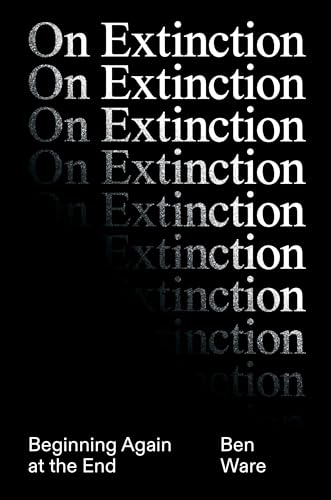
On Extinction: Beginning Again At The End
On Extinction takes us on a breathtaking philosophical journey through desperate territory. As we face 'the end of all things', Ben Ware argues we must face our apocalyptic future without flinching. In fact, extinction is the very lens through which we should examine our current reality.
Radical politics today should not be concerned with merely averting the worst but rather with beginning again at the end. To think about the future in this way is itself a form of liberation that might incubate the necessary radical solutions we need.
Combining lessons from Kant, Hegel, Adorno, and Lacan, as well as drawing on popular culture and ecology, Ware recasts the most urgent issue of our times and resolves that we can only consider our collective end by treating it as a starting point.
Radical politics today should not be concerned with merely averting the worst but rather with beginning again at the end. To think about the future in this way is itself a form of liberation that might incubate the necessary radical solutions we need.
Combining lessons from Kant, Hegel, Adorno, and Lacan, as well as drawing on popular culture and ecology, Ware recasts the most urgent issue of our times and resolves that we can only consider our collective end by treating it as a starting point.
191 pages, Kindle Edition
Published March 12, 2024
Ratings & Reviews
Friends & Following
Create a free account to discover what your friends think of this book!
Community Reviews
Displaying 1 - 13 of 13 reviews

July 14, 2024
Save me from the eternal recurrence of the graduate school essay.
Reading this was a return to the catechism of literary theory's greatest hits from twenty years ago (Freud, D&G on S&M, Kant, Lacan, Benjamin, Kafka and some classic quotations, even Lee Edelman!) given a pat on the head and a slight turn towards the facts of ecological change. Nothing is new. Everything is dialectical, which for Ware seems to mean that he has to end chapters exhorting some sort of anodyne revolution. Following in the worn tradition, there are references to pop culture TV and films (Squid Games, etc) that fit the argument, such as it is. Very North American, very male-interest heavy.
There are some zingers here. I liked, for example, Ware's description of Butler's take on ecology as "falling somewhere between deep ecology, New Age animism, and a Disney cartoon fantasy". I also enjoyed his gentle criticisms of protest movements that exist for the sake of the spectacle, where activists are essentially demanding that developed states take their own laws seriously. But there is too much unfocused "smart quotation" time, too many high-handed references to criticism without Ware having any kind of oar in the water, and too much time spent with silly ideas like Ware's primitivistic exhortation for readers to champion "a new political barbarism, a barbarism that can actively confront what our 'civilized society' delivers up".
I want to pause on this last point. Ungenerously, I imagined Ware and many others reading this and discussing it excitedly over a brunch of the proverbial (and excellent) avocado toast. Yes, that all sounds great... sigh. What I am trying to say is that Ware doesn't read as callous. He reads as utterly naive, and as careless, throughout the book. There is a real problem with this kind of writer who makes arrogant statements about the very real decisions that are for many people life or death. To think about extinction and climate change is to confront devastating violence, yet there is no recognition of what this means in any of these pages. Instead, you get the deracinated psychoanalytic individualism that glosses over what any of its vague assertions might mean for real people living real lives who are trying to figure out what being a barbarian might do to fight climate change. It's silly.
Anyway, began with excitement, ended with a feeling of release from the seminar.
But - as always - a worthwhile spin on the Verso carousel. Sometimes you win, sometimes you get this, but I never regret reading a Verso book.
Reading this was a return to the catechism of literary theory's greatest hits from twenty years ago (Freud, D&G on S&M, Kant, Lacan, Benjamin, Kafka and some classic quotations, even Lee Edelman!) given a pat on the head and a slight turn towards the facts of ecological change. Nothing is new. Everything is dialectical, which for Ware seems to mean that he has to end chapters exhorting some sort of anodyne revolution. Following in the worn tradition, there are references to pop culture TV and films (Squid Games, etc) that fit the argument, such as it is. Very North American, very male-interest heavy.
There are some zingers here. I liked, for example, Ware's description of Butler's take on ecology as "falling somewhere between deep ecology, New Age animism, and a Disney cartoon fantasy". I also enjoyed his gentle criticisms of protest movements that exist for the sake of the spectacle, where activists are essentially demanding that developed states take their own laws seriously. But there is too much unfocused "smart quotation" time, too many high-handed references to criticism without Ware having any kind of oar in the water, and too much time spent with silly ideas like Ware's primitivistic exhortation for readers to champion "a new political barbarism, a barbarism that can actively confront what our 'civilized society' delivers up".
I want to pause on this last point. Ungenerously, I imagined Ware and many others reading this and discussing it excitedly over a brunch of the proverbial (and excellent) avocado toast. Yes, that all sounds great... sigh. What I am trying to say is that Ware doesn't read as callous. He reads as utterly naive, and as careless, throughout the book. There is a real problem with this kind of writer who makes arrogant statements about the very real decisions that are for many people life or death. To think about extinction and climate change is to confront devastating violence, yet there is no recognition of what this means in any of these pages. Instead, you get the deracinated psychoanalytic individualism that glosses over what any of its vague assertions might mean for real people living real lives who are trying to figure out what being a barbarian might do to fight climate change. It's silly.
Anyway, began with excitement, ended with a feeling of release from the seminar.
But - as always - a worthwhile spin on the Verso carousel. Sometimes you win, sometimes you get this, but I never regret reading a Verso book.

June 17, 2024
Terrible. Every reference was to a dead white european dude who had his words twisted to supposedly fit a global mass extinction and climate crisis that, despite having finished the book, I can't even tell if the author fully accepts. I do know he is uninformed and ignorant, given his repeated references to a "so-called sixth mass extinction." It's clear that the author has no expectation that these crises will affect himself or anyone he really loves personally, and he embraces them as an opportunity to further communist revolution, without any description of what that revolution might look like or entail that would even begin to justify the massive suffering and loss of life.
I liked the idea of looking into what embracing beginning again might look like given that everything we have now might end, but not embracing that end because what comes next might eventually be better. It's like burning down the Louvre because you can always make more paintings and some of them might be better than what's there now. I'm not at all clear on if he even understands that these are real people who are dying.
I liked the idea of looking into what embracing beginning again might look like given that everything we have now might end, but not embracing that end because what comes next might eventually be better. It's like burning down the Louvre because you can always make more paintings and some of them might be better than what's there now. I'm not at all clear on if he even understands that these are real people who are dying.
February 26, 2024
A well researched, provocative confrontation and visceral reminder that our existence is limited.
This book is a slow burn that, by the end instills a sense of urgency to recalibrate and actively engage in the present.
Extremely thought provoking and introduced a lot of new concepts for me to take in. While not an easy read I'd say it's quite accessible. I'm grateful that in spite of the heavy subject matter each chapter is unique in a way that was able to grip me (before getting *too* depressed) anew all over again. Good stuff.
Thank you to the Author & Publisher for allowing me to read this book early in return for my honest thoughts and review.
This book is a slow burn that, by the end instills a sense of urgency to recalibrate and actively engage in the present.
Extremely thought provoking and introduced a lot of new concepts for me to take in. While not an easy read I'd say it's quite accessible. I'm grateful that in spite of the heavy subject matter each chapter is unique in a way that was able to grip me (before getting *too* depressed) anew all over again. Good stuff.
Thank you to the Author & Publisher for allowing me to read this book early in return for my honest thoughts and review.

April 10, 2024
I’m still not entirely practiced at reading philosophy, even when it’s more tailored to a lay audience such as myself. But I still can’t away from this with a lot of things to think about regarding not just biological extinction but psycho-emotional and social from environmental, existential, and economic factors. But more than just a polemic about how we are doomed, the author hires into details at how extinction can become a new beginning, a necessary extinguishing to rebuild from the ground up. I think I need to re-read it over time to get some lie details straight in my head, but with the short length and the well-written language, I imagine I might

July 28, 2024
Ben Ware begins his book by setting out the context and purpose plainly. On Extinction is a ‘philosophical and psychoanalytical critique of our damaged times.’ The Visiting Senior Research Fellow in Philosophy at King’s College. London then proceeds to take his readers on a dizzying journey, in the company of some outstanding thinkers. Before the book begins to take steam even, Immanuel Kant, Friedrich Nietzsche, Judith Butler, and Georg Wilhelm Friedrich Hegel jump out from the pages to alternatively startle and regale the reader!
Ben Ware defines extinction or the end by employing the highly imaginative notion of ‘apocalyptic jouissance.’ According to this notion, an end not only infuses the emotions of anxiety and dread, but also informs a paradoxical sense of enjoyment and wild excitement that transcends trivial pleasure. Ben Ware also attempts to explain the concept of extinction in terms of capitalism. Impending and past catastrophes such as pandemics, threat of nuclear calamities, climate change etc. not just lead to pessimism and resignation but also birth inexplicably opposing emotions such as enjoyment, identitarian narcissism, and a time of endless suffering which French philosopher Louis Althusser simply calls ‘barbarism.’
The author also cleverly introduces dark and introspective movies and television shows for advocating a dismantling of the capitalist system. One striking example being Darren Aronofsky’s 2019 film Mother! A poet, simply named ‘Him’ (a role essayed by Javier Bardem) and his wife, also unnamed and the ‘mother’ in the movie (Jennifer Lawrence) lead a serene existence in a home which the couple assiduously restore after it was destroyed in a fire. The tranquility and peace of the couple does not last long, courtesy a stream of uninvited guests. Beginning with the arrival of a doctor and his wife, the house is soon teeming with an unruly band of barbarians who fornicate, trash and dirty the place at random. Finally, the violation of the place extends to the desecration of mother herself when her body is repugnantly violated. As Ware informs his readers, an ecological interpretation of ‘mother’ here might mean Mother Nature or Gaia (goddess of earth). While Gaia in all her benevolence creates a veritable paradise for her children, the latter view such creation as a resource ripe for wanton plunder.
Ironically, the violators of mother are integral constituents of nature. This perverse feature is emblematic of what the French philosopher Jacques Lacan describes as ‘nature’s rottenness’ (‘pouritture’), from within which seeps culture as ‘antiphusis’ (anti-nature). A riveting section on Walter Benjamin’s frighteningly prophetic text Experience and Poverty – penned in the early 1930s – that mulls discomfiting ways in which new technologies will result in a novel kind of “poverty of human experience characterized by excess rather than lack: a suffocating abundance of new ideas and styles that produce a feeling of generalized exhaustion; a sense that, from culture to people, everything has now been ‘devoured”, provokes a surprisingly contrarian reaction from Ware. In a reassuring vein, he opines that Benjamin’s warning’s may not necessarily be a terrible thing. His Cassandra like proclamations ought to inspire humanity to try and “begin again.”
Ben Ware tries to convey to his readers that only in the wake of an existential crisis such as the threat of extinction, does mankind become not just visible, but also relevant. He draws inspiration from the works of Gunther Anders, Jean-Pierre Dupuy, Maurice Blanchot and Theodor Adorno to bolster this claim. The Swiss American composer Ernest Bloch once famously remarked, ‘The true genesis is not at the beginning, but at the end, and it starts to begin only when society and existence become radical.’ Ware by concluding in a vein like Bloch asserts that the biological end of all things may as well mean beginning again at the end (of prehistory): “abolishing a mode of political and economic life which seeks to tether us all – the yet to be born – to a sick but undying present.”
Ben Ware defines extinction or the end by employing the highly imaginative notion of ‘apocalyptic jouissance.’ According to this notion, an end not only infuses the emotions of anxiety and dread, but also informs a paradoxical sense of enjoyment and wild excitement that transcends trivial pleasure. Ben Ware also attempts to explain the concept of extinction in terms of capitalism. Impending and past catastrophes such as pandemics, threat of nuclear calamities, climate change etc. not just lead to pessimism and resignation but also birth inexplicably opposing emotions such as enjoyment, identitarian narcissism, and a time of endless suffering which French philosopher Louis Althusser simply calls ‘barbarism.’
The author also cleverly introduces dark and introspective movies and television shows for advocating a dismantling of the capitalist system. One striking example being Darren Aronofsky’s 2019 film Mother! A poet, simply named ‘Him’ (a role essayed by Javier Bardem) and his wife, also unnamed and the ‘mother’ in the movie (Jennifer Lawrence) lead a serene existence in a home which the couple assiduously restore after it was destroyed in a fire. The tranquility and peace of the couple does not last long, courtesy a stream of uninvited guests. Beginning with the arrival of a doctor and his wife, the house is soon teeming with an unruly band of barbarians who fornicate, trash and dirty the place at random. Finally, the violation of the place extends to the desecration of mother herself when her body is repugnantly violated. As Ware informs his readers, an ecological interpretation of ‘mother’ here might mean Mother Nature or Gaia (goddess of earth). While Gaia in all her benevolence creates a veritable paradise for her children, the latter view such creation as a resource ripe for wanton plunder.
Ironically, the violators of mother are integral constituents of nature. This perverse feature is emblematic of what the French philosopher Jacques Lacan describes as ‘nature’s rottenness’ (‘pouritture’), from within which seeps culture as ‘antiphusis’ (anti-nature). A riveting section on Walter Benjamin’s frighteningly prophetic text Experience and Poverty – penned in the early 1930s – that mulls discomfiting ways in which new technologies will result in a novel kind of “poverty of human experience characterized by excess rather than lack: a suffocating abundance of new ideas and styles that produce a feeling of generalized exhaustion; a sense that, from culture to people, everything has now been ‘devoured”, provokes a surprisingly contrarian reaction from Ware. In a reassuring vein, he opines that Benjamin’s warning’s may not necessarily be a terrible thing. His Cassandra like proclamations ought to inspire humanity to try and “begin again.”
Ben Ware tries to convey to his readers that only in the wake of an existential crisis such as the threat of extinction, does mankind become not just visible, but also relevant. He draws inspiration from the works of Gunther Anders, Jean-Pierre Dupuy, Maurice Blanchot and Theodor Adorno to bolster this claim. The Swiss American composer Ernest Bloch once famously remarked, ‘The true genesis is not at the beginning, but at the end, and it starts to begin only when society and existence become radical.’ Ware by concluding in a vein like Bloch asserts that the biological end of all things may as well mean beginning again at the end (of prehistory): “abolishing a mode of political and economic life which seeks to tether us all – the yet to be born – to a sick but undying present.”

May 20, 2024
Philosophy is not my strong suit. Most of my knowledge of thinkers like Kant and Freud comes from the sitcom The Good Place. As such, there were many times when I was reading Ben Ware’s On Extinction that I was acutely aware of the material going over my head. Luckily, his authorial style is still pleasing to read, feeling comparable to a well-written New Yorker article, and his arguments are well-explained.
A member of the psychology department at King’s College in London, here he uses the writings of great philosophers to examine our society’s growing sense of impending doom, as the signs of climate change continue to appear in growing numbers with each passing year. He opts not to comment on the current mass extinction or global warming directly, instead offering up a “philosophical and psychoanalytic critique of our damaged times,” to mostly fascinating effect, even for someone who is unfamiliar with the writings being examined.
With such heavy subject matter, one would be forgiven for thinking that the book will be filled with doom and gloom. To the contrary, while there is certainly some of that in these pages, the overall message seems to be one of hope for a new beginning to arise from this apparent end. He argues that we as a species must learn to look at our situation differently and works through our likely feelings on the matter by comparing them to a mix of major works of philosophy and pop culture like the movie Melancholia.
He is able to find flaws with many ways of thinking but is especially critical of capitalism. A particularly thought-provoking section on Walter Benjamin’s eerily prescient 1933 text “Experience and Poverty” discusses the ways that new technologies will lead to a novel kind of “poverty of human experience” befalling mankind, that “is characterized by excess rather than lack: a suffocating abundance of new ideas and styles that produce a feeling of generalized exhaustion; a sense that, from culture to people, everything has now been ‘devoured.'” He posits however, that this shouldn’t be seen as necessarily a bad thing, instead it should inspire us to try and “begin again” (emphasis his).
It’s all too easy to look at the world around us and slip into despair, but Ware’s book serves as a bit of a balm for such feelings. We as a species are facing an inflection point of our own devising, and it is critical that we make the right decisions with how we face it. In this brief but well-thought and articulated book, Ware makes a strong case for us to “begin again, and begin again with laughter.”
Review written for AFPLJournal.com
A member of the psychology department at King’s College in London, here he uses the writings of great philosophers to examine our society’s growing sense of impending doom, as the signs of climate change continue to appear in growing numbers with each passing year. He opts not to comment on the current mass extinction or global warming directly, instead offering up a “philosophical and psychoanalytic critique of our damaged times,” to mostly fascinating effect, even for someone who is unfamiliar with the writings being examined.
With such heavy subject matter, one would be forgiven for thinking that the book will be filled with doom and gloom. To the contrary, while there is certainly some of that in these pages, the overall message seems to be one of hope for a new beginning to arise from this apparent end. He argues that we as a species must learn to look at our situation differently and works through our likely feelings on the matter by comparing them to a mix of major works of philosophy and pop culture like the movie Melancholia.
He is able to find flaws with many ways of thinking but is especially critical of capitalism. A particularly thought-provoking section on Walter Benjamin’s eerily prescient 1933 text “Experience and Poverty” discusses the ways that new technologies will lead to a novel kind of “poverty of human experience” befalling mankind, that “is characterized by excess rather than lack: a suffocating abundance of new ideas and styles that produce a feeling of generalized exhaustion; a sense that, from culture to people, everything has now been ‘devoured.'” He posits however, that this shouldn’t be seen as necessarily a bad thing, instead it should inspire us to try and “begin again” (emphasis his).
It’s all too easy to look at the world around us and slip into despair, but Ware’s book serves as a bit of a balm for such feelings. We as a species are facing an inflection point of our own devising, and it is critical that we make the right decisions with how we face it. In this brief but well-thought and articulated book, Ware makes a strong case for us to “begin again, and begin again with laughter.”
Review written for AFPLJournal.com

October 8, 2024
"There are, strictly speaking, no blank pages on which the text of history can be written, only those already overwritten with a network of still illegible signifiers, marked by the hands of previous generations."
A bleak, philosophical take on climate change, politics, and the state of the world. It could be summed up with the True Detective line: Time is a Flat Circle.
Ben Ware prepares for our bleak future. He examines Late Capitalism's impact on politics. Climate Change is bringing extinction but also demonstrating that we have all seen this before. The future is in the past, and it is also the secret to prepare for the future.
Favorite Passages;
This catastrophic convergence, far from placing the possibility of a global humanity on the immediate horizon, has instead intensified a series of sad passions and alienating symp- toms: surplus rage, hyper-anxiety, cynical resignation, the addiction to numbing forms of enjoyment, identitarian narcissism, collective paranoia, melancholic withdrawal, historical forgetting, the desperate attempt to preserve the ‘human’ as it already exists under capitalism. What we are talking about here then is a new kind of traumatized psy- chic reality, a new wounded subjectivity, one that won’t be overcome by a dialectics of mortal fear (being scared ‘so much that we start fighting for our lives’64), but which will instead require a political shift away from the time of end- less suffering
This beginning again, which the death drive announces, has always already begun. There are, strictly speaking, no blank pages on which the text of history can be written, only those already overwritten with a network of still illegible signifiers, marked by the hands of previous generations. A revolutionary politics of the death drive will thus take as its goal the liberation of these texts into history, their coming to legibility: an actualization of a past that has not yet fully existed, a past that still remains ahead of us in time. In this respect, the death drive reconfigures political temporality as such. No longer a straight line heading towards some pre-determined ‘future’, but now, rather, a series of repetitions, or better still revolutions, with each one interrupting the oppressive course of history and producing the new. Such is the foundation of a true politics of immortality today: a beginning again from scratch with one’s face turned resolutely towards the unfinished past.
A bleak, philosophical take on climate change, politics, and the state of the world. It could be summed up with the True Detective line: Time is a Flat Circle.
Ben Ware prepares for our bleak future. He examines Late Capitalism's impact on politics. Climate Change is bringing extinction but also demonstrating that we have all seen this before. The future is in the past, and it is also the secret to prepare for the future.
Favorite Passages;
This catastrophic convergence, far from placing the possibility of a global humanity on the immediate horizon, has instead intensified a series of sad passions and alienating symp- toms: surplus rage, hyper-anxiety, cynical resignation, the addiction to numbing forms of enjoyment, identitarian narcissism, collective paranoia, melancholic withdrawal, historical forgetting, the desperate attempt to preserve the ‘human’ as it already exists under capitalism. What we are talking about here then is a new kind of traumatized psy- chic reality, a new wounded subjectivity, one that won’t be overcome by a dialectics of mortal fear (being scared ‘so much that we start fighting for our lives’64), but which will instead require a political shift away from the time of end- less suffering
This beginning again, which the death drive announces, has always already begun. There are, strictly speaking, no blank pages on which the text of history can be written, only those already overwritten with a network of still illegible signifiers, marked by the hands of previous generations. A revolutionary politics of the death drive will thus take as its goal the liberation of these texts into history, their coming to legibility: an actualization of a past that has not yet fully existed, a past that still remains ahead of us in time. In this respect, the death drive reconfigures political temporality as such. No longer a straight line heading towards some pre-determined ‘future’, but now, rather, a series of repetitions, or better still revolutions, with each one interrupting the oppressive course of history and producing the new. Such is the foundation of a true politics of immortality today: a beginning again from scratch with one’s face turned resolutely towards the unfinished past.

July 11, 2026
O maior mérito do livro de Ben Ware é limpar o terreno no que diz respeito às teorias da esquerda contemporânea sobre a catástrofe climática e a extinção humana. Ware encontra a centralidade da humanidade onde se queria, ou se pensava, a sua ausência. Mostra como as estratégias de descentrar o "homem" nunca se concretizam, os filmes que surgem como críticas ao capitalismo reforçam uma postura passiva frente a exploração. A forma que mais se repete no livro é: "X não é radical o suficiente", passível de ser empregada para falar de doutrinas filosóficas niilistas ou filmes e séries mainstream. O expediente é zizekiano, como é o universo teórico de Ware: Kant, Hegel, Marx, Freud e Lacan são presenças constantes, agregadas a Adorno, Wittgenstein e escritores como Kafka. As lentes são modernistas: o presente é visto aos olhos dos teóricos citados, a maioria deles figuras que escreveram na primeira metade do século XX ou foram peças chave desse momento. A ideia geral não é minimizar a catástrofe ou os males do capitalismo, mas perceber como um certo pensamento que se propõe a entender o fim possível da humanidade corrobora com a permanência das coisas como estão.

October 14, 2024
While short in length, this philosophical discussion of humanity's extinction is very dense with thought. Calling on thinkers like Kant, Freud, Brecht, and the ancients too, Ben Ware takes the reader on a journey deep into our extinction due to all of the crises we currently face: climate change, war and the flagrant abuses of untrammelled capitalism. It is a sobering read and one that stays with you in the quiet moments of night. Yet Ware provides hope for us - if we can face the extreme damage capitalism has wrought on us individually and collectively. To begin again at the end, we must overthrow capitalism and create a new revolutionary way of being. For me that means, becoming the foresters and stewards of this earth and not its destroyers. Do we have that strength and commitment when capitalism distracts us with its empty and false trophies?

May 11, 2024
I don't think I'm well-practiced enough in philisophy to fully understand this. For a neophyte like me, this is easily one of the more challenging reads I've gotten through this year. What's abundantly clear, though, is that we're already living in the apocalypse. It's a heavy read in the sense that knowing we're on a course that can't be corrected as it's already underway and that can make you feel so impossibly small and powerless, but it's also a reminder that now, more than ever, we need to take care of us.

June 13, 2025
Very Eurocentric but I recognize that Ware’s background is in Western philosophy. I liked the writing style though - it’s a pretty quotable book.

November 10, 2024
Interesting book that more so unravels the tapestry of "the end" by pulling at various threads. More interested in pulling at said threads than weaving something new.
"Species shame" was an interesting concept for me.
The book Scatter, Adapt, Remember by Annalee Newitz still hits home for me more than this, though.
"Species shame" was an interesting concept for me.
The book Scatter, Adapt, Remember by Annalee Newitz still hits home for me more than this, though.

December 20, 2024
Important subject matter and the author makes some stellar points but at times feels like an academic thesis so it was a bit of work to get through - but could also very well be that I’m too stupid
Displaying 1 - 13 of 13 reviews