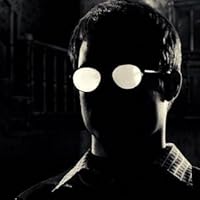
Can you find seven dogs in this picture of a castle? How about two little girls in a relatively small neighbourhood?
Dee and Mary discover a way to hide in plain sight so that Dee doesn’t always have to go home and babysit or do household chores for her mother. For awhile, it’s great fun to sit apart from the rest of the world and watch them unawares. But it’s not exactly normal.
It hadn’t occurred to Dee and Mary that what they were doing would have consequences…
Pat Cadigan is an American-born science fiction author, who broke through as a major writer as part of the cyberpunk movement. Her early novels and stories all shared a common theme, exploring the relationship between the human mind and technology.
Her first novel, Mindplayers, introduced what became a common theme to all her works. Her stories blurred the line between reality and perception by making the human mind a real and explorable place. Her second novel, Synners, expanded upon the same theme, and featured a future where direct access to the mind via technology was in fact possible.
She has won a number of awards, including the prestigious Arthur C. Clarke Award twice,in 1992, and 1995 for her novels Synners and Fools.
She currently lives in London, England with her family.
Though I’m a frequent reader of the site, before I picked up “Chalk” I hadn’t actually read any of This Is Horror’s series of chapbooks. Which is somewhat surprising, given that I’m a reader of pretty much all of those writers published.
But somehow they have — so far — escaped my attention. Until, as I say, “Chalk”.
Pat Cadigan is something of a legend in the SF community, having won the Arthur C. Clarke award twice and (more recently) a Hugo award. This is her first foray that I’ve seen into horror, and so I was expecting good things.
And I wasn’t disappointed.
“Chalk” is a short story following a pair of children, Dee and Mary, growing up in small town America, playing and exploring their neighbourhood and discovering certain places where they are apparently invisible when together, through the use of possibly magical carpenters chalk
It is a heady mixture of nostalgia and potent social comment. The setting comes alive under Cadigan’s prose, with the simple familiarity of childhood eyes. A small area of the world is inflated in scale, comprising the entire world with only a misty and undefined land beyond. It harks back to a soft childish ignorance which we all experienced where we saw our surroundings at a much closer and more intimate level than in later life.
Childhood friendship is also a big theme, with the bond between Mary and Dee tested gently by differences between them, but also forging a genuine closeness between the two girls. The tragedy-tinged conclusion reflects on this, harking at the separation which almost inevitably affects childhood friendships — I myself am still in contact with few of those I knew in my school days.
Cadigan is an excellent writer. I’m not sure that was ever in doubt, but her prose sparkles with a cheeky life in the voice of her central character. It isn’t easy to write a complex story from a child’s perspective, but Cadigan displays here the lightness of touch to make the images and ideas resonate within the reader.
The tone of this story is wonderfully pitched. It blurs the line between the unexplained and the unexplainable, underscoring that in many things in life we simply can never know the realities and absolute truths. That lack of explanation is mirrored in the inescapable sorrow of the conclusion, and the simple fact that childhood years cannot, once passed, be reclaimed.
This is an excellent and enjoyable short story, well-written and with complex and realistic characters. The length and pace are perfectly set, and the horror creeps subtly up out of universal memories and nostalgia. I have long been an advocate of short-form fiction and I can’t help but feel in that objective the combination of Pat Cadigan and This Is Horror in “Chalk” is a major step forward.
I'll admit, I bought this book based purely on the cover art. I loved the style and the eerie vibe the image broadcast.
Cadigan's story did not disappoint. Two young girls attempt to shuck of responsibility by finding a new kind of place to hide. The result is an uncanny spyglass into the Anycity, America.
I enjoyed the casual buildup to the climax. It happens so fast that I did a double-take to verify what I thought happened happened.
This is the sort of story that makes small press runs so much fun.
Sleepless, I was looking for Kindle versions of Pat Cadigan's award-winning sf stories when I encountered Chalk on Goodreads. Because it was so near the end of the month and the story was short, I decided to read and then return it immediately so that it did not encroach on the next monthly allowance. Given my initial low commitment, I was initially surprised that the story engaged me so strongly. By the time I finished I realised that although I do not know the physical environment she described so vividly, the story engaged me in an emotional landscape that I recognised. Visiting the places of our childhood evokes bittersweet memories, and the loss of any significant person sharpens poignancy to an almost unbearable point. This I have heard: we cannot get back what we lost, but what we can have now and for the future may be worthwhile. So what will I do to honour all these bittersweet memories of events and places shared with the person who is no longer here? Shall I have the courage to embrace them; shall I change everything I am doing and run towards their light, or persist as I do? and which is which?