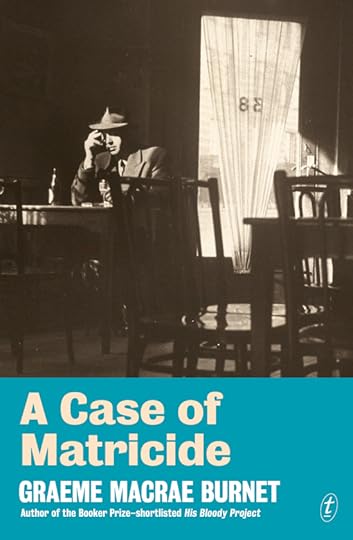
From the Booker-nominated author of Case Study and His Bloody Project comes the next adventure of Inspector Gorski.
In the unremarkable French town of Saint-Louis, the troubled Inspector Georges Gorski takes the case of a local woman who has called the to report that she suspects her son, a novelist named Robert, of plotting her death. Between the suspicious death of their dog, Robert’s callous disregard for his mother’s accusations, and her unreliable state of mind, Gorski decides to keep a close eye on their house. He visits with increasing frequency, trying to understand why—and how—a man might murder his mother. As Gorski’s closeness to the Duymanns swiftly slips from curious to dangerous, his grip on the case—and reality—irreversibly loosens.
In his unmistakably Nabokovian style, in which the line between fiction and reality blurs and narration and truth are questioned at every turn, Burnet constructs an elegant, bizarre, and destabilizing account of the ways guilt moves between mind and body, suspect and investigator, and writer and reader.
Graeme Macrae Burnet was born in Kilmarnock in 1967. He studied English Literature at Glasgow University before spending some years teaching in France, the Czech Republic and Portugal. He then took an M.Litt in International Security Studies at St Andrews University and fell into a series of jobs in television. These days he lives in Glasgow.
He has been writing since he was a teenager. His first book, The Disappearance of Adèle Bedeau (2014), is a literary crime novel set in a small town in France. His second novel, His Bloody Project (2015), revolves around the murder of a village birleyman in nineteenth century Wester Ross. He likes Georges Simenon, the films of Michael Haneke and black pudding.
The third book with Inspector Gorski is a little more private than the previous two since Gorski's complicated family relations are more exposed, linked together with his current case which is not simple at all. The seemingly sleepy French town simmers underneath, and the lives of its burgeois inhabitants are offer more of the unexpected. Terrific plot and execution, together with characters make this book an engaging read. *A big thank-you to Graeme Macrae Burnet, Bolinda Audio, and NetGalley for a free audiobook in exchange for my honest review.*
A local woman calls the police to report that she suspects her son of plotting her death. Inspector Gorski decides to keep a close eye on them and visits with increasing frequency, trying to understand why and how a man might murder his mother.
This is the third book featuring Inspector Georges Gorski and the small town of Saint-Louis in France but it's not necessary to have read the previous books. I do recommend the whole series though. I have a hard time expressing why this author's writing appeals to me. There's certainly nothing deep or earth-shattering about the stories or the characters but I'm drawn to them anyway. Inspector Gorski carries on much internal dialogue as he debates with himself about how he or his actions or inactions might appear to other residents of the town and he is constantly preparing answers to questions never asked.
Graeme Burnet has a most unusual style of writing. We learn from the foreword that this story (as with the previous two in the series) was written by Raymond Brunet (a close spelling to Burnet!) and translated from the French by the narrator but then we spend most of the time in the head of the main character. It's almost like burrowing down throught the layers of an onion. There are a couple of different covers for this book but this one is my favourite!
I think I've read everything Graeme Macrae Burnet has written but this is the first audiobook of his work that I've listened to. The book is narrated by Geoffrey Breton and his narration is extremely fitting even though he has a British accent and the story takes place in a small town in France. Much as I enjoyed the audiobook, I'd still like to read the physical book if and when the library gets copies. I can't wait to see where Mr. Burnet goes from here as I suspect we're done with Inspector Gorski.
My deepest appreciation to Bolinda Audio via Netgalley for approving my request to listen to an advance copy of this audiobook. All opinions expressed are my own. Publication Date: October 3, 2024
Burnet's playing musical chairs with murder..............
Number 3 in the Gorski arc. I don't know if this is a finale or not. However, as it stands, it is beginning to show a pattern tying all the 3 books together.
Like I mentioned in my review of Accident on the A35, Macrae takes his plot points and character struggles and juggles them about and tries them out on different characters at different times. This has left me pondering about stories and what they mean and how they become different if the time is moved or if they happen to one person instead of another. Furthermore on how the onlookers (readers in this case) see them in a different way plus ' judge' them differently as well,
I've enjoyed these a lot and am, of course, ready for more from Macrae, Brunet's pen.
An ARC gently provided by author/publisher via Edelweiss
A Case Of Matricide is the third book in the Georges Gorski series by award-winning Scottish author, Graeme Macrae Burnet. In the town of Saint Louis, the Chief of Police, Georges Gorski has always felt like an outsider, always felt like he’s under surveillance, but lately his purposelessness borders on acute.
The townspeople follow their routines and little out of the ordinary happens: a stray dog is brought to the police station; a high-school student is suspended for sharing inappropriate literature; the florist downstairs keeps an eye on an increasingly-demented Mme Gorski.
Except that it’s such a minor thing, it’s almost a relief to respond to an alert about a guest staying longer than usual at the Hotel Bertillon: the nameless Slav is quite unforthcoming with detail, but Gorski hasn’t any legal recourse when no offence has been committed.
Madame Duymann tells Gorski that her son has threatened to kill her, by violent and other means, and kicked her pet dog to death. Robert Duymann, apparently a celebrated author, claims she is quite demented. Of course Gorski has to speak to her, and keep an eye on the son, (who wears slip-on shoes, making him untrustworthy in Gorski’s estimation), then makes a record of the visit.
His attention to detail involves checking local veterinary surgeries to verify Robert Duymann’s story about the dog, perhaps inviting ridicule, even if it provides an amusing tale when his daughter, Clemence comes for dinner.
Is he clutching at straws, hoping for something more important to do when he finds something not quite right about the death scene of a local factory owner? Is the ageing doctor too eager to call it a cardiac arrest? Why is the mayor, Gorski’s father-in-law, at the scene? And is the death, in a car accident, of the man’s receptionist, described as an erratic driver, in any way suspicious?
Before matters are resolved (if they ever really are, the reader will have to draw their own conclusions), there have been three suicide attempts, the description of the unsuccessful one blackly funny; as well as the deaths mentioned, an older man and two older women meet their ends; someone is blackmailed; and the dog is given a home.
Gorski’s narrative is interspersed with a sort of catch-up of what the townsfolk are up to just then. Macrae Burnet certainly has the measure of the French provincial town: his depiction of its inhabitants, their frequent pettiness, their flaws and foibles, is perfect.
Macrae Burnet gives the reader a story within a story within a story as author Duymann writes about matricide, Brunet writes about Duymann and Macrae Burnet writes about Brunet. There are plenty of parallels between their lives including two sons with demented mothers, suicide by train, and the feeling of being trapped in a small town. Although, of his unfavourable depiction of Saint Louis, Brunet told an interviewer: “just because you love something, doesn’t mean you shouldn’t write about it with honesty.”
While he does do something that will surprise, Gorksi’s unending self-examination, second-guessing, rationalising and over-interpreting everything is a constant source of humour, but he makes some insightful observations too. Accomplices “hold sway over each other not merely for the duration of a particular job, but for as long as they both remain in the land of the living. It is a kind of grim marriage” and “what mattered was not what had actually occurred, but what people believed to have occurred.”
As with earlier instalments, the reader who skips the Foreword and Afterword is doing themself a huge disservice, as these enhance the story, are an essential, if tongue-in-cheek, part of the fiction, providing extra detail, an interesting perspective, and parts are laugh-out-loud funny. While it’s a pity that Gorski’s story has come to an end, whatever else Macrae Burnet comes up with will be a must-read. This is literary crime at its best. This unbiased review is from a copy provided by Text Publishing.
I don't read many detective novels and so I never had a favourite detective. But after three Gorski-novels, now I do!
Gorski has changed though, he drinks more and is less sharp. In 'A Case of Matricide' a mysterious Slave visits sleepy St Louis for no apparent reason, a local writer threatens to murder his mother and a rich industrialist dies in mysterious circumstances. Gorski suspects the cases may be connected, but then he takes a decision that upends everything.
I recommend reading the first two installments before starting this... not because the cases are connected, but because you follow Gorski's development and especially because of the meta-games that GMB is playing with us and which are good fun and perhaps the true mystery...
The prologue announces this is, unfortunately, the final part in the Gorski-trilogy, but with Macrae Burnet you never know - a lost manuscript by his 'Gallic Doppelganger' may yet turn up...
Meta fiction, anyone? Here it is—at its best. Inspector Georges Gorski (who readers met in The Disappearance of Adèle Bedeau and The Accident on A35) is back for his third appearance in A Case of Matricide.
Readers of those books are familiar with Graeme Macrae Burnet’s conceit: he pretends to be translating a novel by Raymond Brunet (an anagram of the author’s real name). In the purported translation, Inspector Gorski, the chief of police of Saint-Louis, France, is now a bit older and a lot more desperate.
He is divorced, living with his demented mother, and drinking more (and hiding the evidence of his drinking). Nothing much happens in Saint-Louis. The inspector spends his time trying to uncover the truth about the mysterious lodger in a nearly empty hotel and answering calls from an elderly woman who believes her son, the uncelebrated novelist Robert Duymann (another anagram), is plotting to kill her. Then, a prominent businessman drops dead because of what appears to be an ordinary heart attack. Or is it?
As he keeps track of all three of these story threads, along with frequent stops at Le Pot, an off-the-main-street bar, Gorski’s mind often drifts to a childhood transgression, when he deliberately broke the family’s mustard spoon and dealt with the guilt of lying about it. We can surmise that Gorksi is a guilt-ridden personality who is increasingly alienated from his own life. His awkward flirtation with the proprietor of a flower shop on the first floor of his mother’s apartment shows a man out of touch with himself.
The actual matricide and its reasons are not what the reader will suspect. In fact, Gorski is a victim of his own fear and overanalyzing, and although he has decent instincts, he has trouble connecting the dots.
Although afterwords can sometimes be missed, not this time. In the aftermath, Burnet once again takes on the translator’s role, filling in the outlines of Brunet’s biography and fleshing out his analysis of what the reader has just read. I am always in awe at how cleverly Graeme Macrae Burnet writes and the fictional (although seemingly factual) world he creates. This is a fitting end to his fabulous trilogy.
A flurry of odd cases breaks into the dull routine of Inspector Georges Gorski’s days, forcing him to see connections that may or may not exist, and leading him to re-examine his own life. First, there’s a request for help from an elderly woman who claims that her son is threatening to murder her. Then, M. Virien, manager of the seedy Hotel Bertillon, has become suspicious of a man who is staying there. And finally, a rich businessman, Marc Tarrou, has been found dead in his office. The lazy and rather incompetent police medical examiner is happy to file it as a heart attack, but Gorski thinks perhaps the heart attack came as a result of Tarrou having been attacked in some way. All three cases are nebulous, and may not be cases at all.
This is the final novel in a trilogy about Georges Gorski, set in the small town of Saint-Louis, in the corner of France that borders Germany and Switzerland, some time in the 1970s. All three are more literary fiction than crime novel, and it is the characterisation and setting that make them special, although the plots are interesting too. It has been seven years since the second book, The Accident on the A35, came out and a full ten since the first, The Disappearance of Adele Bedeau. That was a bit of a problem for me in that the details of the first two had disappeared from my memory, much though I loved them, and I came to the conclusion that this is a trilogy probably best read almost as a three-volume novel. The heart of all three is the character of Gorski, and I feel reading them closer together would have given me a clearer picture of his development over time. However, this one, like the other two, can be read as a standalone, though I think they work better together than separately.
Burnet continues the literary game he started in the first book, of claiming in his introduction that the books were written by Raymond Brunet, a Frenchman who was himself a resident of Saint-Louis, and translated into English by Graeme Macrae Burnet. At this point I must mention that for once it’s vital to read the introduction of each book before reading the book, and just as vital to read the afterwords. They are in fact part of the novel. Inside this book is another novelist, the man accused of threatening to murder his mother, who may or may not be a self-portrait of Brunet. But then he may also be another version of Gorski. Confused? I think that’s the intention – there are layers of identity throughout the book which may all be describing different characters but can just as easily be seen as showing different aspects of one personality – the author’s, or rather Brunet’s, the fictional author. It’s brilliantly done – nebulous enough to leave the reader somewhat unsettled and grasping for certainties that always feel as if they’re just out of reach.
Brunet and Burnet both admit to the influence of Simenon’s Maigret in the creation of the tone of the book and Gorski’s character, and Gorski himself was inspired to join the police by reading Maigret novels. When I reviewed the earlier books I hadn’t read much Maigret, but now that I have, I can see how expertly Burnet has caught the tone in his writing and especially in the way he, like Simenon, creates a wonderfully realised setting that becomes a character in its own right. The town of Saint-Louis is drab and grey, small enough for everyone to know everyone else’s business. Burnet uses that to great effect in Gorski’s character, now introspective to a dangerous degree, feeling eternally observed, second-guessing the impact of each of his own actions and words, and obsessing over what other people are thinking or saying about him. It becomes quite claustrophobic to be inside his head, but it is an entirely credible picture of a man whose insecurities seem to be increasing as his life narrows. Not only has he never escaped Saint-Louis, here he is now in middle-age, back living with his mother who is sinking into dementia, occupying the same bedroom as when he was a child, with only a weekly visit from his daughter to break the monotony.
Gorski’s methods are also similar to Maigret’s – he simply talks to people and waits for them to reveal themselves, and spends a lot of his working day in bars. But he is what Maigret might have been if Maigret had failed – if he had never got the exciting cases, if he had been stuck in a dead-end town rather than in Paris, if his wife had left him. However, while the overall shade is Maigret’s colour of noir, there is a strand of deadly black humour running through this which makes it feel quite different, and somehow more modern.
I haven’t said much about the plot for two reasons: one, I feel it’s better not to know too much about these books before reading, and two, the plots are not the most important aspect, or at least not as plots. Especially in this one, the three strands are so linked to Gorski’s inner thoughts and actions that they almost feel like extensions of his character – they become aspects of his personality, much like the game playing with the Brunet/Burnet/Gorski names. If this all sounds vague and hard to grasp then that’s about right. In the end, the mystery is: who is Gorski – and the supplementary question is, can we ever answer that for anyone, even ourselves?
An excellent trilogy, more literary than crime, that looks at the question of identity in a uniquely original way, and one in which each book can be enjoyed at face value but also leaves the reader’s thoughts thoroughly provoked. I’m looking forward to following my own suggestion of regarding them as three volumes of one novel and re-reading them all together.
I love Burnet's books, from his first "His Bloody Project" to the Gorski trilogy. This is book three of the trilogy and its set in a small French village where life drifts along slowly, one average day to the next, and then, "Bam" there's a plot twist that I honestly did not see coming (and believe me when I say I can always see them coming), needless to say, that just made the whole story for me! I'm still reeling from it and the ending, Wow!
3.5 stars Macrae Burnet has a style of writing that works brilliantly to create a detachment from his characters but at the same time you know them well. I had little sympathy for Gorski but he was still interesting. His character shows how childhood shame can filter through your entire life. The conclusion to this story probably didn’t give me much satisfaction because I didn’t like his character.
A case of matricide, a postmodernist take on thriller, is a delectable feast without the fanfare. For the lovers of Paul Auster's showmanship, here is an author who turns the detective story into an illusionist performance without breaking the flow.
The author claims he is the translator of a French book "A Case of Matricide" and in his foreward talks of how the author originally died by suicide and this the last book that was to be published by his estate after his mother's death. What this does is plays with the reader all along and significantly alters the reading experience.
The book starts with Chief inspector of a small town, George Goscki getting a call from a woman who claims her son, also an author, is trying to murder her. He also drops in to investigate a foreigner who has come to town and, as it is later revealed, following the inspector around. Almost 30% into the book you start to lose sense of characters, timelines and the book gets into a different gear.
I loved the play that appears dry and unemotional. I even briefly remembered the stranger by Camus, but then the author is too wily to be contained. It doesn't tie loose ends, does not answer the questions and the ending is a contract that is more in the heads of the reader. Special callout to the narrator of the audiobook.
Brilliant book even standalone. Hope this gets the recognition it deserves.
I find myself in the minority here, but I absolutely hated this book. Though I can appreciate the irony in the inspector investigating someone who calls saying her son is trying to kill her and then ends up doing the same, the whole book felt slow and loquacious, as though the author was trying to reach a certain word count as simply went back to add more dreary detail to achieve that goal. In fact the case of matricide for the inspector felt out of character and senseless. This may be because I had not realised this was book 3 of a trilogy, but I came to loathe the inspector and was really rooting for the train. The narrator had good production and pacing, but was for the last third was constantly sniffing or breathing audibly which made it very difficult to continue. Thank you to NetGalley, the author and translator, and Bolinda audio for my copy of this audiobook.
I received an audiobook version of this book from the publisher and even though this thriller is by one of my favorite authors I had trouble following the plot is this format. I bought the Kindle version and enjoyed the book a lot more the plot is very subtle and there are a lot of different characters in the book. I enjoyed this author’s writing because is creates a very believable world of characters that live in a small town and continue their daily lives despite the usual deaths, infidelities and the hopes of eventually leaving the town for a bigger things.
Chief inspector Georges Gorski seems to spend a lot of time drinking while working in the French town of Saint Louis. He has returned to the family home and looks after his elderly mother. He ponders the death of a manufacturer and encounters a stranger in town.
Enjoyed this well written and well narrated novel (I listened to the audiobook). Quirky characters who are not all they seem to be. Things are going on in the background in this well paced novel. Will a death be resolved or will there be more? Enjoy being intrigued.
Disappointing. Similar to operating a very slow pin ball machine, the reader was thrown gently from one grey area to another dull brown one while gently bumping against slowly moving downcast characters in the story. Just found the content dull and monotonous despite the twists towards the end of the book.
A Case Of Matricide is the third book in the Georges Gorski series by award-winning Scottish author, Graeme Macrae Burnet. The audio version is narrated by Geoffrey Breton. In the town of Saint Louis, the Chief of Police, Georges Gorski has always felt like an outsider, always felt like he’s under surveillance, but lately his purposelessness borders on acute.
The townspeople follow their routines and little out of the ordinary happens: a stray dog is brought to the police station; a high-school student is suspended for sharing inappropriate literature; the florist downstairs keeps an eye on an increasingly-demented Mme Gorski.
Except that it’s such a minor thing, it’s almost a relief to respond to an alert about a guest staying longer than usual at the Hotel Bertillon: the nameless Slav is quite unforthcoming with detail, but Gorski hasn’t any legal recourse when no offence has been committed.
Madame Duymann tells Gorski that her son has threatened to kill her, by violent and other means, and kicked her pet dog to death. Robert Duymann, apparently a celebrated author, claims she is quite demented. Of course Gorski has to speak to her, and keep an eye on the son, (who wears slip-on shoes, making him untrustworthy in Gorski’s estimation), then makes a record of the visit.
His attention to detail involves checking local veterinary surgeries to verify Robert Duymann’s story about the dog, perhaps inviting ridicule, even if it provides an amusing tale when his daughter, Clemence comes for dinner.
Is he clutching at straws, hoping for something more important to do when he finds something not quite right about the death scene of a local factory owner? Is the ageing doctor too eager to call it a cardiac arrest? Why is the mayor, Gorski’s father-in-law, at the scene? And is the death, in a car accident, of the man’s receptionist, described as an erratic driver, in any way suspicious?
Before matters are resolved (if they ever really are, the reader will have to draw their own conclusions), there have been three suicide attempts, the description of the unsuccessful one blackly funny; as well as the deaths mentioned, an older man and two older women meet their ends; someone is blackmailed; and the dog is given a home.
Gorski’s narrative is interspersed with a sort of catch-up of what the townsfolk are up to just then. Macrae Burnet certainly has the measure of the French provincial town: his depiction of its inhabitants, their frequent pettiness, their flaws and foibles, is perfect.
Macrae Burnet gives the reader a story within a story within a story as author Duymann writes about matricide, Brunet writes about Duymann and Macrae Burnet writes about Brunet. There are plenty of parallels between their lives including two sons with demented mothers, suicide by train, and the feeling of being trapped in a small town. Although, of his unfavourable depiction of Saint Louis, Brunet told an interviewer: “just because you love something, doesn’t mean you shouldn’t write about it with honesty.”
While he does do something that will surprise, Gorksi’s unending self-examination, second-guessing, rationalising and over-interpreting everything is a constant source of humour, but he makes some insightful observations too. Accomplices “hold sway over each other not merely for the duration of a particular job, but for as long as they both remain in the land of the living. It is a kind of grim marriage” and “what mattered was not what had actually occurred, but what people believed to have occurred.”
As with earlier instalments, the reader who skips the Foreword and Afterword is doing themself a huge disservice, as these enhance the story, are an essential, if tongue-in-cheek, part of the fiction, providing extra detail, an interesting perspective, and parts are laugh-out-loud funny. While it’s a pity that Gorski’s story has come to an end, whatever else Macrae Burnet comes up with will be a must-read. This is literary crime at its best. This unbiased review is from a copy provided by NetGalley and Bolinda Audio.
OK, here’s what I think is happening: the author whose name is on the cover, Graeme MacRae Burnet, has translated a novel by Raymond Brunet, from the original French; Brunet, who is also a character in Burnet’s book, has written a series of romans a clef which may or may not be, but definitely are, about himself as a teen and young man; he has also included another character, a third writer, who is also definitely Brunet in the present, living a future which is also his. Comprenez? Burnet may also be a character in Brunet’s book, who knows. If that sounds frustrating, it is, and so are the characters and their situations and settings, and I’m not quite sure I even excavated all the levels of existence and authorship. The trilogy is sort of a sordid noir about people I’m not sure I'd ever want to know, drifting through their lives and deaths in an interesting/frustrating/boring way, and for whatever reason, I was compelled to read them from beginning to end. It was like watching a shabby magician pull off a trick so bizarre and unlikely you want to see it again, even if you don't. I can’t remember ever having to work so hard to understand (or care about) all the little plots, tiny intrigues about people who, again, you really wouldn’t want to know in life, but some internal propulsion kept me reading… The setting is both exact and vague, set in some unknown year that based on characters’ ages defies mathematics; it’s France in the late 60s, 70s, 80s, you name it, and there are absolutely no identifying details like song titles or clothing styles or car models, just a town called Saint-Louis which could be anywhere in France or the world. I read the first book in the trilogy a year ago and even reading my comments on it doesn’t bring much of it back, except for the ending, but the second and third book each add several levels to the literary torte, without adding any kind of compelling mystery. A word of advice here: don’t read this third one without reading the second book first, but the first isn’t necessary to understand the next two. Happy puzzling that one out, eh? And also, I’m not completely sure what I know at this point (je sais pas, hein?) but the little I came away with entertained me enough to set me searching for other books by this author (Burnet, I think, not the other guys.) 4 stars
4.5 stars. An enjoyable, witty, sometimes humorous detective fiction, character based novel with a little meta fiction. The story is set in Saint-Louis, a small town in France, where Chief Inspector Gorski lives. The novel is told mainly from Gorski’s perspective, describing Gorski making his rounds, talking to people and frequently having a drink in a bar or at people’s places. Gorski investigates minor incidents such as finding out who the foreigner staying at the local hotel is. He interviews Madame Duymann who claims her son is trying to kill her. He also interviews the son, Robert Duymann, who has written a novel set in Saint-Louis. Then Marc Tarrou, owner of one of the factories in Saint-Louis, drops dead of an apparent heart attack and then his secretary has a car accident. Gorski’s mother is becoming increasingly demented and should be going into a nursing home.
A novel about people and relationships. Their public and private personas. Just how much does Gorski control of his own life?
There is a Georges Simenon’s detective Maigret feel to this novel.
There is a clever afterword pointing out issues in the detective story that the reader may have missed.
I was fully drawn in by this one, and it made no difference that I hadn't read the previous books . Firstly I was far too interested in all the goings on of the small town, but then when we solely looked at Gorski, it was even more intriguing. He was an interesting character . I appreciated the afterword too, to put some context to the character. Nicely narrated, and very enjoyable .
Scottish author Graeme Macrae Burnet loves playing meta textual games. And that is patently evident in his trilogy of crime novels featuring French police detective Geroges Gorski, of which A Case of Matricide is the third and last. The books are purportedly written over forty years ago by a little known French author Raymond Brunet and merely translated by Burnet (note the similarities in the names). Some background explains all of this. The first book of this series The Disappearance of Adèle Bedeau is the only one of Brunet’s books to be popular. Both this and the previous novel in this series The Accident on the A35, were translated from manuscripts that were lodged with solicitors and released only on the death of Brunet’s mother. But all three draw from Brunet’s life and in particular, the people and locations of the French town of Saint-Louis. As such they are full of reflections and resonances and clues to the character, experiences and desires of Brunet himself. A Case of Matricide opens with short vignettes focussed on various characters in Saint-Louis. The narrative then centres back in on Police Chief Georges Gorski as he goes about his day. Not much happens – there is a mysterious Slavic guest at the local hotel, a local, the mother of a locally famous author called Raymond Duymann is worried that her son is ploitting to kill her, and Gorski himself is dealing with his own mother who is suffering from dementia. Eventually there is a somewhat mysterious death of a local businessman, but Gorski is warned off investigating by his ex-father-in-law the town’s mayor. Do not go into A Case of Matricide expecting a classic French mystery (a la Maigret) with a clever denouement. This is first a foremost a character study of Gorski and, in a reflected way of the author Brunet, but also of the town itself and its denizens, sitting in a fog of corruption and compromise. So, for example, Duymann is clearly a stand in for Brunet (at one point it appears that Duymann is writing a novel called A Case of Matricide), but so is Gorski. While this can be read as a stand-alone novel, Burnet builds on the character, his history, and the ideas that form the previous two books. A lengthy Afterward by Burnet explains some of this but also pulls him as the translator into this mind-bending spiral. Burnet explains some of these resonances and how he has interpreted Brunet’s wishes, and then takes himself to the locations mentioned in the books, including a small pub in Saint-Louis. So that even through to its final page A Case of Matricide, and the series as a whole, plays like a hall of mirrors. The way in which Burnet has been able to channel the French formal style, while playing with crime fiction tropes and delivering an implicit but deep character study over these three novels has been nothing short of incredible.
This is the final book in Burnet's trilogy in which he writes as his alter ego, Raymond Brunet. I must admit to a degree of apprehension about a Scotchman writing a book set in a rural village of the Haut-Rhin, but any doubt was soon dispelled. This trilogy is a real treat, and it finishes with the best book yet.
I detected hints of a Georges Simenon influence a few times, and Burnet confirms this in a sort of afterword which he writes as if he has translated the lost books of Brunet. They are gallic noir, but with Burnet's own stamp, leaning towards the cosy.. The real enjoyment is gathered from characters of Saint-Louis, which Burnet takes his time to introduce, but it is time well spent.
Burnet / Brunet's chief inspector is the lackadaisical Georges Gorski, a typical local policeman for whom it would take something seismic to take him out of his daily routine of wandering the streets and frequenting his favourite cafe.
Its a crime novel in which the crimes are not the point, but having said that, there are a few very rewarding twists in the last chapters. The crux is in the existencial crisis faced by several of the key characters, not least Gorski. Burnet uses the afterword to also point out any clever touches that may have been missed. Detail is important here, and close reading pays off; though the main twist did come as a surprise to me.
Three novels to savour, with the best saved to last.
I hate to do this for a freebee I received but I have to give an honest opinion and I found this deathly boring. Gorski was just horrible and gross and spent all his time drinking and making questionable "investigation" decisions.
I won't bother with any of the others in the series.
In his third novel featuring the detective Georges Gorski, Scottish author Graeme Macrae Burnet has completed a stunning meta crime fiction series set in the small town of Saint-Louis, on the French-Swiss border. A CASE OF MATRICIDE (Text Publishing 2024) is ostensibly by the (fictional) author Raymond Brunet, translated and with a Foreword by Graeme Macrae Burnet. Very meta! But also a simple, lucid and extraordinarily intimate account of the goings on in this place, and its quirky inhabitants.
In the Foreword, Macrae Burnet gives a potted history of the ‘author Raymond Brunet’ (a clever anagram of his own name), from the screen adaptation of Brunet’s novel THE DISAPPEARANCE OF ADELE BEDEAU in 1982 to his death by suicide when he threw himself under a train in 1992. It was believed that THE DISAPPEARANCE OF ADELE BEDEAU was his only novel, but after his death, two further manuscripts were sent to his publisher, THE ACCIDENT ON THE A35 (also now published) and this one, A CASE OF MATRICIDE. As Macrae Burnet (supposed translator and fan of Brunet’s work) states, the title should be an obvious clue as to why these books were not released in Brunet’s lifetime. The Foreword continues to explore Brunet’s ‘lost narrative’ rise to fame (again), and discusses the ethical issues of publication of the third novel, A CASE OF MATRICIDE, about which he says: ‘Tragically, (it) makes it all too clear why both Raymond Brunet’s life and writing career ended in the way they did’.
Confused? Don’t be. Macrae Burnet is a skilled and clever craftsman. I’ve also loved his other novels, especially HIS BLOODY PROJECT, which was another example of how Macrae Burnet loves to write about writing, assume the character of author, and present auto fiction that could be memoir or equally could be fiction. He blurs the lines between what constitutes certain genres, which makes for really interesting reading.
He writes with character absolutely front and centre. Every plot line is derived from the engaging characters, and he scrutinises humanity and our many foibles with microscopic intent. Themes include desire, greed, ambition, fallibility, insecurity, deceit, deception and identity. His books are gripping psychological thrillers, dark and unnerving but also spare and funny. Throughout he includes vignettes of a peek at the life of certain characters at a specific time on a given day, which provides the reader an overview of the characters of this town and how they all fit together. In the main narrative, Chief Inspector Georges Gorski puzzles over the pieces, trying to assemble the facts – a woman believes her son is going to kill her, a prominent manufacturer suddenly dies, a mysterious stranger stalks the streets (or is he stalking Gorski himself?) As Gorski moves between the bars of the small town, drinking, eavesdropping on conversations, interviewing suspects and following clues, he is also struggling with his own personal problems (covered in the previous two novels but expanded upon even further in this one).
This book is described as ‘entertaining, profound and moving’ and it is indeed all of those things. Who is reader and who is writer? Who is narrator and who is protagonist? Who is investigator and who is suspect? What dark secrets lie behind the eyes of everyone living in Saint-Louis, including perhaps the Chief Inspector himself?
It is impossible to accurately describe Macrae Burnet’s writing style. His prose is simple, evocative, deeply atmospheric, beguiling, seductive, intensely human, playful, intelligent and yet highly readable and accessible. He is a writer I have come to admire and respect for his ability to develop wholly authentic and believable characters, and to befuddle the reader with just enough sleight of hand to make us wonder who is actually in control of this book, and whether a reader’s own insights might change the way the book is received.
Like all the other people who gave low reviews - this was a bit of a stiff read because it felt boring at some points. For starters at the beginning we are introduced to the idea that someone's dead body is lying in an apartment and because its the only death mentioned early on I found myself flipping to the beginning constantly, trying to match the name of that character to the people in the story. That person's story is incomplete. We never come back to it. When the matricide event finally does come up it (more than halfway into the book) it feels like a plot twist in the sense that the person who at some point seems most likely to commit this crime is in fact not who did it? But at the same time given the course of the book and the depressing manner in which its written it did not seem like much of a plot twist - more of a "wait, no way. I read that wrong" My introduction to this author is through this book and I came to find out it was the last of a trilogy. I am unsure how the main character (G. Gorski) was in the first two books but the entire book basically consists of him narrating what seems to be a miserable existence. Living with his elderly mom and navigating her dementia while dealing with a drinking problem. Most of the book feels like he goes from the bar to the police headquarters (his job) and then back to his house. I think part of what made the read seem stiff is that reading through makes you feel uncomfortable more than anything else. Gorski is chief of police but he is created as a cowardly character who lives in eternal fear of 1) stepping outside his social class 2) social engagements 3) adventure 4) spontaneity - in all honesty he himself feels like a boring person to be around but at the same time as a reader getting the feeling that he has been fearful and indecisive basically all of his life makes you feel bad for him. Given the ending this feeling in itself feels weird because he does something that is truly awful so as a reader you do not want to feel bad. I also have to point out as police chief he is trying to piece together how the deaths of two people may be related (if at all) while also navigating accusations of a woman who claims her son is trying to kill her. Since he is the narrator we as readers are led to believe that there are suspicious things about these two deaths...but nothing comes of these suspicions because Gorski is extorted out of investigating by his ex-father-in-law! In that sense the story feels unfinished. While our main character seems unlikeable while also pitiful at the same time the other characters in the story also seem...to have twisted morals. The man accused by his mother of threats to kill her is guilty of killing his mom's dog, Gorski's ex-wife seems like a woman who never took her marriage too serious, Gorski's ex-father-in-law extorts him out of investigating a homicide, if not two. The woman Gorski has romantic inclination toward is fully married. The rich man who was killed was a creep who preyed on the women in his office. All in all, the fact that almost every character seems to be sort of a bad person left a bad taste in my mouth but perhaps it could be argued that this makes the book hyper-realistic. If there is something I really appreciate its how the author highlights the way dementia essentially ruins Gorski's relationship with his mom. By the end of the book there is no magical cure for his mother's dementia. As a reader reading about his internal struggle with how to deal with putting his mom in a home and then later reading how his mom smashed her plate of food...which might have ultimately led to the ending puts into perspective what it's like caring for an ailing parent with no support. Perhaps it is bold to say but if Gorski had more social supports, actual friendships, perhaps that ending would not have been written the way it was.
Objectively these Gorski books are not up to the level of Graeme Macrae Burnet's other work but I still really find them immersive and beguiling.
It's the Inspector Georges Gorski character that is so compelling.
Gorski is the police chief in the small French town of Saint-Louis who has an insecure sense of self, partly shaped by his working class background and a failed marriage to the mayor's daughter.
He's a complete outsider and the books use Gorski's character to explore the rigidity of small town life. Despite his humble origins his police role is squarely middle class and he feels his position is precarious. He's also a source of social unease for the town's established tribes because he doesn't really fit anywhere.
I love him. He's plagued by a sense of melancholy and angst, and his personal problems are a central part of the narratives.
He lives with his mother, who has dementia and in the novels we are privy to his internal thought processes, complete with guilt, and sense of failure.
He's frequently preoccupied with minor embarrassments and the feeling of being judged.
If that sounds like your kind of thing then dive in, especially if you like it laced with a little metaficton.
This has the feel of a final volume but I cling to the hope we will get more Gorksi books.
4/5
From the Booker-nominated author of Case Study and His Bloody Project comes the next adventure of Inspector Gorski.
In the unremarkable French town of Saint-Louis, the troubled Inspector Georges Gorski takes the case of a local woman who has called the to report that she suspects her son, a novelist named Robert, of plotting her death. Between the suspicious death of their dog, Robert’s callous disregard for his mother’s accusations, and her unreliable state of mind, Gorski decides to keep a close eye on their house. He visits with increasing frequency, trying to understand why—and how—a man might murder his mother. As Gorski’s closeness to the Duymanns swiftly slips from curious to dangerous, his grip on the case—and reality—irreversibly loosens.
In his unmistakably Nabokovian style, in which the line between fiction and reality blurs and narration and truth are questioned at every turn, Burnet constructs an elegant, bizarre, and destabilizing account of the ways guilt moves between mind and body, suspect and investigator, and writer and reader.
Thanks to the publisher and Netgalley for this eARC in audiobook format.
Graeme Macrae Burnet’s A Case of Matricide is a compelling addition to the Chief Inspector Georges Gorski series, blending intricate mystery with profound psychological insight. Set in the unremarkable French town of Saint-Louis, this novel delves into the dark recesses of small-town life, where secrets and lies are as common as the cobblestone streets.
The story revolves around Chief Inspector Georges Gorski, who is called to investigate a peculiar case: an elderly woman claims her son, Robert Duymann, has threatened to kill her. As Gorski delves deeper, he uncovers a web of deceit and hidden motives that challenge his perceptions of morality and justice. The narrative is further complicated by the mysterious death of a prominent local manufacturer, adding layers of intrigue to the investigation.
Geoffrey Breton’s narration is a standout feature of this audiobook. His performance captures the essence of Gorski’s character—his weariness, his determination, and his underlying vulnerability. Breton’s ability to convey the nuances of each character’s voice adds depth to the story, making the listening experience immersive and engaging.
Burnet’s writing is sharp and evocative, painting a vivid picture of Saint-Louis and its inhabitants. The novel’s atmosphere is thick with tension, and Burnet masterfully builds suspense through his meticulous plotting and character development. Gorski’s internal struggles, particularly his relationship with his ailing mother, add a poignant layer to the narrative, making him a deeply relatable and human protagonist.
The themes explored in A Case of Matricide are both timely and timeless. Burnet examines the complexities of familial relationships, the moral ambiguities of justice, and the impact of personal and societal corruption. The novel’s philosophical undertones invite readers to ponder the nature of truth and the consequences of our actions.
A Case of Matricide is a thought-provoking and gripping mystery that will appeal to fans of literary crime fiction. Graeme Macrae Burnet has crafted a story that is as intellectually stimulating as it is emotionally resonant. Geoffrey Breton’s narration enhances the experience, making this audiobook a must-listen for anyone who appreciates a well-told tale of suspense and psychological depth.
What would happen if someone decided to write a classic noir thriller with the usual tropes inverted? Suppose the detective, already a lonely person who can't sustain a relationship and tends to like whisky or beer a bit more than is good for him, were to become the focus to the exclusion of any attempt to find the perpetrators of ghastly, grisly crimes. What if the detective's inner life, his thoughts, his feelings, his endless emotional evasions, his compulsive overthinking, became the sole focus?
What would happen would be something like Graeme Macrae Burnet's Georges Gorski series, ending in Gorski's ultimate disintegration and capitulation in A Case of Matricide. Gorski attempts to follow all kinds of leads that end up going nowhere because there was apparently nothing there to begin with. Meanwhile, everything in his life, including and especially his relationship with his demented mother, who believes Georges to be his long-dead father, implodes.
In chapter after chapter, the reader is led to believe he or she is at last going to be able to follow some convoluted trail to solving a ghastly crime, only to have that trail fizzle into Gorski once more trying to figure out if there even is a trail as he sits in his favorite bar for anonymous drinkers. In the last quarter or so of the book, there is virtually no character but Gorski; the others feel like phantasms of of his alcoholic imagination, because that's pretty much what they are.
Graeme Macae Burnet is a subtle, tricky writer who at times lets his considerable gifts get in the way of telling a good story. His great strength is to limn the details of ordinary lives that people never pay attention to: the anonymous souls we pass on the street or see in third-rate restaurants or who run small failing businesses. No one in my awareness matches Burnet for the description of small-town life in areas no travel guide ever features. He's so good with the everyday that he may at times miss the larger picture. Still, he's well worth a read. You might want to start with A Case of Matricide and work backward.
Outstanding—and I’m really sad that it’s (apparently) the final Gorski novel. While these books are all shelved in the “Mystery” section, they really function as a subversion of the genre, using its trappings in service of more philosophical and existential aims. The satisfaction of reading detective fiction is having the mystery resolved at the end and watching how all the clues snap neatly into place. These novels move us from mystery to certainty, from chaos to order. But these Gorski novels are a complete inversion—there is never a resolution of the mystery at its heart; if anything, only more questions, more uncertainty, more chaos. Gorski (and us readers) always seem to be left tottering on the edge of the abyss at the end of each book, more aware—not less—of the mystery and dread that lies at the heart of our finite existence on this planet.
I know it sounds heavy and grim—but there’s a great deal of wit and wry humor; and styled as old school, European novels, these books are so well written and crafted. Finally, Gorski is such a compelling and solitary character and we root for him and laugh with recognition at the many workaday indignities and annoyances he suffers through. We are all Gorski. Now I’m not sure I liked the twist towards the end of the novel, which shows us Gorski in a very different light, but I thought Burnet really stuck the landing. It’s quite a feat Burnet has achieved here and I look forward to reading more of his work.