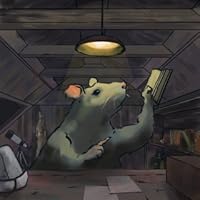
In a Steampunk Oxford, Ignatius and Indigo are both agents for the Union Jacks, a secret organisation. The role of the Union is to protect the British Empire, which is at the height of its powers, and help in its technological advances. They have discovered the existence of the mystical Book of Consciousness written by the creator of the cosmos, the genderless Omnisoul. The book is the history of everything that is, that has been and that will be. The agents are aided by Skye, who accidentally calls forth seven merciless immortals called the Charon.
Known as the Beautiful and the Damned, the Charon are the Infernal Dukes of Hell, created to carry out the will of the Omisoul. But they are tired of their immortality and want to end their existence. Elsewhere, the sorcerer Ragnar of Roc has conjured a hole in spacetime, allowing the draconic Elder God Calabi Ya to re-enter the cosmos from the Ghost Worlds. He is as old as the Omnisoul and wants the book to learn his destiny. The two Union Jacks leave Oxford and are taken on a journey across the cosmos in the great ship Taraka, which sails through space and time. Ignatius and Indigo are mere pawns in the cosmic ocean of fate, carried to fabled places, witness to bloody massacres, and half-willing conspirators in the Charon's plot to thwart the Omnisoul's plan and defeat the protectors of the Well at the Centre of Time.
Timeslayers is a science fiction book with an ambitious premise, blending: time travel, alternate realities and action. Despite its creative potential, it didn’t fully land for me. While there are some fun and inventive ideas here, the execution often felt uneven across some key areas.
CHARACTERS: The characters had interesting setups but lacked depth and emotional connection. I found it hard to get fully invested in their journeys, their personalities felt underdeveloped and inconsistent sometimes. The motivations weren’t always clearly explored and I struggled to care about their outcomes. With a concept this wild, I think stronger character work would’ve helped the story emotionally.
WORLD BUILDING: This is one of the more intriguing elements of the book. The idea of timelines being manipulated and the characters battling through them is such a strong concept. I can see the real imagination of the author here, different eras and twists on history. However, the world building often felt rushed or not fully explained to the reader. I would’ve liked more time spent clarifying the rules of time travel and giving each setting more details, instead of heavily repeating the same specific aspects again and again.
ACTION PLOT: The action is one of the most stronger elements in this book - fast, frequent and filled with imaginative ideas. Time jumping chaos. However, the stakes didn’t always feel clearly defined, which made it harder to care about the outcome.
PACING: The pacing was uneven. Some scenes moved too fast with major plot developments happening without enough build up to them. Other times, the plot dragged and lost focus. Gave the impression that the book was trying to do a lot in a short amount of pages.
WRITING: Colin Sephton’s writing is very straightforward, so at times it felt flat or overly functional (just explaining the mechanic of something very specific and straightforward). There were moments where the dialogue felt overly expositional, pulling me out of immersion. That said, some action scenes had good momentum and I could tell that the author is passionate about this story and this world.
FINAL THOUGHTS: Timeslayers is a bold and creative attempt at genre blending sci-fi, but for me it didn’t quite come together. With more development in the characters and a stronger grasp on pacing and emotional scenes, it could’ve been much more impactful. Still, I appreciate the ambition behind the concept (making my 2.5 a 3 on Goodreads).
I think this Debut is actually a good one (despite my rating). We have the information that this is the first book in a series, so I will definitely read the next one to see the improvement.
I received an advance review copy for free, and I am leaving this review voluntarily.
“There are only two types of being with such power - those who have no vested interest in the contents contained within the artefact, completely ignorant of its contents, of its worth, a rare being indeed; and those born of the Elder God! So, which are you?”
The Book of Consciousness is the book that everyone seems to want to get their hands on, some to make their existence better, some to make others’ existence worse. Ignatius and Indigo are just a couple of humans who stumble upon the reality of demons, gods, dragons and super-beings, and that maybe there really is something beyond the world in which we live.
Once you get past the world-building, who is who and what is what, Timeslayers is a fascinating, thought-provoking read. I actually read it twice, almost immediately. The first time to figure it all out, and the second time to settle down and enjoy the story. In my head, Ignatius and Indigo are a couple of strange eccentrics who just don’t want to be the same as anyone else, and they’re not, they’re really not! Indigo, in particular, has no qualms about killing or maiming anyone who crosses her and her newfound allies. While Ignatius is trying to work out how the universe works!
“Shadows are like doors. Doors to dark prisons.... You should never play in the shadows, you never know who... or what... may be there waiting to cross the threshold of that particular door!”
If you’re a fan of Terry Pratchett or of what the world might consist of outside of our planet, then I would recommend Timeslayers, the debut novel from Colin Sephton. I can’t wait to discover what happens in the next book in the series.
Thank you to Cinnabar Moth Publishing and Colin Sephton for the opportunity to read and review Timeslayers which is published on 7 May 2024.
This story had a lot of world building, which I enjoyed to some extent. It helped to understand how the author was envisioning the settings, as well as descriptions of the beings would look in those settings. However, I feel that there was more world building and visual character description than there was a story. As for what story there was, I constantly felt confused about what was going on. There were enough characters that it was easy to be confused about who was all present at what times, and there were times that I was getting characters confused with each other (and how they were relevant to the story). I didn't realize that there was a glossary until I reached the end of the book, and it did include characters & their relevance. There may have been a few spoilers in the glossary, but it definitely would have helped with my confusion. I think my confusion was in large part because it seemed like we were dropped in the middle of the story, and not given any context to help catch up with the events of the story.
I received an advance review copy for free, and I am leaving this review voluntarily.
One of my peeves is when an author drops the reader into a new, unfamiliar world with no background or context (see Gibson below in these observations, who unapologetically never gives any to the reader). That makes for a challenging read, which is not a problem if the story makes up for it. And then there are those stories that are almost all world-building.
This is me, but I found this one to be cumbersome. Example:
“When and how the mind begins to leave its trace upon the fabric of the cosmos is one of the great unknown mysteries. The whole cosmos is influenced by every thought, word and action of every individual life form within it. The unconscious mind is the untapped omnipresent power of the cosmos, with the power to forever change the cosmic tide. ”
That odd style of repeating words/phrases in successive sentences (cosmos, power) kept distracting me. Another example: “It was like a cross between an ironclad and a dirigible. Carvings covered its entire surface. It was a huge edifice, like a cross between a gothic cathedral and Art Nouveau organic forms, with magnificent arched stained-glass windows spires towering a hundred feet above. ”
“Like a cross between” twice? There was enough of that to bother me. Others may not take notice.
The two named protagonists in the description Ignatius and Indigo have surprisingly small roles until the last quarter of the book. I’m not sure what I was expecting, but it might have been along the lines of Eliza Braun and Wellington Books of Pip Ballantine and Tee Harris’s Perculiar Occurences novels.
I read a lot. I read books that I think I might like (that’s easy) and I also read books that I’m not sure about because sometimes I need to see a different perspective (less easy). That usually applies to nonfiction, but sometimes to fiction - took me 11 years to get through Neuromancer. I didn’t like Gibson’s style - really didn’t like it - but I evolved of sorts and after four other tries, finally made it through and the didn’t like it part was less. And, there are rare times when I read a book that I thought I’d like, but struggled to get through.
Unfortunately, this is one of those. And when I am faced with situations like this and find I am not the target audience, I try to think of who that could be. I’m not sure… maybe fans of Gene Wolfe, or Stephen Donaldson (I liked his first trilogy… though he got even more obfuscatory by the final quad of Covenant). My perceptions are of course, mine, and shouldn’t keep anyone from exploring this for themselves.
One helpful hint would do well to be disclosed up front: there is a glossary at the end (thank you for that) with admitted some story spoilers that is useful.
Another picked nit (a small one, if I’m allowed), I thought this a tad incongruous: from the glossary: “The Omnisoul is indescribable, eternal, omnipotent, omniscient and omnipresent, the only Truth and the First Cause.” But… the Omnisoul asks of Ignatius and Indigo “Are these Asura? An insult to my creation! They think themselves powerful superhumans, demigods or demons?” A flaw in the omniscience… it didn’t know something?
I am going to be frank: I did not enjoy this book. But, it isn't a complete waste, and I could see how a sequel or further work of this author could probably be quite good.
Starting off in a Steampunk/Occult re-imagining of Victorian Era Oxford, we find ourselves witness to a robbery gone wrong, only to have ourselves launched on an adventure across dimensions and realities, with a lot of high concepts being thrown around from page to page. In an interview on his publisher's Youtube chanel - Cinnabar Moth Publishing -, Sephton mentioned how one of his inspirations was seeing the mythological character of Thor being represented in various media, and this theme of figures of myth being imagined and re-imagined permeates the story. The setting itself is a neat idea, the plot itself is a neat idea. But there is a clunkiness to the execution which makes following the story more laborious than it needs to be.
The major obstacle to this being a good book is the author's tendency to over-explain things, often repeating the same idea three of four times in as many paragraphs. There were also a few passages were a lot of information was dumped on me, but without it adding anything necessary to the story at hand. Were he to have left more room for the reader to get their own idea of the characters and world presented, more show and less tell, I think I would have enjoyed this story so much more.
This novel started out very dark with some gore that I was not expecting and it almost turned me completely off but I am glad I kept reading. First note that there is a glossary at the end that explains a lot but I would suggest reading it when you are about 30-40% into the book and that will enlighten you about what is going on as well as give a description of all the characters involved. The glossary was a major help in deciphering the book plus throws in a lot of history too.
So we have Ignatius and indigo who are members of the Union Jacks who are trying to protect the British empire and they are looking for the Book of Consciousness. But someone they hired to steal the book (Skye) for them has an ulterior motive. Then the Charon show up who have been searching for the Book of Consciousness for a long time. They are immortal and are looking for a way to end their immortal lives since they are imprisoned by the Omnisoul and have very little life of their own. The Charon are not able to open the book themselves but find out quickly that Ignatius and Indigo can. The Book holds the answers to the fate of the Charon so the Charon are inclined to keep the humans alive. This is a very intriguing adventure. I received an advanced review copy for free am leaving a review voluntarily.
Timeslayers is the first volume of the Chronicles of the Charon series. I was really enthusiastic when I picked up the book. The story is set in an alternate version of Oxford and follows the story of two agents of a secret organisation that safeguards the British Empire. It deals with ancient books, secret libraries, time, space and knowledge. Overall, everything I love reading about. I had read series with a similar plot before so I was really invested when I started the book.
Unfortunately, while I think that it holds great potential and deals with a very interesting central idea, it fell a bit short of my expectations. I liked the idea of myths and legends from all around the world meshing but I felt like you had to actually have a knowledge of these things to comprehend the story. For an ebook format, the glossary at the end is not accessible and helpful enough. It led to me getting a bit lost and confused in the end. A lot of characters were introduced as well but the characterization itself was a little lacking to me.
I will still pick up volume 2 to see if I can learn more about the characters and this world and get rid of the confusion I felt when I finished the book, as the plot still holds great potential as I previously said.
I received an advance review copy for free, and I am leaving this review voluntarily.
Timeslayers is an ambitious leap that doesn't stick the landing.
I received a free ARC to review of Timeslayers. Sephton clearly has a strong interest towards deep world building and it shows in his work. I think for this novel, however, less would have been much much more. Timeslayers at times feels less like a cohesive story and more of a whirlwind tour through an immense universe that Sephton has certainly spent a great deal of time developing.
There are moments of beautiful prose throughout, but they crowded out by clunky dialogue, heavy exposition, confusing jumps in POV, and an uncomfortably overt Male Gaze-y approach to literally every female character in the book.
Overall I think Sephton has potential for solid creative writing, I just think a stronger focus on writing and reviewing vs worldbuilding is deeply needed.
For such a relatively short book, there is a lot of great world building. On the other hand, I didn't feel I really got to know the characters quite so much as I could have. There was a glossary at the end of the book, but I didn't realize it was there until after finishing. Including some of the details from the glossary might have given the characters a bit more depth when reading. Overall, I thought the storyline was intriguing.
I received an advance review copy for free and I am leaving this review voluntarily.
This is a really ambitious idea, sort of like Babel mixed with Hitchhiker’s Guide mixed with Stargate and Discworld.
I struggled with the concept to start with- it’s a really complex weave of world-building that feels a bit blurry, but it does come into focus as the story goes on. There’s also a handy glossary near the back that I wished I had known about before i started it.
The prose is good, a bit repetitive in places and definitely needed a better editor to polish it. But it’s certainly not bad and is vivid enough to paint the picture. Lots of nice descriptions that convey the mystical aspects.
The concepts in it are original enough. Book of Consciousness, the Charon, Elder Gods, the Omnisoul. All very nicely done.
It’s a decent read, but you’re going to need to like this sort of thing. I would say that it’s for those who enjoyed authors like Eoin Colfer (Artemis Fowl) and Philip Pullman (His Dark Materials) or films like Valerian and the City of 1000 Planets or Sky Captain and the World of Tomorrow.
Would I read more from this author? Yes Would I recommend this to a friend? Yes (if they like this sort of thing)
Timeslayers delivers a thrilling blend of steampunk adventure and cosmic fantasy. The richly crafted world of Union Jacks agents, immortals, and ancient gods feels vast yet intimate, with each twist pulling you deeper into its intrigue. A must-read for fans of imaginative, high-stakes storytelling.
From the streets of steampunk Oxford to the farthest reaches of space and time, Timeslayers is a whirlwind of action, mystery, and myth. Ignatius and Indigo’s journey with the Charon is as dangerous as it is fascinating, making this a gripping page-turner from start to finish.
Epic in scope and vivid in detail, Timeslayers fuses steampunk style with high fantasy and cosmic lore. The stakes are nothing less than the fate of existence itself, yet the story remains grounded through sharp character work and immersive settings.
With ancient gods, mystical books, and immortals seeking their own end, Timeslayers weaves a tale that’s both action-packed and philosophical. It challenges fate itself while delivering unforgettable worlds and characters. A fresh take on fantasy adventure.