

What do you think?

A Gravidade das Circunstâncias
A redescoberta de uma autora de culto e de um romance perturbador e fundamental da literatura austríaca do século xx.
Prémio Robert Walser
Prémio Franz Kafka
Entrega a partir de 18 de março de 2024.
Depois de anos a esforçar-se por se resignar à felicidade da maternidade e da vida doméstica, a tímida e distante Berta Faust, sempre com a cabeça algures a cismar e a duvidar, encontra-se internada na enfermaria número 66. Protegida do mundo exterior e dos outros, sobretudo da sua amiga Wilhelmine e do ex-marido Wilhelm, e da força de gravidade das circunstâncias, «da vida concreta, tal como ela é», Berta terá ainda de cumprir um último sacrifício para encontrar a paz e a absolvição do acto insano e desesperado que marcou o seu exílio definitivo da realidade.
Distinguida, ainda em manuscrito, com o prestigiado Prémio Robert Walser, A Gravidade das Circunstâncias é a fulgurante obra de estreia de Marianne Fritz, autora de culto, que marcou assim de forma indelével a literatura austríaca do século xx. Um romance inesquecível em que a tragédia se cruza com a sátira, a estranheza com o génio, para contar a história de uma mulher incapaz de lidar com a realidade e os seus horrores, lançando, ao mesmo tempo, uma sombra nos anos do pós-guerra e da Reconstrução da sociedade europeia.
Os elogios da críticas
«Uma história de terror que entra, silenciosa e paulatinamente, no coração da escuridão doméstica.»The New York Times
«Fritzganhou o Prémio Franz Kafka em 2001 e a sua obra, tal como a dele, é de uma profundidade perturbadora.»The Chicago Tribune
«Fritz surgiu, ao que parece, do nada para surpreender o mundo literário com a sua crónica de horror doméstico impiedosa, simples e bem elaborada, que demonstrava um equilíbrio aparentemente sem esforço entre humor e filosofia.»Times Literary Supplement
«A Gravidade das Circunstâncias é uma obra-prima de narrativa bem trabalhada, uma pequenajóia que mostra tudo o que pode (e deve) fazer, sem parecer que está a tentar.»Los Angeles Review of Books
«Um livro angustiante sobre os horrores da maternidade, dos ciúmes e dos traumas de guerra.»Kirkus Reviews
«Um monumento à literatura austríaca.»Télérama
Prémio Robert Walser
Prémio Franz Kafka
Entrega a partir de 18 de março de 2024.
Depois de anos a esforçar-se por se resignar à felicidade da maternidade e da vida doméstica, a tímida e distante Berta Faust, sempre com a cabeça algures a cismar e a duvidar, encontra-se internada na enfermaria número 66. Protegida do mundo exterior e dos outros, sobretudo da sua amiga Wilhelmine e do ex-marido Wilhelm, e da força de gravidade das circunstâncias, «da vida concreta, tal como ela é», Berta terá ainda de cumprir um último sacrifício para encontrar a paz e a absolvição do acto insano e desesperado que marcou o seu exílio definitivo da realidade.
Distinguida, ainda em manuscrito, com o prestigiado Prémio Robert Walser, A Gravidade das Circunstâncias é a fulgurante obra de estreia de Marianne Fritz, autora de culto, que marcou assim de forma indelével a literatura austríaca do século xx. Um romance inesquecível em que a tragédia se cruza com a sátira, a estranheza com o génio, para contar a história de uma mulher incapaz de lidar com a realidade e os seus horrores, lançando, ao mesmo tempo, uma sombra nos anos do pós-guerra e da Reconstrução da sociedade europeia.
Os elogios da críticas
«Uma história de terror que entra, silenciosa e paulatinamente, no coração da escuridão doméstica.»The New York Times
«Fritzganhou o Prémio Franz Kafka em 2001 e a sua obra, tal como a dele, é de uma profundidade perturbadora.»The Chicago Tribune
«Fritz surgiu, ao que parece, do nada para surpreender o mundo literário com a sua crónica de horror doméstico impiedosa, simples e bem elaborada, que demonstrava um equilíbrio aparentemente sem esforço entre humor e filosofia.»Times Literary Supplement
«A Gravidade das Circunstâncias é uma obra-prima de narrativa bem trabalhada, uma pequenajóia que mostra tudo o que pode (e deve) fazer, sem parecer que está a tentar.»Los Angeles Review of Books
«Um livro angustiante sobre os horrores da maternidade, dos ciúmes e dos traumas de guerra.»Kirkus Reviews
«Um monumento à literatura austríaca.»Télérama
136 pages, Kindle Edition
First published January 1, 1978
About the author
Marianne Fritz
8 books54 followersMarianne Fritz (1948–2007) was an Austrian novelist. Her first book, The Weight of Things, marked the beginning of an ambitious cycle of novels with the overarching title of Festung, or “The Fortress,” comprising Das Kind der Gewalt und die Sterne der Romani, Dessen Sprache du nicht verstehst, and the gargantuan Naturgemäß, the third volume of which she was preparing at the time of her death.
Ratings & Reviews
Friends & Following
Create a free account to discover what your friends think of this book!
Community Reviews
Displaying 1 - 30 of 191 reviews

February 9, 2021
"La gravedad de las circunstancias" es una novela diferente, incómoda, turbadora y brutal.
Berta, el gran personaje de la novela, es una mujer cuya respuesta más común a cualquier situación o pregunta que se le haga es "Bueno, bueno", aunque "las palabras que no pronunciaba solían proliferar en su cabeza con una intensidad tremenda." Rudolf, que en una sola ocasión, días antes de marchar a la guerra, la sedujo, define a Berta como una mujer cándida, más que un niño pequeño. “¡Me lo hice con un bebé!” le explica a su compañero de armas Wilhelm al que hace prometer que cuidará de ella si a él le pasara algo. Rudolf no vuelve vivo. De esa única relación nace un niño.
Wilhelm, dotado de una asombrosa capacidad para amoldar la sonrisa a lo que su interlocutor precisa, que “se lo creía todo y no se creía nada”, que era “el soñador por naturaleza que no soñaba”, que, “en pocas palabras: era un digno representante de su nación”, cumplió su promesa y se casó con la cándida Berta, se hizo cargo del hijo y juntos tuvieron otra hija. La gran amiga de Berta, curiosamente llamada Wilhelmine, mezquina, egoísta, rencorosa, vengativa y protagonista de los no pocos toques de humor corrosivo que tiene la novela, estaba convencida de que debería haber sido ella la elegida y no Berta.
Con estos mimbres se teje el drama terrible que se va construyendo en la vida de Berta, esposa complaciente y madre preocupada hasta la locura por el futuro de sus hijos.
"Tú crees que la locura no tiene su lógica. Y te equivocas de medio a medio. Todo tiene su lógica. Todo."Fritz, en esta su primera novela, ganadora del Premio Robert Walser en 1978, penetra a cuchillo en esa lógica y lo hace de forma tan desconcertante como eficaz. El discurso, no lineal, es exigente con el lector que tiene que poner mucho de su parte para no perderse en los continuos cambios temporales y de voces que se producen sin previo aviso, pero ¿cuándo la lógica de una locura ha sido algo sencillo de explicar? Su tono es enérgico, su ritmo ágil, su lenguaje austero y sutil, su desarrollo fragmentario y esquemático. El resultado es una novela desoladora, donde se alternan escenas conmovedoras con otras humorísticas, aunque no por ello menos estremecedoras, que reflejan de una forma despiadada las enfermizas relaciones que se establecen entre los personajes.
La vida real, la gravedad de las circunstancias, puede ser un peso insoportable.
“Las zarpas de la vida que modelan y dejan marcas; la garra que aplasta, aprieta y presiona; la gravedad de las circunstancias, la vida real, nada de eso puede afectarla cuando duerme. Así de simple. El sueño lo ahuyenta todo. Todas las personas y todas las cosas“.

February 7, 2021
Here is my advice. Set aside an hour or two, perhaps on a snowy and cold February Sunday, as I did, make a large, hot, black coffee, and read this in one sitting.

June 29, 2020
Şeylerin Ağırlığı... Gül Gürtunca çevirisiyle 2023 yılında
yayınlarımız arasında olacak.
yayınlarımız arasında olacak.

August 11, 2017
This is one of my reads for #womenintranslation month from the Dorothy Project pile I have at home. The horror of this book snuck up on me and I almost felt trapped by the described events - for some time as a reader I was navigating Wilhelm vs. Wilhelmina, and the two Berthas, the children and what seemed like two marriages. It is clear that war plays a part. But then there is this moment where everything clicks into focus, and I knew more than I wanted to, and I can't remember the last time I had that kind of moment with a book. It was very unnerving. I am curious about the novelist herself, since this book is said to be her only "translatable" title according to notes from the translator.

May 5, 2024
3,5*
When she’s asleep, you know, she’s not caught up in the world, so concerned with the surface of things. The stamping and the molding hands of life, the rolling, pressing and flattening fingers –the weight of things, life as such, it can’t hurt her as long as she’s asleep.
“A Gravidade das Circunstâncias” não era o livro que queria ter terminado no Dia da Mãe, mas ou ando muito despistada ou nada neste livro apontava para um desfecho destes. Este é mais um daqueles livros bizarros que juntaria a “Divórcio”de Susan Taubes e “Mrs. Caliban” de Rachel Ingalls, todos louvados como obras de genialidade feminina esquecidas ou subvalorizadas aquando da sua publicação e com os quais realmente me debato. Pessoalmente, considero-o uma farsa sobre a Áustria do pós-guerra, com personagens não de carne e osso mas como símbolos de um determinado zeitgeist…
He believed all and nothing, doubted all and nothing, was born a dreamer who never dreamed. In a nutshell: he was a worthy representative of his nation.
…em que Berta, Wilhelm e Wilhelmine parecem representar em vez de viver, substituindo os diálogos por falas que incluem mantras que repetem constantemente: Berta com os seus “pois, pois” e Wilhelm com os seus “ses” e “mas”.
“A Gravidade das Circunstâncias” cruza várias linhas cronológicas, a de 1945 em que Whilhem se casa com Berta, a ex-namorada do amigo morto em combate; a de 1963 quando ele já celebra o terceiro aniversário de casamento com a segunda mulher, Wilhelmine; e a de 1958, em que a pantomima que parece marcá-las sofre uma viragem macabramente trágica, quando Berta, assoberbada e sozinha face a dois filhos com dificuldades de aprendizagem, decide fazer uma pausa.
After the singing hour they joked and played around. There was no homework, no Fs, no letters home, no black-and-blue marks on their bodies from fighting or gymnastics, no jabs and no jeers, no “ifs” and “buts”, no “on-the-one-hands” or “on-the-others” and no warnings about behaving better and minding their manners.
Depois de ter sido agraciada com o Prémio Robert Walser, Marianne Fritz embarcou num projecto que implicava um ciclo de romances, um das quais com 3 mil páginas num estilo que ninguém conseguiu ainda traduzir, que afinal ficou por concluir devido à sua morte. “A Gravidade das Circunstâncias” é, no entanto, apenas uma novela, mas pela sua peculiaridade e pela sua reflexão sobre “a ferida da vida” exige uma certa disponibilidade mental e até temporal para ser lida num curto período.
You clearly think madness has no logic. But that’s a decisive misapprehension! Everything has its logic. Everything, understand?
When she’s asleep, you know, she’s not caught up in the world, so concerned with the surface of things. The stamping and the molding hands of life, the rolling, pressing and flattening fingers –the weight of things, life as such, it can’t hurt her as long as she’s asleep.
“A Gravidade das Circunstâncias” não era o livro que queria ter terminado no Dia da Mãe, mas ou ando muito despistada ou nada neste livro apontava para um desfecho destes. Este é mais um daqueles livros bizarros que juntaria a “Divórcio”de Susan Taubes e “Mrs. Caliban” de Rachel Ingalls, todos louvados como obras de genialidade feminina esquecidas ou subvalorizadas aquando da sua publicação e com os quais realmente me debato. Pessoalmente, considero-o uma farsa sobre a Áustria do pós-guerra, com personagens não de carne e osso mas como símbolos de um determinado zeitgeist…
He believed all and nothing, doubted all and nothing, was born a dreamer who never dreamed. In a nutshell: he was a worthy representative of his nation.
…em que Berta, Wilhelm e Wilhelmine parecem representar em vez de viver, substituindo os diálogos por falas que incluem mantras que repetem constantemente: Berta com os seus “pois, pois” e Wilhelm com os seus “ses” e “mas”.
“A Gravidade das Circunstâncias” cruza várias linhas cronológicas, a de 1945 em que Whilhem se casa com Berta, a ex-namorada do amigo morto em combate; a de 1963 quando ele já celebra o terceiro aniversário de casamento com a segunda mulher, Wilhelmine; e a de 1958, em que a pantomima que parece marcá-las sofre uma viragem macabramente trágica, quando Berta, assoberbada e sozinha face a dois filhos com dificuldades de aprendizagem, decide fazer uma pausa.
After the singing hour they joked and played around. There was no homework, no Fs, no letters home, no black-and-blue marks on their bodies from fighting or gymnastics, no jabs and no jeers, no “ifs” and “buts”, no “on-the-one-hands” or “on-the-others” and no warnings about behaving better and minding their manners.
Depois de ter sido agraciada com o Prémio Robert Walser, Marianne Fritz embarcou num projecto que implicava um ciclo de romances, um das quais com 3 mil páginas num estilo que ninguém conseguiu ainda traduzir, que afinal ficou por concluir devido à sua morte. “A Gravidade das Circunstâncias” é, no entanto, apenas uma novela, mas pela sua peculiaridade e pela sua reflexão sobre “a ferida da vida” exige uma certa disponibilidade mental e até temporal para ser lida num curto período.
You clearly think madness has no logic. But that’s a decisive misapprehension! Everything has its logic. Everything, understand?

December 14, 2016
Lordy lord. A brilliant, dark, and darkly funny book that I wish was only fiction. It's so sweetly harsh. So killing-you-softly-with-its-song till your soft-serve body leaks out of its cone and soils your only pair of good pants. So fatally resonant to 1945 and also 1914 and also 2016. The ills are silently around us, seemingly benevolent, permeating the earth in which each worm crawls as it is supposed to do. Just following the inevitable narrative as we are supposed to do. We think all things will continue the way they have, but stories gain momentum and tell themselves. When a wave swells past a certain point, there is no stopping it. Our ears are tuned to the increasing frequency as if it's just a matter of degrees, when it's a categorically diffent sound altogether. I don't even know if I'm reviewing this book right now or if the fears that have haunted my nights for the past month, the darkness that is a tangible taste in my dried out mouth and a screw in my stomach, has taken over. This is a deathsong, babies. This is a repeating motif, a refrain sung almost without effort. Go to sleep now, sweet ones.

January 22, 2016
One of those books whose word count belies its depth. Plot materializes like a squid undulating in its own inky emissions. Definitely hoping more Fritz appears in English translation.

August 2, 2023
4.5/5
Şeylerin Ağırlığı kısa ama zor bir roman. İçine girmesi zor, duygusundan çıkması daha zor. Savaşın insanlar üzerinde bıraktığı hasarı annelik ve akıl sağlığı üzerinden ele alıyor yazar. Güçlü anlatımıyla az malzemeyle çok şey hissettirmeyi başarıyor. Başlarda evrene dahil olmakta biraz zorlandım ama sonra her şey yerli yerine oturuyor. Kitabın sürprizlerini kaçırmamak için detaya giremiyorum ama şunu rahatlıkla söyleyebilirim ki hikayenin attığı yumruk çok sert, acısı hemen geçecek türden bir yumruk değil. Çok etkileyici.
Şeylerin Ağırlığı kısa ama zor bir roman. İçine girmesi zor, duygusundan çıkması daha zor. Savaşın insanlar üzerinde bıraktığı hasarı annelik ve akıl sağlığı üzerinden ele alıyor yazar. Güçlü anlatımıyla az malzemeyle çok şey hissettirmeyi başarıyor. Başlarda evrene dahil olmakta biraz zorlandım ama sonra her şey yerli yerine oturuyor. Kitabın sürprizlerini kaçırmamak için detaya giremiyorum ama şunu rahatlıkla söyleyebilirim ki hikayenin attığı yumruk çok sert, acısı hemen geçecek türden bir yumruk değil. Çok etkileyici.

June 6, 2016
Life is a wound, and this wound...this wound is slow to heal
There is more than what meets the eye in every word of this book. A blow and a gush of blood about to happen behind every other sentence, double meanings in names, surnames, musical references, streetnames, city names and numbers. The translation is powerful and yet it makes me wish I had listened to my best friend and joined her in learning German while I was studying Spanish instead, so many years ago. I believe the original text would read even bleaker and angrier, with this constant undertone of amused fatality, a dry humour that only makes the descent into madness more absurd and inevitable. Everything is so light, everything is so increasingly dreadful and sickly dark. The private horror of the people small, apparently normal lives runs parallel with the war horrors never reconciled of a whole nation (Austria) that seem to prefer a dreamy obliviousness to true healing or taking of responsibility . The cynical critique of society and its class system, of whom is considered superior and why, emerges from observations of the weakness and lack of backbone of certain people and the lack of interest of those who should care.
Life, so says the wise, appears incurable
Nobody is safe and nothing stays sacred for long. Most of the characters of The Weight of Things are confronted and smashed to pieces by historical events they can't change nor control. Yet their vicissitudes are just as meaningul as big war events. The only figure who attempts to control everything and everyone in pure self-serving interest is despicable Wilhelmine. A soulless, soulcrashing, envious character who won't hesitate to emotionally blackmail a mental patient to get what she wants, what she thinks she deserves. Wilhelm, so obsessed with serving important people and avoid conflict, ends up being meek and lacking true moral fiber, a man without real qualities, trying to be as normal and average as he can. Berta, everyone's scapegoat, verbally abused even by her own children, left alone till she sinks in a pure psychotic episode, is a compelling victim turned unaware-evil. Even if I saw what was about to come and it tore my insides, I could not stop feeling for her. She becomes sick, in a sick, delusional world. All her life desperately looking for insight, for a grasp of who she should be and how to live, the weight of life and its molding fingers an unbearable partner of her every breath.
Bring word of life, and you bring pain. Bring word of death, and you bring deliverance
Marianne Fritz following, colossal, unconventional, unpublishable body of work speaks for itself. I am now very eager to read it, if it's even possible. This first novel is silence and desperate scream, dry philosophy, furious gloom. With its fragmented timeline, devastating dream sequences, pitiless vignettes of intellectual snobs, power-hungry and self-invested mental patients and awkward children, the little room left for love and grace results equally unbelievable and a respite. There is no redemption in sight for anyone. Just pain or its avoidance. Duty that bears no gifts. A desire to protect that ends up destroying the intended beneficiary like Cronus ate his children.

March 5, 2024
Çok çarpıcı, bir o kadar da zor bir kısa roman. Yazarın dili alışılmışın dışında, kurgusu da. Savaşın psikolojik yıkımını çok sert bir anlatıyla aktarıyor Marianne Fritz. Şeylerin ağırlığını hissediyorsunuz, bu ağırlığın hayat yarası açan yaşamın kendisi olduğunu şansız Berta ve sorunlu iki yavrusu ile savaşta ölen kocasının arkadaşı Wilhelm üzerinden anlıyorsunuz.
İsimlerin akıl karıştırması ve ilk 20-30 sayfada odaklanma sorunu bu kısacık romanı hacimce büyütüyor. Neyse ki çok zor metne rağmen çeviri çok iyi. Arka kapakta yazdığı gibi “parçalanmış zihinlere” ayna tutan “parçalanmış anlatımlar”. Zor ama kısa bu novellayı listenize alın lütfen.
İsimlerin akıl karıştırması ve ilk 20-30 sayfada odaklanma sorunu bu kısacık romanı hacimce büyütüyor. Neyse ki çok zor metne rağmen çeviri çok iyi. Arka kapakta yazdığı gibi “parçalanmış zihinlere” ayna tutan “parçalanmış anlatımlar”. Zor ama kısa bu novellayı listenize alın lütfen.

January 22, 2016
A story that comes out of the shadows and descends resolutely back into them until it is swallowed up entirely. It emerges from the gloom of gaps and omissions, in a loosely outlined narrative stretched across three decades. For a while we are held in suspension of anticipation and uncertainty before new darkness cover the pages, these cast by each new detail added into storyline, bit by bit, until, filled with details, the book becomes a yawning black void. It's a slow creep of a seemingly nameless and sourceless dread, but Marianne Fritz's success is that this feels not like an arbitrary literary or plot mechanism, but like something more essential and real than the story that rises inexorably out of it before being submerged once again.
This was Fritz's first novel in 1978, inaugurating thirty years of sustained determined work on a single monolithic project into the debris of the 20th century, The Fortress. Later pages begin to look like this:
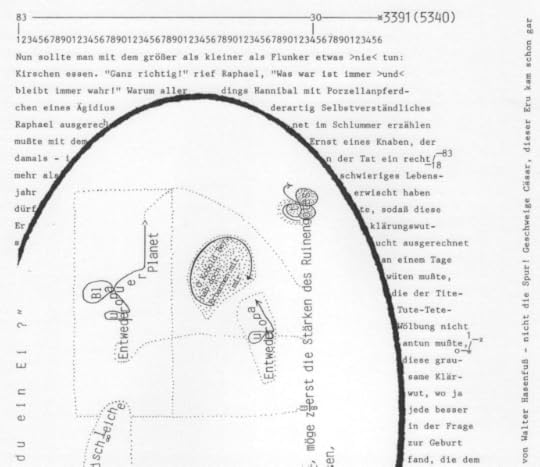
(which you can see more of here: http://www.mariannefritz.at/)
This was Fritz's first novel in 1978, inaugurating thirty years of sustained determined work on a single monolithic project into the debris of the 20th century, The Fortress. Later pages begin to look like this:
(which you can see more of here: http://www.mariannefritz.at/)

April 7, 2025
Fiquei muito indecisa sobre este pequeno livro. O estilo não me conquistou, mas a história, de loucura e dor infinita, é interessante.
Marianne Fritz tem um estilo que vai desde a comédia ao terror passando pelo romance e pelo meio brinca com algumas palavras dando-lhes outros sentidos.
Wilhelmine é casada com Wilhelm, que já foi casado com Berta, que teve um filho com Rudolf, que era amigo de Wilhelm…nunca um início com tão poucas personagens foi tão complicado de interiorizar.
Não gostei particularmente de nenhuma personagem. Wilhelmine é uma cabra, Wilhelm um paspalho e até Rudolf, que aparece em poucas páginas, é desagradável. Berta é uma daquelas personagens por quem sentimos alguma compaixão, mas acaba isso desaparece quando ela faz algo que é horrível.
E o que é a Gravidade das Circunstâncias? É a vida, tal como ela é.
89/198 – Áustria

Marianne Fritz tem um estilo que vai desde a comédia ao terror passando pelo romance e pelo meio brinca com algumas palavras dando-lhes outros sentidos.
Wilhelmine é casada com Wilhelm, que já foi casado com Berta, que teve um filho com Rudolf, que era amigo de Wilhelm…nunca um início com tão poucas personagens foi tão complicado de interiorizar.
Não gostei particularmente de nenhuma personagem. Wilhelmine é uma cabra, Wilhelm um paspalho e até Rudolf, que aparece em poucas páginas, é desagradável. Berta é uma daquelas personagens por quem sentimos alguma compaixão, mas acaba isso desaparece quando ela faz algo que é horrível.
E o que é a Gravidade das Circunstâncias? É a vida, tal como ela é.
89/198 – Áustria

September 2, 2015
I reviewed this for the Chicago Tribune:
Typically beautiful things — love, friendship, a mother's concern for her children — take on terrible associations, and terrible things — war, death, mental illness — become ultra-terrible in "The Weight of Things" by the Austrian writer Marianne Fritz, who was born in 1948 and died in 2007, and who sought no less than to understand "the disaster of Western civilization."
The novel, brilliantly translated by Adrian Nathan West, is being promoted as "the first book, and the first translated book, and very possibly the only translatable book by its author." This compact and stylized work won the Robert Walser Prize in 1978, after which Fritz dedicated herself to a 10,000-page undertaking entitled "The Fortress," which proved so diagrammatic and non-linear that her "her proofreader gave up after a thousand pages" and her publisher had no choice but to print copies directly from her original typescript.
"The Weight of Things" is extreme in the opposite direction, tiny and dense with a count of just 127 small and generously margined pages, cohering into a morally forceful and scathing look at the relationship of national identity and history — particularly in a country that participated in Nazism — to personal responsibility and memory. Each page flows with an undercurrent of creeping dread, even when the events are absurd, as when Wilhelmine, the cleaning lady and false friend to the tragic protagonist Berta Faust — who lives in the ominously numbered Building 13 on Allerseelengasse in Donaublau — refers to Berta repeatedly by the cruel, pseudo-affectionate (but sadly, not inappropriate) nickname "my little catastrophe."
The book hopscotches through time, moving from the close of World War II to 1963, when we see Berta at the asylum to which she has been involuntarily committed, where she receives an unpleasant visit from her former husband, Wilhelm, and his new wife, the scheming Wilhelmine.
As Fritz unfurls the story's tragi-farcical arc, one of the beautiful things that takes on a terrible resonance is "The Blue Danube," the celebrated waltz by the Austrian composer Johann Strauss II. Rudolf, a music teacher, deflowers the willing and ignorant Berta on one of his leaves from the front. Recounting it to his fellow soldier, Wilhelm, he despairs that the incident — which results in his impregnating her with a child he will not live to see — took place "just because I played her (...) the 'Blue Danube!' (...) Do you get it? 'The Blue Danube': Strauss, of all things."
The book itself is like piece of music, repeating and circling back with leitmotifs and refrains. Berta is frequently characterized as "a-man-a-word-and-then-you're-lost," for instance, and in the asylum, the Wise Little Mother refers over and over again to the fact that "Life is a wound."
But the novel resembles nothing so pretty as a waltz. The atmosphere Fritz evokes feels like a fugue, both in the sense of a contrapuntal composition in which a short melody is introduced and successively taken up by others, and in the sense of a state of loss of awareness of one's identity.
Fritz depicts most of her characters as wanting merely, as Wilhelm does, to be "consoled by the thought that there was, after all, far more to the world than an average citizen like himself could ever imagine." She peoples her tale with characters lacking in accountability and engaging in a willful suppression of self-reflection.
Heartbreakingly, Berta's desire to be less superficial results in her undoing, for in "her yearning for an ideal, her wish to shelter (her children) Little Berta and Rudolf from the weight of things" she commits her most grievous and irrecoverable act. Complexly, though, Fritz suggests that through this ordeal, Berta achieves a bizarre (and probably Pyrrhic) victory: "The inwardness she had struggled for, tirelessly and to no purpose, now suffused her face, and it would never leave her thereafter."
Fritz won the Kafka Prize in 2001 and her work, like his, is both deeply upsetting and profound. Her translator writes in his "Afterword" that "there is a class of artists whose work is so strange and extraordinary that it eschews all gradations of the good and the mediocre: genius and madness are the only descriptors adequate to its scale," and he situates Fritz quite forcefully in this class. He seems to be correct.
Typically beautiful things — love, friendship, a mother's concern for her children — take on terrible associations, and terrible things — war, death, mental illness — become ultra-terrible in "The Weight of Things" by the Austrian writer Marianne Fritz, who was born in 1948 and died in 2007, and who sought no less than to understand "the disaster of Western civilization."
The novel, brilliantly translated by Adrian Nathan West, is being promoted as "the first book, and the first translated book, and very possibly the only translatable book by its author." This compact and stylized work won the Robert Walser Prize in 1978, after which Fritz dedicated herself to a 10,000-page undertaking entitled "The Fortress," which proved so diagrammatic and non-linear that her "her proofreader gave up after a thousand pages" and her publisher had no choice but to print copies directly from her original typescript.
"The Weight of Things" is extreme in the opposite direction, tiny and dense with a count of just 127 small and generously margined pages, cohering into a morally forceful and scathing look at the relationship of national identity and history — particularly in a country that participated in Nazism — to personal responsibility and memory. Each page flows with an undercurrent of creeping dread, even when the events are absurd, as when Wilhelmine, the cleaning lady and false friend to the tragic protagonist Berta Faust — who lives in the ominously numbered Building 13 on Allerseelengasse in Donaublau — refers to Berta repeatedly by the cruel, pseudo-affectionate (but sadly, not inappropriate) nickname "my little catastrophe."
The book hopscotches through time, moving from the close of World War II to 1963, when we see Berta at the asylum to which she has been involuntarily committed, where she receives an unpleasant visit from her former husband, Wilhelm, and his new wife, the scheming Wilhelmine.
As Fritz unfurls the story's tragi-farcical arc, one of the beautiful things that takes on a terrible resonance is "The Blue Danube," the celebrated waltz by the Austrian composer Johann Strauss II. Rudolf, a music teacher, deflowers the willing and ignorant Berta on one of his leaves from the front. Recounting it to his fellow soldier, Wilhelm, he despairs that the incident — which results in his impregnating her with a child he will not live to see — took place "just because I played her (...) the 'Blue Danube!' (...) Do you get it? 'The Blue Danube': Strauss, of all things."
The book itself is like piece of music, repeating and circling back with leitmotifs and refrains. Berta is frequently characterized as "a-man-a-word-and-then-you're-lost," for instance, and in the asylum, the Wise Little Mother refers over and over again to the fact that "Life is a wound."
But the novel resembles nothing so pretty as a waltz. The atmosphere Fritz evokes feels like a fugue, both in the sense of a contrapuntal composition in which a short melody is introduced and successively taken up by others, and in the sense of a state of loss of awareness of one's identity.
Fritz depicts most of her characters as wanting merely, as Wilhelm does, to be "consoled by the thought that there was, after all, far more to the world than an average citizen like himself could ever imagine." She peoples her tale with characters lacking in accountability and engaging in a willful suppression of self-reflection.
Heartbreakingly, Berta's desire to be less superficial results in her undoing, for in "her yearning for an ideal, her wish to shelter (her children) Little Berta and Rudolf from the weight of things" she commits her most grievous and irrecoverable act. Complexly, though, Fritz suggests that through this ordeal, Berta achieves a bizarre (and probably Pyrrhic) victory: "The inwardness she had struggled for, tirelessly and to no purpose, now suffused her face, and it would never leave her thereafter."
Fritz won the Kafka Prize in 2001 and her work, like his, is both deeply upsetting and profound. Her translator writes in his "Afterword" that "there is a class of artists whose work is so strange and extraordinary that it eschews all gradations of the good and the mediocre: genius and madness are the only descriptors adequate to its scale," and he situates Fritz quite forcefully in this class. He seems to be correct.

May 15, 2024
https://kansasbooks.blogspot.com/2024...
"¿Quedaba rastro de la nostalgia y del silencio punzante?"
No recuerdo ahora mismo cómo he llegado hasta la autora austriaca Marianne Fritz, puede que fuera a través del Dorothyproject, que es una editorial americana que la ha visibilizado después de no sé cuantos años de permanecer enterrada. La han visibilizado en inglés, porque sus obras son imposibles de conseguir ni siquiera en alemán, su idioma original, aunque cuando esta novela se publicó en su momento en 1978 incluso ganó premios. Pero lo cierto es que ahora mismo, ésta es la única novela de Marianne Fritz a la que hay acceso, y tenemos la suerte de que Alpha Decay la trajo a España en su momento. Lo incongruente de este asunto es que las obras de Marianne Fritz son imposibles de conseguirse ni en su idioma original, el alemán. La publicación de esta novela marcó el comienzo de un proyecto masivo de varios volúmenes denominado Die Festung (La Fortaleza) de la que La Gravedad de las Circunstancias fue la primera de la serie. Este proyecto se basó en la historia de la Primera y Segunda República de Austria. Marianne Fritz trabajaría en este proyecto el resto de su vida. Publicó su segunda novela en 1980 como Das Kind der Gewalt und die Sterne der Romani (El niño de la violencia y las estrellas de los romaníes) pero después del éxito de la novela que me ocupa, esta segunda fue un rotundo fracaso. Y ahora después de haber terminado La gravedad de las circunstancias, confieso que daría la mitad de mi biblioteca por echarle la zarpa a esta segunda novela de la serie: Das Kind der Gewalt und die Sterne der Romani (El niño de la violencia y las estrellas de los romaníes), pero me temo que por ahora es imposible de conseguir en ningún idioma.
“Tienes que acordarte de lo que te voy a decir. Tienes que mirar a Berta con mis ojos: si no, no la vas a entender.”
Esta es una novela de la que lo mejor es no contar mucho del argumento porque al ser una narrativa fragmentada, se va desvelando poco a poco. Sí es verdad que en un principio me costó ubicarme porque no sabía realmente quiénes eran Berta Faust o Wilhelm o Wilhelmina... hay una continua repetición en los nombres, porque Berta empieza siendo Berta Faust y más adelante se convertirá en Berta Schrei por matrimonio y cuesta entrar, además de que este apellido Schrei será compartido por casi todos los personajes en esta novela; otro lio para mi era el hecho de que no sabía dónde y en qué tiempo estaban situados los personajes, si en el presente o en el pasado en forma de flashbacks y porque parecía que de alguna forma Marianne Fritz enfrentaba al lector con pequeñas postales desconectadas unas de otras, pero ya digo que poco a poco la autora iba colocando la historia en su sitio a base de capítulos cortísimos y titulándolos simplemente por una frase dentro de ese capítulo como por ejemplo:
"¿No es cierto que la vida es un sueño terrible?
Tan espectrales e irreales como los años de la guerra
Un Hombre, una Palabra, y estás perdida."
Otro detalle significativo es el hecho de que muchos nombres de personas y lugares en esta novela tienen una doble lectura, por ejemplo el apellido de soltera de Berta, Faust, se puede traducir por puño además de la connotación goethiana, y su apellido de casada, Schrei significa grito o llanto en alemán, lo que aumenta la atmósfera de claustrofobia y terror doméstico en la que se va convirtiendo esta novela porque cuando por ejemple se dice en algún momento “En la casa de los Schrei…” por muy calmada que esté en ese momento la atmósfera familiar, ya ha calado en el lector… Marianne Fritz establece una historia con cuatro personajes básicamente: una joven llamada Berta, Wilhelm, la amiga de Berta, Wilhelmina y Rudolf, el primer amor de Berta que muere en la guerra en 1945. La novela transcurre entre 1945 y 1963 y continuamente va saltando en el tiempo, presente, pasado, vuelta al presente… Marianne Fritz juega continuamente con la repetición, no solo de los nombres, sino de los números, de las fechas, y sobre todo de ciertas palabras...
"Es interioridad. Lo que me falta es interioridad. Soy demasiado superficial, tiendo demasiado al exterior", se recriminaba Berta a menudo, y se afanaba de buena fe en desarrollar eso que se le resistía una y otra vez: una mirada dirigida al interior."
Berta, el centro neurálgico de esta novela, es una mujer frágil que se referirá a la vida real como la gravedad de las circunstancias, una especie de metáfora de lo que significa para ella la imposibilidad de gestionar ciertos hechos que han sucedido en su vida. Se deja llevar en su ingenuidad sin embargo las consecuencias de la guerra la han dejado profundamente marcada “Si las zarpas de la vida modelan y dejan marcas, ¿por qué no presentaba ella la más minima señal?” y quizás en su ingenuidad no es consciente de que la vida la ha dejado marcada y que emocionalmente las señales son muy evidentes para los demás una vez emprendida su vida doméstica, pero los pequeños hechos que se van sucediendo, la forma en la que Marianne Fritz nos la describe en su vida matrimonial, con sus hijos, ya se nos hace evidente que para Berta, la vida real no existe. Está obsesionada con el hecho de que no vive para dentro de sí misma, sino solo de cara al exterior pero quizás esa creencia le viene de la presión social y familiar con la que se ve obligada a vivir. Es tanta la presión, el ahogo doméstico, que solo se libera en sueños:
“Cuando duerme, no es tan superficial, no tiende tanto al exterior. Las zarpas de la vida modelan y dejan marcas; la garra que aplasta, aprieta y presiona; la gravedad de las circunstancias, la vida real, nada de eso puede afectarla cuando duerme. Es así de simple. El sueño lo ahuyenta todo.”
Me resulta muy complicado hacer una reseña mínimamente decente si quiero obviar el argumento de esta pequeña gran novela, que me ha descubierto a una autora a la que me encantaría seguir leyendo pero que me va a resultar imposible porque no hay nada más a lo que agarrarse. Me ha fascinado la narración no solo fragmentada, sino totalmente rota y casi caótica dentro de su orden, porque lo que pretende es reflejar es ese desorden, esa farsa de una sociedad que venía de vivir un horror e intentaba conservar las apariencias. La toxicidad del personaje de Wilhelmina, por ejemplo o la pasividad de Wilhelm Schrei, no dejan de reafirmar esta atmósfera desoladora de ese periodo en la historia.
“Berta Schrei, que consideraba que lo sueños hacían referencia a la vida real y que por tanto, había que tenerlos en consideración, estaba tumbada en la cama boca arriba, con la mirada dirigida a la ventana, decidió que era mejor pasar el resto de la noche en vela.”
La gracia puede que esté también en que Marianne Fritz no traza a sus personajes con profundidad psicológica, ni siquiera con profundidad emocional, todo funciona como una especie de sátira naif, en la que la mayoría de la información se va revelando gradualmente y en la que ellos se mueven como fantasmas. Es una novela corta que me podía haber leído en una tarde, o en dos tacadas y sin embargo, me he visto releyendo capítulos, párrafos, avanzando y retrocediendo continuamente. La he disfrutado muchísimo porque al mismo tiempo que me ha parecido una novela de terror por esa atmósfera de ahogo de una mujer a la que le resulta imposible liberarse de la garra que la aplasta y la aprieta que es la vida real, al mismo tiempo es sorprendente como va impactando. Parece una narrativa sencilla, simple, y sin embargo, Marianne Fritz consigue lo más difícil: calar y que la historia se quede, yo creo que ya para siempre. Durante la narración se repiten continuamente las palabras vida, sueño y heridas. Indescriptible Marianne Fritz, y única.
“- La vida es esperanza y la esperanza es una herida. No cabe la menor duda. [...] ¿No lo sabe? ¿Cómo? ¿No sabe que la esperanza es una herida? Entonces, ¿qué es lo que sabe?”
♫♫♫ One of these mornings - Moby♫♫♫

February 26, 2021
The most alive and affecting moment in this for me was the Thomas Bernhard quotation in the translator's afterward that ends with our always affable Austrian friend calling Fritz's 3000+ page masterwork "a fatuous vulgarity." I felt like Bernhard's strong words for his fellow Austrian's life work justified my tepid at best response to this, apparently the author's only publishable/translated book. The writing just seemed wafted. No characterization, lots of exclamation points! One clear page on which the mother weeps for her daughter being placed in a special school (relatable for me). Otherwise, the weight of things and ideas as such didn't make much of an impression on me. It's not because this is subtle writing. It doesn't feel careful or precise enough for that. Never a huge fan of not being sure if what I'm reading is reality or a dream, for example. Or pairs of characters with the same name. At least it's short. Would love to read a novella-length description of the 3000+ page "fatuous vulgarity."

April 14, 2017
What a nightmare. To think this little book could be the seed of an entire literary universe we monolingual knuckle-draggers may never have access to... Many worlds, many wounds.

April 19, 2024
A história de Berta, uma mulher que anda com a cabeça sempre algures "a cismar e a duvidar", do seu ex-marido Wilhelm - um chaffeur impecável, e da sua "melhor amiga", Wilhelmine. Wilhelm e Wilhelmine acabam por casar, Berta está internada numa enfermaria psiquiátrica. Tudo isto na Áustria do pós- Segunda Guerra.
Sabem quando um livro é estranho e vocês ficam "hmmmm conta-me mais 🤔"? É assim que este livro nos faz sentir.
Para já, posso começar por afirmar que adoro esta capa e adoro o título. Quando percebemos o que Marianne Fritz quer dizer com "a gravidade das circunstâncias" ficamos até meio abananados, aceitar "a vida concreta, tal como ela é".
Não quero desvendar muito sobre o enredo porque este é daqueles livros que o melhor é partir à descoberta, sem se saber absolutamente nada.
"A gravidade das circunstâncias" é um livro estranho, esquisito até. Terminei-o sem saber bem o que tinha achado, com a sensação de que a autora é genial, mas eu é que não consegui atingir o patamar. Ou seja, entendo o propósito de Marianne Fritz, mas tenho a certeza que não o compreendi totalmente.
Tem muitas referências bíblicas, muitos jogos de palavras que farão sentido no original, mas que é difícil de traduzir. Por falar em tradução, louvo o trabalho do tradutor Paulo Rêgo e das notas de tradução no final do livro, que ajudam a compreender melhor a genialidade da autora.
"A gravidade das circunstâncias" é um livro diferente de tudo o que anda por aí, um livro sem um objectivo concreto, um livro que não deixa o leitor indiferente.
É um livro silencioso, sombrio, perturbador, um retrato de uma escuridão que não estou habituada a ler.
Na badana desta edição, está escrito que este livro "marcaria o início de um ambicioso projecto literário, com mais de dez mil páginas, ao qual Marianne Fritz dedicou toda a sua vida, afastando-se progressivamente de todo o contacto social". Eu não sei quanto a vocês, mas eu fiquei logo fã da senhora. Fiquei também muito intrigada e, devo dizer, depois de terminada a leitura, que continuo assim 😅
"Pois, pois..."
Sabem quando um livro é estranho e vocês ficam "hmmmm conta-me mais 🤔"? É assim que este livro nos faz sentir.
Para já, posso começar por afirmar que adoro esta capa e adoro o título. Quando percebemos o que Marianne Fritz quer dizer com "a gravidade das circunstâncias" ficamos até meio abananados, aceitar "a vida concreta, tal como ela é".
Não quero desvendar muito sobre o enredo porque este é daqueles livros que o melhor é partir à descoberta, sem se saber absolutamente nada.
"A gravidade das circunstâncias" é um livro estranho, esquisito até. Terminei-o sem saber bem o que tinha achado, com a sensação de que a autora é genial, mas eu é que não consegui atingir o patamar. Ou seja, entendo o propósito de Marianne Fritz, mas tenho a certeza que não o compreendi totalmente.
Tem muitas referências bíblicas, muitos jogos de palavras que farão sentido no original, mas que é difícil de traduzir. Por falar em tradução, louvo o trabalho do tradutor Paulo Rêgo e das notas de tradução no final do livro, que ajudam a compreender melhor a genialidade da autora.
"A gravidade das circunstâncias" é um livro diferente de tudo o que anda por aí, um livro sem um objectivo concreto, um livro que não deixa o leitor indiferente.
É um livro silencioso, sombrio, perturbador, um retrato de uma escuridão que não estou habituada a ler.
Na badana desta edição, está escrito que este livro "marcaria o início de um ambicioso projecto literário, com mais de dez mil páginas, ao qual Marianne Fritz dedicou toda a sua vida, afastando-se progressivamente de todo o contacto social". Eu não sei quanto a vocês, mas eu fiquei logo fã da senhora. Fiquei também muito intrigada e, devo dizer, depois de terminada a leitura, que continuo assim 😅
"Pois, pois..."

December 10, 2024
Sıra dışı bir edebi çizgisi olduğu anlaşılan Avusturyalı yazar Marianne Fritz’den kısacık ama derin bir roman. Parçalanmış ve çizgisel olmayan yapısıyla biraz karmaşık olmakla birlikte okudukça netleşiyor, insanın içine işliyor. Savaşın getirdiği travmaları konu eden (“Hayat bir yaradır ve bu yara kolay iyileşmez” dedirten bir karakteri var), hem psikolojik boyutu hem de anlatımı güçlü olan bu roman kesinlikle okunmaya değer. Pek ortalıkta olmayan böyle güçlü yazarları, eserleri dilimize kazandırıp özenle yayınladığı için Jaguar’a teşekkürler. Gül Gürtunca’nın çevirisi de gayet iyi.

July 28, 2023
Çok sevdim! 91 sayfa olmasına rağmen çok etkileyici bir eser Şeylerin Ağırlığı. İkinci Dünya Savaşı zamanında geçen üç kişilik bir aşk hikayesi diye kabaca özetlemek mümkün olsa da kitabın kurgusu muazzam. Düz bir çizgide ilerlemeyen bir zaman var, o nedenle ilk başta kitabın içine girmek biraz zor olabilir ama sabrettiğinizde kendinizi akışın içinde buluyorsunuz. İyi ki dilimize kazandırılmış. Okuduğum için çok mutluyum.
Read
May 12, 2017I now have a ~6,000 pq yearning in my heart entitled Naturgemäß - I guess I'll have to make due with Bottom's Dream for now.
Really loved this book - seems like it would fit right into Ducornet's Tetralogy of Elements.
A very weird book to read at 2:30 in the morning in a nursery while watching your newborn infant take a car seat test.
Really loved this book - seems like it would fit right into Ducornet's Tetralogy of Elements.
A very weird book to read at 2:30 in the morning in a nursery while watching your newborn infant take a car seat test.

July 2, 2016
En un mundo como el actual, en el que la literatura femenina se identifica erróneamente con el chick lit, es más necesario que nunca la labor de ciertas editoriales destinadas a poner sobre la mesa otras literaturas femeninas. Infinitas literaturas femeninas que nada tiene que ver con el ensimismamiento idiotizante de “Bridget Jones” y discípulas. Pienso, así al vuelo y casi sin recapitular, en el esfuerzo de Periférica hace unos años al publicar a Joyce Mansour. También en Sexto Piso y su mimo hacia la imprescindible figura de Renata Adler. Imposible obviar a Libros del Asteroide al rescate de Jenny Offill. Y, por encima de todas, ¿cómo pasar por alto la tarea de Alpha Decay a la búsqueda de letras femeninas contestatarias como las de Fleur Jaeggy, que merecen estar a la luz, seguir hablando a los lectores en voz bien alta?
Todas estas autoras, tan diferente las unas de las otras, tienen algo en común: abanderan una visión de la literatura que nada tiene que ver con la planicie desoladora del chick lit. Sus visiones dibujan una orografía compleja de cumbres y valles, de riscos escarpados y acantilados amenazantes, de mares bravíos y lagos de profundidades oscuras e inquietantes. Así las cosas, no es de extrañara que precisamente haya sido la editorial Alpha Decay la que haya empezado a publicar en nuestro país la obra de Marianne Fritz, escritora mítica no sólo por la complejidad de su escritura, sino por el panorama mental fragmentado que fabula en sus novelas y que es una expresión directa de un panorama después de la batalla particularmente complicado: Austria en la posguerra.
La obra cumbre de Fritz, “La Fortaleza“, es uno de esos ciclos narrativos se consideran a la vez de lectura obligada y de lectura imposible. La primera novela de este ciclo es “La Gravedad de las Circunstancias“, que es precisamente la que ha sido publicada recientemente por Alpha Decay en nuestro país. En ambos casos, trenzado al ADN de las letras de Marianne Fritz van las hebras del perturbador talante austríaco, ese que sigue sorprendiéndonos en figuras como la del director Ulrich Seidl. Una aproximación a lo cotidiano con una naturalidad extrema bajo la que late una oscuridad inquietante que sólo se puede percibir a través de fisuras que van resquebrajando el friso frontal… Hasta que este se desmorona, claro.
Esa es precisamente la estructura sobre la que se erige “La Gravedad de las Circunstancias“. La novela está protagonizada por Berta Schrei, por sus dos hijos y su mejor amiga Wilhelmine. En la periferia del retrato orbitan dos presencias masculinas, una ausente (padre del hijo de Berta) y otra presente (Wilhelm, padre de la hija y pareja de Berta). Los primeros capítulos del libro transcurren con normalidad y el lector puede pensar que se encuentra ante un retablo de la difícil vida de posguerra… Sin más.
Pero pronto el relato empieza a agrietarse, a fragmentarse, a ir en su propia contra. Fritz alimenta la confusión cronológica de tal forma que resulta complejo saber si te encuentras ante una narración especular o ante una profusión de flash-backs y flash-forwards desordenados… La lectura entra en una suspensión fascinada que desemboca en un tramo final en el que (¡ojo! ¡spoilers!) la esquizofrenia narrativa queda justificada por algo que podía haber pasado desapercibido hasta ese momento: el estado mental de Berta, en el que habíamos confiado hasta el momento, es de todo menos fiable. Al fin y al cabo, la esquizofrenia del relato es espejo de la esquizofrenia real del personaje protagonista.
De esta forma, lo fascinante de “La Gravedad de las Circunstancias” es cómo arranca desde la literatura femenina más clásica y formal para, poco a poco, introducirse en el bosque de la contranatura. Lo normal sería (y es) empatizar inicialmente con el personaje de Berta y, a partir de ahí, entender todo lo que ocurre a su alrededor en clave de “pobre mujer, lo que está sufriendo“. Cuando el relato revela la gran verdad, el abominable acto que ha llevado a la protagonista hasta La Fortaleza (que, en este caso, es un psiquiátrico por mucho que mute a otras construcciones más adelante en el ciclo narrativo de Fritz), la empatía se hace imposible, se abre una fractura en nuestras emociones como lectores y de ahí brotan unas negras pero refrescantes aguas difíciles de encontrar en otros libros.
Al fin y al cabo, poco después de la apertura del libro, Marianne Fritz ya define a Berta en los siguientes términos: “Cuando duerme, no es tan superficial, no tiende tanto al exterior. Las zarpas de la vida que modelan y dejan marcas; la garra que aplasta, aprieta y presiona; la gravedad de las circunstancias, la vida real, nada de eso puede afectarla cuando duerme. Así de simple. El sueño lo ahuyenta todo. Todas las personas y todas las cosas“. Y más adelante todavía, el relato se encallará deliberadamente en el ahínco de Berta por “proteger” a sus hijos de la gravedad de las circunstancias primero a través de la sobrexposición y más tarde a través de ese mismo sueño que debería alejarlos de la superficialidad de la vida moderna.
Con tantas pistas sembrando la novela, el twist final no debería pillarnos por sorpresa. Sobre todo, porque tienen menos intención de twist que de voluntad de mostrar el frágil estado psicológico de la nación austriaca después de la guerra… Más que con este twist, lo que debería quedar después de la lectura de “La Gravedad de las Circunstancias” es más bien una sensación desasosegante y apremiante a la vez. Desasosegante por la maestría con la que Marianne Fritz ha hecho caer sobre el lector un retrato de la psique femenina complejamente desestabilizador. Y apremiante por la necesidad de seguir leyendo a Fritz y a cualquier otra autora que demuestre que otros mundos (de literatura femenina) son posibles.
Todas estas autoras, tan diferente las unas de las otras, tienen algo en común: abanderan una visión de la literatura que nada tiene que ver con la planicie desoladora del chick lit. Sus visiones dibujan una orografía compleja de cumbres y valles, de riscos escarpados y acantilados amenazantes, de mares bravíos y lagos de profundidades oscuras e inquietantes. Así las cosas, no es de extrañara que precisamente haya sido la editorial Alpha Decay la que haya empezado a publicar en nuestro país la obra de Marianne Fritz, escritora mítica no sólo por la complejidad de su escritura, sino por el panorama mental fragmentado que fabula en sus novelas y que es una expresión directa de un panorama después de la batalla particularmente complicado: Austria en la posguerra.
La obra cumbre de Fritz, “La Fortaleza“, es uno de esos ciclos narrativos se consideran a la vez de lectura obligada y de lectura imposible. La primera novela de este ciclo es “La Gravedad de las Circunstancias“, que es precisamente la que ha sido publicada recientemente por Alpha Decay en nuestro país. En ambos casos, trenzado al ADN de las letras de Marianne Fritz van las hebras del perturbador talante austríaco, ese que sigue sorprendiéndonos en figuras como la del director Ulrich Seidl. Una aproximación a lo cotidiano con una naturalidad extrema bajo la que late una oscuridad inquietante que sólo se puede percibir a través de fisuras que van resquebrajando el friso frontal… Hasta que este se desmorona, claro.
Esa es precisamente la estructura sobre la que se erige “La Gravedad de las Circunstancias“. La novela está protagonizada por Berta Schrei, por sus dos hijos y su mejor amiga Wilhelmine. En la periferia del retrato orbitan dos presencias masculinas, una ausente (padre del hijo de Berta) y otra presente (Wilhelm, padre de la hija y pareja de Berta). Los primeros capítulos del libro transcurren con normalidad y el lector puede pensar que se encuentra ante un retablo de la difícil vida de posguerra… Sin más.
Pero pronto el relato empieza a agrietarse, a fragmentarse, a ir en su propia contra. Fritz alimenta la confusión cronológica de tal forma que resulta complejo saber si te encuentras ante una narración especular o ante una profusión de flash-backs y flash-forwards desordenados… La lectura entra en una suspensión fascinada que desemboca en un tramo final en el que (¡ojo! ¡spoilers!) la esquizofrenia narrativa queda justificada por algo que podía haber pasado desapercibido hasta ese momento: el estado mental de Berta, en el que habíamos confiado hasta el momento, es de todo menos fiable. Al fin y al cabo, la esquizofrenia del relato es espejo de la esquizofrenia real del personaje protagonista.
De esta forma, lo fascinante de “La Gravedad de las Circunstancias” es cómo arranca desde la literatura femenina más clásica y formal para, poco a poco, introducirse en el bosque de la contranatura. Lo normal sería (y es) empatizar inicialmente con el personaje de Berta y, a partir de ahí, entender todo lo que ocurre a su alrededor en clave de “pobre mujer, lo que está sufriendo“. Cuando el relato revela la gran verdad, el abominable acto que ha llevado a la protagonista hasta La Fortaleza (que, en este caso, es un psiquiátrico por mucho que mute a otras construcciones más adelante en el ciclo narrativo de Fritz), la empatía se hace imposible, se abre una fractura en nuestras emociones como lectores y de ahí brotan unas negras pero refrescantes aguas difíciles de encontrar en otros libros.
Al fin y al cabo, poco después de la apertura del libro, Marianne Fritz ya define a Berta en los siguientes términos: “Cuando duerme, no es tan superficial, no tiende tanto al exterior. Las zarpas de la vida que modelan y dejan marcas; la garra que aplasta, aprieta y presiona; la gravedad de las circunstancias, la vida real, nada de eso puede afectarla cuando duerme. Así de simple. El sueño lo ahuyenta todo. Todas las personas y todas las cosas“. Y más adelante todavía, el relato se encallará deliberadamente en el ahínco de Berta por “proteger” a sus hijos de la gravedad de las circunstancias primero a través de la sobrexposición y más tarde a través de ese mismo sueño que debería alejarlos de la superficialidad de la vida moderna.
Con tantas pistas sembrando la novela, el twist final no debería pillarnos por sorpresa. Sobre todo, porque tienen menos intención de twist que de voluntad de mostrar el frágil estado psicológico de la nación austriaca después de la guerra… Más que con este twist, lo que debería quedar después de la lectura de “La Gravedad de las Circunstancias” es más bien una sensación desasosegante y apremiante a la vez. Desasosegante por la maestría con la que Marianne Fritz ha hecho caer sobre el lector un retrato de la psique femenina complejamente desestabilizador. Y apremiante por la necesidad de seguir leyendo a Fritz y a cualquier otra autora que demuestre que otros mundos (de literatura femenina) son posibles.

July 1, 2020
This is a peculiar little book full of quirks and a constant tension. I read along thinking "What am I missing? What is coming?" And you will not see it coming because it is not a matter of authorial deceit or gag so much as narrative arc, a slow tightening of a single guitar string until it has no choice but to snap.
Wilhelm is a chauffeur who infuriates Wilhelmina by always seeing both sides of a situation. She wishes her man were more decisive and dwelt less in grey areas. And she is waiting for him to psychologically cut ties with Berta, whose husband died in the war. This peculiar group of characters is like an odd shifting triangle where any two points converge on or recede from one another at different times in the story. Translater West's afterword mentions that Fritz's writing has been called a type of "counter history," a "writing against history" in that it focuses on the individual and their often passive role in the wider circumstances that shape their lives. I don't know that it argues so much against free will as it depicts the way time and place grind down the common man and woman.
Although it was Fritz's first book, it may be the only one that's translatable given that she moved on to a 10,000 page project whose complexity matched its page count.
Read an interview with the translator here:
https://www.theparisreview.org/blog/2015/10/01/the-nonessential-on-marianne-fritz/
Wilhelm is a chauffeur who infuriates Wilhelmina by always seeing both sides of a situation. She wishes her man were more decisive and dwelt less in grey areas. And she is waiting for him to psychologically cut ties with Berta, whose husband died in the war. This peculiar group of characters is like an odd shifting triangle where any two points converge on or recede from one another at different times in the story. Translater West's afterword mentions that Fritz's writing has been called a type of "counter history," a "writing against history" in that it focuses on the individual and their often passive role in the wider circumstances that shape their lives. I don't know that it argues so much against free will as it depicts the way time and place grind down the common man and woman.
Although it was Fritz's first book, it may be the only one that's translatable given that she moved on to a 10,000 page project whose complexity matched its page count.
Read an interview with the translator here:
https://www.theparisreview.org/blog/2015/10/01/the-nonessential-on-marianne-fritz/

January 24, 2019
Knife-edged narrative: thin, clean, sharp, potentially lethal. The translator's afterward gives a fascinating glimpse of Fritz's lifelong literary project, one in which she strove to render life and literature indistinguishable. It's entrancing just to ponder, especially if this vicious slice is any indication.
From the translator: “Freedom is not absent amid the duress of time past, but remains in the artwork as an imaginative horizon: the space of the dreaming mind that cannot but turn away from its own degradation, and the compulsion to defiance that imbues it like a calling.”
From the translator: “Freedom is not absent amid the duress of time past, but remains in the artwork as an imaginative horizon: the space of the dreaming mind that cannot but turn away from its own degradation, and the compulsion to defiance that imbues it like a calling.”

September 3, 2023
Dört saatlik otobüs yolculuğunda bir buçuk saatte bitirdim. Hikayenin ağırlığı şeylerin ağırlığı gibi mideme çöktü. Hüzünlü keder verici bir hikaye. İnsana dair işte.

December 29, 2023
4,5
Kitabın son sayfasını çevirip içimdeki ağırlık ve yorgunlukla yüzleşmek yetmedi üzerine bu kitabı okuduğum için pişman olmadığım ve hatta memnun olduğum hissi peyda olunca bu çelişkiyi ancak benign masochism tanımı ile anlatabileceğimi düşündüm. Eğer siz de acı eşiğinizin ya da zorlanma eşiğinizin bir tık altında deneyimlerden hoşlanıyorsanız (hüzünlü kitaplar okumak, şarkılar dinlemek, acı yemek, korku filmi izlemek gibi) benign masochism sizin de yumuşak karnınız olabilir ve o zaman bu kitap tam size göre…
Jaguar’a şu ana kadar beni yanıltmadığı için teşekkür ediyorum…
Kitabın son sayfasını çevirip içimdeki ağırlık ve yorgunlukla yüzleşmek yetmedi üzerine bu kitabı okuduğum için pişman olmadığım ve hatta memnun olduğum hissi peyda olunca bu çelişkiyi ancak benign masochism tanımı ile anlatabileceğimi düşündüm. Eğer siz de acı eşiğinizin ya da zorlanma eşiğinizin bir tık altında deneyimlerden hoşlanıyorsanız (hüzünlü kitaplar okumak, şarkılar dinlemek, acı yemek, korku filmi izlemek gibi) benign masochism sizin de yumuşak karnınız olabilir ve o zaman bu kitap tam size göre…
Jaguar’a şu ana kadar beni yanıltmadığı için teşekkür ediyorum…

February 24, 2017
Quirky and dark...very, very dark. And brilliant.

June 19, 2026
Romanın Türkçedeki adı Şeylerin Ağırlığı olsa da, bana kalırsa Almanca özgün adı Die Schwerkraft der Verhältnisse kitabın asıl meselesini çok daha iyi yansıtıyor. Çünkü Almancadaki Verhältnis kelimesi Türkçede tek bir sözcükle karşılanamıyor; hem insanlar arasındaki ilişkileri, hem bireyin içinde bulunduğu koşulları, hem toplumsal düzeni, hem de kişinin bakış açısını içeriyor.
Roman boyunca aynı olayın, aynı kişinin ya da aynı nesnenin farklı karakterler için bambaşka anlamlar taşıdığını görüyoruz. Birinin yük olarak taşıdığı şey, diğerinin imrendiği bir ayrıcalık haline gelebiliyor.
Romandaki "ağırlık" da yalnızca nesnelerin ya da yaşanan olayların ağırlığı değil; insanların birbirleriyle, geçmişleriyle, toplumla ve aynı nesnelerle kurdukları ilişkilerin ağırlığı. Schwerkraft sözcüğünün "yerçekimi" anlamı burada özellikle önem kazanıyor. Karakterler, tıpkı yerçekiminden kaçamayan cisimler gibi, kendi ilişkilerinin, koşullarının ve bakış açılarının çekim alanında yaşıyorlar.
Belki de romanın en etkileyici yanı, aynı nesnenin bile farklı insanlar için bambaşka bir ağırlık taşıyabildiğini göstermesi. Ağırlık nesnenin kendisinde değil; onunla kurulan ilişkide, ona yüklenen anlamda ve içinde bulunulan koşullarda yatıyor. Bu da özgün başlıktaki Verhältnisse kelimesini romanın anahtarlarından biri haline getiriyor.
Kitabı bir ilk roman olarak oldukça güçlü buldum. 90 sayfada bu kadar yoğun bir meseleyi taşıyabilmesi etkileyici. Yazarın sonraki kitaplarının da Türkçeye çevrildiğini görmek isterim.
Roman boyunca aynı olayın, aynı kişinin ya da aynı nesnenin farklı karakterler için bambaşka anlamlar taşıdığını görüyoruz. Birinin yük olarak taşıdığı şey, diğerinin imrendiği bir ayrıcalık haline gelebiliyor.
Romandaki "ağırlık" da yalnızca nesnelerin ya da yaşanan olayların ağırlığı değil; insanların birbirleriyle, geçmişleriyle, toplumla ve aynı nesnelerle kurdukları ilişkilerin ağırlığı. Schwerkraft sözcüğünün "yerçekimi" anlamı burada özellikle önem kazanıyor. Karakterler, tıpkı yerçekiminden kaçamayan cisimler gibi, kendi ilişkilerinin, koşullarının ve bakış açılarının çekim alanında yaşıyorlar.
Belki de romanın en etkileyici yanı, aynı nesnenin bile farklı insanlar için bambaşka bir ağırlık taşıyabildiğini göstermesi. Ağırlık nesnenin kendisinde değil; onunla kurulan ilişkide, ona yüklenen anlamda ve içinde bulunulan koşullarda yatıyor. Bu da özgün başlıktaki Verhältnisse kelimesini romanın anahtarlarından biri haline getiriyor.
Kitabı bir ilk roman olarak oldukça güçlü buldum. 90 sayfada bu kadar yoğun bir meseleyi taşıyabilmesi etkileyici. Yazarın sonraki kitaplarının da Türkçeye çevrildiğini görmek isterim.

September 12, 2026
my 1000th read!

July 3, 2017
A promising entryway into a literary world I can only hope will make its way into english. In particular I long for a translation of Dessen Sprache du nicht verstehst, or Whose Language You Don't Understand, called by Thomas Bernhard "proletarian trash"--and 3,300 pages of it at that. Curious as to whether the content (a farming family caught up in death and struggle around labor issues at the crux of the transition from agrarianism to industrialization, one of whom is an anarchist who kills a wealthy landowner that is also his girlsfriend's father) or the sprawling and high-modernist style (which Bernhard himself seemed to shy away from in his own writing) was his point of contention. Either way, just the barebone plot description of this sprawling epic given over in the afterword by the translator of the book in review sets me to longing. I hope it will be done. Fritz has been dead but ten years, so there is hope she will not remain buried in the anglophonic world forever. Cross yours fingers with me.

January 11, 2016
Just finished this and wow, what a devastating read.
Maybe the blurb on the cover says it best when it describes The Weight of Things as "A tiny, shattering masterpiece."
Somber and poetic in its simplicity, this book slowly burrowed its way under my skin and then proceeded to break my heart.
One of the most touching books I have read in a while.
Maybe the blurb on the cover says it best when it describes The Weight of Things as "A tiny, shattering masterpiece."
Somber and poetic in its simplicity, this book slowly burrowed its way under my skin and then proceeded to break my heart.
One of the most touching books I have read in a while.
Displaying 1 - 30 of 191 reviews