

What do you think?
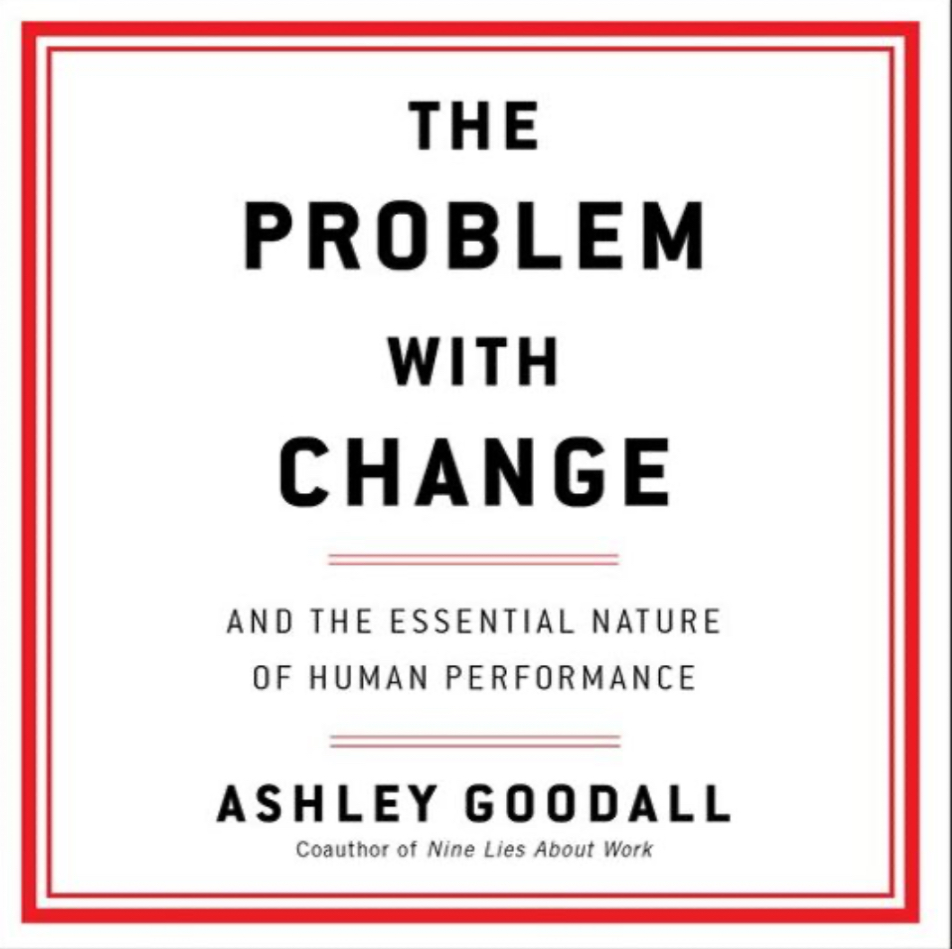
The Problem with Change: And the Essential Nature of Human Performance
If you’ve had enough of the constant turbulence that defines corporate life today, you’re not alone. Learn why change is bad for people and for business, and discover how to create the stability that we all need to thrive.
For decades, “disruption” and “change” have been seen as essential to business growth and success. In this provocative and incisive book, leadership expert Ashley Goodall argues that what has become a sacred dogma is both wrong and harmful.
Whether it’s a merger or re-org or a new office layout, change has become the ultimate easy button for leaders, who pursue it with abandon, unleashing a torrent of disruption on employees. The result is what Goodall calls “life in the blender”—a perpetual cycle of upheaval, uncertainty, and unease.
The problem with change, Goodall argues, is that a culture where everything from people to processes to strategic priorities are constantly in flux exerts a psychological toll that undermines motivation, productivity, and performance. And yet so accustomed are we to constant churn that we have become numb to its very real consequences.
Drawing on two decades spent leading HR organizations at Deloitte and Cisco, Ashley Goodall reveals why change is not the same as improvement, and how, by prioritizing team cohesion (instead of reshuffling teams at will), by using real words (rather than corporate-speak), by sharing secrets (not mission statements), by fixing only the things that are truly broken (instead of moving fast and breaking everything in sight, and more, leaders at every level can create the stability that people need to thrive.
For decades, “disruption” and “change” have been seen as essential to business growth and success. In this provocative and incisive book, leadership expert Ashley Goodall argues that what has become a sacred dogma is both wrong and harmful.
Whether it’s a merger or re-org or a new office layout, change has become the ultimate easy button for leaders, who pursue it with abandon, unleashing a torrent of disruption on employees. The result is what Goodall calls “life in the blender”—a perpetual cycle of upheaval, uncertainty, and unease.
The problem with change, Goodall argues, is that a culture where everything from people to processes to strategic priorities are constantly in flux exerts a psychological toll that undermines motivation, productivity, and performance. And yet so accustomed are we to constant churn that we have become numb to its very real consequences.
Drawing on two decades spent leading HR organizations at Deloitte and Cisco, Ashley Goodall reveals why change is not the same as improvement, and how, by prioritizing team cohesion (instead of reshuffling teams at will), by using real words (rather than corporate-speak), by sharing secrets (not mission statements), by fixing only the things that are truly broken (instead of moving fast and breaking everything in sight, and more, leaders at every level can create the stability that people need to thrive.
1 pages, Kindle Edition
Published May 7, 2024
About the author
Ashley Goodall
9 books20 followersI’m an executive, leadership expert, and author, and have spent my career exploring large organizations from the inside. I look for the lessons from the real world that help people and teams thrive, and that make work a more human place for all of the humans in it.
I’m the co-author, with Marcus Buckingham, of Nine Lies About Work: A Freethinking Leader’s Guide to the Real World (Harvard Business Review Press, April 2019), and of two cover stories in the Harvard Business Review: The Feedback Fallacy, (March/April 2019), and Reinventing Performance Management, (April 2015).
My first experiences of teams and leadership were as a student musician and conductor. I was fascinated by the unspoken understanding between people playing together and carried this fascination into the corporate world. I currently serve as the Senior Vice President of Leadership and Team Intelligence (LTI) at Cisco, an organization focused entirely on serving teams and team leaders.
I live in Montclair, NJ with my wife and son. Music has been inside me for as long as I can remember. I revel in the rhythms of words, songs, and human interactions. I look for humor in everyday situations. I love what makes people weird.
You can connect with me on LinkedIn, Twitter (@littleplatoons), or Instagram (@ashley_goodall). And if you’re someone who believes, as I do, that work can be better, for all of us, than it is today, then join The Freethinking Leader Coalition to learn more at freethinkingleader.org.
I’m the co-author, with Marcus Buckingham, of Nine Lies About Work: A Freethinking Leader’s Guide to the Real World (Harvard Business Review Press, April 2019), and of two cover stories in the Harvard Business Review: The Feedback Fallacy, (March/April 2019), and Reinventing Performance Management, (April 2015).
My first experiences of teams and leadership were as a student musician and conductor. I was fascinated by the unspoken understanding between people playing together and carried this fascination into the corporate world. I currently serve as the Senior Vice President of Leadership and Team Intelligence (LTI) at Cisco, an organization focused entirely on serving teams and team leaders.
I live in Montclair, NJ with my wife and son. Music has been inside me for as long as I can remember. I revel in the rhythms of words, songs, and human interactions. I look for humor in everyday situations. I love what makes people weird.
You can connect with me on LinkedIn, Twitter (@littleplatoons), or Instagram (@ashley_goodall). And if you’re someone who believes, as I do, that work can be better, for all of us, than it is today, then join The Freethinking Leader Coalition to learn more at freethinkingleader.org.
Ratings & Reviews
Friends & Following
Create a free account to discover what your friends think of this book!
Community Reviews
Displaying 1 - 15 of 15 reviews
December 18, 2024
The author does a nice job articulating the problems people face while going through corporate changes and has good general management advice in the second half.
• Corporate America has an optimistic view of change
○ View was strengthened in 1997 by Clayton Christensen’s The Innovator’s Dilemma. The simplified conclusion everyone drew was change is good
○ “Large-scale change is necessary, always; instigating change is the way to win; and if you are not disrupting every element of your operations, you are losing. These are the commandments of the cult of disruption. And their effect on humans at work has been dire.”
• Change has a lot of negative impacts on the people going through the change
○ Uncertainty
§ People hate uncertainty. Experiments show uncertainty about pain is worse than the pain
○ Lack of Control
§ People to whom change is done lose the motivation to drive improvement
§ “the lack of agency compares unfavorably with exposure to secondhand smoke in terms of physical health, mental health, morbidity, and mortality, and that diminished agency has a greater correlation with heart disease than does smoking.”
○ Feeling of not belonging
§ People do better when they feel as if they belong to a stable group.
§ “We frame the value of spending time at the office in terms of collaboration and innovation, when its most important function is actually the forging of human bonds, in important part by the delightful and enjoyably subversive mechanism of gossip.”
§ “We understand, in some abstract way, the importance of the feeling of belonging, yet we get the scale wrong. We talk about belonging to a company or to an organization—when the research demonstrates that that’s not how belonging works—and we fail to understand the importance of belonging to a small, local, tightly connected group.
○ Problem of Displacement
§ Small rituals ground people and a keep them comfortable. Change distrusts those and they are hard to rebuild
§ “Rituals take time to develop, so the longer you’ve lived somewhere, the more developed your rituals will be, and the more enmeshed in the daily place-ballet you will be. And this connection of time to place to ritual explains why relocation is so harmful.”
○ Loss of meaning
§ Workers who see meaning in their work are happier
§ “The loss of meaning that results from change is, first, a loss of coherence, and second, a resultant undermining of significance. This means that companies and their leaders cannot compensate for the erosion of coherence, in times of change, by pointing to ideas and projects that are intended to be inspirational—and it’s part of the reason why, when leaders are cheerfully flipping the blender buttons on and off, their assertions that they are “excited” (lifted up, we must imagine, by the significance of the whole thing) are so grating. When nothing makes sense, it’s annoying to be told how much it all mean”
§ “The science that we have examined points us to a humbler view of meaning. Not one of soaring oratory, or noble deeds, or apple trees and honeybees and peace throughout the land, but rather one in which we understand how the world around us works, and can find a way of living and playing within it that makes us feel connected to it, and located in it, and in some small way bend the arc of the future in a way that seems right to each of us.”
○ Loss of team
§ We spend a lot of time building relationships in teams. One hidden cost of change is the lost effort of getting to know your teammates.
• Solution 1: raise the bar for when large scale change is needed
• Solution 2: If change is needed
○ Slow the pace of change.
§ “Slowing the pace does a couple of things. First, it signals to everyone involved that there’s a plan, which is always a good thing and surprisingly often an overlooked thing. Beyond this, though, making time is super-helpful in its own right. Because so many of the ingredients of human work-health—building routines, learning where to go for help or advice, getting to know teammates and their skills—have a time dimension, allowing things to evolve more slowly lessens the risks inherent in sudden disruption.”
○ Make space for others
§ Listening makes space for others to talk
§ Sharing information makes space for other's decisions
§ Asking questions makes space for others to shape solutions
• General management advice that also helps change
○ Performance reviews
§ “Performance management, if you’re not familiar with the term, is the slightly Orwellian name given to the process involving goal-setting, annual or semiannual reviews and feedback, and performance ratings; in its traditional form, it represents a kind of all-you-can-eat smorgasbord of our worst and most erroneous ideas about human performance. Goals must be set for people, because they are extrinsically motivated and otherwise probably won’t do much work. Performance reviews and ratings are needed, because if people aren’t told where they stand and how to improve, they’ll never get any better—certainly not of their own volition. And it’s important to give people feedback, because if we don’t tell them where they fail to measure up, they’ll never figure it out for themselves, and because growth happens only when we tell people how to do the things they can’t do—in that way, it’s a gift.”
§ “Ratings, because of our human idiosyncrasies and unreliability when judging others, are that most dangerous animal—noise masquerading as data. 4 And feedback is a gift, neurologically speaking, in exactly the same way that terrifying someone is a gift: When we feel judged (whatever the “positive intent” of the person sharing the judgment), our brains fritz out, and our ability to learn is impaired. 5”
○ Identifying excellence is a key part of a manager’s job
§ "Because a clear idea of excellence is central to both stability and growth—a central part of the job of a team leader is to recognize excellence. Not to reward it financially, because people aren’t coin-operated; not to assess it; not to hand out scores; not to gauge progress on a scale of abstract qualities; not to encode it in annual goals; not to input any and all these into the all-seeing system—no, instead to flag, immediately, the moments of brilliance. “That’s a super email—can I tell you why I think so?” “I hadn’t thought of that point at all—do you have a moment to explain more?” “I loved what you said there, and here’s why.””
○ Share secrets
§ It's valuable to make people feel part of the inner circle and understanding the company.
§ Company value statements tend not to do that.
□ “It is almost as though there is a master list of company values hidden away somewhere, and each company gets to consult it every few years when it feels its old values are a bit tired, and choose seven or eight new ones at random. So there is the value about customer obsession, the value about innovation, the value about collaboration, the one about embracing differences, the one about servant leadership or transformative leadership or authentic leadership or whatever leadership adjective is in vogue that particular month; there is the one about respectful disagreement, and the one about taking care of the outside world; and for the edgier companies, there is some version of the one about not being an asshole.”
○ Good managers are predictable and distinctive
§ Predictable and easy to know leaders are more effective and teams like better
§ When teams are asked to list words about their leader, better leaders have a stronger overlap across their teams on which words people choose to describe them. But, good leaders can have very different attributes from other good leaders.
○ Speak real words
§ Better leaders use words that have actual meaning rather than corporate jargon
• Corporate America has an optimistic view of change
○ View was strengthened in 1997 by Clayton Christensen’s The Innovator’s Dilemma. The simplified conclusion everyone drew was change is good
○ “Large-scale change is necessary, always; instigating change is the way to win; and if you are not disrupting every element of your operations, you are losing. These are the commandments of the cult of disruption. And their effect on humans at work has been dire.”
• Change has a lot of negative impacts on the people going through the change
○ Uncertainty
§ People hate uncertainty. Experiments show uncertainty about pain is worse than the pain
○ Lack of Control
§ People to whom change is done lose the motivation to drive improvement
§ “the lack of agency compares unfavorably with exposure to secondhand smoke in terms of physical health, mental health, morbidity, and mortality, and that diminished agency has a greater correlation with heart disease than does smoking.”
○ Feeling of not belonging
§ People do better when they feel as if they belong to a stable group.
§ “We frame the value of spending time at the office in terms of collaboration and innovation, when its most important function is actually the forging of human bonds, in important part by the delightful and enjoyably subversive mechanism of gossip.”
§ “We understand, in some abstract way, the importance of the feeling of belonging, yet we get the scale wrong. We talk about belonging to a company or to an organization—when the research demonstrates that that’s not how belonging works—and we fail to understand the importance of belonging to a small, local, tightly connected group.
○ Problem of Displacement
§ Small rituals ground people and a keep them comfortable. Change distrusts those and they are hard to rebuild
§ “Rituals take time to develop, so the longer you’ve lived somewhere, the more developed your rituals will be, and the more enmeshed in the daily place-ballet you will be. And this connection of time to place to ritual explains why relocation is so harmful.”
○ Loss of meaning
§ Workers who see meaning in their work are happier
§ “The loss of meaning that results from change is, first, a loss of coherence, and second, a resultant undermining of significance. This means that companies and their leaders cannot compensate for the erosion of coherence, in times of change, by pointing to ideas and projects that are intended to be inspirational—and it’s part of the reason why, when leaders are cheerfully flipping the blender buttons on and off, their assertions that they are “excited” (lifted up, we must imagine, by the significance of the whole thing) are so grating. When nothing makes sense, it’s annoying to be told how much it all mean”
§ “The science that we have examined points us to a humbler view of meaning. Not one of soaring oratory, or noble deeds, or apple trees and honeybees and peace throughout the land, but rather one in which we understand how the world around us works, and can find a way of living and playing within it that makes us feel connected to it, and located in it, and in some small way bend the arc of the future in a way that seems right to each of us.”
○ Loss of team
§ We spend a lot of time building relationships in teams. One hidden cost of change is the lost effort of getting to know your teammates.
• Solution 1: raise the bar for when large scale change is needed
• Solution 2: If change is needed
○ Slow the pace of change.
§ “Slowing the pace does a couple of things. First, it signals to everyone involved that there’s a plan, which is always a good thing and surprisingly often an overlooked thing. Beyond this, though, making time is super-helpful in its own right. Because so many of the ingredients of human work-health—building routines, learning where to go for help or advice, getting to know teammates and their skills—have a time dimension, allowing things to evolve more slowly lessens the risks inherent in sudden disruption.”
○ Make space for others
§ Listening makes space for others to talk
§ Sharing information makes space for other's decisions
§ Asking questions makes space for others to shape solutions
• General management advice that also helps change
○ Performance reviews
§ “Performance management, if you’re not familiar with the term, is the slightly Orwellian name given to the process involving goal-setting, annual or semiannual reviews and feedback, and performance ratings; in its traditional form, it represents a kind of all-you-can-eat smorgasbord of our worst and most erroneous ideas about human performance. Goals must be set for people, because they are extrinsically motivated and otherwise probably won’t do much work. Performance reviews and ratings are needed, because if people aren’t told where they stand and how to improve, they’ll never get any better—certainly not of their own volition. And it’s important to give people feedback, because if we don’t tell them where they fail to measure up, they’ll never figure it out for themselves, and because growth happens only when we tell people how to do the things they can’t do—in that way, it’s a gift.”
§ “Ratings, because of our human idiosyncrasies and unreliability when judging others, are that most dangerous animal—noise masquerading as data. 4 And feedback is a gift, neurologically speaking, in exactly the same way that terrifying someone is a gift: When we feel judged (whatever the “positive intent” of the person sharing the judgment), our brains fritz out, and our ability to learn is impaired. 5”
○ Identifying excellence is a key part of a manager’s job
§ "Because a clear idea of excellence is central to both stability and growth—a central part of the job of a team leader is to recognize excellence. Not to reward it financially, because people aren’t coin-operated; not to assess it; not to hand out scores; not to gauge progress on a scale of abstract qualities; not to encode it in annual goals; not to input any and all these into the all-seeing system—no, instead to flag, immediately, the moments of brilliance. “That’s a super email—can I tell you why I think so?” “I hadn’t thought of that point at all—do you have a moment to explain more?” “I loved what you said there, and here’s why.””
○ Share secrets
§ It's valuable to make people feel part of the inner circle and understanding the company.
§ Company value statements tend not to do that.
□ “It is almost as though there is a master list of company values hidden away somewhere, and each company gets to consult it every few years when it feels its old values are a bit tired, and choose seven or eight new ones at random. So there is the value about customer obsession, the value about innovation, the value about collaboration, the one about embracing differences, the one about servant leadership or transformative leadership or authentic leadership or whatever leadership adjective is in vogue that particular month; there is the one about respectful disagreement, and the one about taking care of the outside world; and for the edgier companies, there is some version of the one about not being an asshole.”
○ Good managers are predictable and distinctive
§ Predictable and easy to know leaders are more effective and teams like better
§ When teams are asked to list words about their leader, better leaders have a stronger overlap across their teams on which words people choose to describe them. But, good leaders can have very different attributes from other good leaders.
○ Speak real words
§ Better leaders use words that have actual meaning rather than corporate jargon

Read
May 23, 2024Business books: what to read this month https://on.ft.com/3QGurLT
From my FT review: a “stylishly written dissection of the worst of modern corporate mismanagement”
From my FT review: a “stylishly written dissection of the worst of modern corporate mismanagement”

August 17, 2024
The Problem with Change examines organizational change and its often-overlooked consequences. The book challenges the assumption that change, particularly disruptive change, is a good thing. Goodall argues that while change can be necessary, the way it is typically managed leads to negative outcomes for both organizations and employees. By exploring the psychological and social costs of change, Goodall provides helps us understand why change initiatives frequently fail to deliver the promised benefits.
While I love the idea of this book, I found the execution to be rather scattered. The overall structure of the book felt disjointed with the first half, on the problems of change, only connecting loosely to the second half, on how to make change less disruptive. Some of the discussions felt more like rants than necessary (like on using real language). Overall, this made the very valuable content in the book a challenge to extract.
The book begins with an exploration of what it’s like to live through constant change. Goodall describes how organizations subject employees to overlapping and often endless cycles of change that foster uncertainty, disengagement, and exhaustion. Despite the good intentions behind these initiatives, they often do not achieve their intended goals. In fact, they frequently make things worse by leaving employees unsure of what is valuable or where to focus their efforts. Goodall highlights that the real issue isn’t change itself but the haphazard, unrelenting nature of how it’s introduced and managed. He critiques the modern business culture that equates disruption with progress, emphasizing that change is not synonymous with improvement. Many organizational changes fail because they overlook the actual costs involved, such as lost employee trust, diminished collaboration, and reduced productivity.
The book delves into the specific ways change can be harmful, including uncertainty, loss of control, breakdown of belonging, displacement (physical and psychological), and the loss of meaning. All of these combine to weaken motivation and overall well-being. Goodall argues that organizations often fail to consider these human factors when planning change initiatives, resulting in long-term negative impacts.
Goodall proposes an alternative approach centered on treating people as fully human rather than as simplified models driven purely by extrinsic motivations. He suggests leadership should focus on creating stability and predictability while empowering employees to build skills, find meaning, and experience belonging in their work. Practical strategies include providing space for employee autonomy, recognizing excellence in real-time, and respecting the rituals and routines that ground employees’ work lives. Goodall advocates for dynamic stability — maintaining flexibility without compromising the human need for consistency and control. Much of this will be most successful if leaders pay more attention to making teams successful since individual experience is primarily mediated through the team.
In summary, *The Problem with Change* offers a lot of good ideas on why organizational change is problematic and how to do it better. Unfortunately, it does so in a way that ends up being a grab bag of ideas without enough organizing structure to make them memorable. The result is gems interspersed with overly detailed side quests into psychological research, uneven use of examples (sometimes too few, sometimes too many), and the occasional rant. Overall, the book is worth a read if you're willing to mine for the gems yourself.
While I love the idea of this book, I found the execution to be rather scattered. The overall structure of the book felt disjointed with the first half, on the problems of change, only connecting loosely to the second half, on how to make change less disruptive. Some of the discussions felt more like rants than necessary (like on using real language). Overall, this made the very valuable content in the book a challenge to extract.
The book begins with an exploration of what it’s like to live through constant change. Goodall describes how organizations subject employees to overlapping and often endless cycles of change that foster uncertainty, disengagement, and exhaustion. Despite the good intentions behind these initiatives, they often do not achieve their intended goals. In fact, they frequently make things worse by leaving employees unsure of what is valuable or where to focus their efforts. Goodall highlights that the real issue isn’t change itself but the haphazard, unrelenting nature of how it’s introduced and managed. He critiques the modern business culture that equates disruption with progress, emphasizing that change is not synonymous with improvement. Many organizational changes fail because they overlook the actual costs involved, such as lost employee trust, diminished collaboration, and reduced productivity.
The book delves into the specific ways change can be harmful, including uncertainty, loss of control, breakdown of belonging, displacement (physical and psychological), and the loss of meaning. All of these combine to weaken motivation and overall well-being. Goodall argues that organizations often fail to consider these human factors when planning change initiatives, resulting in long-term negative impacts.
Goodall proposes an alternative approach centered on treating people as fully human rather than as simplified models driven purely by extrinsic motivations. He suggests leadership should focus on creating stability and predictability while empowering employees to build skills, find meaning, and experience belonging in their work. Practical strategies include providing space for employee autonomy, recognizing excellence in real-time, and respecting the rituals and routines that ground employees’ work lives. Goodall advocates for dynamic stability — maintaining flexibility without compromising the human need for consistency and control. Much of this will be most successful if leaders pay more attention to making teams successful since individual experience is primarily mediated through the team.
In summary, *The Problem with Change* offers a lot of good ideas on why organizational change is problematic and how to do it better. Unfortunately, it does so in a way that ends up being a grab bag of ideas without enough organizing structure to make them memorable. The result is gems interspersed with overly detailed side quests into psychological research, uneven use of examples (sometimes too few, sometimes too many), and the occasional rant. Overall, the book is worth a read if you're willing to mine for the gems yourself.

February 5, 2025
The Problem with Change by Ashley Goodall was a good read. Having worked at a large corporation like Microsoft for over 12 years, I could deeply relate to Goodall’s concept of the “blender” effect—where companies constantly shift, reorganize, and change direction. This book reassured me that the frustration and uncertainty I’ve felt during corporate reorgs aren’t unique to me; they’re shared by employees everywhere.
Goodall does an excellent job of explaining why stability, team reliance, predictability, and workplace rituals matter to employees. He also provides practical solutions for leaders to reduce anxiety and create an environment that fosters both engagement and strong business results.
This is a must-read for every executive in major companies. If leaders truly want to drive success, they should start by understanding how relentless change impacts their people.
Goodall does an excellent job of explaining why stability, team reliance, predictability, and workplace rituals matter to employees. He also provides practical solutions for leaders to reduce anxiety and create an environment that fosters both engagement and strong business results.
This is a must-read for every executive in major companies. If leaders truly want to drive success, they should start by understanding how relentless change impacts their people.

October 6, 2026
The Problem with Change by Ashley Goodall was a great read and a very honest look at how companies handle change. The author explains how constant change can affect people’s performance, well-being, and ability to work well together. What I liked most is that he points out something that seems obvious: people need stability, good teams, and some sense of predictability to do their best work. Yet companies often overlook these basic needs when they go through reorganizations and other changes. Goodall cuts through the corporate BS and reminds leaders of things they already know but often fail to act on. I would recommend this book to anyone leading or going through change in a large organization.
October 18, 2025
2.5 stars. Why? The first half is very practical and follows the premise of change articulated in the title. And then as is too often the case in such books, the second half changed (irony there intended) to be filled with tangents and detours detracting from the original thesis. Overall full of practical and useful advice which could have been condensed into a book less than half the size without forfeiting utility.
April 3, 2025
Much needed book for the business world. Speaks the mind of millions of employees who live the blender life in organisations which are obsessed with change and transformation just for the sake of it. The importance of stability and rootedness is often discounted for human and organisation well being
November 15, 2024
The book I want to write! Perfectly related to change saturation and in particular, the saturation that comes from leadership transitions. Bought my own copy after starting the one from the library at work and fully annotated and marked it up with so many good things.
February 5, 2025
Eihän tämä ole mikään yhtenäinen kirja, vaan oikeastaan artikkelikokoelma. Yksittäiset jutut kuitenkin ajatuksia herättäviä.

June 4, 2025
Great first half, quite cynical and funny, very reflective of corporate life. But the second half seemed to aim to provide tips and recommendations without fully landing on any.

July 12, 2025
very reconizable.
August 4, 2025
Things we knkw, but just don't do.

March 14, 2026
I think it has some good information and is worth reading. (about 8 hours) release date: May 2024.
How change affects workers and children, etc.
I haven't finished it yet.
How change affects workers and children, etc.
I haven't finished it yet.

June 6, 2026
Insightful, useful and well written

August 24, 2024
Livre présentant de grandes généralités sur les effets négatifs du changement mal géré sur les employés. Je ne souhaite pas savoir ce qui ne fonctionne pas, je veux connaître les solutions.
Displaying 1 - 15 of 15 reviews