""Rapunzel, Rapunzel, let down your hair!"" calls the witch to the beautiful girl imprisoned in her tower, and Rapunzel lowers her long, golden braid for the witch to climb. One day they are watched bay a prince who has heard Rapunzel's lovely voice singing out across the countryside. Enchanted by it, he decides to try calling to her, too. But when Rapunzel lets down her hair for the prince, it leads to grave danger and deep tragedy that only true love can overcome. DorothC)e Duntze's elegant, imaginative illustrations capture all the wonder and romance of this beloved Grimm tale.
Paul O. Zelinsky grew up in Wilmette, Illinois, the son of a mathematics professor and a medical illustrator. He drew compulsively from an early age, but did not know until college that this would be his career. As a Sophomore in Yale College he enrolled in a course on the history and practice of the picture book, co-taught by an English professor and Maurice Sendak. This experience inspired Paul to point himself in the direction of children's books. His first book appeared in 1978, since which time he has become recognized as one of the most inventive and critically successful artists in the field.
He now lives with his wife in Brooklyn, New York. They have two grown daughters.
Among many other awards and prizes, he received the 1998 Caldecott Medal for his illustrated retelling of Rapunzel, as well as Caldecott Honors for three of his books: Hansel and Gretel (1985), Rumpelstiltskin (1987), and Swamp Angel (1995).
Lo he leído en una preciosa edición que acaba de publicar Edelvives y que es preciosa. Está ilustrada por Francesca Dell'Orto y os juro que hace magia con sus dibujos. Como todos los cuentos de los hermanos Grimm, tiene una parte muy oscura y retorcida, donde incluso no ves un posible final feliz para los protagonistas. Me ha encantado este cuento y sin duda me ha sorprendido, ya que se parece muy poco a todo lo que han sacado sobre esta conocida historia. Si tenéis niños, os recomiendo muchísimo que consigáis esta edición y se la leáis o la lean con vosotros, es una maravilla.
Gorgeous illustrations that pay homage to Renaissance art. A story that takes inspiration from various sources of the "Rapunzel" story that we all know. I never knew that the name of the female protagonist - Rapunzel - was taken from an herb plant called rapunzel, or rampion. And the story itself wasn't the "folk tale" that the Grimm brothers made it out to be. It was an adaption of their own story written many years before, and in turn, this story was inspired from a French version that took its root from the original story in Naples, Italy. Now that's what I called folk tale 😊😄. It's so amazing to see how generations after generations, a story can be passed on and turned into different versions but still retaining the same idea. In the original Italian version, the girl was named after parsley - the herb that her mother craved during pregnancy. Not rapunzel/rampion. Can you believe that? 😄. And the fact that the author/illustrator decided to use Renaissance Italian art in this book is just brilliant.
Una versión ilustrada de uno de los cuentos de hadas más famosos. Zelinsky crea, por medio de imágenes potentes, a veces delicadas, a veces febriles, y los atisbos de narración uno de los retellings más cautivadores de esta historia.
Once upon a time there was a happily married couple whose only sorrow was that they did not have a child. Then one day, they learn the woman is pregnant and the sorrow is replaced with joy. The wife liked to sit by the window overlooking a beautiful walled garden owned by a sorceress. One day she saw an abundant bed of the herb rapunzel, and a great need to eat some overcome her. Telling her husband she will die if she doesn't have some, he dutifully climbs down into the garden and steals some. But it's not enough, and the next day he goes back - and is caught by the sorceress.
On explaining his problem to her, she tells him he can take the rapunzel, but in exchange she will take their baby when it is born. She names the child Rapunzel, and raises her in isolation in the wilderness. When Rapunzel turns twelve, the sorceress takes her through the forest and puts her in a tall, narrow tower with no door and only one window, high up. It's a magic tower, and spacious inside, but Rapunzel is sealed off from the world. To get inside, the sorceress calls out "Rapunzel Rapunzel, let down your hair", and she climbs it.
One day a prince discovers the tower and is curious; he has heard rumours of a fabled beauty trapped inside. He hides in the forest and witnesses the sorceress's method for gaining access. When the sorceress is gone, he calls out to Rapunzel to lower her hair and climbs inside, giving her the shock of her life. But he's nice and friendly and soon they become lovers and Rapunzel falls pregnant. The sorceress, on discovering that Rapunzel has betrayed her, cuts off her hair and sends her out into the wilderness to perish. Instead, Rapunzel survives and has not one baby but twins, a boy and a girl.
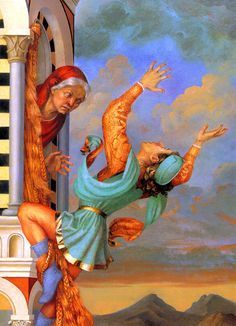
Meanwhile, when the prince returns to the tower and calls out to Rapunzel to lower her hair, the sorceress hooks the shorn hair to the window and confronts him at the top of the tower. She tells him Rapunzel is lost to him forever, and in shock and despair he falls. He doesn't die, but he is blinded and weak, and stumbles for months through the wilderness until, lo! he hears Rapunzel's voice and finds her. Her tears of joy fall onto his face and his blindness is cured. Together with their two children they return to the town and the king's palace, where they live happily ever after.
"Rapunzel" wasn't a story I really read as a kid - I didn't have my own copy, or a beloved version. I knew the story in a vague way, but I don't know if that's because Rapunzel tropes and distinctive symbols crop up so much in our society and culture (like a lot of other fairy tales and Shakespeare plays). In short, I can't actually say with any certainty whether I read the story as a child or not. As an adult with a young child of my own, I suddenly became interested in collecting really good editions of fairy tales and other classic stories - hence my lovely Robert Ingpen-illustrated editions of Alice’s Adventures in Wonderland and others.
Finding a good edition of fairy tales is a harder task, though. Ideally, I wanted to browse through book shops and check out the version quality (text) and the illustrations, before committing to buying any. Sadly, the bookshops only had rather trite and silly, or Disneyfied, editions, collections of heavily abridged stories in "bedtime" volumes. So I took a gamble on Paul O Zelinsky's beautifully illustrated retelling, buying it without being able to check it out first.
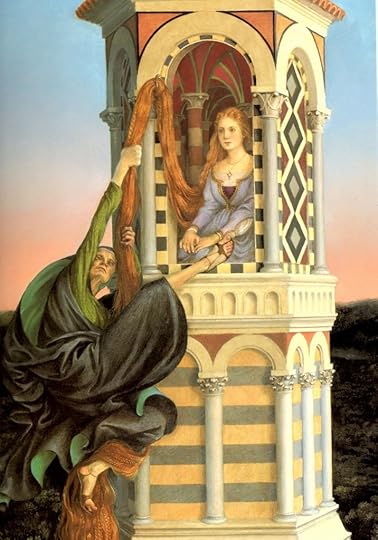
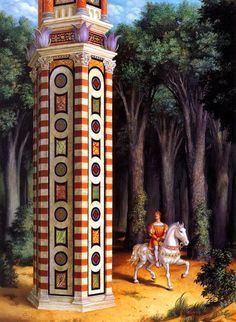
And it is a beautiful rendering of the story of Rapunzel. I wanted a version that hadn't been made cutesy or had the darkness removed from it - fairy tales should be dark stories, they were originally moralistic, cautionary warning tales, after all. Zelinsky's illustrations are vivid and richly detailed, colourful and patterned yet still broody and full of atmosphere. (I do find the prince's mullet to be a bit off-putting, though!) The story reads well, though in typical fairy tale fashion, plot holes abound. You just have to take those in stride; realism was never the point of a fairy tale, though Zelinsky (whose is "the son of a mathematics professor and a medical illustrator" according to his Goodreads page) provides a lot of precision in his illustrations, which also have the feel of classic Italian paintings. The illustrations are both real and romantic; as an adult I feel that they don't really capture the human emotions or fill in any gaps in the story, but I also feel that as a child I would have been drawn to this style of illustration (I liked the precise and finely detailed, like intricate mazes and Where's Wally? pictures).
Not having anything to compare it to, though, I can't offer an opinion on this retelling over others. I've given you an abridged run-down of Zelinsky's retelling above, and I'd love to hear how it compares to other versions that you've read. This is just the kind of edition I was looking for, and it has a three-page "note" at the back about the history of the story and its history, and the alterations its undergone over the centuries, which is by far the more fascinating part of the story for me! My young son, however, is quite interested in the story itself, and I hope it will be one he (and any sibling he may have) can enjoy for years to come.
Maybe because my teacher said something in class, but I was expecting something different from this book. I thought maybe it would be 'de-constructing' the fairy tale in someway, but instead it was just sort of putting it together in a mismash of various versions, some Grimm, some earlier traditions. The illustrations were interesting, and the abundance of cats in the pictures were nice.
As terrible as it sounds, what I loved most about reading this was seeing the parallel's between The Grimm's original tale, and the novelisation version of Rapunzel 'Cress' by Marissa Meyer! There were so many similarities between the two that I never knew about (only previously seeing the Disney movie Tanged) so reading this was really enjoyable for that element!
We have several picture book versions of Rapunzel, this one is my son's favorite. He prefers the hexagonal design of the tower in the illustrations to the round towers in other versions.
A husband and wife are expecting a child. The Mother-to-be has an insane craving for rapunzel and finally wares her husband down to jump the fence and get her some rapunzel, even though said garden is owned by an enchanted evil fairy. Eventually he gets caught and in his panic for freedom gives up his first born child. What a loving Father. The baby girl is given up for "adoption" and is named Rapunzel, poor girl not only is she locked in a tower but she is named after lettuce. Eventually, a young Prince wanders by and enchanted by Rapunzel's singing voice, climbs up her hair, falls madly in love and forms an escape route. The Evil Fairy catches on, but all ends well.
I really enjoyed this Grimm fairy tale. It had all the makings of a great story, with a really interesting take on one night stands. There was danger, intrigue and a little bit of romance. I had only read the watered-down version when I was little and found it interesting to see what Disney left out. Next to the likes of Cinderella and Sleeping Beauty I think Rapunzel gets lost in the shuffle, which is very unfortunate as she there is more to her than just a great head of hair.
The inside cover credits The Brothers Grimm for the origins of this story. The illustrations in this book are absolutely stunning. Paul O. Zelinsky fills the large formatted pages in this book with what looks like Italian Renaissance oil paintings inspired by Botticelli’s Birth of Venus. The illustrator captures incredible detail in the characters’ faces, making their every emotion and expression vividly real to life. There is a lot of text in this book, and it is fairly small in font considering it is a picture book. Some the words used, such as “plummeted,” “wretched,” and “luxuriant,” might make this story difficult for 1st and 2nd graders to follow. This is not your average children’s fairy tale picture book, especially if they are accustomed to Disney cartoon style illustrations that depict characters with friendly rounded features, and brightly animated everything. Zelinsky uses true to life colors, the characters are dressed in Renaissance clothes, their features are angular and emotions such as fear and anger and are captured in great detail in their facial expressions. One image shows the stepmother with frighteningly wide eyes and angry expression holding a pair of scissors in one hand and Rapunzel’s hair in a firm grip in the other, as Rapunzel appears to be helplessly crying holding her head in her hands. This is taking place up in the tower over a breathtaking view of mountainous, but deserted looking land below which renders feelings of fear, danger and isolation. This image comes just before the point in the story where true to the original Grimms’ version Rapunzel says: “If you, please, stepmother, help me with my dress. It is growing so tight around my waist, it doesn’t want to fit me anymore.” Which suggests that Rapunzel was doing a little more than having a little chat over milk and cookies with the prince. Unless the children have a highly refined, sophisticated eye for Renaissance art, great concentration skills, an advanced vocabulary and understanding of metaphors and subtext, I would say this book might not have a high level of child appeal for most children below 3rd or 4th grade.
Language Arts/Social Studies/Art/Fine Arts/Science Grades 1-4 Read aloud this version and “Sugar Cane A Caribbean Rapunzel” by Patricia Storace and have the students write a paper that compares and contrasts the two versions of this tale. For Social Studies the students can learn about different cultures based on the German and Caribbean versions of the story. For Art students can learn about Renaissance art history by studying paintings by Botticelli and see the similarities in style to the paintings in Zelinsky’s Rapunzel. There is also a 14-minute film version of Zelinsky’s Rapunzel, the video says it is for grades K-4 and includes activity ideas that I think children would enjoy. It suggests having the children dramatize the story and paint a backdrop for their dramatization on large cardboard. Science can include discussing gardens with the students, and ask them to describe what their fantasy garden would look like as an introduction to science units on planting. 3rd –4th graders can start learning about plants in more detail and plant life cycles.
This entire review has been hidden because of spoilers.
After reading a dozen or so of these fairy tales, you've just about read them all. I shouldn't judge each individual story in terms of how they fit into the whole, but I'm going to anyway. Since the Brothers Grimm simply collected stories, sometimes editing and adding, the collection of fairy tales that they put together is not exactly unique or interesting. Read one story a month and, sure, you might have a higher opinion of the collection as a whole. But if you read more often than that you will be disappointed with the repetitiveness of some of the stories.
Quite frankly, I was also disappointed with the predictability of the stories: predictability in a fairy tale is not a negative characteristic, necessarily, but when you know how the story will end before starting it there's something wrong. Perhaps because the Grimms received criticism that these tales weren't fit for children and so edited the heck out of them with children in mind is the reason why EVERY story has a ridiculously happy ending. It's unfortunate, as far as I'm concerned, that the Grimms didn't take a stand to say that fairy tales are not just for children. Not that adults need unhappy endings, but the story should be allowed to dictate itself and go wherever, sometimes to unhappy places. In this respect, Anderson far surpasses the Grimm collection.
Of course the Brothers Grimm hold an important place in history for putting together this collection. And, in general, I'm not saying that these stories are bad. Just disappointing as a whole. So I still encourage everyone to have a copy lying around.
Rapunzel written by Paul O. Zelinsky is rendition of an old-Italian folktale. Where a girl is locked away in a tower by an evil witch because her husband had stolen her a Rapunzel plant in which she was craving. The evil witch forces her into a tall tower where there are no windows or doors. Every night the prince comes to her and the plot her escape. Until the witch finds out and cuts off Rapunzel’s hair and tricks the prince into coming up the tower. She pushes him out and forever blinds him. The prince spend the next while walking around unknowingly because of his blindness and finds Rapunzel and they live happily ever after together with their children. Zelinsky used oil paintings for the illustration and picked sense from the story that will expand the visual image of the story. It allows the readers to really understand the story and the small details that aren’t written in words. For instance, the beauty in the tower Rapunzel is trapped in and the love that the evil witch actually has for her, things that the reader wouldn’t know by just reading the words in the story. For any age child this book would be perfect being read to or reading it themselves. I think the morals in this story is perfect and the maturity level is just right.
Zelinsky, P. O. (1997) Rapunzel. New York, NY: Puffin Books.
The story is old, one I heard quite some time ago, however the artwork is spectacular and I cant help but feel like some of the pictures were inspiration for the creators of Tangled. The color Rapunzel primarily wears in this is a light purple, and in the first picture we see of her as a girl her dress is decorated with a pattern that looks like flowers or suns (which reminded me very much of the sun of 'the lost princess' in Tangled). The witch also reminds me a bit of an older Mother Gothel. The prince's kingdom at the end also reminds me a bit of Rapunzel's kingdom in Tangled. Overall, even without these similarities that I so love, the detail of the artwork is magnificent, the people, especially their faces, have been done so well with expression even in their eyes. I don't think I even want to try any other versions after having read this version. I really loved the artwork. I would definitely recommend this version, especially if the person wanting to read it has seen Tangled.
Rereading old folklores in the original writing really makes you stop and think how much Disney had to change the stories to make them kid friendly...and people actually told these stories to kids! As an adult I really do love the classic folklores, and I specifically chose this book because of the illustrations. We all know the story of Rapunzel. "Let down your haiiiiiiir" (in Mother Gothel's voice), but the original has the prince throwing himself out of the tower and having his eyes stabbed by thorns and the only way to heal him is by Rapunzel crying tears into his eye sockets. I know, what a way to heal someone. I think this story was originally created to teach kids not to steal or take things that aren't yours or maybe to not lock people in towers. The illustrations remind me a lot of the book Rollie Pollie Ollie. It sort of looks like the illustrator used colored pencils, but it reminds me a lot of using paper cut out and pasted onto a page. I think the illustrations were very well done and really helped bring the story to life.
“Rapunzel” is a Grimm fairytale complete with all the characteristics common in fairytales.
Character – In “Rapunzel” the hero is the prince who falls in love with and offers to rescue Rapunzel from the witch. The rival in the story is the witch. The witch is described as a mean, old woman who keeps Rapunzel locked in a tower away from the outside world.
Plot – The story is traditional fairytale – a damsel in distress finds love and happiness with a handsome prince.
Motif – In “Rapunzel” there is an evil witch, a beautiful young woman, and a handsome prince. There is also Rapunzel’s very long hair that is used as a rope for the witch and the prince to see Rapunzel.
Contrast – There is contrast between Rapunzel and the witch. The witch is old, Rapunzel is young; the witch is mean, Rapunzel is nice.
My rating for this book is two stars. The story is a bit trite but makes a nice read for young children (with the exception of how the prince loses his eyesight).
Rapunzel is about a young girl taken from her parents on the day she is born and raised by a sorceress who puts her in a tower to live when she turns twelve. One day a prince is riding by and he hears her singing and knows he must see her. When the sorceress discovers that Rapunzel has a frequent visitor she cuts off her hair and banishes her into the forest, and when the prince tries to visit Rapunzel again the sorceress pushes him from the tower, and as a result of the fall he is blinded.
The classic story of Rapunzel has been passed down through the ages. With each illustration from the award winning artist Paul O. Zelinsky, the readers can truly feel the fear of the husband, the rage of the sorceress, the pain inflicted on Rapunzel and the Prince, and the joy in being reunited.
Awards: The Caldecott Medal Grade Level: 1st Grade and up Classroom uses: art lesson, rest time read-aloud, used to teach main events (reading comprehension)
I have never read the original Rapunzel story, and after reading this I was shocked to see how different it was compared to the movie "Tangled" as well as other movies and tales told about the story. When I think of the book Rapunzel,I picture images of a handsome prince, long blonde hair, and an evil stepmother. A pregnant Rapunzel, blinded prince, and secret marriage in a castle do not. As I read through the the original story I was completely engaged throughout. I could not believe how much detail was put into each of the illustrations and the oil paintings that were used. Each of the paintings portray the scenes from each page perfectly and I felt as if I was in each scene I was reading. I feel like this version of Rapunzel is a lot different from what children are used to reading and may freak them out a little so I would recommend waiting till they are past the age of understanding that princesses and fantasy stories are not real.
Most readers are familiar with this fairy tale. Rapunzel, taken from her parents at birth, is locked in a tower by an evil sorceress. The only means of entering the tower is by climbing Rapunzel’s long, luscious locks. One day a handsome prince hears Rapunzel singing in the tower and devises a plan to meet her. Upon meeting, they fall in love, get married, and, after a brief scuffle with the sorceress, live happily ever after. What makes Zelinsky’s version so special? The answer is quite simply the breathtaking illustrations. Zelinsky brings this tale to life with his realistic and intricate Italian Renaissance inspired oil paintings. It is no surprise that Zelinsky received the 1998 Caldecott Medal for his stunning work. Zelinsky’s choice of interpretation can be examined in the author’s note, as well as the history and evolution of this tale. (Ages 6 and up)
Rapunzel is a classic fairytale about a beautiful girl with very long hair who lives in a tower alone. Rapunzel grows up to be a beautiful woman who catches the eye of a prince. The witch, Rapunzel’s stepmother, discovers that Rapunzel and the Prince have married in secret and are expecting a child. In her rage, the witch cuts off Rapunzel’s long hair, banishes her to a far off land, and blinds the prince. The prince blindly wanders for months until he stumbles upon Rapunzel, whose tears give him back his sight, and the family returns to the prince’s kingdom to live happily ever after. I like this picture book about the classic fairytale. The illustrations had a classic air to them due to being done with oil paints. I felt like this illustration style aided in the romanticism of the classic fairytale.
This novel has a collection of different stories written by the Grimm brothers. Each dark tale usually involves some suffering or threat they must overcome. The Grimms collected many old legends throughout Europe. The readers get to see a bit of the world of castles and nobles transformed into a dark fantasy. I have read some of these tales before and while this version is not as gruesome as others it does leave out some details in different stories. If you do not like darker tales with gruesome outcomes for many characters I would not recommend this to you. There aren’t really any light and stories for each has some kind of morbid quality.I would recommend this to anyone who is curious about the original stories behind classic Disney films like Cinderella. I would also recommend this if you are interested in folklore.
Rapunzel, one of the Brothers Grimm’s most famous fairy tales, tells the story of a girl with long golden hair who is locked away in a tower by a sorceress. The tale combines elements of mystery, magic, and romance, as Rapunzel’s isolation ends when a prince discovers her and the two fall in love. The story is simple but deeply symbolic, exploring themes of freedom, control, and the power of love to overcome confinement. The Grimm version is darker than modern retellings. It reflects the moral and emotional depth typical of their stories. Despite its age, Rapunzel remains timeless and continues to inspire adaptations in books, films, and art. I highly recommend Grimm’s Rapunzel to readers who enjoy classic fairy tales with rich symbolism and emotional depth. It’s perfect for anyone interested in traditional folklore or the origins of stories that have shaped modern fairy-tale culture.
I read a different version aloud (illustrated by Dusikova) but compared it to this version. The students and I were fascinated by the witch's garden with the human teeth around the edge of the wall. Meanwhile we read the book Fruitbowl by Hoffmann and Duntze's illustration of the thistle in the garden was a great point to make a book to book connection where we talked about how artichokes are flowers (what!) and they are members of the thistle family (what?). We were fascinated by the witch's dress with slugs, snails and toad. We wondered if the characters were miniature in our world, or us in a giant's world and one student suggested that the witch's garden was someone's mouth and the story took place in a body.
This book is very well written and I think that it is very cool because it can have 2 meanings. Children might see it as just a normal fairytale but if you are an adult there can be a few meanings to it. The story shows you that you should never give up on something you love and that nothing can stop you in life as long as you want it. It also shows you that you need to learn from your mistakes in order to keep on a straight path. You also might not see the bad in someone and think they are keeping you safe but if you really start to look into things they are keeping you from success. I thought that this book would be similar to the movie tangled but it was very different and had deeper meanings to it. I would prefer the movie storyline but this was very interesting.- Hailey Savarella
Paul Zelinsky has brought the traditional Rapunzel, popularized by the Brothers Grimm, to life in gorgeous oil paintings. His writing is careful and gripping, and his stylized visual interpretation of the story is stunningly beautiful. The evil of the witch, the despair of bereaved parents, the innocence of the shut-up girl, and the new love of the young married couple all help to communicate the complex emotional themes of this timeless story.
Like many other traditional fairy tales, this one contains some violence which may be troubling to sensitive children, and it may not be appropriate for very young readers.
This retelling of one of the best of the Grimm fairy tales is one of the best presentations. The artwork is superb and in exquisite detail. The images are oil paintings in the style of the Renaissance masters, giving the modern young reader a backdoor introduction to that memorable style. However, for me the most interesting aspects of the book is the note at the end where there is a brief history of the basic tale of “Rapunzel.” I learned that it is a tale whose origin can be traced to Naples and passed to Germany through France. While the expression changes as it moves from country to country and across several languages, the basic tale remains the same.
My girls love, love this book. Winner of the 1998 Caldecott Medal, the lush, Italian Renaissance inspired illustrations rescue this old German folk tale from banality. Not my favorite fairy tale, I nevertheless prefer Mr. Zelinsky's version of the story. More frank and realistic (the witch discovers the prince's visits when she realizes Rapunzel is pregnant), it is also gracefully told. And I love the illustrations. (Don't forget to read his notes at the back of the story, explaining the research he did that led him to write it and illustrate it the way he did.)