Striking, surreal illustrations and a haunting, evocative text tell a mysterious tale of a threatened natural world, and a hopeful new start.. * SHORTLISTED FOR THE KATE GREENAWAY AWARD *
Once, the only sounds to be heard were the buzzing of bees in the grass, the murmuring of moles in the earth, and the song of birds in the sky. These warmed the hearts of those who cared to listen - until the others came to fill the sky with a cacophony of noise. With dramatically lit artwork and a spare, intriguing text, Varmints tells of a pastoral world in need of protection and of the souls who love it enough to ensure its regeneration.
Helen Ward won the first Walker Prize for Children’s Illustration and twice won the British National Art Library Award. She has also been short-listed for the 2003 Kate Greenaway Medal. She lives in Gloucestershire, England.
I picked this one up in 2008 and have been meaning to read it again for a while now. It's an amazing picture book, very mature in subject matter, a book that you'll need to revisit again and again and ponder endlessly. It's also the type of book I would have absolutely loved as a small child (I love it now, too, of course) - at five, six years of age, The Dark Crystal was my favourite movie and it was a dark, menacing tale with sinister creatures, death, violence and adventure. So don't rush to think this is too dark for children. I've always had the kind of imagination that thrived off the "darker" stuff.
Varmints tells an analogy, or parable, that mirrors our history in a condensed form. There are those who love the hum of bees, the whisper of the wind, the wilderness - and then others arrive, with their tall buildings that "scratched the sky where birds once sang. Those gentle sounds faded and were gone." Every day, more newcomers arrived, the noise grew and grew until they couldn't think ... "So they stopped thinking."
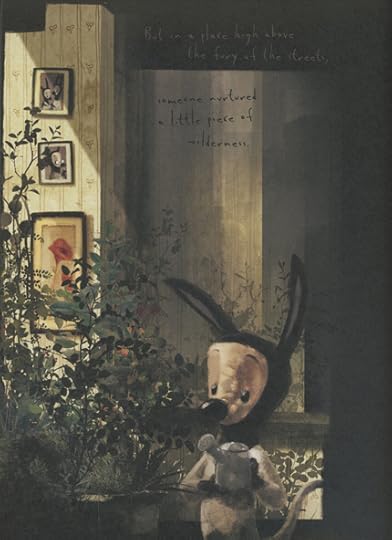
But someone is nurturing a little piece of wilderness, and at the right time takes it to the right place... and that little bit of wilderness grows.
I can't recommend this book enough. It's an analogy for our own industrialisation, and the sacrifices we've made - and the wilderness has made. The prose is light and atmospheric, perfectly complimented by the illustrations that add to the voice of the story - you need both, together, for the full impact. Not every child is going to like this but for those whose imaginations crave deeper, more fantastic stories, this would be perfect for them.
Absolutely heart-wrenchingly stunning. Every pages is an absolute delight. I only wish that the words had been hand-written - the fact that this is even noticable is only because of how perfect every other little detail is.
The story is as old as industrialisation but I'm sure it has never been told so succinctly and beautifully as here.
Varmints by Helen Ward, I really enjoyed reading this book with a very powerful message. However, I did have to read it more than once to know what the message was. I love the cover which first attracted me to the book with the character that looks like a bunny in the centre of the page, dark looking, with all the plants around also dark but has a light background behind him.
This book is very dark but thinks it has to be to give the right message on how important it is to look after the environment around us. There are two different characters in the book, they are bunnies and badgers. Starts of with bunnies in a field, bright colours on the right heading to the left. Which is interesting as normally the characters in a picture book are on the left page going right but the environment is perfect for them and doesn't need to go anywhere. What a weird way to start a book? But... You see the badgers on the right walking left as they have finished what they need to do. However, for the bunnies this is only the start, they are now on the left side of the page going on a journey. At the top of the page, there is a dark cloud where it all starts.
Throughout the book, it is very dark, only at the start and end when there are bees meaning light shows there is hope and the importances of bees for the environment. The framing in the book doesn't really happen as most of the picture covers the book with the dark text on a dark background. This could mean the writer doesn't want you to only read the writing as sometimes you don't see the writing straight away but wants you to look at the pictures with the message it is trying to come across. However, this could be an implied reader because the reader would have to know about the dangers of not looking after the environment to be able to understand the story so for children this might be hard but a good way to show them the impacts it could have.
There is a picture with a rectangular frame in the middle of the page, this means the character is insecure. This could be the case because the sound of bees has come back but doesn't know what will happen to the environment.
When the badgers are around and start to get dark this means that it is their fault that they have taken away the bees. The group of badgers gets bigger and bigger until there is just one on a single page. This can mean they are in power and have taken over the environment but as soon as there is hope with one bunny there is always light on the character and the badgers disappear. When the plant gets taken to receive the light and grows, the page starts to become more light again until its back to how it use to be. Well, you think anyway till you see they have started a new life somewhere else 'in the high blue sky' as the old plant is to damaged to be fixed.
I love how the text moves around not always at the bottom of the book and the last page instead of saying the end it says the beginning because it's a new start for the environment.
This beautifully illustrated book begins with a description of a Varmint, which means an irritating or obnoxious animal.' However, the character on the cover is just the opposite. Peace and quiet are the most important things in the world but the darkness of the buildings cast a shadow over these sacred things. There is however, one varmint determined to reinstate nature the way it was intended to be. Will he succeed?
Every single detail in this book is absolutely stunning. The typography is simple yet so effective and it allows children to concentrate on the delightful illustrations throughout. Children would be able to use the illustrations and create amazing descriptions from it. I loved the poignant storyline that showed the effects of climate change and this is an important subject to discuss with children.
Varmints, written by Helen Ward and illustrated by Marc Craste, is a simple yet powerful picture book for older readers (Grades 4 and up). This story is told in three sections that include three diverse worlds, where each is indicated by a vellum page that reminded me a bit of the start of old film footage. The story begins in a beautiful sun-filled meadow full of the sound of buzzing bees. There are "varmints" working in the field, which look a bit like rabbits. Suddenly, there is a transformation of this beautiful world, as an army of varmints bring forth tall buildings. These varmints work as a team--losing their independence and their own thinking. The noise builds and builds, making it difficult for them to think. There is, however, one varmint who clings to the past, caring for a small potted plant in his small apartment.
This book quickly had me connecting to the Pixar film Wall-E, where its inhabitants cause their own demise. In the case of this book, I couldn't help but think of the definition of "varmint", which is noted just inside the book cover: "an irritating or obnoxious person or animal". In think about other definitions of this word, I would add that varmints often cause harm or annoyance to others. However, in the case of this book, the varmints are only destructive to themselves. They erect the tall structures, harming their natural world, and going against their own yearnings and instincts while losing a sense of self.
Ward and Caste's story sounds too familiar as I think about our own environment and the overuse of materials and abuse of this planet. As a result, Varmints would make a great addition to a science class exploring environmental issues and would be an interesting addition to a dystopia unit. I also viewed the short film on Vimeo and enjoyed it as well; it takes the basic premise of the story and develops it a bit more--creating a real connection between the viewer and the sweet-eyed varmint. Both pieces--book and movie--create a dark environment through color and font choice that affect the overall mood and tone of this interesting story.
This beautifully illustrated book by Marc Craste made the text by Helen Ward seem more more meaningful. The words were few, yet intense and in my opinion, easy enough for young children to comprehend. The text on some of the illustrations were hardly noticed - you had to look with a keen eye, which I think made them more meaningful and connected to the dark scenes in this story. The idea that life is becoming over run with buildings, noises, and all kinds of extra "STUFF" is a concern of mine. There seems to be fewer opportunities (especially due to time)to enjoy what we have here and now. No time to see, hear, feel, taste or smell what is beautiful and precious around us. We keep adding more and more with less and less time, thought and energy towards any of it. Some of the illustrations made me very sad thinking about how dissmal our lives can become when we don't stop for the precious things, people, places in front of us - nature, family, friends, students who have something to share. No energy to think or just be. I don't think my first graders will see the same thing that I saw - I think they will see the funny looking varmint looking for, searching for beauty and peace - And happy when he finds it once again.
I was blown away to find a children's picture book with dark striking art like a graphic novel, and a message as much me as anything I could ever write. It immediately became my favorite picture book, and I ran out on my lunch break to buy a copy for my best friend. This book is as much him as it is me, and for our perspective to be found in such a tidy package is well worth sharing. I couldn't actually interest any children in this book, but most of the adults I shared it with, thanked me for sharing this precious jewel that I discovered at the library.
This book is so dark and beautiful. I bought it from my kids school book fair, neither of them (7 and 5) were very interested in it even after I purchased it and read it to them at home, I guess I prefer for them to love cheerful, colorful books with unicorns and rainbows. Maybe someday when life's harsher realities set in they'll appreciate the message in this lovely little book. I loved it though, I got chills the first time I got to the page that said "so they stopped thinking". I love the art & the story though told with very few words is very moving.
This book demands attention. From the curious creature staring out at the reader on the cover, to its large physical nature and wild typography and breath-taking art, Ward and Marc Craste's creation needs a patient orator and audience. A variety of themes could be interpreted - loss of natural habitat through urbanisation, loss of identity, societal collapse, Communism(?!), enduringly persistent hope and the joy of love - but therein lies the crux of reader response and exploratory talk. Varmints reminds me of Helen Ward's The Tin Forest also.
If this is simply [Part One] as the cover suggests, I can't wait for [Part Two].
A stunning, wordless film accompanying the book has been lovingly created by Craste - https://www.youtube.com/watch?v=S-uec.... 24 minutes long, it can be broken up into sections for viewing in the classroom (and is unfortunately interrupted anyway by pesky youtube advertising). Children in KS2 will, I think, love the animation and the central character, and be engaged by the conversations around its content. Utterly enthralling, particularly if you can find an ad-free version.
A dark but beautiful picture book which presents a relevant and powerful message. The book starts off in the light, with bees buzzing and a happy peaceful lifestyle of the gentle and sweet bunny-looking creatures. As the book progresses, and more industrialisation and skyscrapers are built, the imagery gets darker and darker. It almost looks hopeless but then one Varmint journeys to find the light again. Its message demonstrates how the planet is being destroyed but the possibility that there is always hope and the need for brave individuals to take action and find the light. This message has multiple meanings as it can relate to any moment in our lives. No matter what, there is always a way out of a troubling time, but there is a need to acknowledge and identify the problem. Although it has a hopeful ending there is still an element of unease. A great read for children to explore and ask questions in a complex world. Some of which may remain unanswered. Fantastic themes to explore for Years 3 and above.
Varmints is a beautifully illustrated and thought-provoking picture book. The illustrations are dark and surreal, but they perfectly capture the sense of loneliness and isolation that the varmint feels. The story is simple but effective, and it teaches children important lessons about courage, friendship, and environmental protection.
The varmint is a sympathetic and relatable character. He is kind and gentle, but he is also brave and determined. He is a reminder that even the smallest creatures can make a big difference. The noisy creatures are also well-developed characters. They are not inherently evil, but they are selfish and careless. They represent the dangers of unchecked development and the importance of protecting our natural world.
What are we to make of this book? Who does it suggest is to blame for despoiling of idyll there once was? While the text is self-consciously elliptical, one thing is clear: the blame lies with ‘Others’ who ‘came one day’ from outside, the ‘varmints’ (a variant, we are told, of the word vermin), with THEM.
Vermin, outsiders, them, the others... Problematic, highly charged language, considering the history of the demonisation of migrants and ‘foreigners’.
That this is a fuzzily environmental story about nature doesn’t make this careless use of language ok. In fact there’s a racialised version of environmentalism and I’m afraid this Innocuous looking picture book is uncritically part of it.
This book is one of my favourite books since the day I read it! It starts really peacefully and it suddenly changes into a place of terror and suspense. I think the author did a good job at choosing the vocabulary to make it suspenseful. In addition to this the pictures were well chosen to confuse the reader and make them think about what is happening. I would recommend this book because it is an adventure and would be great for those readers who like mythical creatures and mysteries. I would give this book 4 stars.
Currently exploring this book with Year 5 during my final placement and enjoying delving deeply into it. The children writing their own versions of the story focusing firstly on the drastic comparison between the peaceful earth and what happens when ‘the others’ arrive. The class are watching the animation of the story alongside this which adds extra information to the story. Excited to see where he children take their own stories based upon a ski isle structure and plot.
Nice book with some genuinely wonderful visuals. Could definitely be used to explore a lot of interesting themes and settings with a KS1 class. Personally I do feel the narrative was a tad preachy- the demonising of "the others" with their "empty heads" has a rather "holier than thou" feel to it. Which is a shame, because the artwork is phenomenal.
This book is about a small creature who loves the trees and the flowers. My favourite part of the book was when the little creature is happy. I liked how the book is about wildlife and animals. What the author did well was showing people that you should care about animals and wildlife more.
I would recommend this book to people who cut down trees because it teaches people about that.
I really like how simple yet mysterious this book is. Really detailed, deep/dark and clever illustrations make the reader really ponder and make meaning of the text. Overall I think this would be a picturebook that could really allow for quality work in the classroom, with an abundance of learning opportunities: outdoor learning - nature and wildlife, art, lighting and planting seeds.
A sinister but powerful picture book giving an analogy of our industrialisation of the planet, and the beauty and wonder, but also sense of self and connection to the world we have lost as a result. Children and adults alike will appreciate and enjoy this book. The wonderful illustrations compliment the story beautifully, too.
This beautifully written and illustrated book shares hope in a way that doesn't feel treacly or preachy. Hopefully through works like this readers of all ages will be encouraged to "nurture a little piece of wilderness" in the best ways. Highly recommended.
Simply beautiful artwork with a good underlying message worth talking about but the transition to the ending chapter really seemed too abrupt a change in tone and could potentially undermine the goal of making this a more meaningful thought provoking endeavor.
This book is filled with wonderful illustrations. The writing is beautiful and the message behind it is so powerful. The book is simple yet incredibly meaningful. It is an incredible read for all ages.
Even those who cannot access the text can understand the story from the pictures. The use of colour telling the reader everything. A powerful story, with well chosen language. Some of the text was hard to read due to the colours chosen.
Beautiful, powerful, both in the words and the imagery chosen. A new world exists, the Earth can be reborn, we can change, we can get back in sync with our Earthly mother. Beautiful colour palette, use of space, shadows, angles, layout and font.