

What do you think?
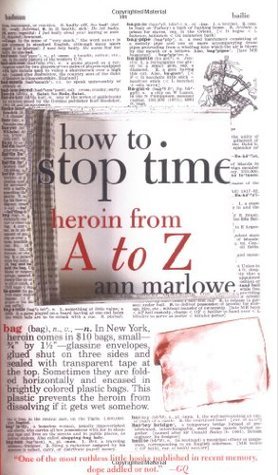
How to Stop Time: Heroin from A to Z
How to Stop Time is an important contemporary contribution to the classic accounts of the seductive attractions and dangerous distractions of drug use.
In this hypnotic and piercingly intelligent chronicle, Ann Marlowe dissects her former heroin habit, and recounts in harrowing detail the rigors and realities of life under the influence while building a successful Wall Street career and establishing a reputation as a critic in the alternative press. A one-time Harvard grad student in philosophy, Marlowe ruthlessly examines the paradoxical nature of addiction, and connects her own experience to a wider discussion of heroin in the context of our post-consumer, digital society.
In this hypnotic and piercingly intelligent chronicle, Ann Marlowe dissects her former heroin habit, and recounts in harrowing detail the rigors and realities of life under the influence while building a successful Wall Street career and establishing a reputation as a critic in the alternative press. A one-time Harvard grad student in philosophy, Marlowe ruthlessly examines the paradoxical nature of addiction, and connects her own experience to a wider discussion of heroin in the context of our post-consumer, digital society.
320 pages, Paperback
First published September 9, 1999
Ratings & Reviews
Friends & Following
Create a free account to discover what your friends think of this book!
Community Reviews
Displaying 1 - 30 of 56 reviews

March 11, 2016
I took this book out from the library with the expectation that I would skim it quickly, hopefully finding a few good quotes for an essay I'm writing. Once I started, however, I could not stop myself from reading each and every captivating word. In How to Stop Time, Ann Marlowe takes us through her life from the lens of her heroin addiction. While she claims that she wasn't a junkie or hardcore addict like many of her friends, the drug definitely seemed to be a large part of her life and she was certainly dependent on it.
The most notable part of this memoir was its structure-- the book was set up like a dictionary, stories and memories prompted by an alphabetical list of words (thus Heroin from A to Z). While other readers may have found this a bit gimmick-y, I truly enjoyed the shift from traditional memoir structure. As a fellow writer, it made me truly reflect on Marlowe's control of her words and writing-- something that I truly envy.
I'd really recommend this for anyone interested in memoirs, specifically those pertaining to addiction. I've read a lot of eating disorder memoirs-- not traditionally thought of as "addictions," but over the years I have realized that my own battle with anorexia was an addiction in and of itself.
5 STARS *****
The most notable part of this memoir was its structure-- the book was set up like a dictionary, stories and memories prompted by an alphabetical list of words (thus Heroin from A to Z). While other readers may have found this a bit gimmick-y, I truly enjoyed the shift from traditional memoir structure. As a fellow writer, it made me truly reflect on Marlowe's control of her words and writing-- something that I truly envy.
I'd really recommend this for anyone interested in memoirs, specifically those pertaining to addiction. I've read a lot of eating disorder memoirs-- not traditionally thought of as "addictions," but over the years I have realized that my own battle with anorexia was an addiction in and of itself.
5 STARS *****

August 17, 2020
This is the first book I've been able to start & finish in six months. Because it's easy to read, not take seriously, is structured so there are no real highs or lows ... but gives you enough soothing hope that YOU TOO could use heroin casually with no worse long-term effects than wasting some time on living up to your Full Potential! So it was a relaxing secretly-optimistic little escape that I'm not portraying properly here but within the context of 2020 I don't think I'm the only one who might feel this way reading this super-privileged New Yorky BS this year.
Ann Marlowe is the kind of woman who insists that because SHE has never experienced severe menstrual cramps, nobody else does, and anybody who claims to has a character defect, is making excuses, etc.
Ann Marlowe is the kind of woman who insists that because SHE has never experienced severe menstrual cramps, nobody else does, and anybody who claims to has a character defect, is making excuses, etc.

April 13, 2014
The writing is very good, and there are a lot of good ideas here. In particular, I like her musings about how we try to stop time. The only fault I'd mention, is that in parts she, I think, mistakenly presents her experience as universal. She's clearly a very unique person. Highly intelligent, educated, talented, ambitious. And she comes from a very particular place in society. So there were moments, especially in the first half, where she'd make a comment that vexed me a bit. Overall, however, I found the book very enjoyable. Some of the segments of this book resonated with me very much.

June 1, 2007
a
anthony
he called me out on my all too generous rating.
b
book
this book now gets one star instead of four.
c
crack
because I must have been smoking rocks when I gave this book four stars. Oh yeah, I'm in graduate school and I smoke crack. I'm pretty fucking awesome, aren't I?
anthony
he called me out on my all too generous rating.
b
book
this book now gets one star instead of four.
c
crack
because I must have been smoking rocks when I gave this book four stars. Oh yeah, I'm in graduate school and I smoke crack. I'm pretty fucking awesome, aren't I?
December 5, 2018
I really struggled to enjoy this book on any level whatsoever.
Firstly, the A-Z dictionary style format means that it is pretty light on narrative, and the glimpses we are offered into Marlowe's addiction are not particularly engaging or revealing.
Secondly, I didn't connect emotionally with this book at all - HTST lacks the tortured urgency of William S Burroughs' masterpiece, Junkie, and offers none of the vitality or grim desperation of Irvine Welsh's Trainspotting trilogy. It just plods along, saying nothing much about anything at all.
The book offers nothing more than a superficial glance at the most banal and tawdry details of the life of a Heroin addict. In short, it is boring. Extremely boring.
There is no doubt, however, that Marlowe thinks she has written something pretty special. Sadly, she is more concerned with showcasing her knowledge of dope culture and 'the scene' than she is about saying anything profound about addiction. Her self assured and condescending tone grated on me throughout (can you tell?)
About halfway through the book, Marlowe reveals that she has received a lot of criticism from former heroin users who claim that her $10 per day, always-snorted-never-injected heroin 'habit' did not constitute a real addiction - That she was more interested in being part of the scene, than she was in the drug itself. I have a lot of sympathy with this view - to me, Marlowe comes across as something of a tourist, playing at addiction.
So, if you are looking for a book that deals with the grim, self destructive urge to anaesthetise yourself against an increasingly hopeless world, best to give this one a miss. Similarly, if you are looking to read something profound about the nature of addiction and the human condition, ditto.
However, if you are looking for a self indulgent, patronising analysis of how a rich, middle class white woman spent her weekends snorting the occasional line of heroin at various rock shows across New York, this just might be the book for you.
Firstly, the A-Z dictionary style format means that it is pretty light on narrative, and the glimpses we are offered into Marlowe's addiction are not particularly engaging or revealing.
Secondly, I didn't connect emotionally with this book at all - HTST lacks the tortured urgency of William S Burroughs' masterpiece, Junkie, and offers none of the vitality or grim desperation of Irvine Welsh's Trainspotting trilogy. It just plods along, saying nothing much about anything at all.
The book offers nothing more than a superficial glance at the most banal and tawdry details of the life of a Heroin addict. In short, it is boring. Extremely boring.
There is no doubt, however, that Marlowe thinks she has written something pretty special. Sadly, she is more concerned with showcasing her knowledge of dope culture and 'the scene' than she is about saying anything profound about addiction. Her self assured and condescending tone grated on me throughout (can you tell?)
About halfway through the book, Marlowe reveals that she has received a lot of criticism from former heroin users who claim that her $10 per day, always-snorted-never-injected heroin 'habit' did not constitute a real addiction - That she was more interested in being part of the scene, than she was in the drug itself. I have a lot of sympathy with this view - to me, Marlowe comes across as something of a tourist, playing at addiction.
So, if you are looking for a book that deals with the grim, self destructive urge to anaesthetise yourself against an increasingly hopeless world, best to give this one a miss. Similarly, if you are looking to read something profound about the nature of addiction and the human condition, ditto.
However, if you are looking for a self indulgent, patronising analysis of how a rich, middle class white woman spent her weekends snorting the occasional line of heroin at various rock shows across New York, this just might be the book for you.
August 3, 2021
Justo lo que buscaba cuando empecé a leer "Sobre el hachís" de Benjamin, y que no encontré. Profundo sin ser pretencioso, huye del estereotipo según el cual para hablar de la droga hay que ser una reventada. Desmitificante y justo por eso es estimulante. El hecho de que hable no tanto de la droga (que también) como de la relación que mantenemos con las drogas debido a las dificultades y carencias del mundo tardocapitalista permite que una pueda identificarse casi plenamente con las reflexiones filosóficas, políticas y psicológicas que Ann Marlowe plasma aquí.
Hay quien se queja del formato "abecedario" y de que te mande de un sitio para otro del libro constantemente, pero tiene cierta gracia y creo que sintoniza con el tema el verte todo el rato en un "loop" de avance y retroceso, que algunas entradas sean largas y otras cortas, que creas que vas a acabar cuando viene otra redirección a otro pensamiento... Todo eso consigue darle la lectura la sensación de que la persona que nos narra su historia realmente nos sumerge en el flujo de pensamiento propio de un estado excitado. Personalmente, lo he disfrutado muchísimo, seguramente porque yo también sufro algo de TOC, ansiedad, tengo miedo al paso del tiempo y me siento indefensa frente al mundo industrial y la ciudad de cemento. La adicción no tiene mucho que ver con la química de la droga, ni esta ejerce un poder IRRESISTIBLE, sino que, a nuestra manera, todes elegimos nuestra adicción, porque todes buscamos ese amuleto, esa manía mundana que nos permita sentir que controlamos aunque sea nuestra destrucción, pero también nuestras prioridades.
Hay quien se queja del formato "abecedario" y de que te mande de un sitio para otro del libro constantemente, pero tiene cierta gracia y creo que sintoniza con el tema el verte todo el rato en un "loop" de avance y retroceso, que algunas entradas sean largas y otras cortas, que creas que vas a acabar cuando viene otra redirección a otro pensamiento... Todo eso consigue darle la lectura la sensación de que la persona que nos narra su historia realmente nos sumerge en el flujo de pensamiento propio de un estado excitado. Personalmente, lo he disfrutado muchísimo, seguramente porque yo también sufro algo de TOC, ansiedad, tengo miedo al paso del tiempo y me siento indefensa frente al mundo industrial y la ciudad de cemento. La adicción no tiene mucho que ver con la química de la droga, ni esta ejerce un poder IRRESISTIBLE, sino que, a nuestra manera, todes elegimos nuestra adicción, porque todes buscamos ese amuleto, esa manía mundana que nos permita sentir que controlamos aunque sea nuestra destrucción, pero también nuestras prioridades.

January 30, 2012
A very un-shrill, unsensational look at heroin and addiction (which of course makes a lot of people very upset.) There is a healthy dose of skepticism and distance but also a sense of nostalgia and tenderness toward the "scene" and the time. The format itself is a joke referring to the author's strained relationship with "alphabetical order" (totally arbitrary despite the appearance of order) and also yet another attempt to "stop time" in that it overrides chronological order, becoming a stream-of-consciousness web of associations, complete with a few "hyperlinks" - references to other entries going both forward and backward in time.
There is a running theme of the author's struggle to reconcile her bourgeois up-bringing and capitalist inclinations with the subculture that she finds herself drawn to, while they are ironically revealed to be not all that different. She draws some interesting parallels between the consumption of heroin and mainstream consumerism, as well as mainstream advertising and the "branding" of heroin (irony upon irony and yet the joke is still on the user/consumer.)
I must say that I have developed quite an obsession with Ann Marlowe after reading this.
There is a running theme of the author's struggle to reconcile her bourgeois up-bringing and capitalist inclinations with the subculture that she finds herself drawn to, while they are ironically revealed to be not all that different. She draws some interesting parallels between the consumption of heroin and mainstream consumerism, as well as mainstream advertising and the "branding" of heroin (irony upon irony and yet the joke is still on the user/consumer.)
I must say that I have developed quite an obsession with Ann Marlowe after reading this.

August 22, 2011
hated, hated, and hated- author was totally unlikable- not that an author has to be likable but you can like unlikable authors- but nothing about this book/author is likable. She claims she was addicted yet never experienced withdrawal or the pains of addiction- then you weren't addicted-not in the physical sense-not in any sense- it is called a casual user- yes heroin addicts can be casual users. The book was slow and boring, the author comes off as pretentious and you just can't warm up to her book or her story. I usually like,or at least find a likable quality, in most books-yeah, no- not this one.

January 25, 2010
I first read this book in high school--I bought it at St. Mark's Bookshop during a Thanksgiving in New York with my parents during which we had the traditional meal at a diner in Hell's Kitchen populated on that day only by cab drivers. I had, I think, blintzes. Anyway, the genre of drug memoir is a strict one, very prescriptive in terms of how repentant the addict should be, how low rock bottom ought to be, and how glowingly self-righteous the emerged new soul will sound in the retelling. Ann Marlowe is strident in her abandonment of those tropes, choosing instead to chart her memoir through alphabetically organized vignettes, some philosophical and others heartlessly concrete. The approach may sound played by now--the book came out about ten years ago, after all, way before the tidal wave of memoirs and the "lyric essay"--but I can promise that it's weirdly suited to a woman holding a Harvard MA in Philosophy who wants to revisit the particularities of heroin addiction. I take a hard line on memoirs, especially those that mine perennially juicy topics, but I guarantee that this drug memoir is on a different order. Even on re-reading, and with a wholly different level of fascination with urban drug narratives.

August 30, 2013
As someone who represents heroin addicts on a daily basis, I loathed the author. Her pretension and lack of awareness of her own wealthy, white privilege (even though she swears on several occasions that she looks Hispanic) is infuriating. That said, the book was an interesting insight to the life of a chronic user (not an addict).

November 5, 2007
The best "addiction memoir" that I've ever read. Stylistically amazing, and shows how an unusual style can work with the material, rather than seem like a gimmick (David Shields, are you listening?) I have read this several times, and gotten more out of it each time.

December 15, 2012
This is a smart book from a smart author. The perspective on false perceptions of heroin use is unique to say the least. I can't believe this has flown under the radar for a wider audience than simply Village Voice readers for nearly 14 years.

August 20, 2012
What a crock of self-satisfied, inaccurate crap!

June 26, 2017
Disjointed, meditative, sometimes hilarious. The details of maintenance of her 'normal' life are fascinating. The kind of memoir I love, a personality that blasts through the page.

Read
December 3, 2011Ann Marlowe’s formidably intelligent memoir finds its structure in the drug’s various and surprising lessons. “There are a million things you can learn from [doing dope],” she writes, “but they are only fully available to you once you stop using it.” While Marlowe seeks to debunk heroin’s glamour (“the drug isn’t really that great”), she argues convincingly that opiates freed her mind for artistic effort, shaking loose just enough of the relentless logic she acquired in her studies at Harvard College and Business School. Not that Marlowe has collapsed into aesthetic pretension or fuzzy-headedness: her book, a series of “stringent,” alphabetically organized meditations, inherits its structure from Pascal, to cite one obvious forebear. Yet Marlowe’s forte, like Elizabeth Wurtzel’s in BITCH, is the startling metaphoric connection.
For example, under the rubric of “Athletics,” she explores the link between heroin and sports. Marlowe maintains that she never became truly addicted, in part because her system, bolstered with martial arts and daily runs, flushed away the heroin with speedy efficiency. Nor was she an atypical user: Most of Marlowe’s junkie friends were athletes, blessed with a store of energy not easily burned off in Manhattan’s confines unless workouts alternated with visits to Avenues C and D. “Heroin provides,” she summarizes, “the all-absorbing, anxiety-deflecting presentness which we can also find in sports.” And if heroin users court a variety of physical and psychological risks, Marlowe goes on to imply, so do marathon runners, yoga fanatics, and even spa junkies like the late Princess Diana, whose favorite fixes were high colonics and aromatherapy.
Marlowe’s alphabetical organization—a system that lends itself to “arbitrary,” “random,” or lyrical thought, as she points out—implies that, like Wurtzel, she has found that her experiences and thought-processes can’t be smoothly yoked to the traditional Rising Action/Climax/Falling Action grid discussed above. But had Marlowe’s narrative structure mirrored too closely the heroin user’s quest for static oblivion, HOW TO STOP TIME would itself have become static, even unreadably dull. On the contrary, her narrative structure makes possible a kind of suspense: One glances at the next page, wonders what words like “democracy” and “dentist” could possibly be doing in a book about heroin addiction, and reads on.
(originally published in the NASHVILLE SCENE)
For example, under the rubric of “Athletics,” she explores the link between heroin and sports. Marlowe maintains that she never became truly addicted, in part because her system, bolstered with martial arts and daily runs, flushed away the heroin with speedy efficiency. Nor was she an atypical user: Most of Marlowe’s junkie friends were athletes, blessed with a store of energy not easily burned off in Manhattan’s confines unless workouts alternated with visits to Avenues C and D. “Heroin provides,” she summarizes, “the all-absorbing, anxiety-deflecting presentness which we can also find in sports.” And if heroin users court a variety of physical and psychological risks, Marlowe goes on to imply, so do marathon runners, yoga fanatics, and even spa junkies like the late Princess Diana, whose favorite fixes were high colonics and aromatherapy.
Marlowe’s alphabetical organization—a system that lends itself to “arbitrary,” “random,” or lyrical thought, as she points out—implies that, like Wurtzel, she has found that her experiences and thought-processes can’t be smoothly yoked to the traditional Rising Action/Climax/Falling Action grid discussed above. But had Marlowe’s narrative structure mirrored too closely the heroin user’s quest for static oblivion, HOW TO STOP TIME would itself have become static, even unreadably dull. On the contrary, her narrative structure makes possible a kind of suspense: One glances at the next page, wonders what words like “democracy” and “dentist” could possibly be doing in a book about heroin addiction, and reads on.
(originally published in the NASHVILLE SCENE)

April 6, 2009
Coming from a recovering heroin addict, I could relate to this book, as what I liked about the book is that it showed how Heroin Addiction can affect even the upper class, the intelligent studious individuals. It broke down the stereotype, and Ann made it easy for those who weren't addicts, to understand what a downward spiral this addiction is,and how it differs from others. Many people could read this and take it seriously unlike "SMACK" which was the typical, "Junkie" read, in my opinion.

May 5, 2012
This fearless memoir is going to turn everything you thought about heroin addicts on its head. It's the most honest tale chronicling both the good and bad of being heavily involved in a drug that I've ever read, and also weaves in Marlowe's struggle with her family and other relationship issues - personal challenges that underlie everyone's story, whether they choose to use drugs as a coping mechanism or not.

March 16, 2010
'Get to know someone who has survived addiction. It will change your perspective on pretty much everything.'
reading a book is not exactly like knowing someone in person, but a book still could make you think again
reading a book is not exactly like knowing someone in person, but a book still could make you think again
August 11, 2015
One of my very favorite books. It's not the subject matter (drugs) that interests me as much as this desire to stop time, and the lengths we go to forget for awhile the most important fact of our existence.
June 10, 2020
If you're down with recovery bashing and someone supposedly having been addicted to heroin describing opiate withdrawal as nothing but a bad flu, feel free to read this wannabe addict's dashing dance with the drug.
June 8, 2009
Incisive, brilliantly constructed, and fascinating.
Read
April 19, 2010I live on Chiva Row aka Pill Hill. I was a speed freak until I moved here. Now I appreciate the lure of tar.

February 15, 2011
I found the alphabetical listings to be a fascinating way to tell a story. I disliked the author very much and I found her to be a complete snob, but I can't deny the book 4 stars.

April 12, 2018
eeeh yo, what would ann marlow make of west virginia now, i wonder.

April 20, 2022
Really odd but interesting read. It pulls you in and keeps you interested without getting you emotionally involved.

February 18, 2023
“I love disaster / and I love what comes after”
December 9, 2024
Ann Marlowe is a smart, ambitious, cool, and intellectually curious person. Her memoir about her seven-year-long relationship with heroin during the mid-1990s in New York's Lower East Side is also many things. It's a dramatic tale of local haunts and great characters creating a culture in the downtown music and art scene. It's also a journey into addiction and through to the other side.
Marlowe moved to New York after graduating from Harvard with a BA in philosophy and a few years pursuing her PhD. Still, other interests called her, including the world of finance, business, and rock and roll which led her to Manhattan. Perhaps it was her combination of intellect and discipline that made her recognize that heroin, though deeply alluring, was also a long, slow, and dissatisfying lifestyle that may never kill you but would ultimately drain one's desire to care much. While holding a 'real job' with financial security, one where she adapts quickly to the corporate uniform including well-tailored suits and the classic Burberry raincoat worn with a sensible silk scarf around the neck, Marlowe also begins writing rock criticism for the alternative press such as the Village Voice.
The writing style of How to Stop Time is excellent; I can imagine her press coverage of Siouxsie and the Banshees, or Lydia Lunch, or whomever she actually wrote about because the book alternates between engrossing descriptions of the scene and contemplative inner thoughts about her own participation within the drug culture. She shares the shock and overwhelm of her first high, and the routine of her day-to-day drug scores while bringing the reader to nights at The Pyramid Club, and explaining the code of cool, within the music scene, as well as hanging with the regulars Vazacs, aka 7B Horseshoe Bar, El Sombrero and much-loved Max Fish, and her intimate and uncertain network of friends and lovers in the Lower East Side.
The book is a vivid drama of the LES when heroin was cheap and available in a neighborhood of emerging musicians, cheap rent, and ranging talents. Within the genre of drug memoirs, what is distinct about Marlowe is that she holds the reigns on her drug use while retaining her stability. Like the rock criticism she recalls writing then, she threads the narrative with knowledge and philosophizing about the attraction of self-destruction. "The chemistry of the drug is ruthless: it is designed to disappoint you. Yes, once in a while there's a night when you get exactly where you're trying to go. Magic. Then you chase that memory for a month." It clearly takes a toll on her physical body, but Marlowe's innate interest in physical strength and her natural competitiveness at work motivate her to use the rushes and lows as a means to engage and seek out the meaning and company of others. Of her childhood she writes "By the time I was eleven or twelve I was initiated into the reigning mania. Daily, I made my bed and did light dusting." Marlowe's narrator, the bright hard-working kid who becomes the magna cum laude philosophy student at Harvard, gives a particular rhythm to this heroin memoir that is a time capsule of a cultural moment, and a great pensée on drug use and the destructive urge to stall-out rather than shimmer in one's own life.
"Heroin is an urban drug, an accessory of life lived in nights, under artificial light, among indifferent crowds always in a hurry."
The book is almost 300 pages but Marlowe writes in the heroic voice of a champion winning against the odds, and this pulls the story forward. A friend loaned me this book off his bookshelf, a signed first edition, so I was careful to read it as soon as possible in order to return it, but once I began reading, I did not want to put the book down.
"The life heroin bestows is not less painful, just less profound; not less stressful, just less surprising. And while dope does stop time, it also stops beauty. After I quit, it gradually came to me that the messy stuff I'd been screening out with dope–the nitty-gritty of having a relationship, constructing friendships, getting along with acquaintances, meeting new people–the stuff that hadn't seemed worth the trouble, the stuff that had to be controlled so I could focus on the important matters, was in fact the only material life presents."
Marlowe moved to New York after graduating from Harvard with a BA in philosophy and a few years pursuing her PhD. Still, other interests called her, including the world of finance, business, and rock and roll which led her to Manhattan. Perhaps it was her combination of intellect and discipline that made her recognize that heroin, though deeply alluring, was also a long, slow, and dissatisfying lifestyle that may never kill you but would ultimately drain one's desire to care much. While holding a 'real job' with financial security, one where she adapts quickly to the corporate uniform including well-tailored suits and the classic Burberry raincoat worn with a sensible silk scarf around the neck, Marlowe also begins writing rock criticism for the alternative press such as the Village Voice.
The writing style of How to Stop Time is excellent; I can imagine her press coverage of Siouxsie and the Banshees, or Lydia Lunch, or whomever she actually wrote about because the book alternates between engrossing descriptions of the scene and contemplative inner thoughts about her own participation within the drug culture. She shares the shock and overwhelm of her first high, and the routine of her day-to-day drug scores while bringing the reader to nights at The Pyramid Club, and explaining the code of cool, within the music scene, as well as hanging with the regulars Vazacs, aka 7B Horseshoe Bar, El Sombrero and much-loved Max Fish, and her intimate and uncertain network of friends and lovers in the Lower East Side.
The book is a vivid drama of the LES when heroin was cheap and available in a neighborhood of emerging musicians, cheap rent, and ranging talents. Within the genre of drug memoirs, what is distinct about Marlowe is that she holds the reigns on her drug use while retaining her stability. Like the rock criticism she recalls writing then, she threads the narrative with knowledge and philosophizing about the attraction of self-destruction. "The chemistry of the drug is ruthless: it is designed to disappoint you. Yes, once in a while there's a night when you get exactly where you're trying to go. Magic. Then you chase that memory for a month." It clearly takes a toll on her physical body, but Marlowe's innate interest in physical strength and her natural competitiveness at work motivate her to use the rushes and lows as a means to engage and seek out the meaning and company of others. Of her childhood she writes "By the time I was eleven or twelve I was initiated into the reigning mania. Daily, I made my bed and did light dusting." Marlowe's narrator, the bright hard-working kid who becomes the magna cum laude philosophy student at Harvard, gives a particular rhythm to this heroin memoir that is a time capsule of a cultural moment, and a great pensée on drug use and the destructive urge to stall-out rather than shimmer in one's own life.
"Heroin is an urban drug, an accessory of life lived in nights, under artificial light, among indifferent crowds always in a hurry."
The book is almost 300 pages but Marlowe writes in the heroic voice of a champion winning against the odds, and this pulls the story forward. A friend loaned me this book off his bookshelf, a signed first edition, so I was careful to read it as soon as possible in order to return it, but once I began reading, I did not want to put the book down.
"The life heroin bestows is not less painful, just less profound; not less stressful, just less surprising. And while dope does stop time, it also stops beauty. After I quit, it gradually came to me that the messy stuff I'd been screening out with dope–the nitty-gritty of having a relationship, constructing friendships, getting along with acquaintances, meeting new people–the stuff that hadn't seemed worth the trouble, the stuff that had to be controlled so I could focus on the important matters, was in fact the only material life presents."

April 27, 2021
Not at all what I expected - Marlowe clearly depicted her life through the prism of being a very regular user of (but in her words not addicted to) heroin, but took all of the supposed glamour and allure out of it. Although it greatly affected her life and relationships, heroin did so by dulling her emotions and interactions to the point of making the specifics almost completely forgettable. Forget heroin chic - this is all about heroin mundane. I would have never imagined it this way and can see why she easily dropped it when she finally decided to do so. I began this book thinking it would all be a party- albeit a dangerous one - and instead it was like she lived her life in half a nap. Which itself is fascinating and honest.

Read
September 9, 2025For some reason I read it as a life story of a friend I have. It was one of the more interesting books on addiction, I found "The Night of the Gun" unreadable and I can't help but feel the same for "Junky" so far as well, though I will try to read it some more. I especially liked her thoughts on addiction as a means of not having to face your fear of death, I can relate to that. I read through this book in one day. It was really engaging. I found it strange that even though I thought her life had been so happening and full of emotions and stuff, she claimed that that is exactly what heroin took from her, a "real" life full of emotions and real happenings.

September 22, 2025
This book has been on my TBR for a long time, I’m glad I finally had the chance to read.
Ann Marlowe offers a nuanced and unexpected view into her experience of heroin addiction and how it “stops time.” The unconventional alphabet format and nonlinear writing compromised my full immersion into what is otherwise a fascinating memoir.
Ann Marlowe offers a nuanced and unexpected view into her experience of heroin addiction and how it “stops time.” The unconventional alphabet format and nonlinear writing compromised my full immersion into what is otherwise a fascinating memoir.
Displaying 1 - 30 of 56 reviews