

What do you think?

Fairies: A celebration of pixies, sprites, mermaids and brownies
Ratings & Reviews
Friends & Following
Create a free account to discover what your friends think of this book!
Community Reviews
Displaying 1 - 23 of 23 reviews
September 12, 2024
2.5 Stars
One Liner: Works more like an index
So, the blurb says that the book is a collection of beautiful images and fascinating tales about fairies from various lands and cultures.
Hardly surprising that I requested it right away. I love reading about fairies and mythical creatures (good, bad, and ugly). When I saw the long list in the table of contents, I was delighted. Given the page count and the extensive work involved, I knew it wouldn’t be in-depth. I don’t need it to cover everything.
However, the content is really sparse. Moreover, the focus is more on pop culture usage or appearance of the creatures than their original tales.
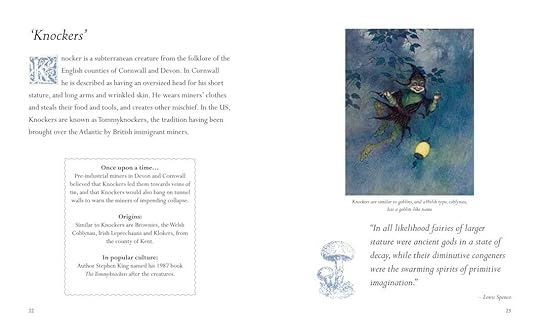
Each fairy gets this - One para about the creature. A short snippet (3-5 lines) about where it was used in fiction, origin in one line, presence in popular culture and an illustration/ photo, and a quote by the authors, actors, etc., about fairies.
That’s it. Rinse and repeat for all of them.
While the list is lengthy and includes flower and plant fairies, tinker bell, ariel (not mermaid Shakespeare’s from Tempest), fairies from folklore, leprechauns, and even plant devas and yakshas from Hinduism, it doesn’t do anything else much.
We at least get a visual representation of the said fairy – sometimes a painting, some pencil sketches, and some pictures (photographs). I didn’t mind the lack of consistency as it seems that they picked the best possible option available on the internet. However, I did very much mind the lack of detail. The ‘tales’ are not even tales, TBH. I’d find more content on online blogs (and I did too).
I’m not annoyed (just disappointed) since I got the ARC for free but I don’t think people would be too happy if they paid for it and found barely any useful information.
To summarize, Fairies is an index of the mythical creatures that broadly come up under the tag of the term fairies. It might work as a starting point (to find a fairy or see if it is what you want) but does nothing beyond that.
Thank you, NetGalley and Amber Books, for eARC. This review is voluntary and contains my honest opinion about the book.
#NetGalley #Fairies
One Liner: Works more like an index
So, the blurb says that the book is a collection of beautiful images and fascinating tales about fairies from various lands and cultures.
Hardly surprising that I requested it right away. I love reading about fairies and mythical creatures (good, bad, and ugly). When I saw the long list in the table of contents, I was delighted. Given the page count and the extensive work involved, I knew it wouldn’t be in-depth. I don’t need it to cover everything.
However, the content is really sparse. Moreover, the focus is more on pop culture usage or appearance of the creatures than their original tales.
Each fairy gets this - One para about the creature. A short snippet (3-5 lines) about where it was used in fiction, origin in one line, presence in popular culture and an illustration/ photo, and a quote by the authors, actors, etc., about fairies.
That’s it. Rinse and repeat for all of them.
While the list is lengthy and includes flower and plant fairies, tinker bell, ariel (not mermaid Shakespeare’s from Tempest), fairies from folklore, leprechauns, and even plant devas and yakshas from Hinduism, it doesn’t do anything else much.
We at least get a visual representation of the said fairy – sometimes a painting, some pencil sketches, and some pictures (photographs). I didn’t mind the lack of consistency as it seems that they picked the best possible option available on the internet. However, I did very much mind the lack of detail. The ‘tales’ are not even tales, TBH. I’d find more content on online blogs (and I did too).
I’m not annoyed (just disappointed) since I got the ARC for free but I don’t think people would be too happy if they paid for it and found barely any useful information.
To summarize, Fairies is an index of the mythical creatures that broadly come up under the tag of the term fairies. It might work as a starting point (to find a fairy or see if it is what you want) but does nothing beyond that.
Thank you, NetGalley and Amber Books, for eARC. This review is voluntary and contains my honest opinion about the book.
#NetGalley #Fairies
July 24, 2024
"Miracles are made of wings you forgot were on your back."
All the fairies, fairies from literature and fairies from folklore, where they came from with pictures and quotes. Nice and Fun read!
Thank you Amber Books for giving me a chance to read Fairies: A celebration of pixies, sprites, mermaids and brownies by Dominic Connolly via NetGalley. I highly suggest reading this on paper as there are beautiful illustrations.
All the fairies, fairies from literature and fairies from folklore, where they came from with pictures and quotes. Nice and Fun read!
Thank you Amber Books for giving me a chance to read Fairies: A celebration of pixies, sprites, mermaids and brownies by Dominic Connolly via NetGalley. I highly suggest reading this on paper as there are beautiful illustrations.

July 20, 2024
Beauty is a fairy; sometimes she hides herself in a flower-cup, or under a leaf, or creeps into the old ivy, and plays hide-and-seek with the sunbeams, or haunts some ruined spot, or laughs out of a bright young face.
Dominic Connolly’s book is soooo beautiful! I haven’t seen an illustrated book that’s so lovely in a long, long time. Connolly has collected dozens upon dozens of old-fashioned fairy pictures. The fairy descriptions prove exhaustive, as Connolly relies not only on folklore but also literature. Here’s a children’s book that adults will treasure even more than their kids do. Highly, highly recommended.
In the interest of full disclosure, I received this book from NetGalley and Amber Books in exchange for an honest review.
Dominic Connolly’s book is soooo beautiful! I haven’t seen an illustrated book that’s so lovely in a long, long time. Connolly has collected dozens upon dozens of old-fashioned fairy pictures. The fairy descriptions prove exhaustive, as Connolly relies not only on folklore but also literature. Here’s a children’s book that adults will treasure even more than their kids do. Highly, highly recommended.
In the interest of full disclosure, I received this book from NetGalley and Amber Books in exchange for an honest review.

September 17, 2024
This is a very good collection on the fairies listed in various literature material and theatre or tv adaptations but mostly from the folklores were real and I can vouch for it. Author had collated most of those fairies listed in his this collection and gave a brief introduction to each. Though I have read of many from literature but one from the folklore I can relate from stories heard too.
That one is "Yakshas". In Hindu culture Yakshas and Yakshinis are hidden supernatural beings who are neither good nor bad but can be based on how you are if you ever meet them. Their true form was so horrific that no one ever wanted to face them upfront.
They are the guardians of the treasure hidden in the earth and resemble fairies. 36 Yakshinis are described in scriptures. It is said that they are the giver of any desirous thing one wants if they seek for their blessings but before that the one who recites chanting rhymes made to call them, must be very aware to not make the mistake of even a letter in it, else the repercussions will not be good.
Overall, this is good one to read know many of these about.
My NetGalley review
That one is "Yakshas". In Hindu culture Yakshas and Yakshinis are hidden supernatural beings who are neither good nor bad but can be based on how you are if you ever meet them. Their true form was so horrific that no one ever wanted to face them upfront.
They are the guardians of the treasure hidden in the earth and resemble fairies. 36 Yakshinis are described in scriptures. It is said that they are the giver of any desirous thing one wants if they seek for their blessings but before that the one who recites chanting rhymes made to call them, must be very aware to not make the mistake of even a letter in it, else the repercussions will not be good.
Overall, this is good one to read know many of these about.
My NetGalley review
July 25, 2024
This is a cute little book about fairy’s but sadly, for me, it didn’t provide much when it came to the stories. The book delves in to the origins of fairy’s in literature and folklore but I just wish there would have been more material.
It probably serves as a good index and the illustrations are gorgeous to look at but it wasn’t really what I expected.
𝙈𝙖𝙣𝙮 𝙩𝙝𝙖𝙣𝙠𝙨 𝙩𝙤 𝙉𝙚𝙩𝙜𝙖𝙡𝙡𝙚𝙮 𝙛𝙤𝙧 𝙡𝙚𝙩𝙩𝙞𝙣𝙜 𝙢𝙚 𝙧𝙚𝙖𝙙 𝙩𝙝𝙞𝙨 𝙗𝙤𝙤𝙠 𝙞𝙣 𝙚𝙭𝙘𝙝𝙖𝙣𝙜𝙚 𝙛𝙤𝙧 𝙖𝙣 𝙝𝙤𝙣𝙚𝙨𝙩 𝙧𝙚𝙫𝙞𝙚𝙬!
It probably serves as a good index and the illustrations are gorgeous to look at but it wasn’t really what I expected.
𝙈𝙖𝙣𝙮 𝙩𝙝𝙖𝙣𝙠𝙨 𝙩𝙤 𝙉𝙚𝙩𝙜𝙖𝙡𝙡𝙚𝙮 𝙛𝙤𝙧 𝙡𝙚𝙩𝙩𝙞𝙣𝙜 𝙢𝙚 𝙧𝙚𝙖𝙙 𝙩𝙝𝙞𝙨 𝙗𝙤𝙤𝙠 𝙞𝙣 𝙚𝙭𝙘𝙝𝙖𝙣𝙜𝙚 𝙛𝙤𝙧 𝙖𝙣 𝙝𝙤𝙣𝙚𝙨𝙩 𝙧𝙚𝙫𝙞𝙚𝙬!

October 8, 2024
I received an advance reader copy of this book to read in exchange for an honest review via netgalley and the publishers.
Fairies is an information book all about the many different types of fairies, pixies, mermaids, sprites, etc. Each double page spread features a basic amount of information about each and an illustration, sketch or photograph, and a quote. I did expect a lot more from this book and I'm sure this is one of those books that is much better in physical format rather than e-book, however I was expecting much more in-depth information for each fae being. This would be a great book for anyone starting out learning about magical beings.
Fairies is an information book all about the many different types of fairies, pixies, mermaids, sprites, etc. Each double page spread features a basic amount of information about each and an illustration, sketch or photograph, and a quote. I did expect a lot more from this book and I'm sure this is one of those books that is much better in physical format rather than e-book, however I was expecting much more in-depth information for each fae being. This would be a great book for anyone starting out learning about magical beings.
September 4, 2024
I would like to thank Netgalley and Amber Books Ltd for a free copy of the book in exchange for an honest review.
This was a nice read, but a bit basic. The cultural references could have done with being a bit more up to date.
This was a nice read, but a bit basic. The cultural references could have done with being a bit more up to date.
January 29, 2026
"I'd like to thank the publisher for providing me with a review copy of the book via NetGalley.
Fairies: A Celebration of Pixies, Sprites, Mermaids, and Brownies is an attempt to provide an overview of fairies and fae creatures across the world from various literature and folklore. Each entry provides a basic overview, some trivia, a sentence about the origin of the fairy type, and a piece of popular culture. The entries also include illustrations or pictures, and each includes a quote related to fairies, sometimes related to the entry but other times not.
The book is divided into two sections; Fairies from Literature and Fairies from Folklore. I'm not sure how successful the break between the two sections is. What is literature and what is folklore? Poets are often brought up in the folklore section, and what is poetry if not literature? Also, the literature section is heavily comprised of Cicely Mary Barker's Flower Fairies (or, at least, it felt that way), which isn't inherently a problem, but I struggled with why the author included the Flower Fairies they did and excluded other or didn't give more of a broad overview. It felt almost as if the Flower Fairies were filling out the page count, which is unfortunate as I felt there were more fairy-type beings that could have been added.
Of course, that brings up the next potential point of contention. Fairies, more or less, are typically anthropomorphic (but not always) wee folk found in European cultures, with the Tuatha De Danann, Aos Si, or Sithe often held up as a framework, in addition to brownies, boggarts, hobs, and other household spirits/sprites. One of the potential pitfalls of books like this is essentially trying to retrofit other distinct cultural folklore spirits into a western European/Celtic framework.
While I think this book actually handled this aspect pretty well, it does bring to question why we have so many flower fairies, but only a few examples of fae-like spirits from the Americas and Africa, or why some of the Asian fae-like spirits were chosen instead of others.
I will say, if the book needed divisions, I would have liked to see the book broken up in a section detailing specific fae individuals (Princess Ozma, Queen Mab, Morgan Le Fay, etc) and another detailing more generic fae types, such as banshee, lanvaettir, dryads, and the like
Overall, I think this is a pretty decent overview of Celtic/western European fae-like spirits with a smattering of spirits thrown in from other cultures. It could have merged the two sections (or done without much of the literature section), but that's a minor quibble. All-in-all, if you're looking for a good-looking fairy field guide-style book to put on an end table or coffee table, this might be a great option for you. If you're looking for depths of information or a good global overview, you may want to keep looking."
Fairies: A Celebration of Pixies, Sprites, Mermaids, and Brownies is an attempt to provide an overview of fairies and fae creatures across the world from various literature and folklore. Each entry provides a basic overview, some trivia, a sentence about the origin of the fairy type, and a piece of popular culture. The entries also include illustrations or pictures, and each includes a quote related to fairies, sometimes related to the entry but other times not.
The book is divided into two sections; Fairies from Literature and Fairies from Folklore. I'm not sure how successful the break between the two sections is. What is literature and what is folklore? Poets are often brought up in the folklore section, and what is poetry if not literature? Also, the literature section is heavily comprised of Cicely Mary Barker's Flower Fairies (or, at least, it felt that way), which isn't inherently a problem, but I struggled with why the author included the Flower Fairies they did and excluded other or didn't give more of a broad overview. It felt almost as if the Flower Fairies were filling out the page count, which is unfortunate as I felt there were more fairy-type beings that could have been added.
Of course, that brings up the next potential point of contention. Fairies, more or less, are typically anthropomorphic (but not always) wee folk found in European cultures, with the Tuatha De Danann, Aos Si, or Sithe often held up as a framework, in addition to brownies, boggarts, hobs, and other household spirits/sprites. One of the potential pitfalls of books like this is essentially trying to retrofit other distinct cultural folklore spirits into a western European/Celtic framework.
While I think this book actually handled this aspect pretty well, it does bring to question why we have so many flower fairies, but only a few examples of fae-like spirits from the Americas and Africa, or why some of the Asian fae-like spirits were chosen instead of others.
I will say, if the book needed divisions, I would have liked to see the book broken up in a section detailing specific fae individuals (Princess Ozma, Queen Mab, Morgan Le Fay, etc) and another detailing more generic fae types, such as banshee, lanvaettir, dryads, and the like
Overall, I think this is a pretty decent overview of Celtic/western European fae-like spirits with a smattering of spirits thrown in from other cultures. It could have merged the two sections (or done without much of the literature section), but that's a minor quibble. All-in-all, if you're looking for a good-looking fairy field guide-style book to put on an end table or coffee table, this might be a great option for you. If you're looking for depths of information or a good global overview, you may want to keep looking."

September 4, 2024
I'd like to thank the publisher for providing me with a review copy of the book via NetGalley.
Fairies: A Celebration of Pixies, Sprites, Mermaids, and Brownies is an attempt to provide an overview of fairies and fae creatures across the world from various literature and folklore. Each entry provides a basic overview, some trivia, a sentence about the origin of the fairy type, and a piece of popular culture. The entries also include illustrations or pictures, and each includes a quote related to fairies, sometimes related to the entry but other times not.
The book is divided into two sections; Fairies from Literature and Fairies from Folklore. I'm not sure how successful the break between the two sections is. What is literature and what is folklore? Poets are often brought up in the folklore section, and what is poetry if not literature? Also, the literature section is heavily comprised of Cicely Mary Barker's Flower Fairies (or, at least, it felt that way), which isn't inherently a problem, but I struggled with why the author included the Flower Fairies they did and excluded other or didn't give more of a broad overview. It felt almost as if the Flower Fairies were filling out the page count, which is unfortunate as I felt there were more fairy-type beings that could have been added.
Of course, that brings up the next potential point of contention. Fairies, more or less, are typically anthropomorphic (but not always) wee folk found in European cultures, with the Tuatha De Danann, Aos Si, or Sithe often held up as a framework, in addition to brownies, boggarts, hobs, and other household spirits/sprites. One of the potential pitfalls of books like this is essentially trying to retrofit other distinct cultural folklore spirits into a western European/Celtic framework.
While I think this book actually handled this aspect pretty well, it does bring to question why we have so many flower fairies, but only a few examples of fae-like spirits from the Americas and Africa, or why some of the Asian fae-like spirits were chosen instead of others.
I will say, if the book needed divisions, I would have liked to see the book broken up in a section detailing specific fae individuals (Princess Ozma, Queen Mab, Morgan Le Fay, etc) and another detailing more generic fae types, such as banshee, lanvaettir, dryads, and the like
Overall, I think this is a pretty decent overview of Celtic/western European fae-like spirits with a smattering of spirits thrown in from other cultures. It could have merged the two sections (or done without much of the literature section), but that's a minor quibble. All-in-all, if you're looking for a good-looking fairy field guide-style book to put on an end table or coffee table, this might be a great option for you. If you're looking for depths of information or a good global overview, you may want to keep looking.
Fairies: A Celebration of Pixies, Sprites, Mermaids, and Brownies is an attempt to provide an overview of fairies and fae creatures across the world from various literature and folklore. Each entry provides a basic overview, some trivia, a sentence about the origin of the fairy type, and a piece of popular culture. The entries also include illustrations or pictures, and each includes a quote related to fairies, sometimes related to the entry but other times not.
The book is divided into two sections; Fairies from Literature and Fairies from Folklore. I'm not sure how successful the break between the two sections is. What is literature and what is folklore? Poets are often brought up in the folklore section, and what is poetry if not literature? Also, the literature section is heavily comprised of Cicely Mary Barker's Flower Fairies (or, at least, it felt that way), which isn't inherently a problem, but I struggled with why the author included the Flower Fairies they did and excluded other or didn't give more of a broad overview. It felt almost as if the Flower Fairies were filling out the page count, which is unfortunate as I felt there were more fairy-type beings that could have been added.
Of course, that brings up the next potential point of contention. Fairies, more or less, are typically anthropomorphic (but not always) wee folk found in European cultures, with the Tuatha De Danann, Aos Si, or Sithe often held up as a framework, in addition to brownies, boggarts, hobs, and other household spirits/sprites. One of the potential pitfalls of books like this is essentially trying to retrofit other distinct cultural folklore spirits into a western European/Celtic framework.
While I think this book actually handled this aspect pretty well, it does bring to question why we have so many flower fairies, but only a few examples of fae-like spirits from the Americas and Africa, or why some of the Asian fae-like spirits were chosen instead of others.
I will say, if the book needed divisions, I would have liked to see the book broken up in a section detailing specific fae individuals (Princess Ozma, Queen Mab, Morgan Le Fay, etc) and another detailing more generic fae types, such as banshee, lanvaettir, dryads, and the like
Overall, I think this is a pretty decent overview of Celtic/western European fae-like spirits with a smattering of spirits thrown in from other cultures. It could have merged the two sections (or done without much of the literature section), but that's a minor quibble. All-in-all, if you're looking for a good-looking fairy field guide-style book to put on an end table or coffee table, this might be a great option for you. If you're looking for depths of information or a good global overview, you may want to keep looking.
August 10, 2024
This book is a great introduction to fairies throughout history, from literature and from world cultures. It is a book for all ages with some beautiful examples of artwork and illustration. I particularly liked that there were examples from all over the world. Often books on fairies focus just on the Celtic fairies.
The format divides the fairies into two sections; Fairies from Literature and Fairies from Folklore. Each example is supplied with references to its origin, references in literature and popular culture. There is an image with each example and a quote. This is perfect for children as it offers small tidbits of information and then things they can go away and find out more from the references.
This is a beautiful book. I made lots of notes as I read in order to learn more from folklorists and writers. I will definitely order a copy in hardback to add to my folklore collection.
I would like to thank NetGalley and Amber Books for the opportunity to read this advance copy. All opinions are my own.
The format divides the fairies into two sections; Fairies from Literature and Fairies from Folklore. Each example is supplied with references to its origin, references in literature and popular culture. There is an image with each example and a quote. This is perfect for children as it offers small tidbits of information and then things they can go away and find out more from the references.
This is a beautiful book. I made lots of notes as I read in order to learn more from folklorists and writers. I will definitely order a copy in hardback to add to my folklore collection.
I would like to thank NetGalley and Amber Books for the opportunity to read this advance copy. All opinions are my own.
July 9, 2024
An overview of many of the types of fairies found in folklore, shown alongside some of their appearances in art through the years and in modern culture. It’s a very basic introduction without much information but makes a nice little reference book. There are some lovely works of art included (although it seemed strange not to include many of the Flower Fairy illustrations by Cicely Mary Barker when they play such a big part in the text) and some good quotes too. Unfortunately the e-book version of this I received was rather poorly laid out and disjointed – perhaps it works better as a hard copy since it seems to be designed in a way more suited to the format.
Thanks to Netgalley and the publisher for an advance coy in return for an honest review.
Thanks to Netgalley and the publisher for an advance coy in return for an honest review.
July 18, 2024
I read this courtesy Net Galley and Amber Books. Fairies are all over the world, and this enchanting book discusses a few. Author Dominic Connolly breaks down fairy origins and abilities and gives some examples of how those fairies have been used in popular media over time. The author tells the reader the stories behind famous fairies such as Shakespeare’s Titania and JM Barrie’s Tinker Bell and what kind of fairies they are. Fairies, we are told, come from folk beliefs and have been everything from demoted angels or demons and pagan deities, spirits of the dead, and spirits of nature. This charming book comes complete with illustrations from classic painters, and is an enjoyable read.
#Fairies #NetGalley #CampNetGalley
#Fairies #NetGalley #CampNetGalley
March 3, 2025
2.5/5 Stars
A big thank you to NetGalley, Amber Books and Dominic Connolly for the opportunity to read and review this book!
What a well-researched, broad and delightful resource. I really appreciate the very apparent time and effort Dominic put forth and although it wasn't quite what I was expecting I could tell this was a passion project and I am glad it got out there. I think the calling it a celebration was a bit heavy-handed as it served, as pointed out by other reviewers, as more of an index than a true, focused celebration. I think for anyone with a broad interest in different types of fairies it serves as a good starting point
A big thank you to NetGalley, Amber Books and Dominic Connolly for the opportunity to read and review this book!
What a well-researched, broad and delightful resource. I really appreciate the very apparent time and effort Dominic put forth and although it wasn't quite what I was expecting I could tell this was a passion project and I am glad it got out there. I think the calling it a celebration was a bit heavy-handed as it served, as pointed out by other reviewers, as more of an index than a true, focused celebration. I think for anyone with a broad interest in different types of fairies it serves as a good starting point
April 28, 2026
Not sure how this book got published or if the author had a hook up or is popular from something else. This book is a loose collection of random fairies, random quotes and a paragraph describing each fairy with the depth of a puddle. Some of the creatures in this book are not even closely related to fairies/pixies/nymphs.
Some of my favorite quotes from this work include:
“Coincidentally there is a cherry blossom variety of fairy washing up liquid”
“Videos of cicely Mary barkers books being flicked through now abound on YouTube”
As an academic text: sucks
As a bestiary: sucks
As an informative or entertaining text for school children: sucks.
Seriously who tf was this book for?
Some of my favorite quotes from this work include:
“Coincidentally there is a cherry blossom variety of fairy washing up liquid”
“Videos of cicely Mary barkers books being flicked through now abound on YouTube”
As an academic text: sucks
As a bestiary: sucks
As an informative or entertaining text for school children: sucks.
Seriously who tf was this book for?

July 9, 2024
Thank you, Amber Books Ltd | Amber Books & NetGalley for the chance to review this book and give my honest review!
It is an interesting collection of artwork, myths, stories and histories that show different faeries from different cultures and how there is not one image of a faerie but many.
The examples of faeries I originally didn't associate with being faeries were shocking. But I guess in a way Faeries can be a class of species in the supernatural world.
It is an interesting collection of artwork, myths, stories and histories that show different faeries from different cultures and how there is not one image of a faerie but many.
The examples of faeries I originally didn't associate with being faeries were shocking. But I guess in a way Faeries can be a class of species in the supernatural world.

August 24, 2024
This book contains many fairies I had never heard of, so in that way, it is rather expansive. The information, however, is very light, with just a few facts on each.
The main thing that jarred me was the different styles of images for each fairy: some photos, others illustrations. The artwork didn't follow the same theme and feel, which made the book feel a bit messy and disjointed.
*Temporary e-copy received via Netgalley in exchange for an honest review
The main thing that jarred me was the different styles of images for each fairy: some photos, others illustrations. The artwork didn't follow the same theme and feel, which made the book feel a bit messy and disjointed.
*Temporary e-copy received via Netgalley in exchange for an honest review
September 29, 2024
Less a collection of fascinating tales and more an index of different fairy types, this book is an interesting read nonetheless.
Filled with charming illustrations and information such as the origin and from what pop culture the fairy (or fairy like folk) are from.
This is almost a gateway book into the world of mythical beings and cryptozoology that fascinates so many of us.
Thank you NetGalley and Amber books ltd for my advanced reader copy.
Filled with charming illustrations and information such as the origin and from what pop culture the fairy (or fairy like folk) are from.
This is almost a gateway book into the world of mythical beings and cryptozoology that fascinates so many of us.
Thank you NetGalley and Amber books ltd for my advanced reader copy.
July 26, 2024
This book was a delightful escape into a magical world. It dives into the fascinating realm of fairies, giving readers a mix of folklore, stunning illustrations, and engaging storytelling. Connolly's writing style is approachable and captivating, making it easy to get lost in the enchanting tales. If you're looking for a light and whimsical read, this book is definitely worth picking up.
February 26, 2026
I expected more but definitely should have read more than the first page before deciding i wanted to read. The cover was too cute though.
September 14, 2026
working on upping my mythology game
September 15, 2026
Mostly a lot of garbage.

September 22, 2024
I wanted to love this book so much. It just fell a little flat for me. When I saw the extensive list of fairyin the beginning I was so excited, but there just wasn't very much information. Some of the entities listed I wouldn't count as fairies, but it is very diverse. So many cultures are included, but I feel like I would have enjoyed this more if it included less fairies and more information. Maybe save some of them for a second book? It focuses on pop culture a lot which is really neat, but again some of the references were very obscure.
3 stars
3 stars

July 9, 2024
Thank you to the publishers - Amber Books Ltd and Amber Books – for giving me access to this book as an E-ARC via Netgalley. All opinions are my own.
A nice little compendium of different fairies both in fiction and folklore. It could provide a good start for a child who is interested in learning more about folklore. For a person who has a basic comprehension of folklore, myths and the like it might a bit too basic but never the less, a good book to start with for the absolute beginner.
Nice art featured inside.
A nice little compendium of different fairies both in fiction and folklore. It could provide a good start for a child who is interested in learning more about folklore. For a person who has a basic comprehension of folklore, myths and the like it might a bit too basic but never the less, a good book to start with for the absolute beginner.
Nice art featured inside.
Displaying 1 - 23 of 23 reviews