Many of the earliest books, particularly those dating back to the 1900s and before, are now extremely scarce and increasingly expensive. Hesperides Press are republishing these classic works in affordable, high quality, modern editions, using the original text and artwork.
Lev Nikolayevich Tolstoy (Russian: Лев Николаевич Толстой; most appropriately used Liev Tolstoy; commonly Leo Tolstoy in Anglophone countries) was a Russian writer who primarily wrote novels and short stories. Later in life, he also wrote plays and essays. His two most famous works, the novels War and Peace and Anna Karenina, are acknowledged as two of the greatest novels of all time and a pinnacle of realist fiction. Many consider Tolstoy to have been one of the world's greatest novelists. Tolstoy is equally known for his complicated and paradoxical persona and for his extreme moralistic and ascetic views, which he adopted after a moral crisis and spiritual awakening in the 1870s, after which he also became noted as a moral thinker and social reformer.
His literal interpretation of the ethical teachings of Jesus, centering on the Sermon on the Mount, caused him in later life to become a fervent Christian anarchist and anarcho-pacifist. His ideas on nonviolent resistance, expressed in such works as The Kingdom of God Is Within You, were to have a profound impact on such pivotal twentieth-century figures as Mohandas Gandhi and Martin Luther King, Jr.
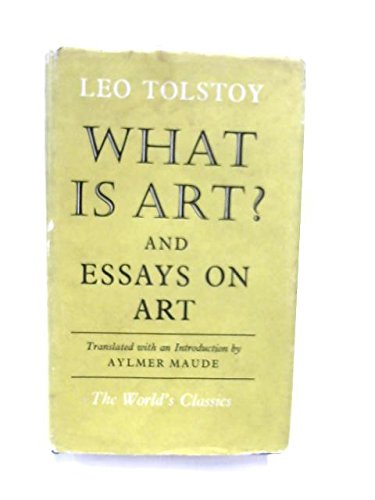
ottom Line: Tolstoy's "What is Art" contains an earlier draft and a final extended essay by the author of several of the world's greatest novels. He grapples with the question of what he thinks should be considered as art. Art he believes should not merely be pretty or entertaining. Art must be the original, inspired product of a naturally superior, creative person. It must clearly express the unique emotional message of a person who has experienced a spontaneous, and unique creative moment. This expression must be so created as to be immediately understandable by any person, without that person needing any training to appreciate the artistry behind the expression. In all cases, Art to be art must further the religious beliefs common to the time and place where the artist is inspired. Despite the masterful language and forceful passion of this literary master, I am not convinced by his argument.
As a reading experience, this book is very successful as a display of powerful writing. Tolstoy bears his heart and his point of view. I do not find his argument consistent or consistently convincing. This is great writing, but intended for a limited audience. It not intended as a pleasurable reading. Your experience of this book will vary depending on your need to be in agreement with an author and your ability to appreciate writing even if the conclusions proposed are ones with which you cannot fully agree.
Much of what Tolstoy writes reads like a garrulous old man complaining about "modern art". Once you realize that he is complaining about the likes of Beethoven, Richard Wagner, all of ballet, every art school and almost every novelist, you begin to realize that every generational change in art has produced the same arguments against trends then occurring in art. Further, Tolstoy is in favor of a communist, religious world such that no one has the chance to live in comfort. Everyone must be directly engaged in the daily struggle to survive and art cannot come from anyone who is not living a life of such struggle. In passing note that Tolstoy had lived the life of a rich, titled, dissipated Russian noble, before promoting a mystic Christian communism.
He has a number of unbending absolutes. Art cannot be created in more than one media. Opera is a combination of poetry and music and therefore cannot be art. Any training in the craftsmanship needed to produce art is destructive of art because it promotes imitation. Imitation is always the opposite of art. All art must be a unique expression.
When Tolstoy speaks to the absolute necessity of art to further religion he is not as absolute. He accepts that religious beliefs change over time and culture. Therefore the artist cannot be expected to be ahead of these changes. But many religions, including modern Christian beliefs are corrupted and depend on imitative and false art. Further, to be art, people from all cultures have to be able to appreciate the intended message of the artist.
Rather than a point for point discussion of all that Tolstoy has written I shall summarize with a few points. I had bought this book hoping to get ideas about how to better appreciate the work of, in particular the work of a great writer. This book was not written to my purposes. I find enough with which to agree that I cannot dismiss all of what the great man has written. The art to which Tolstoy would have us limit our attention would be simplistic, short, and often maudlin and only from the so called primitive crafts of untrained artisans. There is no respect for the large scale, complex or ambitious person with an inspiration beyond making some simple country dance or fireside story. Many will cheer the end of all forms of artistic pretense or snobbery. Ultimately I think his vision is for a narrow and repetitive world of religiously dominated and controlled, false art
The rating is solely because I couldn't finish it - I'm sure it's a great essay. But the translator actually wrote, at the beginning of chapter three, that "many readers skip this chapter". I did, and then figured that I might as well skip the rest of the book as well.... The portion I read was a discourse on the philosophical meaning of aesthetics.
Perspective intéressante où l'art ne serait qu'un moyen de transmettre les émotions entre les individus. L'auteur cultive l'universalité et l’accessibilité de l'art, point de vu axé sur la morale chrétienne ce qui à l'image de Tolstoi.
Art. What is art, after all. I have wondered about art and considered everything made: art. I find it difficult to just know what is and isn't art. What makes 'good' art and what makes 'bad' art? I've never did find a conclusion to that... It just was, all the time and this book, even if I had a lot of difficulties with it, made me think about it. I didn't get to an actual conclusion at the end of the book, but that doesn't make this a bad book or it doesn't say this book isn't art itself. I'm still trying to get to the idea of it all. Does art make you feel anything or is an emotion 'bad'? Is art everything or are there restrictions?
This book was good, for what I understood of it. Like I said, it did make me think about stuff I hadn't made a point to think about, which is good, because a book that makes you stop and just wonder about what is written, about the subject is a good book. Sometimes what was written didn't get to be understood by my mind, it was like I couldn't get to the core of what was written. It may be because it was my first essay-non-fiction type of read. I'm more into fiction, but the subject interested me, plus I love the idea of non-fiction, helps with knowledge of a subject and art is one of those subject I would like to know more about.
I'm still not sure what a great artist is, what great art is, but I know that whatever comes alive under your eyes, under the brush, the pen, the what-ever... It must be art! Or so I think.
As for the book, it was interesting, some places made me pause the book, not because it was bad, but because the sentence made me think, made me stop and wonder and pause and reflect on it.I don't believe many words were too difficult for my knowledge of English, but some sentences I found troublesome. It may be the way it was written or even the subject. I had never read an other book on art before. Because of that, I don't have anything to compare the book to. It was good on a first read and I'm sure I'll read it again, because I still find some concept of the book difficult and I forgot most of the interesting concepts because of the language.
Game on pause. I will understand you, Leo Tolstoy's book on art, I will.
An engaging, readable, but controversial essay on art by Tolstoy. Basically, Tolstoy adopts a moralist view on art: art is that which transmits feelings, in particular elevated feelings of the brotherly union of mankind. These feelings must be transmittable to anyone, and so a true work of art is always understandable to all. This view has such radical implications that, in Tolstoy's words, 99,999 of 100,000 artworks are not actually works of art at all. All of Tolstoy's books are bad or even mere counterfeit works of art, except two short stories about God. He does like Dickens and Hugo, and some Chopin, but they are part of a very select few 'universal artists'. I think Tolstoy's essays are very readable (his writing style is not too shabby) and they all provide food for thought. However, I believe Tolstoy's most contentious theory is that humanity is in persistent progress, progress which is guided by religious perception, and which, by virtue of being 'progress', justifies whatever religious perception we may currently have as a society. Do we all share a religious perception? Is humanity progressing? Would that progress be guided by this perception? These are all questions to which Tolstoy owes a thoughtful answer.