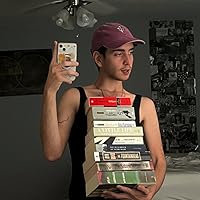
I received this book through Goodreads' giveaway. It came in today and I read it... today. Duh. Anyways. It's not a polished collection quite yet so keep that in mind.
Overall, it seems like a solid collection of poetry. It plays more with space and form than it does with language and imagery. I don't think this is something I'd read if it hadn't been given to me, as it's not my cup of tea in the end, but I'd recommend this for 1. fans of hers who aren't too into reading but love her work and her style, and her as a whole 2. a teenage girl or 3. a person who isn't too into poetry and wants an easy read as a first step in.
Yeah, I'd consider this more "basic" in the world of poetry. I'd place it a couple steps up from Rupi Kaur and her insta-poetry, as Marina actually puts thoughts into her work and not just inspirational quotes she heard elsewhere but reworked. The literal images Marina uses are also interesting in their own right, although the style of publishing makes some of them extra distorted, which I think was on purpose, but I do wish some were clearer and sharper.
Now, because this is unfinished, I can't share direct quotes, but I do want to allude to a couple things. (I also want to mention that I write poetry, so there will be comparisons to what I have done within my own work so I can give explicit examples)
First things first: page numbers are not consistent. I would say just under half the book does not have a page number, which is unfortunate, as the table of contents lists them.
Marina does play with form and spacing, but it doesn't seem super intentional. There are parts where she could have made small mental images through hyper-alignment, or making the poem look jagged to emphasize just how not-smooth her life was. As this alluded second poem exists about a quarter into her book and looks visually similar to others at the start, which is to say it's already a bit jagged all over; it doesn't stand out. For example, she has one where she spaces out the word "down" vertically. So I feel like she knows what I'm talking about, she's just not utilizing it where I wish she was.
There's a trend of not capitalizing in poems. I admit guilt here too. But Marina is found a couple of times to capitalize the start of "sentences" but not "I" as a pronoun. Minor gripe. I don't like it unless it's intentional. For example, one poem I wrote has a subject "talking" and each word they speak is Captialized At The Front, except when it starts to devolve and show his selfishness. Then the "I"s, when said in repetition, are lowercase to bring attention to the "i" and help visually show how he wants all the attention. (The same goes for punctuation. She'll use periods at the end of one "sentence" but not another. Or commas to separate one list and then three stanzas down, the list just runs together)
Basically, I wish there was more obvious intention behind her playing with form and spacing.
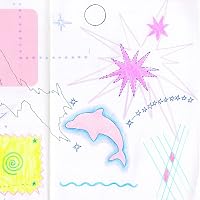
HOWEVER! She does get really playful with it by incorporating images and moving her words around them, and I think it's great. I don't think she has a purpose necessarily for it so much as it looks cool, but sometimes that's all the form is. Just cool. I just prefer intention when form is messed with. Personal preference, obviously.
There are a few areas where I believe Marina could tighten up her language to have a stronger effect. One poem could lose the last word and the last three lines would read with a small slant rhyme that would drive the impact home. In another, she mentions two holidays because they share a popular dinner dish. I think ditching the specifics of the dates and moving more into the food item and what occurs around it, rather than the date it falls upon, would tune in better to what she's working towards.
Alongside language is imagery. A lot of her analogies are rather cliche, however I will acknowledge that they don't come across as super cliche in the moment. She works them in well. However, she also makes very odd analogies that I don't understand. I think walrus bones were mentioned once and I still don't understand the use of that mental image. There's also one where the last two lines feel tacked on to make it feel more artsy (literally refers to art) but doesn't seem to actually mesh with the previous text, which really jarred me out of my enjoyment of it.
I'd also love to see more creative titles. They're very obvious to the poem, which is fine, but some are literally just the last line reworded. It's fine, it's just not... fun. I guess. Although I may be too influenced by 2000s emo boy bands (particularly Fall Out Boy).
I do want to end on a good note:
Million Tiny Knives had a great rhythm and I thoroughly enjoyed reading it. Out Of Production also deserves that sort of accolade. They both utilized irregular rhyme, nearing the rap style (where multiple rhymes can exist at the same time, and may exist within the same line), and it's probably my favourite style to read as it's just so fun and you can really hammer home some strong concepts, especially when read out loud. I guess it makes sense that the ones that work really well verbally are my favourites, as she is a singer and songwriter after all.
She has a few more with great rhythm without overbearing rhymes, but I'm not a fan of the content within those particular pieces, so while I enjoyed the experience, I didn't enjoy the poem. But that's personal taste in subject matter.
To me, Cocoon feels like it is the most intentional in form and in visuals, with a solid poem to go with it. If the rest of the book gave me the same feeling as Cocoon, I'd have few qualms about it. It feels like it was the one that succeeded most in what Marina set out to do with publishing these. It plays heavily with form, with word (and letter!) placement, with the integration of literal images... it's visually fun and interesting. And the imagery within the poem is consistent, well-placed, and well-written. She even plays with word choice for double meanings! While not my favourite poem, I think it's the most successful poem.
TLDR: Marina plays with form a lot, but it doesn't feel like a lot of the choices were intentional for the sake of elevating the poem but for the sake of making it look more like a modern poem. She uses a lot of cliches in her imagery, but it doesn't feel cliche in the moment because it works well. However, she sometimes tacks on extra imagery that doesn't seem to fit within the piece for the same of having it, and it knocks my shoes off in a bad way. And she writes really great rhythmic pieces, which doesn't really surprise me.
And, if it wasn't obvious, if I had to suggest one poem to show off what Marina is capable of, I'd pick Cocoon. It's not a great representation of the collection as a whole, but it showcases just how strong of a poet she can be/is.
Overall, it's a perfectly fine time. I truly think someone not super into poetry would enjoy this, and I do think it would encourage them to explore poetry more as well. Those already into poetry may also enjoy this collection, I just don't expect it to be shown in any poetry-exclusive class modules, although I wouldn't argue if Cocoon appeared somewhere.
So yeah! I hope this all makes sense :D