Within ten years of the NHS being launched infant mortality declined by 50 percent.
Death by infectious disease declined by 80 percent.
Every year the NHS makes over 590 million contacts.
Aneurin Bevan left school at thirteen and worked as a miner in Wales. Ernest Bevin left school at eleven and rose through the ranks as a union leader. Herbert Morrison left school at fourteen and rose to prominence through local government.
Not many cabinet ministers can hold a candle to those ministers of that 1945 Labour government.
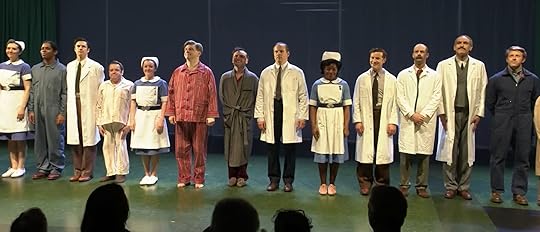
Nye is an excellent play! It is sad, moving, and also funny.
These are my favourite scenes:
1. Nye: I’ll read poetry. Philosophy. The classics. I’ll learn about science! History. Economics. Politics. Marx. Engels. Dialectical materialism. Socialism. Class struggle! Ideological control!
2. Nye: I can visualise the words coming. And I can enunciate them.
3. Nye: No no no, not a strike. Not a strike. The working classes will c-uh unite around an event. Gwen: A strike? Nye: An industrial confrontation. Gwen: Like a strike. Nye: An event that disrupts relations. Gwen: A strike. Just say a strike. It’s a strike.
*These scenes do not make sense unless you have read the play!
Compromise also has an interesting role in the play. Bevan (not Bevin, I always get the two mixed up!) did not compromise the ends but he did the means:
1. The new National Health Service was to be launched on the 5th July with or without the doctors.
2. However, Bevan compromised on health representatives on the boards, consultancy outside the NHS contracts, and the buying and selling of GP surgeries within the healthcare system.
There are only two adjustments that I would make:
1. I thought that the portrays of Churchill and Herbert Morrison were a bit cartoonish.
2. Maybe a bit on the post-1945 Labour government years? There is this scene in the play in which Churchill argues that Bevan is trying to destroy the solidarity of the doctors' union with concessions; Bevan replies: 'concessions, Winston, or compromises?'. However, Bevan exacerbated the split in the Labour Party between the right and left, which weakened the party in the 1950s.
And what about the future of the NHS? It was recently its 77th birthday. However, there are problems! By 2010, overall satisfaction with the NHS was 74 percent and around 2.5 million people were waiting for hospital treatment (and only 7,000 for more than three months). By 2023, satisfaction was 24 percent and around 7.8 million people were waiting for hospital treatment!
Can this Labour government reverse this? Spending on the NHS under the New Labour governments was 34 percent (as a percentage of GDP); however, it is projected to be 49 percent by the end of the 2020s.
Does the UK risk becoming a country with a health service attached to it? And what is the alternative? An insurance-based system? I hope not.