Jump to ratings and reviews
Rate this book

The Clock in the Sun: How We Came to Understand Our Nearest Star

Rate this book
Winner, 2025 Choice Outstanding Academic Title

On the surface of the Sun, spots appear and fade in a predictable cycle, like a great clock in the sky. In medieval Russia, China, and Korea, monks and court astronomers recorded the appearance of these dark shapes, interpreting them as omens of things to come. In Western Europe, by contrast, where a cosmology originating with Aristotle prevailed, the Sun was regarded as part of the unchanging celestial realm, and it took observations through telescopes by Galileo and others to establish the reality of solar imperfections. In the nineteenth century, amateur astronomers discovered that sunspots ebb and flow about every eleven years―spurring speculation about their influence on the weather and even the stock market.

Exploring these and many other crucial developments, Pierre Sokolsky provides a history of knowledge of the Sun through the lens of sunspots and the solar cycle. He ranges widely across cultures and throughout history, from the earliest recorded observations of sunspots in Chinese annals to satellites orbiting the Sun today, and from worship of the Sun as a deity in ancient times to present-day scientific understandings of stars and their magnetic fields. Considering how various thinkers sought to solve the puzzle of sunspots, Sokolsky sheds new light on key discoveries and the people who made them, as well as their historical and cultural contexts. Fast-paced, comprehensive, and learned, The Clock in the Sun shows readers our closest star from many new angles.

336 pages, Hardcover

Published October 8, 2024

Loading...
Loading...

About the author

Ratings & Reviews

What do you think?
Rate this book

Friends & Following

Create a free account to discover what your friends think of this book!

Community Reviews

5 stars
7 (46%)
4 stars
7 (46%)
3 stars
1 (6%)
2 stars
0 (0%)
1 star
0 (0%)
Displaying 1 - 8 of 8 reviews
Profile Image for Nataliya.
1,011 reviews17.2k followers
October 15, 2024
It took me quite a while to read this book, and it’s entirely my fault. I recall very little from those physics classes taken a few decades ago, and so it was a poor choice for sleepy reading before bed. It required actually paying attention, and once I was able to commit to it properly it ended up quite interesting.

Even the Sun has spots, the saying goes — but how much did I actually know about sunspots before this book? (Very little, it turns out) And as a matter of fact, how *do* we actually know what we know about the Sun? How did we go from a deity in the Sun to seeing it as a light source attached to the celestial firmament to understanding it as the incandescent ball of gas (or - correction, sorry - plasma?)
(Speaking of incandescent gas, this book deserves an extra star just for introducing me to this song:

”The sun is mass of incandescent gas,
A gigantic nuclear furnace
Where hydrogen is built into helium
At a temperature of millions of degrees.”


And a correction re: plasma separately recorded by They Might Be Giants:

The sun is a miasma
Of incandescent plasma
The sun's not simply made out of gas
No, no, no
The sun is a quagmire
It's not made of fire
Forget what you've been told in the past
)

This is the story of how we came to understand what we know about the Sun, including those mysterious sunspots (which certainly became less mysterious once I was done with the book, although not less fascinating). It starts heavy on history and slowly becomes heavy on science and solar physics. We go through astronomic observations in Ancient China, Ancient Greece, Mesopotamia; the transition from the Christian Church view of the Earth in the center of the world, heavily influenced by Aristotle, to the heliocentric view, and eventually to the modern understanding of the Universe. There are extensive quotations from the astronomers of the past, and it’s fascinating to hear their voices in this way, with quite a bit of context.

The sunspots, those seeming imperfections in what was supposed to be perfect, had a periodicity to them, the titular clock in the Sun. Of course we humans would immediately want to assign all kinds of things to be the consequence of solar cycle, from weather to economy to business cycles, and Sokolsky spends quite a bit of time analyzing those theories. All while the solar wind, the consequence of magnetic field of the Sun, reaches all the way to us, causing pretty auroras among other things.

And by the end the science is heavier, with spectroscopy and solar neutrinos and magnetic dipoles and the behavior of magnetic fields in plasma and solar wind. Sokolsky does not shy away from the science, even including an appendix on electromagnetic fields and atomic spectra, but he manages to stay just on this side of comprehensible.

Rounding up to 4 stars. I learned a lot, and it was actually interesting.

__________
Thanks to NetGalley and Columbia University Press for providing me with a digital ARC in exchange for an honest review.

——————

Also posted on my blog.
16 reviews
Read
October 11, 2024
"You cannot see My face; for no one shall see Me and live." Pierre Sokolsky quotes from Exodus in the introduction of his book, drawing the extended analogy of Sun as god. Indeed, for most cultures in history the Sun was an actual god, and the Medusan idea expressed in this verse from Exodus probably struck us originally embedded in its blinding rays. And yet humanity has not only looked at the face of the Sun but has even made a study of its blemishes. These dark areas, called sunspots, appearing and disappearing with regularity on our star's surface, have turned out to be manifestations of phenomena with biblical potential. The Clock in the Sun tells the fascinating history of solar physics and how we came to understand these mysterious spots.

You can read the rest of my review on Open Letters Review:
https://openlettersreview.com/posts/t...
Profile Image for Simms.
605 reviews17 followers
September 28, 2024
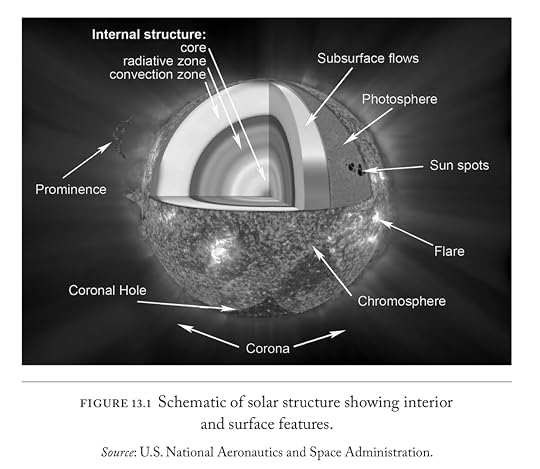
Pretty good! I have read more than my fair share of astrophysics and cosmology, but a lot of the details discussed here were new to me. That does mean that it's quite possibly a pretty niche book, to be fair. But it's worth reading for anyone who's interested in that particular niche. I just wish the ARC I was reading had fewer broken/placeholder diagrams - I bet I would have followed the finer points a lot better with the proper visual aids.

Thanks to NetGalley and Columbia University Press for the ARC.
Profile Image for Tim Pendry.
1,239 reviews519 followers
October 31, 2025

This is what popular science should always be - a coherent and non-patronising account of its subject, unafraid to be difficult when it is necessary rather than communicate a half truth because it might make the subject more 'accessible' to the average reader.

What we have here is a history of science as well as an account of what we think we know about the Sun, some of it more certainly and some requiring further research or confirmation. It is our own star in a vast universe of such stars far beyond our human imagining.

The history of our knowledge is impeccably laid out and chronological. We travel through civilisation until we reach our current state of knowledge. The clock in the title indicates a remarkable electro-magnetic regularity (including an 11-year solar cycle).

Sometimes, the non-specialist may get a little lost in the detail but, no worries, the coherence of the underlying narrative means that this necessary complexity can be passed through without the wider narrative being lost. The difficult material is always there to explore later.

In the interstices of the history and the science, Sokolsky (an astro-physicist in his own right) gives plenty of space to what we humans have tried to do with our knowledge as it unfolded, in particular surmising a link between sunspot activity and the weather or such social events as business cycles.

Although, being a good scientist. he is not dismissive of reasonably cogent hypotheses, he concludes, probably to the satisfaction of most readers, that any link is highly tenuous at the human scale although there may well be such effects in terms of ice ages.

One intriguing idea is that a solar-generated cooling (which may be on the way) is not expected to do more than mitigate insufficiently the general trend to presumed anthropogenic global warming although I would not put it past sun and volcanoes combining to surprise us!

The sun itself is not going to go out in a matter of a few thousand years as some Victorians believed, according to what was known then, but will continue for billions. However, changes in its makeup will inevitably make life intolerable for humans in a few hundred million.

Few species have survived anywhere near as long and none that are complex so we are likely to have other survival concerns long before then but Elon Musk may have a point that our future may eventually have to involve migration outwards to Mars and the other stars.

The main risk to us is, in theory but probably not in reality, not something existential to our species but to our civilisation given that solar flares with their surges of electro-magnetic energy could have a devastating effect on the digital economy we are building for ourselves.

In fact, the earth remains reasonably protective of us and our equipment. Satellites are vulnerable (a significant element in our communications structure) and I would not want to be in a commercial aircraft flying over the Arctic during a major solar storm but there is no reason for panic.

Space weather forecasting has also become increasingly effective so any serious potential effects should be mitigated fairly easily. Science has progressed far since the uncovering of the solar wind as late as the 1950s.

Regardless of all that, this book cannot be recommended highly enough to anyone who wants a single volume account of the state of solar science at the end of the first quarter of the twenty first century or to anyone who wants a case study on the exponential increase in our knowledge of the world.
14 reviews4 followers
November 17, 2024
This review is based on a ARC from Netgalley.

This is a comprehensive exploration of the scientific journey to understand the Sun. The book traces the history of solar studies, from early observations to the latest advancements in solar physics. As a theoretical and mathematical physicist, I will evaluate the scientific rigor, depth of theoretical content, and overall contribution to the field presented in this work.

Sokolsky’s narrative is rooted in a solid understanding of solar physics. The book effectively covers the fundamental processes governing the Sun's behavior, such as nuclear fusion, solar magnetic fields, and helioseismology. The descriptions of these processes are precise, aligning with current scientific consensus and incorporating recent research findings.

One of the strengths of "The Clock in the Sun" is its contextual richness. Sokolsky adeptly weaves the historical development of solar studies with biographical sketches of key scientists, providing a narrative that is both educational and engaging. The book highlights the interdisciplinary nature of solar research, showing how advancements in physics, astronomy, and technology have converged to deepen our understanding of the Sun.

Sokolsky also touches on the practical implications of solar research, such as its impact on understanding climate change and developing space weather prediction models. These sections underscore the broader significance of solar physics in addressing contemporary scientific and societal challenges.

I found Sokolsky’s writing clear and engaging, making complex topics accessible without overly diluting the scientific content. The use of analogies and illustrative examples helps demystify intricate solar processes for a general readership. However, this approach may occasionally frustrate readers with a strong background in theoretical physics who are looking for more detailed and technical discussions.

From a critical standpoint, while the book excels in providing a broad and accessible overview of solar physics, it could enhance its appeal to a specialised audience by incorporating more detailed theoretical and mathematical analyses. Expanding on the advanced models and quantitative aspects of solar phenomena would provide a deeper understanding for readers well-versed in the field.
220 reviews6 followers
July 13, 2026
The Clock in the Sun: How We Came to Understand Our Nearest Star is a captivating and meticulously researched exploration of the history of humanity's understanding of the Sun. Pierre Sokolsky masterfully traces the evolution of solar knowledge across civilizations, demonstrating how observations, cultural beliefs, and scientific inquiry gradually transformed one of humanity's oldest mysteries into one of astronomy's most fascinating fields of study.

One of the book's greatest strengths is its seamless integration of scientific history with cultural and intellectual history. From early observations recorded in China, Korea, and medieval Russia to Galileo's telescopic discoveries and the emergence of modern solar physics, the narrative reveals how changing methods of observation and evolving worldviews shaped our understanding of the Sun and its remarkable cycles. This broad historical perspective makes the scientific journey both accessible and deeply engaging.

The book skillfully explains the significance of sunspots, solar cycles, and magnetic activity while placing these discoveries within the wider development of astronomy and scientific thought. By connecting ancient interpretations with contemporary space-based observations, Sokolsky demonstrates the remarkable continuity of humanity's curiosity about the cosmos and the enduring value of scientific exploration.

Written with exceptional clarity, historical depth, and scholarly precision, The Clock in the Sun makes a significant contribution to the history of science, astronomy, and scientific communication. It is an outstanding resource for historians, educators, astronomy enthusiasts, students, and readers seeking a richer understanding of how centuries of observation and discovery have shaped our knowledge of the star that sustains life on Earth.
Profile Image for Michael Drew.
226 reviews5 followers
September 13, 2026
The Clock in the Sun turns the seemingly narrow subject of sunspots into a sweeping history of how humanity learned to understand the Sun.
Pierre Sokolsky connects observations across China, Russia, Korea, Europe, and the modern scientific era, showing how ideas about the Sun changed across cultures and centuries.
The book's strongest feature is its use of the solar cycle as a thread connecting astronomy, physics, history, culture, and even economic speculation.
Its accessible treatment makes sophisticated developments in solar astronomy approachable without losing their historical and scientific significance.
Its recognition as a 2025 Choice Outstanding Academic Title further reflects the book's value as both scholarship and accessible science.
Profile Image for Nemo.
51 reviews1 follower
June 4, 2024
This is a fun and interesting read. A good choice of book, even if you are just mildly interested in the subject.
Displaying 1 - 8 of 8 reviews