Jump to ratings and reviews
Rate this book

Siege at Peking

Rate this book
On June 20, 1900 the foreign legations at Peking were attacked by Boxers and Imperial Chinese troops, with the equivocal support of the Empress Dowager, Tz'u Hsi. The ensuing siege was to last for 55 days, and the news of it shook the world. The Siege of the Legations was a landmark in the development of Modern China. It brought to a head the crisis in the Celestial Empire's relations with the outside world. Its outcome exacerbated the decline of the Empire and the Manchu dynasty which had ruled China since 1644. Peter Fleming, epitome of the enlightened gentleman explorer, traveled extensively in China and Central Asia as a correspondent of The Times (London) early in the 1930s. He interviewed survivors of the siege, and his report is as vivid today as when first published.

261 pages, Hardcover

First published January 1, 1959

4 people are currently reading
138 people want to read

About the author

Peter Fleming

33 books48 followers
Adventurer and travel writer. A brother of James Bond author Ian Fleming, he married actress Celia Johnson in 1935 and worked on military deception operations in World War II. He was a grandson of the Scottish financier Robert Fleming, who founded the Scottish American Investment Trust and the merchant bank Robert Fleming & Co.

Ratings & Reviews

What do you think?
Rate this book

Friends & Following

Create a free account to discover what your friends think of this book!

Community Reviews

5 stars
19 (22%)
4 stars
40 (46%)
3 stars
22 (25%)
2 stars
3 (3%)
1 star
2 (2%)
Displaying 1 - 12 of 12 reviews
Profile Image for Charles.
616 reviews119 followers
March 1, 2025
A history of an event occurring during the year 1900 anti-foreign and anti-Christian Boxer Rebellion in which the diplomatic quartier of the Imperial Chinese capitol Beijing was besieged by Chinese Boxer militia and the Chinese army for 55-days.

description
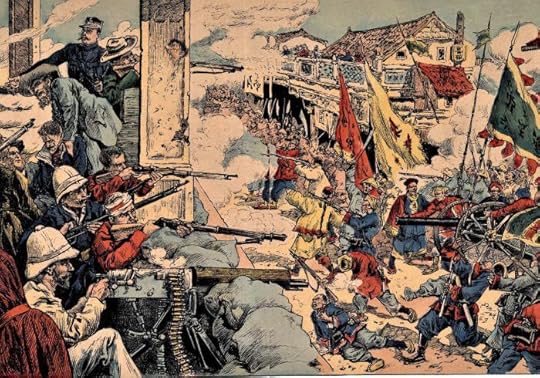
1900 Period color graphic “The Siege of the European Legations in Peking”.

My dead tree version was 273-pages. It had a US 1959 copyright. This book includes: Maps, Footnotes, Bibliography, and an Index.

Peter Fleming: was a: British adventurer, journalist, soldier, and travel writer. Fleming passed in 1971 at age 64. He wrote more than 20 books in both fiction and non-fiction. This is the first book I have read by the author.

This book was “written for a general reader,” wrote Fleming. The reader must have had the education of a General? It was an intermediate work. It is recommended to having a background knowledge of late 19th and the beginning of the 20th century political and colonial history of the Great Powers. Familiarity with Chinese geography and international Belle Époque society would also be helpful.

TL;DR Synopsis

The Siege at Peking was a 65-year-old history of an event occurring 125-years ago that shook the Great Powers: Great Britain, Germany, France, United States, Russia, Japan, Italy, and Austria-Hungary, of the time. The Chinese Empire was opened-up and carved-up by them similarly to Africa, beginning with the Opium Wars (1839) and ending with WWII (1945). This was known as the Scramble for China.

The Boxer Rebellion (1899-1901) was a popular anti-foreign, and anti-Christian uprising in Northern China. It was a purging of traditional China of western influence and the imposition of Foreign Concessions. White, Catholic and Protestant missionaries and their Chinese converts were massacred. Likewise, all western, including Japanese businessmen, engineers, workers, etc. involved in western development were killed. The Rebellion had the tacit approval of the Imperial Chinese government under the control of the Dowager Empress Cixi although the government was internally divided. In effect, it was an undeclared war on the Great Powers.

The Great Power diplomats in Beijing were unprepared for the Boxer Rebellion. This was despite receiving warnings from missionaries of violence against Christians and foreigners AKA Europeans to the North and West of the capitol. It was what is now called a “breakdown in intelligence.” Although, it did not lie in the process of amassing data, and communicating them to decision makers. The international decision makers rejected the intelligence. It was only when the Boxers appeared in Beijing, and then were assisted by the Chinese army, that they realized the world had turned upside down.

About 4000 people: diplomats, and citizens of the Great Powers, including 900 military (soldiers, sailors, marines) and 1000’s of Christian Chinese barricaded themselves in amongst the international consulates and embassies of the legation quartier of the Chinese capitol Peking (now Beijing). There, they were under almost continuous attack by the Boxer militia and elements of the Chinese army. The first, early attempt to relieve the siege by an international force of marines and armed sailors failed. It almost ended in disaster. After 55-days a larger, landed Transnational Expeditionary Force fought their way 160 km (100 mi) from the coast to storm the city and broke The Siege. Afterwards, there was a great deal of looting.

The Rebellion collapsed, when the Imperial government fled the city on the arrival of the Expeditionary Force. Peace was eventually negotiated in the undeclared war upon the Great Powers. A large indemnity, and further foreign concessions were wrested from the Chinese. However, remarkably, the Empress dowager remained in-power.

The narrative describes the: origins of The Siege in the Boxer Rebellion; the actions of the Chinese court, Great Power governments, before, during and after The Siege; the life of the besieged before, during and immediately after it; and the military aspects of The Siege and relief.

Fleming’s narrative is in the Victorian-era journalistic-style of his alma maters: Oxford, Eton, and the pre-WWII Times of London. That is, its engaging and well-written in a very British-style from the Twilight of Empire. Having spent time in China during and pre-War, and having served as an officer in WWII, Chinese locations and military operations had more colour than expected. The research was credible. Written in a hybrid journalistic/academic-style it contained a dash of adventure fiction, that made for quick reading.

The Review

Fleming wrote this book in 1959, that was almost 60-years after The Siege. He did no interviews. However, a large period corpus on The Siege existed in the eight-languages of the Great Powers, counting American and British English separately. (Victorians loved this type of book.) He also had access to the “private papers” of a scant few besieged British principals.

Being a journo, he chased the story. He applied the high-bar of the Times of London style-guide and the eye of an ex-Lieutenant Colonel in the Grenadier Guards to the information. He also exercised his travel/adventure writing skills and experience in pre and wartime China. Out popped a “Popular History”.

This book was not what I expected. It was credible and entertaining.

In general, the book’s prose was good. Good copyediting left the book well-groomed. The prose level was above what I would consider appropriate for a “popular history.” In places the prose was a tad melodramatic, in an antique fashion. I admired the sentence and paragraph structure, as well as the overall organization. To his credit, it could be quite humorous in places, in a British way. It was also more technical than modern popular histories. Several times I was sent to the dictionary. “loess being but one example. I did note a few instances of repetition. For example, kaoliang a type of sorghum extensively cultivated at the time in Northern China received the same description a few times. Another example were numerous references to military actions being in "the G. A. Henty tradition". That is, a swashbuckling action with a positive conclusion.

An issue I had was with the Mandarin Chinese to English transliterations for people and places. Scholars have been fussing with them since The Siege and since the book was published. Shanghai remains Shanghai. Tientsin is now Tianjin. The Dowager Empress Tzü Hai is now Empress Dowager Cixi.

In addition, Fleming includes a lot of French quotations without translation.

The book assumed an understanding of early 20th Century military terms and military equipment. “H-Hour”, coup de main, and Krag–Jørgensen being examples. Likewise, period military tactics, techniques and procedures were discussed. However, both operational-level and tactical-level descriptions were generally in a concise, military reporting fashion.

The high-level strategy of the Great Powers, was well handled. However, it was the political machinations of the multi-national Expeditionary force that proved the most interesting.

The book contained descriptions of both sex and violence.

Whilst there was no discussion of sexual relations between the Victorians in close quarters under siege in the legation. There was mention of the European soldiers whoring and Russians taking Chinese women by force. Most interesting was the dismissal of Boxer outrages against European women. (They would just kill them outright.) From a quoted period piece:
The legend of European women being outraged before being killed is supported by no evidence and is inherently unlikely; to the sexual appetite of the Chinese male the female barbarians—large footed, big-nosed, and white skinned—made a negligible appeal.
There was a surfeit of violence. Life, particularly the lives of Chinese peasants was poor, nasty, brutish and short. They perished by the hundreds. The Europeans where generally unperturbed at the deaths of so many Chinese at the hands of other Chinese or Europeans. However, when Chinese began slaughtering Europeans, the dynamic was very different. That there was a war on using pre-WWI weapons including magazine rifles and machine guns increased the casualties. Many times, these weapons were used against Chinese armed with swords, and spears. The violence in the narrative was not graphic, in terms of gore, but it was descriptive. In particular, the elaborate ways the Chinese had for putting folks to death. It was medieval. The Chinese preferred edged-weapons. Decapitations were common. A court aristocrat could be told to suicide by the Empress, in a poetic fashion. Poison was the preferred method. Poison was also alleged to be preferred for aristocrats murdering each other. The body count was near genocidal.


Both the climate and the geography of Northern China, and their effect on events were well covered. Unfortunately, the period geography of the Tientsin (Tianjin) to Peking (Beijing) axis that the Expeditionary Force followed has been swallowed-up in urbanization. They are barely recognizable on Satellite maps. The International Legation adjacent to the Palace in the Imperial City has likewise disappeared and the embassies relocated.

Footnotes were at the bottom of each page. Footnotes were more likely to provide amplifying information vs. a literary citation. I found them interesting and helpful, but uneven.

Military history is about maps. There were seven maps. All of them were good. The maps were hand sourced, “line maps” with: rivers, towns and cities, rails, and roads. Important topographical features are omitted from them. Their presentation and annotation adequately supported the narrative.

The Bibliography contained no reference younger than 1951, with most from the very early 1900’s.

The Index was brief, with mostly name references, and only most important physical and events.

Fleming’s was a story of: men and a woman, nations, and organizations in contention.

Fleming was scrupulous about naming the important characters in The Siege of the in-country Great Powers, and the Chinese Government. Interestingly, very few words were spent on the leadership in Europe and America? It should be noted that only folks of a certain rank or class and above were named. Chinese Christians and Boxers who performed great service or infamies went unrecognized. This solidified a very British and class-conscious vein-of-thought that ran through both Fleming’s and the earlier material.

The likely true European hero of The Siege was Claude Maxwell MacDonald. Whilst not the most senior of diplomats besieged, he rose to the occasion and ‘managed’ a very diverse group to eventual safety. The description of the needed effort reminded me of the aphorism, “Like herding snakes.” His efforts reminded me that successful, British ex-soldier, diplomats were a common phenomenon in the late empire.

A very important and enigmatic figure in The Siege, and China at the time, was the Dowager Empress Cixi. Fleming waffles on her true nature, which is now lost in history. She virtually controlled the Imperial Government as an opportunistic despot. She seized the Boxers as a chance to punish the Great Powers for years of humiliations. At the end, she personally was unharmed, albeit the Empire suffered yet another humiliation. Fleming tries hard to humanizer her at the end, when in fact she was what now would be a war criminal.

The contentious command of the Expeditionary Force was a wonder. All the eight Great Powers needed to participate. Although, only the Japanese had troops nearby and available. The other Asia/Pacific Great Powers were pre-occupied. The French were bogged down in Indo-China, the Americans in the Philippines, and the British in South Africa. A scratch force resulted. In addition, honour was at stake amongst what had been rivals. The result was a level of cooperation more like a medieval warband than a modern fighting force. Fortunately, Chinese resistance was weak. The individual parts were greater enough, that their functioning as a whole was not consistently required.

How the The Siege did not result in a massacre, once the Chinese government began supporting the Boxers was Fleming’s most important revelation. Chinese court politics were unlike western politics at the time. The Dowager Empresses held complete control of the government and had power of life or death over her every subject. For example, she had executed all the overt dissenters to her policy of supporting the Boxers.

Chinese armies, unlike western armies were the property of their generals. The Chinese generals with the strongest and most modern armies were: not located in Northern China, opposed to being allied with the peasant Boxers, realized the internal and external political peril of the situation, and successfully avoided becoming involved whilst still saving face. Only the weakest, and least modernly equipped and well-trained Chinese army was involved in The Siege. Otherwise, The Siege would have been over quickly.

In addition, the still living western-oriented or prudently fearing the Great Powers members of the court politicked and took steps to sabotage the besiegers efforts. Their hidden treason successfully hampered The Siege.

Fleming’s obfuscated conclusion was “The legation was very lucky, not have been massacred.” Despite the foolhardiness of the diplomats not initially recognizing the danger, their own and their governments ramshackle efforts to negotiate a settlement, the Great Power militaries working at cross-purposes—they were saved by the delays of Chinese courtiers opposing their Empress at the risk of their own lives.

Summary

The Siege of Peking was a Belle Époque event that was forgotten in the greater calamity of WWI. Still its worth reading about. It typifies the pre-Modern Scramble for China and its influence can be followed to the rise of the Japanese empire, and the Pacific War of WWII effecting more modern times.

The greatest strength of this book was it put the reader in a position to compare the historical events found in the histories and news written during and shortly after the event, at a different level-of-detail and 60-year remove. A current reading provides a further remove, to compare against Fleming’s analysis.

Fleming’s analysis was solid, although it was rendered in his journalistic best. The narrative was a bit too exciting, in the G. A. Henty tradition. (It was a popular history.) Still, he did have a f;air for adventure-writing and did a readable job for an audience interested and educated in military and diplomatic history. He was particularly good at conveying abstruse (a word he did use) points of military detail.

Whilst he cut through the nationalism of this transnational Belle Époque siege. He, perpetuated the racism, sexism and classism of the period. Except for the Imperial court, the Chinese were a faceless mass who mostly fought ineptly, and universally lived meanly, suffered, and died in their thousands. Likewise, The Siege affected European Gentleman, their Ladies, and their help. European missionaries and their refugee converted flocks were their Whiteman’s Burden. He gave only token notice of the later. Fleming demonstrated he was a product of the Twilight of Empire, a mid-twentieth-century upper-class Englishman. A product of Eton and Oxford, a decorated British ex-officer, and journalist of good, wealthy family. Class hung heavy over this book.

Finally, this book was not an easy read. Perhaps to the Times of London reading, British public of 1959 this was a Popular History? To an internet-addled, Anglo-American reader of the 21st Century, it was a harder read about the poliorcetics (a word Fleming somehow neglected using?) of The Siege at Peking.

This is a worthwhile read for someone who already has a background in early 20th Century military and diplomatic history and China. With that background, it is an entertaining and quick history with a lot of period detail on Europeans in China at the beginning of the 20th Century and the waning days of the Qing dynasty.

Readers interested in a film loosely dramatizing The Siege may be interested in 55 Days at Peking (1963).
Profile Image for Philip.
1,771 reviews113 followers
October 22, 2023
Excellent account of the 1900 siege of Peking, told with Fleming's usual flair, intelligence and humor. Most likely a dated (and undoubtedly less-than-PC) retelling, since this was now published closer to the actual event than to today; and so I'm sure there are more scholarly (and accurate?) accounts out there - but this is still my favorite, (as also is Fleming's recounting of the 1904 Younghusband Expedition in his Bayonets to Lhasa).

COOL STUFF: I recently picked up a good first edition at an amazing roadside used bookstore outside Hudson, NY - the "Little Red Book Shack." This place is an obvious labor of love for owner Melanie Nelson, who has maintained it for God-knows-how-many years.


Thousands of books carefully sorted and displayed in a number of small cabins, and everything either $1 (hardcover) or 50¢ (paperback). Spent a blissful couple of hours there while visiting family in the area, also picking up a copy of Yeager An Autobiography, a cheap Heart of Darkness (which I want to reread now having just finished King Leopold's Ghost: A Story of Greed, Terror, and Heroism in Colonial Africa), and several others. PLEASE do yourself a favor and take the time to visit if you're ever anywhere along the Hudson River between NYC and Albany - truly a hidden gem!

You can learn more at: https://melanienelson.chrislands.com/
Profile Image for Markus Laine.
1 review1 follower
August 5, 2014
Peter Fleming's book, first published in 1959 gives a detailed account of the siege of the foreign legations in Beijing during the last months of the Boxer Rebellion in 1900. Anti-foreign sentiment in China had been running high for the previous years and the Righteous Harmonious Fist (义和团) , better known in the West as the Boxers had been attacking missionaries and Chinese Christian converts in the northern provinces. The Boxers, a motley collection of different gangs around the Northeast and without a central organization, were thought in local folklore to be invincible and unaffected by swords or bullets. They had caught the attention of the Empress Dowager, the de facto ruler of the empire, who wanted to use them against foreign western influences she, and other hardliners at court detested.


Boxers first and later regular Chinese troops attacked the diplomatic quarters in Beijing, where in addition to the usual residents a considerable population of refugees from the adjoining cities and provinces had gathered. Against seemingly impossible odds the small foreign garrison held the overwhelming enemy at bay, until a relief force was able to reach them from Tianjin some two months later.

Fleming spends quite some time in explaining the background behind the attack. Almost 60 years between the events and publishing the book provide him with an opportunity to view the developments with criticism directed also at western powers. China's humiliation by the powers in the century leading to the Boxer Rebellion is spelled out and intrigues at the imperial court explained.

However, the forte of the book is in the action. The author succeeds in really reconstructing the development of the situation in the legations in astonishing detail. Chinese attacks and countermeasures of the defenders are described lively and individual acts of courage or cowardice are not forgotten The dramatis personae are introduced in enough detail and through their actions to make one really identify with them. A lot of research went into this piece of work.

A history book about a pivotal time in the development of modern China that reads like thriller 50 years after it's publication. Really liked this one!

Read the 1984 Oxford University Press paperback, 273 pages.

This and more reviews also at www.bibliasia.com
Profile Image for Hilmi Isa.
378 reviews29 followers
November 25, 2014
Buku ini memfokuskan kepada peristiwa yang berlaku apabila kawasan kedutaan asing di Peking,China,dikepung oleh pejuang bersenjata/pemberontak Boxer dan tentera kerajaan Dinasti Ch'ing atau Manchu yang bermula pada 20 Jun sehingga 15 Ogos 1900. Kawasan ini menempatkan beberapa pejabat kedutaan yang turut mengandungi pegawai-pegawai tinggi yang bertaraf duta dan kakitangan-kakitangan berkaitan. Perwakilan-perwakilan ini melibatkan negara-negara seperti yang berikut; Autria-Hungary,Belgium,British,Perancis,Itali,Jerman,Jepun,Belanda,Rusia,Sepanyol,dan Amerika Syarikat. Apabila dua orang pegawai tinggi perwakilan diplomatik dari Jepun dan Jerman dibunuh,menandakan bahawa kawasan kedutaan asing ini akan menjadi sasaran serangan. Turut terdapat sejumlah mubaligh Kristian dan orang awam China yang berpegang kepada agama Kristian tumpang berlindung. Hal ini kerana mereka menjadi sasaran atau mangsa di dalam Kebangkitan/Pemberontakan Boxer ini.
Walaupun bab-bab awal buku ini memaparkan serba sedikit sejarah latar belakang bagaimana bermulanya Kebangkitan/Pemberontakan Boxer,namun,seperti yang saya nyatakan di atas,buku ini lebih memfokuskan atau menceritakan situasi yang dihadapi oleh mereka yang dikepung. Menariknya,penulis turut mendedahkan konflik-konflik atau masalah-masalah kecil yang dihadapi ketika dalam kepungan.
Konflik yang seumpamanya ini turut dihadapi oleh kontinjen tentera antarabangsa yang dihantar untuk menyelamatkan mereka yang terkepung di Peking. Perasaan nasionalisme yang kuat dan keinginan yang tinggi untuk menjadi yang pertama sampai sebagai penyelamat telah menyebabkan koordinasi dan kejituan kuasa ketenteraan tidak dapat diaplikasikan secara optimum dan berkesan.
Penulisnya,Peter Fleming,menamatkan bukunya dengan membuat satu kesimpulan bahawa peristiwa bersejarah ini berakhir secara anti-klimaks. Walaupun terdapat mereka yang menjadi dalang utama dihukum,tetapi,akhirnya,Maharani Tz'u-Hsi,yang sebenarnya memainkan peranan paling penting,terlepas begitu sahaja.
Profile Image for Tim Chamberlain.
115 reviews19 followers
August 10, 2014
An engaging, entertaining (if somewhat partial and now a little out-dated) history of the Siege. Well worth reading as a general overview / introduction and for insights into the perspective of those under siege; but anyone pursuing a deeper level of interest or historical study will probably be frustrated by the scant referencing to primary source material quoted in the text.
Profile Image for Theo H.
3 reviews
September 30, 2020
If you are looking for an objective well rounded piece of literature about the Siege of Peking in 1900, you won't find it here. This book written by Peter Fleming gives a detailed first person account towards the incidents but at most times inputs his own opinion which makes its hard to take the book seriously. The informal nature of the language sometimes feels like I was reading a fan fiction of the events. Its particularly outdated eurocentric view was difficult to say the least.
Profile Image for M. D.  Hudson.
181 reviews129 followers
April 14, 2010
I am obsessed with the siege of the European (and American and Japanese) legations at Peking in 1900 during the Boxer Rebellion. Arrogance, heartlessness, ferocity, courage, cowardice, diplomatic waffling (and lying), turn-of-the-century Victorian conventions under great strain, resourcefulness and pretty much the whole gamut of human experience is balled up in this little siege. Fleming’s account is a good one, if not great. Beware the somewhat brittle and antique pro-Anglo aspect to it (Peter Fleming is the brother of James Bond’s creator Ian, and there is a similar Rule Britannia feel to the proceedings and sinister Dr. No “Orientals” scheming throughout). Fascinating tale, however.
Profile Image for Kay.
283 reviews16 followers
March 24, 2009
A rather old fashioned read maybe but packed with facts and accounts about the Boxer rebellion and those at the receiving end of the violence and attacks. It was a little hard going at times, perhaps I was expecting a less dry tone, but it was none the less an important read in my exploration of Chinese history.
Profile Image for Matt.
352 reviews13 followers
January 24, 2015
I've read a number of books by Peter Fleming and I find them to be uniformly excellent. It is a pity that his brother, Ian, is better known and, most likely, read more often than Peter is. I recommend this or any of his other books.
462 reviews
September 14, 2007
A little dated but a good read nevertheless. As the focus is the siege of the foreign Legations in Beijing, the larger story of the Boxer uprising is not dealt with except peripherally.
Profile Image for Jan.
1,254 reviews
December 16, 2012
Despite being rather old this is an excellent account. Wellwritten, thoughtful and capable of providing perspective beyond the traditional "westerners surrounded by savages"
Profile Image for Joshua Horn.
Author 2 books11 followers
February 6, 2014
A great book on this interesting episode of history. Very readable, I just wish he spent more time on some parts
Displaying 1 - 12 of 12 reviews

Can't find what you're looking for?

Get help and learn more about the design.