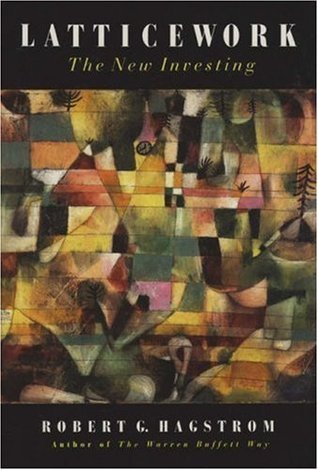
In this engaging and challenging book, Robert Hagstrom outlines a new approach to investing based on the ideas of two highly successful investors: Charlie Munger of Berkshire Hathaway and bill Miller of Legg Mason. Both Munger and Miller believe in the latticework approach to investing, one that is based on a working knowledge of a variety of disciplines. Latticework is a true liberal arts approach to investing. It carries the reader from Ben Franklin's vision of education to St. John's College with its Great Books program to the cutting-edge Santa Fe Institute, a multi-disciplinary research center which brings together scientists from a variety of fields to address complex adaptive systems, including markets and economies. In helping readers develop the worldly vision they need to succeed financially, Latticework also points the way to a richer, fuller, more rewarding life.
Robert G. Hagstrom is Senior Vice President and Director of Legg Mason Focus Capital. He has authored the New York Times best-selling The Warren Buffett Way and The Warren Buffett Portfolio, as well as The Nascar Way. He lives with his family in Wayne, Pennsylvania.
Investing: The Last Liberal Art contains no direction on how to read a balance sheet, or on how to project earnings into the future and discount them back to today’s value, nor are there arcane financial terms to send readers scrambling for dictionaries. Still, Investing is an essential book for professional and amateur stock pickers who want to excel, portfolio managers preparing to interview prospective analysts, and investors trying to choose amongst the many advisors ready to serve their needs.
Hagstrom takes his central premise that a broad education will pay dividends in investment performance from Warren Buffett’s quieter partner, Charlie Munger. Munger, through several speeches and in his book Poor Charlie’s Almanack, contends that to be successful in stock picking “you’ve got to have models in your head ... and you’ve got to array your experiences - both vicarious and direct - on this latticework of models.”
Hagstrom takes Munger’s latticework idea and provides both the ‘why’ and the ‘how to’ in a concise, straightforward and entertaining format - a bit like Bill Bryson’s A Short History of Nearly Everything through an investment lens. He covers physics, biology, sociology, psychology, philosophy, literature, and mathematics, and concludes with a chapter on decision making. Hagstrom helpfully appends the reading list for the Maryland’s St. John’s College, where “the entire curriculum is devoted to discussing the great books of Western civilization; [where] there are no separate disciplines or departments, no electives,” and his bibliography is even broader - another excellent source for those wishing to take up his challenge.
There is, of course, information directly relevant to investors. In his chapter on Psychology, Hagstrom ponders the question ‘How often should investors review their holdings to be “indifferent to the historical distribution of returns on stocks and bonds?” From pioneering work of behavioural economists Richard Thaler and Shlomo Benartzi, the answer is once per year. When smartphones come pre-loaded with apps allowing us second by second stock valuations, and when larger market swings generate headlines in all media, our instinctual “myopic loss aversion” kicks in and we are driven to suboptimal investment decisions. Without knowing our own psychological predispositions - we feel losses about twice as intensely as gains - it is impossible to correct for them and to achieve superior returns. We should be strategic rather than tactical with our investment portfolios.
In his chapter on Philosophy, Hagstrom shifts from individual traits to those of the broader market. “One reason we have such difficulty understanding markets is that we have been locked into an equilibrium description of how they should behave.” “We must remain open minded to accepting new descriptions of systems that appear complex.” Hagstrom’s first point harkens to his chapter on physics, while the second relates to his chapter on biology. Markets are complex systems with many feedback loops, and “the only way to do better than someone else, or more importantly, to outperform the stock market, is to have a different way of interpreting the data that is different from other people’s interpretations. To that I would add the need to have sources of information and experiences that are different.” A broader reading list rather than more Google alerts.
For investors trying to sort through investment advisors’ credentials and experience, Hagstrom offers some considerations in his final chapter on decision making. “Having been schooled in modern portfolio theory and the efficient market hypothesis, will [they] quickly and automatically default to [the] physics-based model of how markets operate, or will [they] slow down [their] thinking and also consider the possibility that the market’s biological function could be altering the outcome? Even if the market looks hopelessly efficient, will [they] also consider that the wisdom of the crowds is only temporary?” The latticework that advisors use is just as important as their technical education.
“Reading this book requires both an intellectual curiosity and a significant measure of patience,” cautions Hagstrom, perhaps underestimating his audience, but readers will be well rewarded and very likely more successful with their investing. Despite its broad relevance, unfortunately, Investing will likely find audience only with those already inclined towards the Gatsby ideal - “that most limited of all specialists, the ‘well-rounded man’.” (With apologies for Fitzgerald’s gender bias).
I have rallied against STEM and business education for some time and it's rally against the liberal arts who like Ghandi do not put up a fight. This is yet another book that articulates so well the net affect on society.
The book is written with such positive light of what a liberal arts education could do for a person. The ability to think is what should be the focus, not the acquisition of knowledge. It has several great book lists that I hope to add to my noggin. I love the examples from Charlie Munger, as he was one of many inspirational characters who got me in gear to add reading as a part of my mental diet.
I plan on making this book a necessary part of my internship program.
What a fascinating and fun book. Investing: The Last Liberal Art by Robert Hagstom is an exploration of some of the biggest intellectual ideas in Western thought. Inspired by Charlie Munger's advocacy of building a "latticework" of mental models, Hagstrom goes through a wide variety of different academic fields and explains some of the big ideas from each in simple terms. The book discusses the origin of particular intellectual ideas, the lineage of influence on subsequent work, and their ultimate influence on economics and finance. For example, Hagstrom explains how physicists such as Brahe, Kepler, Galileo, and Newton discovered principles of equilibrium in physics. That in turn, heavily influenced Alfred Marshall to apply the principle to economics. In turn, Paul Samuelson used insights from Marshall and a host of other economists to apply the concept of equilibrium to stock markets. As time went on, and our understanding of complex adaptive systems grew, economists then came to think of equilibrium in dynamic terms. Each step reflects a significant evolution in thought which built on previous work by others, demonstrating the value of interdisciplinary knowledge. The book is a short read and full of examples that will be engaging for anyone who is interested in a wide variety of subjects. Although it is written to appeal to those who are interested in investing specifically, it's a great short work on the history of modern Western thought in general.
Easy to read book on polydisciplinary wisdom. As most of the best books on this subject, investing, even though being the main focus, is simply in the background.
In the last chapter, the author writes something that perfectly sets the context for this in my mind slightly overlooked investment book (1st ed 2000): “Improving the resource condition of our System 2 thinking – that is to say, deepening and broadening our reserves of relevant information – is the principal reason this book was written”. Writing that in 2000, two years before Daniel Kahneman received the Swedish Riksbank’s economic prize in memory of Alfred Nobel for a lifetime’s effort to put System 2 in people’s System 1 (so to speak), the timing was impeccable. However, Robert Hagstrom’s elegant book had one drawback: the title. Named Latticework: The New Investing it failed to catch attention. This was however resolved the next year with the paperback edition. Scholars populating the world of Benjamin Franklin, Charlie Munger and the Santa Fe institute are certainly familiar with the reference point of the original title: Munger’s presentation to the students at USC in April of 1994, where he spoke under the header Stock Picking As a Subdivision of The Art of Worldly Wisdom. This speech, and Hagstrom’s book shoot off from the assumption that uniting the mental models from several disciplines – physics, biology, psychology, philosophy etc. – to create a figurative latticework of understanding is a powerful tool to build a richer life and achieving superior investment results along the way.
The journey towards worldly wisdom travels through two equally important territories. Firstly, learning significant concepts from the different disciplines (“the big ideas”). Secondly, learning to recognize patterns of similarities among them. Investing: The Last Liberal Art deals with the former, by way of educating and stimulating the reader of the starting points to the big ideas within seven disciplines. Perfectly fitting to the idea of interconnectedness and understanding X due to seeing the similarities with Y, Hagstrom is the obvious hand-in-glove author of this book. Being intimately familiar with the Buffett and Munger worldly views via several previous books (The Warren Buffett Way as the standout), he also works at Legg Mason Investments whose collaboration with the Mungeresque multi-disciplinary Santa Fe Research Institute, gives him a continuous and re-enforcing education on the topic.
But then how is the world of economics and finance related to physics, biology and philosophy et al? For starters, what is supply and demand if not the (physics) law of equilibrium at work? The chapter on physics overall is a gem, where I personally am most intrigued by the importance of the cumulative nature of human knowledge – a backbone of the latticework model. There would be no “Sir” in Isaac Newton without Kepler, Galilei and Descartes. And furthermore would there have been a Eugene Fama without Newton, Bachelier and Samuelson? As for biology: “Natura non facit saltum” (the motto of The Origin of Species). Nature does not make leaps. And neither does capitalism, explaining why certain businesses generate “über-profits” without extra competition for prolonged periods of time (and vice versa). Great companies in good industries tend to stay that way, an obvious early-age Munger- realization. In one of the more intricate twists of irony, Sir Isaac Newton himself was made poster boy for another important piece of the latticework puzzle; sociology, via the infamous South Sea Company mania. How can sociology be important to one’s reference points? By interlinking biology’s adaptive systems with psychology, it explains the simultaneous brilliance and madness of crowds. The key separator of course is societies needing to be diverse and independent (i.e. individuals independent of each other), which of course is not the case in financial markets with everybody watching the same CNBC.
As the author aptly suggests, let’s give Charlie Munger – who bizarrely could be one of the more underappreciated figures in finance outside a tiny cult-clique – the last word: “What I’m urging on you is not that hard to do. And the rewards are awesome. It’ll help you in business... It’ll help you in life. And it’ll help you in love...It makes you better able to serve others and...yourself, and it makes life more fun”. Loollapalooza, Munger-style!
Charlie Munger once said "stock picking is a subdivision of the art of worldly wisdom". Instead of looking at markets through mere finance/economics lens, you need to consider a wide body of knowledge.
Combining mental models from different disciplines to form a latticework of understanding can lead to ideas with high conviction. Physics, Biology, Sociology, Psychology, Philosophy, Literature, Mathematics, Decision making-all of them are somehow tied to the world of investing.
Economics borrowed the idea of equilibrium from Physics. The search for this equilibrium, as Schumpeter suggested, is an adaptive process. Basically, market possesses simultaneously the effects of Newtonian Physics and Darwinian biological interpretation.
Since market is adaptive, individual behavior constantly changes as they interact with other individuals in the system which is a sociological phenomenon. Two variables dictate whether markets can remain robust: diversity and independence.
Some research suggests a very counter-intuitive finding: if market consists of diverse group of agents (smart, average, and below avg intelligence), it becomes more robust than a market consisting of only smart people, indicating the significance of diversity among participants.
On the other hand, independence ensures any individual's mistake from being correlated with the group. Both diversity breakdown and loss of independence can lead to market/system being inefficient.
Philosophically speaking, there is a dilemma whether questions of markets are ontological or epistemological in nature. If it's former, we may never be able to fully understand markets. If it's latter, it may mean once we ask the right questions, we will eventually be able to figure out.
Investing, of course, is also a mathematical game. If you're not a good Bayesian, the odds are against you to be a good investor. Sizing your bets also matters a great deal. Kelly Criterion, which has a formulaic approach to sizing your positions, is expressed as 2p-1=x, where 2 times the probability of winning minus 1 equals % of one's bankroll that should be bet. This was originally used in blackjack and later optimized in investing. Since investing is not exactly blackjack, many use half-Kelly or fractional-Kelly formula for portfolio management.
Finally, decision making itself can make a huge difference in investment results. Answer these 3 questions:
1. A bat and a ball cost $1.10. The bat costs one dollar more than the ball. How much does the ball cost?
2. If it takes 5 machines 5 mins to make 5 widgets, how long would it take 100 machines to make 100 widgets?
3. In a lake, there is a patch of lily pads. Everyday, the patch doubles in size. If it takes 48 days for the patch to cover the entire lake, how long will it take for the patch to cover half of the lake?
Answers are mentioned below.
Over 50% of Harvard, MIT, and Princeton students got it wrong. Our intuitive thinking can trump our reflective thinking process all the time, which Daniel Kahneman categorized as System 1 and System 2 thinking respectively. Investing is more about system 2 thinking than system 1.
Since market is a complex adaptive system, our exploration will never stop. We will never know enough to find the panacea to figure out investing. Investing continues to intrigue us despite our acknowledgement that there is no panacea to be found.
(Answers to the questions: $ 0.05, 5 mins, and 47 days)
This is the third fine book I finished early this year. For investors like me, this book is worthy of atleast one re read. I would infact put it on the must read pack for anyone interested in serious investing. As we know in investment, a developed mind that can navigate through uncertainty and emotional upheavals is a must have tool. This book can lay the foundation for developing such a mind, mainly through multidisciplinary reading and broad based thinking using mental models. Beyond investors, this book is a must read for anyone who wonders about both the vast mysteries of this earth and the equally large amount of knowledge created for their understanding. It gives you a tour of major disciplines and their big ideas. A helpful bibliography is attached for further reading. I wish I had come across this volume when I was an young student. However it’s never too late to get started on a proper liberal arts education.
This isn't your typical book on how to invest. In fact, on a much deeper level, it's not even about economics and finance. Well, markets and investing do feature a lot throughout the book but the book isn't definitively about them. The essence of the book is its well grounded argument for a liberal arts education developed in the backdrop of stock markets and investing. The book talks about mental models and abstractions derived from various disciplines like sociology, psychology, biology, physics etc. and tries to apply those key ideas in context of investing in stock markets. With individual chapters dedicated to select disciplines, it's an engrossing read and it often takes some bit of reflection to recollect the insights presented in individual chapters. However, at the same time, chapters are filled with a lot of anecdotes and with a bit of concentrated reading, they are fun to read. On a personal note, deriving insights from Darwin's work of evolution and imagining market as an organism under constant evolution was deeply thought provoking. Almost all the chapters aimed to strengthen the reader with a key idea which could then be developed into a mental model after deep reflections. To sum it up, if you aim to learn how to invest, this isn't for you. But, if you are willing to expand your thinking and learn to think about problems from a diverse perspective, often from seemingly unrelated disciplines, this is exactly the book you should be going for.
Latticework: success in investing based on a working knowledge of a variety of disciplines Key Takeaways
Latticework Latticework is itself a metaphor. And on the surface, quite a simple one at that. Everyone knows what latticework is, and most people have some degree of firsthand experience with it. There is probably not a do-it-yourselfer in America who hasn’t made good use of a four-by-eight sheet of latticework at some point. We use it to decorate fences, to create shade over patios, and to support climbing plants. It is but a very small stretch to envision a metaphorical lattice as the support structure for organizing a set of mental concepts Physics – Equilibrium Physics is the science that investigates matter, energy, and the interaction between them – the study, in other words, of how our universe works. It encompasses all the forces that control motion, sound, light, heat, electricity, and magnetism, and their occurrence in all forms, from the smallest subatomic particles to entire solar systems. It is the intellectual foundation of many well-recognized principles such as gravitation and such mind-boggling concepts as quantum mechanics and relativity. Equilibrium is defined as a state of balance between opposing forces, powers, or influences. An equilibrium model typically identifies a system that is at rest; this is called “static equilibrium.” The concept of equilibrium is so deeply embedded in our theory of economics and the stock market, it is difficult to imagine any other idea of how these systems could possible work…One place where the question is being raised is the Santa Fe Institute, where scientists from several disciplines are studying complex adaptive systems – those systems with many interacting parts that are continually changing their behavior in response to changes in the environment…If a CAS is, by definition, continuously adapting, it is impossible for any such system, including the stock market, ever to reach a state of perfect equilibrium. What does that mean for the stock market? It throws the classic theories of economic equilibrium into serious question. The standard equilibrium theory is rational, mechanistic, and efficient. It assumes that identical individual investors share rational expectations about stock prices and then efficiently discount that information into the market. It further assumes there are no profitable strategies available that are not already priced into the market. The counterview from SFI suggests the opposite: a market that is not rational, is organic rather than mechanistic, and is imperfectly efficient. The SFI pointed out 4 distinct features they observed about the economy: dispersed interaction, no global controller, continual adaptation, out of equilibrium dynamics. Biology – Evolution What we are learning is that studying economic and financial systems is very similar to studying biological systems. The central concept for both is the notion of change, what biologists call evolution. The models we use to explain the evolution of financial strategies are mathematically similar to the equations biologists use to study populations of predator-prey systems, competing systems, or symbiotic systems. Complex systems must be studied as a whole, not in individual parts, because the behavior of the system is greater than the sum of the parts. The old science was concerned with understanding the laws of being. The new science is concerned with the laws of becoming Social Sciences – Complexity, Complex Adaptive Systems, Self-Organized Criticality Although Johnson’s maze is a simple problem-solving computer simulation, it does demonstrate emergent behavior. It also leads us to better understand the essential characteristic a self-organizing system must contain in order to produce emergent behavior. That characteristic is diversity. The collective solution, Johnson explains, is robust if the individual contributions to the solution represent a broad diversity of experience in the problem at hand. Interestingly, Johnson discovered that the collective solution is actually degraded if the system is limited to only high-performing people. It appears that the diverse collective is better at adapting to unexpected changes in structure. Folly to think you can eliminate every waste, every performer who doesn’t meet the highest bar, and excel and survive. Can shift the entire bell curve to the right, but you still need the full spectrum Notes: We have observed anecdotal evidence of emergent behavior, perhaps without realizing what we were seeing. The recent bestseller, Blind Man’s Bluff: The Untold Story of american Submarine Espionage, presents a very compelling example of emergence. Early in the book, the authors relate the story of the 1966 crash of a B-52 bomber carrying four atomic bombs. Three of the four bombs were soon recovered, but a fourth remained missing, with the Soviets quickly closing in. A naval engineer named John Craven was given the task of locating the missing bomb. He constructed several different scenarios of what possibly could have happened to the fourth bomb and asked the members of the salvage team to wager a bet on where they thought the bomb could be. He then ran each possible location through a computer formula and – without ever going to sea! – was able to pinpoint the exact location of the bomb based on a collective solution It is when the agents in the system do not have similar concepts about the possible choices that the system is in danger of becoming unstable. And that is clearly the case in the stock market…The value of this way of looking at complex systems is that if we know why they become unstable, then we have a clear path to a solution, to finding ways to reduce overall instability. One implication, Richards says, is that we should be considering the belief structures underlying the various mental concepts, and not the specifics of the choices. Another is to acknowledge that if mutual knowledge fails, the problem may center on how knowledge is transferred in the system. Psychology – Mr. Market, Complexity, Information Another aspect of behavioral finance is what some psychologists refer to as mental accounting – our tendency to think of money in different categories, putting our funds into separate “mental accounts,” depending on circumstances. Mental accounting is the reason we are far more willing to gamble with our year-end bonus than our monthly salary, especially if it is higher than anticipated. It is also one further reason why we stubbornly hold onto stocks that are doing badly; the loss doesn’t feel like a loss until we sell Philosophy – Pragmatism Strictly for organizational simplicity, we can separate the study of philosophy into 3 broad categories. First, critical thinking as it applies to the general nature of the world is called “metaphysics”…Metaphysics means “beyond physics.” When philosophers discuss metaphysical questions, they are describing ideas that exist independently from our own space and time. Examples include the concepts of God and the afterlife. These are not tangible events like tables and chairs but rather abstract ideas that metaphysical questions readily concede the existence of the world that surrounds us but disagree about the essential nature and meaning of the world. The second body of philosophical inquiry is the investigation of 3 related areas: aesthetics, ethics, and politics. Aesthetics is the theory of beauty. Philosophers who engage in aesthetic discussions are trying to ascertain what it is that people find beautiful, whether it be in the objects they observe or in the state of mind they achieve. This study of the beautiful should not be thought of as a superficial inquiry, because how we conceive beauty can affect our judgments of what is right and wrong, what is the correct political order, and how people should live. Ethics is the philosophical branch that studies the issues of right and wrong. It asks what is moral and what is immoral, what behavior is appropriate and inappropriate. Ethics makes inquiries into the activities people undertake, the judgments they make, the values they hold, and the character they aspire to achieve. Closely connected to the idea of ethics is the philosophy of politics. Whereas ethics investigates what is good or right at the individual level, politics investigates what is good or right at the societal level. Political philosophy is a debate over how societies should be organized, what laws should be passed, and what connections people should have to these societal organizations. Epistemology, the third body of inquiry, is the branch of philosophy that seeks to understand the limits and nature of knowledge. The term itself comes from two Greek words: episteme, meaning “knowledge,” and logos, which literally means “discourse” and more broadly refers to any kind of study or intellectual investigation. Epistemology, then, is the study of the theory of knowledge. To put it simply, when we make an epistemological inquiry, we are thinking about thinking. When philosophers think about knowledge, they are trying to discover what kinds of things are knowable, what constitutes knowledge (as opposed to beliefs), how it is acquired (innately or empirically, through experience), and how we can say that we know a thing. For pragmatism, anyone who seeks to determine the true definition of a belief should look not at the belief itself but at the actions that result from it. He called the proposition “pragmatism,” a term, he pointed out, with the same root as practice or practical, thus cementing his view that the meaning of an idea is the same as its practical results. “Our idea of anything, Peirce explained, “is our idea of its sensible effects.” In his classic 1878 paper, “How to Make Our Ideas Clear,” Peirce continued: “The whole function of thought is to produce habits of action. To develop its meaning, we have, therefore, simply to determine what habits it produces, for what a thing means is simply what habits it involves.” A belief is true, James said, because holding it puts a person into more useful relations with the world…People should ask what practical effects come from holding one philosophical view over another If truth ad value are determined by their practical applications in the world, then it follows that truth will change as circumstances change and as new discoveries about the world are made. Our understanding of truth evolves. Darwin smiles. So we can say that pragmatism is a process that allows people to navigate an uncertain world without becoming stranded on the desert island of absolutes. Pragmatism has no prejudices, dogmas, or rigid canons. It will entertain any hypothesis and consider any evidence. If you need facts, take the facts. If you need religion, take religion. If you need to experiment, go experiment. “In short, pragmatism widens the field of search for God,” says James. “Her only test of probable truth is what works best in the way of leading us.” Pragmatism, in summary, is not a philosophy as much as it is a way of doing philosophy. It thrives on open minds, and gleefully invites experimentation. It rejects rigidity and dogma; it welcomes new ideas. It insists that all possibilities should be considered, without prejudice, for important new insights often come disguised as frivolous, even silly notions. it seeks new understanding by redefining old problems. One of the secret to Bill Miller’s success is his desire to take a Rubik’s Cube approach to investing. He enthusiastically examines every issue from every possible angle, from every possible discipline, to get the best possible description – or redescription – of what is going on. Only then does he feel in a position to explain. To his investigation he brings insights from many fields…He continually studies physics, biology, and social science research, searching for ideas that will help him become a better investor…In an environment of rapid change, the flexible mind will always prevail over the rigid and absolute…Because you recognize patterns, you are less afraid of sudden changes. With a perpetually open mind that relishes new ideas and knows what to do with them, you are set firmly on the right path. Literature – self-education of a Latticework through books, Adler’s Active Reading We must educate ourselves and the vehicle for doing so is a book supplemented with all other media both traditional and modern…So we are talking about learning to become discriminating readers: to analyze what you read, to evaluate its worth in the larger picture, and to either reject it or incorporate it into your own latticework of mental models…We can all acquire new insights through reading if we perfect the skill of reading thoughtfully. The benefits are profound: not only will you substantially add to your working knowledge of various fields, you will at the same time sharpen your skill at critical thinking. The central purpose of reading a book, Adler believes, is to gain understanding…This is not the same as reading for information. Reading that makes you stop and think is the path to greater understanding – not solely because of what you are reading but also because of the process of reflection in which you are engaged. You are learning from your own thinking as well as from the author’s ideas. You are making new connections. Adler describes as the difference between learning by instruction and learning by discovery. It’s evident of in the satisfaction we feel when we figure out something on our own, instead of being told the answer. Receiving the answer might solve the immediate problem, but discovering the answer by your own investigation has a much more powerful effect on your overall understanding. Adler proposes that all active readers need to keep 4 fundamental questions in mind: what is the book about as a whole, what is being said in detail, is the book true, in whole or in part, what of it? The heart of Adler’s process involves 4 levels of reading: elementary, inspectional, analytical, and syntopical. Each level is a necessary foundation for the next, and the entire process is cumulative. Elementary reading is the most basic level, the one we achieve in elementary education In inspectional reading, the second level, the emphasis is on time and the goal is to determine, as quickly as possible, what the book is about. It has two levels: prereading and superficial reading. Prereading is a fast review to determine whether a book deserves a more careful reading. Look at the table of contents, index, how much can you learn about the main themes through this overview. Next, Adler recommends systematic skimming. Read a few paragraphs here and there, read the author’s conclusion. These two activities should take between 30-60 minutes and help you determine if it is worth your time to read the book Analytical reading is the most thorough and complete way to absorb a book. Through analytical reading you will answer what is the book about as a whole and in detail and provide you the most complete answer to if the book is true. It has goals: develop a detailed sense of what the book contains, interpret the contents by examining the author’s own particular point of view on the subject; and to analyze the author’s success in presenting that point of view convincingly. Take notes, make an outline, write in your own words what you think the book is about, write the author’s main arguments The fourth and highest level is what Adler calls syntopical reading, or comparative reading. In this level of reading, we are interested in learning about a certain subject, and to do so we compare and contrast the works of several authors rather than focusing on just one work by one another. Adler considers this the most demanding and most complex level of reading. It involves two challenges: first, searching for possible books on the subject; and then deciding, after finding them, which books should be read The challenge for us as readers is to receive that knowledge and integrate it into our latticework of mental models. How well we are able to do so is a function of two very separate considerations: the author’s ability to explain, and our skills as careful, thoughtful readers. We have little control over the first, other than to discard one particular book in favor of another, but the second is completely within our control I believe in…mastering the best that other people have figured out, [rather than] sitting down and trying to dream it up yourself…You won’t find it that hard if you go at it Darwinlike, step by step with curious persistence. You’ll be amazed at how good you can get…It’s a huge mistake not to absorb elementary worldly wisdom…Your life will be enriched – not only financially but in a host of other ways – if you do. – Charlie Munger, Poor Charlie’s Almanack Decision Making – Continuously add more building blocks to your knowledge base in order to build more robust mental models Failures to explain are caused by our failures to describe Our institutions of higher learning may separate knowledge into categories, but wisdom is what unites them. What I got out of it
A beautiful book on how to approach being a multidisciplinary thinker as it applies to investing.
Hagstrom presents a compelling case for the benefits of a broad education (worldly wisdom) as applied to the problem of investing by taking the reader on a journey through some “big ideas” from disciplines such as Physics, Biology, Sociology, Philosophy, and Literature, providing the reader with not only a good set of various mental models (Complex Adaptive Systems, Equilibrium, Genetic Mutation, Myopic Loss Aversion) but also an example of how one may proceed in acquiring models from other sources to become a lifelong learner. Goes together very well with Range, Thinking In Bets, and Influence.
The book covers a wide spectrum of topics. It is based on Charlie Mungers latticework of mental model approach. Enjoyed the one on psychology, biology and Philosophy the best.
I have read a few books and blogs on mental models and applying those to decisions, but this is the first book that helped me understand them on a deeper level. I hit somewhat of an obstacle with applying mental models in my life which is what led me to this book. That, and I found it for $3.
Prior to reading the book I could understand a concept (model), and then apply it to a situation, but I didn't know how to apply multiple models, and weigh them independently, in decision making. The models that Hagstrom provides are the big, basic models from different disciplines. I appreciated that, and he even gives background on the history of the model as well as a short biography when appropriate. As Munger says, it is helpful to understand a person and their life when trying to understand their work.
While I will have to put what I have learned into practice to understand the models better and learn to acquire more models, I feel I have made a substantial advancement in understanding mental models. I have a better understanding of applying multiple models, deciding which work best, and also weighing the correctness of a given model in a situation.
If I was reading it again, I would read the final chapter first before starting with Chapter 1.
Interesting take on both investing and college education. After reading, I'd recommend reading the last 2 chapters first. Then, if intrigued, go back and read from the beginning. The author's premise is that the liberal arts degree was meant to expand our thinking not focus it in one limited area. I concur his his assessment. He spends a chapter on various liberal art topics - physics, biology, social sciences, psychology, philosophy and literature. He weaves his investment philosophy through each topic. The general idea is that exposure to more than one discipline will give us a latticework of mental models which can be applied to our investing. Whether you're a professional investor or individual investor, there is merit in having a broader world view married to a formal system of critical analysis and decision making.
Hagstrom is not providing investment advice. However, the book is worthwhile in its message of increasing understanding of subjects as opposed to fact gathering.
The book is interdisciplinary in nature and talks about investing from multiple perspective. The author primarily focuses on the fact that the notion of investing, economics and markets are symbiotically associated with a larger body of human knowledge, yet the forces of this new era compels and demands us to specialise in one particular field. One needs to start on the quest of connections and parallels between Finance and ideas in multiple avenues of knowledge to be able to invest in a more incisive, intuitive and astute way. Sir Robert Hagstrom beautifully builds upon the hypothesis that investment strategies derives its inherent nature from the discipline of varied fields like Physics, Biology, Philosophy, Social Sciences, Psychology and Literature and proves them with brilliant analogy. All in all, if you want to read about investing from a broader perspective, I'd recommend this book.
This book interconnects a wide range of topics that influence investors and the stock market. I was pleasantly surprised to be intrigued by topics I thought I wouldn’t be interested in, and this interconnection of various topics is the main goal of the book.
I loved the chapters on literature and decision making!
It’s a book about how investing requires a lattice work of mental models. It’s a collection of stories and reviews of research. However, I find it’s too common sense and a bit far fetched. I wish he could make some unique connection between investing and those subjects, but it’s all too easy to see. Such as physics is about equilibrium. Maths is about DCF…
This book is basically a collection of summaries from various other authors like Taleb, Kahneman, Pabrai, Munger, Yuval Noah Harari etc. Good value add if this is among the first investment related books you pick, not so much otherwise.
A book with a theme and delivery as fascinating and eye-grabbing as its title, but the author allows his agenda that he's trying to push, to detract from the taste and ultimately leave me with a lingering skepticism. That's how I would describe this.
This book contains many of the themes that I've been searching for and pondering for a long time - a philosophical enquiry into finance. And no, not a woke college course that might pop up in the 1st search result for this.
Rather, questions I keep asking myself are - what IS finance? What IS it, on a metaphysical level? We know the sciences like math is DISCOVERED - mathematicians discover the laws of calculus and discover how things work, but mathematicians do not CREATE maths. And we know the arts like English literature is CREATED - literature does not exist in the natural world but is instead constructed by humans. So is finance created or discovered? When complicated financial equations eventually tidy themselves up, and cancel each other out, into one neat, clean and startling mathematical equation - what are the underlying forces at play?
Why can contradictory strategies co-exist, and both work out? If we were to hypothetically know all information and plug them into a model, would the model spit out the 'true' result? Are markets even truly understandable? What strategy would God use?
These are all philosophical ponderings that the book appears to be, initially. And it does a good job of it! Hagstrom leads the reader on a stroll across the nooks and crannies of finance, drawing parallels between the varied fields of physics, biology, literature, philosophy and the like, as a metaphor for the different camps of economists who all attempt to understand this wild world.
Somewhere along the way, he falls off the track where we see eye to eye. Maybe the different stages where we are in life has smtg to do with it. Hagstrom is a die-hard for building grandiose mental models and attempting to analogize and assimilate unrelated fields into markets - an approach which I started out with, but slowly shied away from to 'keep it simple, stupid'. Hagstrom advocates for looking beyond the world of accounting, finance and economics, and draw insights from the entire world of knowledge out there, whether that be smtg stupid like literature or smtg far-fetched like chemistry. Presumably because he started his journey from accounting and finance, and gradually led himself to 'worldly wisdom' as he describes it.
I on the other hand, started my finance journey by 'trying to be a genius' and attempting to force-fit various unrelated mathematical theorems or philosophical arguments into economics, thinking that there would always be smtg relatable there. The problem with this overly broad and vague approach is - so what? It leaves me with nothing tangible to plug into a model. If I use a metaphysical approach like the Theory of Reflexivity to have a philosophical world-view, how much do I know to increase my cost of capital in my model? Any number that I ultimately choose to use, would be pulled outta my ass.
Rather, my journey from a latticework of mental models, and along the way sifting through crazy, intangible theories economists cook up, to finally settling at the well-walked road of accounting and finance, served me better and kept me grounded. Tangible skills, tangible models. That's why I'm always skeptical of stuff like when Peter Lynch said his time studying metaphysics at college helped him become a better investor than his time spent studying accounting and finance, or when Soros explains his process with smtg as grandiose, but as a result vague and intangible, as his Theory of Reflexivity.
The premise of the author's layout and personal framework to think about investing is deep, but ultimately isn't deep enough to answer some questions I ask myself every day.
And dude, my biggest issue with the author's agenda (that of the case for a broad af, liberal arts education in university) is - what's stopping a STEM student from picking up a book or 2 in these topics in his spare time? What's stopping an engineer from 'thinking broadly' and 'considering all the evidence'?
Your time in university education is NOT the time to think deeply across many topics and become a philosopher - because if you do, exam times will approach faster than you expect, and you won't have time to revise all the topics in time. Your time in university should be to engage with material only in a way that allows you to finish everything in time and get the highest score possible. The time to think deeply about the material comes AFTER you graduate, because by then you have no exam stakes at hand. The exam/ assessment system inherently incentivizes brute memorization learning across all topics tested. It penalizes trying to be a philosopher accumulating 'worldly wisdom'.
You are in university to get a degree and get the highest score you can, not to stimulate yourself intellectually. Play the game. Stimulate yourself intellectually AFTER university because by then you have time to truly dissect and synthesize material, and no longer need to rush to learn everything before exams.
I have read a few of Robert G. Hagstroms books now and i would have to say that this is by far the most consistem with the premise of intention of any of his books. He takes Investing literature and shaves the edges off the roughened corners to create a fluidic and melodic peice of prose that can be easily attained and retained by any generalist reader.
The Last Liberal Art should be read in conjunction with Peter Lynch's One up on Wall Street to truely appreciate how having a broader knowledge and education and an openess to a more cosmopolitan world will allow you the average person to become a successful and sustainable retail investor. These two books should sit on opposing pans to balance out the scales and allow comprehension and reflection to reward your hard work with dividends and growth.
Hagstrom takes the reader through a variety of scenarios based around the liberal arts from philosophy, biology, sociology, psycology and maths and physics to name some of the more compelling subjects. It is important to understand that he opens each chapeter with a very short introduction on why that subject matter is important to finance and then obliquely dives into the subject matter, so that you the reader are tangentially fed into the field of study and then discharged back into investing through the summary of how this arguement has shown its importance in investing.
For this reason alone i would recommend that this book, Investing: The Last Liberal Art and Peter Lynch's first two books, Learn to Earn and One up on Wall Street should be the first two books you read before committing to investing. There is no hyperbole, guff or manure, it is simply two authors sharing their knowledge, perspectives, learnings, research, practices and reflection with the discerning reader and future investor. As a new investor myself, and a person who has read widely and deeply on a range of subjects, have i read more thought provoking and action refining books than these three.
In the last two years i have prodigously on the subjects of finance and economics to help move me from being dependent on unreliable employers to becoming financially dynamic. I haven't quite achieved that yet in full but i have moved well beyond the point of no return. I will soon be giving up FIFO work to become the husband and father i want to be because of books and authors such as Hagstrom and Lynch. There is no better recommendation for advice based books than to stand there and say, "I read, I understood, Iput into practice, and I have achieved".
These books haven't just paid dividends but have also saved me from a lot of mistakes and more importantly repeated miseries with my finances. Please read this for the interesting content and perspective it offers, and if you decide to act or refine your actions then i salute you.
I thought this book was going to be for people with a liberal arts background. I hoped Hagstrom would reveal all the great qualities a liberal arts education would have for an investor, and how to apply those ideas. Instead, it worked in the opposite view, and assumed the reader was not well read at all. So, it felt like it was for an investor who needed to be convinced about the merits of opening their minds.
It had chapters on all the major fields of a liberal arts degree - math, physics, biology, history, literature, sociology, psychology etc, and then went through the major works in each of those fields. So you learn a little about Galileo, Newton, Darwin, Marx, Tetlock, Kahneman, and so on. The greater your understanding of humans, the greater your understanding of markets and therefore investing.
The book was based on the ideas put forward by Benjamin Franklin and Charlie Munger (whose hero is Benjamin Franklin). To be great at anything, you need to be able to rely on a latticework of mental models that are not domain specific. Unfortunately, there was not much by way of actionable info and only brief overviews of some of the great works of mankind.
If you have read on a variety of subjects to any extent, this book is probabaly not worth reading.
EDIT: I think this excerpt from the book's first chapter summarizes the thesis very well. Instead of reading the book, just try reading a lot about a lot.
Charlie Munger believes that “true learning and lasting success come to those who make the effort to first build a latticework of mental models and then learn to think in an associate, multidiscplinary manner. It may take some work, he warned, especially if your education has forced you to specialize. But once those models are firmly set in your mind, you are intellectually equipped to deal with many different kinds of situations. You can reach out and grasp the model that better solves the overall problem. All you have to do is know it and develop the right mental habits.”
This book serves best as an introduction to investing beyond the traditional finance classwork. The focus is on building a multi-disciplinary latticework of mental models to enable intelligent investing over the long run. It references a host of other works, which makes it a useful reference guide to do deeper dives if a particular subject tickles one's fancy. However, the book on its own is not particularly original and is somewhat dry.
- "If a complex adaptive system is, by definition, continuously adapting, it is impossible for any such system, including the stock market, ever to reach a state of perfect equilibrium." - "Kahnemann and Tversky were able to prove mathematically that individuals regret losses more than they welcome gains of the exact same size--two to two and one-half times more... The now-popular concept of loss aversion, embedded in prospect theory, ultimately forced economists to rethink their basic assumptions of how people make decisions... the two factors that contribute to an investor's unwillingness to bear the risks of holding stocks are loss aversion and a frequent evaluation period." - "The study of the psychology of misjudgment is every bit as valuable as the thoughtful analysis of a balance sheet." - "Mandelbrot was right. Failure to explain is caused by failure to describe. Wittgenstein lives." - "In analytical reading, you accept information from the author as it is given; in comparative reading, your investigation must serve your own needs." - "In physics-based system, the mean is stable. We can run a physics experiment ten thousand times and get roughly the same mean over and over again. But markets are biological systems. Agents in the system --investors--learn and adapt to an ever-changing landscape. The behavior of investors today, their thoughts, opinions and reasoning, is different from investors of the last generation."
Whilst I appreciate the message of this book-that a broader education produces better thinkers than a narrow, specific one-the execution of many of the book's aspects falls short. As someone who is a biologist by trade, has studied physics before going to university (and maintain a passing interest in it ever since), and have read plenty of books over the past years, including some on behavioural economics and philosophy, much of what was described in the book wasn't really that new to me. I wouldn't agree with some of the ideas brought up in many of the chapters-for example in the physics and biology topics, there are a wealth of different ideas Hagstrom could have called upon to link to certain characteristics of investment trading, such as predator/prey cycles from biology. He could have generally opined on the value of the scientific method, the nature of changing theories etc something he failed to capitalise on enough.
As someone who has reconnected with an interest in reading and has grown to appreciate the value of a broader education, the literature chapter was a welcome addition, with the inclusion of St John's college's reading list as an example of the broadness of education offered by some American colleges. I would say the main chapters of importance for anyone interested in, or current working in, investing should be the sociology/psychology chapters.
We are often blindsided by our notion of sticking to one discipline, being specialized, having a core philosophy of looking at the world. The tendency to gain expertise in one area is not a bad thing to do or bad thing to be but not having the flexibility to look at other disciplines or other school of thoughts may deprive us of building a mental model that is more useful. It’s obviously better to have lots of angles to look at things than having a single or few “go to” theories. It’s better to have a wider worldview than a narrower one. And that can be achieved by incorporating multidisciplinary approach in our way of study and work and way of life.
I didn’t find this book as a “how to” pick stocks or “how to” invest. It explained and described how multidisciplinary approach can help us make better decision in an ever changing world and why it’s important to adopt a bayesian philosophy where we update our models with each new information and get out of the bubble of sticking to one notion or idea. Stubbornness of sticking to one notion or idea will only leave us in the dark.
Having read the excellent Poor Charlie’s Almanack and Seeking Wisdom, and done my own deep dive into mental models, it’s difficult to really take something new away from Investing The Last Liberal Art or to recommend it to anyone.
I’m also unsure about considering Philosophy and Literature suitable areas to pick mental models from as they are products of their time - more so than other scientific disciplines - and thus difficult to base decisions on. We want to filter our decisions through models that are unlikely to change, after all.
But they were the two fields where I learnt the most from: - St. John’s Great Books curriculum and education style - Adler’s How To Read A Book - Improving critical thinking by becoming better readers
All in all, it was a decent reminder of some concepts, but I think Hagstrom neglected some more important models (inversion? first principles? leverage?) and could have covered many more inside the 180 or so pages of this book.
Read the above books or a blog like Farnam Street instead.
Great book as always by Robert. Risk, psychology and probability are better narrated in “the warren baffet way”but this book expanded the knowledge boundaries of investing.
Even the most seemingly “far fetched” chapter 7(literature), so gladly surprised the author decides to talk about critical thinking and cited heavily one of my favorite books “ how to read a book”
This is NOT a book that gives good introductions to all subjects listed in the book, clearly the author knows what he is talking, but for someone less familiar with one subject, the book can be dry and abstract. Nor a book to investing beginners.
As someone from a math background, and has a passion in investing, a very relatable read. To me, this book is quite an excellent derivation and application in finance and investing.
This is a rah rah book for the advocacy of Charlie Munger’s mental models and a more interdisciplinary attitude towards higher education. The author has separate chapters for physics, biology, sociology, psychology, philosophy, literature, mathematics, and decision making ( Kahneman’s Systems 1& 2) where he touches on basic knowledge in each discipline and then tries to show how this knowledge could help the investing professional. Not being an investing pro I guess what one could get out of this book is a kick in the pants to make the effort to study the Great Books. He does add the St Johns reading list ( One of the few universities that specializes in a traditional Great Books education ) at the end which is useful, I guess.
This book is different from most investing-related books that I have read. It follows the principle that investing is actually a liberal art, and being a good investor requires an individual to have broader horizons and the importance of wisdom over intellect.
The book draws parallels from different streams of arts or sciences with the investing world, including physics, biology, psychology, philosophy, mathematics, etc. The conclusion is in line with Charlie Munger's investing philosophy - that being a good investor is about constructing a latticework of mental models and having the flexibility to keep updating them.
Would recommend this to people interested in the investing profession, who are more interested in the behavioural aspects.