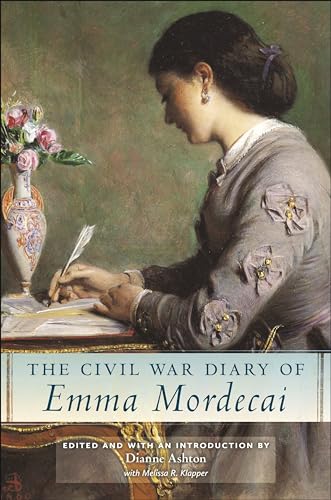
Did Jews own slaves in the antebellum American South? Did these same Jews support the Confederate cause? While it may be distressing to contemporary American Jews to learn that their co-religionists supported slavery and the Confederacy, Jews were found on both sides of the slavery debate and the Civil War. In fact, for some Jews, there was no question that God supported the Confederacy’s cause. Examples of this belief can be found in “The Civil War Diary of Emma Mordecai” edited and with an introduction by Dianne Ashton with Melissa R. Klapper (New York University Press). While the majority of the work features Mordecai’s diary, it’s the 80-plus page introduction – originally written by Ashton, but revised by Klapper after Ashton’s death – that is the most interesting portion of the book. See the rest of my review at https://www.thereportergroup.org/book...
[I was provided a review copy of this book by the publisher via Netgalley]
The Civil War Diary of Emma Mordecai edited and with an introduction by Dianne Ashton, with Melissa R. Klapper, is a unique and ultimately enlightening document that gives readers insight into the perspective of a Jewish woman living in (and supporting) the Confederate South.
Strictly speaking, 'The Civil War Diary' is not actually Emma's original 1864-1865 Diary. It is derived from a typed 1886 transcript that Emma created of her diaries which had, as Emma notes in varying moments of the text, been partially destroyed by rodents, insects, and general wear and tear.
Thankfully, both the original diary papers and the transcript still exist, so we are able to know that the 1886 transcript retains spelling mistakes, punctuation, etc, from the original diary, and that is not a rewrite but an authentic capture of what Emma wrote during 1864-1865.
What is added are occasional dates, explanations, and even side comments. In one entry where Emma writes down that she was told an excellent joke, her 1886 added note laments: "Wish I had recorded the joke--wonder I didn't."
Emma's diary captures what ends up being the last months of the Civil War. While the earlier entries boast about Confederate successes--including a nasty entry where Emma seemingly gleefully recounts a black Union soldier being captured and forced to be the personal slave of a Confederate officer--it soon builds into Confederate losses and the total restructuring of Emma's world.
Most notably, Emma and those around her are forced to confront a new reality where slaves are no longer slaves, and where they are no longer beholden to treat Emma with inherent deference and respect. Emma's response is to bitterly write of the enslaved people in her sister's household, now leaving to make their own way: "They will now begin to find out how easy their life as slaves has been, & to feel the slavery of their freedom."
As the formerly enslaved people of the household gradually decide to make a life elsewhere, Emma and the others must become accustomed to doing their own labor, as finding servants--now actual paid servants, rather than the polite euphemism Emma typically uses to refer to slaves--to help is difficult.
Emma writes, "Felt stiff and sore with my unaccustomed labours of yesterday." She even complains of the fact that she felt no gratitude from the rest of the household for her work--one must wonder how often the enslaved people in the household felt true gratitude from Emma and her family.
Emma's life as a Jewish woman also plays a key role in the text. Emma writes of religious days, of going to the synagogue, and her religious believes are intertwined with her belief in the Confederacy and her way of coping with the world around her. As a reader, it can be frustrating to read Emma's religious thoughts, only to be followed a few pages later by her lamenting the idea of freedom for those around her.
About 50% of the book is dedicated to a lengthy introduction, although I think calling it simply an "introduction" does this section of the text a disservice. The introduction provides necessary and enlightening context into the events and world of the diary, along with important information about Emma and the other people mentioned throughout the text. The analysis of the text in this section is also invaluable.
Overall, I would definitely recommend this book to anyone interested in Civil War texts or historial memoirs. This unflinching look into the attitude of a Southern woman during the final year of the Civil War is a must-read for anyone with an interest in this era, especially if you are looking for a diarist who wrote fairly bluntly about the bitterness and condescension she felt towards the abolition of slavery.
Thanks to the publisher and NetGalley for providing me with an ARC.
In this non-fiction book, the entire of the saved parts of Emma Mordecai's diary are included preceded by a lengthy introduction begun by Prof Dianne Ashton before her untimely death and completed by Prof Melissa Klapper.
Mordecai was a Jewish resident of Richmond, Virginia whose diary recounts the last years of the US Civil War where she lived with a relative on a farm outside of the city. Mordecai came from a well off family and was a slave owner. She fervently defended the "Southern way of life" and spent much of her time tending to hospitalized Confederate soldiers and following the war's progress, especially as it closed in on Richmond.
The academic authors did a good job of covering what is known about Mordecai's life and the context in which she lived, including her views on race, her devotion to Judaism, and the lives of members of her family. There's also a good overview of her life after the war.
It was painful to read the words of a slave owner who called her slaves "servants" but including many denigrating descriptions of the African Americans working for her. I chose to read an ARC of this book because I was curious about the life of a Jewish woman living in the South during the Civil War, but I found the diary difficult to get through.
Every so often it serves as great mental exercise to pick a book—randomly for added thrills!--that on paper does not seem one written for you. Books with viewpoints you may not agree with about people who are unlike yourself. Of course having no anchor would make for a tough read, but provided there’s something one can relate to, it becomes at times the reading equivalent of deadlifting a quarter-ton.
Emma Mordecai is Jewish. So am I. She is American. So am I. She lived in the 19th century. A claim I cannot make. She lived in the South. Nope, not me. She had slaves. I may have unpaid taxes. She on paper was a textbook white supremacist. I’m not even married to a white person. As you can see, there’s a lot we can learn from each other!
There’s another dualism going on more so than the author and myself: The Civil War Diary of Emma Mordecai is basically two books in one. First we’ve a rather excellent preface running a robust 90 pages (plus footnotes) which provides an informative backdrop of Judaism in the south, the war itself, Emma’s background, ‘rivals’ (ie, other diarists of the era), and more. This is followed by the diary running a bit longer.
This thus becomes a tough book to rate. The preface was great, the diary, honestly not so much. For those decided on whether to read the diary from a Jewish studies standpoint, you may be disappointed. Emma basically comes off as a 19th century version of an upper-class Jewish woman in the tristate area whose parents belong to a Reform synagogue and go thrice a year (nothing against Reform, I am one after all!). Also, as noted above, she’s very, very racist, but try and find someone of her background (in other words, not Black) living in the antebellum south who wasn’t.
There is not a lot about Judaism in the diary itself—surely not as much as the preface hints at. Sure, it may have been an important part of her life, but as a diary was a personal ledger of oneself, perhaps she felt it was more important to talk about daily happenings, the weather, and the war itself over profound ruminations of this week’s parashah. The diary most likely will find more fans among Civil War buffs, but not the type who are into the battles, but more so what was going on around them.
Kinde/eBook note: the diary contains absolutely no indexing making it pretty much impossible to jump to any sections. Having a chapter per date may be asking too much given how many there are and how short many are, but at least month-by-month with additional chapters for the letters (probably the only shining section of the diary portion of the book) is direly needed. It’s confusing why this was not done in spite of the intro having great formatting and proper footnotes.
3/5 (Preface = 4.5/5, Diary 2.5/5)
---Notable Highlights---
Wish I had the preface author’s optimism: “Unlike hospital work, religion was a consistent theme throughout Emma’s diary. The diary became the prime location for articulating her religious convictions, recording her prayers, and noting her acts of piety and worship.”
Then and now, most of us agree with this: “While Christians often delighted to see them and expected the visits to result in conversion to Christianity, the opposite often happened. Jews who went to church more often came away convinced that faith in a man—Jesus—was misguided.”
‘Sorry mom, just beating up my lazy inclination’ “Rose & I did great violence to our lazy inclinations, she busying herself a long time in the Garden, & I after practicing for an hour or two on the piano, set hard to work repairing my old hoop skirt, which took me until 6 P.M.”
This was a fascinating read for anyone who is interested in American Jewish history or Civil War history.
The first half isn't the diary itself but an explanation for how the book came to be and historical context, as well as biographical information about Emma Mordecai and her family. The second half is the diary itself.
Emma's Jewishness doesn't come up that much, and I found it interesting that the more things change, the more they stay the same. In this case, Jews tend to blend in with their surroundings. Back then, it meant regarding herself as a Southerner first, with slaves and all. The references to Judaism are more like "It was Yom Kippur today, and I went to services," but there's little to inform her approach to the world, which came from the culture she was living in. She did strive to keep to her religion, but with only 25,000 Jews in the confederate South, and most of her family having married out of the religion, her exposure was limited.
As a Civil War diary, it was replete with interesting information such as what they wore, what food they ate, and how they regarded the Union. It's all typed of course, but the handwritten notes were written so beautifully and I enjoyed reading them.
Thank you to NetGalley, Dianne Ashton's estate, Melissa R. Klapper and NYU Press for an advanced copy for review.
The Civil War Diary of Emma Mordecai by Edited and with an introduction by Dianne Ashton with Melissa R. Klapper is a great nonfiction/memoir that I really enjoyed.
This is an interesting glimpse into both the unique and “ordinary” world of a woman during the Civil War. Through these journal entries we can see the specific concerns and challenges that Emma experienced due to being Jewish, and also some of the things that all women experienced to some degree during this time.
The significant introduction, historical context, and background that was given before the entries are produced gives a wealth of knowledge to help the reader understand a bit more about Emma, her surroundings, and the time that she lived in. The selected images were also a lovely addition.
4/5 stars
Thank you NG and NYU Press for this wonderful arc and in return I am submitting my unbiased and voluntary review and opinion.
I am posting this review to my GR and Bookbub accounts immediately and will post it to my Amazon, Instagram, and B&N accounts upon publication on 10/29/24.
A remarkable account of the Civil War from the perspective of a Jewish woman living in the Confederate South, which offers a unique perspective of the events, in which she was fully involved. The diaries give the reader a unique insight into the life and times, filtered through Emma Mordechai’s sensibilities, and it’s a vivid account indeed. There’s a long and welcome introduction placing the diaries into their historical context, and the historical, cultural and societal background is thoroughly filled in. The book has been well edited and includes many evocative illustrations. The diaries themselves are presented without footnotes – all you need to know is placed elsewhere – which makes reading them an intimate and immersive experience. I found this book a fascinating and informative read, offering as it does details of a specifically Jewish life, which we don’t often encounter in contemporary accounts of life in the American south.
Emma Mordecai’s diary is a rare first-hand peek into Southern life during the American Civil War. As a single woman, a Jew, and a slave owner, she captures her unique perspective in a fascinating way that is difficult to put down. The lengthy introduction (over 80 pages) is a book unto itself. Placing Emma in the proper context of geography, culture, and family was very helpful. Reading the actual diary is much easier after all the background information provided. I am very thankful for all the research that went into producing this volume. It is very educational, interesting, and thought provoking. This is an important piece of history that every American should read. *I received a complimentary copy of this ebook courtesy of NYU Press through NetGalley. All thoughts and opinions are my own.
This is an interesting and informative book! I was immediately drawn into the book after reading the foreword by Richard Drucker- (husband of the deceased Dr. Dianne Ashton).
The first half of the book is the introduction, which introduced the reader to Emma Mordecai. It also provides loads of information and facts pertaining to the Civil War. The second half contains excerpts from Emma's diary.
The subject of racism and particularly southern Jewish racism was something I never knew about. It was eye-opening, to say the least. The book whetted my interest concerning this subject.
I was provided a complimentary copy of the book from New York University Press via Netgalley. All thoughts and opinions are my own.
As a lover of history I love when I can read primary accounts of people who have lived through major world events. When it comes in the version of a diary I am even more excited (maybe because I am noisy). Although I did not like the writer, Emma, I did enjoy reading about her experience during the Civil War. The writers of this book do a very good job of giving a good background and explanation of certain things via their introduction. Would recommend this book to anyone who enjoys first hand accounts or the Civil War.
The Civil War Diary of Emma Mordechai is absolutely wonderful. The writers did an amazing job of adding bits and pieces of relevant information together as they went through the diary, helping to bring it to life. Emma's story is told from a perspective I had never thought about. I love the non-bias way Emma's story was told, allowing the reader to judge for themselves. I would definitely recommend this to any and everyone.
In the Civil War diary of Emma Mordecai by Diane Ashton and Melissa Clapper it is about a Jewish woman living in Richmond Virginia and losing her home due to the Civil War in the year long diaries she kept about her woe’s and tribulations throughout the 12 months she documented in her journal. She was forced to move with her brother and sister-in-law and we hear about all the changes she goes through not only the isolation of moving from the city to the country but the indignity she felt when first coming up on freed black men who spoke to her without deference and her bewilderment at them not knowing their place. I know a lot of people will read this and think badly of Emma and her racist viewpoints because most people cannot see past their own nose but for those who realize Emma it’s just a product of her time then you will probably enjoy this book. I love reading life from others points of views, this isn’t the actual diary,but a Jewish historian talking about her diary. It was started by Doctor of history Diane Ashton but due to her untimely death it was finished by her colleague and friend Dr. Melissa Clapper. This is a great book and a great view into the lives and opinions that would help form those opinions in a time that may be baffling to the modern day reader. My favorite quote is by Maya Angelou and it is when we know better we do better and after reading this book and getting to know Emma as much as I could through the narrative I would love to think her opinions would’ve been different had she been born at a different time but she was a product of her raising end it pains me to think anyone would think ill of this lonely woman when they haven’t even walked a block in her shoes. I do wish it was her actual diary but the authors explaining her statements made it an even better read. I just wish we would have at least got excerpts directly from her diary but I digress it was still an awesome book and one I absolutely loved and totally recommend for any fan of history the Civil War Jewish history in women’s history ETC. I want to thank NYU press for my free arc copy via NetGalley please forgive any mistakes as I am blind and dictate my review.
The first half of the book is the introduction, which introduced the reader to Emma Mordecai. It also provides loads of information and facts pertaining to the Civil War. The second half contains excerpts from Emma's diary. I would recommend for any fan of Civil War history. Thank you to Netgalley, the author and the publisher for a chance to read and review this book in exchange for an honest review.