

What do you think?
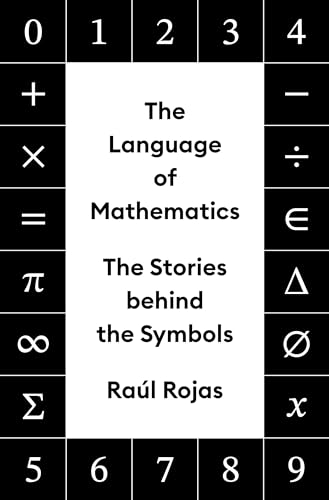
The Language of Mathematics: The Stories behind the Symbols
A marvelous compendium of mathematical symbols and their fascinating histories
Galileo famously wrote that the book of nature is written in mathematical language. The Language of Mathematics is a wide-ranging and beautifully illustrated collection of short, colorful histories of the most commonly used symbols in mathematics, providing readers with an engaging introduction to the origins, evolution, and conceptual meaning of each one.
In dozens of lively and informative entries, Raúl Rojas shows how today’s mathematics stands on the shoulders of giants, mathematicians from around the world who developed mathematical notation through centuries of collective effort. He tells the stories of such figures as al-Khwarizmi, René Descartes, Joseph-Louis Lagrange, Carl Friedrich Gauss, Augustin-Louis Cauchy, Karl Weierstrass, Sofia Kovalevskaya, David Hilbert, and Kenneth Iverson. Topics range from numbers and variables to sets and functions, constants, and combinatorics. Rojas describes the mathematical problems associated with different symbols and reveals how mathematical notation has sometimes been an accidental process. The entries are self-contained and can be read in any order, each one examining one or two symbols, their history, and the variants they may have had over time.
An essential companion for math enthusiasts, The Language of Mathematics shows how mathematics is a living and evolving entity, forever searching for the best symbolism to express relationships between abstract concepts and to convey meaning.
Galileo famously wrote that the book of nature is written in mathematical language. The Language of Mathematics is a wide-ranging and beautifully illustrated collection of short, colorful histories of the most commonly used symbols in mathematics, providing readers with an engaging introduction to the origins, evolution, and conceptual meaning of each one.
In dozens of lively and informative entries, Raúl Rojas shows how today’s mathematics stands on the shoulders of giants, mathematicians from around the world who developed mathematical notation through centuries of collective effort. He tells the stories of such figures as al-Khwarizmi, René Descartes, Joseph-Louis Lagrange, Carl Friedrich Gauss, Augustin-Louis Cauchy, Karl Weierstrass, Sofia Kovalevskaya, David Hilbert, and Kenneth Iverson. Topics range from numbers and variables to sets and functions, constants, and combinatorics. Rojas describes the mathematical problems associated with different symbols and reveals how mathematical notation has sometimes been an accidental process. The entries are self-contained and can be read in any order, each one examining one or two symbols, their history, and the variants they may have had over time.
An essential companion for math enthusiasts, The Language of Mathematics shows how mathematics is a living and evolving entity, forever searching for the best symbolism to express relationships between abstract concepts and to convey meaning.
280 pages, Hardcover
First published January 14, 2025
Ratings & Reviews
Friends & Following
Create a free account to discover what your friends think of this book!
Community Reviews
Displaying 1 - 15 of 15 reviews
February 22, 2025
Interesting anecdotes that put together a roadmap of the development of mathematical thought from Indian, Babylonian, Chinese, Arabic, and European mathematicians (as well as several instances showing how the UK and Europe have not melded intellectually). History, etymology, and oh yes math are used to show how concepts and language flow - glad I got to come along for the ride.
October 7, 2025
It was remarkable to see how impossible algebra, and even arithmetic, was back in the era when all math problems were written as paragraphs and basic math notation wasn't invented yet! There were a lot of neat snippets that supported a theme of "Good, clear notation leads to insights that weren't possible before." This makes me think of Feynman diagrams and how Julian Schwinger said they "brought quantum field theory to the masses" (too bad Feynman diagrams weren't in this book!). But it's too disjointed, too much of a collection of random anecdotes, for those themes to come out as strongly as they could have. There's a good throughline here that I bet a trained historian could have turned into a really strong history of math/science book.

March 13, 2026
I really enjoyed the math history we got, but I wanted to learn more about what each symbol does and how it's used and why. It was more how the symbol came to be used for its current purpose: who used it first, who promoted it, what alphabet was it taken from, what stylistic changes have been made to it over time.

March 9, 2026
In „The Language of Mathematics: The Stories behind the Symbols“ untersucht Raúl Rojas die faszinierende Entstehungsgeschichte mathematischer Symbole und deren tiefgreifende Bedeutung für die Wissenschaft. Er beschreibt den historischen Übergang von rein textbasierten Erklärungen hin zu einer modernen Formelsprache, die komplexe Sachverhalte präzise und elegant darstellt. Dabei beleuchtet der Autor den maßgeblichen Einfluss arabischer Gelehrter wie al-Khwarizmi sowie die Beiträge europäischer Pioniere wie Euler und Leibniz.
Die Texte erläutern zudem, wie alltägliche Notationen – etwa das Gleichheitszeichen oder die Variable x – durch kulturellen Austausch und gelegentliche Übersetzungsfehler ihre heutige Form fanden. Letztlich vermittelt das Buch ein tieferes Verständnis für die Ästhetik der Mathematik und zeigt auf, wie diese universelle Sprache über Jahrhunderte hinweg entwickelt wurde.
Das Buch „The Language of Mathematics: The Stories behind the Symbols“ von Raúl Rojas ist eine umfassende Hommage an die jahrtausendelange Entwicklung der mathematischen Zeichensprache. Rojas, der auf Jahrzehnte der Lehre zurückblickt, verfolgt mit diesem Werk das Ziel, die oft „bewusstlose, mechanische“ Nutzung mathematischer Konzepte durch ein tiefes Verständnis ihrer historischen Wurzeln zu ersetzen.
Hier sind die zentralen Aspekte, die dieses Werk auszeichnen:
Verbindung von Geschichte und Anwendung
Das Buch ist kein enzyklopädisches Verzeichnis, sondern lädt dazu ein, über die „Riesen“, auf deren Schultern die heutige Mathematik steht, zu staunen. Es zeigt auf, dass die Natur in der Sprache der Mathematik geschrieben ist und dass ohne die Kenntnis ihrer „Charaktere“ (Dreiecke, Kreise, geometrische Figuren) das Universum ein dunkles Labyrinth bleibt.
Didaktische Struktur
Mit 54 Abschnitten in neun Kapiteln ist das Werk so konzipiert, dass jeder Abschnitt für sich steht und in beliebiger Reihenfolge gelesen werden kann. Diese Struktur soll insbesondere Studenten stimulieren, wenn sie durch den bloßen Formalismus an der Tafel ermüdet sind. Rojas räumt dabei bewusst Redundanzen ein, da Wiederholung das Einprägen komplexer Geschichten fördert.
Kulturelle und linguistische Tiefe
Rojas verfolgt die Symbole durch verschiedene Epochen und Reiche – von den Sumerern und Babyloniern über die griechische Antike und das goldene Zeitalter des Islam bis hin zur Renaissance und der Moderne.
Besonders hervorzuheben sind die etymologischen Analysen, etwa wie aus dem indischen Wort für „Halb-Sehne“ durch Übersetzungsfehler der Begriff „Sinus“ (lateinisch für Bucht oder Höhle) wurde oder wie die Suche nach „Wurzeln“ auf botanische Missverständnisse bei der Übersetzung arabischer Texte zurückgeht.
Fokus auf Eleganz und Schönheit
Die Mathematik wird nicht nur als Werkzeugkasten, sondern als eine Disziplin voller „Eleganz“ präsentiert. Rojas diskutiert die „schönsten Formeln“, wie die Eulersche Identität oder den Satz des Pythagoras, und betont, dass eine kraftvolle Notation die Vorstellungskraft beflügelt.
Statistische und moderne Einblicke
Das Buch bietet ungewöhnliche Einblicke, wie eine statistische Analyse der am häufigsten verwendeten Symbole (das Gleichheitszeichen steht mit 94 % an der Spitze). Zudem schlägt es die Brücke zu modernen Entwicklungen wie der Einstein-Konvention, dem „Halmos-Grabstein“ am Ende von Beweisen oder Programmiersprachen wie APL.
Zusammenfassend lässt sich das Werk als eine „unvollendete Kathedrale“ charakterisieren, die sich ständig weiterentwickelt und den Leser dazu motiviert, die Abstraktionen des Alltags zu hinterfragen. Es ist ein Plädoyer dafür, Mathematik als eine lebendige, sich entwickelnde Wissenschaft zu begreifen, die ihre eigene Stimme sucht.
Die Geschichte hinter der Bezeichnung „Wurzel“ (lateinisch radix) für die Lösung einer Gleichung ist eine der kuriosesten Fehlinterpretationen in der Mathematikgeschichte und basiert auf einer Verschmelzung von mathematischen und botanischen Konzepten.
Hier ist der historische Verlauf dieser Entwicklung:
Griechische Geometrisierung
Die alten Griechen lösten numerische Probleme oft geometrisch. Die gesuchte Unbekannte einer Gleichung wurde als Länge einer Strecke dargestellt. Aus diesem Grund nannten die Römer, die direkt aus griechischen Texten übersetzten, die Lösung einer algebraischen Aufgabe latus (lateinisch für „Seite“).
Arabische Begriffe
Während des Goldenen Zeitalters des Islam nutzten arabische Mathematiker wie al-Khwarizmi die Begriffe mal und jadhr für die Unbekannte. Jadhr bezeichnete die Variable, deren Wert ermittelt werden sollte, während mal ihr Quadrat repräsentierte.
Der Übersetzungsfehler
Das Wort jadhr ist eine direkte Anspielung auf die griechische Tradition und bedeutet eigentlich „Fundament“ oder „Basis“ einer geometrischen Konstruktion. Je nach Kontext kann das Wort im Arabischen jedoch auch die Basis oder Wurzel einer Pflanze bedeuten.
Wurzeln schlagen in Europa
Die ersten europäischen Übersetzer arabischer Abhandlungen entschieden sich gegen den römischen Begriff latus und wählten stattdessen die botanische Bedeutung von jadhr, nämlich radix („Wurzel“). Damit verschwand der ursprüngliche Bezug zur geometrischen Konstruktion hinter einem „verbalen Schleier“.
Popularisierung
Mathematiker und Übersetzer wie Johannes Hispaniensis, Gerhard von Cremona und Leonardo Fibonacci verbreiteten diese neue Terminologie in Europa. Fibonacci betitelte beispielsweise ein Kapitel seines Werkes Liber Abaci mit „De reperiendis radicibus quadratis et cubitis“.
Heute nutzen wir den Begriff „Wurzel“ ganz selbstverständlich, obwohl er eigentlich auf einem botanischen Missverständnis mittelalterlicher Übersetzer beruht. Interessanterweise waren jüdische Gelehrte, die direkt vom Arabischen ins Hebräische übersetzten, präziser und identifizierten jadhr korrekt mit gader, was „Seite“ oder „Kante“ bedeutet.
Im Buch „The Language of Mathematics“ werden als Antwort auf eine Umfrage der russischen Mathematikerin Natasha Kondratieva aus dem Jahr 2002 die folgenden drei Formeln als die schönsten bezeichnet:
Der Satz des Pythagoras
a^2 + b^2 = c^2
Diese Formel ist eine der am häufigsten genannten und gehört zu den ersten Gleichungen, die man im Geometrieunterricht lernt. Ihre Schönheit liegt in ihrer Einfachheit und der Tatsache, dass sie intuitiv – sogar ganz ohne Worte – bewiesen werden kann.
Die Eulersche Identität
e^(iπ) + 1 = 0
Diese Formel wird oft als die ästhetischste angesehen, weil sie die wichtigsten Fundamente der Mathematik in einer einzigen kurzen Gleichung vereint: die Zahlen 0 und 1, die Grundoperation der Addition, die transzendenten Zahlen e und π sowie die imaginäre Einheit i.
Die Eulersche Polyederformel
V - E + F = 2
Diese ebenfalls von Leonhard Euler stammende Formel beschreibt einen fundamentalen Zusammenhang in der Geometrie: Die Anzahl der Ecken (Vertices) eines Polyeders minus der Anzahl seiner Kanten (Edges) plus der Anzahl seiner Flächen (Faces) ergibt immer zwei.
Euler selbst war von diesem Ergebnis so begeistert, dass er seine Überraschung darüber in einem Brief an einen Freund ausdrückte.
Laut der im Buch zitierten Statistik ist das Gleichheitszeichen (=) das am häufigsten verwendete mathematische Symbol, da es in 94 % aller mathematischen Ausdrücke vorkommt. Direkt danach folgen die öffnenden und schließenden Klammern, die in fast 60 % der Ausdrücke enthalten sind.
Betrachtet man die allgemeine Verteilung aller Zeichen in mathematischen Aussagen, ergibt sich folgendes Bild:
* Lateinische Buchstaben: 36 %
* Mathematische Operatoren: 15 %
* Zahlen: 13 %
* Klammern: 8 %
* Relationsoperatoren: 7 %
* Griechische Buchstaben: 6 %
* Satzzeichen: 6 %
* Pfeile: 3 %
Hinsichtlich spezifischer Identifikatoren sind die Buchstaben n, i und x in mathematischen Texten am populärsten, während in Ingenieurstexten am häufigsten x, y und n zu finden sind.
Insbesondere die Variablen x und y nehmen durch ihre Verwendung in kartesischen Koordinaten eine privilegierte Stellung ein und gelten als die beiden am häufigsten genutzten Buchstaben in der Mathematik.
Die Geschichte des Gleichheitszeichens (=) ist untrennbar mit dem walisischen Arzt und Mathematiker Robert Recordeverbunden, der dieses heute universelle Symbol im Jahr 1557 einführte.
Hier sind die Details zu seiner Entstehung und Verbreitung:
Die Geburtsstunde
Recorde präsentierte das Symbol erstmals in seinem Buch The Whetstone of Witte. Vor dieser Zeit wurden mathematische Gleichheiten meist rein verbal beschrieben oder durch eine einfache Linie markiert.
Die philosophische Wahl
Er entschied sich für zwei parallele horizontale Linien, weil seiner Ansicht nach:
„Noe 2 thynges can be moare equalle.“
Ursprüngliches Aussehen
In Recordes Erstveröffentlichung waren die Linien noch deutlich länger als in der heutigen Schreibweise.
Konkurrenz durch andere Zeichen
Das Gleichheitszeichen musste sich erst gegen andere Notationen behaupten. So popularisierte etwa René Descartes das Symbol ∝, das besonders auf dem europäischen Kontinent verbreitet war.
Globale Etablierung
Zunächst wurde das =-Zeichen vor allem in England populär. Es dauerte bis etwa 1700, bis es durch die Verwendung prominenter Wissenschaftler wie Isaac Newton und Gottfried Wilhelm Leibniz zum allgemeinen Standard wurde.
Häufigkeit
Heute ist es statistisch gesehen das wichtigste Symbol der Mathematik: 94 % aller mathematischen Ausdrücke enthalten ein Gleichheitszeichen.
Trotz der Erfindung eines so fundamentalen Werkzeugs endete das Leben von Robert Recorde tragisch: Er starb bankrott und verschuldet in einem Gefängnis, da es ihm – im Gegensatz zu seinen mathematischen Gleichungen – nicht gelang, sein finanzielles Gleichgewicht zu halten.
Die Texte erläutern zudem, wie alltägliche Notationen – etwa das Gleichheitszeichen oder die Variable x – durch kulturellen Austausch und gelegentliche Übersetzungsfehler ihre heutige Form fanden. Letztlich vermittelt das Buch ein tieferes Verständnis für die Ästhetik der Mathematik und zeigt auf, wie diese universelle Sprache über Jahrhunderte hinweg entwickelt wurde.
Das Buch „The Language of Mathematics: The Stories behind the Symbols“ von Raúl Rojas ist eine umfassende Hommage an die jahrtausendelange Entwicklung der mathematischen Zeichensprache. Rojas, der auf Jahrzehnte der Lehre zurückblickt, verfolgt mit diesem Werk das Ziel, die oft „bewusstlose, mechanische“ Nutzung mathematischer Konzepte durch ein tiefes Verständnis ihrer historischen Wurzeln zu ersetzen.
Hier sind die zentralen Aspekte, die dieses Werk auszeichnen:
Verbindung von Geschichte und Anwendung
Das Buch ist kein enzyklopädisches Verzeichnis, sondern lädt dazu ein, über die „Riesen“, auf deren Schultern die heutige Mathematik steht, zu staunen. Es zeigt auf, dass die Natur in der Sprache der Mathematik geschrieben ist und dass ohne die Kenntnis ihrer „Charaktere“ (Dreiecke, Kreise, geometrische Figuren) das Universum ein dunkles Labyrinth bleibt.
Didaktische Struktur
Mit 54 Abschnitten in neun Kapiteln ist das Werk so konzipiert, dass jeder Abschnitt für sich steht und in beliebiger Reihenfolge gelesen werden kann. Diese Struktur soll insbesondere Studenten stimulieren, wenn sie durch den bloßen Formalismus an der Tafel ermüdet sind. Rojas räumt dabei bewusst Redundanzen ein, da Wiederholung das Einprägen komplexer Geschichten fördert.
Kulturelle und linguistische Tiefe
Rojas verfolgt die Symbole durch verschiedene Epochen und Reiche – von den Sumerern und Babyloniern über die griechische Antike und das goldene Zeitalter des Islam bis hin zur Renaissance und der Moderne.
Besonders hervorzuheben sind die etymologischen Analysen, etwa wie aus dem indischen Wort für „Halb-Sehne“ durch Übersetzungsfehler der Begriff „Sinus“ (lateinisch für Bucht oder Höhle) wurde oder wie die Suche nach „Wurzeln“ auf botanische Missverständnisse bei der Übersetzung arabischer Texte zurückgeht.
Fokus auf Eleganz und Schönheit
Die Mathematik wird nicht nur als Werkzeugkasten, sondern als eine Disziplin voller „Eleganz“ präsentiert. Rojas diskutiert die „schönsten Formeln“, wie die Eulersche Identität oder den Satz des Pythagoras, und betont, dass eine kraftvolle Notation die Vorstellungskraft beflügelt.
Statistische und moderne Einblicke
Das Buch bietet ungewöhnliche Einblicke, wie eine statistische Analyse der am häufigsten verwendeten Symbole (das Gleichheitszeichen steht mit 94 % an der Spitze). Zudem schlägt es die Brücke zu modernen Entwicklungen wie der Einstein-Konvention, dem „Halmos-Grabstein“ am Ende von Beweisen oder Programmiersprachen wie APL.
Zusammenfassend lässt sich das Werk als eine „unvollendete Kathedrale“ charakterisieren, die sich ständig weiterentwickelt und den Leser dazu motiviert, die Abstraktionen des Alltags zu hinterfragen. Es ist ein Plädoyer dafür, Mathematik als eine lebendige, sich entwickelnde Wissenschaft zu begreifen, die ihre eigene Stimme sucht.
Die Geschichte hinter der Bezeichnung „Wurzel“ (lateinisch radix) für die Lösung einer Gleichung ist eine der kuriosesten Fehlinterpretationen in der Mathematikgeschichte und basiert auf einer Verschmelzung von mathematischen und botanischen Konzepten.
Hier ist der historische Verlauf dieser Entwicklung:
Griechische Geometrisierung
Die alten Griechen lösten numerische Probleme oft geometrisch. Die gesuchte Unbekannte einer Gleichung wurde als Länge einer Strecke dargestellt. Aus diesem Grund nannten die Römer, die direkt aus griechischen Texten übersetzten, die Lösung einer algebraischen Aufgabe latus (lateinisch für „Seite“).
Arabische Begriffe
Während des Goldenen Zeitalters des Islam nutzten arabische Mathematiker wie al-Khwarizmi die Begriffe mal und jadhr für die Unbekannte. Jadhr bezeichnete die Variable, deren Wert ermittelt werden sollte, während mal ihr Quadrat repräsentierte.
Der Übersetzungsfehler
Das Wort jadhr ist eine direkte Anspielung auf die griechische Tradition und bedeutet eigentlich „Fundament“ oder „Basis“ einer geometrischen Konstruktion. Je nach Kontext kann das Wort im Arabischen jedoch auch die Basis oder Wurzel einer Pflanze bedeuten.
Wurzeln schlagen in Europa
Die ersten europäischen Übersetzer arabischer Abhandlungen entschieden sich gegen den römischen Begriff latus und wählten stattdessen die botanische Bedeutung von jadhr, nämlich radix („Wurzel“). Damit verschwand der ursprüngliche Bezug zur geometrischen Konstruktion hinter einem „verbalen Schleier“.
Popularisierung
Mathematiker und Übersetzer wie Johannes Hispaniensis, Gerhard von Cremona und Leonardo Fibonacci verbreiteten diese neue Terminologie in Europa. Fibonacci betitelte beispielsweise ein Kapitel seines Werkes Liber Abaci mit „De reperiendis radicibus quadratis et cubitis“.
Heute nutzen wir den Begriff „Wurzel“ ganz selbstverständlich, obwohl er eigentlich auf einem botanischen Missverständnis mittelalterlicher Übersetzer beruht. Interessanterweise waren jüdische Gelehrte, die direkt vom Arabischen ins Hebräische übersetzten, präziser und identifizierten jadhr korrekt mit gader, was „Seite“ oder „Kante“ bedeutet.
Im Buch „The Language of Mathematics“ werden als Antwort auf eine Umfrage der russischen Mathematikerin Natasha Kondratieva aus dem Jahr 2002 die folgenden drei Formeln als die schönsten bezeichnet:
Der Satz des Pythagoras
a^2 + b^2 = c^2
Diese Formel ist eine der am häufigsten genannten und gehört zu den ersten Gleichungen, die man im Geometrieunterricht lernt. Ihre Schönheit liegt in ihrer Einfachheit und der Tatsache, dass sie intuitiv – sogar ganz ohne Worte – bewiesen werden kann.
Die Eulersche Identität
e^(iπ) + 1 = 0
Diese Formel wird oft als die ästhetischste angesehen, weil sie die wichtigsten Fundamente der Mathematik in einer einzigen kurzen Gleichung vereint: die Zahlen 0 und 1, die Grundoperation der Addition, die transzendenten Zahlen e und π sowie die imaginäre Einheit i.
Die Eulersche Polyederformel
V - E + F = 2
Diese ebenfalls von Leonhard Euler stammende Formel beschreibt einen fundamentalen Zusammenhang in der Geometrie: Die Anzahl der Ecken (Vertices) eines Polyeders minus der Anzahl seiner Kanten (Edges) plus der Anzahl seiner Flächen (Faces) ergibt immer zwei.
Euler selbst war von diesem Ergebnis so begeistert, dass er seine Überraschung darüber in einem Brief an einen Freund ausdrückte.
Laut der im Buch zitierten Statistik ist das Gleichheitszeichen (=) das am häufigsten verwendete mathematische Symbol, da es in 94 % aller mathematischen Ausdrücke vorkommt. Direkt danach folgen die öffnenden und schließenden Klammern, die in fast 60 % der Ausdrücke enthalten sind.
Betrachtet man die allgemeine Verteilung aller Zeichen in mathematischen Aussagen, ergibt sich folgendes Bild:
* Lateinische Buchstaben: 36 %
* Mathematische Operatoren: 15 %
* Zahlen: 13 %
* Klammern: 8 %
* Relationsoperatoren: 7 %
* Griechische Buchstaben: 6 %
* Satzzeichen: 6 %
* Pfeile: 3 %
Hinsichtlich spezifischer Identifikatoren sind die Buchstaben n, i und x in mathematischen Texten am populärsten, während in Ingenieurstexten am häufigsten x, y und n zu finden sind.
Insbesondere die Variablen x und y nehmen durch ihre Verwendung in kartesischen Koordinaten eine privilegierte Stellung ein und gelten als die beiden am häufigsten genutzten Buchstaben in der Mathematik.
Die Geschichte des Gleichheitszeichens (=) ist untrennbar mit dem walisischen Arzt und Mathematiker Robert Recordeverbunden, der dieses heute universelle Symbol im Jahr 1557 einführte.
Hier sind die Details zu seiner Entstehung und Verbreitung:
Die Geburtsstunde
Recorde präsentierte das Symbol erstmals in seinem Buch The Whetstone of Witte. Vor dieser Zeit wurden mathematische Gleichheiten meist rein verbal beschrieben oder durch eine einfache Linie markiert.
Die philosophische Wahl
Er entschied sich für zwei parallele horizontale Linien, weil seiner Ansicht nach:
„Noe 2 thynges can be moare equalle.“
Ursprüngliches Aussehen
In Recordes Erstveröffentlichung waren die Linien noch deutlich länger als in der heutigen Schreibweise.
Konkurrenz durch andere Zeichen
Das Gleichheitszeichen musste sich erst gegen andere Notationen behaupten. So popularisierte etwa René Descartes das Symbol ∝, das besonders auf dem europäischen Kontinent verbreitet war.
Globale Etablierung
Zunächst wurde das =-Zeichen vor allem in England populär. Es dauerte bis etwa 1700, bis es durch die Verwendung prominenter Wissenschaftler wie Isaac Newton und Gottfried Wilhelm Leibniz zum allgemeinen Standard wurde.
Häufigkeit
Heute ist es statistisch gesehen das wichtigste Symbol der Mathematik: 94 % aller mathematischen Ausdrücke enthalten ein Gleichheitszeichen.
Trotz der Erfindung eines so fundamentalen Werkzeugs endete das Leben von Robert Recorde tragisch: Er starb bankrott und verschuldet in einem Gefängnis, da es ihm – im Gegensatz zu seinen mathematischen Gleichungen – nicht gelang, sein finanzielles Gleichgewicht zu halten.
January 26, 2025
This book does not play well with a Kindle Paperwhite. Since this book is specifically about mathematical symbols and notation I would expect it would show the notation correctly, but on Paperwhite it doesn't even display elementary things such as inline fractions properly. 5 over 8 displays as 58, not even as 5/8. Square root radicals likewise disappear. Superscripts and subscripts get mangled too. Anything more complicated? Forget about it. Sigma notation summations such as summing all elements a sub i from i = 0 to n show up as ∑ i=0nai.
Everyday infinite series such as the Leibniz formula for π/4 = 1 - 1/3 + 1/5 - 1/7 + ... shows up as the nonsensical 1 - 13 + 15 - 17 + ... = π4 !
Kindle on PC displays the notation properly, as does Kindle on Android. If I had been reading the book exclusively on one or the other rather than on my Paperwhite I might have given this review 5 stars, but on Kindle Paperwhite I was tempted to ask for a refund.
Everyday infinite series such as the Leibniz formula for π/4 = 1 - 1/3 + 1/5 - 1/7 + ... shows up as the nonsensical 1 - 13 + 15 - 17 + ... = π4 !
Kindle on PC displays the notation properly, as does Kindle on Android. If I had been reading the book exclusively on one or the other rather than on my Paperwhite I might have given this review 5 stars, but on Kindle Paperwhite I was tempted to ask for a refund.

May 13, 2025
One of the biggest developments in the history of maths was moving from describing relationships and functions with words to using symbols. This interesting little book traces the origins of a whole range of symbols from those familiar to all, to the more obscure squiggles used in logic and elsewhere.
On the whole Raúl Rojas does a good job of filling in some historical detail, if in what is generally a fairly dry fashion. We get to trace what was often a bumpy path as different symbols were employed (particularly, for example, for division and multiplication, where several still remain in use), but usually, gradually, standards were adopted.
This feels better as a reference, to dip into if you want to find out about a specific symbol, rather than an interesting end to end read. Rojas tells us the sections are designed to be read in any order, which means that there is some overlap of text - it feels more like a collection of short essays or blog posts that he couldn't be bothered to edit into a consistent whole.
There are a couple of historical points I would raise an eyebrow at. At one point we are told 'While Europe groped through the darkness of the Middle Ages, the Arabs rescued the scientific legacy of the Greeks.' This is not to minimise the huge Arabic contribution to maths in this period, but there was a significant account of mathematical activity in the Middle Ages, which running through to the end of the fifteenth century would include, for instance, the Oxford Calculators, Fibonacci, Oresme and more.
There was also an odd statement that the Romans had no year zero because zero 'simply could not be expressed with Roman notation.' While it's true that it couldn't be expressed it wouldn't have been meaningful anyway. Years aren't a number line, and it seems perfectly logical to go from the first year before Christ to the first year of his life, if you aren't mentally boxed in by current mathematics.
Because it doesn't really work well as a book to read end to end I can't give it more than three stars, but there's plenty to catch the attention of someone with an interest in mathematics and a curiosity as to how our weird and wonderful symbols came into use.
On the whole Raúl Rojas does a good job of filling in some historical detail, if in what is generally a fairly dry fashion. We get to trace what was often a bumpy path as different symbols were employed (particularly, for example, for division and multiplication, where several still remain in use), but usually, gradually, standards were adopted.
This feels better as a reference, to dip into if you want to find out about a specific symbol, rather than an interesting end to end read. Rojas tells us the sections are designed to be read in any order, which means that there is some overlap of text - it feels more like a collection of short essays or blog posts that he couldn't be bothered to edit into a consistent whole.
There are a couple of historical points I would raise an eyebrow at. At one point we are told 'While Europe groped through the darkness of the Middle Ages, the Arabs rescued the scientific legacy of the Greeks.' This is not to minimise the huge Arabic contribution to maths in this period, but there was a significant account of mathematical activity in the Middle Ages, which running through to the end of the fifteenth century would include, for instance, the Oxford Calculators, Fibonacci, Oresme and more.
There was also an odd statement that the Romans had no year zero because zero 'simply could not be expressed with Roman notation.' While it's true that it couldn't be expressed it wouldn't have been meaningful anyway. Years aren't a number line, and it seems perfectly logical to go from the first year before Christ to the first year of his life, if you aren't mentally boxed in by current mathematics.
Because it doesn't really work well as a book to read end to end I can't give it more than three stars, but there's plenty to catch the attention of someone with an interest in mathematics and a curiosity as to how our weird and wonderful symbols came into use.
August 4, 2025
[Review for Tasmanian Times]
Mathematics either fascinates or leaves us indifferent – there’s no middle ground. But for those who thrill at the insights math provides into the world around us, Raul Rojas, Professor of mathematics, statistics and computer science, and an expert in neural networks and artificial intelligence, has provided this wonderful small book on the stories behind how the symbols we use to make math work were created.
Some symbols indicate, in a single pen- or brush-stroke, a concept like addition or subtraction, but, somewhat surprisingly, took many centuries to evolve. Another universal symbol for ‘equal’ (two parallel horizontal lines) was anything but straightforward to conceptualise, let alone symbolise. Likewise the stunning insight that basic numbering required a ‘null’ number – zero, required breathtaking genius.
So math is simple and complex, often counter-intuitive, and its history is full of characters.
Alfred North-Whitehead and Bertrand Russell’s grand 1910 opus – Principia Mathematica – was an epic quest to find a complete and consistent set of axioms that encompass the entirety of mathematical logic that underpin our ability to question, quantify and understand the natural world. It would’ve been one of mathematics’ greatest achievements, but was its most outstanding and grandest failure. It started out well, though ‘the reader has to move at a snail’s pace through a jungle of mathematical notation to find, after hundreds of pages, the proof that 1+1=2’.
So far, so good. Whitehead and Russell had faith that all that could be known could be reduced to provable logical statements. But it can’t.
Young mathematician, Kurt Godel took a long look at the issues and came away with two Incompleteness Theorems that showed mathematical logic had limits to the provability of problems using natural numbers. In other words, 1+1 [very probably] = 2.
Either way, this book is a set of small joys for math-happy explorers of mathematical-cultural history. Recommended.
Mathematics either fascinates or leaves us indifferent – there’s no middle ground. But for those who thrill at the insights math provides into the world around us, Raul Rojas, Professor of mathematics, statistics and computer science, and an expert in neural networks and artificial intelligence, has provided this wonderful small book on the stories behind how the symbols we use to make math work were created.
Some symbols indicate, in a single pen- or brush-stroke, a concept like addition or subtraction, but, somewhat surprisingly, took many centuries to evolve. Another universal symbol for ‘equal’ (two parallel horizontal lines) was anything but straightforward to conceptualise, let alone symbolise. Likewise the stunning insight that basic numbering required a ‘null’ number – zero, required breathtaking genius.
So math is simple and complex, often counter-intuitive, and its history is full of characters.
Alfred North-Whitehead and Bertrand Russell’s grand 1910 opus – Principia Mathematica – was an epic quest to find a complete and consistent set of axioms that encompass the entirety of mathematical logic that underpin our ability to question, quantify and understand the natural world. It would’ve been one of mathematics’ greatest achievements, but was its most outstanding and grandest failure. It started out well, though ‘the reader has to move at a snail’s pace through a jungle of mathematical notation to find, after hundreds of pages, the proof that 1+1=2’.
So far, so good. Whitehead and Russell had faith that all that could be known could be reduced to provable logical statements. But it can’t.
Young mathematician, Kurt Godel took a long look at the issues and came away with two Incompleteness Theorems that showed mathematical logic had limits to the provability of problems using natural numbers. In other words, 1+1 [very probably] = 2.
Either way, this book is a set of small joys for math-happy explorers of mathematical-cultural history. Recommended.

November 30, 2025
The Language of Mathematics: The Stories behind the Symbols is a compact, engaging book that brings together two of my strongest passions, past and present: history and mathematics. Its primary aim is to trace the earliest recorded appearances of many mathematical symbols and to provide entertaining context for each one: the mathematics it encodes, the historical milieu in which it arose, the alternative notations it replaced or competed with, and the mathematicians who coined or popularized it. Along the way, the reader is taken on a tour from Sumer and Babylon through Greece, India, the Islamic Golden Age, a little bit of China and the Maya world and, finally, Europe from the time of the Greeks to the twentieth century, with appropriate stops along our very mathematically productive last 5 centuries.
A deeper current that runs through the book is the idea that mathematical notation is not merely a technical convenience, but rather a driver of conceptual progress. Symbolic systems let mathematicians see relationships at a glance and think in ways impossible with prose alone, while the chapters show how every symbol (Hindu-Arabic numerals and zero, arithmetic operators, set-theoretic signs, quantifiers, constants like π and e, the notations of calculus…) hides centuries of argument, error, translation, and typographical experimentation.
The book is genuinely accessible to any interested reader. First published in Spanish by Fondo de Cultura Económica, it reflects the author’s background as a Mexican-born mathematician writing for a broad audience. As I said, it is a fine piece of outreach and a very enjoyable read, full of delightful tidbits I didn’t know (such as the fact that the nabla symbol, ∇, is named after an ancient Middle Eastern harp).
A deeper current that runs through the book is the idea that mathematical notation is not merely a technical convenience, but rather a driver of conceptual progress. Symbolic systems let mathematicians see relationships at a glance and think in ways impossible with prose alone, while the chapters show how every symbol (Hindu-Arabic numerals and zero, arithmetic operators, set-theoretic signs, quantifiers, constants like π and e, the notations of calculus…) hides centuries of argument, error, translation, and typographical experimentation.
The book is genuinely accessible to any interested reader. First published in Spanish by Fondo de Cultura Económica, it reflects the author’s background as a Mexican-born mathematician writing for a broad audience. As I said, it is a fine piece of outreach and a very enjoyable read, full of delightful tidbits I didn’t know (such as the fact that the nabla symbol, ∇, is named after an ancient Middle Eastern harp).

June 27, 2026
In this book, mathematician & computer scientist Raul Rojas explores the fascinating history of mathematical notation, revealing how the symbols we use today were shaped by centuries of accidental discoveries, typography, and the collective efforts of mathematicians, including al-Khwarizmi, Rene Descartes, Carl Friedrich Gauss, and David Hilbert. Rojas details how early mathematicians borrowed from the Greek, Latin, and Gothic alphabets to make formulas memorable, associating letters with phonetic sounds.
Key concepts covered by Rojas include the notion of equality (universally denoted by two parallel horizontal line segments) and the number zero, which was absent from early numerical notions. Sandwiched between a 3-page introduction and a 2-page epilogue are 9 numbered chapters with the following titles:
- The Long History of Mathematical Symbols
- Numbers and Variables
- Arithmetic Operators
- Relational and Grouping Operators
- Calculus/Analysis
- Sets and Functions
- Constants
- Combinatorics
- Various Topics
Mathematical notation allows us to express complex abstract relationships perfectly and universally. By understanding the origins of these symbols, one can view math not just as numbers, but as a historically crafted language used to describe the universe.
Key concepts covered by Rojas include the notion of equality (universally denoted by two parallel horizontal line segments) and the number zero, which was absent from early numerical notions. Sandwiched between a 3-page introduction and a 2-page epilogue are 9 numbered chapters with the following titles:
- The Long History of Mathematical Symbols
- Numbers and Variables
- Arithmetic Operators
- Relational and Grouping Operators
- Calculus/Analysis
- Sets and Functions
- Constants
- Combinatorics
- Various Topics
Mathematical notation allows us to express complex abstract relationships perfectly and universally. By understanding the origins of these symbols, one can view math not just as numbers, but as a historically crafted language used to describe the universe.
Read
September 26, 2025This little book is a collection of essays about the history or origin stories for the many symbols used in mathematics. Rojas addresses not only the +, -, < symbols, but the numbers themselves, as well as much more esoteric symbols borrowed from other languages and traditions. He makes no attempt to teach mathematics, describing fairly lightly the contexts in which the various symbols occur. The first roughly 100 pages cover material that everybody will have seen before leaving high school. There is a small section that some may have seen in advanced high school classes and he tacks on some discussion of symbols found in other fields, such as physics and logic. The Introduction notes that because this is a collection of brief essays, some of the background material is repeated in different sections. An interesting book, but not one I would recommend for a math-phobic audience.
November 27, 2025
While I admire the obvious affection and sincerity with which Rojas wrote this, the truth is the genesis of most mathematical symbols is basically that a mathematician adopted an existing typographical symbol and then everyone else did, too. (Though I think actual mathematicians would like this book, since in the handful of times Rojas covered logic symbols I found myself delighted to discover who first used those symbols.)

January 26, 2026
A curious and fascinating look into the languages that we all take for granted. Of course they have to have come from somewhere, these strange symbols, but do we ever consider it?
Now I know just that little bit more.
Now I know just that little bit more.

May 13, 2026
A fun meander. First half definitely recommended! Had no idea the consolidation of maths symbols was so linked to the printing press. Second half ramps up the assumed math knowledge significantly so may be less interesting.
March 23, 2025
The first half of the book was very interesting, the second half was a little too technical for me.
June 29, 2025
Some problems with the translation. Information cited without reference. Some errors.
Displaying 1 - 15 of 15 reviews