

What do you think?
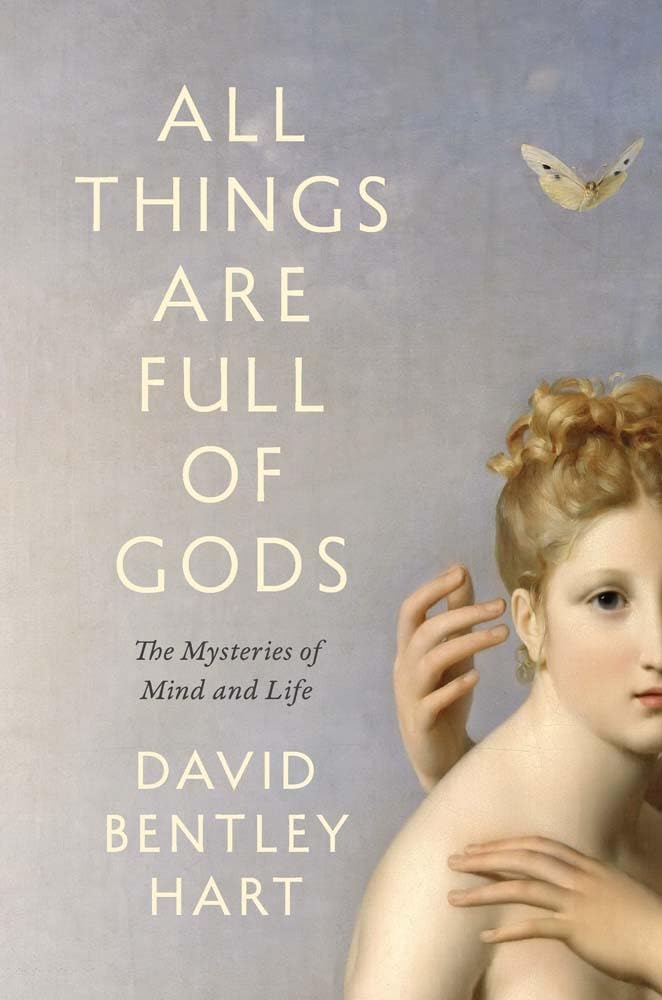
All Things Are Full of Gods: The Mysteries of Mind and Life
In a blossoming garden located far outside all worlds, a group of aging Greek gods have gathered to discuss the nature of existence, the mystery of mind, and whether there is a transcendent God from whom all things come. Turning to Eros, Psyche asks, “Do you see this flower, my love?”
So begins David Bentley Hart’s unprecedented exploration of the mystery of consciousness. Writing in the form of a Platonic dialogue, he systematically subjects the mechanical view of nature that has prevailed in Western culture for four centuries to dialectical interrogation. Powerfully rehabilitating a classical view in which mental acts are irreducible to material causes, he argues, through the gods’ exchanges, that the foundation of all reality is spiritual or mental rather than material. The structures of mind, organic life, and even language attest together to an infinite act of intelligence in all things that we may as well call God.
Engaging contemporary debates on the philosophy of mind, free will, revolutions in physics and biology, the history of science, computational models of mind, artificial intelligence, information theory, linguistics, cultural disenchantment, and the metaphysics of nature, Hart calls readers back to an enchanted world in which nature is the residence of mysterious and vital intelligences. He suggests that there is a very special wisdom to be gained when we, in Psyche’s words, “devote more time to the contemplation of living things and less to the fabrication of machines.”
So begins David Bentley Hart’s unprecedented exploration of the mystery of consciousness. Writing in the form of a Platonic dialogue, he systematically subjects the mechanical view of nature that has prevailed in Western culture for four centuries to dialectical interrogation. Powerfully rehabilitating a classical view in which mental acts are irreducible to material causes, he argues, through the gods’ exchanges, that the foundation of all reality is spiritual or mental rather than material. The structures of mind, organic life, and even language attest together to an infinite act of intelligence in all things that we may as well call God.
Engaging contemporary debates on the philosophy of mind, free will, revolutions in physics and biology, the history of science, computational models of mind, artificial intelligence, information theory, linguistics, cultural disenchantment, and the metaphysics of nature, Hart calls readers back to an enchanted world in which nature is the residence of mysterious and vital intelligences. He suggests that there is a very special wisdom to be gained when we, in Psyche’s words, “devote more time to the contemplation of living things and less to the fabrication of machines.”
511 pages, Hardcover
Published August 27, 2024
About the author
David Bentley Hart
48 books756 followersDavid Bentley Hart, an Eastern Orthodox scholar of religion and a philosopher, writer, and cultural commentator, is a fellow at the Notre Dame Institute for Advanced Study. He lives in South Bend, IN.
Ratings & Reviews
Friends & Following
Create a free account to discover what your friends think of this book!
Community Reviews
Displaying 1 - 30 of 73 reviews

November 5, 2024
This book will likely come to be seen as groundbreaking in the Mind/Body Problem debate for the 21st century. In arguing for mind over matter, DBH utilizes a dialectic method harkening back to Thomas Aquinas, Plato, and Aristotle. The "gods" themselves have the great debate of Mind and Matter in a cerebral garden to the tune of almost 500 pages. Psyche leads the discussion, along with her husband Eros, and Hermes---all supporting the argument for Mind---while Hephaistos defends his claim to Matter as the basis of all things. The mode of the dialectical method plays precisely into the argument DBH brings us to: semantic over syntax. The Good, True, and Beautiful all exist in the "hermeneutical realm", which only exists to the self-reflective "I".
Likely the most controversial take in the book will be DBH's monism. While dismantling cartesian materialism, DBH also utterly dismantles substance-dualism. (Majority of Christian philosophers are substance dualists and I expect some harsh critiques of this book.) DBH sees these arguments as two sides of the same coin, with philosophical monism being the only coherent answer. The world is Mind. Matter is Mind. Nature is Mind. Humans and animals are Mind. It's in the title, "All Things Are Full of Gods."
For those wanting to perhaps dive into a particular section, his chapter on LLMs and Code is very relevant. Spoiler: machine can never become conscious. Matter descends from Mind. Syntax cannot become Semantical, despite ever increasing processing power and data points.
What I found unique about this book is its beauty. Despite the rigorous philosophy, there are sections of complete elegance and beauty enough to drive one to tears. Eros doesn't speak very much, but when he does he asks the most poignant questions.
Likely the most controversial take in the book will be DBH's monism. While dismantling cartesian materialism, DBH also utterly dismantles substance-dualism. (Majority of Christian philosophers are substance dualists and I expect some harsh critiques of this book.) DBH sees these arguments as two sides of the same coin, with philosophical monism being the only coherent answer. The world is Mind. Matter is Mind. Nature is Mind. Humans and animals are Mind. It's in the title, "All Things Are Full of Gods."
For those wanting to perhaps dive into a particular section, his chapter on LLMs and Code is very relevant. Spoiler: machine can never become conscious. Matter descends from Mind. Syntax cannot become Semantical, despite ever increasing processing power and data points.
What I found unique about this book is its beauty. Despite the rigorous philosophy, there are sections of complete elegance and beauty enough to drive one to tears. Eros doesn't speak very much, but when he does he asks the most poignant questions.

September 15, 2024
Among the books that I have read which were written in my lifetime, this one strikes me as by far the most important. This is a book that the world needs, and that it needs now.
Such a suggestion may seem silly to the person that only reads its first couple (or even its first couple hundred) pages, but I think it’s accurate. Over the past four centuries, it has become increasingly common to understand persons and nature as machines; Hart reinvests these things with the numinous significance proper to them.
Such a suggestion may seem silly to the person that only reads its first couple (or even its first couple hundred) pages, but I think it’s accurate. Over the past four centuries, it has become increasingly common to understand persons and nature as machines; Hart reinvests these things with the numinous significance proper to them.

November 9, 2024
Only David Bentley Hart would have the audacity to put his words into the mouths of the gods. Throughout the book, he sketches out a philosophical idealism that would make your momma proud.
If mind’s intentionality, subjectivity, and consciousness itself all prove to be an irreducible reality as he so forcefully argues, then it is Mind that is fundamental reality and the Ground of all things made manifest in the natural universe. If, however, first person qualitative experience can somehow be explained through a third person scientific empirical investigation, then the philosophical picture that Hart wants to construct will have a hard time coming to fruition.
Come take a seat in the garden on the gods and listen in to what they might have to say.
If mind’s intentionality, subjectivity, and consciousness itself all prove to be an irreducible reality as he so forcefully argues, then it is Mind that is fundamental reality and the Ground of all things made manifest in the natural universe. If, however, first person qualitative experience can somehow be explained through a third person scientific empirical investigation, then the philosophical picture that Hart wants to construct will have a hard time coming to fruition.
Come take a seat in the garden on the gods and listen in to what they might have to say.

August 5, 2025
“What wakens us from the silence of nothingness to become speakers of the word is the need to respond to the voice of God speaking to us, and that voice echoes within every word we speak.”
In which Hart puts the final nail in the coffin of reductive materialism, and adds five more for good measure.
As verbose, dense, and comprehensive as you would expect. I don’t pretend to have grasped all or even a majority of the minutiae Hart delves with reckless scholarly abandon, but the broad strokes of his argument, and even many of the meticulous digressions, are painstakingly wrought yet intuitively explicated. He also has on his side the benefit of simple good sense, evident in the most basic (and constantly recurring) argument of the book which essentially observes: short of a metaphysical dualism—that actually resolves nothing and only prolongs the problem for materialism—all of reality must either reduce to a primordial matter (from which comes mind), or a primordial mind (from which comes matter). If the former, then consciousness may be accounted for within a godless paradigm of so-called “strong emergence,” an evolutionary development from slime to Einstein. If the latter, however, then the entire cosmos—mind, matter, nature, and supernature—are birthed from and continually subsist within “one great thought,” a mind of minds manifesting itself in both physical phenomena and particular events of rational consciousness. The only problem for subscribers to the first thesis, Hart convincingly shows, is its radical impossibility. The simple “qualitative abyss” that opens between even the most complex “third-person” material organism and even the simplest spark of “first-person” awareness proves an inescapable thorn in the side of the materialist god Hephaestus (funny that), who over six days of ambrosia fueled discourse battles against his more spiritually minded brethren Hermes, Eros, and Psyche.
Hart also takes consistent recourse to the third and fourth causes of Aristotle — the “top-down” Formal Cause and Final Cause, banished from the sciences in early modernity in favor of their more fashionable cousins, the “bottom-up” boys of Material and Efficient Cause. Turns out the Greek was onto something, though, and inconvenient implications for your materialist program aren’t enough to erase the inarguable forces which compel intention, action, and change from beyond the fragile borders of time and space. Telos is back, yo.
Hart deserves credit for his kaleidoscopic synthesis of thinkers and theories, as well as plenty of original contributions of his own. But it isn’t like these arguments, and the cornucopia of others pursued throughout the book, are only just now being discovered. Between this and something like Iain McGilchrist’s neuroscientific manifesto The Master and His Emissary, the intellectual infrastructure needed to shift our collective understanding of consciousness and its meaning for the cosmos lies ready and waiting. To that end, another feature of the book is to show how mechanistic scientism’s persistence as the dominant framework of modernity is due less to philosophic integrity, empirical evidence, or plain common sense, than to dogmatic prejudice and a willful rejection of its own innate principles (which it implicitly denies can even exist), that, followed honestly, will always lead organically through and beyond itself, to the great Mind, the font from which all things come, and in which all things find their end.
In which Hart puts the final nail in the coffin of reductive materialism, and adds five more for good measure.
As verbose, dense, and comprehensive as you would expect. I don’t pretend to have grasped all or even a majority of the minutiae Hart delves with reckless scholarly abandon, but the broad strokes of his argument, and even many of the meticulous digressions, are painstakingly wrought yet intuitively explicated. He also has on his side the benefit of simple good sense, evident in the most basic (and constantly recurring) argument of the book which essentially observes: short of a metaphysical dualism—that actually resolves nothing and only prolongs the problem for materialism—all of reality must either reduce to a primordial matter (from which comes mind), or a primordial mind (from which comes matter). If the former, then consciousness may be accounted for within a godless paradigm of so-called “strong emergence,” an evolutionary development from slime to Einstein. If the latter, however, then the entire cosmos—mind, matter, nature, and supernature—are birthed from and continually subsist within “one great thought,” a mind of minds manifesting itself in both physical phenomena and particular events of rational consciousness. The only problem for subscribers to the first thesis, Hart convincingly shows, is its radical impossibility. The simple “qualitative abyss” that opens between even the most complex “third-person” material organism and even the simplest spark of “first-person” awareness proves an inescapable thorn in the side of the materialist god Hephaestus (funny that), who over six days of ambrosia fueled discourse battles against his more spiritually minded brethren Hermes, Eros, and Psyche.
Hart also takes consistent recourse to the third and fourth causes of Aristotle — the “top-down” Formal Cause and Final Cause, banished from the sciences in early modernity in favor of their more fashionable cousins, the “bottom-up” boys of Material and Efficient Cause. Turns out the Greek was onto something, though, and inconvenient implications for your materialist program aren’t enough to erase the inarguable forces which compel intention, action, and change from beyond the fragile borders of time and space. Telos is back, yo.
Hart deserves credit for his kaleidoscopic synthesis of thinkers and theories, as well as plenty of original contributions of his own. But it isn’t like these arguments, and the cornucopia of others pursued throughout the book, are only just now being discovered. Between this and something like Iain McGilchrist’s neuroscientific manifesto The Master and His Emissary, the intellectual infrastructure needed to shift our collective understanding of consciousness and its meaning for the cosmos lies ready and waiting. To that end, another feature of the book is to show how mechanistic scientism’s persistence as the dominant framework of modernity is due less to philosophic integrity, empirical evidence, or plain common sense, than to dogmatic prejudice and a willful rejection of its own innate principles (which it implicitly denies can even exist), that, followed honestly, will always lead organically through and beyond itself, to the great Mind, the font from which all things come, and in which all things find their end.

June 4, 2025
"So, yes, modernity is to a great extent nihilism, in the simplest, most exact sense: a way of seeing the world that acknowledges no truth other than what the human will can impose upon things. And, for the most part, the reality the modern world chooses to impose is a “rationality” of the narrowest kind, obsessed with what things are and how they might be used rather than struck with wonder by the inexplicable truth that things are. It’s a rationality that no longer knows how to stand before that gaze that looks back from the natural order, or even to see that it’s there. The world’s no longer the home in which humanity dwells or a presence to which humanity feels the need to respond; it’s merely mechanism and a great reserve of material resources awaiting exploitation by the projects of the will. As the mystery of the world isn’t a thing their markets or their wills can manipulate, they’ve simply forgotten it, and this obtuseness is certainly part of what continues to drive them toward ecological destruction." from the Coda, The Voice of Echo

December 8, 2024
The BBC's venerable "Desert Island Discs" used to ask its interviewees what - in addition to The Bible and the complete works of Shakespeare (I doubt today's BBC insists on these) - they would wish to take to the island with them. This book would be my choice, for a number of reasons, one of which is that it demands many readings. It is not for the faint hearted, being a philosophical exploration of the nature of mind, and of being, in the form of a Platonic dialogue extending over nearly 500 pages. It is in some ways a development of the third, "Bliss", section of Hart's illuminating book on "God", but it stands alone. Four self-described "superannuated" classical deities - Psyche, Eros, Hermes and Hephaistos - participate in the debate, which is largely devoted to critically examining the proposition that mind and consciousness have arisen out of purely mechanical processes. Hart (through the mouths of the first three of the deities) is brave enough to confront every past and current argument for that position, and confident enough also to give voice to an ardent defender of that position in the form of Hephaistos (the craftsman, hence elbow-deep in materiality). The author is, of course, well known as an eminent (if controversial) Greek Orthodox theologian, but he is not averse to calling on Hindu and other traditions to tease out the arguments herein, and he does not force the reader into any narrowly sectarian, dogmatic, position. I suppose this could deter some fellow Christians from undertaking the book, but it would be their loss. It has, I believe, been called a masterpiece, with which I would heartily concur.

November 9, 2025
A most timely book. Dr. Hart scales back his normal supercilious tone and exhaustive vocabulary in favor of a socratic dialogue with our beloved Greek gods Hermes, Eros, Psyche, and Hephaestus. Hart's position is clear, philosophical naturalism is reductionistic and cannot explain consciousness, language, or life.
Hart's Coda at the end of the book is portentous and harrowing: things I have been thinking about for the last two years. The age of the machine is coming to a final crescendo. The Finale? Singularity and Silence. Only the whimpering of our human spirit of bygone ages can be heard among the fetid mass of objects, production, and market economies.
Hart is a true Shellingian and for that I adore this guy. He dabbles into Suffi mysticism and Hindi ontology, but he is a German idealist at heart.
-b
Hart's Coda at the end of the book is portentous and harrowing: things I have been thinking about for the last two years. The age of the machine is coming to a final crescendo. The Finale? Singularity and Silence. Only the whimpering of our human spirit of bygone ages can be heard among the fetid mass of objects, production, and market economies.
Hart is a true Shellingian and for that I adore this guy. He dabbles into Suffi mysticism and Hindi ontology, but he is a German idealist at heart.
-b

February 25, 2026
In which DBH provides the reader insight into a 6 day conversation held by the gods Eros, Psyche, Hermes, and Hephaestus. I was disappointed to learn that the gods have many the same foibles and vices that DBH himself displays (in addition to an overusage of the word "homunculus"), so now I'll need to rethink my piety.
On content:
I'm genuinely impressed by the range of authors DBH brings together to say something on the philosophy of mind and nature. He is likely one of the most well-read people alive. He engages contemporary theories in physics and biology as well as philosophers as diverse as Plato, Aristotle, Plotinus, Aquinas, Kant, Hegel, Schelling, Nietzsche, Husserl, Blondel, Merleau-Ponty, Dennet, Searle, and the Churchlands to name a few. On top of this, he's engaging various mystics and Hindu philosophy. His range across philosophy and the sciences is truly impressive.
I would struggle to succinctly explain DBH's own views given the fact that I only listened to this book and that this is a poor means for engaging dense argumentation. Also, Hart is prown to the poetic when the prosaic would function better for philosophical clarity.
That being said, some parts were clearer than others, and one thing Hart did particularly well was to show the profound difficulty (or nigh impossibility) that a mechanistic materialism has when it comes to explaining consciousness. I suspect that philosophy of mind could be the death of the old school mechanistic views that have been around for some time now. Certainly to me, it seems more and more like an assumption than a conclusion at the end of an argument.
On style:
I appreciate that Hart wrote this as a dialogue between four characters since it shows some care for creativity and interest. But still, they all spoke in Hart's own cumbersome voice which was distracting and unwieldy. And having listened to quite a few podcasts with Hart, it's impossible not to see some of Hart's own shortcomings of temperament in his characters.
I really will need to reread this in the future, or portions at least, to do this impressive work its due justice.
On content:
I'm genuinely impressed by the range of authors DBH brings together to say something on the philosophy of mind and nature. He is likely one of the most well-read people alive. He engages contemporary theories in physics and biology as well as philosophers as diverse as Plato, Aristotle, Plotinus, Aquinas, Kant, Hegel, Schelling, Nietzsche, Husserl, Blondel, Merleau-Ponty, Dennet, Searle, and the Churchlands to name a few. On top of this, he's engaging various mystics and Hindu philosophy. His range across philosophy and the sciences is truly impressive.
I would struggle to succinctly explain DBH's own views given the fact that I only listened to this book and that this is a poor means for engaging dense argumentation. Also, Hart is prown to the poetic when the prosaic would function better for philosophical clarity.
That being said, some parts were clearer than others, and one thing Hart did particularly well was to show the profound difficulty (or nigh impossibility) that a mechanistic materialism has when it comes to explaining consciousness. I suspect that philosophy of mind could be the death of the old school mechanistic views that have been around for some time now. Certainly to me, it seems more and more like an assumption than a conclusion at the end of an argument.
On style:
I appreciate that Hart wrote this as a dialogue between four characters since it shows some care for creativity and interest. But still, they all spoke in Hart's own cumbersome voice which was distracting and unwieldy. And having listened to quite a few podcasts with Hart, it's impossible not to see some of Hart's own shortcomings of temperament in his characters.
I really will need to reread this in the future, or portions at least, to do this impressive work its due justice.

Did Not Finish
September 8, 2024Nope, I think philosophy aint for moi

June 26, 2025
I like a good debate. New things can be discovered, stones turned over, truth emerged, or, - if not the truth per se, - at least you can walk away with a changed perception of the matters discussed.
This book is structured as a good debate about the nature of our existence, consciousness and, for the luck of the better word, God. However, the debate held for about 500 pages felt over-repetitive and stale well before its end.
Author presents us, basically, with two opponents: Hepheistos, who argues for various mechanistic l /physicalist approaches to the Universe, often cites different philosophers and proposes different kind of theories and ideas; and Psyche, who argues for the “spirit / mind came first” approach - even though she wants to present it as spiritual Panpsychism, - and, despite me generally being on her side, comes off as having a single argument of “We have not seen anything mental arose from matter, so it cannot ever. Therefore spirit came first! I know this 110%!”
Many things could be said about the overall good nature of the debate, the thoughts and observations presented from both sides. Some things did not occur to me before, some things did. Overall, it was a great read for people interested in philosophy, even if over-repetitive (thanks to Psyche) and prolonged.
My problems with the books are two-fold.
First of all, I think Psyche’s inability to come to a common ground with her opponent if they are virtually talking about the same thing, albeit using slightly different language is tiresome. Psyche evokes the dualist language all the time. It really annoyed me that she claims for matter and spirit to be the same, - with matter being a manifestation of spirit / mind, - and yet every theory Hephaitos presented that virtually says the same but without invoking the “spirit came first” idea she rejects immediately, presenting it as if she found some flaws in it. If you’re non-dualist, Eic Chaisson’s idea about organic and non-organic life being only a difference in degree should really intrigue you. After all, if you claim all existence is Mind trying to experience itself, there were 9 BILLION years of existence without any sign of organic matter. How else should this One Mind experienced itself during that time and why was all that inorganic matter manifested with a probable intent of some day to arrive at organic life if not to also be part of this One Experience? This idea is a real Panpsychism, and despite it coming from a “lower” direction it arrives at the same place Psyche is so eager to argue for. Yet, it seems that simply because she does not like the direction she rejects the idea immediately, in a very dismissive condescending tone. Think, dear Psyche, what you’re rejecting and how it actually relates to your arguments. Listen to what your opponent is actually saying. Sometimes the language of the opponent can be so different from yours it feels like you’re talking about different things, but in reality you’re talking about the same.
Another example includes a case of emergence. Psyche argues that there can never be a case of strong emergence since it contradicts the very physicalists laws, and something new can never emerge from simple matter (believe me, her almost every argument boils down to this reason). And yet when Hephaisos suggests a theory that say that consciousness is an intrinsic property of matter, even of its smallest bits, and is always present in all the atomic and subatomic particles, - turning the case from strong emergence to a structural emergence, which Psyche agrees is possible, - Psyche goes own how it is not possible and cannot be a property, instead of focusing on the fact that this is indeed is made possible by making a consciousness an intrinsic property of matter (or, even when Hephaisos rephrases and notices that properties are not really attributes of matter, they just are just characteristics observable from a third-person-point of view - she never even tries to understand that this can be easily described in her language and is virtually the same.
After all, what is even matter? You zoom in, all you find is emptiness and some energy vibrating on an incomprehensible level. All particles are seemingly just mathematical objects to describe how the laws of physics work. You also have the quantum phenomenon of observation that changes the results. Where is matter here? An illusion. It fits really well with the Brahman picture that Psyche is painting, it just arrives at it from “below”, not from “top-down”. Yes, obviously science cannot make real conclusions about everything being One Consciousness just yet, but scientists are not oblivious to this illusory state of matter and the importance of an observer for quantum events. Why, then, Psyche, you so don’t want to accept that you are even talking about the same thing? The question “What came first, spirit or matter?” does not even make sense. If they are the same, it is the wrong question to ask. If everything that we know of began at Big Bang, where there was not matter as manifestation, and yet all that we see and experience was still hidden and present (whether you argue for formal causes or intrinsic properties of existence, which honestly sound the same), then you’re doing a poor job of understanding your own arguments, Psyche.
Finally, the second point I think the book could have been better at is this: Hephaisos sometimes comes off as a straw man for a mechanistical, non-spiritual position. He does not press where he could, he does not come up with the best metaphors and examples, he does not always point out the flaws in logic and he surrenders way to easy in certain places. He allows Psyche to rave for pages and pages after being interrupted by her many times over the course of the book. Yes, he has some long monologues, but they mostly never come to a conclusion and are cut off by Psyche’s overexplaining her “matter cannot produce mind” position again and again in much greater lengths.
As I understand, the author holds the positions that Psyche argues for, and despite his generally good presentation of physicists models and ideas, they still come off as ingenuine, or made from a weak point. To be fair, Hephaisos even states so in one of the closing dialogues, just to be “corrected” that he has lost “by logic points”. No, he did not. He just never pursued the debate the same way as real physicalist would. He never pointed out a possibility of different use of language. And a few times that he did try, the author allowed for Psyche and her two minions to talk over him even more.
Mind you, despite me being so tough on Psyche I am actually not a mechanicalist. I hold positions more close to her views, then to purely mechanistic ones. And yet her approach and her inability to extend a hand to an opponent, despite the opponent suggesting many different ideas, some of which sound extremely like the same thing Psyche is talking about, - her approach was annoying and irritating. I am glad she is 100% sure in everything that she says and never allows for a mistake in her reasoning, based on purely metaphysical “logic”.
I could go on more about her “arguments” about nihilism (no formal cause, then everything goes, can kill everything that lives and experience no remorse; this is most assuredly the wrong position to hold, as there are plenty instances of religious atrocities and warfare throughout history, with only difference being that there were weapons of mass destruction and technology that allows for such severe human loss numbers) or assurance for existence of free will (which would be especially interesting to see how she reconciles free will with everyone being a part of Single One Mind experiencing itself in different shades, - this theory basically forces you to deny free will and it cannot be otherwise), but, alas, I am not writing a book here. Yet.
Anyway, that’s my thoughts on the book. I have 10 pages worth of notes and probably should start a YouTube channel to express everything that I could on this topic. Maybe I will.
Drop a comment if you're think I am onto something with this review, or am utterly mistaken. If you're one of those 5 people who read this book :-)
This book is structured as a good debate about the nature of our existence, consciousness and, for the luck of the better word, God. However, the debate held for about 500 pages felt over-repetitive and stale well before its end.
Author presents us, basically, with two opponents: Hepheistos, who argues for various mechanistic l /physicalist approaches to the Universe, often cites different philosophers and proposes different kind of theories and ideas; and Psyche, who argues for the “spirit / mind came first” approach - even though she wants to present it as spiritual Panpsychism, - and, despite me generally being on her side, comes off as having a single argument of “We have not seen anything mental arose from matter, so it cannot ever. Therefore spirit came first! I know this 110%!”
Many things could be said about the overall good nature of the debate, the thoughts and observations presented from both sides. Some things did not occur to me before, some things did. Overall, it was a great read for people interested in philosophy, even if over-repetitive (thanks to Psyche) and prolonged.
My problems with the books are two-fold.
First of all, I think Psyche’s inability to come to a common ground with her opponent if they are virtually talking about the same thing, albeit using slightly different language is tiresome. Psyche evokes the dualist language all the time. It really annoyed me that she claims for matter and spirit to be the same, - with matter being a manifestation of spirit / mind, - and yet every theory Hephaitos presented that virtually says the same but without invoking the “spirit came first” idea she rejects immediately, presenting it as if she found some flaws in it. If you’re non-dualist, Eic Chaisson’s idea about organic and non-organic life being only a difference in degree should really intrigue you. After all, if you claim all existence is Mind trying to experience itself, there were 9 BILLION years of existence without any sign of organic matter. How else should this One Mind experienced itself during that time and why was all that inorganic matter manifested with a probable intent of some day to arrive at organic life if not to also be part of this One Experience? This idea is a real Panpsychism, and despite it coming from a “lower” direction it arrives at the same place Psyche is so eager to argue for. Yet, it seems that simply because she does not like the direction she rejects the idea immediately, in a very dismissive condescending tone. Think, dear Psyche, what you’re rejecting and how it actually relates to your arguments. Listen to what your opponent is actually saying. Sometimes the language of the opponent can be so different from yours it feels like you’re talking about different things, but in reality you’re talking about the same.
Another example includes a case of emergence. Psyche argues that there can never be a case of strong emergence since it contradicts the very physicalists laws, and something new can never emerge from simple matter (believe me, her almost every argument boils down to this reason). And yet when Hephaisos suggests a theory that say that consciousness is an intrinsic property of matter, even of its smallest bits, and is always present in all the atomic and subatomic particles, - turning the case from strong emergence to a structural emergence, which Psyche agrees is possible, - Psyche goes own how it is not possible and cannot be a property, instead of focusing on the fact that this is indeed is made possible by making a consciousness an intrinsic property of matter (or, even when Hephaisos rephrases and notices that properties are not really attributes of matter, they just are just characteristics observable from a third-person-point of view - she never even tries to understand that this can be easily described in her language and is virtually the same.
After all, what is even matter? You zoom in, all you find is emptiness and some energy vibrating on an incomprehensible level. All particles are seemingly just mathematical objects to describe how the laws of physics work. You also have the quantum phenomenon of observation that changes the results. Where is matter here? An illusion. It fits really well with the Brahman picture that Psyche is painting, it just arrives at it from “below”, not from “top-down”. Yes, obviously science cannot make real conclusions about everything being One Consciousness just yet, but scientists are not oblivious to this illusory state of matter and the importance of an observer for quantum events. Why, then, Psyche, you so don’t want to accept that you are even talking about the same thing? The question “What came first, spirit or matter?” does not even make sense. If they are the same, it is the wrong question to ask. If everything that we know of began at Big Bang, where there was not matter as manifestation, and yet all that we see and experience was still hidden and present (whether you argue for formal causes or intrinsic properties of existence, which honestly sound the same), then you’re doing a poor job of understanding your own arguments, Psyche.
Finally, the second point I think the book could have been better at is this: Hephaisos sometimes comes off as a straw man for a mechanistical, non-spiritual position. He does not press where he could, he does not come up with the best metaphors and examples, he does not always point out the flaws in logic and he surrenders way to easy in certain places. He allows Psyche to rave for pages and pages after being interrupted by her many times over the course of the book. Yes, he has some long monologues, but they mostly never come to a conclusion and are cut off by Psyche’s overexplaining her “matter cannot produce mind” position again and again in much greater lengths.
As I understand, the author holds the positions that Psyche argues for, and despite his generally good presentation of physicists models and ideas, they still come off as ingenuine, or made from a weak point. To be fair, Hephaisos even states so in one of the closing dialogues, just to be “corrected” that he has lost “by logic points”. No, he did not. He just never pursued the debate the same way as real physicalist would. He never pointed out a possibility of different use of language. And a few times that he did try, the author allowed for Psyche and her two minions to talk over him even more.
Mind you, despite me being so tough on Psyche I am actually not a mechanicalist. I hold positions more close to her views, then to purely mechanistic ones. And yet her approach and her inability to extend a hand to an opponent, despite the opponent suggesting many different ideas, some of which sound extremely like the same thing Psyche is talking about, - her approach was annoying and irritating. I am glad she is 100% sure in everything that she says and never allows for a mistake in her reasoning, based on purely metaphysical “logic”.
I could go on more about her “arguments” about nihilism (no formal cause, then everything goes, can kill everything that lives and experience no remorse; this is most assuredly the wrong position to hold, as there are plenty instances of religious atrocities and warfare throughout history, with only difference being that there were weapons of mass destruction and technology that allows for such severe human loss numbers) or assurance for existence of free will (which would be especially interesting to see how she reconciles free will with everyone being a part of Single One Mind experiencing itself in different shades, - this theory basically forces you to deny free will and it cannot be otherwise), but, alas, I am not writing a book here. Yet.
Anyway, that’s my thoughts on the book. I have 10 pages worth of notes and probably should start a YouTube channel to express everything that I could on this topic. Maybe I will.
Drop a comment if you're think I am onto something with this review, or am utterly mistaken. If you're one of those 5 people who read this book :-)

Read
January 10, 2026I think this book, at long last, might be what turns me into a Neoplatonist.
This is a monument of erudition that I’m not yet able to evaluate fully, but it seems convincing much of the time and can be quite beautiful. It is somewhat repetitive, but I at least needed the repetition to wrap my head around the ideas. Besides being a fitting tribute to Plato, the dialogue format works well for integrating possible objections or counterpoints to the arguments. It also makes some extremely dense material more readable, though I will have to read more widely to decide if it’s doing justice to the arguments of the numerous philosophers discussed. It pairs well with Ball’s How Life Works (I would not have understood the last third of this book very well without reading Ball first), and deals with the philosophical implications of Ball’s explicit invocation of teleology better than Ball himself does (although perhaps not in the only way possible). All in all, I found it very profound and very bracing.
This is a monument of erudition that I’m not yet able to evaluate fully, but it seems convincing much of the time and can be quite beautiful. It is somewhat repetitive, but I at least needed the repetition to wrap my head around the ideas. Besides being a fitting tribute to Plato, the dialogue format works well for integrating possible objections or counterpoints to the arguments. It also makes some extremely dense material more readable, though I will have to read more widely to decide if it’s doing justice to the arguments of the numerous philosophers discussed. It pairs well with Ball’s How Life Works (I would not have understood the last third of this book very well without reading Ball first), and deals with the philosophical implications of Ball’s explicit invocation of teleology better than Ball himself does (although perhaps not in the only way possible). All in all, I found it very profound and very bracing.

December 31, 2025
4.5 stars, rounded down — I am not quite persuaded that everyone ought to read this book (in the way of, for example, _The Matter with Things_) — but it’s very, very good.

August 7, 2025
I tried to read this book via Audible during my long drives to/from work. This isn't the book for that media -- it's written like a play which doesn't work well in the audio format. The author is apparently in possession of an expansive vocabulary and likes to use it. I found this book all but incomprehensible and downright boring as I raced back and forth on I-64. There's a glitch in the audible book in Chapter 2 where the narration skips to the conclusion; this nearly caused me to drive into one of the many the Jersey barriers with the incredible joy the thought of being finished brought, but it wasn't to be--the book wasn't over and the narrator returned to the proper place in the book. I did not. I took the opportunity to give up on the book.

December 14, 2025
Ein unglaublich kreatives, und durchaus unterhaltsames Buch. Alleine das Anliegen und die gewählte Form ist zu würdigen. Aber dennoch stimme ich ihm inhaltlich sowie mit seinen vielen, vielfältigen aber ehrlich geschilderten Axiomen nicht völlig überein.
Zur Form des Buches:
David Bentley Hart (geb. 1965), ein Orthodoxer Theologe, der sich zudem selbst als Neuplatoniker bezeichnen würde, gibt mit „All things are full of Gods“ den Lesenden ein Werk, das wohl dem konservativen Formalismus des deutschsprachigen Wissenschaftsdiskurses zur „Philosophy of Mind“ einen literarisch-intellektuellen Mittelfinger zeigt. Diese Beschreibung, auch wenn etwas vulgär, ist wohl aber nicht für die Person Harts unangebracht. Harts Humor und intellektuelle Finesse schämt sich nicht vor manch spitzfindiger Polemik, die mich manchmal an Luther und Barth erinnert. Solche Polemik passiert nämlich gerade dann schnell, wenn man die Trockenheit wissenschaftlicher Monographien in Form und Aufbau anerkennt, und auf Formen wissenschaftlicher Expositionen zurückgreift, wie der über Tausend Jahre bewährte ,platonische Dialog‘.
Diese Entscheidung für einen platonischen Dialog machte Hart nachdem er bereits das Buch fast fertig hatte. Es war also keine heuristische Tarnung eines faulen-gemütlichen Vorgehens.
Doch auch Harts Buch ist von der Komplexität her kein Bilderbuch oder ein Malen nach Zahlen. Das erkennt man bereits im Prolog, wo er schildert, das klassische, alte aber auch immer noch andauernde Problem des Leib-Seele-Problems zu lösen. Und dies in Form eines platonischen Dialogs zwischen den griechischen Göttern, Hermes, Eros, Psyche und Hephaistos. Seine Wörter in den Münden der griechischen Götter.
Das hört sich ‚Wild‘ an. Es wird aber noch wilder.
Seine Aussagen sind hin und wieder so klar und voll von Wahrheitsansprüchen, dass man sich fragt, ob er sich genau überlegt hat, was er hier sagt und wie er das nun begründen und behandeln möchte. Ist das tugendhafter Mut, orthodox-neuplatonischer Kampf-Evangelikalismus oder einfach gesagt: Größenwahn?
Letzte beiden Punkte möge man vorschnell mit dem US-Amerikanischen Kulturprotestantismus verbinden wollen. Hart, der selbst ein US-Bürger ist, lässt sich aber nicht in diese Rhetorik einordnen. Nicht als ‚Woke‘ oder im intellektuellen Komplexititätsbewusstsein als ‚Broke‘. Hart ist erfrischend und herausfordernd. Und dies glücklicherweise nicht in Form dieser grässierenden Identitätspolitik und des unreflektierten Ideologisierens von pseudo-wissenschaftlichen Wahrheitsansprüchen in monographischer Form.
Zum Inhalt:
Im Buch wird geschildert, wie philosophisch (und nicht nur theologisch) sowie logisch jeder materialistische und naturalistische Ansatz zum geistigen Bewusstsein (Mind) unangebracht und inadäquat ist. Jeglicher Neo-Atheismus wird hier als unwissenschaftlichen Ansatz philosophisch entblößt.
Er ist gegen ein Naturalismus (alles ist tote Materie), aber auch gegen ein „Dualismus“ zwischen Materie und Geist (in Form jener Descartes Lesart). Sein neuplatonisch, ost-orthodoxer Ansatz ist hingegen ein „Monolismus“; eine Wirklichkeit, die von Gott ausgeht, und in ihn eingeht und von Gott durchdrungen ist.
Paar seiner Aussagen:
34: „I reject the underlying premise that matter is something essentially dead and unthinking.“
328: “All this really proves, however, is that the laws of life aren´t contained in the laws of physics, though the laws of physics are embraced within the laws of life.”
422: “We know the world because something within us that´s more original than ourselves is always reaching out to something outside us that´s more ultimate than the world.“
Ebd.: „I think this is what Plato unterstood in saying that all the knowledge we acquire is really a kind of remembering: that deppest and most original yearning within us recalls the last and highest end beyond all things and, in doing so, open us to all things.”
„All acts of the mind are participations of the mind of God.“
Fazit:
Man mag wohl meinen, er sitze hin und wieder selbst unter dem Baum der Erkenntnis, um sich gegenseitig mit anderen neuplatonisch-transzendierenden Wesen die Früchte zu zeigen. Doch dieser klassische Positivismus-Vorwurf, der in den Vorkommnissen heutzutage oft so inhaltlich flach ist, wie diejenigen Konzeptionen derjenigen Kritisierenden, mag wohl das dortige Gespräch zwischen den Göttern nicht genügend erfasst zu haben. M. E. gebührt dem Buch eine Lesart, die über den selbstgenügenden Begriffsfetischmus der wissenschaftlichen Diskursen hinaus geht.
Die Frage bleibt, ob DBH nicht nur die trockene Philosophy of Mind transzendiert, sondern auch unsere eigenen Köpfen. Seine Verortung des Göttlichen in unserem Bewusstsein, bzw. präziser unseres Bewusstseins als Partizipanten am göttlichen Bewusstsein, mag wohl eine schöne, auch offen-dynamische Hegomonie des Wirklichen geben. Aber mir, mir komisch dialektische Persönlichkeit, bringt dieser von DBH vorausgesetzter Monolismus – auch wenn ich seine Abneigung gegenüber Dualismus und Dualismen ja in gewisser Hinsicht teile – nicht nur die von ihm angestrebene ‚innere Ruhe‘.
Heuristisch können wir - wir in uns gespaltene Wesen - wohl nicht ohne Dualismen und Gegenüberstellungen denken und deuten. All unsere Kategorisierungen und auch so methodisch sinnvollen, selbstergebenden ‚Klüfte‘ und ‚garstige Graben der Geschichten‘ sind letztlich menschliche Wirklichkeitsdeutungen. Die sprachlich-logischen Konstruktionen, die das Verhältnis zwischen Mensch und Gott ordnen, haben sich gerade in der Theologie verselbstständigkeit und verabsolutiert. Immanenz und Transzendenz sind absoluter, als wohl das Göttliche selbst…. Aber diese Graben und Klüfte, die sich zwischen Gott und Mensch ergeben haben, sind nicht nur fehlende intellektuelle Überbrückungsversuche.
Im Moment von unermesslichen Leid brauch es ein Gegenüber Gottes, dass das Böse und das Sinnlose als solches mit einem deftigen „Nein“ als solches benennt. Gericht ist Durchsetzung des Heils indem das Böse vernichtet wird.
Was ich sagen möchte: Mir fehlt bei DBH der ‚Bruch‘, die ‚Krise‘ und die schweigende Ohnmacht. (Hier bin ich doch zu sehr Dialektiker)
DBHs Konzept, wie es mich auch an Pannenberg erinnert, schafft einen Deutungs- und Wirklichkeitshorizont, der weiterhin an einer „offenen“ (!) Teleologie festhält. Doch jede auch noch so offenene Teleologie muss sich die Frage stellen, ob sie sich nicht manchmal auch selbst verarscht. Denn das ‚Offene‘ in diesen Teleologien darf niemals vergessen werden. Auch ‚offene Teleologien‘ stehen vor der Gefahr, nur im Namen, nicht im Ansatz ‚offen‘ zu sein. Dann wird’s wieder ein Hegemonieprojekt im Göttergarten der eigen Ratio.
Manchmal denke ich, dass trotz der Notwendigkeit eines teleologischen Deutungshorizont im Denken und Verstehen von WIrklichkeit und Wahrheit es auch Momente gibt, wo dieser Ansatz mehr schweigen als zu reden hat.
DBH’s Gespräch ist genial. Aber dieses Gespräch passt mehr in den Garten einer Dachterasse, die von platonisch-wohlhabenden Freigeistern, namens festangestellte Akademiker und Akademikerinnen, mit fließenden Riesling und läuterer Muse über ‚Schönheit‘ sinnieren.
Währenddessen, am Boden, wortwörtlich auf und in den Dreck liegend sitzen die Hiobsgestalten.
Solch platonische Dialoge schaffen es oft nicht zu ‚Schweigen‘ und mal nicht zu Konzeptualisieren. Da waren selbst die Freunde Hiobs zu Beginn ihrer Solidarität besser.
Brauch es nicht mehr die Anerkennung von Kontingenz, Leid (und Bösen), die Sprachlosigkeit – weniger ein panentheistisches Beseelen dessen? Ist das DBH zu dualistisch, mal das größte Leid als Sinnlos anzuerkennen, auch wenn währenddessen ‚Sinn‘ nicht abgelehnt wird? Oder ist es doch mehr die Polyfonie des Lebens, was auch immer damit gemeint ist.
Heuristisch hilft wohl die Unterscheidung zwischen Gott und Mensch in moralischer Hinsicht doch mehr, als DBH zu konzeptualisieren vermag. Ich stimme hierbei ihm überein, wie dies auch nicht das Ende alles Gesagten sein darf (es ist ja heuristisch). Aber in den verschieden Modis der Wirklichkeitserfahrung und -deutung, und der mir etwas sympathischen Dialektik, ist wohl Monolismus, so gut er auch gemeint ist, idealistisch ‚schön‘, doch im Angesicht jener anderen Angesichter der Welt bevormundend.
Gott soll es vorbehalten sein, das Böse in etwas Guten zu transformieren. Und wir sollen bereits mit Blick auf den „ewigen Frieden“ leben. Doch manch solcher platonischen Vorwegnahmen der ewigen Gemeinschaft vermischen mehr die Widersprüche des Lebens, als dass sie das widersprüchlich zu überwindende transformieren.
Zur Form des Buches:
David Bentley Hart (geb. 1965), ein Orthodoxer Theologe, der sich zudem selbst als Neuplatoniker bezeichnen würde, gibt mit „All things are full of Gods“ den Lesenden ein Werk, das wohl dem konservativen Formalismus des deutschsprachigen Wissenschaftsdiskurses zur „Philosophy of Mind“ einen literarisch-intellektuellen Mittelfinger zeigt. Diese Beschreibung, auch wenn etwas vulgär, ist wohl aber nicht für die Person Harts unangebracht. Harts Humor und intellektuelle Finesse schämt sich nicht vor manch spitzfindiger Polemik, die mich manchmal an Luther und Barth erinnert. Solche Polemik passiert nämlich gerade dann schnell, wenn man die Trockenheit wissenschaftlicher Monographien in Form und Aufbau anerkennt, und auf Formen wissenschaftlicher Expositionen zurückgreift, wie der über Tausend Jahre bewährte ,platonische Dialog‘.
Diese Entscheidung für einen platonischen Dialog machte Hart nachdem er bereits das Buch fast fertig hatte. Es war also keine heuristische Tarnung eines faulen-gemütlichen Vorgehens.
Doch auch Harts Buch ist von der Komplexität her kein Bilderbuch oder ein Malen nach Zahlen. Das erkennt man bereits im Prolog, wo er schildert, das klassische, alte aber auch immer noch andauernde Problem des Leib-Seele-Problems zu lösen. Und dies in Form eines platonischen Dialogs zwischen den griechischen Göttern, Hermes, Eros, Psyche und Hephaistos. Seine Wörter in den Münden der griechischen Götter.
Das hört sich ‚Wild‘ an. Es wird aber noch wilder.
Seine Aussagen sind hin und wieder so klar und voll von Wahrheitsansprüchen, dass man sich fragt, ob er sich genau überlegt hat, was er hier sagt und wie er das nun begründen und behandeln möchte. Ist das tugendhafter Mut, orthodox-neuplatonischer Kampf-Evangelikalismus oder einfach gesagt: Größenwahn?
Letzte beiden Punkte möge man vorschnell mit dem US-Amerikanischen Kulturprotestantismus verbinden wollen. Hart, der selbst ein US-Bürger ist, lässt sich aber nicht in diese Rhetorik einordnen. Nicht als ‚Woke‘ oder im intellektuellen Komplexititätsbewusstsein als ‚Broke‘. Hart ist erfrischend und herausfordernd. Und dies glücklicherweise nicht in Form dieser grässierenden Identitätspolitik und des unreflektierten Ideologisierens von pseudo-wissenschaftlichen Wahrheitsansprüchen in monographischer Form.
Zum Inhalt:
Im Buch wird geschildert, wie philosophisch (und nicht nur theologisch) sowie logisch jeder materialistische und naturalistische Ansatz zum geistigen Bewusstsein (Mind) unangebracht und inadäquat ist. Jeglicher Neo-Atheismus wird hier als unwissenschaftlichen Ansatz philosophisch entblößt.
Er ist gegen ein Naturalismus (alles ist tote Materie), aber auch gegen ein „Dualismus“ zwischen Materie und Geist (in Form jener Descartes Lesart). Sein neuplatonisch, ost-orthodoxer Ansatz ist hingegen ein „Monolismus“; eine Wirklichkeit, die von Gott ausgeht, und in ihn eingeht und von Gott durchdrungen ist.
Paar seiner Aussagen:
34: „I reject the underlying premise that matter is something essentially dead and unthinking.“
328: “All this really proves, however, is that the laws of life aren´t contained in the laws of physics, though the laws of physics are embraced within the laws of life.”
422: “We know the world because something within us that´s more original than ourselves is always reaching out to something outside us that´s more ultimate than the world.“
Ebd.: „I think this is what Plato unterstood in saying that all the knowledge we acquire is really a kind of remembering: that deppest and most original yearning within us recalls the last and highest end beyond all things and, in doing so, open us to all things.”
„All acts of the mind are participations of the mind of God.“
Fazit:
Man mag wohl meinen, er sitze hin und wieder selbst unter dem Baum der Erkenntnis, um sich gegenseitig mit anderen neuplatonisch-transzendierenden Wesen die Früchte zu zeigen. Doch dieser klassische Positivismus-Vorwurf, der in den Vorkommnissen heutzutage oft so inhaltlich flach ist, wie diejenigen Konzeptionen derjenigen Kritisierenden, mag wohl das dortige Gespräch zwischen den Göttern nicht genügend erfasst zu haben. M. E. gebührt dem Buch eine Lesart, die über den selbstgenügenden Begriffsfetischmus der wissenschaftlichen Diskursen hinaus geht.
Die Frage bleibt, ob DBH nicht nur die trockene Philosophy of Mind transzendiert, sondern auch unsere eigenen Köpfen. Seine Verortung des Göttlichen in unserem Bewusstsein, bzw. präziser unseres Bewusstseins als Partizipanten am göttlichen Bewusstsein, mag wohl eine schöne, auch offen-dynamische Hegomonie des Wirklichen geben. Aber mir, mir komisch dialektische Persönlichkeit, bringt dieser von DBH vorausgesetzter Monolismus – auch wenn ich seine Abneigung gegenüber Dualismus und Dualismen ja in gewisser Hinsicht teile – nicht nur die von ihm angestrebene ‚innere Ruhe‘.
Heuristisch können wir - wir in uns gespaltene Wesen - wohl nicht ohne Dualismen und Gegenüberstellungen denken und deuten. All unsere Kategorisierungen und auch so methodisch sinnvollen, selbstergebenden ‚Klüfte‘ und ‚garstige Graben der Geschichten‘ sind letztlich menschliche Wirklichkeitsdeutungen. Die sprachlich-logischen Konstruktionen, die das Verhältnis zwischen Mensch und Gott ordnen, haben sich gerade in der Theologie verselbstständigkeit und verabsolutiert. Immanenz und Transzendenz sind absoluter, als wohl das Göttliche selbst…. Aber diese Graben und Klüfte, die sich zwischen Gott und Mensch ergeben haben, sind nicht nur fehlende intellektuelle Überbrückungsversuche.
Im Moment von unermesslichen Leid brauch es ein Gegenüber Gottes, dass das Böse und das Sinnlose als solches mit einem deftigen „Nein“ als solches benennt. Gericht ist Durchsetzung des Heils indem das Böse vernichtet wird.
Was ich sagen möchte: Mir fehlt bei DBH der ‚Bruch‘, die ‚Krise‘ und die schweigende Ohnmacht. (Hier bin ich doch zu sehr Dialektiker)
DBHs Konzept, wie es mich auch an Pannenberg erinnert, schafft einen Deutungs- und Wirklichkeitshorizont, der weiterhin an einer „offenen“ (!) Teleologie festhält. Doch jede auch noch so offenene Teleologie muss sich die Frage stellen, ob sie sich nicht manchmal auch selbst verarscht. Denn das ‚Offene‘ in diesen Teleologien darf niemals vergessen werden. Auch ‚offene Teleologien‘ stehen vor der Gefahr, nur im Namen, nicht im Ansatz ‚offen‘ zu sein. Dann wird’s wieder ein Hegemonieprojekt im Göttergarten der eigen Ratio.
Manchmal denke ich, dass trotz der Notwendigkeit eines teleologischen Deutungshorizont im Denken und Verstehen von WIrklichkeit und Wahrheit es auch Momente gibt, wo dieser Ansatz mehr schweigen als zu reden hat.
DBH’s Gespräch ist genial. Aber dieses Gespräch passt mehr in den Garten einer Dachterasse, die von platonisch-wohlhabenden Freigeistern, namens festangestellte Akademiker und Akademikerinnen, mit fließenden Riesling und läuterer Muse über ‚Schönheit‘ sinnieren.
Währenddessen, am Boden, wortwörtlich auf und in den Dreck liegend sitzen die Hiobsgestalten.
Solch platonische Dialoge schaffen es oft nicht zu ‚Schweigen‘ und mal nicht zu Konzeptualisieren. Da waren selbst die Freunde Hiobs zu Beginn ihrer Solidarität besser.
Brauch es nicht mehr die Anerkennung von Kontingenz, Leid (und Bösen), die Sprachlosigkeit – weniger ein panentheistisches Beseelen dessen? Ist das DBH zu dualistisch, mal das größte Leid als Sinnlos anzuerkennen, auch wenn währenddessen ‚Sinn‘ nicht abgelehnt wird? Oder ist es doch mehr die Polyfonie des Lebens, was auch immer damit gemeint ist.
Heuristisch hilft wohl die Unterscheidung zwischen Gott und Mensch in moralischer Hinsicht doch mehr, als DBH zu konzeptualisieren vermag. Ich stimme hierbei ihm überein, wie dies auch nicht das Ende alles Gesagten sein darf (es ist ja heuristisch). Aber in den verschieden Modis der Wirklichkeitserfahrung und -deutung, und der mir etwas sympathischen Dialektik, ist wohl Monolismus, so gut er auch gemeint ist, idealistisch ‚schön‘, doch im Angesicht jener anderen Angesichter der Welt bevormundend.
Gott soll es vorbehalten sein, das Böse in etwas Guten zu transformieren. Und wir sollen bereits mit Blick auf den „ewigen Frieden“ leben. Doch manch solcher platonischen Vorwegnahmen der ewigen Gemeinschaft vermischen mehr die Widersprüche des Lebens, als dass sie das widersprüchlich zu überwindende transformieren.

September 16, 2024
I respect David Bentley Hart's intelligence and I was excited to receive my copy of All Things Are Full of Gods, which I pre-ordered as soon as it was available on Amazon. But for as brilliant as he is, he seems unable to write for the intelligent non-specialist, and the style of this book - a dialog between several Greek gods - does him no favors because he doesn't have the talent for that style of writing to pull it off.

June 23, 2025
Not a perfect book, but I absolutely loved it. A very necessary rejection of the prevailing mechanistic and materialistic view of nature, mind, and matter. Beautifully rendered in the style of a Platonic dialogue.

January 16, 2025
A couple of quick thoughts before my review: 1) I'm being a bit disingenuous, since I've only read about 60% of the book. 2) In terms of literary awareness and erudition, I'm pretty much unworthy of reviewing a book of this high level of language and complex thought. But, for those interested in a rank layman's opinion of (what I have read) of this book, here goes:
The book is beautifully written, and the language is exquisite. By which I mean Hart uses such esoteric language that it becomes burdensome to constantly look up meanings of words rarely (if ever) encountered in normal language while one tries to mine meaning from very complex arguments. I would imagine that this was not a problem for the six (6) commenters on the back cover leaf of the book, but might be a problem for perhaps the other 8 billion potential readers. I think the language used would be well suited for sonnets or other poems, but for me it made the understanding of the arguments more difficult than need be. At times it seemed that the author was just being obtuse about his phenomenal vocabulary and language skills with the hope that the book might only be enjoyed and understood by folks similarly invested and educated in the most obscure words in the English language.
That aside, the book is a thorough discussion of conflicting thoughts about physicalism and mind (or consciousness) as the primary feature of nature or creation. The discussion is couched in the dialogue among several mythical gods. The key characters in these debates were: Psyche, the Greek Goddess of soul and Hyphaestus, the Greek God of fire and blacksmithing, arguing for the primacy of mind and materialism, respectively. Other characters were Eros, Greek god of love, and Hermes, Greek god of thieves and merchants.
I did skip most of the last 40% or so of the book, because by the time I was halfway through I began to think of reading as a chore rather than a joy. The last few chapters, I had hoped, would come to a decisive conclusion (in the argument of mind vs. matter), but I was a bit disappointed that after all the logic imbuing the various arguments put forth by the gods I discerned no definitive conclusion at all.
If you like beautiful but obscure words (to the layman), and have a dictionary at hand, and lots of time at your disposal (perhaps a months-long vacation at an isolated venue), then this would be a good book to take with you. Or, if you teach English lit and/or philosophy of mind or are just effing brilliant and curious you might truly enjoy this book. I'll get back to the forty percent of the book that I skipped over during the next year or two.
The book is beautifully written, and the language is exquisite. By which I mean Hart uses such esoteric language that it becomes burdensome to constantly look up meanings of words rarely (if ever) encountered in normal language while one tries to mine meaning from very complex arguments. I would imagine that this was not a problem for the six (6) commenters on the back cover leaf of the book, but might be a problem for perhaps the other 8 billion potential readers. I think the language used would be well suited for sonnets or other poems, but for me it made the understanding of the arguments more difficult than need be. At times it seemed that the author was just being obtuse about his phenomenal vocabulary and language skills with the hope that the book might only be enjoyed and understood by folks similarly invested and educated in the most obscure words in the English language.
That aside, the book is a thorough discussion of conflicting thoughts about physicalism and mind (or consciousness) as the primary feature of nature or creation. The discussion is couched in the dialogue among several mythical gods. The key characters in these debates were: Psyche, the Greek Goddess of soul and Hyphaestus, the Greek God of fire and blacksmithing, arguing for the primacy of mind and materialism, respectively. Other characters were Eros, Greek god of love, and Hermes, Greek god of thieves and merchants.
I did skip most of the last 40% or so of the book, because by the time I was halfway through I began to think of reading as a chore rather than a joy. The last few chapters, I had hoped, would come to a decisive conclusion (in the argument of mind vs. matter), but I was a bit disappointed that after all the logic imbuing the various arguments put forth by the gods I discerned no definitive conclusion at all.
If you like beautiful but obscure words (to the layman), and have a dictionary at hand, and lots of time at your disposal (perhaps a months-long vacation at an isolated venue), then this would be a good book to take with you. Or, if you teach English lit and/or philosophy of mind or are just effing brilliant and curious you might truly enjoy this book. I'll get back to the forty percent of the book that I skipped over during the next year or two.

Currently Reading
May 17, 2026157 pages in. Hart's witty and often combative prose is perfectly made for dialogue. At the core of his contention is that materialism, modernity's reigning metaphysics (albeit an implicit metaphysics that most of us accept as default, without recognizing we possess a metaphysics at all), is not as "self-evident" as we have been led to believe. There are serious holes. Indeed, it may be more likely that mind precedes matter - that consciousness did not arise from a mechanical universe, but that consciousness exists alongside it or, as Hart contends in the character of Psyche, that the "mechanical" and "objective" universe is permeated by mind, by intentionality and teleology. Key to his argument is a queer fact at the center of our lives: Our subjective experience is necessarily prior to all "objective" experience. Spooky.
December 9, 2024
A terrific and enlightening treatise on reality and consciousness! A must-read masterpiece!
I felt totally and delightfully captivated from start to finish, invariably, by DBH's point and counterpoint style of discourse between his protagonist Gods, at once prosaic and poetic, articulated in a sophisticated, flowing, beautiful and precise English. This book is definitely not meant for the faint-hearted or impatient types, nor for an audience not versed in basic notions in philosophy. Do not even try. It's complicated. But the prize is worth the enterprise.
By the way, this is the very first book I've read from this author. Let's start with some missing features that could have made for a tad better reading experience. I think he should have included a Glossary recapitulating the fallacies he mentions during the course of his exposé. I also feel that he should have included a very brief Summary at the back of the book, of every unsatisfactory philosophical paradigm he has argued against. Lastly, I felt that some protagonists were speaking for too long at times, i.e., not like in a real or even hypothetical conversation. For instance, see Douglas Hofstadter's GEB, for an example of how smoothly the dialogue between Achilles and Mr. Tortoise unfold. Here, the Gods weren't quite imbued with convincing personalities and idiosyncrasies.
Well, there is definitely room for improvement, but man, I'm just bickering! This book is awesome! It's one of the best I've ever read my whole life.
The plot revolves around four Gods (Psyche, Eros, Hephaistos and Hermes), chilling during teatime in their intermundane garden, and engaging in a conversation about the nature of consciousness, reality and language, among other topics, over the course of six days. You will come across references to many well-known philosophers of mind, and their diverging worldviews will be deconstructed one by one (or at least their loopholes exposed and shown to be inconsistent). The aim will be to show, step by step, that a form of Idealism akin to the Neoplatonic or Vedantic philosophy is indeed more logical and consistent than a dogmatic adhesion to scientific materialism and its offshoots. So, you are in for a deep dive into epistemology and ontology, existentialism, spirituality, biology, physics, integral meta-theory and what have you. You can feel a web of intertextuality weaving itself, especially if you have read many of the originals, including the Upanishads in one form or another.
I highly recommend reading Iain McGilchrist's The Matter with Things either before or after reading this one.
All in all, All Things are full of Gods is mandatory reading for many years to come. Great job!
October 1, 2024
An absolute triumph of a book. Hart brilliantly pulls together a philosophy of mind and life in a poetic and harmonious synthesis - somehow still improving on his earlier work.

May 8, 2025
Phenomenal and thorough dealing with the problem of mind and the substance of reality by means of a dialogue between the gods Psyche, Hephaestus, Eros, and Hermes. The stunning clarity of the book is found in continually bringing the reader back to the issue of consciousness being a unitary first-person subjective standpoint, and clearing away any conflation with the contents OF consciousness. That (along with repudiating dualism, of course) cuts out most of the nonsense of the whole debate and makes the answer quite obvious, showing all contrary points of view to be more or less different degrees of ridiculous self-caricature.
Psyche is at once endearing, intelligent, kind, charming, quick-witted, and utterly lucid in explanation. Hephaestus certainly sounds like every smug, triumphalistic naturalist I have ever come across -- though ultimately as a god with a charming warmth beyond that, and a good degree of honesty.
I really loved the dialogue about biological life, as well. A++
Just note that there are some high-level concepts and terms in this tome, so have a dictionary ready and perhaps a search engine or AI bot to help clarify some things as you read, if you're not already privy to the scope of the debate.
Psyche is at once endearing, intelligent, kind, charming, quick-witted, and utterly lucid in explanation. Hephaestus certainly sounds like every smug, triumphalistic naturalist I have ever come across -- though ultimately as a god with a charming warmth beyond that, and a good degree of honesty.
I really loved the dialogue about biological life, as well. A++
Just note that there are some high-level concepts and terms in this tome, so have a dictionary ready and perhaps a search engine or AI bot to help clarify some things as you read, if you're not already privy to the scope of the debate.

April 18, 2026
"All of reality is the manifestation of that infinite reason that dwells in God; all of it's composed of signs and symbols, through which infinite mind is always speaking to us...and inviting us to respond."
My Merriam-Webster app was working overtime while reading this!!!! And I'm not even exaggerating when I say that half of the words I looked up weren't even in the dictionary lol.
This was one of my most anticipated reads on my tbr and I am very sad that it didn't live up to the expectations I had for it. It felt like reading a repetitive, wordy textbook. David Bentley Hart is incredibly intelligent and he makes sure you know it... however, I think the mark of a good writer is being able to write intelligently while still engaging readers who may not be experts on whatever topic you're discussing.
I loved the unique setup of the book as a 6 day discussion between Greek gods, and I also really enjoyed the meat of what the author was saying. The delivery was just very off-putting to the point that it felt like a chore to read. BUT, the actual ideas in the book are thought provoking and wonderful, which is why I'm giving it 3 stars. If I were to base my rating on pure enjoyment, I'd probably do 1.5/2 stars.
My Merriam-Webster app was working overtime while reading this!!!! And I'm not even exaggerating when I say that half of the words I looked up weren't even in the dictionary lol.
This was one of my most anticipated reads on my tbr and I am very sad that it didn't live up to the expectations I had for it. It felt like reading a repetitive, wordy textbook. David Bentley Hart is incredibly intelligent and he makes sure you know it... however, I think the mark of a good writer is being able to write intelligently while still engaging readers who may not be experts on whatever topic you're discussing.
I loved the unique setup of the book as a 6 day discussion between Greek gods, and I also really enjoyed the meat of what the author was saying. The delivery was just very off-putting to the point that it felt like a chore to read. BUT, the actual ideas in the book are thought provoking and wonderful, which is why I'm giving it 3 stars. If I were to base my rating on pure enjoyment, I'd probably do 1.5/2 stars.

February 6, 2025
A very thought-provoking read that was a bit of a slog, at times, for me to finish. The work proved challenging in both form (esoteric diction) and content (philosophy of mind), which is not necessarily bad. Yet, this yielded a lack of clarity at points.
Overall, I really appreciate DBH’s strong case against the physical reductionism of mind. I’m just not sure of his positive case for neo-platonist panpsychism (if it can be called that).
In the end, I humbly submit that I may have jumped into the deep end of this discussion and was not adequately equipped to appreciate the project as situated within the broader discourse.
Overall, I really appreciate DBH’s strong case against the physical reductionism of mind. I’m just not sure of his positive case for neo-platonist panpsychism (if it can be called that).
In the end, I humbly submit that I may have jumped into the deep end of this discussion and was not adequately equipped to appreciate the project as situated within the broader discourse.

December 9, 2025
Dreadful. Some of the worst "philosophy" I've read. It was more just bad poetry. The arguments, to the extent that they could even be deciphered through the verbose rhetorical flourishes and the unmotivated insistence on describing everything through the language ancient baroque metaphysics, are entirely inert. They inform me only of the authors spite towards the prevailing materialist paradigm, and love for Neoplatonism and ornate theology, and are compelling only for those already on board with his conclusions. The only thing this book is "full of" is itself.

February 13, 2025
'Human beings turn for companionship to the thin, pathetic, vapid reflections of their own intelligence in their technology only because they first sealed their ears against the living voice of the natural world, to the point that now nothing more than its fading echo is still audible to them.'
December 6, 2024
4.5. A bit wordy at times - in typical DBH style - but the content can't be denied. Very Good.

May 9, 2026
You begin to see how it is that there are so many young children in India for example who have a solid grasp of Hindu Vedantic philosophy without ever having set foot in a university, and yet could run rings around a western graduate studying the philosophical idealism that forms much of the basis of this book. Staggeringly verbose and self indulgent, it was disheartening to see the potential for something genuinely enlightening drowned beneath what can only be described as the authors intellectual onanism.
It ( to my limited abilities at least) came across as something like a dog on the trail of a squirrel with adhd- no tangent left undisturbed- you will need a lot of stamina to stay on track
Im instinctively suspicious of authors who needlessly sprinkle their works with latin quotations or require a thorough grounding in their subject prior to tackling the current one- it shows not only a failure to adequately utilise the English language but a lack of confidence in their own ability to communicate their findings to anyone outside of classicaly educated academia. .
The subject is itself fascinating ( hence the four stars, a desperately needed, albeit inefficient counterbalance to the Cartesian materliasim that saturates most high street best seller lists) , the tragedy is however it demands of its readers not so much a high degree of intellectual capability but instead shear mental endurance. ... Maybe I should stick to something trashy, simpler, more low brow - Hegel or Wittgenstein maybe?
It ( to my limited abilities at least) came across as something like a dog on the trail of a squirrel with adhd- no tangent left undisturbed- you will need a lot of stamina to stay on track
Im instinctively suspicious of authors who needlessly sprinkle their works with latin quotations or require a thorough grounding in their subject prior to tackling the current one- it shows not only a failure to adequately utilise the English language but a lack of confidence in their own ability to communicate their findings to anyone outside of classicaly educated academia. .
The subject is itself fascinating ( hence the four stars, a desperately needed, albeit inefficient counterbalance to the Cartesian materliasim that saturates most high street best seller lists) , the tragedy is however it demands of its readers not so much a high degree of intellectual capability but instead shear mental endurance. ... Maybe I should stick to something trashy, simpler, more low brow - Hegel or Wittgenstein maybe?
November 22, 2024
A masterpiece.
January 22, 2026
Very interesting relationship of theological ideas but takes significant faith assumptions

September 20, 2025
Ye gods! And all because she picked a rose.
And - Phaesty, my obdurate friend!
I'd read just enough to gain a small foothold here and there. Enough scraps of
Keith Ward
Donald Wallenfang's intros to phenomenology and metaphysics
DBH's The Experience of God
Plato's Symposium
Bernard McGinn's Essential Writings of Christian Mysticism (Bonaventure etc)
Until We Have Faces, by C S Lewis
Enough about Orthodox Christianity
But nowhere near enough to be a full participant. (And certainly not enough science.)
Even then I was at sea for a fair bit of it, and a lot just drifted by. And then there was the problem of capacity.
I'd got into the habit of using audiobooks as fuel to overcome the inertia of facing down housework. The brain stimulated in one area while another area attended to tasks of otherwise enervating drudgery. Usually this works well because, although listening to audiobooks draws some energy, sufficient is still available to attend to the more or less mind-neutral tasks at hand.
But one morning I attempted this, listening to All Things Are Full of Gods while cleaning the shower (that most enervating and drudgerous of all tasks). A little way into this exercise, I found myself standing there, cleaning sponge in hand, staring into space. It doesn't work - the book just draws too much brain energy - almost nothing is left over.
And actually, let's just be honest and say, 'The present author [or writer of this review],' to borrow the wry words of Johannes de silentio, 'is no philosopher, he has not understood the System, nor does he know if there really is one, or if it has been completed. As far as his own weak head is concerned the thought of what huge heads everyone must have in order to have such huge thoughts is already enough.' (Søren Kierkegaard, Preface to Fear and Trembling, p5)
I'm content to have spent the 22 hours and 12 min (or longer, with the rewinds) listening to the discourse, gleaned a few things here and there, noted a few things down for future use, and marvelled in an enjoyable, and even reassuring, way (and actually I ultimately don't say this sarcastically) at the huge head engaged in such thoughts.
And then a breakthrough - brought about by two factors. (1) Discovering the read-along feature (after I downloaded the Kindle version to grab a quote for my next SLW book), and (2) a positive shift in the book to the discussions of soul and such.
A huge chunk of the book was, for me, preaching to the choir, in the sense that I already basically agree with the broad, general propositions being argued for (the 'basic' bit is at my end) - ie that there's more to the cosmos and life than the merely mechanistic; that there's a purposive intentality behind it all; that things are more than merely material. All that happens, is that the points are discussed at a far greater depth, arguments are countered from people I've never heard of, and objections are raised of which I wasn't previously aware and in which I had no real interest. In other words, I already agreed with the position (in very basic terms) that a vast proportion of the polemic of the book is seeking to establish. (Actually, even though it's an incredible and impressive project, it's hard to imagine who the ideal audience for the book is.)
Meanwhile, I take no special pleasure, I hope, in witnessing the 'winning' of an argument in favour of a point of view or proposition I already agree with. That we do often take such pleasure is a sign of immaturity in our human psyche and culture, I reckon. It does serve to reassure I suppose (as earlier mentioned), which probably isn't always a bad thing, and is maybe even good.
As I say, it's not until the book starts to explore the propositions about soul and Mind, and such, that I started to get really interested. There were earlier glimmers, but a major turning point for me was the chapter on panpsychism, and then it really began to flourish on Day 6: Nature and Supernature. The Coda is powerful and salient too.
Now it drew my concerted attention. Listening/reading, skipping back to bits where my attention might have slipped, wanting to comprehend and absorb. Now, the expansions, details and deep-delvings on the basic premise with which I already agreed were fascinating and illuminating.
Look at this cracking passage spoken by Eros (and you really are better to just read it in a normal internal voice, by the way, than listen to the voice actor's rendition in the audiobook):
'There’s an apperceptive “I” in each of us, more original than the finite ego each of us takes as his or her “me,” and this “I” is forever directed toward a transcendental “that” or “Thou” exceeding the perceptible world, a realm of values or purposes in whose light the world of things becomes an open field of knowledge and judgment. I might almost speak of two “supernatural” poles—two vanishing points where nature either sinks down into foundations deeper than itself or soars up into an exalted realm higher than itself. We know the world because something within us that’s more original than ourselves is always reaching out to something outside us that’s more ultimate than the world. I take this to be not merely an epistemological truth, but an ontological truth as well. I think this is what Plato understood in saying that all the knowledge we acquire is really a kind of remembering: that deepest and most original yearning within us recalls that last and highest end beyond all things and, in doing so, open us to all things.' (p492, Kindle)
And this, also from the mouth of Eros and also crackingly lovely (sorry, it's long, but worth it):
'So, all right, you wince when I speak of this preoccupation of our will and intellect with that transcendental horizon as “love,” but what is love other than a total attachment that requires no rationale beyond itself? In our every encounter with the world, we’re addressed at the deepest level of our longings by the absolute, those ultimate ends toward which our minds are turned in a primal embrace of Being as such—of the fullness of reality in its very essence. And the more we surrender to that love, the more insatiable, unrelenting, and consuming it becomes. The mind always has some sort of original awareness of absolute truth, even if it has at first no categories by which to name it or concepts in which to capture it; and this awareness apprises the mind constantly of the incompleteness of what it already understands, or of the contingency of what it believes. This isn’t to say that the mind always heeds that knowledge; but, when it does try to discover and understand the truth, what it’s seeking is a kind of delight that goes beyond mere personal gratification, and a kind of fulfillment that can supersede any transitory disappointments or frustrations that the search for truth might bring. Sometimes this search can force one radically to alter one’s deepest convictions, at times shatteringly, and yet even this doesn’t necessarily deter the will from continuing on its quest. One often, and impractically, continues to venture outward toward the world’s highest truth out of a deep longing for what my dear Psyche called the “nuptial” unity of mind and being, and for the joy of knowing that unity intimately. So, yes, the indissoluble bond between mind and world is one of love—an indefatigable adherence of the will and mind to something inexhaustibly desirable . . . inexhaustibly beautiful.' (p502, Kindle)
A last observation: There's an irony in gods debating the existence of the more-than-material. It's almost as if, should Hephaistos (the antagonist) win the argument, he argues himself out of existence. I think that this is an irony that Bentley Hart means - from it we're meant to deduce the irony of humans debating the existence of Mind and Soul, all the while employing those facilities in the debate. As if we might win the debate in favour of a mechanistic and/or purely functionalist universe, and in the process actually become no more than machines (at best) or (at worst) cease to exist altogether.
'The history of modern disenchantment [dis‐enchantment],' as Psyche tells us in the Coda, 'is the history of humankind’s long, ever deepening self-exile.' p556
Fortunately, if we might dare to hope, the opposite can be true.
And - Phaesty, my obdurate friend!
I'd read just enough to gain a small foothold here and there. Enough scraps of
Keith Ward
Donald Wallenfang's intros to phenomenology and metaphysics
DBH's The Experience of God
Plato's Symposium
Bernard McGinn's Essential Writings of Christian Mysticism (Bonaventure etc)
Until We Have Faces, by C S Lewis
Enough about Orthodox Christianity
But nowhere near enough to be a full participant. (And certainly not enough science.)
Even then I was at sea for a fair bit of it, and a lot just drifted by. And then there was the problem of capacity.
I'd got into the habit of using audiobooks as fuel to overcome the inertia of facing down housework. The brain stimulated in one area while another area attended to tasks of otherwise enervating drudgery. Usually this works well because, although listening to audiobooks draws some energy, sufficient is still available to attend to the more or less mind-neutral tasks at hand.
But one morning I attempted this, listening to All Things Are Full of Gods while cleaning the shower (that most enervating and drudgerous of all tasks). A little way into this exercise, I found myself standing there, cleaning sponge in hand, staring into space. It doesn't work - the book just draws too much brain energy - almost nothing is left over.
And actually, let's just be honest and say, 'The present author [or writer of this review],' to borrow the wry words of Johannes de silentio, 'is no philosopher, he has not understood the System, nor does he know if there really is one, or if it has been completed. As far as his own weak head is concerned the thought of what huge heads everyone must have in order to have such huge thoughts is already enough.' (Søren Kierkegaard, Preface to Fear and Trembling, p5)
I'm content to have spent the 22 hours and 12 min (or longer, with the rewinds) listening to the discourse, gleaned a few things here and there, noted a few things down for future use, and marvelled in an enjoyable, and even reassuring, way (and actually I ultimately don't say this sarcastically) at the huge head engaged in such thoughts.
And then a breakthrough - brought about by two factors. (1) Discovering the read-along feature (after I downloaded the Kindle version to grab a quote for my next SLW book), and (2) a positive shift in the book to the discussions of soul and such.
A huge chunk of the book was, for me, preaching to the choir, in the sense that I already basically agree with the broad, general propositions being argued for (the 'basic' bit is at my end) - ie that there's more to the cosmos and life than the merely mechanistic; that there's a purposive intentality behind it all; that things are more than merely material. All that happens, is that the points are discussed at a far greater depth, arguments are countered from people I've never heard of, and objections are raised of which I wasn't previously aware and in which I had no real interest. In other words, I already agreed with the position (in very basic terms) that a vast proportion of the polemic of the book is seeking to establish. (Actually, even though it's an incredible and impressive project, it's hard to imagine who the ideal audience for the book is.)
Meanwhile, I take no special pleasure, I hope, in witnessing the 'winning' of an argument in favour of a point of view or proposition I already agree with. That we do often take such pleasure is a sign of immaturity in our human psyche and culture, I reckon. It does serve to reassure I suppose (as earlier mentioned), which probably isn't always a bad thing, and is maybe even good.
As I say, it's not until the book starts to explore the propositions about soul and Mind, and such, that I started to get really interested. There were earlier glimmers, but a major turning point for me was the chapter on panpsychism, and then it really began to flourish on Day 6: Nature and Supernature. The Coda is powerful and salient too.
Now it drew my concerted attention. Listening/reading, skipping back to bits where my attention might have slipped, wanting to comprehend and absorb. Now, the expansions, details and deep-delvings on the basic premise with which I already agreed were fascinating and illuminating.
Look at this cracking passage spoken by Eros (and you really are better to just read it in a normal internal voice, by the way, than listen to the voice actor's rendition in the audiobook):
'There’s an apperceptive “I” in each of us, more original than the finite ego each of us takes as his or her “me,” and this “I” is forever directed toward a transcendental “that” or “Thou” exceeding the perceptible world, a realm of values or purposes in whose light the world of things becomes an open field of knowledge and judgment. I might almost speak of two “supernatural” poles—two vanishing points where nature either sinks down into foundations deeper than itself or soars up into an exalted realm higher than itself. We know the world because something within us that’s more original than ourselves is always reaching out to something outside us that’s more ultimate than the world. I take this to be not merely an epistemological truth, but an ontological truth as well. I think this is what Plato understood in saying that all the knowledge we acquire is really a kind of remembering: that deepest and most original yearning within us recalls that last and highest end beyond all things and, in doing so, open us to all things.' (p492, Kindle)
And this, also from the mouth of Eros and also crackingly lovely (sorry, it's long, but worth it):
'So, all right, you wince when I speak of this preoccupation of our will and intellect with that transcendental horizon as “love,” but what is love other than a total attachment that requires no rationale beyond itself? In our every encounter with the world, we’re addressed at the deepest level of our longings by the absolute, those ultimate ends toward which our minds are turned in a primal embrace of Being as such—of the fullness of reality in its very essence. And the more we surrender to that love, the more insatiable, unrelenting, and consuming it becomes. The mind always has some sort of original awareness of absolute truth, even if it has at first no categories by which to name it or concepts in which to capture it; and this awareness apprises the mind constantly of the incompleteness of what it already understands, or of the contingency of what it believes. This isn’t to say that the mind always heeds that knowledge; but, when it does try to discover and understand the truth, what it’s seeking is a kind of delight that goes beyond mere personal gratification, and a kind of fulfillment that can supersede any transitory disappointments or frustrations that the search for truth might bring. Sometimes this search can force one radically to alter one’s deepest convictions, at times shatteringly, and yet even this doesn’t necessarily deter the will from continuing on its quest. One often, and impractically, continues to venture outward toward the world’s highest truth out of a deep longing for what my dear Psyche called the “nuptial” unity of mind and being, and for the joy of knowing that unity intimately. So, yes, the indissoluble bond between mind and world is one of love—an indefatigable adherence of the will and mind to something inexhaustibly desirable . . . inexhaustibly beautiful.' (p502, Kindle)
A last observation: There's an irony in gods debating the existence of the more-than-material. It's almost as if, should Hephaistos (the antagonist) win the argument, he argues himself out of existence. I think that this is an irony that Bentley Hart means - from it we're meant to deduce the irony of humans debating the existence of Mind and Soul, all the while employing those facilities in the debate. As if we might win the debate in favour of a mechanistic and/or purely functionalist universe, and in the process actually become no more than machines (at best) or (at worst) cease to exist altogether.
'The history of modern disenchantment [dis‐enchantment],' as Psyche tells us in the Coda, 'is the history of humankind’s long, ever deepening self-exile.' p556
Fortunately, if we might dare to hope, the opposite can be true.
Displaying 1 - 30 of 73 reviews