Jump to ratings and reviews
Rate this book

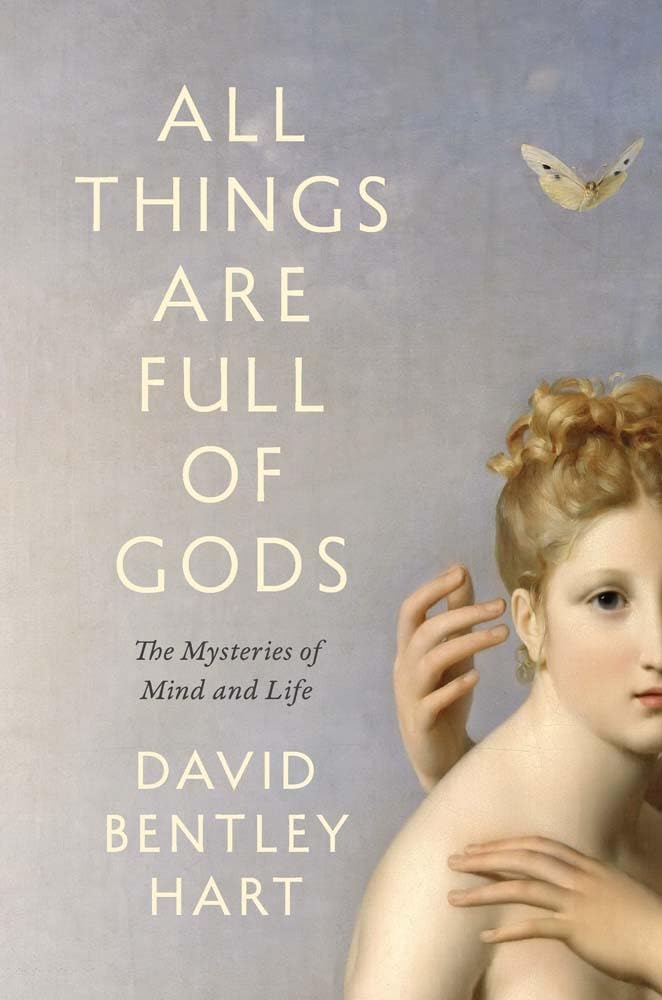
All Things Are Full of Gods: The Mysteries of Mind and Life

Rate this book
In a blossoming garden located far outside all worlds, a group of aging Greek gods have gathered to discuss the nature of existence, the mystery of mind, and whether there is a transcendent God from whom all things come. Turning to Eros, Psyche asks, “Do you see this flower, my love?”

So begins David Bentley Hart’s unprecedented exploration of the mystery of consciousness. Writing in the form of a Platonic dialogue, he systematically subjects the mechanical view of nature that has prevailed in Western culture for four centuries to dialectical interrogation. Powerfully rehabilitating a classical view in which mental acts are irreducible to material causes, he argues, through the gods’ exchanges, that the foundation of all reality is spiritual or mental rather than material. The structures of mind, organic life, and even language attest together to an infinite act of intelligence in all things that we may as well call God.

Engaging contemporary debates on the philosophy of mind, free will, revolutions in physics and biology, the history of science, computational models of mind, artificial intelligence, information theory, linguistics, cultural disenchantment, and the metaphysics of nature, Hart calls readers back to an enchanted world in which nature is the residence of mysterious and vital intelligences. He suggests that there is a very special wisdom to be gained when we, in Psyche’s words, “devote more time to the contemplation of living things and less to the fabrication of machines.”

511 pages, Hardcover

Published August 27, 2024

272 people are currently reading
2010 people want to read

About the author

David Bentley Hart

44 books698 followers
David Bentley Hart, an Eastern Orthodox scholar of religion and a philosopher, writer, and cultural commentator, is a fellow at the Notre Dame Institute for Advanced Study. He lives in South Bend, IN.

Ratings & Reviews

What do you think?
Rate this book

Friends & Following

Create a free account to discover what your friends think of this book!

Community Reviews

5 stars
148 (56%)
4 stars
78 (29%)
3 stars
28 (10%)
2 stars
5 (1%)
1 star
3 (1%)
Displaying 1 - 30 of 48 reviews
Profile Image for Jackson Lile.
2 reviews
November 5, 2024
This book will likely come to be seen as groundbreaking in the Mind/Body Problem debate for the 21st century. In arguing for mind over matter, DBH utilizes a dialectic method harkening back to Thomas Aquinas, Plato, and Aristotle. The "gods" themselves have the great debate of Mind and Matter in a cerebral garden to the tune of almost 500 pages. Psyche leads the discussion, along with her husband Eros, and Hermes---all supporting the argument for Mind---while Hephaistos defends his claim to Matter as the basis of all things. The mode of the dialectical method plays precisely into the argument DBH brings us to: semantic over syntax. The Good, True, and Beautiful all exist in the "hermeneutical realm", which only exists to the self-reflective "I".
Likely the most controversial take in the book will be DBH's monism. While dismantling cartesian materialism, DBH also utterly dismantles substance-dualism. (Majority of Christian philosophers are substance dualists and I expect some harsh critiques of this book.) DBH sees these arguments as two sides of the same coin, with philosophical monism being the only coherent answer. The world is Mind. Matter is Mind. Nature is Mind. Humans and animals are Mind. It's in the title, "All Things Are Full of Gods."
For those wanting to perhaps dive into a particular section, his chapter on LLMs and Code is very relevant. Spoiler: machine can never become conscious. Matter descends from Mind. Syntax cannot become Semantical, despite ever increasing processing power and data points.
What I found unique about this book is its beauty. Despite the rigorous philosophy, there are sections of complete elegance and beauty enough to drive one to tears. Eros doesn't speak very much, but when he does he asks the most poignant questions.
Profile Image for Bret.
20 reviews10 followers
September 15, 2024
Among the books that I have read which were written in my lifetime, this one strikes me as by far the most important. This is a book that the world needs, and that it needs now.

Such a suggestion may seem silly to the person that only reads its first couple (or even its first couple hundred) pages, but I think it’s accurate. Over the past four centuries, it has become increasingly common to understand persons and nature as machines; Hart reinvests these things with the numinous significance proper to them.
Profile Image for Clayton Christopher.
38 reviews
November 9, 2024
Only David Bentley Hart would have the audacity to put his words into the mouths of the gods. Throughout the book, he sketches out a philosophical idealism that would make your momma proud.

If mind’s intentionality, subjectivity, and consciousness itself all prove to be an irreducible reality as he so forcefully argues, then it is Mind that is fundamental reality and the Ground of all things made manifest in the natural universe. If, however, first person qualitative experience can somehow be explained through a third person scientific empirical investigation, then the philosophical picture that Hart wants to construct will have a hard time coming to fruition.

Come take a seat in the garden on the gods and listen in to what they might have to say.
Profile Image for Travis K.
74 reviews24 followers
August 5, 2025
“What wakens us from the silence of nothingness to become speakers of the word is the need to respond to the voice of God speaking to us, and that voice echoes within every word we speak.”

In which Hart puts the final nail in the coffin of reductive materialism, and adds five more for good measure.

As verbose, dense, and comprehensive as you would expect. I don’t pretend to have grasped all or even a majority of the minutiae Hart delves with reckless scholarly abandon, but the broad strokes of his argument, and even many of the meticulous digressions, are painstakingly wrought yet intuitively explicated. He also has on his side the benefit of simple good sense, evident in the most basic (and constantly recurring) argument of the book which essentially observes: short of a metaphysical dualism—that actually resolves nothing and only prolongs the problem for materialism—all of reality must either reduce to a primordial matter (from which comes mind), or a primordial mind (from which comes matter). If the former, then consciousness may be accounted for within a godless paradigm of so-called “strong emergence,” an evolutionary development from slime to Einstein. If the latter, however, then the entire cosmos—mind, matter, nature, and supernature—are birthed from and continually subsist within “one great thought,” a mind of minds manifesting itself in both physical phenomena and particular events of rational consciousness. The only problem for subscribers to the first thesis, Hart convincingly shows, is its radical impossibility. The simple “qualitative abyss” that opens between even the most complex “third-person” material organism and even the simplest spark of “first-person” awareness proves an inescapable thorn in the side of the materialist god Hephaestus (funny that), who over six days of ambrosia fueled discourse battles against his more spiritually minded brethren Hermes, Eros, and Psyche.

Hart also takes consistent recourse to the third and fourth causes of Aristotle — the “top-down” Formal Cause and Final Cause, banished from the sciences in early modernity in favor of their more fashionable cousins, the “bottom-up” boys of Material and Efficient Cause. Turns out the Greek was onto something, though, and inconvenient implications for your materialist program aren’t enough to erase the inarguable forces which compel intention, action, and change from beyond the fragile borders of time and space. Telos is back, yo.

Hart deserves credit for his kaleidoscopic synthesis of thinkers and theories, as well as plenty of original contributions of his own. But it isn’t like these arguments, and the cornucopia of others pursued throughout the book, are only just now being discovered. Between this and something like Iain McGilchrist’s neuroscientific manifesto The Master and His Emissary, the intellectual infrastructure needed to shift our collective understanding of consciousness and its meaning for the cosmos lies ready and waiting. To that end, another feature of the book is to show how mechanistic scientism’s persistence as the dominant framework of modernity is due less to philosophic integrity, empirical evidence, or plain common sense, than to dogmatic prejudice and a willful rejection of its own innate principles (which it implicitly denies can even exist), that, followed honestly, will always lead organically through and beyond itself, to the great Mind, the font from which all things come, and in which all things find their end.
Profile Image for Brian Hanson.
363 reviews6 followers
December 8, 2024
The BBC's venerable "Desert Island Discs" used to ask its interviewees what - in addition to The Bible and the complete works of Shakespeare (I doubt today's BBC insists on these) - they would wish to take to the island with them. This book would be my choice, for a number of reasons, one of which is that it demands many readings. It is not for the faint hearted, being a philosophical exploration of the nature of mind, and of being, in the form of a Platonic dialogue extending over nearly 500 pages. It is in some ways a development of the third, "Bliss", section of Hart's illuminating book on "God", but it stands alone. Four self-described "superannuated" classical deities - Psyche, Eros, Hermes and Hephaistos - participate in the debate, which is largely devoted to critically examining the proposition that mind and consciousness have arisen out of purely mechanical processes. Hart (through the mouths of the first three of the deities) is brave enough to confront every past and current argument for that position, and confident enough also to give voice to an ardent defender of that position in the form of Hephaistos (the craftsman, hence elbow-deep in materiality). The author is, of course, well known as an eminent (if controversial) Greek Orthodox theologian, but he is not averse to calling on Hindu and other traditions to tease out the arguments herein, and he does not force the reader into any narrowly sectarian, dogmatic, position. I suppose this could deter some fellow Christians from undertaking the book, but it would be their loss. It has, I believe, been called a masterpiece, with which I would heartily concur.
4 reviews1 follower
June 4, 2025
"So, yes, modernity is to a great extent nihilism, in the simplest, most exact sense: a way of seeing the world that acknowledges no truth other than what the human will can impose upon things. And, for the most part, the reality the modern world chooses to impose is a “rationality” of the narrowest kind, obsessed with what things are and how they might be used rather than struck with wonder by the inexplicable truth that things are. It’s a rationality that no longer knows how to stand before that gaze that looks back from the natural order, or even to see that it’s there. The world’s no longer the home in which humanity dwells or a presence to which humanity feels the need to respond; it’s merely mechanism and a great reserve of material resources awaiting exploitation by the projects of the will. As the mystery of the world isn’t a thing their markets or their wills can manipulate, they’ve simply forgotten it, and this obtuseness is certainly part of what continues to drive them toward ecological destruction." from the Coda, The Voice of Echo
Profile Image for barbs.
345 reviews40 followers
did-not-finish
September 8, 2024
Nope, I think philosophy aint for moi
Profile Image for Brent.
650 reviews61 followers
November 9, 2025
A most timely book. Dr. Hart scales back his normal supercilious tone and exhaustive vocabulary in favor of a socratic dialogue with our beloved Greek gods Hermes, Eros, Psyche, and Hephaestus. Hart's position is clear, philosophical naturalism is reductionistic and cannot explain consciousness, language, or life.

Hart's Coda at the end of the book is portentous and harrowing: things I have been thinking about for the last two years. The age of the machine is coming to a final crescendo. The Finale? Singularity and Silence. Only the whimpering of our human spirit of bygone ages can be heard among the fetid mass of objects, production, and market economies.

Hart is a true Shellingian and for that I adore this guy. He dabbles into Suffi mysticism and Hindi ontology, but he his a German idealist at heart.

-b
Profile Image for Ilia.
117 reviews6 followers
June 27, 2025
I like a good debate. New things can be discovered, stones turned over, truth emerged, or, - if not the truth per se, - at least you can walk away with a changed perception of the matters discussed.

This book is structured as a good debate about the nature of our existence, consciousness and, for the luck of the better word, God. However, the debate held for about 500 pages felt over-repetitive and stale well before its end.

Author presents us, basically, with two opponents: Hepheistos, who argues for various mechanistic l /physicalist approaches to the Universe, often cites different philosophers and proposes different kind of theories and ideas; and Psyche, who argues for the “spirit / mind came first” approach - even though she wants to present it as spiritual Panpsychism, - and, despite me generally being on her side, comes off as having a single argument of “We have not seen anything mental arose from matter, so it cannot ever. Therefore spirit came first! I know this 110%!”

Many things could be said about the overall good nature of the debate, the thoughts and observations presented from both sides. Some things did not occur to me before, some things did. Overall, it was a great read for people interested in philosophy, even if over-repetitive (thanks to Psyche) and prolonged.

My problems with the books are two-fold.

First of all, I think Psyche’s inability to come to a common ground with her opponent if they are virtually talking about the same thing, albeit using slightly different language is tiresome. Psyche evokes the dualist language all the time. It really annoyed me that she claims for matter and spirit to be the same, - with matter being a manifestation of spirit / mind, - and yet every theory Hephaitos presented that virtually says the same but without invoking the “spirit came first” idea she rejects immediately, presenting it as if she found some flaws in it. If you’re non-dualist, Eic Chaisson’s idea about organic and non-organic life being only a difference in degree should really intrigue you. After all, if you claim all existence is Mind trying to experience itself, there were 9 BILLION years of existence without any sign of organic matter. How else should this One Mind experienced itself during that time and why was all that inorganic matter manifested with a probable intent of some day to arrive at organic life if not to also be part of this One Experience? This idea is a real Panpsychism, and despite it coming from a “lower” direction it arrives at the same place Psyche is so eager to argue for. Yet, it seems that simply because she does not like the direction she rejects the idea immediately, in a very dismissive condescending tone. Think, dear Psyche, what you’re rejecting and how it actually relates to your arguments. Listen to what your opponent is actually saying. Sometimes the language of the opponent can be so different from yours it feels like you’re talking about different things, but in reality you’re talking about the same.

Another example includes a case of emergence. Psyche argues that there can never be a case of strong emergence since it contradicts the very physicalists laws, and something new can never emerge from simple matter (believe me, her almost every argument boils down to this reason). And yet when Hephaisos suggests a theory that say that consciousness is an intrinsic property of matter, even of its smallest bits, and is always present in all the atomic and subatomic particles, - turning the case from strong emergence to a structural emergence, which Psyche agrees is possible, - Psyche goes own how it is not possible and cannot be a property, instead of focusing on the fact that this is indeed is made possible by making a consciousness an intrinsic property of matter (or, even when Hephaisos rephrases and notices that properties are not really attributes of matter, they just are just characteristics observable from a third-person-point of view - she never even tries to understand that this can be easily described in her language and is virtually the same.

After all, what is even matter? You zoom in, all you find is emptiness and some energy vibrating on an incomprehensible level. All particles are seemingly just mathematical objects to describe how the laws of physics work. You also have the quantum phenomenon of observation that changes the results. Where is matter here? An illusion. It fits really well with the Brahman picture that Psyche is painting, it just arrives at it from “below”, not from “top-down”. Yes, obviously science cannot make real conclusions about everything being One Consciousness just yet, but scientists are not oblivious to this illusory state of matter and the importance of an observer for quantum events. Why, then, Psyche, you so don’t want to accept that you are even talking about the same thing? The question “What came first, spirit or matter?” does not even make sense. If they are the same, it is the wrong question to ask. If everything that we know of began at Big Bang, where there was not matter as manifestation, and yet all that we see and experience was still hidden and present (whether you argue for formal causes or intrinsic properties of existence, which honestly sound the same), then you’re doing a poor job of understanding your own arguments, Psyche.

Finally, the second point I think the book could have been better at is this: Hephaisos sometimes comes off as a straw man for a mechanistical, non-spiritual position. He does not press where he could, he does not come up with the best metaphors and examples, he does not always point out the flaws in logic and he surrenders way to easy in certain places. He allows Psyche to rave for pages and pages after being interrupted by her many times over the course of the book. Yes, he has some long monologues, but they mostly never come to a conclusion and are cut off by Psyche’s overexplaining her “matter cannot produce mind” position again and again in much greater lengths.

As I understand, the author holds the positions that Psyche argues for, and despite his generally good presentation of physicists models and ideas, they still come off as ingenuine, or made from a weak point. To be fair, Hephaisos even states so in one of the closing dialogues, just to be “corrected” that he has lost “by logic points”. No, he did not. He just never pursued the debate the same way as real physicalist would. He never pointed out a possibility of different use of language. And a few times that he did try, the author allowed for Psyche and her two minions to talk over him even more.

Mind you, despite me being so tough on Psyche I am actually not a mechanicalist. I hold positions more close to her views, then to purely mechanistic ones. And yet her approach and her inability to extend a hand to an opponent, despite the opponent suggesting many different ideas, some of which sound extremely like the same thing Psyche is talking about, - her approach was annoying and irritating. I am glad she is 100% sure in everything that she says and never allows for a mistake in her reasoning, based on purely metaphysical “logic”.

I could go on more about her “arguments” about nihilism (no formal cause, then everything goes, can kill everything that lives and experience no remorse; this is most assuredly the wrong position to hold, as there are plenty instances of religious atrocities and warfare throughout history, with only difference being that there were weapons of mass destruction and technology that allows for such severe human loss numbers) or assurance for existence of free will (which would be especially interesting to see how she reconciles free will with everyone being a part of Single One Mind experiencing itself in different shades, - this theory basically forces you to deny free will and it cannot be otherwise), but, alas, I am not writing a book here. Yet.

Anyway, that’s my thoughts on the book. I have 10 pages worth of notes and probably should start a YouTube channel to express everything that I could on this topic. Maybe I will.

Drop a comment if you're think I am onto something with this review, or am utterly mistaken. If you're one of those 5 people who read this book :-)
Profile Image for Michael Baranowski.
444 reviews13 followers
September 16, 2024
I respect David Bentley Hart's intelligence and I was excited to receive my copy of All Things Are Full of Gods, which I pre-ordered as soon as it was available on Amazon. But for as brilliant as he is, he seems unable to write for the intelligent non-specialist, and the style of this book - a dialog between several Greek gods - does him no favors because he doesn't have the talent for that style of writing to pull it off.
Profile Image for Kenneth Bachmann.
91 reviews11 followers
January 16, 2025
A couple of quick thoughts before my review: 1) I'm being a bit disingenuous, since I've only read about 60% of the book. 2) In terms of literary awareness and erudition, I'm pretty much unworthy of reviewing a book of this high level of language and complex thought. But, for those interested in a rank layman's opinion of (what I have read) of this book, here goes:

The book is beautifully written, and the language is exquisite. By which I mean Hart uses such esoteric language that it becomes burdensome to constantly look up meanings of words rarely (if ever) encountered in normal language while one tries to mine meaning from very complex arguments. I would imagine that this was not a problem for the six (6) commenters on the back cover leaf of the book, but might be a problem for perhaps the other 8 billion potential readers. I think the language used would be well suited for sonnets or other poems, but for me it made the understanding of the arguments more difficult than need be. At times it seemed that the author was just being obtuse about his phenomenal vocabulary and language skills with the hope that the book might only be enjoyed and understood by folks similarly invested and educated in the most obscure words in the English language.

That aside, the book is a thorough discussion of conflicting thoughts about physicalism and mind (or consciousness) as the primary feature of nature or creation. The discussion is couched in the dialogue among several mythical gods. The key characters in these debates were: Psyche, the Greek Goddess of soul and Hyphaestus, the Greek God of fire and blacksmithing, arguing for the primacy of mind and materialism, respectively. Other characters were Eros, Greek god of love, and Hermes, Greek god of thieves and merchants.

I did skip most of the last 40% or so of the book, because by the time I was halfway through I began to think of reading as a chore rather than a joy. The last few chapters, I had hoped, would come to a decisive conclusion (in the argument of mind vs. matter), but I was a bit disappointed that after all the logic imbuing the various arguments put forth by the gods I discerned no definitive conclusion at all.

If you like beautiful but obscure words (to the layman), and have a dictionary at hand, and lots of time at your disposal (perhaps a months-long vacation at an isolated venue), then this would be a good book to take with you. Or, if you teach English lit and/or philosophy of mind or are just effing brilliant and curious you might truly enjoy this book. I'll get back to the forty percent of the book that I skipped over during the next year or two.
Profile Image for Jack Naylor.
41 reviews2 followers
October 1, 2024
An absolute triumph of a book. Hart brilliantly pulls together a philosophy of mind and life in a poetic and harmonious synthesis - somehow still improving on his earlier work.
Profile Image for John Andrew Szott III.
93 reviews29 followers
February 6, 2025
A very thought-provoking read that was a bit of a slog, at times, for me to finish. The work proved challenging in both form (esoteric diction) and content (philosophy of mind), which is not necessarily bad. Yet, this yielded a lack of clarity at points.

Overall, I really appreciate DBH’s strong case against the physical reductionism of mind. I’m just not sure of his positive case for neo-platonist panpsychism (if it can be called that).

In the end, I humbly submit that I may have jumped into the deep end of this discussion and was not adequately equipped to appreciate the project as situated within the broader discourse.
Profile Image for The Tactical Witcher.
19 reviews
January 16, 2025
A terrific and enlightening treatise on reality and consciousness! A must-read masterpiece!

I felt totally and delightfully captivated from start to finish, invariably, by DBH's point and counterpoint style of discourse between his protagonist Gods, at once prosaic and poetic, articulated in a sophisticated, flowing, beautiful and precise English. This book is definitely not meant for the faint-hearted or impatient types, nor for an audience not versed in basic notions in philosophy. Do not even try. It's complicated. But the prize is worth the enterprise.

By the way, this is the very first book I've read from this author. Let's start with some missing features that could have made for a tad better reading experience. I think he should have included a Glossary recapitulating the fallacies he mentions during the course of his exposé. I also feel that he should have included a very brief Summary at the back of the book, of every unsatisfactory philosophical paradigm he has argued against. Lastly, I felt that some protagonists were speaking for too long at times, i.e., not like in a real or even hypothetical conversation. For instance, see Douglas Hofstadter's GEB, for an example of how smoothly the dialogue between Achilles and Mr. Tortoise unfold. Here, the Gods weren't quite imbued with convincing personalities and idiosyncrasies.

Well, there is definitely room for improvement, but man, I'm just bickering! This book is awesome! It's one of the best I've ever read my whole life.

The plot revolves around four Gods (Psyche, Eros, Hephaistos and Hermes), chilling during teatime in their intermundane garden, and engaging in a conversation about the nature of consciousness, reality and language, among other topics, over the course of six days. You will come across references to many well-known philosophers of mind, and their diverging worldviews will be deconstructed one by one (or at least their loopholes exposed and shown to be inconsistent). The aim will be to show, step by step, that a form of Idealism akin to the Neoplatonic or Vedantic philosophy is indeed more logical and consistent than a dogmatic adhesion to scientific materialism and its offshoots. So, you are in for a deep dive into epistemology and ontology, existentialism, spirituality, biology, physics, integral meta-theory and what have you. You can feel a web of intertextuality weaving itself, especially if you have read many of the originals, including the Upanishads in one form or another.

I highly recommend reading Iain McGilchrist's The Matter with Things either before or after reading this one.

All in all, All Things are full of Gods is mandatory reading for many years to come. Great job!

Profile Image for Justin Fowler.
7 reviews4 followers
May 8, 2025
Phenomenal and thorough dealing with the problem of mind and the substance of reality by means of a dialogue between the gods Psyche, Hephaestus, Eros, and Hermes. The stunning clarity of the book is found in continually bringing the reader back to the issue of consciousness being a unitary first-person subjective standpoint, and clearing away any conflation with the contents OF consciousness. That (along with repudiating dualism, of course) cuts out most of the nonsense of the whole debate and makes the answer quite obvious, showing all contrary points of view to be more or less different degrees of ridiculous self-caricature.

Psyche is at once endearing, intelligent, kind, charming, quick-witted, and utterly lucid in explanation. Hephaestus certainly sounds like every smug, triumphalistic naturalist I have ever come across -- though ultimately as a god with a charming warmth beyond that, and a good degree of honesty.

I really loved the dialogue about biological life, as well. A++

Just note that there are some high-level concepts and terms in this tome, so have a dictionary ready and perhaps a search engine or AI bot to help clarify some things as you read, if you're not already privy to the scope of the debate.
Profile Image for Andrew.
597 reviews17 followers
September 20, 2025
Ye gods! And all because she picked a rose.

And - Phaesty, my obdurate friend!

I'd read just enough to gain a small foothold here and there. Enough scraps of
Keith Ward
Donald Wallenfang's intros to phenomenology and metaphysics
DBH's The Experience of God
Plato's Symposium
Bernard McGinn's Essential Writings of Christian Mysticism (Bonaventure etc)
Until We Have Faces, by C S Lewis
Enough about Orthodox Christianity
But nowhere near enough to be a full participant. (And certainly not enough science.)

Even then I was at sea for a fair bit of it, and a lot just drifted by. And then there was the problem of capacity.

I'd got into the habit of using audiobooks as fuel to overcome the inertia of facing down housework. The brain stimulated in one area while another area attended to tasks of otherwise enervating drudgery. Usually this works well because, although listening to audiobooks draws some energy, sufficient is still available to attend to the more or less mind-neutral tasks at hand.

But one morning I attempted this, listening to All Things Are Full of Gods while cleaning the shower (that most enervating and drudgerous of all tasks). A little way into this exercise, I found myself standing there, cleaning sponge in hand, staring into space. It doesn't work - the book just draws too much brain energy - almost nothing is left over.

And actually, let's just be honest and say, 'The present author [or writer of this review],' to borrow the wry words of Johannes de silentio, 'is no philosopher, he has not understood the System, nor does he know if there really is one, or if it has been completed. As far as his own weak head is concerned the thought of what huge heads everyone must have in order to have such huge thoughts is already enough.' (Søren Kierkegaard, Preface to Fear and Trembling, p5)

I'm content to have spent the 22 hours and 12 min (or longer, with the rewinds) listening to the discourse, gleaned a few things here and there, noted a few things down for future use, and marvelled in an enjoyable, and even reassuring, way (and actually I ultimately don't say this sarcastically) at the huge head engaged in such thoughts.

And then a breakthrough - brought about by two factors. (1) Discovering the read-along feature (after I downloaded the Kindle version to grab a quote for my next SLW book), and (2) a positive shift in the book to the discussions of soul and such.

A huge chunk of the book was, for me, preaching to the choir, in the sense that I already basically agree with the broad, general propositions being argued for (the 'basic' bit is at my end) - ie that there's more to the cosmos and life than the merely mechanistic; that there's a purposive intentality behind it all; that things are more than merely material. All that happens, is that the points are discussed at a far greater depth, arguments are countered from people I've never heard of, and objections are raised of which I wasn't previously aware and in which I had no real interest. In other words, I already agreed with the position (in very basic terms) that a vast proportion of the polemic of the book is seeking to establish. (Actually, even though it's an incredible and impressive project, it's hard to imagine who the ideal audience for the book is.)

Meanwhile, I take no special pleasure, I hope, in witnessing the 'winning' of an argument in favour of a point of view or proposition I already agree with. That we do often take such pleasure is a sign of immaturity in our human psyche and culture, I reckon. It does serve to reassure I suppose (as earlier mentioned), which probably isn't always a bad thing, and is maybe even good.

As I say, it's not until the book starts to explore the propositions about soul and Mind, and such, that I started to get really interested. There were earlier glimmers, but a major turning point for me was the chapter on panpsychism, and then it really began to flourish on Day 6: Nature and Supernature. The Coda is powerful and salient too.

Now it drew my concerted attention. Listening/reading, skipping back to bits where my attention might have slipped, wanting to comprehend and absorb. Now, the expansions, details and deep-delvings on the basic premise with which I already agreed were fascinating and illuminating.

Look at this cracking passage spoken by Eros (and you really are better to just read it in a normal internal voice, by the way, than listen to the voice actor's rendition in the audiobook):

'There’s an apperceptive “I” in each of us, more original than the finite ego each of us takes as his or her “me,” and this “I” is forever directed toward a transcendental “that” or “Thou” exceeding the perceptible world, a realm of values or purposes in whose light the world of things becomes an open field of knowledge and judgment. I might almost speak of two “supernatural” poles—two vanishing points where nature either sinks down into foundations deeper than itself or soars up into an exalted realm higher than itself. We know the world because something within us that’s more original than ourselves is always reaching out to something outside us that’s more ultimate than the world. I take this to be not merely an epistemological truth, but an ontological truth as well. I think this is what Plato understood in saying that all the knowledge we acquire is really a kind of remembering: that deepest and most original yearning within us recalls that last and highest end beyond all things and, in doing so, open us to all things.' (p492, Kindle)

And this, also from the mouth of Eros and also crackingly lovely (sorry, it's long, but worth it):

'So, all right, you wince when I speak of this preoccupation of our will and intellect with that transcendental horizon as “love,” but what is love other than a total attachment that requires no rationale beyond itself? In our every encounter with the world, we’re addressed at the deepest level of our longings by the absolute, those ultimate ends toward which our minds are turned in a primal embrace of Being as such—of the fullness of reality in its very essence. And the more we surrender to that love, the more insatiable, unrelenting, and consuming it becomes. The mind always has some sort of original awareness of absolute truth, even if it has at first no categories by which to name it or concepts in which to capture it; and this awareness apprises the mind constantly of the incompleteness of what it already understands, or of the contingency of what it believes. This isn’t to say that the mind always heeds that knowledge; but, when it does try to discover and understand the truth, what it’s seeking is a kind of delight that goes beyond mere personal gratification, and a kind of fulfillment that can supersede any transitory disappointments or frustrations that the search for truth might bring. Sometimes this search can force one radically to alter one’s deepest convictions, at times shatteringly, and yet even this doesn’t necessarily deter the will from continuing on its quest. One often, and impractically, continues to venture outward toward the world’s highest truth out of a deep longing for what my dear Psyche called the “nuptial” unity of mind and being, and for the joy of knowing that unity intimately. So, yes, the indissoluble bond between mind and world is one of love—an indefatigable adherence of the will and mind to something inexhaustibly desirable . . . inexhaustibly beautiful.' (p502, Kindle)

A last observation: There's an irony in gods debating the existence of the more-than-material. It's almost as if, should Hephaistos (the antagonist) win the argument, he argues himself out of existence. I think that this is an irony that Bentley Hart means - from it we're meant to deduce the irony of humans debating the existence of Mind and Soul, all the while employing those facilities in the debate. As if we might win the debate in favour of a mechanistic and/or purely functionalist universe, and in the process actually become no more than machines (at best) or (at worst) cease to exist altogether.

'The history of modern disenchantment [dis‐enchantment],' as Psyche tells us in the Coda, 'is the history of humankind’s long, ever deepening self-exile.' p556

Fortunately, if we might dare to hope, the opposite can be true.
Profile Image for J.D. Cetola.
113 reviews1 follower
August 7, 2025
I tried to read this book via Audible during my long drives to/from work. This isn't the book for that media -- it's written like a play which doesn't work well in the audio format. The author is apparently in possession of an expansive vocabulary and likes to use it. I found this book all but incomprehensible and downright boring as I raced back and forth on I-64. There's a glitch in the audible book in Chapter 2 where the narration skips to the conclusion; this nearly caused me to drive into one of the many the Jersey barriers with the incredible joy the thought of being finished brought, but it wasn't to be--the book wasn't over and the narrator returned to the proper place in the book. I did not. I took the opportunity to give up on the book.
19 reviews
May 23, 2025
It’s quite a few years since I’ve read a long work of non-fiction such as this from cover to cover. I did so with enormous excitement and enjoyment.

I won’t try to rehearse the arguments in any detail as very many reviewers have already done so, and I couldn’t do justice to the many arguments. It’s nothing less than a dialogue on what must be one of the profoundest questions of this or indeed any time - is the orientation of Reality top-down or bottom-up? That is, is the primary reality mind/spirit or matter/mechanism? Hart, through the gods Psyche, Eros, and Hermes, argues strongly for the former (Psyche calls the latter option “the ontology of death”) against the devil’s advocate, Hephaistos, who represents and voices Hart’s own honest doubts.

I find the arguments of Psyche and friends, that mind, with its qualities of unity, irreducible subjectivity, intentionality, rationality and so on, simply can’t derive from matter stimulating, uplifting and almost totally convincing. I kept finding objections only to find them convincingly dealt with a little further on.

Hart is reportedly an Eastern Orthodox Christian but, while he eventually identifies the unity of being and intelligibility with the idea of God, it is to his credit that at no point in the book does he make any appeal to revealed religion, relying completely on arguments from first principles.

My niggling doubt is that he might be committing the error, found in philosophy from at least as far back as Descartes, of drawing conclusions about how nature must be from what seems imaginable or conceivable.

But even if he is, even if Hephaistos is right and mind does after all derive from matter, it seems to me that all is not lost. What this would mean is that the possibility of mind - of there being ceatures somewhere who at the very least take themselves to be conscious bearers of subjectivity and intentionality - has been present in, part of, Reality from the very beginning, from the first explosion of totally mindless elementary matter. We know this because here we are.

At this point someone like the late Daniel Dennett will say that our belief that we are bearers of these attributes is “really” an illusion, a trick created by our neurophysiology. But in fact “really” has no purchase here - the claim just transfers the reality to the “illusion”. Why not say instead that our neurophysiology gives us our minds? Nothing, as far as I can see, is lost. It’s a bit like saying that our sensory apparatus tricks us into believing the sky is blue when we can just as easily say that our sensory apparatus gives us the blue of our sky - only someone so committed to physicalism that they can’t contemplate allowing any reality at all to consciousness or blueness needs to use this deflationary locution.

A century ago the British emergentist Conwy Lloyd Morgan coined the marvellous term “the go of the world”, by which he meant something like Causality as a general principle, that is, that which moves the state of the universe forward through time from one nanosecond to the next (this leaves out, admittedly, the question of what time itself is). So suppose the “go”, over aeons, took, through its interaction with matter, ever more complex forms - atoms, molecules, etc, so that eventually here on earth it somehow takes the localised form of the rational, intentional actions of human beings - of what Sellars and John McDowell call the logical space of reasons.

Of course, that does nothing to dent the arguments of Psyche and her friends because we have absolutely no idea how the “somehow” in my last sentence can be fleshed out. But I still feel it’s not impossible. It’s enough, I think, to prevent the triumph of the ontology of death.

The physicist and science writer Paul Davies, who is cited several times in this book and whom I greatly admire, wrote this: “Some call it purpose, some design. These loaded words…capture only imperfectly what it is that the Universe is about. But that it is about something, I have absolutely no doubt.” Davies more or less leaves it there; this book is, in many ways, a continuation from where he left off. It is a very necessary antidote to the nihilism of this troubled century.
Profile Image for Desirae.
3,096 reviews180 followers
March 20, 2025
I began this journey, as author David Bentley Hart suggests, as a way to interact with the celestial concept of philosophy. What transpires, when you have four Greek Gods, discussing the merits of earthly nature on a sunny afternoon in their ever-blooming garden? Unfortunately, a lot of nothing.

The argument that Hart is trying to have here – that these immortal beings are questioning everything from science, medicine, religion, love and being dissolves itself as soon as it begins. Why would these spectral forms have these conversations? Why do immortal beings have mortal questions? What separates these beings from their earthly counterparts, and why would their days be occupied by such conversations? The narration is written by an author who is questioning the bounds of the universe, his questions are posed through the guise of the Olympian world. Older and more interesting God’s then the western God. I imagine them in a Rococo style atmosphere, similar to Jean-Honore Fragonard’s “The Swing,” a lush world full of rich colors, an idealist landscape, lending to open thought and conversation. These older beings are able to extrapolate time in a more organic way than the monotheistic religions of the Abrahamic faith, and my sense is that Hart understands that and chose them to narrate and navigate through his world.

Hart notes: “Nature is the structure of the mind. Nature is thought.” And I can’t say that I disagree with that, and thought like nature, changes, grows, dies, is reborn/reformed, similarly to the structure of our characters days of discourse on the many philosophical merits of their discussion.

It’s important to note that Psyche, by traditional mythos, began her life as a human, and perhaps, that is why the structure of the tale is bookended by her control of the conversation. Her friends, Hermes and Hephaestus, (Patron of Artisans, and messenger of the gods) and her partner Eros, circle around and entertain her many thoughts and points, and in turn, she coaxes alternate arguments from them. Is she the manic-pixie-dream-girl of Philosophy? She does appear to be the central force that molds the direction of their thoughts. The three males placate her as she moves from topic to topic in a multilayered week-long conversation. Does Hart believe Psyche to be a being? Or, does Psyche, the feminine aspect of this quartet, merely represent the mind?

The narrative is often brought back to “the ghost in the machine.” The conscience and the unconscious. The ‘ghost’ is the unexplained aspect. The machine can be both ‘man,’ as well as the product that comes from man, i.e. the ‘machine,’ but the ghost is the ever present question that occupies our characters for the majority of the book.

Despite the extensive conversations held between Psyche, Eros, Hephaestus, and Hermes, at no time do they wax on their own creation or conception. In exasperation, on Day 5, Hephaestus says: “Oh please, no one, god or mortal, knows how life began.” Has Hart hypothesized that all creatures, celestial or otherwise are random in nature? That the complexity of cells can metamorphize via one path to immortal thought and another to mortal? As I mentioned in the beginning, a lot of nothing. These figures languidly argue, long-winded thoughts, but nothing becomes of nothing. Much like the Boccaccio style conversation, it never truly begins and never truly ends. What came first, the thought, or the consciousness to have the thought? Can you question philosophy without questioning your own existence? I’m not convinced, but Hart believes it to be so.
Profile Image for Dave Courtney.
897 reviews32 followers
January 11, 2025
I imagine someone else has noted this somewhere, but i can't help but smile over the quirky and intuitive nature of Hart framing his argument as a discussion between the gods. Which on the surface might seem more than a bit ridiculous and self aggrandizing, but in fact is all part of helping to distancing any potential sense of self importance from what is arguably some of the most important ideas we can be discussing and reflecting on. It also helps infuse the seriousness with some notes of humor. Imagining the gods bantering about the essential qualities of mind and matter is, well, kind of fun.

That said, it's not hyperbolic, nor an understatement to say that this just might be the most important and relevant book to come out on philosophy in the last 50 years at least. It's substantive and complex, but the process he employs is reflective of a building argument that logically flows from one chapter to the next, and from one section to another. It's a cumulative work that requires the whole, and the fact that the whole is as lengthy as it is means an investment. I'm a decently fast reader, and this took me half a year to finish (for anyone interested as well, the audio version is also well done- works well as a tandem read).

An investment that's worth your time if you have any interest in the philosophy of the mind. A necessary investment for anyone interested in the academic interests.

As a thesis I think this essentially boils down to two things- mind over matter and monism over dualism. These two things form the driving interest of his philopshical exercise. And one thing worth noting. While the argument for mind and monism clearly reflect his own conclusions and get the weight of philosophical discussion, he ultimately leaves room for questions and pushbacks to coexist. The discussion doesn't lead to a conversion as much as it leads to a fully fleshed out and reasoned argument for his position.

That said, I have been teetering on the monism line regarding the substance of mind and material for a while, so I didn't need much persuasion to push me over. And if I uphold that monism, it's pretty difficult to avoid the logical conclusion of mind as given rather than emergent. If all material reality is reflective of this sort of consciousness, then what follows is mind as equal property with the capacity to reflect on itself.

This is one I will be revisiting often.
Profile Image for Milo.
265 reviews7 followers
September 15, 2025
Too tempting a proposal to resist – a Socratic exchange between louche gods around Intermundia. The question of rigour can be put aside for a moment. David Bentley Hart was moulded in the baths of rigour. However mordant he can be, rigour remains watchful at his side. But his writing is also, partially on the back of this mordancy, impressively ductile. He can move into comedy, into general banter, and present in his typology of characters a real feeling of discussion, despite diverging into huge chapter-length speeches. This is the quality of Plato in his most dramatic dialogues. I must also commend his representation of Hephaestus, insofar as the punching bag (who must be seriously bruised by journey’s end) is never made out to be quite so stupid or wretched as someone contradicted continually for six-hundred pages might otherwise have been. He is given the grace of contrarian thought, insofar as he only need Psyche to concede one point for her position to crumble. (The negative space of DBH, by which his argument is given credence in large part for the lack of logically consistent alternatives, does sometimes make his positive arguments a little more rhapsodic and by this dint a little less convincing. This tendency is made self-conscious within the dialogue.) He is also not converted; if it is not quite a Platonic aporia, in which the argument simply disintegrates, it is nonetheless a concession that there is some basic assumption about the world that seems to guide Psyche and Hephestus on their clashing courses – the up against the down – and that it is this abstract principle, more than anything else, that determines the direction of argument. Certainly DBH cannot comprehend a universe in which Up countermands Down, though at once he can comprehend the ideas and bases that lead to that thought. Particularly in the closing passages – which I think are a very moving, and much improved variant on similar words spent in The Experience of God – there is sense of what cannot be fully expressed despite such firm conviction in Psyche/DBH. In these mysteries are perhaps the heart of the Hephaestean position, and it is these that DBH cannot entirely dislodge. Therefore, despite the appearance of logical supremacy, there is the remnant of an impasse. DBH, on this principle, allows the disagreement to persist. For a man who has relatively little respect for the most counterviews he strikes down, this is a delicate concession.
Profile Image for William Peace.
Author 16 books8 followers
August 30, 2025
This book is not an easy read. The text brims with philosophical terms so that I found myself reading with my phone within easy reach to look up the unfamiliar terms. It is 483 pages long with 11 pages of footnotes and a 14-page index. Clearly, it is a scholarly masterpiece. And yet, one wants to keep reading to discover the revelation one can sense is coming, to achieve new insights, and to rediscover important truths. Rather than frame the book as an extended first-person lecture, the author has assigned the debate on the nature of existence to four Greek gods who have near infinite knowledge, the authority of being gods and engaging characters. They are: Psyche, the goddess of soul and life, Eros, Psyche's husband and god of love, Hermes, the messenger of the gods and the divine intermediary between heaven and earth, and Hephaistos, the god of craftsmen and manufacturing; he is the deity of all technical virtuosity, ingenuity and skill. The dialogue takes place at the estate of Eros and Psyche, in one of its many gardens. Everything is in blossom. In that place, everything always is. Psyche begins the debate by picking a rose and commenting on its beauty. She then leads the discussion of existence over the next several days. Hephaistos roll, throughout the debate, is the represent the position of reductionist materialism philosophy, which takes the position that everything can be explained scientifically. Topics include mind, life, matter, brain, machine, soul and nature. Much of the discussion centers on the inability of some philosophers (current and ancient) to demonstrate that science (including nuclear physics, modern chemistry and quantum mechanics) does, in fact, answer all of the interesting questions. For example, there are revelations about genetic science which prompt questions about how a living single cell 'knows' how to modify its own capability to respond better to its environment. The conclusion is that life, mind and language must be put it place by a 'higher power'. In spite of many scientific attempts, life has never been produced in a laboratory. Likewise, there is no explanation for the existence of mind, in all its glory, including consciousness. Language owes its existence to mind.
Why isn't there a condensed version of this book which uses everyday language to make the point that atheism is a dead-end belief?
Profile Image for Dan.
553 reviews146 followers
November 16, 2024
In the dispute between idealists and materialists, the first ones usually have the advantage of perceiving and accepting that there is at least another horizon - by necessity non-material - that makes everything possible (with Kant and his transcendental idealism as the main example). Materialists are stuck in their flat world and consequently are trying hard to find proofs on how mind, language, conscience, and similar things are emerging from the material world or just simply denying their existence (with Darwin and his natural selection as their ultimate model). Hart here embraces an idealistic monism that stands behind both the material and spiritual world; a monism that eventually resolves into the rational, moral, beautiful, and old Christian God.

The book is great in pointing out the flaws of modern materialism and in showing how the modern scientific method eventually turned into an worldview; and even more fundamentally turned into an ontology. That is, modern science started with an extreme methodological reduction of nature in order to allow its measurements and formulas (as did for example by Galileo and Newton), and it ended in the last century with the total and fundamental conviction that nature is nothing more than this methodological and quantitative reduction. Nietzsche – not mentioned here at all – expressed this process quite well with his pronouncement that “It is not the victory of science that distinguishes our nineteenth century, but the victory of scientific method over science.”

Some of the problems of this book are: it does not go deeper (for example beyond the phenomenology as developed up to Husserl or beyond the Christian perspective), it is stuck in old distinctions (like subject/object, matter/form, matter/spirit, or syntax/semantic), it pays too much homage to reason, it is too much engaged with its popular adversaries, it tries too hard to be scientific in a mainstream way, and a few more.
Profile Image for T..
299 reviews
Want to read
January 16, 2025
Charles Carman reviews the book in both Touchstone

“The Church and her theologians must reclaim the mind and language from the realm of material replication and mechanical technique, or theology will cease to be.”

—and in The New Atlantis:

“What happens in such a scheme, Hart wonders, where we surrender the meaning of our lives to machines that have no idea what meaning is? If we submit our future to quantitative prediction instead of qualitative wisdom? When we willingly divest ourselves of the mind by giving over our attention and compliance to a counterfeit? Eventually, the historical and material forces will bear down on the belief in the mind. There will be little space left for the idea of the divine. Language will become mechanism. Engines of prediction will be appointed to the forefront of our military strategy, political leadership, educational upbringing, and economic growth. In such an inhospitable atmosphere, the phenomena of the mind begin to warp: consciousness, attention, wonder, love, poetry, philosophy. As this progresses, Hart writes,

'Human beings turn for companionship to the thin, pathetic, vapid reflection of their own intelligence in their technology only because they first sealed their ears against the living voice of the natural world, to the point that now nothing more than its fading echo is still audible to them. . . . They long for the silence to be made complete.'”

https://www.touchstonemag.com/archive...

https://www.thenewatlantis.com/public...
Profile Image for Zeke Merlis.
48 reviews
December 11, 2025
All Things Are Full of Gods is the first serious work of philosophy I have read. (Second overall—I read David Edmonds’s Would You Kill the Fat Man?: The Trolley Problem and What Your Answer Tells Us about Right and Wrong in middle school.) Yes, I failed to understand much of it. Sometimes I let paragraphs wash over me, taking away only a dim impression of their actual substance. This is to say that I am nowhere near qualified to write even a Goodreads review of the book. Here I go anyway.

In a way, the premise of the book is simple: Hart aims to demonstrate that the materialist, mechanistic picture of reality which prevails in late-modern thought is inadequate to explain the existence of life, of mind, and of language. I went in fully prepared to accept his reasoning. I myself do not put much stock in materialism, and think the existence of consciousness is one of the stronger arguments against it. But Hart’s thesis is far more radical than it initially appears. He would overturn René Descartes’s “ghost in the machine” as well as Immanuel Kant’s “ding an sich” in favor of a view of reality itself as mind, intelligible to us because it and we are both sub-levels, as it were, of a divine consciousness. There is no disconnect between us and the world at large; the sensory perception by which we grasp our surroundings is a function of being itself. In his own words:

Life is indeed hierarchical, consisting in inseparable levels of causal interdependency, governed by top-down processes that can’t simply be reduced to their constituent parts or to operations in isolation from one another; and the uppermost of those levels, so to speak, which is utterly indispensable to all the systems that depend upon it, is that purely hermeneutical space, which in its turn is presided over by the formal power of mind—[...] mind as such, the essential finality, purposiveness, intentionality, cognitive depth, and pervasive consciousness that underlies all nature and shapes vitality out of matter, and into which life ascends out of mere material potency [...]. That life is the crystallization of the mental agency in all things, and individual minds are especially intense and translucent crystallizations of the mental agency in living systems.


What Hart advocates is nothing less than a complete overhaul of our view of reality, one which stops just short of ending methodological naturalism entirely. And sometimes, I’m afraid, it seems a bit like quackery:

I know that the standard Neo-Darwinian account of evolution tells us that [homeostasis] can be adequately explained by natural selection operating on chance mutations of the genome over unimaginably huge evolutionary epochs, but I have to wonder whether one can imagine any stage of selection and attrition [...] where what survived was not already an active homeostatic system, already apparently urged toward persistence in a disequilibrious state by something [...] much too well calibrated and ordered to look like a mere physical interaction of material forces.


Is it so hard to imagine? And does its being hard to imagine make it untrue? To be clear, this is far from the full extent of Hart’s argument against Neo-Darwinism, but it does seem a bit like he is here objecting to the concept of natural selection in and of itself. I don’t know. I’m not a biologist, and neither is Hart—but some of the people he cites are. I shall have to read Denis Noble. (Interestingly, one of the authors cited in this section, Perry Marshall, is, per his own website, an “engineer-turned-marketer-turned-business consultant,” which does not inspire confidence in his views on philosophy of science.)

The more I read, however, the more plausible it all seemed. Hart goes farther than I would, at times teetering dangerously close to pantheism: I myself think we can acknowledge that mind is divine while maintaining a hard barrier between creature and Creator. We are ostensibly made in his image, after all. But even the more improbable arguments usually crystallize into something, if not believable, then at least coherent. All Things Are Full of Gods demands to be read with an open mind.

The most interesting thing about the book, which I have not yet even alluded to, is its format. It is written in the style of a Platonic dialogue between four Hellenic gods. Espousing Hart’s own opinions are Psyche, the soul; Eros, the love-god; and Hermes, the writer. Their antagonist is Hephaistos, the craftsman, who is as much an atheist as a god can be. Hart believes that this ancient template is “still the best form in which to present philosophical ideas.” To my mind, it has advantages as well as drawbacks: the explicit dialectic makes the reasoning clearer and more intuitive, not to mention more entertaining to read, but interlocutors—even Olympian ones—can tend to repeat themselves. This is to say that the book could stand to be much shorter, and would indeed be so if Hephaistos would only quit positing variations on the same argument every chapter.

Most notable about the Platonic format, of course, is that Hart is to my knowledge a devout, if heterodox, Christian. His use of heathen gods, his appeals to pagan Greek and Eastern philosophy, bespeak an admirable universalism in his outlook. All things are full of gods; all minds are participants in the One divinity, the Brahman, underlying everything. This is an unavoidably theistic work, but a thoroughly nonreligious one as well.

Favorite sentence: “No doubt, in its dawn, this reduction of lived existence to the dialectic between an objectively meaningless cosmos and a subjectively self-creating will must have felt like a kind of emancipation; but it has always also been the metaphysical accomplice of a project of setting loose the will to power; now unencumbered by any sense of anything inviolable or sacred, or any sense of the self’s dependency upon a higher order of truth.”
Profile Image for Keri.
5 reviews
April 3, 2025
David Bentley Hart is I think the most important living public intellectual. He has a broad cultural grasp of Philosophical, Religious, literary and scientific thought.

This is an expansive exploration of the state philosophy of mind along with some interesting thoughts on the state of biological science. AI seems to be an extension of 17th century metaphors that see the human being as a machine, Hart recognises the danger of such thought and shows that it rests on weak philosophical ground.

I won't pretend it is an easy read, but it can be a satisfying one, there is beauty and playfulness in Hart's writing, I needed to have a dictionary on hand to look up words from his abundant vocabulary. If you want a challenge and a greater insight into the nature of the modern mind, I highly recommend reading this book. It may well be best to read his "The Experience of God" book first.
559 reviews2 followers
Read
June 30, 2025
Hart is no Plato, and no Shakespeare either. As a dramatist, he's alright at best. Nevertheless, I think the dialogue was still a good choice. As polemical as the book can still be at points, the dialogical form forces him to engage with his opponents more consistently, and at times with more charity, than in many of his other books. The personae are far too clearly avatars for his own thoughts much of the time, but the thoughts are still well-examined and explained. Overall, one of his better books (of those I've read) and a strong distillation of the broadly pre-modern idealist/panpsychist position (I must admit that, given my own predispositions towards this conception, I may be judging the book more generously than one committed to another metaphysics, but still, I think it's a useful entry to the library).
Profile Image for Ben.
116 reviews5 followers
December 7, 2025
Unequivocally the best treatment of Philosophy of mind available. Hart’s prose is sesquipedalian and tends towards the grandiloquent—however, the dialectical format makes for an enjoyable read despite its technical and complex nature. Required reading for anyone interested in the subject.

“Somehow we habitually fail to see—or train ourselves not to see—just how . . . how uncanny the structure of consciousness truly is. . . . This doubling of mind in the mirror of its own nature, this illumination from within, this reflexivity of the mind’s knowledge of itself in knowing the world, without which there could be no consciousness at all—well, it’s all so inexplicable in physical terms that, at least in those moments when we lower our defenses, it should simply overwhelm us with its obviously numinous nature.”

~ David Bentley Hart, All Things Are Full of Gods, Day 4, Chapter 5.
Displaying 1 - 30 of 48 reviews

Can't find what you're looking for?

Get help and learn more about the design.