

What do you think?

Anarchist Seeds beneath the Snow
From William Morris to Oscar Wilde and George Orwell, left-libertarian thought has long been an important but neglected part of British cultural and political history. In this detailed study, David Goodway seeks to recover and revitalise the indigenous anarchist tradition. Both a cultural history of left-libertarian thought in Britain and an application of that history to current politics, Goodway argues that a recovered anarchist tradition could, and should, be a touchstone for contemporary political radicals.
449 pages, Kindle Edition
First published January 1, 2006
About the author
David Goodway
21 books4 followersBritish historian and a respected international authority on anarchism and libertarian socialism. Gained a doctorate under Eric Hobsbawm and taught for a number of years at Leeds University.
Ratings & Reviews
Friends & Following
Create a free account to discover what your friends think of this book!
Community Reviews
Displaying 1 - 5 of 5 reviews

December 27, 2013
This is a confused book, studded with some interesting nuggets. For those approaching it for the first time, the best choice is to read the introduction, and then skip to different chapters that look interesting. The conclusion only adds to the confusion.
The problem is that Goodway has to points to make, and they work against each other. On the one hand, he wants to highlight a submerged intellectual tradition in British thought--what he calls Left Libertarianism, or anarchy. On the other hand, he wants define and declare what counts as really real anarchism, and ignores that which doesn’t meet his definition. Life, unfortunately, is too sloppy to fit into his neat categories.
The first sign of confusion comes in the introduction, when he starts by talking about how anarchism is a long tradition of the left, though ignored in Anglo-Saxon countries, and is marked by a strong critique of capitalism. True or not, these statements jar on the modern reader’s ear, what with anarchism and, more prominently, libertarianism, having a fairly prominent place in modern political discourse--though it sits almost entirely on the right side, with anarcho-capitalism and the alliance of libertarianism and paleo-conservatism in Ron Paul’s constituency. It takes Goodway a few pages to finally acknowledge there is such a thing as right-wing libertarianism, and then he dismisses it in a few sentences as ‘confusing’ the issue. He could easily take up the matter in the conclusion, which quickly covers recent developments in libertarianism, but does not--so even if right-wing strains of anarchism and libertarianism are somewhat new, he fails to acknowledge them or explain their relationship to other forms of anarchism.
Similarly, he is coy--almost but not quite silent--about the connections between anarchism and violence, especially at the end of the nineteenth and beginning of twentieth centuries. He acknowledges the connection, and that much anarchism theorizing developed in France, Spain, Italy, and Russia, where it was more closely connected with violent revolution (and took off in the U.S. first among communities of immigrants from those countries), but then drops the thread, except to acknowledge that anarchism is still a vibrant tradition in Latin America and continues to inspire violence elsewhere, though this is a “weapon of the weak” he says. (Oddly evoking the famous phrase of the anarchist/left-libertarian anthropologist James Scott, but without citing him, and using the term in a pejorative way.)
For Goodway, true left anarchism is characterized by three qualities: a hostility to the state (and capitalism), advocacy of direct action, and organization through cooperative associations governed from the bottom up. He sees this tradition coming out of socialism (though with a liberal critique of big government) and is linked to trade unionism and syndicalism. His interest, though, is not in working-class varieties of left-anarchism but those espoused by British writers--a true tradition, if a limited one. (Goodway argues that anarchism offered less to intellectuals than Marxism, since it had no positions of power, attacked the middle class, and lacked an elaborate theoretical structure.) Amid all the confusions, Goodway’s identification of this tradition in political theory is worthwhile--even important. It is a constellation of beliefs and intellectual tradition which was vibrant (i’m less assured than he is that it continues) and was an important part of the twentieth century, even as it was ignored.
With the matter of definitions concluded, Goodway moves through a series of chapters on different writers, arranged roughly chronologically. The chapters are loosely connected, but can be read without regard to the others, and perceived quality will probably depend on one’s fondness for the subject. There are interesting insights here, but they are often swamped by Goodway’s insistence upon measuring each subject’s thoughts against his own definition of anarchism. This tendency can be stultifying, and obscure the true breath of the different writers. (The exception is Powys, on whom Goodway devotes two chapters; he wants not only to turn Powys into an anarchist icon, but restore his literary reputation.)
For those more interested in American developments, there are some suggestions, but these are (understandably) not developed. Powys spent a lot of time in America, as did another subject, Aldous Huxley, giving Goodway a chance to discuss American libertarianism, which tended be individualistic, and supportive of private property, in contrast to European varieties. It also tended to attract eccentrics, artists, and writers, all of whom worked alone and preferred to be by themselves. One thinks here of Kenneth Rexford and his libertarian circle.
In the end, the book has to be read against itself. Dispense with the overly-restrictive definitions and see a vibrant, interesting, and worthwhile tradition--one that sought liberty and a curbing of the state’s power even as that power became greater than any other time in history.
The problem is that Goodway has to points to make, and they work against each other. On the one hand, he wants to highlight a submerged intellectual tradition in British thought--what he calls Left Libertarianism, or anarchy. On the other hand, he wants define and declare what counts as really real anarchism, and ignores that which doesn’t meet his definition. Life, unfortunately, is too sloppy to fit into his neat categories.
The first sign of confusion comes in the introduction, when he starts by talking about how anarchism is a long tradition of the left, though ignored in Anglo-Saxon countries, and is marked by a strong critique of capitalism. True or not, these statements jar on the modern reader’s ear, what with anarchism and, more prominently, libertarianism, having a fairly prominent place in modern political discourse--though it sits almost entirely on the right side, with anarcho-capitalism and the alliance of libertarianism and paleo-conservatism in Ron Paul’s constituency. It takes Goodway a few pages to finally acknowledge there is such a thing as right-wing libertarianism, and then he dismisses it in a few sentences as ‘confusing’ the issue. He could easily take up the matter in the conclusion, which quickly covers recent developments in libertarianism, but does not--so even if right-wing strains of anarchism and libertarianism are somewhat new, he fails to acknowledge them or explain their relationship to other forms of anarchism.
Similarly, he is coy--almost but not quite silent--about the connections between anarchism and violence, especially at the end of the nineteenth and beginning of twentieth centuries. He acknowledges the connection, and that much anarchism theorizing developed in France, Spain, Italy, and Russia, where it was more closely connected with violent revolution (and took off in the U.S. first among communities of immigrants from those countries), but then drops the thread, except to acknowledge that anarchism is still a vibrant tradition in Latin America and continues to inspire violence elsewhere, though this is a “weapon of the weak” he says. (Oddly evoking the famous phrase of the anarchist/left-libertarian anthropologist James Scott, but without citing him, and using the term in a pejorative way.)
For Goodway, true left anarchism is characterized by three qualities: a hostility to the state (and capitalism), advocacy of direct action, and organization through cooperative associations governed from the bottom up. He sees this tradition coming out of socialism (though with a liberal critique of big government) and is linked to trade unionism and syndicalism. His interest, though, is not in working-class varieties of left-anarchism but those espoused by British writers--a true tradition, if a limited one. (Goodway argues that anarchism offered less to intellectuals than Marxism, since it had no positions of power, attacked the middle class, and lacked an elaborate theoretical structure.) Amid all the confusions, Goodway’s identification of this tradition in political theory is worthwhile--even important. It is a constellation of beliefs and intellectual tradition which was vibrant (i’m less assured than he is that it continues) and was an important part of the twentieth century, even as it was ignored.
With the matter of definitions concluded, Goodway moves through a series of chapters on different writers, arranged roughly chronologically. The chapters are loosely connected, but can be read without regard to the others, and perceived quality will probably depend on one’s fondness for the subject. There are interesting insights here, but they are often swamped by Goodway’s insistence upon measuring each subject’s thoughts against his own definition of anarchism. This tendency can be stultifying, and obscure the true breath of the different writers. (The exception is Powys, on whom Goodway devotes two chapters; he wants not only to turn Powys into an anarchist icon, but restore his literary reputation.)
For those more interested in American developments, there are some suggestions, but these are (understandably) not developed. Powys spent a lot of time in America, as did another subject, Aldous Huxley, giving Goodway a chance to discuss American libertarianism, which tended be individualistic, and supportive of private property, in contrast to European varieties. It also tended to attract eccentrics, artists, and writers, all of whom worked alone and preferred to be by themselves. One thinks here of Kenneth Rexford and his libertarian circle.
In the end, the book has to be read against itself. Dispense with the overly-restrictive definitions and see a vibrant, interesting, and worthwhile tradition--one that sought liberty and a curbing of the state’s power even as that power became greater than any other time in history.

Did Not Finish
May 22, 2023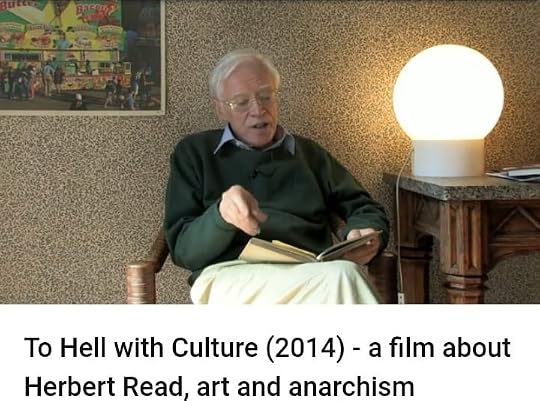
(David Goodway on YouTube)

December 13, 2017
I read this book solely for the discussion on JC Powys contained in Chapters 6 and 8 (and in the Afterword) - which, as the writer notes, is a lot of space to cover a writer considered minor by most. While it was interesting, and I certain appreciated the fondness for JCP's writing (which I obviously share), JCP's individual anarchism is really more libertarian than anarchistic (I wouldn't call JCP politically anarchistic, even later). Given its overtones, I think it's an unfortunate word to bucket JCP with, when he is such an original that he largely defies classification, even "libertarian" isn't quite right, although it's more accurate. Given JCP's incredible fondness for what might be called "The Western Tradition", one might even find him "reactionary" in his thinking in some respects. The political anarchists in "A Glastonbury Romance" are treated rather poorly (so are the communists and the capitalists), that it's difficult to establish any strong political feeling on his end (he met Emma Goldman - so what? - he met Isadore Duncan, who even danced for him, but he was hardly a communist), but he has very strong feelings about personal autonomy, sexual and literary freedom (evidenced in his letters and his testifying in the Ulysses trial in the United States). Regardless - on this particular point he was not an influence on anyone; I find it particularly odd that if JCP's anarchistic thoughts were so important, why no one - to my knowledge - has been influenced by them artistically (although perhaps personally). Also, his popular and possible more influential books like "The Meaning of Culture" are not primarily or even significantly based on this type of "anarchistic" thinking. So this approach - like many others I've seen attempting to "bucket" JCP - really fails (Saturnian, Pater-ite among them). But I thank the author for recognizing the greatness of "Porius", and his excepts from that work support his view, but this is just a tiny piece of an enormous puzzle that no one yet has been able to wrap their head around, as the greatness of JCP at his best is really beyond treatment as a whole, which honestly is one of the problems he has, he doesn't lend himself to comprehensive type of review, so he doesn't readily lend himself to Ph.D topics, and his books are very long. Regardless, I do appreciate, particularly in the discussion of Porius, the focus on the "anarchist" element of JCP, and maybe that's a good word, but in the "excessively open and free" and "personal" sense, and not any other.

May 2, 2024
I went into this book cynically, having read some of the reviews on its tendency to dwell on ideological purity instead of more profound political concerns. However, particularly in the second half, Goodway started reeling off some really interesting ideas, particularly from Alex Comfort and Herbert Read, regarding how exactly one might manoeuvre people into thinking more left-libertarian. That was what I found interesting about this book; not the stuff on Morris (superficial) or the spats between Goldman and Orwell (unengaging) but the moments where it really focuses on the novel ideas we can thank some of these writers for, and what we might do with them.

September 22, 2021
This book is interesting at first, but it eventually got so boring that it is one of the few books I've started without finishing.
Displaying 1 - 5 of 5 reviews