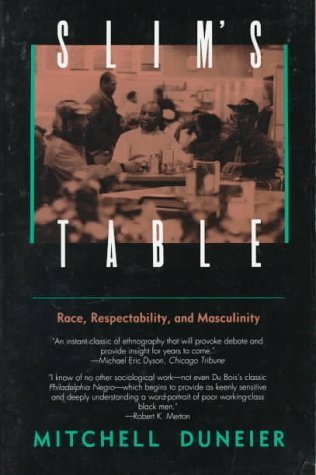
At the Valois "See Your Food" cafeteria on Chicago's South Side, black and white men gather over cups of coffee and steam-table food. Mitchell Duneier, a sociologist, spent four years at the Valois writing this moving profile of the black men who congregate at "Slim's Table." Praised as "a marvelous study of those who should not be forgotten" by the Wall Street Journal, Slim's Table helps demolish the narrow sociological picture of black men and simple media-reinforced stereotypes. In between is a "respectable" citizenry, too often ignored and little understood.
" Slim's Table is an astonishment. Duneier manages to fling open windows of perception into what it means to be working-class black, how a caring community can proceed from the most ordinary transactions, all the while smashing media-induced stereotypes of the races and race relations."—Citation for Chicago Sun Times Chicago Book of the Year Award
"An instant classic of ethnography that will provoke debate and provide insight for years to come."—Michael Eric Dyson, Chicago Tribune
"Mr. Duneier sees the subjects of his study as people and he sees the scale of their lives as fully human, rather than as diminished versions of grander lives lived elsewhere by people of another color. . . . A welcome antidote to trends in both journalism and sociology."—Roger Wilkins, New York Times Book Review
Mitchell Duneier is an American sociologist currently Professor of Sociology at Princeton University and regular Visiting Distinguished Professor of Sociology at the City University of New York, Graduate Center.
I like to think that Mitchell Duneier was a fan of "people watching". Because that's all he did for the first 3/4 of this book lol. There were some good insights into the black culture present in Chicago that I did enjoy, and I liked the real experiences he shared of being in the diner with the other patrons. At first I was confused by the conclusion, but I agree with the author that modern day masculinity is missing something that it once had 50 years ago. Overall solid book, probably wouldn't read again but good knowledge.
Engaging and thorough ethnography examining life in a restaurant in Chicago’s Hyde Park. After eight chapters of work on the subject, the author then turns to analyze how sociologist and ethnographers often misrepresent the black experience due to bias (and what I might call racism). The level of humility of the author’s analysis and work is so refreshing.
Slim's table is a great book for any seeking to gain a better understanding of African American society. The mass media portrays a lot of misconceptions about African Americans and this book is a great look into why those misconceptions and stereotypes are wrong. A very insightfull read.
I thoroughly enjoyed Chapter 9 - the perspective Duneier took just felt so humbled and vulnerable. Also, the message in Chapter 10 about one's innocence and power deteriorating the truth made a lot of sense (in sociology, anthropology, and one's own life). I feel like I will always have that notion on the back-burner moving forward in my life.
What I found particularly interesting (and relevant) in this book was the discussion of a perceived innocence in relation to black people and communities. I was reminded of the section of Coates's We Were Eight Years In Power where he talks about South Shore in Chicago and the big chunks of black America that are simply not visible in mainstream society, and the effects of that omission in the creation of black stereotypes. Definitely a reminder to dig deeper and more critically into what we think we know and understand about other communities.
Dueirer is white, male and a student at the University of Chicago, a school famous for sociological investigation. And there have been a number of studies that center on the local African-American population, neighborhoods adjacent to campus. Duneier takes earlier studies to task citing insufficient evidence and narrow observations that result in sweeping generalizations, stereotypes that are damning and that perpetrate damaging mythologies. Dueirer's work places him with a group of middle aged men, most of modest means. He finds the men moral, responsible, hard working and respectful of each other. Dueirer does not impose his findings on other generations, populations, geographies or classes.
Coming on top of Whyte's Street Corner Society, this idea of urban ethnography continues to disturb me. There is a dis-ingeniousness to the work with such partial revelations as to purpose and a sense of dishonesty in the presumed distance of observation and later note taking. Duerier claims dispassion but uses the term "ghetto" when others would work as well, and that word is certainly presumptive. Dueirer closes with a regret at leaving Slim's table, but no real credit to the participants, no real involvement of the men he says he studied. And 30 years later, I wonder what's left of it all in that place and who sits at Slim's table today.
Slim’s table is an engaging ethnographic studies about respectability and racial innocence through the case study of Valois, a diner in Hyde Park, where men of different races congregate. The first few chapters felt very ethnographic, which felt engaging but also made me wonder what the point of the book was. Things started become clearer when Duneier starts criticizing the sociological approach to the study of black “ghettos” and black masculinity. His point is well taken: under the guise of an innocent ethnographic approach, ethnographers perpetuate a biased representation of black men. Duneier argues for a move beyond claims to racial innocence and towards social scientific truth. This move which I found to be most interesting was only proposed in the last chapter and not thoroughly elaborated on. What exactly is the relationship between innocence and truth? Are they mutually exclusive? Is social scientific truth innocent, or does it need to be?
I don't have many uncles, men or colleagues to "shoot the sh.." with as put in this book. It felt like I was there at Slim's table, in the discussions, the debates, enjoying the scenery of the restaurant so vivid in my mind. I loved the different view points of the patrons. This book was easy to read for the most part but some of the vocabulary was challenging for me. This is a book I own and will definitely re-read in future.
When I moved to Hyde Park a few years after the ethnographic work for this was completed, I discovered a whole world of Black people who never appeared in the Cosby-basketball-drug dealer-welfare queen stereotypes that filled the media. This book is about those people, people who are convenient to ignore. It’s about respectability, about humility. And about the deep costs of maintaining academic/intellectual “ innocence.”
very cool to read about valois and hyde park in the 90s, and no surprise to hear how UChicago has impacted the black residents over the years. I found the stories of the regulars at valois so much more interesting than the sociological analysis - which was fine but nothing too revolutionary and unfortunately a little dated since this was written in the 90s
A good book to read on race. Seem that the author wrote mostly from live observation and interviews. A more positive light that reflected a true image of the black man rather than the same old stereotype that all want to believe. a refreshing type of book on the subject of race, its worth reading.
Fascinating slice of Chicago in a time/place in this ethnography of a restaurant on the border of Black and White Chicago. Goes deeper than basic racial tropes and treats the real people at the restaurant with dignity and respect.
Duneier's Slim's Table has been my introduction to ethnography. So far, I'm finding this compelling, exciting, useful.
This January I'm beginning a DMin program in contextual theology. The syllabus of my first course is full of texts searching out the connection between ethnographic research and ecclesial praxis and thought. From my current vantage point--still eight weeks prior to my first class--I'm enamored with the possibilities of bringing these conversations together.
In picking up Duneier's ST, I'm immediately aware that I'm listening in on a conversation already in progress. The conversations already well parceled out, with a lot of commonplace stories and a lot of debates about the modes, methods, and goals of ethnography. ST also introduces me more specifically into the discourse of urban ethnography. (The closing section of ST marks out Duneier's position in a number of debates about black working class masculinity on the edge of the ghetto.)
Right now, I'm content to listen in. I have a lot to learn, a lot to discover about how and why people in this conversation are doing and saying and not saying what they are.
But I'm excited to learn to listen better and, hopefully, get a better picture of what's going on.
I read it again and started remembering what it’s about. It’s about black people’s lives.
1. Slim met white guy 2. The black guys jail, trouble, ghettos 3.black Americans 4. Experience in Hyde park neighborhood with black peoples 5.”see your food”-restaurant called Valois the owner is Greek 6. Around Greek group btw black peoples 7. Jobs 8. Cultures and community
I really enjoyed this book. Even as dated as it was, I imagine a communal space somewhere, where the old heads hold forth. THe sociological concerns this book raises are multifold, among them the need for media to find the lowest of the low to stamp "black morality" on, instead of people like this; the working poor and the middle class. Lots to think about.
A sociological study on what has happened to role-models for blacks in urban settings. The author uses his associations with a group of black males from a local cafe to break down stereotypes of black inner city males.
This book is great. It's about the neighborhood that I lived in during the year I spent in Chicago. It's really strange to read a book about a place that you know.