Jump to ratings and reviews
Rate this book

Cahokia Jazz

Rate this book
A thrilling tale of murder and mystery in a city where history has run a little differently—from the bestselling author of Golden Hill.

In a city that never was, in an America that never was, on a snowy night at the end of winter, two detectives find a body on the roof of a skyscraper.

It's 1922, and Americans are drinking in speakeasies, dancing to jazz, stepping quickly to the tempo of modern times. Beside the Mississippi, the ancient city of Cahokia lives on—a teeming industrial metropolis, containing every race and creed. Among them, peace holds. Just about. But that body on the roof is about to spark off a week that will spill the city's secrets, and bring it, against a soundtrack of wailing clarinets and gunfire, either to destruction or rebirth.

The multiple-award-winning Francis Spufford returns, with a lovingly created, richly pleasure-giving, epically scaled tale set in the golden age of wicked entertainments.

496 pages, Paperback

First published October 5, 2023

784 people are currently reading
18975 people want to read

About the author

Francis Spufford

22 books762 followers
Officially, I was a writer of non-fiction for the first half of my career, and I certainly enjoyed scraping up against the stubborn, resistant, endlessly interesting surface of the real world. I like awkwardness, things that don't fit, things that put up a struggle against being described. But when I was excited by what I was writing about, what I wanted to do with my excitement was always to tell a story. So every one of my non-fiction books borrowed techniques from the novel, and contained sections where I came close to behaving like a novelist. The chapter retelling the story of Captain Scott's last Antarctic expedition at the end of "I May Be Some Time", for example, or the thirty-page version of the gospel story in "Unapologetic". It wasn't a total surprise that in 2010 I published a book, "Red Plenty", which was a cross between fiction and documentary, or that afterwards I completed my crabwise crawl towards the novel with the honest-to-goodness entirely-made-up "Golden Hill". This was a historical novel about eighteenth century New York written like, well, an actual eighteenth century novel: hyperactive, stuffed with incident, and not very bothered about genre or good taste. It was elaborate, though. It was about exceptional events, and huge amounts of money, and good-looking people talking extravagantly in a special place. Nothing wrong with any of that: I'm an Aaron Sorkin fan and a Joss Whedon fan, keen on dialogue that whooshes around like a firework display. But those were the ingredients of romance, and there were other interesting things to tell stories about, so my next novel "Light Perpetual" in 2021 was deliberately plainer, about the lives that five London children might have had if they hadn't been killed in 1944 by a German rocket. Ordinary lives, in theory; except that there are no ordinary lives, if you look closely enough. It was longlisted for the Booker Prize. Then in 2023 I returned to strong forms of story, and to plotting more like "Golden Hill", with a noir crime novel called "Cahokia Jazz", set in the 1922 of a different timeline, where a metropolis full of Native Americans stood on the banks of the Mississippi. I was aiming for something like a classic black and white movie, except one you never saw, because it came from another history than our own. It won the Sidewise Award for alternate history. And now (2025/6) I've written a historical fantasy, "Nonesuch", set during the London Blitz, where as well as German bombs the protagonist Iris needs to deal with time-travelling fascists, and the remnants of Renaissance magic, preserved in the statues of the burning city. As writers of fantasy, I like C S Lewis, Ursula Le Guin, John Crowley, Tamsyn Muir, Guy Gavriel Kay, Katherine Addison. If you like them, you may like this.

Biography: I was born in 1964, the child of two historians. I'm married to the Dean of an Anglican cathedral in eastern England, I have two daughters, and I teach writing at Goldsmiths College, London.

Ratings & Reviews

What do you think?
Rate this book

Friends & Following

Create a free account to discover what your friends think of this book!

Community Reviews

5 stars
1,501 (32%)
4 stars
1,892 (40%)
3 stars
991 (21%)
2 stars
223 (4%)
1 star
74 (1%)
Displaying 1 - 30 of 849 reviews
Profile Image for Liz.
2,822 reviews3,732 followers
January 1, 2024
3.5 stars, rounded down
“In a city that never was, in an America that never was”. Thus goes the blurb for Cahokia Jazz. This is a world building story about a town where Native Americans own and run this city along the Mississippi River. With their own language, they are a part of America, yet distinct from the normal rules of white supremacy, segregation and the Klan. Not that the whites are happy about that. Otherwise, it’s the same as history; there’s still prohibition and jazz.
It’s 1922 and a body has been found on the roof of the Land Trust. It’s the body of a nervous Takata, white man, in the parlance. A man who has been gutted in some sort of ritualistic sacrifice. A man who’s got a full Klan robe in his apartment closet. Two detectives, one Native American, one white, are investigating the murder.
The book is historical fiction, except it’s sort of not. The reader has to be willing to accept this gray middle ground. In the Author’s Notes, Spufford explains how his Cahokia came to be. Make sure to read it. In fact, Spufford would have done better to have included his rationale on the creation of Cahokia at the beginning of the book.
Spufford takes his time setting the scene, building the town and its citizens. There’s even a kind of “royal” family. I enjoyed letting myself get sucked into the world he created. The cultural themes are much more important than the police procedural plot line.
The main character is a Native American but he’s not from Cahokia. This gives him an outsider’s viewpoint. He’s a well developed MC but the other characters are less so.
I found the pacing of this uneven. I definitely felt it could have been condensed. I’m never sure if it’s just me and my heightened sense of the political, but the book kept me thinking about the current political situation and the Republican “Christian” white supremacy agenda.
My thanks to Netgalley and Faber and Faber for an advance copy of this year.
Profile Image for Daniel Shindler.
319 reviews205 followers
April 19, 2024
“ Cahokia Jazz” is an ambitious novel.Francis Spufford has created an alternative version of American history rooted in a fictional foundational assumption. The society that developed as a result is a mix of race and politics that diverges from the actual course of American history.

Cahokia is a thriving city in 1922 and is the cornerstone of Spufford’s imagined world. Located outside of StLouis, Cahokia actually was the largest Indigenous cultural and population center north of Mexico, flourishing long before Columbus arrived. This vibrant center, along with other Indigenous settlements, was decimated by the viruses that the European interlopers transmitted to the native populations. The central premise of the novel posits that a less virulent strain of virus afflicted the native populations, allowing them to prosper and grow as a viable economic and political presence in North America.

As the story opens, Cahokia is a booming “city state” that is reflective of the vibrating energy of the Jazz Age, when unbridled optimism and excess coursed through a nation changed by a world war.However, Spufford’s map of North America is markedly different than the one in actual history books. Some historical states are non existent and other states are defined by a fictional developmental path.The indigenous people own the land in Cahokia, providing them with the wealth and resources to dominate the city. Aropa, a native language, is spoken in the city and lilts through the air along with English and the strains of Southern black cadence. The Indigenous, white and black residents live side by side in an existence that vacillates between an uneasy truce and tenuous harmony. The KKK is active in the Midwest and competing racial groups cast an avaricious gaze upon the Indigenous wealth. As the novel opens, a dead body is discovered on a rooftop tower. The victim is a white worker who is a member of the Klan. His body has been mutilated and has the earmarks of a ritualistic Aztec style execution. The sensational aspects of the crime threaten to destabilize the uneasy detente in the city.Two detectives are summoned to investigate and quickly find a perpetrator. Their investigation becomes a meditation on race, politics and history.

There is much to absorb in this dense novel. Structurally, the novel is a meld of detective noir and speculative historical fiction. The shifting genres of detective story, city travelogue and political commentary are filtered through the lens of an intricately crafted fictional city.The prose has a gritty edge that mingles with the strains of jazz to reflect the turbulence and energy of Cahokia.

The imagined world building of Cahokia is one of the intriguing aspects of this work. At the same time, the volume of exposition required to explain this world overwhelms the narrative and speculative threads.The central premise prompted me to anticipate a more overtly political novel with possibly different societal outcomes than the actual historical pathways that we know.Yet the society seemed to mirror our current predicaments albeit with one additional power center added to the mix. Possibly the author created this intricate world solely to craft an atmospheric crime novel. I was left admiring the novel as an imaginative effort that did not, for me, realize its potential either as a political commentary or a crime novel.

Despite these shortcomings, I was able to engage in an enjoyable thought provoking experience that left me wishing that the novel had fulfilled more of the promise it held for me at the start of my journey.3.5 stars rounded up to 4.
Profile Image for Peter Boyle.
581 reviews742 followers
October 18, 2023
Francis Spufford's last two novels were both five-star reads for me, so I was more than excited to get my hands on his new one. But I'm afraid to say I didn't get on with it at all.

The action takes place in an alternative version of the US. It's the 1920s, and Cahokia is a booming but violent city, ruled by the takouma population (the Native Americans). A grisly murder sets events in motion and two detectives are assigned to solve the crime. Drummond is corrupt and conniving. Barrow, however, is a decent man: he's an orphaned takouma who can't speak the language. He quickly realises that the homicide he is investigating is only the tip of the iceberg when it comes to evil in this troubled place.

There is a lot of exposition in this novel, way too much for my liking. It's very densely plotted, and at the start I found it hard to keep up with what was going on. The characters were difficult to get a handle on - Barrow is the one we are intended to root for yet I even found him tricky to figure out. I just couldn't engage with the story in any way. I get what Spufford is trying to do: imagine what the US would be like if the indigenous population hadn't been virtually wiped out. It's an intriguing concept, but the plot is nowhere near compelling enough for me to recommend this book.
Profile Image for Anna.
2,115 reviews1,018 followers
January 19, 2024
I love a counterfactual history in which colonialism didn't grind down so much of the world! Upon finding out that Francis Spufford, whose writing I consistently enjoy, had written such a novel I was very excited. And Cahokia Jazz lived up to my high expectations. Although the plot was exciting and I wanted to know what happened, I found myself spacing out my reading in order to stay in the fascinating city of Cahokia for as long as possible. While events in the novel combine murder mystery with mythic archetypes to excellent effect, the whole thing is wonderfully drenched in noir tropes. Very few writers manage to channel Raymond Chandler so well without descending into parody:

Barrow tried to light a cigarette and discovered that he already had one alight in his mouth.
"What the hell is happening out there?" he said.
"Take a breath, son," said Doyle. "Everyone's got people they care about at risk, today."

The protagonist Joe Barrow is a police detective rather than a private dick, investigating a gruesome murder that sparks off Klu Klux Klan rioting in a city where Takouma (native American), Taklousa (black African-American), and Takata (white European-Americans) coexist in relative peace. I loved the atmosphere, world-building, and action. Cahokia really comes to life as Barrow travels around by tram, car, and on foot encountering millionaire industrialists, the Takouma royal family, speakeasy jazz bands, hired goons, journalists, other untrustworthy types, and attractive women who all want to sleep with him. I'll allow that last one as it's a noir tradition and is handled gracefully here. The female characters all have their reasons for liking Barrow (who does indeed come off as appealing) so it isn't just the Protagonist Effect. He fact that he's ambivalent about being a cop and much better at being a jazz pianist helps. The narrative's pacing is also excellent, as the narrative spans a particularly eventful week and each day is given a chapter.

At the beginning of the book there are two maps, always a good sign. The first allows the reader to visualise Barrow's travels through the city and the second to locate Cahokia within North America, so I was delighted with them. I looked up a current map of US states to compare. Nevada, Utah, and Idaho are the mormon 'Republic of Deseret'. Washington is British Oregon. Alaska is Novasibirskaya Territorii. And between Arkansas, Missouri, Illinois, Kentucky, Tenessee, and Mississippi is an additional state, Cahokia. In an afterword, Spufford reveals where Cahokia's history diverged from ours and refers to events after the novel's ending, which added to this alternate history's great charm.

While the world-building was undoubtedly the most pleasurable part of Cahokia Jazz, I was also very impressed with the characterisation and plot. The ending has a gorgeously inevitable symmetry; indeed the novel has a beautifully tidy structure. Barrow isn't the main character at all; the city of Cahokia is. It's a beguiling place that will linger in my mind for a long time. There are very few writers who appear equally adept at writing nonfiction history, historical fiction, and alternative history fiction. Spufford is the only example I can think of and I found Cahokia Jazz an absolute joy to read.
59 reviews4 followers
October 11, 2023
One of my favorite books I’ve read this year, possibly the favorite. I want ten more books set in Cahokia throughout the 20th century because the city is so fascinating. I want an HBO miniseries but I know it wouldn’t do it justice. Absolutely diabolical beautiful ending. Who knew I liked noir! Certainly not me.
Profile Image for Faith.
2,229 reviews678 followers
February 12, 2024
This noir detective story presents an alternate US history in which Native Americans (here called takouma) have equal power with the people of European extraction (takata). Sadly and stereotypically, people of African extraction (taklousa) are mainly janitors or jazz musicians. Honestly, those three similar terms confused me for the first half of the book and I found that needlessly annoying.

This author excels at creating interesting concepts. but I think that he tried to pack in too much in this book. He also sort of misses the mark of race relations in the US. Nevertheless, I do admire the way he always comes up with something new, and the book held my interest.

I received a free copy of this book from the publisher.
Profile Image for Kate O'Shea.
1,325 reviews192 followers
September 28, 2023
Another book that grew on me as it went on. Cahokia Jazz tells the story of Joe Barrow, a cop in the city of Cahokia (which was an Aztec civilisation that died out circa 1400s. The story is set in the 1920s where Joe and his partner, Drummond, are called out to a ritualistic murder on the top of a building.

Everything points to a Takouma (native American) being the perpetrator but as the two investigate it seems that the obvious conclusion may not be entirely correct.

There's a lot in this novel - issues of race, the fact that Cahokia is part of the union states but is run by native Americans leaving a frustrated Klan to try and gain the advantage any way they can. There are some great set pieces - a lockdown before a Klan uprising, a terrifying stand off between the two sides, lots of minor punches to the gut as the two sides clash both trying to get the upper hand and maintain control of a divided city. Remind you of anything?

The novel could have been written about 21st century America, simply substitute different groups but the result is the same.

At its most basic it is a murder mystery with culture wars thrown in. I have to say that the end of the book throws some real curve balls that I did not see coming.

I'd definitely recommend this for fans of historical fiction, anyone who enjoys a murder mystery with a difference or Spufford fans. It's good book and the only bit (and it is a tiny bit) is the sloppy romance stuff (and that's just a personal bugbear).

Thanks to Netgalley and Faber & Faber for the advance review copy.
Profile Image for Algernon.
1,839 reviews1,163 followers
December 7, 2024

‘I submit to you, Joe Barrow, that the reason you keep being in time is that you are in time, this week, in the musical sense. The city is playing a song, and you have a part in it.’

Joe Barrow is a very small cog in the mechanism of a really big city that never was.
Cahokia City is the result of an alternative path in the history of the North American continent, one where Anopa tribes were never conquered by illegal immigrants from Europe and established their own independent state and city in the heart of the American heartland, across the Mississippi river from the tiny village of St. Louis, which was a church, a gas station and a general store, clustered under dripping oak trees.
By the early spring of 1922, Cahokia has already become a member of the union with full rights and a mixed population where a takouma is a person native to the continent, a taklousa is a person a African ancestry and a takata is a person of European descent. The Anopa names might sounds like a needless affectation at the start, but the reader will soon get the hang of the native culture. The rest of the Union followed a path very similar to what we know from ‘real’ history: industrial boom, transcontinental railway, Prohibition, Civil War, World War I and Jazz. There are some deviations though: an independent Mormon state, a state in the South controlled by former slaves, Alaska still under Russian settlement, etc.

This carefully researched cultural landscape would have been probably the most fascinating part of this alternative history novel, if I was not already a big fan of the noir genre and of jazz history and musical expression. These three rich intertwined threads [history, crime, music] produced what will probably crack the top three of my 2024 reads and led to a rise in my enthusiasm for Spufford after only my second novel by him.

‘Sometimes, symbols move solid objects; sometimes they act on flesh and blood. If you don’t pay attention to what things mean, you miss a piece of the puzzle. Without the meaning of things, without the stories people tell about them – that people believe about them – you can’t understand events, Detective. You can’t understand this city.’

Joe Barrow and his partner Drummond are sent to investigate a gruesome murder on the roof of one of the three high rise administrative buildings in Cahokia downtown area. A clerk in the Land Development office has been ritually disembowelled, his still beating heart cut out in a ritual eerily reminiscent of ancient Aztec offerings.
The chief of Police assigns the two detectives to investigate the murder before the city explodes in racial riots, fanned by the yellow press and by the local Ku Klux Klan cell. Barrow and Drummond are comrades who returned together from the Flanders trenches. Barrow, of half-takouma and half-taklousa ancestry, has been convinced by the full takata Drummond to join the police in order to get enough money [from bribes and other perks of the job] for a farm in California. Joe Drummond had given up a promising career as a jazz pianist and composer in order to be with his friend.
The remark about the power of symbols, of rituals and beliefs, is made by the nominal king of the city and Sun-god, leader of the powerful Hashi clan. His sister is goddess of the Moon and his brother the Catholic bishop of the majority takouma population, converted initially by Jesuits coming from Mexico. Once Cahokia joined the union, an important number of European immigrants came to the city, bringing with them not only useful skills and technology but also racism and protestant fundamentalism. The wife of the victim, soon revealed to have been a low rank member of the KKK, explains:

‘We shouldn’t have come here,’ she said. ‘Savages and papists and foreigners and drinkers, and people so mixed up you can’t even tell what they are.’

The story may be written as alternative history, but recent events have amply proven that the lessons of real history have not been learned by our generation:

‘Show me a believer, in pretty much anything, and I’ll show you somebody someplace else who’s making bank. It’s a law of the universe, is what it is.’

The conspiracy is not so hard to guess, not even the main suspect in the murder that set fire to the powder keg of Cahokia politics. The real question is what can one man caught in these turbulent times do, all alone in the city. A couple of side quests, one of a romantic nature and one of artistic expression as Joe falls in love with an unreachable woman and gets invited to play with a visiting band, provide a welcome alternative to the grim revelations of the inquest.

‘What is being attempted here is a repetition of the strategy that worked in Texas and in California, last century, and in Hawaii only twenty or so years ago. Make trouble; demand outside intervention to restore order; when you get it, make sure that the order that is restored conveniently wipes away native power and native property rights. All in line with the great unspoken principle of American history, Detective. Which is, if it’s worth having, the red man shall not be allowed to keep it.’

Somebody is manipulating Cahokia politics for their own interests. It may be a captain of industry, it may be some adept of Manifest Destiny or just a rabid Klan leader, but all the signs point in the direction of a carefully orchestrated murder designed to bring turmoil to the city streets. Joe Barrow, with minimal help and even with some suspicious blocks from his partner Drummond, doggedly follows the leads from the mansions of the powerful Hashi family to the warren-like labyrinth of old takouma slums, from the new streets of German immigrants and gin-runners, to the red district and jazz clubs of the taklousa district.
As we follow him we also learn a lot more about the history of the city, about the Hashi family and about the vibrant, exotic and more than a little dangerous street life of Cahokia ... with a small and feeble glimpse of something else:

‘This will hurt,’ she said. ‘But then, in my opinion, almost everything real does.’
‘That’s a very gloomy philosophy,’ he said, for something to say.
‘True, though, don’t you find? Love hurts. Loss hurts. Failure hurts. Success hurts. Responsibility hurts.’
‘... Music doesn’t hurt.’


>>><<<>>><<<

I’m not sure what else I can reveal without major spoilers. I found this novel much livelier, more gripping that my previous book by Spufford [ Golden Hill ] probably helped along by the noir/hardboiled plot and by the explosive final chapters. Even the prose seems more accessible, less ‘high-brow’ and intricate, probably because I really like to read about the Native American cultural heritage and the way it might survive the onslaught of dominant consumer culture.

Cahokia is not a dying, but a living culture. A living culture lives. Of necessity therefore it changes, grows and adapts as its habitat encourages or even requires those changes. In such circumstances, syncretism is not a defect, is not an impurity. It is an inarguable sign of evolutionary success. Cahokia is not what it was in 1650, in 1750, in 1850? Neither is English-speaking America ...

Are there lessons we can learn from this exercise in alternative history? Yes, but events in late 2024, with elections both in the US and now in Romania, show hatred and suspicion ascendant while common sense, decency and kindness are ignored.

Your best protection from those who would set us at odds with each other is to shake off fear. To lay aside suspicion. To forswear hatred. To recall that we are neighbours, in a metropolis where red and white and black have lived together in trust and confidence for fifty years. Don’t let fear guide your steps this morning, neighbours!’

>>><<<>>><<<

Since I mentioned I am Romanian, I was half proud, half annoyed that Spufford mentions repeatedly the name of Lazar Edeleanu, a Romanian chemist born very very close to my own birthplace [we have an oil industry museum in town]. Spufford changes his ethnicity to German/Jewish/maybe some Romanian blood, because the research that is relevant to the story was commercialized by a company that Edeleanu set up in Germany. He discovered and manufactured phenylisopropylamine , later popularized as benzedrine.

The best half-hidden Easter Egg of the story is spelled out in the Acknowledgements section by the author, for those readers who are not already familiar with the name Kroeber.
Professor of anthropology Alfred Kroeber is one of the characters in the book. He is a real scientist and his research is important to the plot, but his inclusion among all the fictional characters is because his daughter Ursula Kroeber Le Guin, born in 1929, became a great American writer and creator of worlds. This book is dedicated to her memory.
Profile Image for Stefanie.
777 reviews37 followers
April 26, 2024
4.5 stars. This is an alt-historical political noir about an Indigenous America that never was, written by a white British dude. I am not sure I should have liked it as much as I did, but there it is. It's a completely wild mix of genres, and I know opinions are mixed on this, but I think Spufford mostly pulled it off.

I picked this up because of my lowkey obsession with Cahokia, a large-scale Indigenous society that flourished in what's now the St. Louis area from 1100-1300. As opposed to societies like the Incas and Mexica/Aztecs, we know precious little. But we know this society was a pretty big deal, and influences lots of tribes that carry on to our times. This book assumes (as noted in the afterword, and I don't think it's a spoiler) that a less deadly version of smallpox came over with the first European explorers. Thus, Indigenous societies were not decimated. Thus, Cahokia was re-peopled and successfully avoided being conquered by encroaching American settlers, and at the time this book is set in the early 1920s, had been one of the states of the U.S. since the end of the Civil War.

Racial politics are a huge part of Cahokia, and this story. The protagonist, Joe Barrow, is a mix of Indigenous / Black heritage but always assumed to be Indigenous in Cahokia. He's a jazz pianist whose day job is as a detective in Cahokia PD, and the main thrust of the story is his investigation of a conspicuous murder of a white guy. His (white) partner, Phineas Drummond, is a war buddy, but also - as we meet him - maybe not a very nice guy. Even though Barrow is not fully committed to police work, he wants to do right by this case, especially since he's been tagged by the Cahokia "royalty" to find out what's going on as well. As he investigates, he starts to wonder what various groups in the city are hiding, and maybe even his partner...

So yes, there are very cool alt-historical details, a mystery, even a little romance...but at its heart this book is a noir. The protagonist is slowly discovering how everyone and everything (almost) is a little rotten at its core. He has to make a choice about whether or not he wants to be part of any of it, and of course once he does, the question also arises: does he even have a choice about being part of it?

I'm a sucker for romance and while I think it's well done here, the best relationship is between Barrow and his partner Drummond. Whenever these two are on the page together, the whole thing just seems to come together and sing.

I enjoyed my time in this alternate America that Spufford envisioned. I did spare a thought to what Indigenous readers might think of this story. But not being able to speak to that I can just say: this book gave me a lot to think and feel about, and I think it's one of those ones that's going to stay with me.
Profile Image for Nancy.
1,904 reviews474 followers
December 10, 2023
Francis Spufford’s imagination astounds!

I first had read his I May Be Some Time: Ice and the English Imagination, which I savoured for its gorgeous writing and its insight. Then, he wrote the novel On Golden Hill in the style of 18th c novels by Henry Fielding and his sister Sarah. Then he astounded with Perpetual Light, imagining the lives children would have lived had they not been killed in a horrible accident.

Now, he has given us an alternate history/noir novel with Cahokia Jazz.

Spufford imagines a New World visited first by a less deadly smallpox virus, leaving the indigenous population immunized. With a healthy Native American presence they were able to establish their own state in the middle of the continent where native, black, and white are equal. The Jesuits converted the Native Americans by overlaying Christian ideas on the native myths. The land is not privately owned, with limited time leases for its use. And, there are the figureheads of a king and his princess sister.

The white immigrants from the North come for jobs but bring their racial prejudices, and the Klan is a strong organization.

The novel begins with the horrific murder of a white man, found with his heart torn out in imitation of ancient Aztec ritual killings. The whites flee the state, and those who remain are ready to riot against the Native American government.

Detective Barrow, a Native American who grew up in an orphanage, is on the case. Identified as Thrown-Away Boy, a hero in native legend, he is given access to the royal palace, and encountering the beautiful princess, falls in love.

It is a novel rich in detail and character, a great mystery, if not a fast reading page-turner, with interesting red herrings and twists. Its immensely entertaining in the way a murder mystery or alternative history can be, but also reflects our contemporary world’s ills. (One character suggests that the Klan army marching to attack the seat of government were really Jesuits out to stir up trouble!) Plus there is a love story! And scenes in a jazz lounge, with Barrow pounding out Jelly Roll Morton’s “Kansas City Stomp”. And a spunky secretary who staples the hand of a man who goosed her one time too many.

Then, there is the great noir style writing. “His voice was a Boston Brahmin Drawl, with vowels as aristocratically deformed as if an ottoman has been dragged on top of them.” “Muscle work was a stupid thing for a pianist to get involved in.” “Their money was so old that it underlay the United States like geology.”

My faith in Spufford reinforced, I will read anything the man writes.

Thanks to the publisher for a free book.
Profile Image for Paula.
957 reviews224 followers
December 18, 2023
As another reviewer pointed out,I understand what Spufford was trying to do,but it doesn't work. At all.
Profile Image for Anuraag.
12 reviews
March 24, 2024
I don’t know if it was just me or what, but I had a really difficult time following this novel and it just seemed to never end.
Profile Image for Charles.
616 reviews118 followers
November 16, 2024
Alternate History/Hardboiled Detective crossover. A Native American police detective and jazz pianist in a 1920’s United States, where the Cahokia polity survives to exist Texas-like as a Native American majority state within the Union. A bizarre murder threatens the political stability of the Cahokian state within the States.

description
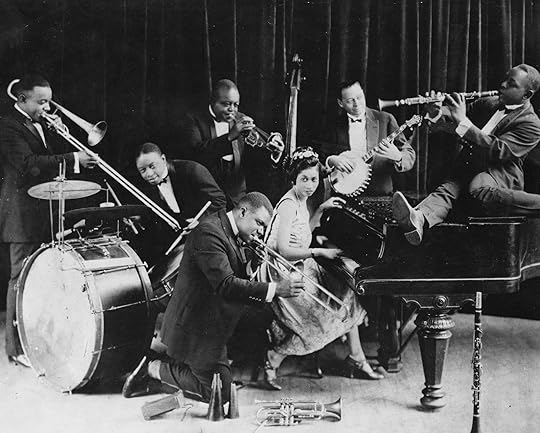
1920’s Cahokian Jazz Band

My audiobook version was almost 16 hours in listening length. A dead tree version would be 464 pages. The book had a 2023 UK copyright.

Francis Spufford is an English author of non-fiction and fiction. He has written nine books, most recently books of fiction. This was the first book I’ve read by the author.

The book was narrated by Andy Ingalls. He did a fine job, with his broad range of voices both male and female. In particular, he did well with the different ethnicities of both sexes within the period.

It’s helpful to have some knowledge of the 1920’s America and a passing familiarity with 18th Century and earlier Native American cultures.

TL;DR Synopsis

Joe Barrow a biracial Black, Native American police detective, accomplished jazz pianist and WWI veteran was new to Cahokia. Cahokia was the capitol of the once sovereign, majority, Native American state of Cahokia now a state within the United States. Barrow and his hillbilly partner Phineas Drummond investigate an Aztec ritualistic murder which polarizes the Cahokian Native American and minority white populations, and destabilizes the state’s government. It’s the alt-Roaring 20’s, with: Prohibition, corruption, racism, political conspiracy, betrayal, and impossible love.

The Review

I’m a fan of science fiction, which can include Alt Histories. I like Hardboiled Detective stories, and the history of the World Between the Wars, which was the early 20th Century. I’ve also got a weaker interest in Fusion jazz, which has given me some exposure to Early jazz. So, the author had struck a chord of my interests.

In addition, I had read Cahokia: Ancient America's Great City on the Mississippi several years ago, and liked it. Some of the work of the author’s world building was already done with me.

The book contains two maps of alt-North America and a lengthy Afterward describing the world building. Neither of these were in my audiobook. I had to hunt-down a text version for them.

Despite having Ear-read this book, I could tell it was well written. Although, a portion of this was likely the fine work of Ingalls, the narrator? I also note that Ear-reading a story with a good narrator can hide a multitude of sins.

The action sequences felt a bit abbreviated. Like with most hardboiled there were a lot of them. There were no car chases, but there was a cavalry charge.

Descriptive prose was good. The story contains a large amount of exposition. If you’re not geeking-out on the world building, you’ll be a troubled reader. I liked the dialog. Although a lot of it was expository too. I also found Barrow was more erudite than expected given his background? There was also not a lot of period vernacular in the story. That period was renown for its slang: gat, lousy, and schnoz being a few examples. Although, maybe it was the Native American speak, in the story, that crowded it out? In addition, I would have expected there would be more profanity, given the numerous Mean Streets traversed? As it was, the most profane dialog was all spoken in German.

Unlike many Alt-histories and all trad Hardboiled stories Spufford used flashbacks. Most of them were back to Cahokian history, a couple were to Barrows' youth. They were technically well done. However, their effectiveness in elaborating on a plot point was suspect.

There was only a single POV—Barrow’s. He was the protagonist: a mountain of a man, a combat veteran, thoughtful, honorable, and a noted jazz pianist. I thought him being both a police detective and a pianist was a bit of a reach. One got him beat-up, and the other the ladies. However, Barrow was meant to be an ambiguous character. He was ambiguous in both race and vocation. That he wasn’t able to speak the Native American language (Anopa) was a gag that was played too long. Barrow’s hillbilly partner was a trad Buddy Cop with an Odd Couple twist relationship. He was a combat veteran too, albeit with almost crippling PTSD. He played all the angles of every opportunity.

There was also The Sun and The Moon. They were the two main, governing Cahokian Native American political figures. They were also the city's two highest spiritual leaders. The Man of the Sun was the: wealthy Harvard-educated, Boston Brahmin accented, hereditary, Cahokian king. The Moon was his niece (a princess), who cut a somewhat Chessmaster (like her Uncle)/Socialite figure. Barrow was in orbit around The Moon in a gender bent, subverted, Cinderella Plot .

Characters were the now-standard arch-types for the hard-boiled genre. There were the: tough cops (Native American and Anglo), the rich criminal(s), mob bosses with assorted gunsels, a sly riff on the obligatory femme fatale, shady journos, the decoy 'bad girl' (dressed as a journo), Madam’s with a heart of gold, club owners, the ‘good girl’ (Native American), etc.. However, their character development was not too deep. Still, a fan of hardboiled would recognize them straight out of Hammett and Chandler’s work. Interestingly, there were no lawyers and proper physicians, bent or otherwise.

The story was only six, action packed, days long. (Barrow didn’t get much sleep.) There were two converging plot-lines. It starts with a grisly Aztec-style, ritualistic murder of a rando. Spufford attempts to distract the reader through a liberal use of red herrings and obstacle reveals. The introduction of: immigrant bootleggers, domestic terrorism, a resurgent Ku Klux Klan, police corruption and shady newspapermen being paid to manipulate the news cycle being the obstacles. There’s also a forbidden love story as the B-plot.

There was: “Sex, drugs, and rock’n roll jazz music” in the story. It was not the best developed aspect of the world building. Sex was all consensual and heteronormative. It was tastefully and non-graphically handled. There was no mention of not easily curable with period medical technology Venereal Disease (VD) (to use the period proper term) or the love whose name cannot be spoken. Substance abuse happened. Prohibition was in-force, but strong drink was plentiful. ‘Natural’ and crude synthetic narcotics were also in-use. The early jazz scene, included historically correct titles, and the lore was well done.

The body count was modest. Violence was: physical, edged weapons, impact weapons, small arms and automatic weapons. It was moderately graphic, as were the woundings. Barrow as very resilient. It six days, he took a pounding that, would have deterred most mortals. However, this was in-line with the genre. Hardboiled detectives are not like mortal men.

Alt-history is world building.

You read Alt-history for the details of the what-if, be it the: survival of the Roman Empire into modern times, the South wins the American Civil War, or John F. Kennedy doesn’t go to Dallas as you do the story’s main plot.

Spufford’s world building was good, but not amazingly good.

IRL, Cahokia, was a Native American city outside of where St. Louis is today. It was the the largest indigenous city north of Mexico before Christopher Columbus, way before the Anglos decimated the native population with: small pox, measles, mumps and scarlet fever. That never happened in the story. Cahokia manages to stay sovereign, until the American Civil War. It then cuts a deal with the North and enters the Union as an ethnic Native American state, similarly to how Texas earlier entered the Union.

The author's Cahokian blending of meso-American and Catholic religions was inventive.

I thought the author did a fine job of adapting a real Indigenous culture into the book. That’s something I hadn’t read before.

Then history gets back on track taking the story into the 1920’s. Cahokia was left: complex, racially-mixed, politically vaguely monarchical and spiritually pagan/Catholic. That is, unlike the rest of the United States. This difference was the origin of the book’s racism theme.

Spufford’s 1920’s was well-imagined too. It reminded me of that period’s Chicago, without Al Capone and with Cahokian British-style Royals having a priest-like responsibility and a Machiavellian bent.

Summary

I started this book with great expectations of a well-written alt-history/ 1920’s hard boiled novel. It was better than I expected.

Spufford takes two pulp genres, and imposes a story with sophisticated themes upon them.

To like this book, you’ve got to suspend belief and embrace the historical-riff. Alt-history-wise this book was as good as Michael Chabon’s, The Yiddish Policemen's Union (my review) and Robert Harris’s, Fatherland . The author's use of hardboiled reminded me of of Nick Harkaway's (another Brit author) riff on the genre in Titanium Noir (my review).Not coincidentally, all of those were alt/history, detective mystery cross-overs.

Hardboiled-wise, it was a good stab at the 1920’s flavor of that genre. It wasn’t as authentic as Dashiell Hammett's The Maltese Falcon or as gritty as the modern Volker Kutscher’s Babylon Berlin , but it was good enough.

The story also leans heavily on modern themes like racism and identity. Race-issues typically didn’t raise their white hooded head in the white-audienced hardboiled of the real 20’s. The tough guys of hard boiled likewise know who they are. Although, these can be occasionally found in alt-histories.

Spufford wrote a more intellectual pulp novel. It crosses over an alt-history with hardboiled and infuses it with the themes of racism, and identity. This story was amongst the most: well-written, somewhat gritty, science fiction, historical fiction detective novels I’ve read in the last year or two. When I finished it, I wished I had Eye-read vs. Ear-read, so I could go back over some of the prose.
Profile Image for Janice.
1,602 reviews62 followers
July 24, 2024
I have been several times to the Cahokia Mounds State Historic Site in western Illinois, have climbed the largest mound's many steps and roamed it's top, as well as among the many smaller mounds across the landscape. These mounds are what is left of a what was once a major cultural and trade center that was occupied by a Native-American people for only about 300 years, having been vacated around 1300-1400 c.e. It is hard not to imagine, while gazing around this once busy land, what it was like in that time. And with where it is located, just across the Mississippi River from modern day St. Louis, it crossed my mind to speculate what it would have been like had it survived the severe climate change that probably led to it being abandoned.
In this novel, which crosses several genres including historical fiction, mystery, and alternative history, Francis Spufford takes the past world of Cahokia and weaves a story set in a thriving major center of Cahokia in 1922. The central character is a man who is both Native American and African American, but not from Cahokia, and who is a police detective on the Cahokia force. He is also a jazz musician who plays piano with jazz bands when he has a chance. This detective, Joe Barrow, and his partner begin investigating the murder of a man whose body they found on the roof of a building in central Cahokia
The author explains the culture of the twentieth century Cahokia by explaining about the three major ethnic groups who make up the population. The largest group are the Natives, called takouma; the whites, called takata, and blacks, called taklousa, are also large groups in this huge metropolis. And during this murder investigation Barrow and his partner, who is takata, learn that the Klu Klux Klan is a huge and threatening group that figures in the cities current interactions, bringing violence and menace into the daily lives of all citizens.
There are constant changes in who the investigation seems to be focused on, and there is also some romance, as Joe Barrow becomes acquainted with the takouma leaders of the city.
For me this was an intriguing read, to see where the author might take this story of a city with it's roots deep in an ancient North American culture, with many elements of that ancient past still thriving. And I greatly enjoyed the creativity that such an undertaking required.
Profile Image for Dan Trefethen.
1,203 reviews76 followers
December 14, 2023
A police procedural set in an alternate world where history diverged from ours. Is it Len Deighton's ''SS-GB'? No, because it features a white cop partnered with a Native cop in a Native place. Is it Michael Chabon's “The Yiddish Policemen's Union”?

No, it's “Cahokia Jazz” by Francis Spufford.

I'm making this book sound derivative of the others, and it's not. For the first fifty pages or so, I thought it might be. Then it blossomed out into something completely different than the others, with a different purpose (and without the technical Maguffin at the end of the previous two stories.)

Had the North American tribes avoided the scourge of disease that decimated them, could they have retained a measure of sovereignty far beyond what they ended up with? Perhaps. That's the basis of this book, but it questions whether the white populace can ever accept a prosperous and stable community of non-white people. We saw a similar question in Colson Whitehead's “The Underground Railroad”, and a somewhat similar answer.

Our protagonist, Joe Barrow, is Native but an orphan from elsewhere so he's not a part of the Cahokia Native community, despite looking like them. He's a cop but a reticent one, taking his cues from his white partner until things turn pear-shaped. Then it becomes a question of who can he trust, and who is on his side. He doesn't always make the right conclusion.

The alternate world that Spufford envisions is an intriguing one, with a heavily Catholic Native community that still retains its indigenous beliefs and cultural practices. They're a part of the Union but not entirely. It's a little as if a Native tribe had a state that was one of the United States, with its own state law, but also ruled by a monarchy as well. An uneasy balance that is threatening to topple.

Some alternate history stories are mainly about the world-building with a thin veneer of plot to justify walking through the world. Others merely hint at the revised world without revealing too much difference. “Cahokia Jazz” is nice blending of the two, with memorable characters (especially Joe Barrow) and a well-thought-out worldview.

And for anyone who knows East St. Louis, they can gaze on the mounds of Cahokia and wonder about what might have been.
Profile Image for Rob.
181 reviews27 followers
April 28, 2024
This started slow than picked up steam. I'm so glad I read it - it was much more than just a murder mystery.

On a snowy night at the end of winter, Barrow and his partner find a body on the roof of a skyscraper. Down below, Americans drink in speakeasies and dance to the tempo of modern times. But this is 1920's Cahokia, the ancient indigenous city beside the Mississippi, filled with people of every race and creed. And it holds secrets and some pretty dangerous characters along the way.

I especially like how the Author weaves the search for the killer/killers of the brutal murder of the corpse found on the roof with that of the history and traditions of the booming city of Cahokia. It worked for me.
Profile Image for Carol Storm.
Author 28 books235 followers
May 10, 2025
This book was brilliantly researched and fairly well written, but for entirely personal reasons I found it a disappointment. All my life I've been fascinated by the vanished Mound Builders and their lost civilization. I was hoping that this book would really show the Native Americans building their own world and having it carry right through to modern times. I wanted to see brave Indian warriors and millions of buffalo and thrilling combat and a happy ending.

What I got instead was a rather genteel fantasy of privilege and piety triumphing over truth and justice. This book is sincere and heartfelt, but often unconvincing and occasionally tedious. This is a detective novel set in the Twenties, a slower, more pious, infinitely less vital version of The Maltese Falcon. The catch is that it's set in "Cahokia," a modern city near St. Louis, built by the tribes who created the mounds and earthworks that were long abandoned by colonial times.

Joe Barrow is a real Mary Sue. He's supposed to be a giant of a man, over six feet, with the muscles of Hercules and a heart of gold. Also he's a red hot jazz piano player. And women adore him. Joe looks like an Indian, but has no idea who his parents are. He comes to Cahokia to get a job in the police department, because Cahokia is one of the few cities where non-whites can have a real future.

The book starts to go down the toilet as soon as Joe's love interest is introduced. The Princess of the Moon is supposed to be local Indian royalty, with religious overtones. She's sort of like the Virgin Mary. You see, this whole book is based on a rather disappointing bait and switch. The Mound Builder civilization only survived because the good old Catholic Church came along just in time to give the natives a "true" religion. The book is full of happy Indian crowds praying to the Virgin, kindly priests blessing the masks and rattles of the shaman, etc. etc. etc. It's great stuff unless you happen to know anything about the real history of the Catholic Church in America . . . or in Europe, for that matter.

But that's just the point. Francis Spufford is a true gentleman, (see his note below) but for reasons of his own he's inclined to present the Church of Rome in the most flattering light possible. There are no pedophile priests in this book, no boarding schools where Indian boys and girls are tortured, starved, raped and murdered. Instead we are offered rather patronizing tributes to nice Indians who do whatever the priests tell them to. And in return, the priests and bishops help the not-so-nice Indian princess hold on to power, through lies, corruption, and yes, murder. It stinks. The whole thing stinks. And that would be quite delightful, if the tough detective exposed the corruption and brought them all down at the end. That's generally the desired outcome in his particular genre.

But our big dumb hero can't get enough. Now I wouldn't mind Clueless Joe selling his soul to the Moon Princess if she were playful, funny, and genuinely captivating, like Daisy Buchanan. Or girlish, impulsive, and genuinely sexy, like Scarlett O'Hara. Or even genuinely cunning, like Sam Spade's girlfriend (the one who shot Miles.) Alas, Princess Couma Hashi is none of these things! She's not Mary Astor in the Maltese Falcon, she's Zita Johann in The Mummy. She's a lifeless mannequin, and a crashing bore. She keeps playing the victim, walking around glassy-eyed, like she expects Boris Karloff to carry her back to the tomb for some red-hot sex with a decaying corpse. And that's what this whole book felt like, really. Necrophilia. A well-meaning English gentleman with the highest principles making love to an ancient corpse. Only it's the rotting corpse of Catholicism, all covered up with native masks and feathers and beads.
Profile Image for Oleksandr Zholud.
1,542 reviews155 followers
July 2, 2025
This in an alt-history detective noir, set in the 1920s in the USA, where strong presence of Native Americans persisted to the 20th century, so, where in our reality, St. Louis stands on the left-hand bank of the Mississippi, in this timeline there is a city called Cahokia on the right-hand one instead. I’ve never read the author before, and two things urged me to read this novel: first, Rich Horton, one of the most prominent SFF shorter works anthologists of today, mentioned it in his blog as his 2025 Hugo nominee. Secondly, I recently finished Native Nations: A Millennium in North America, a ground-breaking non-fic about ‘Indians’ and wanted to see whether the author used this new research in his work.

The story starts, as mysteries often do, with a murdered body. This time, a body of a white man, with his throat cut and his chest spread open to remove his heart, is found on the roof of one of the high buildings, which is suspiciously similar to Aztec sacrifices atop their pyramids. Two policemen are on the beat: the protagonist of our story, Joe Barrow, is a large guy of a mixed ancestry, part takouma (Native American), part taklousa (Black). While formally he is ‘an injun’ (“I am not an ‘Indian,’ ” he said. “That is a name for a navigation error.”), he was raised in an orphanage in Nebraska and doesn’t know local language or traditions, which story-wise gives a way to info-dump. His partner is a white man named Phineas Drummond, who dreams of leaving for California and has nightmares from his days on the European front – they both are WW1 veterans (the war seems to continue, but it is outside our story).

So, there is a possible sacrifice, and local KKK together with a catholic bishop and local press start an active campaign “whites should fear for their lives in this savage remnant of monarchy in our glorious republic”. It looks like they are backed by old money, one Vanderbilt Vanderberg, for the current land ownership doesn’t suit the robber barons’ gilded age (“All the land in Cahokia—the whole state, I mean, not just the city—is owned by the tamaha.” […] “The people! All of the takouma together. Well, literally the word means ‘town,’ but the tamaha is the human beings not the buildings. If you see what I mean. It’s clearer in Anopa. Anyway, we don’t have private ownership here. Instead, people who need to use the land take out leases, for a certain number of years; ninety-nine years, for example, usually, for a city plot, although it can vary. Some very valuable ones only go out for ten years at a time. And the lease will say, you can do such-and-such things with this land, and you are entitled to such-and-such a share of water and, nowadays anyway, to such-and-such a share of electricity. Land, Water and Power, you see; that’s why we’re next door to each other.”).

So, there is a growing unrest, and the murder should be solved ASAP. Meanwhile, more and more layers are uncovered, from informal local monarchy to Natives, who try to reconstruct lost traditions borrowing from Aztecs; a German brewer as a leader of the local mob; a femme fatale…

Overall, an interesting story, well-written (even if it could have been shortened like by 40% if only whodunit was the point). While it indirectly pursues some lines, which can be linked to the non-fic I’ve mentioned above, the author stays on the old views, e.g., assuming the dying out of natives from invasive diseases, so that post-Columbus America is a white man's history coming to a recently emptied land. In this novel, it is assumed that much less virulent smallpox was introduced, so locals received immunity and did not die out. However, new research shows that while the death toll was severe, the land was far from empty, similar to post Black Plague Europe.
Profile Image for Tom Ewing.
710 reviews80 followers
October 7, 2024
Extremely, elegantly readable alternative history set in the Jazz Age of a world where America’s indigenous peoples weren’t depopulated by imported diseases, and now exist in uneasy polity with the later waves of European settlers, particularly in the great multicultural city of Cahokia. A gruesome murder has the potential to upend its fragile political order, and it’s a race against time by detectives Joe Barrow (laconic, mixed heritage, gifted jazzman) and Phin Drummond (cynical, white, haunted) to find out what’s going on.

To say more would spoil the book’s entertaining noir plot, with Spufford relishing the chance to write his way through a bunch of crime tropes, which he does with an enjoyable lack of subversion - the setting being enough of a deviation from the norm.

I guess it’s worth speculating though on why a middle aged, white British guy wrote an alternative history about race in an imagined America, as it’s not the kind of thing you can easily pull off. At the heart of Cahokia Jazz is the sense that a compromised multicultural equilibrium is both the best this imaginary city can hope for and very fragile - as one character says, the forces that want different outcomes only have to be lucky once. That rings uncomfortably true in an American democracy whose elections feel - to numbed liberal British onlookers like Spufford - like games of Russian Roulette. Alternative history gives permission to think about these things in ways that might feel like outsider overreach in a straightforward contemporary novel.
Profile Image for Lindsay.
815 reviews10 followers
Read
May 12, 2024
On the one hand, this is a technically proficient noir novel sent in an interesting alternative history. The pace and prose are strong, as is the theme of jazz and rhythm in the city of Cahokia. I read it quickly and with interest. As a book, divorced of context, it works. But the context is so powerful that I feel like ignoring it is ignoring what is making people want to read the book - an alternative history with a flourishing Native society in the American state of Cahokia in 1922. With a racially ambiguous protagonist, written by a white Brit.

People can write what they want, obviously. And on a surface level, and a little bit deeper, it is written to read "correctly" to the modern non-racist reader. Which maybe is its own problem? But that's where I wanted the nuance to be, and I don't think Spufford was really equipped to do that. Would the Klan have evolved in the same way with a large and powerful Native state smack in the middle (and Dinetah further west, and some mentions of Mississippi sounding like it stuck with the policies of Reconstruction?) Would the racist capitalist tycoons act the same way? Cahokia is shown as an (imperfect) island of tolerance that the outside dominant society wants to control. And that society is something I recognize from modern racial discourse in this timeline. Is this a feature or a bug?

The noir form began to creak a little under all that was asked of it, as it also tried to be a story of a man finding himself. I had to force myself through the last 20 pages after the book felt like it had concluded, as our man went out and was heroic for the third? fourth? time. I am not a connoisseur of noir, but my feeling is that the protagonist does not generally end up in many situations where he one-handedly saves the day. It's more that he gets tossed around by cirucumstance, slowly figuring things out. But the format seemed to require this maudlin, ambiguous ending, which the character work in the novel itself had veered away from as Barrow began to get his act together.

My hypothesis is that it's difficult to update noir. William Gibson did it in ways that I enjoyed, maybe because it was so wildly re-cast into science fiction. But it is to my mind a very gendered genre that makes it difficult for a modern writer to pull off with cred intact. Spufford tries - the sexual harasser gets his come-uppance, and there is one female character who makes it to two dimensions. But the "madly in 'love' with the unobtainable woman" thing doesn't work when society is evolving not to think that obsessively pining after a good-looking lady is a good basis for a romantic relationship. Noir is supposed to be a stylized, world-weary realism. "This is how life/society *really* works." And those are the parts of the book that seemed least real.

Barrow's internal life, his growing into himself, felt most real - and most at odds with the noir setup. He didn't really have a strong identity, doesn't speak Cahokian, though people assume he does when they look at him. This ties in to some of the larger themes of the novel, but seems at odds with noir - whatever else those dudes know, they have a strong sense of who they are (even if they aren't much).

So yeah, I'm not going to rate this. Like I said, it's technically proficient. The world-building is cool. I was rooting for Barrow. The prose was lovely. The mystery plays the noir beats smoothly. But the parts that I enjoyed felt like they were fighting the noir, and I just wanted it to be a more nuanced novel about life in Cahokia.

This isn't the author's fault. Neither is my gut feeling that writing about race in 1920's America should be written by someone with, forgive me, some skin in the game. It's not that he does a BAD job, or makes all the Native people into saints, or all the white people into devils. It's just that a lot of it seems to be lifted from modern white liberal understanding of racial discourse. It takes a bit of hubris to think that one can take understanding of this discourse and from an ocean and century away, speak for those characters. And I kept feeling that hubris overlaying the narrative context and changing my experience of the novel, to be one with sub-optimal levels of dubiousness. YMMV.

p.s. I did enjoy the hat-tip to Ursula K. LeGuin and the cameo of her father in the book, Dr. Kroeber.
Profile Image for Mark Brown.
216 reviews2 followers
February 8, 2024
Not really a fan of the alt.history genre, and this mixture of 1920's detective noir and the impact of a supposedly surviving pre-Columbian Native American culture on St.Louis seems a bit cobbled together. (The real Cahokia mounds are archaeological relics that are all that left of a civilisation that actually died out in the fourteenth century).

The jazz bit is tacked on - because one of the characters happens to be a detective and a piano player as well?

So it's not really a book about jazz, and racism is dealt with only superficially as well. Because of the layering of his society between different indigenous and non- indigenous people has to be repeatedly spelt out ,we have to be given a lot of information that gets in the way of the characters - so when the book handles an episode with the Ku Klux Klan (or what it had become in this world), it lacks power.

It's a shame that Spufford 's elegant and poetic writing style gets suffocated by the plot and its devices, so you end up reading it just "to see what happens" : I should have given up on this earlier.
Profile Image for Hannah.
65 reviews315 followers
Read
April 5, 2025
the great thing about Francis Spufford is whether he’s pulling it off or he isn’t, you have to take him seriously… I think he’s pulling it off here, aside from some nitpicks (I have been to the real Cahokia and was looking forward to getting a geographical sense of place here, but the emphasis is much more on the invented urban geography, more secondary-world, which is obviously fine but not the strongest choice you could have made in a story that’s in a big way about land! I think it’s a good choice to keep us basically urban with only a couple of jaunts out to more agricultural locales, but I could’ve used more of just your workaday stuff like saying “hickories” instead of “trees” once or twice or mentioning the birdsong sounds like pe-wee, mentioning the flatness of the place, the color of the grasses, all of which is available in an urban setting. Cahokia has wonderful fields of tall grass, btw. only place in my life where I have ever frolicked. great frolicking country)

the thing that’s bothering me, not in a bad way but in a way I’m not sure I agree with, is the ending. I think Spufford does a fantastic job here of playing with the noir hero, his outsider status, his ultimate absence of allegiance, and I think that falls away with the ending of this book—very deliberately, it is the whole point of his character arc, no craft quibbles here, I just don’t know whether I agree with it! this is a good problem to have. I think Spufford raises in-text, but then dances around a little bit, the question of, like—is this monarchy morally acceptable? not because of the things the individual monarchs do, which are explored pretty neatly in a standard “does the good of the many” dilemma, but because it is a monarchy, which is not a justifiable form of government. (again, I’m not just bringing this up because it’s my own politics, I think this is raised in the text.)

this is an old old debate—about the complex political justifiability of colonized monarchs of colonized kingdoms, I mean, not the imperial monarchs of empires, who are obviously more ethically cut and dry—and I think in the person of Barrow we nearly thread the needle of making the royal family a sort of Terry Lennox figure, the site of all the love and hope and corruption and despair that our hero can hold in his heart, the living avatar of The World As It Is which can’t be escaped but also can’t be borne, that which the hero can’t stomach and can’t stop loving, and can’t stomach or bear because there is that part of him which is built to love it and is fit for nothing else.

and then , and I am disappointed by it, I guess. I think it’s good heroism, and I think at the end of the day it is good politics, and I don’t think Spufford fails at any juncture to make the argument that —they are!—but I don’t think it’s good noir. it’s interesting to me that Spufford brings up Omelas in his afterword, because I think Omelas and noir have a lot to say to one another. the ones who walk away from Omelas are—in a very un-LeGuin-like turn—driven to a place where the only courage they can find is an individualistic courage rather than a collective one. (this is part of why it’s such a problem play for people.) whereas Barrow’s courage is ultimately collective, and I think that within the framework and standards of the genre, that ultimately deprives the story of a little transcendence.

lots of types of stories have a lot of room for good, transcendent collective heroism—war stories and their descendants, the parts of high fantasy and space opera and quests that they influence; and not coincidentally, these stories can often be unambiguously pro-monarchy in a way that doesn’t bother me—but noir, even against a backdrop of war, is never a war story, and it doesn’t hold with kings. in noir as in the real world, the difference between a king and a slumlord is publicity.

but I don’t think that should necessarily make the story unsatisfying for other people. it makes it unsatisfying for me, because that’s what I love about the genre, but I think it’s a deliberate and informed choice, and you always do have to take Spufford seriously. (that said there’s another whole essay here about women and the noir female victim-villain prison in this book, which I don’t know that I was that impressed by, but this margin is too small to contain)
Profile Image for Paul Dembina.
694 reviews163 followers
June 8, 2024
A murder mystery set in an alternate history version of 1920s America. In this alternate timeline the native American peoples weren't decimated by smallpox and have survived into the early 20th century largely in control of their own state called Cahokia.

Spufford has taken a spin on this and conjured up quite a unique scenario where native American beliefs and languages are woven into the everyday life of the population which is an uneasy mixture of white European, African-American and native American living cheek by jowl.

I won't go into much of the plot details to avoid spoilers, but just to say a very prominent murder is investigated by a cop leading to much intrigue.
Profile Image for Elaine.
963 reviews487 followers
August 22, 2024
4.5 I just loved this book. A wonderful imagining of a United States whose native population was not exterminated but thrived into the 20th Century as an independent culture, modernizing as all cultures do, but maintaining a political and cultural state in the middle of these United States (and elsewhere - but the book takes place where St. Louis otherwise would have been). A fully realized alternative history and a thoroughly satisfying hardboiled detective story. Great characters and fantastic scene setting. Spufford is just so creative - and so thorough - you get lost in this very compelling, and tantalizingly heartbreaking because it didn't happen, other world. I'd happily read a sequel, though I suspect Spufford will go on to something else.
Profile Image for Kip Kyburz.
338 reviews
December 20, 2024
If Spufford were ever to want to return to a setting, this is a prime candidate. Cahokia is a beautifully imagined alt-history, crafting a breathtaking and deeply entrancing locale that melds several dimensions of the American mythos into one gleaming city. I appreciated the plot and really don’t care much about whether or not the mystery is good, bad, or predictable; it’s all secondary to world and main character created.
933 reviews11 followers
June 30, 2024
A swing-era noir tale set in a Native American metropolis, "Cahokia Jazz" seems perfectly scored for my interests, but the novel couldn't hit the high notes.

It does offer a fascinating setting. In our world, the great Midwest metropolis Cahokia peaked about 1,000 years ago. In author Francis Spufford's telling, it remains a power to be reckoned with today.

Cahokia is ostensibly an American state, but history has gone a bit different here, and Native peoples and belief systems still dominate the city's political structure. Their home offers a multiracial melting pot, but there are dirty interests trying to stir up trouble and undermine Cahokian power.

That's evident right from the start, when a body is found atop one of the city's skyscrapers in what looks to be a MesoAmerican-style sacrifice. Two detectives, partners, are called in to investigate. One is an all-American wise guy, on the take and looking out for number one. The other, a bruiser and our lead, Joe Barrow, has native background but no cultural attachments, having grown up in an orphanage.

From there, the story gets complicated, Chinatown-style, as different factions complicate the investigation and reveal unpleasant truths about the dirty-politicking that keeps Cahokia running. Because of his heritage, Barrow is pulled into the Native power structure, prompting him to discover more about who he is.

It's engaging, and there are plenty of twists and turns, but Spufford ends up demanding too much from his lead in a way that feels implausible. Burrow is a bruiser, but he's also an excellent jazz pianist and a pretty smart guy, once he starts thinking for himself. A World War I vet, he's Sergeant York when it comes to dodging machine-gun fire; everyone seems to trust him and like him and want to help him. (It goes without saying he's dynamite in the sack too.)

It's a lot, especially since Barrow flips from amoral goon to warrior of the people in about three days' time. It's too much to work, even if "Cahokia Jazz" offers a strong setting and engaging ideas on the speculative fiction front.
Profile Image for Jess Manners.
635 reviews8 followers
April 7, 2024
This might be a...perfect noir? (or, hard-boiled detective novel? I talk to my students a lot about how the two genres are distinct in important ways, and here I go, blurring them immediately)
I find I often get frustrated by the genre--the plots are too convoluted (for me?), and don't always hold together as much as I want them to (looking at you, Chandler). But this! It's complicated, and I'm sure I missed a lot of ins and outs, but it feels like it all holds together, and there are tons of twists, but the narrative thrust doesn't rely on them too much, so whether they're surprising or not doesn't...really matter.
He's hitting all the crucial beats: an imperfect man holding onto his moral code for all its worth, a femme fatale who is a damsel in distress but is actually a femme fatale but is maybe also a damsel in distress...conspiracies and manipulation and powerful people and petty people and people who are both of those things...it both goes All the Way to the Top and feels personal and small. The world is impossibly dark, and the small sparks of light are constantly in danger of being extinguished, and everything forces a compromise, and even though it all feels incredibly depressing, it also...doesn't.
And then of course there's the whole alternate universe (I'm so painfully ignorant about my own country's history that, until I read the blurb, I was willing to accept that this was just a place in the...southwest? South? West? that I didn't know anything about, rather than something that was almost entirely invented)
And on top of all that, the first of the book's climaxes (I think there are...three? four?) feels very much like The Marrow of Tradition...the sort of inexorable march away from progress lead by the aforementioned powerful, petty men...

None of this is coherent, but I loved this.
Profile Image for Alex Sarll.
7,054 reviews365 followers
Read
August 12, 2023
The story of a long week 101 years ago in an America that never quite was, and more specifically of Joe Barrow, a man torn between two heritages, and also two callings - as the story opens he's dabbling as both a policeman and a pianist. It's hard to say too much about this one without spoiling the expert pace at which Spufford unrolls his tapestry; even if I note my early misgivings about how Cahokia thinks of itself not aligning with what we know of the real Cahokia, and then say that of course that turns out to be deliberate, a point about how living cities don't always remember their past as it happened, but that beyond a certain point it doesn't entirely matter, well, I've already given away a little more than I feel comfortable about. The notion of one of North America's great pre-Columbian cities surviving a little longer than it did here, still standing strong when the settlers arrived, and how that might affect the perpetually vexed question of race in the USA, is a fascinating one - although this being the 2020s, I confess to some trepidation as to how a novel on that theme by a white Brit will be received, regardless of the clear message that if anyone tries to foment racial strife, you should probably begin by asking what they're selling. In taking place in a divergent 20th century America, being framed as a detective story, but having no SF elements beyond the alternate world, The Yiddish Policemen's Union is an obvious point of comparison; I also got echoes of James Ellroy, though with more light in the darkness, or maybe just a greater readiness to forgive humanity's failings. There's perhaps a dash of Earthly Powers too, and at least one nod to The Leopard; exalted company, to be sure, but Cahokia Jazz can hold its head high among them.

(Netgalley ARC)
Profile Image for Clare.
532 reviews8 followers
February 25, 2024
Absolutely loved this - I love Francis Spufford’s fiction writing, Golden Hill was great and The Light Perpetual fully deserved its Booker longlisting so when I saw he had this one out I was super excited to read it. Even more so when it combined two of my favourite things - alternate histories and crime fiction! I suggested it for book group, which was a risk as we did Golden Hill and it was not universally loved, to put it mildly. However, I am still glad I did because although this wasn’t universally loved (or even liked) either, we had some great discussion around the world building, all the plot points and the characters of the detectives and others we are introduced to. I would absolutely read something else set in Cahokia in this timeline, I just found it so vivid and evocative, I couldn’t wait to spend time there as I was reading it. And I felt a real connection with the lead character - Joe Barrow. Highly highly recommended.
Displaying 1 - 30 of 849 reviews

Can't find what you're looking for?

Get help and learn more about the design.