Thurava of Astrava is intended to become a herder, a most honored position for her dwindling community that clings to life on the banks of the Najimov, the river that’s the lifeblood of the high desert. But the Glass City on the horizon threatens the delicate balance the Astravans have managed to hold on to for centuries, polluting the air and water as the city grows bigger and bigger. The Glass City’s clockwork liaisons offer to bring the Astravans into the Glass City’s walls, but they will have to give up their ways and their precious herds to do so. Thurava must decide who she is without her animals, using the stars as her guide, putting herself on a collision course with the secrets the Glass City holds dear.
Lauren C. Teffeau was born and raised on the East Coast, educated in the South, employed in the Midwest, and now lives and dreams in the high desert of New Mexico. When she was younger, she poked around in the back of wardrobes, tried to walk through mirrors, and always kept an eye out for secret passages, fairy rings, and messages from aliens. She was disappointed. Now, she writes to cope with her ordinary existence. Her environmental fantasy novella A Hunger with No Name will be published by University of Tampa Press in the fall of 2024. Her novel Implanted (2018, Angry Robot), mashing up cyberpunk, solarpunk, adventure, and romance, was shortlisted for the 2019 Compton Crook award for best first SF/F/H novel and named a definitive work of climate fiction by Grist. She's published over twenty short stories in a variety of speculative fiction magazines and anthologies. In addition to a bachelor’s degree in English, she also holds a master’s degree in Mass Communication and spent a few years toiling as a researcher in academia. To learn more, please visit http://laurencteffeau.com.
This is a beautiful Sci-fi folklore inspired story. I have a weakness for kickass heroines that don’t go around always kicking ass, but that move through their worlds with their wits as their most powerful weapon. Thurava, daughter of Sitarva of the Astravans is one of those heroines.
Yes, she is heroic but not in the violent way many stories associate with being a hero, but in a more reflective and quiet way, which is not less powerful than blasting laser left and right—btw there are no lasers in this story.
I also really liked that the story focuses on a friendship instead of a romantic relationship. These days, romance—wonderful as it is—permeates about every published book, but this story gives platonic relationships, like friendships, a privileged place, which feels refreshing. After all, we all need friends. Good friends. Friends that will show us a wider sense of reality. I think that was a big plus of this story.
That the chapters are named as the constellations in Thurava’s home world is a delightful detail. That the story follows the lesson taught by the stories behind those constellations is just very clever. That it all works together to give this book a sense of timeless and the weight of a reality that may actually exist, well, that’s just good writing.
This book presents a refreshing take on storytelling, and conflict within a story, where defeating and vanquishing is not the ultimate goal, but rebuilding and understanding are.
A bit slow in places, but as a whole very readable, A Hunger With no Name surprised me in the best possible way.
3.5 stars. There are some shortcuts in storytelling, but I can see why this cli-fi novella got published. It's a potent mix of elements of climate migration, with (yet another) exploration of the place of AI, plus a strong allegory to what happened to indigenous peoples forced into "modern" societies.
In this story, we're following the young Thurava, who's part of a pastoral people who rely on a herd animal called lucerva. She's meant to eventually be a lead herder, a position of power, except that water is running out, the lucerva are dying, and slowly people from her group (the Astravans) are trickling away to the "Glass City," tempted by an easier life.
Thurava eventually goes to the Glass City itself and finds that it's not the wonderful place it's advertised to be (when is it ever?), especially for her people. She's given a piece of machinery called a "reckoner" that helps her navigate and understand the city - but when she starts asking questions about who's really in power and why the Astravans have suffered, she has to make a choice about whether and how she'll fight to make things different. (Side note, loved the repeated reckoner response to Thurava's more incisive questions: "That is a difficult question to answer quickly." What a great dodge for AI, ha!)
As mentioned above, this novella manages to pack a lot of "hot topic" issues into it. As such, there's some weakness in storytelling. To begin to address this, I would have cut some of the beginning time with Thurava out in the desert and expanded her time in the Glass City, for example. I also take issue a bit with the end, which opts for a classic dramatic-type conclusion often seen in YA dystopias. Not that there's anything wrong with that! Except given the complexity of the issues, I would have liked to see a more nuanced response from Thurava. I did like that the novella ends on a bit of an unresolved note at least.
I randomly found this while browsing my library's "new books" shelf - I'm always on the lookout for novellas, and the understated cover piqued my interest. I was also drawn in by the fact that the author lives in the "high desert of New Mexico," a locale that holds a special place in my heart. The setting of this story is clearly inspired by it, as well as the ability of the characters to always focus on orientation by stars.
Honestly, it deserves a wider readership. The ideas it presents are interesting and worthy of discussion, even if the storytelling itself isn't as tight as I'd like. I'd read more from this author.
This is one of those quiet and contemplative novellas, that are light on the action but still have a big impact.
A Hunger with No Name is based on a young woman called Thurava who belongs to a community of star-worshipping nomads known as Astravans, who following the Great Scatter that fractured the world have lived off of the land. Thurava is determined to assume her mother’s mantle as chief herder of the community’s livestock however, the promises of a better life in the Glass City beckon and with each year more and more Astravans are lured towards the metropolis that is slowly depleting the natural resources in its vicinity for the upkeep of its ever growing population.
There is this dystopian-esque aura to the setting and Teffau’s storytelling really immerses you in. The presence of these eerie mechanical liaisons and all the speculative folklore linked to the stars in the night sky means the story has this nice sci-fi and fantasy blend to it. Though it is also a story that is grounded in reality as the underlying messages and parallels to our world are stark, particularly with regards to anthropogenic activities and the effects they have on the environment, heritage and culture.
With Thurava being an adolescent there is also a coming of age slant to the narrative but she immediately comes across as much more mature than other protagonists her age. Often denoted as “the star” of her people, we follow her as she strives to find a balance between what is right by her own principles and what is best for society. Despite the short length her character arc is really compelling.
What was also really beautiful was how each chapter was named for a star/constellation that is fundamental to the Astravan people’s beliefs and how they each linked to Thurava’s journey throughout the story.
Though the pacing is on the slower side this is a quick read and one that will definitely make you stop and think. I highly recommend checking this out if you enjoy spec fic and are looking for a shorter read! Final Rating 4.5/5 Stars
A Hunger with No Name by Lauren C. Teffeau is a brilliantly written novella filled with critical themes and one that pleasantly surprised me.
The world itself was my favourite part. The way that this setting is described is amazing and I was captured by the way that Teffeau describes the world, the skies and everything else. You can really feel how these people adore the world they live in. The Astravan's worship this world and Teffeau has an encapsulating gift that holds us to these descriptions.
This helps tie to the themes present. Thurava, the main character, finds herself in the Glass City - a completely different place than the desert we are introduced to and full of technology. Here, the plot unfolds. Teffeau has us questioning existence, be it natural or otherwise. They also have us debating consumption and extinction, and if these go hand-in-hand.
This is a descriptive novel and one that rewards us emotionally and logically. Lauren C. Teffeau has created an important novel that is wonderfully written and I urge you to give this a read.
Long after climate-caused collapse, some lead a rough nomadic life that sustains them until the distant tech-based, highly segmented (by class) city drains the region of water. The author demonstrates what it means to stand for environmental and social justice. How do you hold to your values, your stories, your lineage when survival is imperiled? A great story!
A Hunger With No Name by Lauren C. Teffeau is another interesting read in the finals of this 2025 SFINCS competition. A bit different in tone and structure for this entry, compared to others that have made it this far…but worthy of the journey it has taken to get here. 👏
We follow Thurava, a young female raised in her tribe by her family and community. Living off the desert and following the history and religion of the stars and their people's existence, Teffeau manages to (quite elegantly) teach us readers the lore and hard lessons many have experienced and navigated in our world's past. This is the often told tale of a simple, hard and earned living of those born to, as well as respecting the land and what it can provide…along with the entry of technology, modern growth and how it can impact an entire region and its way of existence. It's an often tough read filled with sacrifice, sorrow, toil and disappointment…but with layers of hope, endurance, love and resilience that is what keeps us as readers, and the characters in these stories moving forward and striving to make their way through the paths laid before them. 💪
A slow burn, lesson filled journey is what awaits you in the pages of this short desert trek from Teffeau. This is the “bit different in tone” that I mentioned earlier, and what was my only slight issue with this experience. Not in any way bad…I said this was an elegant telling and I wasn't kidding, it just doesn't have much of that heart pumping, tension filled action that the majority of this comp has. Maybe that is what makes this stand out amongst the rest, and placed it in the finals…I applaud Lauren and this Novella, for she really has a beautiful way to tell a hard story. Not only that, but wonderful world building creates the landscape and its hurdles…it's quite impressive to experience the growth of this creation. 🍻
3.5 ⭐ is what this gaze into the night sky left me. A Hunger With No Name is a beautiful telling of a people's toil…but I think the slower pace left me with just too much of a “Hunger” to place it higher…just didn't quite “fill” my reading appetite. Again, not a bad read and it may be just what you're looking for. Recommend…absolutely! And if this isn't quite the review you'd expect after your experience…just remember that it's highly dependent on the reader's taste at the time, and as the stars will tell you…
“There are always complications along the way. Take them in stride, succeed despite them, yes. But never forget that sometimes the answer to a problem might lie in the opposite direction.”
A beautiful example of the brilliance Teffeau has in-store for you in this read…this reader might have been looking in one direction for a faster paced experience, but perhaps I need to also look in the opposite direction more often. Well done Lauren, I hope many find your works and appreciate their beauty! 📚
7/10 stars I read this book as a finalist in the SFINCS3 competition. My opinions are my own and do not necessarily reflect those of my team members.
A Hunger With No Name was a familiar story. A story of the manipulation of a tribe of herdsmen, the Astravans, by the Glass City of Miravat. Miravat is an Oz-like shiny city filled with technological advancements, greedily gobbling up desert-dwellers by offering them a better life and then using them as resources to help power its basic needs.
The main character, Thurava, is an intelligent sixteen-year-old herder of lucerva. These are desert-dwelling, goat-like creatures whose skins clothe the Astravans and who help keep them fed. Thurava is filled with curiosity about her world and its history and remembers the lore of her village, as taught by her mother and the village elders, intent on preserving their heritage.
When environmental challenges to their lifestyle force the Astravans to pack up and move to the Glass City, her curiosity and hunger for knowledge of what lies behind the curtain is awakened. The regime she discovers horrifies her, and so a righteous rebel is born.
“We all have a choice, Thurava. To give up, to destroy, or to go on the best we can.”
To Thurava, the choice is simple.
I found the first third of the novella too slow-paced for my taste and would probably have DNFd if this had not been a competition finalist. I am so glad I persevered, as the story became much more compelling once the tribe reached the Glass City, and by the end, I was thoroughly enjoying it.
The final acts of the story took me by surprise. I did not believe that this main character, who had lived her life caring for other creatures, putting up with hardship to keep them alive, was capable of such destruction and disregard for human life. I think there was a lack of emotional description in places earlier in the story that would have prepared me more for this.
The final sentences were chilling. Can everyone be corrupted by power, eventually?
A Hunger with No Name by Lauren C. Teffeau was quite the statement piece. Though its pacing was too slow for me for much of the story, it did allow us to get to know the MC a lot. The world building was pretty interesting, but I would’ve loved to learn more about the Glass City. I enjoyed the more serious themes of this story and how it got darker at the end, leaving us with a pretty unsettling feeling at the finish.
“Despite all the questions I’ve cast into the sky, the stars have never answered me directly. As the settlement gathers together—the night unfolding around us—surely that must change. But as the most high leads the inquiry, they shine down like they always do: silent, watchful, and well out of reach.”
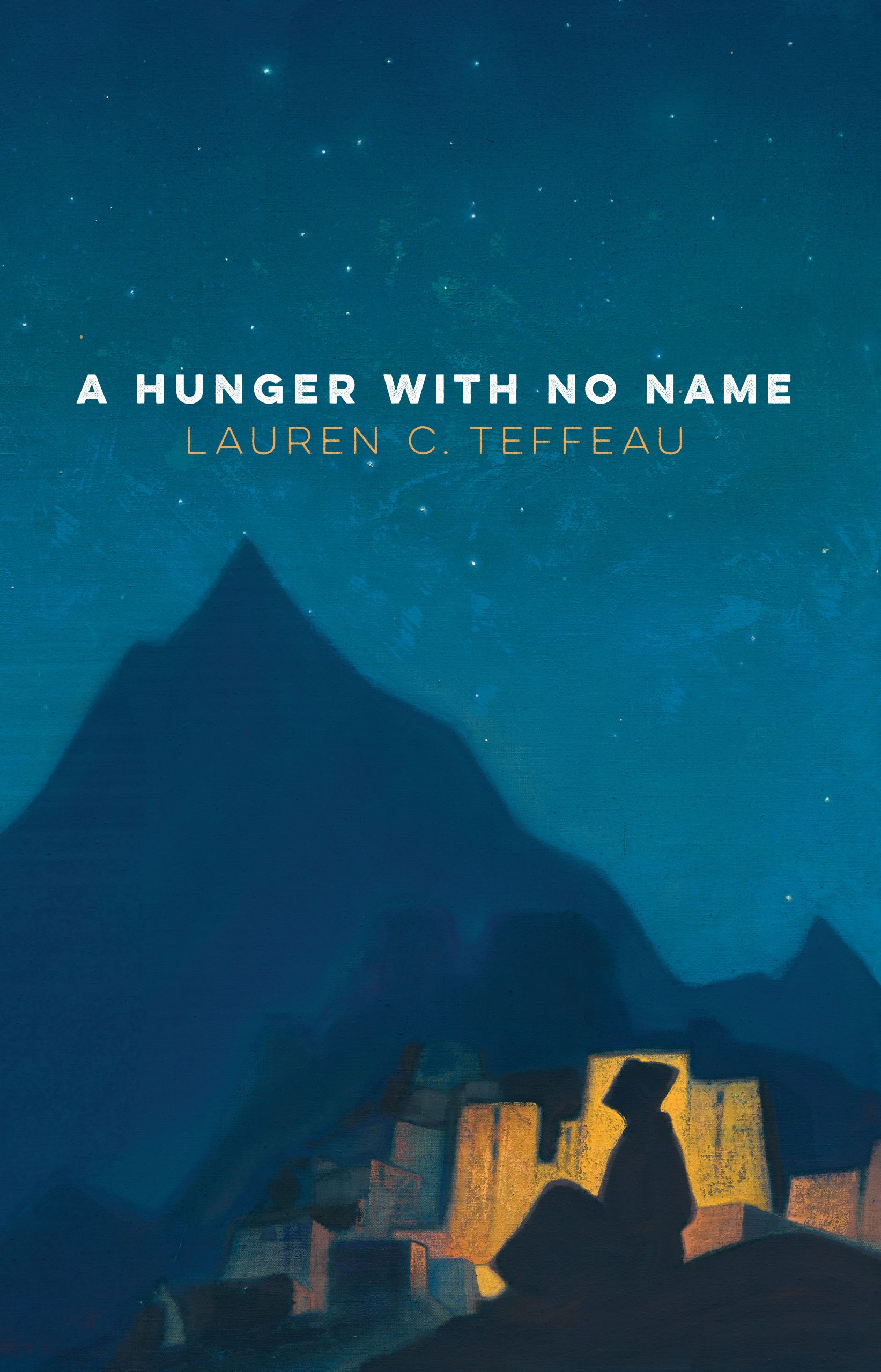
Lauren C. Teffeau’s A Hunger With No Name drew my attention right away with its gorgeous cover and intriguing title. A post-apocalyptic Young Adult sci-fi, it’s also within the realm of the kind of work I’ve often looked at as part of my academic career. With its environmentalist and anti-AI themes, it feels sadly topical in the present moment, but offers hope rather than doom-and-gloom–a call to action rather than a death knell. Although it should certainly appeal to fans of dystopian and post-apocalyptic in general, I would recommend it in particular to fans of Nikky Lee’s SFINCS2 finalist, Once We Flew.
Thurava is a herder in the rugged desert scrubland that remains in the wake of a long-ago environmental catastrophe. Her people, the Astravans, live a semi-nomadic life, while other local groups subsist according to their own cultural and resource-based norms. One of these other groups–the people of the Glass City–live in a community very similar to our own, with more futuristic versions of many of the technologies we use today. When the life-giving river that supports the Astravan way of life begins to dry up, the trickle of Astravans toward the Glass City becomes a hemorrhage, and Thurava is practically forced by her mother to abandon their way of life and establish a new home (and a way to better herself) in the Glass City. Only Thurava’s mother and her mother’s lover remain behind to tend the bovine lucerva the Astravans depend on. The Glass City is immediately suspicious, even before Thurava makes the trek there herself. Mechanical beings have been visiting Astrava for years, enticing Astravans with the promise of a life of ease and greater social mobility. Thurava’s own best friend, Kikriva, followed just this promise, only to fail to keep in touch with Thurava as she’d promised. So, when Thurava does arrive in the Glass City, we’re primed to distrust it. That distrust is soon validated when it becomes clear that all humans in the city are subject to a rigid class system, with immigrants like Thurava and Kikriva at the very bottom. Not only that, but the Astravans must relinquish any personal belongings fashioned from lucerva hide–a symbol of the rejection of the natural in favour of the synthetic, as well as the fact that Astravans must give up their last material connections to their culture in order to assimilate. The potential career paths open to Astravans are severely limited compared with those of humans native to the Glass City, and indiscretions against the City’s polite culture are monitored and punished by mechanical beings. The city itself is managed by an AI that communicates with and controls the population through mechanical bodies known as “liasons.” Ever curious and driven, Thurava takes it upon herself to investigate the liasons and their AI, soon discovering that many of the City’s peculiar and cruel laws are in service not to the human occupants, but to the AI itself.
Thematically and in terms of its plot, Hunger manages to successfully juggle a number of critiques: that of our relationship to environment, our reliance on (or subservience to) various technologies, and the colonial mindset that undergirds much of Western culture. As a young adult protagonist, Thurava’s very firm sense of right and wrong plays well both with these thematics and in terms of the real-world context of the novella’s readers. Although Thurava’s indomitable spirit is bolstered by her people’s traditions, Hunger is ultimately a story about the power of the individual to enact change, with Thurava acting largely unaided throughout the majority of the narrative. This is not uncommon to works in the age category, which often emphasize individuation and differentiation from one’s family, friends, or culture. Nonetheless, Thurava’s goals are easy to root for, since they’re in support of a greater good. Reading the work in 2025, there’s a catharsis to watching powerful villains face a challenge to their authority.
Teffeau’s prose is at turns very beautiful, with a clear sense of when to hold back in order to make key passages shine. Although there were some grammatically and stylistically questionable sentence choices in the opening, the work smooths out very quickly and becomes very easy to read. If I were to critique the writing at all, it would be to say that sometimes the text can bit slightly dense. This is less a matter of the prose itself, however, and moreso an issue of knowing where to place narrative focus. Although the incredibly detailed world and culture of the Astrava is commendable and clearly demonstrates a thoughtfulness on Teffeau’s part, it can occasionally be quite dry. The POV is fairly distant, which is not in and of itself an issue (and Thurava’s personality comes through very strongly), but does mean that sections in which the focus is on Astravan culture lack the level of emotionality that would otherwise elevate them and justify their inclusion. That said, I do very much appreciate the texture of the world–I could feel the dusty landscape as I was reading, and Astrava presents a stark and beautiful contrast to mirrored world of the Glass City.
As noted, Thurava’s characterization is strong. While I wasn’t always certain that I liked her (she can come off as a little unforgiving and unempathetic), the portrait of a young woman up against the odds and with a self-righteous anger fueling her actions was powerfully drawn. One gets the sense, due to Teffeau’s impressive character work, that Thurava is someone who, even outside the context of her struggles against the liasons, would be just as driven by a need to attach herself to cause. The longing she feels for home, along with her deep connection to the landscape and to her culture, feel realistic and relatable. Hunger‘s supporting cast is less developed and detailed. We do get to spend a decent amount of time with Thurava’s mother, as well as one of her rivals, but their characterization is largely limited to the ways in which they relate to Thurava herself (that is, their function in Thurava’s life and within the narrative). I don’t think this is necessarily a problem, since it further emphasizes Thurava’s own need for differentiation, and feels appropriate for the age category of the novella. Hunger perhaps falters a little in terms of Thurava’s characterization at the very end, where a key decision doesn’t quite feel consistent with what we’ve seen of her so far. The choice is thematically rich, tying a neat bow and sending a clear message, but I feel it could have used slightly more build-up and layering in order for it to feel true to Thurava herself.
Hunger is clearly a well-thought-out story, and Teffeau’s talent really shines, yet I did have issues with its pacing and structure. While the latter half of the novella easily gripped me, almost a full half of the book is devoted to Thurava’s life in Astrava prior to her travels to the Glass City. Some inclusion of Astravan culture and Thurava’s everyday life feels important to establishing an emotional anchor for her (and in the reader), but in some ways I think a tighter opening would have been more effective, and more emotionally impactful. This might not be the case were Hunger a novel rather than a novella, but in a shorter story it felt like the focus was a little uneven. Although there were some lovely worldbuilding details and poetic turns of phrase in the first half of the novella, I did find my attention wandering in the lead up to Thurava’s investigations. I love a strong supporting cast, and am typically in favour of exploring the interpersonal dynamics of the main character, but because none of the cast here feel fully realized outside of their utility to Thurava’s story, I’m not sure that we need as much time with them in the opening.
I was thoroughly impressed with Teffeau’s writing in this one, and her talents shine particularly bright in the latter half of the novella, where an almost thriller-like pace takes over. There, the suspicions Teffeau has seeded in the reader really bear fruit, as we await the revelations of the Glass City’s secrets with as much eagerness as Thurava herself. I was impressed by Thurava’s characterization–in particular, how Teffeau was able to make me root for a character and support her cause while simultaneously disliking her a little. To me, that’s exceptionally strong character work.
I certainly recommend A Hunger With No Name, which was a smooth read that engages with many urgent themes and questions. Aside with comparing it to Once We Flew, I’d further compare it with many of the works I gestured to in that review, including the Horizon videogames and the work of R. B. Lemberg.
A beautifully crafted coming of age story with environment v technology theme.
Highly recommend this short novella to any young person feeling stuck in the Serpent's Fork (of balancing Nature and Technology in their lives) . . . And to the older people who care about them.
"A Hunger with No Name" is an impeccably written literary science fiction novella with environmental and anthropological themes. To me it evoked the themes of Ursula Le Guin, with the setting and tone of Clarke’s "City and the Stars" and the quaint video game "Sable."
The story is written in present tense, first-person POV through the eyes of the young Thurava, a member of the nomadic, star-worshipping Astravan people who live off the land in a vast desert. While I didn’t find Thurava to be an urgently compelling character, she served as a perfect vessel to experience my favorite part of this book: the world.
For me, the desert and the stars were characters in themselves. I was taken away by the setting, picturing something akin to the starlit crystal-clear summer skies of the red and rocky American southwest. The desert and stars are characterized not by adjectives or descriptions, but by the Astravan’s and Thurava’s reverence. These people love their home, its animals, the dwindling Najimov river that gives them life. Teffau clearly possesses an adept understanding of culture and history, because she wrote Astravan legends, beliefs, and behaviors in such a compelling way that the Astravans are probably my favorite human culture in any science fiction book.
It's good that I was so attached to the environment and the Astravan people, because therein lies the novella’s main theme: the conservation of natural and cultural resources. As the plot unfolds and Thurava finds herself drawn to the technologically advanced “Glass City” of Miravat, the themes become clear. With the Glass City diverting the Najimov river to benefit the consumptive needs and creature comforts of its own population, I am reminded again of the American Southwest—particularly, the dwindling Colorado River on which the entire Southwest depends, and may soon find itself without.
I'd like to praise Teffau's handling of these themes. She writes in a way that is not pretentious, respecting the reader by simply describing the situation and allowing the reader to come to conclusions on human consumption at its most rudimentary levels.
These are the questions I asked myself while reading: Is it human nature to develop and manipulate nature until we overconsume a resource until it is no more? Is it natural and inevitable for cultures to die out, to move on, to integrate into the consumers and colonizers until their beliefs and traditions become memory? As one character states during the story, “Who needs the stars when you want for nothing?” and “Holding onto the past will only bring you pain."
This begs the most important question of all: What, if anything, can be done to prevent the extinction of culture and natural resources? The author offers a possible answer to this question in the book’s climax. I really appreciated this ending—that the author was not only willing to put this resolution on paper, but that she was willing to acknowledge it as the dirty and morally grey ending that it is.
"A Hunger with no Name" is never action-driven; it has almost no physical conflict aside from a couple of spats with a carnivorous reptilian fauna and some near-misses with the denizens of Miravat. This is a read for spec-fic enthusiasts interested not in space battles or monsters, but in contemplative, often-soothing, sometimes-hard-to-swallow meditations on conservation. If a beautifully written literary adventure appeals to you, however, then I *highly* suggest you join Thurava’s journey under the stars.
I read this novella for the indie novella competition, SFINCS. The following review is my own personal opinion as a judge and does not reflect the views of the team as a whole.
A Hunger with No Name by Lauren C. Teffeau is a contemplative post-apocalyptic eco-sci-fi about a group of pastoral desert-people, the Astravans, trying to keep their way of life and traditions alive in a world that’s becoming more and more hostile, while a nearby, more technologically advanced city, Miravat, tempts them with better living conditions and more safety and at the same time, threatens with losing their identity. The main character, Thurava, the daughter of the community’s herder, although a strong proponent for staying independent, ends up having to go to the Glass City of Miravat and has to figure out whether it is at all possible for her people to hold onto their identities, and if yes, how, and if no, what the solution can be.
I loved the exploration of this culture clash, the many dangers and strangeness immigrants face in a new environment, and the devastating effects of assimilation, while Thurava even figures out (as it often is) what insidious secrets hide behind Miravat’s prosperity. The story is a smart, quiet thought-experiment of these things that actually do happen in our world already, and I especially loved how it doesn’t give a good or solid answer (“That is a difficult question to answer quickly” as the AI in the story keeps repeating) and even Thurava ends up being flawed, making flawed decisions at the end, just trying to do the best she can. This novella will stay with me for a long time.
Disclaimer: This novella has been read as part of the SFINCS3. This review/rating only represents my personal opinion and it might differ with what the team decides.
The pacing of is tight and deliberately escalating, built to mirror the intensifying nature of the protagonist’s hunger. At the start, the pacing is relatively controlled and grounded. By the end, the pacing tightens around the protagonist’s final decisions and transformation. The writing in is sharp, visceral, and highly controlled—it knows exactly what kind of story it wants to tell and commits to it stylistically. At its strongest, the prose is sensory and immediate. Overall, the quality is high for the kind of story it’s telling. A Hunger with No Name by Lauren C. Teffeau is a haunting, thought-provoking novella that blends stark worldbuilding with a powerful meditation on survival and environmental consequence, and I’m grateful for the opportunity to read and review it.
I read a copy of this book as a judge for the SFINCS (Speculative Fiction Indie Novella Championship). This review is a reflection of my opinion and not directly of the book's performance in the competition.
Oh, this book is wonderful. It's rich in its prose and worldbuilding, packs so much depth and life into its characters. It poses questions and grapples with its answers and feels really rather pertinent for the current moment. It revels in youth and age, adaptation and curiosity and culture.
It's just very good!! It rarely surprised me, but did exactly what it set out to do with a lot of skill. It errs on the side of a lot of moral messaging but sees what it's saying with a lot of clarity. I love climate SFF, it must be said, and this is a stellar climate fiction novella.
I enjoyed the juxtaposition of these two cultures. This really felt like a true fantasy/science fiction cross over. It dealt with real life issues of loss of cultural identity as people move into big urban centers and the struggles many indigenous communities face with a changing climate. I live in New Mexico and could feel the author's love for it. Really enjoyed this book. Only minor criticism would be the ending felt a little rushed but would recommend this book.
An excellent read and warning as to what happens if you let AI run your society, and the damage it can do when it doesn't account for anything outside a narrow view of the world.