

What do you think?

Cyndi Lauper: A Memoir
Legendary and iconic singer-songwriter Cyndi Lauper offers a poignant account of the journey that led her to become an international superstar - from her years growing up in Queens, New York, to the making of enduring hits like 'Time After Time', 'Girls Just Wanna Have Fun', and 'True Colors', to becoming an actress, a mother, an outspoken activist, and maintaining a music career that lasted more than 30 years.
352 pages, Paperback
First published September 1, 2012
About the author
Cyndi Lauper
40 books41 followersCynthia Ann Stephanie "Cyndi" Lauper is an American singer-songwriter and actress. She achieved success in the mid-1980s with the release of the album She's So Unusual and became the first artist to have four top-five singles released from one album. Lauper has released 11 albums and over 40 singles, and as of 2008 had sold more than 40 million records worldwide. She continues to tour the world, often in support of human rights.
Cyndi has been married to David Thornton since 1991. They have one son, Declyn Wallace Thornton Lauper. born November 19, 1997.
Cyndi has been married to David Thornton since 1991. They have one son, Declyn Wallace Thornton Lauper. born November 19, 1997.
Ratings & Reviews
Friends & Following
Create a free account to discover what your friends think of this book!
Community Reviews
Displaying 1 - 30 of 329 reviews

September 3, 2021
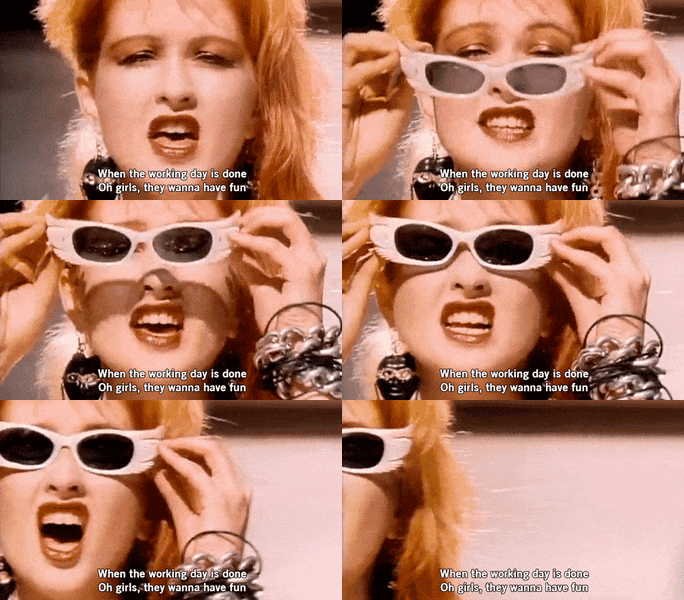
This is the story of the woman that influenced and inspired the likes of Madonna, Lady Gaga, Michael Jackson(!), Nicky Minaj and countless many more, told in her own words and not kowtowing to record labels, male singing icons, ex-boyfriends or anyone else. The first half of this book is mesmerising - telling the story of growing up in a lower class American-Italian family, poorly educated and forever on the look out for abusive males; Cyndi always maintained her creative streaks through art, dance, music, fashion and more with the very limited opportunities she had to hand. This is the real story of an American Dream. A super pro-woman, pro-LGBT and pro-equality woman way before before it became 'cool', Cyndi also never let the countless chauvinists in her life pull one over her. Through numerous ordeals, dead-end jobs, bad boyfriends, bad situations but also through the love for her lesbian sister, her mother, some of her peers and some of her friends towards her late 20s she finally made it big time. This is her story, the story of the girl who just wanted to have fun, but who also continuously campaigned for those whose voices were not being heard. This is what an icon should be like!
I really liked Cyndi as an artist when I was growing up, but now reading about her life story I wish I'd gotten into her music even more; saying that, the second half of this book feels like mostly a for music lovers only tale of her time as a 'pop star' which although focussing a lot on her creative music, art and fashion, for me was more entertaining when focusing on her charitable causes and the troubles with the record companies trying to control her. Still an absolutely fascinating read on so any levels, especially on the effing nightmare that America is for how it has treated LGBT people and women that used their voices to stand and speak up for themselves and for those that can't.
8.5 out of 12. A book despite its warts and all, that is uplifting, telling the story of one of the 'good people' becoming famous, and not loosing herself and continually trying to do her best to make the world a better place for other people. It's also the story of a creator, who just wanted to create what she envisaged despite all the obstacles in her path. 8.5 out of 12. American. Icon.
I really liked Cyndi as an artist when I was growing up, but now reading about her life story I wish I'd gotten into her music even more; saying that, the second half of this book feels like mostly a for music lovers only tale of her time as a 'pop star' which although focussing a lot on her creative music, art and fashion, for me was more entertaining when focusing on her charitable causes and the troubles with the record companies trying to control her. Still an absolutely fascinating read on so any levels, especially on the effing nightmare that America is for how it has treated LGBT people and women that used their voices to stand and speak up for themselves and for those that can't.
8.5 out of 12. A book despite its warts and all, that is uplifting, telling the story of one of the 'good people' becoming famous, and not loosing herself and continually trying to do her best to make the world a better place for other people. It's also the story of a creator, who just wanted to create what she envisaged despite all the obstacles in her path. 8.5 out of 12. American. Icon.

March 5, 2013
I can appreciate that this book was meant to be like a conversation with Cyndi Lauper. What I cannot appreciate is that the writer didn't organize the ramblings into a cohesive, progressive story.
Cyndi Lauper's life is pretty interesting, but the rambling messiness of the book was off-putting. I was not invested in the book, and I had to force myself to finish reading it.
Cyndi Lauper's life is pretty interesting, but the rambling messiness of the book was off-putting. I was not invested in the book, and I had to force myself to finish reading it.

January 30, 2024
I was extremely lucky to hear Cyndi Lauper live in 1989 in Chile, at the national stadium. I dragged my cousin to see her, and we waited for like three hours for it to start but I don't regret a thing. It was in the 'galusha', so I saw almost nothing, but the energy was incredible; and I probably ended up hoarse.
https://www.youtube.com/watch?v=PEABI...
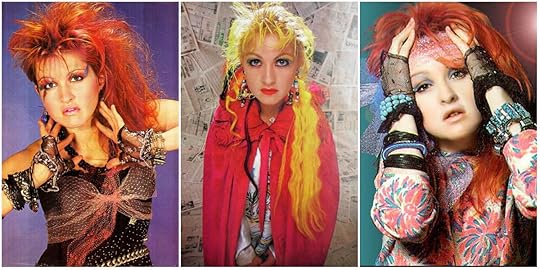
She has undoubtedly been one of the most influential artists of our generation, in the way she dresses and in the way she makes music.
Cyndi Lauper's biography is handled as if it were a radio interview or rather like she was talking to you in a everyday converstion. She talks about her life, and at several points she rambles, jumping from one topic to another, which is a little difficult to follow at first. Like most great artists, her life was difficult (I have yet to meet anyone famous whose life was honey and roses), born in Queens to a family she describes as lower middle class; however, her mother worked two jobs, and her stepfather also worked, from whom she fled at age 17 because he was a sexual predator. What stands out for me in this period is that she has many difficulties in school, especially in English, which seems to indicate learning or concentration difficulties. Despite this, she tried to continue in school several times because of her love of art, she wanted to paint at that time, but at the same time she loved fashion and everything that is visual art. But when she left home, without money or education, she often found herself almost on the streets, doing any job (at which she almost never lasted) and often going hungry. And she being a victim of sexual assault.
As she tells it, almost by chance she started singing as part of other artists' choirs, and her lack of proper education in this is so clear that she ended up losing her voice twice, before becoming famous, which she only achieved when she was 30 years old, which is a late age for a pop singer.
Cyndi constantly speaks out against sexism in the entertainment industry, and speaks frankly about how she never had a good head for business (in the sense of not playing along with record label executives, producers, or frankly others). She was always led by HER idea, and she assures that when she followed the direction of others in terms of music it was a failure, but this caused her to never have money as many would believe, she has never been a millionaire, but rather she has had to work constantly to support herself doing what he likes to do: her music, her art, her visual concept.
https://www.youtube.com/watch?v=-ILk2...
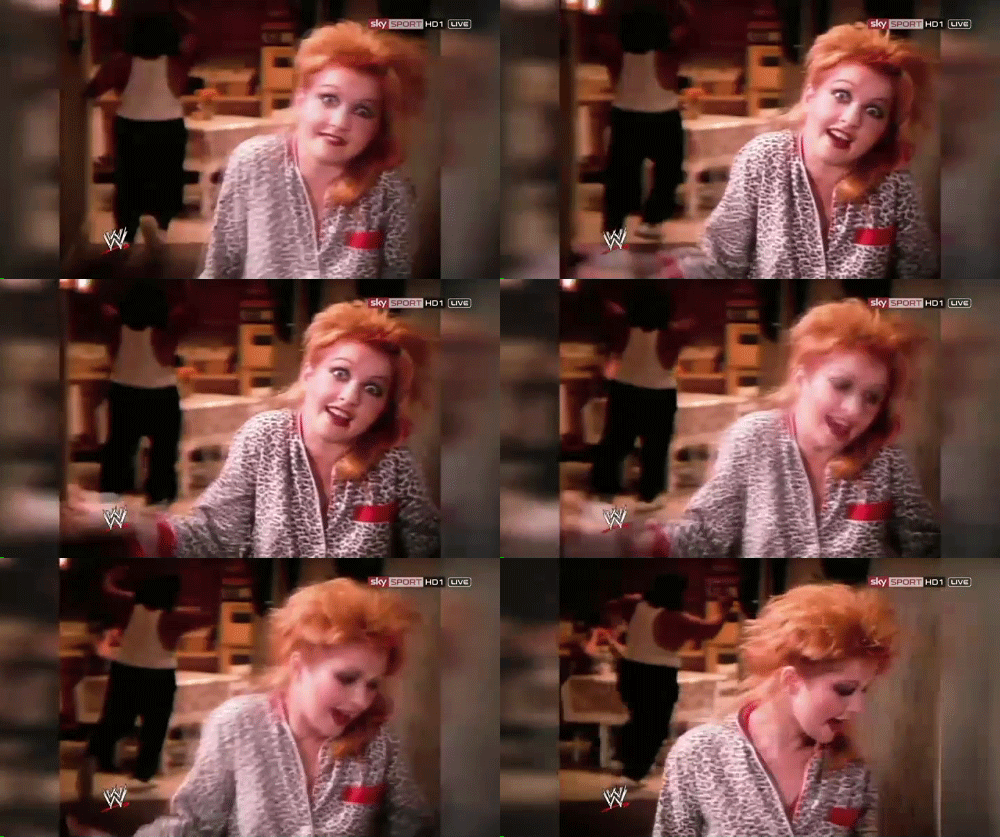
It's plain funny that her family (mom, aunts, brother) and friends (hairdressers from Vidal Sassoon, friends form jobs that she was fired, wrestlers and boyfriend) were in all her first videos, and its like a photo album to her.
Of course if you picked up this book and even if you read all of this, you're a fan like me. And you can believe that she has done quite well, mixing different forms of music, I recently listened to one of her latest recordings and boy, she sounds better than ever.
https://www.youtube.com/watch?v=lgbG9...
The last part of the book talks especially about her activism with the LGBT community, driven by her love for her sister and her friends (she lived through that time when AIDS was the plague of the 20th century).
There is also like a dozen of photos of all her stages at the end of the book.
I hope you keep doing what you like, Cyndi.
------------------------------------------
(Esta vez en castellano)
Tuve mucha suerte de escuchar a Cyndi Lauper en vivo en 1989 en Chile, en el estadio nacional. Arrastré a mi prima para verla y esperamos como tres horas para que comenzara, pero no me arrepiento de nada. Fue en la 'galusha', así que no vi casi nada, pero la energía era increíble, y terminé afónica coreando sus canciones.
https://www.youtube.com/watch?v=PEABI...
Ella ha sido sin dudas una de las artistas más influyentes de nuestra generación, en su forma de vestir y en su forma de hacer música.
La biografía de Cyndi Lauper se maneja como si fuera una entrevista de radio o más bien como si estuviera hablando contigo en una conversación cotidiana. Habla de su vida y en varios puntos divaga, saltando de un tema a otro, lo que resulta un poco difícil de seguir al principio. Como la mayoría de los grandes artistas, su vida fue difícil (todavía no he conocido a nadie famoso cuya vida fuera miel y rosas), nació en Queens en una familia que ella describe como de clase media baja; sin embargo, su madre tenía dos empleos, y también trabajaba su padrastro, de quien huyó a los 17 años porque era un depredador sexual. Lo que me llama la atención en este período es que tiene muchas dificultades en la escuela, especialmente en inglés, lo que parece indicar dificultades de aprendizaje o de concentración. A pesar de esto, intentó continuar en la escuela varias veces por su amor al arte, quería pintar en ese momento, pero al mismo tiempo amaba la moda y todo lo que es arte visual. Pero cuando se fue de casa, sin dinero ni educación, a menudo se encontraba casi en la calle, haciendo cualquier trabajo (en el que casi nunca duraba) y a menudo pasando hambre. Y siendo víctima de agresiones sexuales.
Según cuenta, casi por casualidad empezó a cantar como apoyo de otros artistas, y su falta de formación adecuada en esto es tan evidente que acabó perdiendo la voz dos veces, antes de hacerse famosa, cosa que sólo consiguió cuando tenía 30 años, una edad tardía para un cantante pop.
Cyndi habla constantemente contra el sexismo en la industria del entretenimiento y habla con franqueza de que nunca tuvo buena cabeza para los negocios (en el sentido de no seguir el juego de los ejecutivos de los sellos discográficos, los productores o, francamente, otros). Ella siempre se dejó llevar por SU idea, y asegura que cuando siguió la dirección de otros en cuanto a música fue un fracaso, pero esto provocó que nunca haya tenido dinero como muchos creerían, nunca ha sido millonaria, sino más bien ella ha tenido que trabajar constantemente para mantenerse haciendo lo que a él le gusta hacer: su música, su arte, su concepto visual.
Me pareció gracioso que su familia (mamá, tías, hermano) y amigos (peluqueras de Vidal Sassoon, amigos de los trabajos que la despidieron, luchadores y novio) estuvieran en todos sus primeros videos, y es como un álbum de fotos para ella.
Por supuesto, si tomaste este libro e incluso si leíste todo esto, eres un fan como yo. Y puedes creer que lo ha hecho bastante bien, mezclando diferentes formas de música, hace poco escuché una de sus últimas grabaciones y vaya, suena mejor que nunca.
La última parte del libro habla especialmente de su activismo con la comunidad LGBT, impulsada por el amor por su hermana y sus amigos (vivió esa época en la que el sida era la plaga del siglo XX).
Aparte de eso, hay como una docena de fotos de sus distintas épocas al final del libro.


Espero que sigas haciendo lo que te gusta, Cyndi.
https://www.youtube.com/watch?v=PEABI...
She has undoubtedly been one of the most influential artists of our generation, in the way she dresses and in the way she makes music.
Cyndi Lauper's biography is handled as if it were a radio interview or rather like she was talking to you in a everyday converstion. She talks about her life, and at several points she rambles, jumping from one topic to another, which is a little difficult to follow at first. Like most great artists, her life was difficult (I have yet to meet anyone famous whose life was honey and roses), born in Queens to a family she describes as lower middle class; however, her mother worked two jobs, and her stepfather also worked, from whom she fled at age 17 because he was a sexual predator. What stands out for me in this period is that she has many difficulties in school, especially in English, which seems to indicate learning or concentration difficulties. Despite this, she tried to continue in school several times because of her love of art, she wanted to paint at that time, but at the same time she loved fashion and everything that is visual art. But when she left home, without money or education, she often found herself almost on the streets, doing any job (at which she almost never lasted) and often going hungry. And she being a victim of sexual assault.
As she tells it, almost by chance she started singing as part of other artists' choirs, and her lack of proper education in this is so clear that she ended up losing her voice twice, before becoming famous, which she only achieved when she was 30 years old, which is a late age for a pop singer.
Cyndi constantly speaks out against sexism in the entertainment industry, and speaks frankly about how she never had a good head for business (in the sense of not playing along with record label executives, producers, or frankly others). She was always led by HER idea, and she assures that when she followed the direction of others in terms of music it was a failure, but this caused her to never have money as many would believe, she has never been a millionaire, but rather she has had to work constantly to support herself doing what he likes to do: her music, her art, her visual concept.
https://www.youtube.com/watch?v=-ILk2...
It's plain funny that her family (mom, aunts, brother) and friends (hairdressers from Vidal Sassoon, friends form jobs that she was fired, wrestlers and boyfriend) were in all her first videos, and its like a photo album to her.
Of course if you picked up this book and even if you read all of this, you're a fan like me. And you can believe that she has done quite well, mixing different forms of music, I recently listened to one of her latest recordings and boy, she sounds better than ever.
https://www.youtube.com/watch?v=lgbG9...
The last part of the book talks especially about her activism with the LGBT community, driven by her love for her sister and her friends (she lived through that time when AIDS was the plague of the 20th century).
There is also like a dozen of photos of all her stages at the end of the book.
I hope you keep doing what you like, Cyndi.
------------------------------------------
(Esta vez en castellano)
Tuve mucha suerte de escuchar a Cyndi Lauper en vivo en 1989 en Chile, en el estadio nacional. Arrastré a mi prima para verla y esperamos como tres horas para que comenzara, pero no me arrepiento de nada. Fue en la 'galusha', así que no vi casi nada, pero la energía era increíble, y terminé afónica coreando sus canciones.
https://www.youtube.com/watch?v=PEABI...
Ella ha sido sin dudas una de las artistas más influyentes de nuestra generación, en su forma de vestir y en su forma de hacer música.
La biografía de Cyndi Lauper se maneja como si fuera una entrevista de radio o más bien como si estuviera hablando contigo en una conversación cotidiana. Habla de su vida y en varios puntos divaga, saltando de un tema a otro, lo que resulta un poco difícil de seguir al principio. Como la mayoría de los grandes artistas, su vida fue difícil (todavía no he conocido a nadie famoso cuya vida fuera miel y rosas), nació en Queens en una familia que ella describe como de clase media baja; sin embargo, su madre tenía dos empleos, y también trabajaba su padrastro, de quien huyó a los 17 años porque era un depredador sexual. Lo que me llama la atención en este período es que tiene muchas dificultades en la escuela, especialmente en inglés, lo que parece indicar dificultades de aprendizaje o de concentración. A pesar de esto, intentó continuar en la escuela varias veces por su amor al arte, quería pintar en ese momento, pero al mismo tiempo amaba la moda y todo lo que es arte visual. Pero cuando se fue de casa, sin dinero ni educación, a menudo se encontraba casi en la calle, haciendo cualquier trabajo (en el que casi nunca duraba) y a menudo pasando hambre. Y siendo víctima de agresiones sexuales.
Según cuenta, casi por casualidad empezó a cantar como apoyo de otros artistas, y su falta de formación adecuada en esto es tan evidente que acabó perdiendo la voz dos veces, antes de hacerse famosa, cosa que sólo consiguió cuando tenía 30 años, una edad tardía para un cantante pop.
Cyndi habla constantemente contra el sexismo en la industria del entretenimiento y habla con franqueza de que nunca tuvo buena cabeza para los negocios (en el sentido de no seguir el juego de los ejecutivos de los sellos discográficos, los productores o, francamente, otros). Ella siempre se dejó llevar por SU idea, y asegura que cuando siguió la dirección de otros en cuanto a música fue un fracaso, pero esto provocó que nunca haya tenido dinero como muchos creerían, nunca ha sido millonaria, sino más bien ella ha tenido que trabajar constantemente para mantenerse haciendo lo que a él le gusta hacer: su música, su arte, su concepto visual.
Me pareció gracioso que su familia (mamá, tías, hermano) y amigos (peluqueras de Vidal Sassoon, amigos de los trabajos que la despidieron, luchadores y novio) estuvieran en todos sus primeros videos, y es como un álbum de fotos para ella.
Por supuesto, si tomaste este libro e incluso si leíste todo esto, eres un fan como yo. Y puedes creer que lo ha hecho bastante bien, mezclando diferentes formas de música, hace poco escuché una de sus últimas grabaciones y vaya, suena mejor que nunca.
La última parte del libro habla especialmente de su activismo con la comunidad LGBT, impulsada por el amor por su hermana y sus amigos (vivió esa época en la que el sida era la plaga del siglo XX).
Aparte de eso, hay como una docena de fotos de sus distintas épocas al final del libro.
Espero que sigas haciendo lo que te gusta, Cyndi.

January 5, 2013
I picked up this book based on a recommendation I heard on Sirius radio from former MTV VJ, Mark Goodman, who said he found the book fascinating. Unfortunately, I personally stopped reading after a few chapters just because I couldn't get interested in her story. Which is disappointing considering I paid $26 for the hardback version of the memoir. The main issue I have with this memoir (and I am a BIG fan of memoirs in general), is Cyndi's story begins on one note, then she immediately, by page two, shifts into another story sprung from her initial thought. The rambling continues and I kept wondering where was the editor to say, 'Stick to the topic, Cyndi. THE TOPIC AT HAND.' Cyndi would start a thought then immediately shift to ... 'oh look, a squirrel.' Perhaps that's part of Cyndi's charm that she's a free spirit and I'd imagine that, in real life, this is probably how a conversation with her would progress.
However, for a memoir there has to be some consistency in the story, a pattern of events that are tied together to make the story flow. This almost felt like Cyndi was writing a note to a friend in junior high, detailing her thoughts in no particular order as only 13 year old girls could understand.
Would probably recommend to a Super Fan who wants to know the 'inside story', but for someone who admires her music but isn't really a deep and abiding follower, I'd say pass.
However, for a memoir there has to be some consistency in the story, a pattern of events that are tied together to make the story flow. This almost felt like Cyndi was writing a note to a friend in junior high, detailing her thoughts in no particular order as only 13 year old girls could understand.
Would probably recommend to a Super Fan who wants to know the 'inside story', but for someone who admires her music but isn't really a deep and abiding follower, I'd say pass.

March 23, 2025
In ihrer Autobiographie blickt Cyndi Lauper zurück auf ihre Kindheit in armen Verhältnissen, die teils schwierigen Momente ihrer Karriere und auch ihr politisches und soziales Engagement ist Thema.
Das war alles sehr kurzweilig und man hört Cyndi wirklich in jedem Satz heraus – allerdings ist es dadurch manchmal auch etwas schwierig, ihr zu folgen. Sie ist halt auch beim Schreiben sehr sprunghaft und authentisch, wofür man sie dann ja auch wieder liebt. Es gibt einige schwer zu verdauende Momente, wo sie vor allem mit Dingen wie sexuellen Übergriffen konfrontiert war. Oder als sie immer wieder an großen Tiefpunkten ihres Lebens stand. Aber sie hat eben auch eine sehr positive Erzählweise, und am Ende hat man tatsächlich das Gefühl, dass immer alles irgendwie gut wird. Besonders berührend fand ich auch die Kapitel, in denen es um ihr Engagement für die LGBTQ+-Community geht und welche Hintergründe das alles hat.
Das war alles sehr kurzweilig und man hört Cyndi wirklich in jedem Satz heraus – allerdings ist es dadurch manchmal auch etwas schwierig, ihr zu folgen. Sie ist halt auch beim Schreiben sehr sprunghaft und authentisch, wofür man sie dann ja auch wieder liebt. Es gibt einige schwer zu verdauende Momente, wo sie vor allem mit Dingen wie sexuellen Übergriffen konfrontiert war. Oder als sie immer wieder an großen Tiefpunkten ihres Lebens stand. Aber sie hat eben auch eine sehr positive Erzählweise, und am Ende hat man tatsächlich das Gefühl, dass immer alles irgendwie gut wird. Besonders berührend fand ich auch die Kapitel, in denen es um ihr Engagement für die LGBTQ+-Community geht und welche Hintergründe das alles hat.

October 18, 2012
1984 was a great year. There is the famous book “1984”, the song “Girls Just Want to Have Fun” was #1 and made Cyndi Lauper a household name, and most importantly: I was born! Okay, okay, back to Cyndi Lauper. Love her or hate her, you certainly know who she is. Cyndi Lauper opens up her world in “Cyndi Lauper: A Memoir”.
The main striking factor in “Cyndi Lauper” is the memoir’s tone. As expected, Lauper is very direct and unapologetic with everything she says. Starting with a background bio; Lauper doesn’t follow the protocol of other celebrity memoirs which include begging for either pity or compliments. Lauper simply states the facts and moves on. Although this is a sigh of relief for regular readers of memoirs, Lauper also seems to be detached in her storytelling. Many of the events are emotional, dramatic, and told for the first time; and yet Lauper fails to offer deep insight or a proper arc to the events. This results in unanswered questions from the reader.
Lauper also has the tendency to strike off on tangents which breaks the reader’s pace. Although she does revisit the former topic, at that point, facts are repeated and result in “You’ve already said that” moments. Another weak aspect is Lauper’s constant attempts to convince the reader that she didn’t care about things (e.g. she didn’t care about people’s opinions of her singing, of her clothing, or her choice of men). However, if one feels the need to convince others continuously, then generally, the opposite is felt (meaning: she did/does care).
There are also apparent differences in the tones and the writing styles of Lauper and her contributor Jancee Dunn. It was quite obvious when Dunn would take the foreground. Plus, events which should have had more details (such as personal effects); were shaded by discussions on Lauper’s career. This left something to be desired.
Despite the negatives, “Cyndi Lauper” IS meatier, more mature, and much less annoying than other celebrity memoirs. Lauper is more relatable than expected and her life evokes page-turning. Sadly though, there are times when Lauper sounds too much like she is preaching about her charitable causes in the guise of explaining them.
Although a minor detail, the chapters are too long and don’t provide proper breaks (the “breathing” of the memoir is off). Also annoying was Lauper’s overuse of speaking directly to the reader and saying such phrases as, “Where were we?” and “Back to…” each time she digressed (which is often). Her regular mention of Lady Gaga is also not necessary for discussion.
The latter end of “Cyndi Lauper” focused strenuously on her career and activisms but still lacked the true attachment in storytelling. Something was missing making the text flat and the ending weak. Not to mention, the memoir’s ending felt abrupt, cut-off, and without a proper rounded conclusion.
Overall, however, “Cyndi Lauper” is much better than many other celebrity memoirs on the book shelves. Instead of focusing on drug use, parties, or sex; Lauper instead shows her genuine artistic side. Her passion for music, music theory, and fans is undeniable and it is unusual nowadays for a musician to truly care about the music. Lauper is the “Real Deal” is in this respect. Although it may not be the best book available, comparing “Cyndi Lauper” to other memoirs makes it worthy of being better than average.
The main striking factor in “Cyndi Lauper” is the memoir’s tone. As expected, Lauper is very direct and unapologetic with everything she says. Starting with a background bio; Lauper doesn’t follow the protocol of other celebrity memoirs which include begging for either pity or compliments. Lauper simply states the facts and moves on. Although this is a sigh of relief for regular readers of memoirs, Lauper also seems to be detached in her storytelling. Many of the events are emotional, dramatic, and told for the first time; and yet Lauper fails to offer deep insight or a proper arc to the events. This results in unanswered questions from the reader.
Lauper also has the tendency to strike off on tangents which breaks the reader’s pace. Although she does revisit the former topic, at that point, facts are repeated and result in “You’ve already said that” moments. Another weak aspect is Lauper’s constant attempts to convince the reader that she didn’t care about things (e.g. she didn’t care about people’s opinions of her singing, of her clothing, or her choice of men). However, if one feels the need to convince others continuously, then generally, the opposite is felt (meaning: she did/does care).
There are also apparent differences in the tones and the writing styles of Lauper and her contributor Jancee Dunn. It was quite obvious when Dunn would take the foreground. Plus, events which should have had more details (such as personal effects); were shaded by discussions on Lauper’s career. This left something to be desired.
Despite the negatives, “Cyndi Lauper” IS meatier, more mature, and much less annoying than other celebrity memoirs. Lauper is more relatable than expected and her life evokes page-turning. Sadly though, there are times when Lauper sounds too much like she is preaching about her charitable causes in the guise of explaining them.
Although a minor detail, the chapters are too long and don’t provide proper breaks (the “breathing” of the memoir is off). Also annoying was Lauper’s overuse of speaking directly to the reader and saying such phrases as, “Where were we?” and “Back to…” each time she digressed (which is often). Her regular mention of Lady Gaga is also not necessary for discussion.
The latter end of “Cyndi Lauper” focused strenuously on her career and activisms but still lacked the true attachment in storytelling. Something was missing making the text flat and the ending weak. Not to mention, the memoir’s ending felt abrupt, cut-off, and without a proper rounded conclusion.
Overall, however, “Cyndi Lauper” is much better than many other celebrity memoirs on the book shelves. Instead of focusing on drug use, parties, or sex; Lauper instead shows her genuine artistic side. Her passion for music, music theory, and fans is undeniable and it is unusual nowadays for a musician to truly care about the music. Lauper is the “Real Deal” is in this respect. Although it may not be the best book available, comparing “Cyndi Lauper” to other memoirs makes it worthy of being better than average.

November 18, 2012
Cyndi Lauper’s autobiography begins with her running away from home to escape her step-father the sexual predator. Things don’t get much better for her for quite some time- some truly horrific things happen to her on her way to success. And success is illusive- for all Lauper’s hard work, hit records, and Grammy nominations, she has never become as rich and famous as one would think she should be.
Recognition didn’t come to Lauper until she was thirty. Through her twenties, she worked menial jobs, sang in cover bands, and was never taken seriously, even by her own band mates- she was even sexually assaulted by some of them. She gave free rein to her eccentric style (which has been copied endlessly) and didn’t pull any punches about what she thought, and these habits didn’t endear her to record execs. And so much of the time, she just has had plain bad luck. It’s not that she is blaming fate for her own short fallings; she readily admits when she screws up. This woman never stops working, and, I suspect, never will. Her creative force is just too strong. She describes how she works, and it’s remarkable how she dissects music and puts it back together in new ways.
The book is written like you’re sitting down with Lauper, listening to her tell her story. She narrates with an immediacy that puts you right in the scene. She also digresses like she were sitting in front of you talking. This is not a dry, moment by moment biography! I highly recommend this if you’re a fan.
Recognition didn’t come to Lauper until she was thirty. Through her twenties, she worked menial jobs, sang in cover bands, and was never taken seriously, even by her own band mates- she was even sexually assaulted by some of them. She gave free rein to her eccentric style (which has been copied endlessly) and didn’t pull any punches about what she thought, and these habits didn’t endear her to record execs. And so much of the time, she just has had plain bad luck. It’s not that she is blaming fate for her own short fallings; she readily admits when she screws up. This woman never stops working, and, I suspect, never will. Her creative force is just too strong. She describes how she works, and it’s remarkable how she dissects music and puts it back together in new ways.
The book is written like you’re sitting down with Lauper, listening to her tell her story. She narrates with an immediacy that puts you right in the scene. She also digresses like she were sitting in front of you talking. This is not a dry, moment by moment biography! I highly recommend this if you’re a fan.

January 24, 2021
This book is a clear example of the way that knowing more about an artist whose music one may casually like at least a little makes them much less appealing if in a totally unsurprising way. There is a lot about this book that gives the reader a sinking feeling that they have seen this story before, and that the same things that led to so much suffering and misery in the author's life were precisely the results of the sort of life that she celebrated in her work and of the political and moral worldview that she supported. The author comments throughout this book that the age of free love and no strings relationships in fact had consequences, and she views this as some sort of wicked aspect of an imaginary patriarchy that is holding her down and not the natural result of the ties that intimacy is supposed to build, ties that she seems to lack any sort of understanding in. Of course, the author shows herself to be hostile to godly morality in her personal life and devoted to various misguided and mistaken leftist political ideals, but none of this is exactly surprising. Given the author's disordered life, it is little surprise that she seems to have suffered so much from various inflammatory diseases that are the natural result of her own behavior.
This book is more than 300 pages and gives a harrowing tale of the life of a quirky singer whose easy-going persona as a musician is deeply at odds with the events of her life and with her strident political attitude. The account is straightforwardly chronological, which means that a great deal of the book covers the early life of the singer and her long period of struggle to make a living and to find her way in the world of music in 1970's New York as the lead singer of Blue Angel, a group that had some hype but which never had any sort of sustained success. The author discusses her personal relationships, her political activism, and the way that she struggled to maintain her identity and build a sustained music career. Her discussions of her struggles against label heads and sexism is quite similar to that of Pat Benatar during the same period, although Lauper comes off as a less appealing person herself, even if her career is broadly similar in combining quirky music with theatrical instincts. The author's interest in Grammy award nominations (if not wins) and her desire for respect from other artists is interesting and demonstrates her longing to be loved and appreciated, which is certainly a humanizing tendency.
Even so, despite the fact that the author's lifestyle is frustrating and clearly tragic, there is something intriguing in this book. The author makes it clear, for example, why her voice is not nearly as good as one would hope, given the fact that she refers to it as having been destroyed through various behaviors on several occasions. For a singer, having a voice destroyed is a major problem. It is also rather telling that Lauper considers herself to have been a particularly influential artist not through her music so much as her sense of fashion as well as her approach to music and style. She quite understandably shows no hostility to Madonna, against whom she was pit in the fashion that is so common in the world of music where creative people are pit against each other as rivals, rather than simply allowed to coexist together on the charts and perhaps work together or respect each other or to have or be mutual fans. And one would have to have a heart of stone not to be at least a little sympathetic with Lauper's upbringing, which led her to escape a pedophile stepfather at the age of seventeen and led to quite a long period of struggle to find her place within the world where she could live a decent life not subject to immense privation. If the success of Lauper's "She's So Unusual" seems to have come out of left field, she was already about thirty or so when it happened, which is fairly old for a "new" pop star, it must be admitted.
This book is more than 300 pages and gives a harrowing tale of the life of a quirky singer whose easy-going persona as a musician is deeply at odds with the events of her life and with her strident political attitude. The account is straightforwardly chronological, which means that a great deal of the book covers the early life of the singer and her long period of struggle to make a living and to find her way in the world of music in 1970's New York as the lead singer of Blue Angel, a group that had some hype but which never had any sort of sustained success. The author discusses her personal relationships, her political activism, and the way that she struggled to maintain her identity and build a sustained music career. Her discussions of her struggles against label heads and sexism is quite similar to that of Pat Benatar during the same period, although Lauper comes off as a less appealing person herself, even if her career is broadly similar in combining quirky music with theatrical instincts. The author's interest in Grammy award nominations (if not wins) and her desire for respect from other artists is interesting and demonstrates her longing to be loved and appreciated, which is certainly a humanizing tendency.
Even so, despite the fact that the author's lifestyle is frustrating and clearly tragic, there is something intriguing in this book. The author makes it clear, for example, why her voice is not nearly as good as one would hope, given the fact that she refers to it as having been destroyed through various behaviors on several occasions. For a singer, having a voice destroyed is a major problem. It is also rather telling that Lauper considers herself to have been a particularly influential artist not through her music so much as her sense of fashion as well as her approach to music and style. She quite understandably shows no hostility to Madonna, against whom she was pit in the fashion that is so common in the world of music where creative people are pit against each other as rivals, rather than simply allowed to coexist together on the charts and perhaps work together or respect each other or to have or be mutual fans. And one would have to have a heart of stone not to be at least a little sympathetic with Lauper's upbringing, which led her to escape a pedophile stepfather at the age of seventeen and led to quite a long period of struggle to find her place within the world where she could live a decent life not subject to immense privation. If the success of Lauper's "She's So Unusual" seems to have come out of left field, she was already about thirty or so when it happened, which is fairly old for a "new" pop star, it must be admitted.

September 29, 2012
Just finished Cyndi Lauper's memoir. She chose well in Jancee Dunn who captures Lauper's voice so well. There were a few draggy parts, but mostly a well told hoot. She is not shy about dissing stars who steal her ideas and style and she drops a lotta names, which is always fun. I'm always interested in the process, and Lauper does not disappoint. She puts it down, just how she works, composes, and arranges. One thing I wanted her to talk about was a Joni Mitchell tribute she was part of. She did mention Joni but not the tribute--I never bought a Cyndi Lauper record but I did watch her on Celebrity Apprentice. She's real and original. She blew me away with her Mitchell tribute and that's saying a lot when Diana Krall plays A Case of You on piano in the same set. I watched her performance (I typed in Cyndi Lauper Joni Mitchell tribute and it popped right up) again on YouTube and it is just as good--if not better--because now I know what she is doing up there. She's singing sure, she's putting her own stamp on it, yes, but she's also aiming for a sweet spot that puts her into the heart of the music and the song. She comes off as a really likable person and someone who treats her as "less than" usually finds out she is more than willing to prove them wrong.
September 21, 2012
She's is so unusual but in the best possible way. It's incredible to see that she has gone through so much and yet remains a very positive person who wants to help others.
I especially like the conversational style, it really feels like she's talking to you and only you at times.
I always liked her music but I had no idea that she sang the Blues.
This book has a very positive message not only for women and young LGBT people but also for those of us who could use a little of inspiration to try and help others and make a difference in the world.
Way to go Cyndi and thank you for all you've done for us!
I especially like the conversational style, it really feels like she's talking to you and only you at times.
I always liked her music but I had no idea that she sang the Blues.
This book has a very positive message not only for women and young LGBT people but also for those of us who could use a little of inspiration to try and help others and make a difference in the world.
Way to go Cyndi and thank you for all you've done for us!

March 11, 2013
If you like Cyndi Lauper you should read this book. If you're not a fan probably skip it. Obvious, right? Well some memoirs are more universally appealing than this one. It feels like she's talking to you and telling you stories in a stream of consciousness kind of way. The down side is that while her stories are mostly chronological, they skip around and aren't well organized. And often she doesn't give you enough background information to truly understand why something is interesting. I wish she would have let her co-writer have a little more control.
The last few chapters I actually avoided because I was getting bored. And I'm a fan.
The photos in the book are totally great and plentiful.
The last few chapters I actually avoided because I was getting bored. And I'm a fan.
The photos in the book are totally great and plentiful.

November 7, 2014
She had me in the first paragraph: leaving an abusive home with a toothbrush, clean underpants, and Yoko Ono's Grapefruit. She had me in tears by the end of the first chapter, talking about the history of abuse and oppression in generations of women in her family and how it made her initially reject doing "Girls Just Want To Have Fun," afraid it would send a bad message. But she decided to turn it into an anthem and rallying cry.
From go, Cyndi addresses sexism throughout her life. It is a major theme of the book, and rightly so. She openly shit talks her music idols whenever they're shitty old boys' club attitude disappoints her. She has a strong artistic point of view and does a fantastic job throughout the book of describing her process for developing the sound of specific songs and visuals of stage productions. I'm always disappointed when I read music autobiographies that don't really describe the music, but this is a fantastic exception.
This autobiography, more than any other I've read, is clearly transcribed from interviews with Cyndi. It is conversational, it is distracted, there is a lot of swearing. I loved it, I heard her voice and personality so clearly. For better or worse, in life and in this book Cyndi has no filter. Overall, it's charming and often funny. The few places it faltered for me were when she accuses other artists of ripping her off, and when she mentions dieting to keep her figure slim. She is so passionate and articulate about the ways in which women and queers are oppressed by society, and has done amazing work to combat this, that's it's a disappointment to see her not make the connection with body image.
From go, Cyndi addresses sexism throughout her life. It is a major theme of the book, and rightly so. She openly shit talks her music idols whenever they're shitty old boys' club attitude disappoints her. She has a strong artistic point of view and does a fantastic job throughout the book of describing her process for developing the sound of specific songs and visuals of stage productions. I'm always disappointed when I read music autobiographies that don't really describe the music, but this is a fantastic exception.
This autobiography, more than any other I've read, is clearly transcribed from interviews with Cyndi. It is conversational, it is distracted, there is a lot of swearing. I loved it, I heard her voice and personality so clearly. For better or worse, in life and in this book Cyndi has no filter. Overall, it's charming and often funny. The few places it faltered for me were when she accuses other artists of ripping her off, and when she mentions dieting to keep her figure slim. She is so passionate and articulate about the ways in which women and queers are oppressed by society, and has done amazing work to combat this, that's it's a disappointment to see her not make the connection with body image.
February 14, 2022
Cyndi Lauper seems like a really interesting and talented woman. Sadly, writing a memoir is not one of her talents. I really wanted to like this, but oh God - it’s a rambling mess that lacks any coherence.
Such a pity, as she has a story to tell. Did not finish because it felt like a chore.
Such a pity, as she has a story to tell. Did not finish because it felt like a chore.

February 10, 2025
Cyndi Lauper is an artist that I loved when I was a kid. I never forgot the first time I heard/saw the music video for Girls Just Want to Have Fun, because I loved the catchy tune and cool video. I loved her style and how different she was to other singers. And of course she was involved with wrestling, so it mixed two of my favourite things. Not to mention that she also did the song for The Goonies.
So yeah, she was a big part of my childhood in the 80s, and I still listen to her now.
I wanted to read her memoir because she's always seemed interesting. Plus, I wanted to hear all about her life directly from her. Cyndi's voice shines through every experience she shares. She doesn't hold back.
Another thing I really enjoyed was how her story follows a linear timeline, but at the same time goes off in little tangents that reveal insightful, inspirational, funny, and even sad experiences.
She's quirky and zany, and very creative. I love how much she appreciates art, music and fashion, how she's always combined all of these to make beautiful music and fun, bright visuals. In everything she does.
Her narrative voice is also very interesting and kept me glued all the way through. I remembered a lot of the stuff she covered, but was also surprised by so much of what she revealed. I would've liked to know more about Kinky Boots, but I guess she ran out of room. It's quite a hefty book already. ☺️
Anyway, if you're a Cyndi Lauper fan, you'll definitely enjoy this memoir. It's inspiring because of her creative process and activism, full of surprises, and includes some of the sadder things in her life.
So yeah, she was a big part of my childhood in the 80s, and I still listen to her now.
I wanted to read her memoir because she's always seemed interesting. Plus, I wanted to hear all about her life directly from her. Cyndi's voice shines through every experience she shares. She doesn't hold back.
Another thing I really enjoyed was how her story follows a linear timeline, but at the same time goes off in little tangents that reveal insightful, inspirational, funny, and even sad experiences.
She's quirky and zany, and very creative. I love how much she appreciates art, music and fashion, how she's always combined all of these to make beautiful music and fun, bright visuals. In everything she does.
Her narrative voice is also very interesting and kept me glued all the way through. I remembered a lot of the stuff she covered, but was also surprised by so much of what she revealed. I would've liked to know more about Kinky Boots, but I guess she ran out of room. It's quite a hefty book already. ☺️
Anyway, if you're a Cyndi Lauper fan, you'll definitely enjoy this memoir. It's inspiring because of her creative process and activism, full of surprises, and includes some of the sadder things in her life.

November 9, 2019
The first 50 pages or so meander a lot, but after a while the story gets on track and remains pretty linear, save brief digressions.
I was mainly interested in her life story up to the mid 90s, so the last 100 pages or so were not as captivating. But from around 50 pages to page 250 I hit the sweet spot and had a really good time with this book. Learned some cool shit about her videos and the parts of her life I grew up watching as a kid.
The story of her rise and fall and then sort of evening out was really nice. She didn’t get some wild, dramatic redemption. But she also didn’t just sputter out either. And she always tried to be an agent of positive change.
So:
It has been snowing here for a few days now, and I’m not sure if it is the change or season or what, but this is the first book I have read in a while that I really felt. Not emotion. Just connection. I have always thought there is some nearly intangible thread that connects us all or connects everything. I felt my childhood. Felt New York City. Felt the small studio settings. Felt luxury and poverty. I don’t know if it is me, maybe just a day where my dopamine levels are elevated or normal, or if it is the energy of the author sort of radiating out into the world through their work, but man, I felt this one.
I was mainly interested in her life story up to the mid 90s, so the last 100 pages or so were not as captivating. But from around 50 pages to page 250 I hit the sweet spot and had a really good time with this book. Learned some cool shit about her videos and the parts of her life I grew up watching as a kid.
The story of her rise and fall and then sort of evening out was really nice. She didn’t get some wild, dramatic redemption. But she also didn’t just sputter out either. And she always tried to be an agent of positive change.
So:
It has been snowing here for a few days now, and I’m not sure if it is the change or season or what, but this is the first book I have read in a while that I really felt. Not emotion. Just connection. I have always thought there is some nearly intangible thread that connects us all or connects everything. I felt my childhood. Felt New York City. Felt the small studio settings. Felt luxury and poverty. I don’t know if it is me, maybe just a day where my dopamine levels are elevated or normal, or if it is the energy of the author sort of radiating out into the world through their work, but man, I felt this one.

April 11, 2021
As a day-one fan of her music, I liked that this was an open, honest story. Though a tad disjointed in the telling, it did ring true to the voice and mental track I would have expected Cyndi to have.

December 20, 2022
Three and a half stars rounded up to four. This autobiographical account of Cyndi Lauper is quirky and entertaining, just like her.

November 2, 2014
"God loves all the flowers, even the ones that grow on the side of the road."
The music career of Cyndi Lauper (1953-) is long and fascinating, which she chronicles along with her tireless advocacy for the LGBT community in "Cyndi Lauper: A Memoir" co-authored with Jancee Dunn.
The photos in her book show Cyndi and her sister Elen, in pretty dresses not looking quite so happy, which somewhat summed up her childhood, with her mothers marriages to inappropriate men. Cyndi lived with others as a teen, including a home for runaways leaving home with her dog Sparkle. With a series of service jobs she worked to support herself she joined her first band in 1974, Flyer (1976), Blue Angel (1978). She was involved in a lawsuit (1982) with her ex-manager Elliot Hoffman for the rights to her songs/recording material before the commercial success of her first album. The judge declared: "Let the Canary sing!" and won the case.
The 1983 blockbuster hit album "Shes So Unusual" made Lauper a superstar, she couldn't go anywhere without mass hysteria. She was the first female vocalist to have 4-5 hits on a debut album, fusing the electronic dance beat with Reggae.
Appearing on the May 1984 cover of Rolling Stone, she sported an anti-fashion or "grab bag fashion" wearing fishnet stockings and high top tennis shoes with her colorful outfits. Ms. Magazine voted her as one of the "Women of the Year". With her greater influence and popularity Lauper became highly outspoken for women's rights and the LGBT community.
In mixing music and art, Lauper wrote in great detail about song writing, preforming, touring, working with other musicians and related professionals. The more interesting details of her personal life are closely edited, very little revealed, clearly making this book less appealing. For example, it was difficult to tell if Lauper married David Keith who she dated before she actually married David Thorton in 1991. Readers will need to check online for specific details.
Lauper writes most passionately about her advocacy for the LGBT community, and especially for her friend Gregory Natal who died of HIV/AIDS in 1985. Lauper recalls the wide spread misconception and hysteria related to the epidemic in the 1980's, the loss of many friends, also gay bashing and hate crimes. Lauper was instrumental in the passing of President Obama's 2009 "Hate Crimes Act".
The "True Colors" tours and funding further support the LGBT community, and a 30 bed shelter in Harlem for LGBT youth. In 2005 Lauper was awarded the highest honor of the National Equality Award for her work in the community and support of marriage equality. There are pages of good personal photographs.
The music career of Cyndi Lauper (1953-) is long and fascinating, which she chronicles along with her tireless advocacy for the LGBT community in "Cyndi Lauper: A Memoir" co-authored with Jancee Dunn.
The photos in her book show Cyndi and her sister Elen, in pretty dresses not looking quite so happy, which somewhat summed up her childhood, with her mothers marriages to inappropriate men. Cyndi lived with others as a teen, including a home for runaways leaving home with her dog Sparkle. With a series of service jobs she worked to support herself she joined her first band in 1974, Flyer (1976), Blue Angel (1978). She was involved in a lawsuit (1982) with her ex-manager Elliot Hoffman for the rights to her songs/recording material before the commercial success of her first album. The judge declared: "Let the Canary sing!" and won the case.
The 1983 blockbuster hit album "Shes So Unusual" made Lauper a superstar, she couldn't go anywhere without mass hysteria. She was the first female vocalist to have 4-5 hits on a debut album, fusing the electronic dance beat with Reggae.
Appearing on the May 1984 cover of Rolling Stone, she sported an anti-fashion or "grab bag fashion" wearing fishnet stockings and high top tennis shoes with her colorful outfits. Ms. Magazine voted her as one of the "Women of the Year". With her greater influence and popularity Lauper became highly outspoken for women's rights and the LGBT community.
In mixing music and art, Lauper wrote in great detail about song writing, preforming, touring, working with other musicians and related professionals. The more interesting details of her personal life are closely edited, very little revealed, clearly making this book less appealing. For example, it was difficult to tell if Lauper married David Keith who she dated before she actually married David Thorton in 1991. Readers will need to check online for specific details.
Lauper writes most passionately about her advocacy for the LGBT community, and especially for her friend Gregory Natal who died of HIV/AIDS in 1985. Lauper recalls the wide spread misconception and hysteria related to the epidemic in the 1980's, the loss of many friends, also gay bashing and hate crimes. Lauper was instrumental in the passing of President Obama's 2009 "Hate Crimes Act".
The "True Colors" tours and funding further support the LGBT community, and a 30 bed shelter in Harlem for LGBT youth. In 2005 Lauper was awarded the highest honor of the National Equality Award for her work in the community and support of marriage equality. There are pages of good personal photographs.

November 8, 2012
I loved this book deeply. It felt like hanging out with Cyndi Lauper for several hours, only she turned out to be cooler than I expected - which is saying a lot because she is a long-time personal idol. She writes extremely conversationally about fashion, music, art, performance, love, touring, record labels and feminism, often within the same breath. She is such an Artist, totally in her own world and trying to control every aspect of her performance (which is to say, her life). She is constantly frustrated by money and people in power, but she's got the beat and she believes in her vision.
She makes it clear from the introduction that she does not believe that woman are shallow and 'just wanna have fun.' Her intent was for that song to be an anthem for women. She writes about the violence, both exceptional and every day, that women experience. From her mother's peeping boyfriend to radio label execs and Bruce Springsteen, Cyndi calls out sexism and misogyny on nearly every page.
Cyndi feels a deep commitment to outsiders and marginalized people. She feels, especially, a lot of feelings for the lgbtqi community. Her sister is a lesbian and her long-time friend-family seems to be mostly gay men. She writes tenderly about her friend's death, the partner he left behind, and all the songs she wrote and charities she funded in his memory. He left her his bedazzled Miss Piggy. She writes, "Gregory and Carl bejeweled almost everything they touched -- even me."
This memoir lacked the tender, poetic prose of Just Kids, but that's the only not-positive thing I could say about it. It was hilarious and enjoyable.
She makes it clear from the introduction that she does not believe that woman are shallow and 'just wanna have fun.' Her intent was for that song to be an anthem for women. She writes about the violence, both exceptional and every day, that women experience. From her mother's peeping boyfriend to radio label execs and Bruce Springsteen, Cyndi calls out sexism and misogyny on nearly every page.
Cyndi feels a deep commitment to outsiders and marginalized people. She feels, especially, a lot of feelings for the lgbtqi community. Her sister is a lesbian and her long-time friend-family seems to be mostly gay men. She writes tenderly about her friend's death, the partner he left behind, and all the songs she wrote and charities she funded in his memory. He left her his bedazzled Miss Piggy. She writes, "Gregory and Carl bejeweled almost everything they touched -- even me."
This memoir lacked the tender, poetic prose of Just Kids, but that's the only not-positive thing I could say about it. It was hilarious and enjoyable.

December 22, 2012
I'm a pretty big fan of Cyndi Lauper, and I like reading about the music industry, so when I received, "Cyndi Lauper, A Memoir" as a gift, I was delighted on two counts. As it turns out, I was slightly disappointed on both.
A memoir is a history, and in my view history is best taught as a story, because that's what people respond to. Obviously, real life never has a beginning and an end, but a good storyteller can make it seem that way. Lauper and co-writer Jancee Dunn never quite meet this standard. "A Memoir" is told in much the same way Lauper might tell you her story at a party: in chronological order, more or less, with frequent long asides that make it hard to remember what the hell you're reading. Lauper has obviously had a life jam-packed with interesting and even outrageous experiences, but because her storytelling style is so scatter-shot the reader never feels the wonder.
The best memoirs adhere to a theme, but for the life of me I can't figure out Lauper's. She's highly artistic, very sensitive, terrible with money, and with no filter between brain and mouth, but I still don't understand the theme of her life. Yes, I have already said that life is not a story, but a memoir is, and it therefore needs a theme.
I'm surprised that a major publishing house, outfitted with editors and sundry other professionals, did not act to correct these shortcomings, but perhaps they thought it was better to let Lauper speak in her own voice. If so, she needs a bit of guidance, which I'm sorry to say she did not receive. It pains me to give such an ardent supporter of gay rights a two-star review, but I can't in good conscience rate "Cyndi Lauper, A Memoir" any higher than that.
A memoir is a history, and in my view history is best taught as a story, because that's what people respond to. Obviously, real life never has a beginning and an end, but a good storyteller can make it seem that way. Lauper and co-writer Jancee Dunn never quite meet this standard. "A Memoir" is told in much the same way Lauper might tell you her story at a party: in chronological order, more or less, with frequent long asides that make it hard to remember what the hell you're reading. Lauper has obviously had a life jam-packed with interesting and even outrageous experiences, but because her storytelling style is so scatter-shot the reader never feels the wonder.
The best memoirs adhere to a theme, but for the life of me I can't figure out Lauper's. She's highly artistic, very sensitive, terrible with money, and with no filter between brain and mouth, but I still don't understand the theme of her life. Yes, I have already said that life is not a story, but a memoir is, and it therefore needs a theme.
I'm surprised that a major publishing house, outfitted with editors and sundry other professionals, did not act to correct these shortcomings, but perhaps they thought it was better to let Lauper speak in her own voice. If so, she needs a bit of guidance, which I'm sorry to say she did not receive. It pains me to give such an ardent supporter of gay rights a two-star review, but I can't in good conscience rate "Cyndi Lauper, A Memoir" any higher than that.

May 14, 2022
It's sad. And yet irrelevant. I believe her, her life was miserable. And just because she had one enduring hit (Girls Just Wanna Have Fun) is enough to make her life of failure relevant? She almost got raped. She almost passed the art school year. She almost, but not.
And because the her life is uniformly sad and not much else, the ghost writer starts crap to disorient the reader.
Scene one: she leaves home. She is rightfully scared by her mother's chosen husband watching her through a crack in the glass of the bathroom door. But I have to feel like a creep examining a car wreck: page after page with the architecture of the bathroom or the social life around the bathroom window. About the ring that cracked the glass, and what mommy said. Yea, mommy has chosen this man, and she was happy enough to stay with him. And Cyndi is an unreliable narrator at best. So her mother brought this man to her daughters because ”he is an earner”, but if he is so, why does she do 14 hour shifts? To let him rape her daughters?
Later she talks about almost being a lesbian. Only she is not. And that seems to be her entire life: failure, after failure, after failure.
Is it bad she is a failure? Of course not. That is the story of most of the 8 billion humans of 2022. Indeed she is a lucky one.
And because the her life is uniformly sad and not much else, the ghost writer starts crap to disorient the reader.
Scene one: she leaves home. She is rightfully scared by her mother's chosen husband watching her through a crack in the glass of the bathroom door. But I have to feel like a creep examining a car wreck: page after page with the architecture of the bathroom or the social life around the bathroom window. About the ring that cracked the glass, and what mommy said. Yea, mommy has chosen this man, and she was happy enough to stay with him. And Cyndi is an unreliable narrator at best. So her mother brought this man to her daughters because ”he is an earner”, but if he is so, why does she do 14 hour shifts? To let him rape her daughters?
Later she talks about almost being a lesbian. Only she is not. And that seems to be her entire life: failure, after failure, after failure.
Is it bad she is a failure? Of course not. That is the story of most of the 8 billion humans of 2022. Indeed she is a lucky one.

December 10, 2013
This is very endearing. While I'm not *not* a fan of her music, I've also never been a huge follower and only own one CD. (Her greatest hits, natch.) I am, however, a big fan of her as a personality, and reading this gave me an even greater appreciation of what an amazing person she is. I had no idea what a big champion of women's rights, gay rights, and just plain human rights in general she really is. But what I really related to was the constant feeling of being an outcast, of never quite fitting in. There are times reading this that I was moved to tears, and I can't quite explain why, except to say that I know what she means and I get what she's been through. I appreciate her tenacity to stand up for who she is, and the fact that she has never once made any effort to conform to anyone's standards. There is a lot of this book about her musical process, and her career as a whole, but to me this is what stands out and what her purpose of writing the book is: To be a beacon of hope to those who don't fit in, who feel like they're sort of a stranger in the world. And she does it well.

October 23, 2012
gah. i like cyndi but i didn't really get into her book. my main issue was the style which i wasn't wild about - take this bit 'the trip really was devastating. When you see devastation like that - well, it's devastating.'
also i wasn't keen about the way she wrote about gay issues - it came from a good place on her part, but I (and I'm guessing most of the people reading this book) don't need to be told that it's ok to be gay as if we are all big homophobes.
i also got fed up pretty quickly of how many times she told us that she was different than other people and how she always said the wrong things to the right people... there was also a lot about how Gaga and others admire her and copy her... even Barak Obama told her that Gaga stole her moves! (or something) and she doesn't seem to like Bruce Springsteen or Jeff Goldblum which was a bit of a blow.
Despite all this there were some bits I enjoyed - mainly her early days in music...
sorry cyndi.
also i wasn't keen about the way she wrote about gay issues - it came from a good place on her part, but I (and I'm guessing most of the people reading this book) don't need to be told that it's ok to be gay as if we are all big homophobes.
i also got fed up pretty quickly of how many times she told us that she was different than other people and how she always said the wrong things to the right people... there was also a lot about how Gaga and others admire her and copy her... even Barak Obama told her that Gaga stole her moves! (or something) and she doesn't seem to like Bruce Springsteen or Jeff Goldblum which was a bit of a blow.
Despite all this there were some bits I enjoyed - mainly her early days in music...
sorry cyndi.

December 15, 2021
I have so much respect for Cyndi Lauper--as a survivor of a brutal young life, as a female rocker coming up in the 70s and managing to make it as an artist in the 80s and beyond, as a feminist and and an activist who got handed nothing easily. This book tells it all, showcasing her tough as nails spirit, tender heart, vibrant sensibility, and unique voice, still totally from Queens, NY.

October 18, 2016
Choppy in parts but a good read. Lauper's style will either draw you in or put you off.

December 20, 2021
This memoir validates everything Cyndi's fans would imagine her to be---authentic, empathetic, wonderfully odd, brazen, fearless, funny, talented and true to herself. Every word is a dictation of Cyndi's thoughts and feelings, spoken into a recording device for later transcription. As a writer myself, this process was a bit unnerving when I first began reading. However, as her life story unfolded, I felt closer to Cyndi's world as it was brought to me, the reader, in her own colloquial jargon, rhythm, cadence. Cyndi is quick to point out that she had a hard time with proper English in school; that her way of communicating is more through feelings, music, painting, and dance. Her passion jumps off of each page; the amalgamation of her quirky Queens NY syntax swirls into a magical tale that could only be told her way. As difficult childhoods often do for creatively gifted children, Cyndi learned to survive on sheer guts and imagination---skills that have carried her through a meaningful career and fulfilled home life.
The reader is taken through the male dominated world of the recording industry of the 1980's through the first decade of the 2000's. Cyndi manages to pave her own way, even if it meant giving up certain fame and wealth. She is the real deal when it comes to musical integrity. As a dreamy child who never felt like she belonged in school, Cyndi always had a soft spot for the LGBTQ community. When she lost a dear friend to AIDS, she began her passion for illuminating the need for fundraising research to combat the disease, eventually branching into other gay and lesbian causes. Cyndi's True Colors Foundation is as important to her as her music.
I have always liked Cyndi's musical style, but I never knew the range of her talent. Her music is timeless in that it spans all genres: rock, pop, soul, rhythm and blues, dance, blues, ballads, jazz and folk. I was thrilled to read that contemporary artists such as Lady Gaga and Nikki Minage gave Cyndi credit for some of their musical and visual stylings. (Cyndi's wildly layered thrift store look with draped jewelry and multi-colored hair even pre-dated Madonna.) Cyndi is a self-made singer/ songwriter/producer because she was born to do all three. She is that gifted.
The best way I would sum up Cyndi's life and legacy comes to me in the phrase I had displayed in my classrooms for years: "Speak your mind even if your voice shakes."
The reader is taken through the male dominated world of the recording industry of the 1980's through the first decade of the 2000's. Cyndi manages to pave her own way, even if it meant giving up certain fame and wealth. She is the real deal when it comes to musical integrity. As a dreamy child who never felt like she belonged in school, Cyndi always had a soft spot for the LGBTQ community. When she lost a dear friend to AIDS, she began her passion for illuminating the need for fundraising research to combat the disease, eventually branching into other gay and lesbian causes. Cyndi's True Colors Foundation is as important to her as her music.
I have always liked Cyndi's musical style, but I never knew the range of her talent. Her music is timeless in that it spans all genres: rock, pop, soul, rhythm and blues, dance, blues, ballads, jazz and folk. I was thrilled to read that contemporary artists such as Lady Gaga and Nikki Minage gave Cyndi credit for some of their musical and visual stylings. (Cyndi's wildly layered thrift store look with draped jewelry and multi-colored hair even pre-dated Madonna.) Cyndi is a self-made singer/ songwriter/producer because she was born to do all three. She is that gifted.
The best way I would sum up Cyndi's life and legacy comes to me in the phrase I had displayed in my classrooms for years: "Speak your mind even if your voice shakes."
March 21, 2019
It was hard to read this book because I love Cyndi's music but this book made me dislike Cyndi as a person. She was such a diva and never wanted to listen to anyone regardless if she didn't know how to do something. Her experience making the movie "Vibes" was bad because she claims Jeff Goldblum was weird and Dan Akroyd was mean for questioning her acting skills, and Peter Falk took Jeff's side against her. She cursed at Goldblum for touching her face during a kissing scene and threatened violence against him for not knowing she didn't like that. She claimed he did it on purpose. As serious as he is as an actor, why would he try to ruin a scene? She had never acted before but behaved like she was the authority on everything. Ron Howard and Dan Akroyd both quit because of her. Yet Cyndi claimed it was everyone else's fault. Hmm...
CL insulted Steven Spielberg for not being creative enough to work with her. Later she claims that she turned down "Working Girl" because she didn't want to be in an office again and "Steel Magnolias" because she didn't want to be a beautician again. From what I've read elsewhere, she was briefly considered for roles in those movies but they passed on her when they were able to get more experienced actors. Therein lies a problem with this book. Things that make Cyndi look stupid or bad she either glosses over, gets defensive, or flat out fudges the truth. If you're going to write a memoir, why not just be honest?
It seemed as though everyone she tried to work with she had a problem with. Her defense of the fights with producers, record companies, songwriters, fellow musicians, and directors was a little thin. Sometimes she claimed it was because she's a woman, but mostly she chalked it off to people not knowing what she can do. "They don't know I can produce, write, act, sing." It seems as though she comes at people wrong and is bitter when they don't want to work with her or there's a problem. I can't believe a woman as self aware as Cyndi is so clueless about how to deal with people.
Cyndi seems oversensitive about a lot of things. She's always accusing everyone of putting down women. Spometimes they do but other times, Cyndi is too uptight. She looks down on Bruce Springsteen for not making a scene at an industry party where men are talking dirty and have trophy wives? Just because SHE doesn't mind burning bridges doesn't mean she can expect him to do the same. She expected Bruce to commiserate with her and talk behind people's backs simply because they were both musicians. He wasn't having it and she was disappointed in him! Then she calls Robert Palmer sexist because he's dating a younger girl and has sexy women in his video. Meanwhile Cyndi has videos where she's rolling around naked or in a teddy. Seems slightly hypocritical, no?
Funnily enough, she goes on about not wanting to be objectified and is outraged at being asked to do a nude scene in a movie. This is after she claimed to have a pedo for a stepfather and then went on to work as a stripper. I'm not sure how she was able to justify dancing naked for drooling men with feminism. Maybe because those guys paid her at the end of the night it was ok. And of course there were all those videos where she's naked or half naked. But that's ok because she's the one doing it right?
Another thing that bugs me is the way Cyndi will tell us something really important but not really say much about it. At one point she is sexually assaulted by a man who gave her a ride and wouldn't let her out until she performed oral sex on him. She says this nonchalantly and then continues on with her story until much later when she briefly mentions the assault in therapy. It just seemed strange for her to bring it up like that when it didn't seem to affect her life in any way after it happened. If it did, why not talk about it in your memoir? She does the same thing when she mentions being stoned all the time. This is the first time we are hearing anything about issues with drugs or alcohol. Again, might be an important thing to discuss in your life story.
The editing and organization of this book was nil. Cyndi talked for an entire chapter about her trip to Sweden and all the cool things to see there. I'm not sure why this was included but it should not have been. We could get the same info from a travel agent.
It always bugs me when people pull out their activism when it suits them and then forget all about it when they have to make a video or whatever. Cyndi has done wonders for the gay community. But I think she's a bit of a hypocrite at times. She can be a diva and she can talk too much and not listen and learn enough. I was tempted to drop this book because I didn't want to ruin my idea of the cool and tough Cyndi. She chalks off her bad behavior as part of her Queens Italian upbringing but that's just a copout for acting like an ass sometimes. She rarely admitted she was wrong yet spent a lot of time talking about Hollywood people and their egos. I still love her music. Just not sure if the women behind it is very pleasant.
All of these things are erased from my mind when I watch Cyndi's performance of "When You Were Mine" on the '85 American Music Awards. She's so amazingly present and her voice never sounded better. No gimmicks. Just Cyndi and a bucket of paint. By all rights she should have had the career Madonna had because she's technically the better singer. Madonna writes better songs though and had a way more supportive record company so the rest is history.
CL insulted Steven Spielberg for not being creative enough to work with her. Later she claims that she turned down "Working Girl" because she didn't want to be in an office again and "Steel Magnolias" because she didn't want to be a beautician again. From what I've read elsewhere, she was briefly considered for roles in those movies but they passed on her when they were able to get more experienced actors. Therein lies a problem with this book. Things that make Cyndi look stupid or bad she either glosses over, gets defensive, or flat out fudges the truth. If you're going to write a memoir, why not just be honest?
It seemed as though everyone she tried to work with she had a problem with. Her defense of the fights with producers, record companies, songwriters, fellow musicians, and directors was a little thin. Sometimes she claimed it was because she's a woman, but mostly she chalked it off to people not knowing what she can do. "They don't know I can produce, write, act, sing." It seems as though she comes at people wrong and is bitter when they don't want to work with her or there's a problem. I can't believe a woman as self aware as Cyndi is so clueless about how to deal with people.
Cyndi seems oversensitive about a lot of things. She's always accusing everyone of putting down women. Spometimes they do but other times, Cyndi is too uptight. She looks down on Bruce Springsteen for not making a scene at an industry party where men are talking dirty and have trophy wives? Just because SHE doesn't mind burning bridges doesn't mean she can expect him to do the same. She expected Bruce to commiserate with her and talk behind people's backs simply because they were both musicians. He wasn't having it and she was disappointed in him! Then she calls Robert Palmer sexist because he's dating a younger girl and has sexy women in his video. Meanwhile Cyndi has videos where she's rolling around naked or in a teddy. Seems slightly hypocritical, no?
Funnily enough, she goes on about not wanting to be objectified and is outraged at being asked to do a nude scene in a movie. This is after she claimed to have a pedo for a stepfather and then went on to work as a stripper. I'm not sure how she was able to justify dancing naked for drooling men with feminism. Maybe because those guys paid her at the end of the night it was ok. And of course there were all those videos where she's naked or half naked. But that's ok because she's the one doing it right?
Another thing that bugs me is the way Cyndi will tell us something really important but not really say much about it. At one point she is sexually assaulted by a man who gave her a ride and wouldn't let her out until she performed oral sex on him. She says this nonchalantly and then continues on with her story until much later when she briefly mentions the assault in therapy. It just seemed strange for her to bring it up like that when it didn't seem to affect her life in any way after it happened. If it did, why not talk about it in your memoir? She does the same thing when she mentions being stoned all the time. This is the first time we are hearing anything about issues with drugs or alcohol. Again, might be an important thing to discuss in your life story.
The editing and organization of this book was nil. Cyndi talked for an entire chapter about her trip to Sweden and all the cool things to see there. I'm not sure why this was included but it should not have been. We could get the same info from a travel agent.
It always bugs me when people pull out their activism when it suits them and then forget all about it when they have to make a video or whatever. Cyndi has done wonders for the gay community. But I think she's a bit of a hypocrite at times. She can be a diva and she can talk too much and not listen and learn enough. I was tempted to drop this book because I didn't want to ruin my idea of the cool and tough Cyndi. She chalks off her bad behavior as part of her Queens Italian upbringing but that's just a copout for acting like an ass sometimes. She rarely admitted she was wrong yet spent a lot of time talking about Hollywood people and their egos. I still love her music. Just not sure if the women behind it is very pleasant.
All of these things are erased from my mind when I watch Cyndi's performance of "When You Were Mine" on the '85 American Music Awards. She's so amazingly present and her voice never sounded better. No gimmicks. Just Cyndi and a bucket of paint. By all rights she should have had the career Madonna had because she's technically the better singer. Madonna writes better songs though and had a way more supportive record company so the rest is history.
April 14, 2019
I love Cyndi Lauper. I don’t know if it’s because of my childhood memories sneaking downstairs at night to watch her play Avalon Bones, watching The Goonies with my family, or long car rides with my mom singing Girls Just Wanna Have Fun. Whatever the reason is for loving her, when I learned she had a memoir I knew I had to find a copy.
I don't think that words can describe Cyndi Lauper or her life. In her memoir, she talks about leaving home at 17 to escape her stepfather, and how she works her way up the latter of fame.
Something I loved about reading this memoir is that it gave a deeper meaning to her music. Growing up listening to "Girls Just Want to Have Fun" in the car, I had no idea what it was about. To me, it was a catchy song I hummed or sung whenever I had the chance. I loved learning the meaning behind it because now I am able to appreciate that it's more than just the average catchy pop song (this also applies to the other songs that she talked about and gave backstory to). Another part of the book I loved was when she began to be meet other famous musicians. She talked about learning to love peoples art despite the person who made it, I think that's an important message. I'm not saying support and appreciate every sexist/racist person who can carry a tune or draw a straight line or get a million followers on Instagram just be able to appreciate the work they put into art/made they made.
Something I didn't enjoy about the memoir was how there was a lack of transition. I can appreciate how she never slowed down (one of the reasons I kept picking it up) but sometimes I had to go back a page to see when and how the topic changed. Along with the not great/non-existing transitions, the flow of the story was almost never right. At least the events of the book were mostly told in chronological order with the exception of a few small time jumps. Another thing I didn't enjoy is the whole time reading this book something felt off, maybe it was the lack of transitions or the almost non-existing flow, or maybe it was something else altogether. I love Cyndi, and I love her music but I do not love her book.
I don't think that words can describe Cyndi Lauper or her life. In her memoir, she talks about leaving home at 17 to escape her stepfather, and how she works her way up the latter of fame.
Something I loved about reading this memoir is that it gave a deeper meaning to her music. Growing up listening to "Girls Just Want to Have Fun" in the car, I had no idea what it was about. To me, it was a catchy song I hummed or sung whenever I had the chance. I loved learning the meaning behind it because now I am able to appreciate that it's more than just the average catchy pop song (this also applies to the other songs that she talked about and gave backstory to). Another part of the book I loved was when she began to be meet other famous musicians. She talked about learning to love peoples art despite the person who made it, I think that's an important message. I'm not saying support and appreciate every sexist/racist person who can carry a tune or draw a straight line or get a million followers on Instagram just be able to appreciate the work they put into art/made they made.
Something I didn't enjoy about the memoir was how there was a lack of transition. I can appreciate how she never slowed down (one of the reasons I kept picking it up) but sometimes I had to go back a page to see when and how the topic changed. Along with the not great/non-existing transitions, the flow of the story was almost never right. At least the events of the book were mostly told in chronological order with the exception of a few small time jumps. Another thing I didn't enjoy is the whole time reading this book something felt off, maybe it was the lack of transitions or the almost non-existing flow, or maybe it was something else altogether. I love Cyndi, and I love her music but I do not love her book.

March 4, 2019
A pretty good read. I could really "hear" her voice in this memoir. She writes of her sometimes difficult childhood. up to about 2012. She worked many odd jobs until she started to find success as a singer. She is pretty honest about her experiences in show Biz.
September 11, 2022
I grew up listening to Cyndi Lauper; wanted to feel the “meaning” behind the some of the songs she wrote/sang. I really enjoyed reading about Cyndi’s life and can relate to some of her life experience moments. Thank you Cyndi Lauper for sharing your story.
Displaying 1 - 30 of 329 reviews