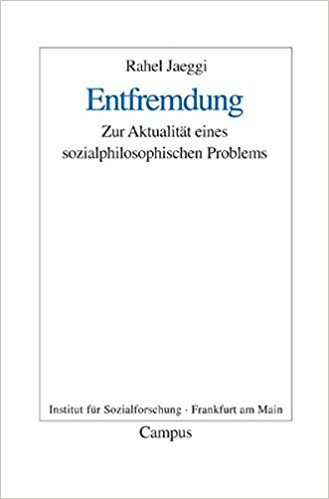
From my reading, it appears that the alienation critique is two-part. First, it has a descriptive component - from what, or from who are we alienated? Secondly, it has a normative component - why is alienation bad, rather than value-neutral or positive? Jaeggi's book does a good job of focusing on the former part by developing, through the latter six chapters, an account of what the self is and how one can be alienated from it. What she doesn't do, however, is focus much on the normative component. As well, it seems to me that there is serious interplay between these two components that is largely ignored.
In terms of her account of the self and how one becomes alienated, Jaeggi does a great job. She gives some concrete accounts of alienation, explains how each is, in their own unique sense, alienating, and then provides a unifying account, based on all of the ways in which each is alienating, as to what alienation is. Her account boils down to something like this: the self is relational, it is what one does and identifies with both in their self and in the world. When the self is alienated from itself, some part of the relation is deficient - our actions don't accord with our identity, our identity is conflicted, etc.
Concerning her discussion of the self, I largely agree. My one critique would be something like so: Given this view of the self, when we consider that each self is, to an extent, built by others before coming into being for itself (parents, education, etc.), does this somehow undermine the authenticity of the self? We can still choose to appropriate new shapes of the self, but won’t the decision to do so itself be conditioned on the given still (i.e. whether we change ourselves depends on how we were raised)? In what sense can it be authentic then, how can it be a self, something individuated, if the basis on which it is individuated is itself something given?
Concerning the normative component of alienation, alienation is understood as bad insofar as it negatively affects one's wellbeing. For Hegel and Marx, their account of wellbeing was objective - there are certain things individuals ought to do, and they are alienated and worse-off to the extent that they do not or cannot. Jaeggi thinks this is contestable, and instead tries to ground her view in what is typically referred to as desire-satisfaction theory of wellbeing, a subjective view. What is good for the agent is what they desire (typically with a few more qualifiers). She fails to develop the normative component beyond this, but I take the normative force to be something like this: alienation is bad insofar as it inhibits the agents ability to effectively pursue desires, or have desires.
While she does not really engage with the wellbeing literature, it is important to note that this kind of view is not incontestable. While desire-satisfaction theory is probably the most popular, it is by no means accepted by all. So, her view is still contestable in this sense. As well, there are aspects of desire-satisfaction theory that seem to be alienating. If we consider the problem of adaptive preferences, agents whose desires/preferences adapt to their situation, it seems that the normative component can be alienating in its own way. If an agent has a certain desire iff it is in a certain set of conditions, and if it were otherwise, they would not have the desire, it seems the idea of desire-satisfaction theory as being an exhaustive account of what is good for the agent is problematized. Certainly, it seems, it would be good for the agent to not adapt, to not have their feasible set of desire-targets arbitrarily restricted. If this is so, it problematizes Jaeggi's account insofar as it relies on desire-satisfaction theory being an exhaustive account of what is good for the agent. This would mean that, potentially, not all alienation will be bad - we may even think being alienated from adapted preferences would be good. This would mean that the alienation critique loses its normative force.
Another issue is whether it is always appropriate for an agent to appropriate some part of the world. In Jaeggi's account, an agent is alienated insofar as they don't make the world their own by appropriating some part of it. However, if we consider a world that is morally repugnant, is it good to make some part of it our own? Would it not be preferable for the agent to, in a way, internalize themselves and withdraw from the world? Consider the case of a woman who lives in a sexist society - she can make the world her own by buying into her role as conceived by the patriarchy, or she can alienate herself from the world and refuse, thereby saving her dignity. It isn't clear if, or how Jaeggi's account can handle cases like this where it seems better for the agent to have her dignity, rather than to appropriate some part of a repugnant world.
Lastly, it seems that Jaeggi's account necessitates that people view themselves as responsible agents, and disallows the possibility of non-agential alienation. Depending on how robust of an account one makes of agency, it seems that this means all but normally functioning adult humans cannot be alienated. This seems potentially problematic - if we consider a case in which a non-human animal's habitat is destroyed, it seems as though they are, in a way, being alienated. Jaeggi's conceptual framework does not allow for us to say this, but it seems to be somewhat plausible to say so.
As well, even in trying to avoid the essentialism of her predecessors, Jaeggi provides essentialism of her own by necessitating that people view themselves as responsible agents. It isn't clear why I ought to view myself as a rational agent - could I not instead be a child for life, disavowing responsibility? Why is this problematic? Attempts to answer this question may bring in more conceptual baggage and make it harder for Jaeggi's account to remain relatively-essentialism-free.
Overall, the book is interesting and well-written and argued. She pulls from a plethora of diffuse thinkers and provides an interesting synthesis of their thought. While the book has its flaws, it is most certainly worth reading.