Arthur Machen was a leading Welsh author of the 1890s. He is best known for his influential supernatural, fantasy, and horror fiction. His long story The Great God Pan made him famous and controversial in his lifetime, but The Hill of Dreams is generally considered his masterpiece. He also is well known for his leading role in creating the legend of the Angels of Mons.
At the age of eleven, Machen boarded at Hereford Cathedral School, where he received an excellent classical education. Family poverty ruled out attendance at university, and Machen was sent to London, where he sat exams to attend medical school but failed to get in. Machen, however, showed literary promise, publishing in 1881 a long poem "Eleusinia" on the subject of the Eleusinian Mysteries. Returning to London, he lived in relative poverty, attempting to work as a journalist, as a publisher's clerk, and as a children's tutor while writing in the evening and going on long rambling walks across London.
In 1884 he published his second work, the pastiche The Anatomy of Tobacco, and secured work with the publisher and bookseller George Redway as a cataloguer and magazine editor. This led to further work as a translator from French, translating the Heptameron of Marguerite de Navarre, Le Moyen de Parvenir (Fantastic Tales) of Béroalde de Verville, and the Memoirs of Casanova. Machen's translations in a spirited English style became standard ones for many years.
Around 1890 Machen began to publish in literary magazines, writing stories influenced by the works of Robert Louis Stevenson, some of which used gothic or fantastic themes. This led to his first major success, The Great God Pan. It was published in 1894 by John Lane in the noted Keynotes Series, which was part of the growing aesthetic movement of the time. Machen's story was widely denounced for its sexual and horrific content and subsequently sold well, going into a second edition.
Machen next produced The Three Impostors, a novel composed of a number of interwoven tales, in 1895. The novel and the stories within it were eventually to be regarded as among Machen's best works. However, following the scandal surrounding Oscar Wilde later that year, Machen's association with works of decadent horror made it difficult for him to find a publisher for new works. Thus, though he would write some of his greatest works over the next few years, some were published much later. These included The Hill of Dreams, Hieroglyphics, A Fragment of Life, the story The White People, and the stories which make up Ornaments in Jade.
Told from a young woman's point of view, The Novel of the White Powder is a story of a young man who goes from a diligent, if a bit obsessed, student of the law to something completely inexplicable and terrifying.
First the sister tries to get her brother to stop reading and studying so much. He does that eventually, but his behaviour soon changes for the worse. Their doctor prescribes some kind of cure and the man starts using it. The suspense mounts bit by bit. It soon becomes clear to his sister that there is something seriously wrong both with the medicine and her brother.
Creepy, great story. No wonder he influenced Lovecraft.
(1895) Straight-up horror, here. The narrator is concerned about her brother. Intent on becoming a lawyer, he has devoted himself to his studies... to the point of obsession. His health seems to be declining from stress and long hours. Finally, she convinces the young man to see a doctor. He returns with a prescription - and soon, he's more outgoing and relaxed. She breathes a sigh of relief - but not for long, as the pendulum swings in the other direction. Soon, he's out partying all the time, neglecting his studies completely. And that's only the beginning...
The first section, the story, is excellent. I wasn't so enthused about the overlong 'explanation' appended to the story. I felt it detracted from the horror.
A man is prescribed a mysterious white powder for his malaise and is instantly pepped up; however, over time, the continued use of the drug changes his habits, until eventually he locks himself in his room and refuses to come out.
With a description like that and a title about 'white powder,' I thought surely this must be a cocaine prescription, since I knew it was widely used in the West during this time.
Alas, this is an Arthur Machen story, so of course the white powder in question has supernatural origins, and quite supernatural side effects on the poor patient,
So this one is recommended, for those who like their tales dark and gothic.
(1895) Another tale from The Three Imposters. (I should probably just read the book).
“It has tempted me to doubt the Eternal Goodness which can permit nature to offer such hideous possibilities…”
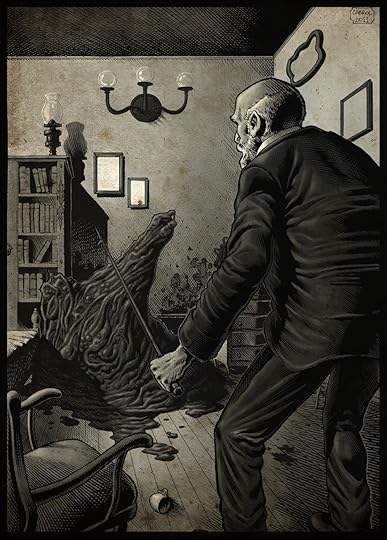
The horror in this short story is twofold. It plays off the fear of losing a loved one to a malign influence and being helpless to stop it, and then adds to that body horror that rivals The Fly, as the brother becomes a shut-in, and his transformation is made more loathsome because you only catch signs of it, in the shuffling steps, and the gurgling and incomprehensible voice, and the stump of a hand glimpsed at the window. It’s also more horrifying to imagine the change by the abject terror it causes in others, such as the sister, and the stolid doctor. What drives the narrative forward is simply seeing a character act strangely. Humans are inquisitive creatures.
At the end Machen delivers a lecture expanding on his usual theme, in which he tries, not wholly unconvincingly, to find the spiritual in the material.
“I think you cannot have failed to notice that for some time hypotheses have been advanced by men of pure science which are nothing less than transcendental… Omnia exeunt in mysterium, which means, I take it, that every branch of human knowledge if traced up to its source and final principles vanishes into mystery.”
Again, Machen hastens to separate himself from the popular craze for mesmerism, theosophies, materializations—all the “machinery of poor tricks and feeble conjuring, the true back-parlor magic of shabby London streets.” And again, as in The White People, he seems to suggest that there is some truth in our “primal fall,” some “awful thing veiled in the mythos of the Tree in the Garden.” Same premise as “Novel of the Black Seal”—that our myths have a basis in terrifying fact.
Arthur Machen’s The Novel of the White Powder feels surprisingly ahead of its time. Part of The Three Impostors, it’s one of the earliest stories to explore horror through the body’s transformation and decay—the very things that would later define body horror. The premise—a prescription gone wrong, causing the body to turn on itself rather than producing an external monster—feels almost prophetic, and it’s easy to see echoes of it in the work of later horror masters like David Cronenberg. Whether or not Cronenberg was influenced directly by Machen, the similarities are striking. The story taps into the terrifying idea that medicine, meant to heal, could instead unleash horrors that start in the mind and slowly consume the body.
Fans of Lovecraft will also spot Machen’s influence in stories like Cool Air and The Colour Out of Space, which explore the unsettling transformation and decay of the human body. Machen was one of Lovecraft’s key literary inspirations, and The Novel of the White Powder makes it easy to see why: its subtle, creeping horror and existential dread laid the groundwork Lovecraft would later expand on.
Even today, the story remains a fascinating piece of horror history. Its premise still feels fresh and disturbing, and for anyone curious about the roots of body horror—or just looking for a classic horror tale that holds up—The Novel of the White Powder is a must-read. Machen’s writing carries a refined, Victorian sense of horror that’s both haunting and timeless.
This was difficult to wrap my head around. Its 6 in the morning here but I'm now questioning reality and how safe any medicine ever is. This is more in line with what I expect of classical literature in comparison to other stories I have read or listened to lately. Although the religious imagery didn't rest well with me.
Then again what story of old doesn't have some form of connotations to religion?
That white powder though, the poor guy who had taken it really did have the trip of his life on it
This entire review has been hidden because of spoilers.
The story is great! The narrator was a lady named Lee Ann Howlett her voice was great to listen to made the story fin great job...I would love to hear more by this narrator! I received the audio book free in exchange for honest reviews
Despite the title, this is a short story, and actually on the shorter side of short. It was originally published in 1895 along with two other interwoven stories in a work called "The Three Imposters." I have not read the collection but this piece stands on its own as a short tale. The story is simple. An Englishman from the upper class is studying for the law and begins suffering from what might be called "nervous exhaustion." He is prescribed a white powder by his doctor and at first he seems full of renewed energy and vigor. However, the powder begins to take an awful toll and the man becomes more and more reclusive until...well, you'll need to read to find out. The story is told by his concerned brother, and in the course of the tale we find that the medicine prescribed by the doctor is not what the pharmacist supplied. As the basis of the drug, the pharmacist used a container of powder that had been on his shelves for many years and had been chemically altered by that long exposure into another substance called Vinum Sabbati--a witch's brew.
The story is pretty simple but effective. Since it's told by the brother, we don't "see" or experience the man's transformations except second hand. This was a common storytelling technique in those days and is still used today, although not as commonly. However, the writing is very fine and we get a good sense of mounting dread from the story. One can see how this tale was likely a strong influence on H. P. Lovecraft and his nameless horrors.
I suspect that Machen's influence here came at least partially from the writings of Sigmund Freud on Cocaine, which mostly appeared between the years 1884 and 1887. The drug was well known by the time Machen wrote this story, and quite a few doctors and researchers had extolled its virtues, although it's less desirable effects were also becoming known.
The collection called "The Three Imposters" is available for free on Project Gutenberg, although I bought this standalone story through Amazon. I've not read the Gutenberg collection but have downloaded it. The link is: https://www.gutenberg.org/ebooks/35517
Arthur Machen’s “The Novel of White Powder” is a short horror story that is ghastly and tragic. Machen’s “The Three Imposters” has 14 short stories that are connected to each other and when I read this short story from a collection of horror stories from different authors, I had a-totally different opinion of what was happening. When I read the whole 14 stories and then re read the Prologue, I saw the true circumstances.
My first impression Miss Leicester’s brother has taken a ancient powder that has changed him into something horrific and how she was a victim.
Story in short- A young lady tells Dyson, who she found visiting a friend in the apartment above , her story of distress and her need of help in a man with spectacle following her.
This lady’s story about her brother is made up, it seems she is Miss Lally also from the “Novel of the Black Seal” which she made up too. It is clear that the man she says is chasing her is actually being chased by her and her evil partners who in search of the man that was one of her accomplices but was horrified and wanting to get away, also he had the gold coin which he dropped and Dyson picked up unawares. When he hears from her about the man with the glasses, he wanted nothing to do with her because he saw this man was harassed. She wanted to entice him in helping her and losing his life like others that went her way in the horror house.
Bizarre and ludicrous is what this story turns out in the end. What we have here is a white powder, having sat on the medicine shelf for years at a pharmacist stop, and upon subjected to fluctuating temperatures over the years has turned naturally into something called the vinum sabbati . This ancient formula was apparently used centuries ago to release the inner demon within a human and a black gooey, evil mass is what remains of our protagonist!
Needless to say, that the whole temperature fluctuation and chemist's intimate knowledge of centuries old, obscure formula for demonic release is ludicrous, to say the least.
Dositej Beograd, 1989. Preveo Ivan Ott Ova novela je osrednje kvalitete, pomalo filistarska. Jezično govoreći nije loša, posjeduje elemente atmosferičnosti te gradi određene scene s izraženijim nabojem. Sadržajno govoreći; jednostavno tipična spika ranomodernističkog horror žanra. Od Machena sam već pročitao https://www.goodreads.com/review/show..., izuzetno loš tekst. Ovdje je bolji, no ništa specijalno.
Read for Victorian Literature class. The vagueness of certain descriptions was slightly frustrating ("The thing I saw was horrible!") That style of the writing reminded me of Lovecraft, and I just learned in class that Lovecraft was inspired by Arthur Machen, so that tracks. Interesting to see how the supernatural overlaps with the scientific in these kinds of stories.
Upper class male behavioral patterns in late 19th century London with a mixture of the supernatural. Reminiscent of R.L. Stevenson's Jekyll and Hyde with chemical transformations.
A clearer connection could have been made between the medication and the motivations of the participant.
One of the more ghastly "transmutations" featured in The Three Imposters. Not as compelling as "The Black Seal." The brother's end does recall the dissolution of Helen Vaughan. (And looks forward to the end of Hell, Said the Duchess! as well.)
This entire review has been hidden because of spoilers.
The story concerns a man whose behavior alters dramatically as the result a change in his prescription. However, even though some of these changes are for the better, his sister (Miss Leicester) remains skeptical, and as it turns out for good reason.
By the standards of today's horror and witchery, it is a bit dull BUT the Lovecraftian horror and the witchery and the substance intake... Gosh, that was very pleasurable and interesting! Need more of Machen in my life.
Una storia horror invecchiata bene. Per chi volesse ascoltarla, su Youtube la trovate con il titolo: Il romanzo della Polvere Bianca letta da Vir la forza delle parole
Every medicated person’s worst nightmare! Easy to see how Lovecraft found this inspiring. Excited to read more by Arthur Machen. Shout out to HP Lovecraft Historical Society’s Literary Society!