'These haiku and senryu by writers from India transcend all geographical, social and cultural boundaries and enter the experience of the readers, no matter where they might live.'
LYNNE REES, well-known haiku writer and co-editor, Another Country: Haiku Poetry from Wales
Delicately weaving through life's tapestry of love and loneliness, joy and grief, the verses in this long-awaited collection brilliantly showcase the exquisiteness of the haiku and senryu, allowing readers to embrace the beauty of each poetic moment. Exploring 'the pragmatic and the metaphysical with humour, heartbreak, profound insight and a serious appreciation of language chosen for its precision and suggestiveness', these poems traverse the whole gamut of human experience.
Compiled and edited by accomplished haiku writers Kynpham Sing Nongkynrih and Rimi Nath, Late-Blooming Cherries features contributions from some of the most prominent haiku artists in India. True, in essence, to the meaning of 'haiku', or 'pleasure verse', and much like the late-blooming cherries of Shillong, this book--which invites readers to reflect on life, nature and human bonds--is meant to be savoured slowly.
As the title suggests, the book is a collection of heart-touching Haiku and Senryu poems by poets from across India.
Despite being a poet, I don’t read contemporary poetry books often. However, when I saw this one, I knew I had to try it. A Haiku is a three-line poem with a fixed syllable count (17). It is a traditional Japanese poetry form with a seasonal reference and a cutting word (usually in the second line).
However, a simplified version involves only the syllable count – 5-7-5. Similarly, a Senryu is very much a Haiku except for the theme. It deals with human emotions, albeit using dark humor.
This book is a compilation of both types of poems, offering us a good variety of themes. I remember the first time I wrote a Haiku. It was incorrect, lol. I counted words instead of syllables. Then, I figured it out (with help, of course). Luckily, I also found a free online Haiku syllable counter tool for verification. I still use the same tool for all syllable-related poems.
Coming to the contents, the book has poems by 58 poets. As mentioned in the book, some poets have contributed five, while some have twenty pieces. We get the poet’s brief bio and their poems. This goes on until the end.
It starts with a foreword, an introduction (by the curator), and a detailed note about Haiku poems. These are informative and useful, especially if you don’t know about Haiku and still want to read the book.
In the introduction, the curator talks about the title and the story behind it. I love it when we get a sneak peek into the backend process. If you want a hint, google yae zakura. Furthermore, learning a bit about the use of the Haiku form in Indian poetry (English and vernacular) was exciting. I didn’t realize we had shows and books dedicated to it! Still, this poetry form hasn’t gotten much exposure.
In the note, I learned about the concept of Zen Buddhism behind Haiku’s simplicity. Don’t skip the initial pages if you read this book. The poems are important; sure. But the background information is equally important. That’s how you can fully enjoy the poems that follow. Think about it. We are told Haiku is not about philosophy but about being in the present. If you miss reading this, it will impact how you perceive the poems. (Sometimes the curtains are blue because it’s the only color left in the store).
Though I loved many, I can’t mention them all here! Sharing only a couple of lines that stayed with me. Note that not all poems follow the conventional 5-7-5 format. Some use the shorter version of 3-5-3 syllables.
mulberry silk – cocooned in the fragrance of grandma
amavasya my scars eclipsed for a night
two flowers – a hand takes away one
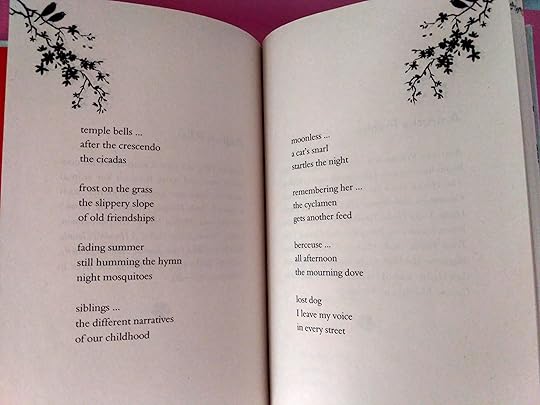
I have to mention the book’s design. It’s a cute little hardbound book with a pastel cover and a contrasting spine. What I loved was those little cherry branches from the corner of each page. So cute, right?
How can it be that I review a Haiku book and not write at least one of my own?
In my hands at last – Little late-blooming cherries Emotions brimming
To summarize, Late-Blooming Cherries is a heart-touching and poignant collection of Haiku poems from diverse poets. Some simple, some pleasant, some poignant, and some heart-breaking; but all expressed in a handful of words!
Thank you, Blogchatter and HarperCollins India, for a copy of the book. This review is voluntary and contains my honest opinion about the book.
A huge shout out to Nandini T from HarperCollins India. I was approved for the book sometime last year, but due to some logistics glitch, I didn’t receive it. When I remembered about it, I sent an email to the publisher explaining the issue. Nandini replied and offered to send a new copy, which reached me in three days. Thank you!
many thanks to harper collins india for sending across this book to me
this was such a beautiful book! i thought it was very inclusive in including the works of so many haiku poets from across india. it had a good introduction section also that really educated me (and i am sure many other readers like myself, who do not have much of an idea when it comes to haiku poetry).
this book really shows the reader how quality always wins over quantity. take these haikus for example. they are three short lines (with exceptions and variations, of course). the words in these three lines are but a small thimbleful. and yet, they encompass the world within them! reading these really reminded me of willaim blake in auguries of innocence: "To see a World in a Grain of Sand And a Heaven in a Wild Flower Hold Infinity in the palm of your hand And Eternity in an hour"
- the perfect explanation for haiku.
i would definitely urge you all to pick up this collection as well. savour them as i did - i read a few every morning as i woke up and sometimes while i had my morning tea, and also every night before i fell asleep. there were days when i also picked up this collection in the midst of the day when i was tired with work and wanted to feel one with nature. what a brilliant little book!
The most famous haiku is arguably “Old Pond / A Frog Jumps in / The Sound of water “by Matsuo Basho. This haiku, written in the 17th century, is a perfect example of the traditional Japanese form, capturing a simple moment in nature with vivid imagery and a sense of impermanence.
Haiku topics are traditionally about nature, the seasons, animals, and other natural occurrences. Haikus focus on singular, fleeting moments in time and on small details that are often overlooked. Some common themes seen in Haikus include lost moments, love, moral concepts, and contrasting elements.
Traditionally, haiku is about nature. One common theme explored by historical and modern haiku poets is seasonal changes. Often, a haiku focuses on a single moment in time and, in many cases, juxtaposes two images.
As the form has evolved, many of its regular traits—including its famous syllabic pattern—have been routinely broken. However, the philosophy of haiku has been preserved: the focus on a brief moment in time; the use of provocative, colorful images; the ability to be read in one breath; and a sense of sudden enlightenment.
The haiku is a Japanese poetic form that consists of three lines, with five syllables in the first line, seven in the second, and five in the third. The haiku developed from the hokku, the opening three lines of a longer poem known as a Tanka.
The Tanka was a popular form of poetry in Japan for centuries and was used to express a wide range of emotions, from love and desire to grief and longing. The influence of Chinese poetry on Japanese culture also played a significant role in the development of Haiku.
Another important aspect of the 5-7-5 format is the idea that a good Haiku answers three questions: Where, When, and what. The autumn dusk. In the first line, Basho tells you where the action of the poem is taking place, offering you a visual to immediately connect with.
Originally, the haiku was supposed to give a description of nature suggestive of one of the seasons, evoking an emotional response. The form gained distinction in the 17th century with the great master Basho. He enriched the haiku and made it an accepted medium of artistic expression.
Haiku is a form of poetry that focuses on a brief moment in time, and a sense of sudden illumination or enlightenment. A haiku is usually composed of seventeen syllables in three short lines. The first line often contains five syllables, the second line seven syllables, and the third line five syllables.
With an endless list of possibilities and properties of engaging poets and readers alike, Here comes a book of Haiku by Indian poets titled LATE BLOOMING CHERRIES Edited by Kynpham Sing Nongkynrih and Rimi Nath.
It carries the works of nearly 60 eminent Haiku poets from India. Each piece is distinct and the culmination of them all in one book is a boon for poetry lovers and a rare privilege bestowed upon readers. Haiku is not new to India. Haiku poetry fascinated both Rabindranath Tagore and Subramanya Bharathi — revered poets from Bengal and Tamil Nadu — at the beginning of the last century.
Senryu is a Japanese form of short poetry similar to haiku in construction: three lines with 17 or fewer morae (or on) in total. However, senryu tend to be about human foibles while haiku tend to be about nature, and senryu are often cynical or darkly humorous while haiku are more serious.
senryu, three-line unrhymed Japanese poetic form structurally similar to haiku but treating human nature, usually in a satiric or ironic vein. Whereas haiku focuses on nature, senryu is concerned with human nature and its foibles. Senryu also finds a place in this book along with Haiku.
Haiku engages your mind, increases your attention to nature, and lifts your spirits. The rules are simple and can be relaxed if you choose. Traditionally, these short poems focus on nature, but themes and humor are fine too. Poets try to capture a moment in time with both richness and simplicity.
Haiku has a calming effect that in an instant can take readers to a different place and time and in doing so, makes them feel the words of each poem as if they were there. Haiku is about feelings and the connection of words to people's life experiences. Reading this book will surely make you agree with this statement.
Some haiku can seem deceptively simple at first glance--too short, simple, and every day, some might argue, to be "great" poetry. But haiku's richness and the reward for haiku readers, lie in its brief and compressed suggestiveness, engaging the reader's participation in ways that longer poetry cannot do.
A traditional Japanese haiku is a three-line poem with seventeen syllables, written in a 5/7/5 syllable count. Often focusing on images from nature, haiku emphasizes simplicity, intensity, and directness of expression.
There are haikus for humor, to raise social awareness, to evoke emotions, or to reminisce on the past. The idea of compression, though, remains the same. Haikus are a microcosm of a larger idea or feeling. They are brief, poignant, and powerful.
A good haiku often captures or produces a moment of epiphany—a moment of realization, understanding, or suchness. One way haiku crystallizes epiphanies is by being immediate and accessible, avoiding artifice. The poem happens now, in the present tense, and focuses on the common and the simple.
Haiku is a poetry of seasons. Because haiku is short, people can remember them easily. For example, everybody, even foreigners who do not speak Japanese, can learn Basho's haiku by heart due to its conciseness. Its shortness enables many people to write and enjoy haiku.
Simplicity is undoubtedly a key feature of haiku, but to me, these poems have everything and nothing to do with simplicity. They depict beauty and art in the simplest of things, yet the language selected to express such imagery is so deliberate that it leaves no word vacant of complexity and meaning.
Do grab a copy of the book and immerse yourself in the views expressed by Haiku poets and definitely you will enjoy it to the core.
The cover and title alone were enough to entice me to pick up this book, a collection of haiku and senryu, Japanese poetic forms. The introduction offers a glimpse into the connection between the title and the contents, while A Note on the Haiku provides a clear explanation of the various aspects of this poetic form, making it a valuable resource for those new to haiku. These Haiku and Senryu, crafted by poets from all over India, encompass a diverse range of themes. Within the pages of this anthology, a kaleidoscope of human experiences and emotions unfolds, each delicately captured in the concise beauty of haiku and senryu. Whether you're seeking a quiet moment of reflection or a quick burst of inspiration, this book welcomes you to savor its delightful poems at any turn. Each poem gives us a glimpse of the author before unveiling the haiku or senryu itself, inviting a deeper connection with the verse. From the intricacies of nature to the profound depths of human feeling, this anthology encompasses a remarkable breadth of themes. As a newcomer to this form of poetry myself, I found myself captivated by the charm of this collection, and it has ignited a desire to delve deeper into the haiku and senryu genres. If you have an affinity for poetry, cherish the beauty of haiku, or simply yearn to explore this captivating style, I wholeheartedly recommend picking up this book and immersing yourself in its exquisite verses.
Lately I, myself have started to enjoy reading Haiku’s a lot and I got my hands on this amazing book “Late Blooming Cherries” written by 58 astonished poets. Each Haiku brings out different emotions about life, death, celebration, about loneliness, tides, seasons, describing the different beauty of nature. The poets have their own unique way of showcasing their words and bringing in their sentiments.
The book itself is such an easy read and one can finish them in just one sitting, the authors have also written in ways where their words are refined but easily understandable for their readers. Every haiku written in this book also complements each other beautifully.
Let’s talk about some of my favorites, the haiku by Arvinder Kaur is so relatable, he basically sums up one’s life in his haiku and not just the good ones but also the bads and the horrifying ones. Anannya Dasgupta’s haiku is another one I absolutely love, the way she talks about the mountains, rivers, the sun and prayers, it was all so beautiful. All in all this book is totally worth the read, every page you turn brings out all different kinds of emotions and some of them take you to places through the words. Being a poet myself I’ve always loved reading a good poem and lately I’ve been seeing a lot of haiku’s, honestly I am fascinated by it myself. This book is a must read for all poetry lovers.
Late-blooming Cherries is a captivating collection of haiku and senryu poetry that takes readers on a journey through the intricacies of life. The verses delicately intertwine themes of love, loneliness, joy, and grief, creating a tapestry of emotions that resonate deeply with the reader. The editors, Kynpham Sing Nongkynrih and Rimi Nath, have curated a remarkable selection of poems from some of India's most talented haiku artists.
As I read through the pages of Late-blooming Cherries, I found myself captivated by the exquisite imagery and the evocative nature of the verses. The poems invite contemplation and reflection, encouraging readers to pause and appreciate the intricacies of life, nature, and human connections.
Much like the late-blooming cherries of Shillong, this book is a slow-burning delight. It is meant to be savored, allowing the reader to fully appreciate the flavors and nuances of each poem. Whether you are a seasoned lover of haiku or new to the genre, this collection is a must-read for anyone who appreciates the beauty and power of concise and evocative poetry.
Late-blooming Cherries is a true gem in the world of haiku and senryu, and I highly recommend it to anyone seeking a poetic journey through the tapestry of life's experiences.
This beautiful, beautiful book evoked so many emotions, but mainly wonder, content, longing, and nostalgia. The imagery in these haiku was stark and had a flavor of Indian-ness to them. Each one of them transported me to different landscapes, seasons, and emotions - that is, somehow, exclusively Indian and universal at the same time.
I always loved haiku for their hard-hitting impact in so few lines. The pictures they create, ever-changing with each new line, and how my mind is trying to keep up with so many emotions is an experience in itself. This book is a rush and a calm breeze all at once.
This anthology delightfully showcased the versatility and creativity of Indian haiku writers, who seamlessly blended traditional Japanese forms with their unique perspectives and experiences. The result is this timeless collection of nostalgia and warmth.
I love how I connected with it so effortlessly and absolutely. If you are looking for a refreshing read, you might want to pick this up. It's easy to read and has the potential to take you back in time!
Unexpected showers every puddle sets free the child in me
First let's talk about the hardcover of this book. It's so very compelling! Starting from the beautiful design of the cover, the red endpapers to the pages.. it felt like being in nature.
So "Late-Blooming Cherries: Haiku Poetry from India" is a delicate and thoughtful collection of poems. Through the simplicity of haiku and senryu, the poets express powerful emotions such as love, loss, joy and sorrow, while also reflecting the profound connection between nature and the human experience.
Each verse is a mix of simplicity and depth, I had to pause and savor the meaning behind the words. Featuring some of India’s finest haiku poets, the anthology is a tribute to the art of minimalistic poetry, where each word carries weight and significance.
Like the late-blooming cherries in Shillong, the poems gradually unfold their beauty. They talk about nature; like seasons, animals, natural events. Despite being short they hold power to make someone feel and relate to it so much.
This book is an invitation to slow down and appreciate the small but meaningful moments that define our lives. It's a meditative experience.
An incredibly well curated anthology of haiku poetry from India , this book spills serenity amidst chaos. Edited by Kynpham Sing Nongkynrih and Rimi Nath, Late Blooming Cherries is a scholarly achievement to bring together a bunch of haiku and senryu emanating flavour and fragrance of different terrains of this subcontinent. The book made me smile, feel pensive, compelled me to reflect on life and relationships and throbbed a desire to be more into Nature and imbibe from it's imperceptible but intensive ways of teaching and showing the deeper truths of existence. A must for all poetry lovers.





![Profile Image for Padmajha [PJ] Me and My Bookshelf.](https://i.gr-assets.com/images/S/compressed.photo.goodreads.com/users/1716366774i/12703387._UX200_CR0,0,200,200_.jpg)