

What do you think?

A History of the Great War #2
The Eastern Front: A History of the First World War
The second instalment in Lloyd's bravura history of the First World War, The Eastern Front chronicles the bloody fighting in Eastern Europe and the Balkans through diary entries, eyewitness reports and memoirs.
The definitive history of the Eastern Front in the First World War, from the acclaimed military historian and author of Passchendaele and The Western Front.
In the second volume of his landmark First World War trilogy, Professor Nick Lloyd tells the story for the first time of what Winston Churchill once called the 'unknown war': the vast conflict in Eastern Europe and the Balkans that brought about the collapse of three empires.
Much has been written about the fighting in France and Belgium, yet the Eastern Front was no less bloody. Between 1914 and 1917, huge numbers of people - perhaps as many as 16 million soldiers and two million civilians - were killed, wounded or maimed in enormous battles that sometimes ranged across a front of 100 km in length.
Through intimate eyewitness reports, diary entries and memoirs - many of which have never been translated into English before - Lloyd reconstructs the full story of a war that began in the Balkans as a local struggle between Austria-Hungary and Serbia, and which sucked in Russia, Germany and Italy, right through to the final collapse of the Habsburg Empire in 1918.
The Eastern Front paints a vivid and authoritative picture of a conflict that shook the world, and that remains central to understanding the tragic, blood-soaked trajectory of the entire twentieth century, including the current war in Ukraine.
The definitive history of the Eastern Front in the First World War, from the acclaimed military historian and author of Passchendaele and The Western Front.
In the second volume of his landmark First World War trilogy, Professor Nick Lloyd tells the story for the first time of what Winston Churchill once called the 'unknown war': the vast conflict in Eastern Europe and the Balkans that brought about the collapse of three empires.
Much has been written about the fighting in France and Belgium, yet the Eastern Front was no less bloody. Between 1914 and 1917, huge numbers of people - perhaps as many as 16 million soldiers and two million civilians - were killed, wounded or maimed in enormous battles that sometimes ranged across a front of 100 km in length.
Through intimate eyewitness reports, diary entries and memoirs - many of which have never been translated into English before - Lloyd reconstructs the full story of a war that began in the Balkans as a local struggle between Austria-Hungary and Serbia, and which sucked in Russia, Germany and Italy, right through to the final collapse of the Habsburg Empire in 1918.
The Eastern Front paints a vivid and authoritative picture of a conflict that shook the world, and that remains central to understanding the tragic, blood-soaked trajectory of the entire twentieth century, including the current war in Ukraine.
672 pages, Hardcover
First published March 28, 2024
About the author
Nick Lloyd
14 books108 followersOne of Britain’s new generation of military historians, Nick Lloyd is a Professor of Modern Warfare at King’s College London and the author of four books on World War I, including The Western Front, Hundred Days, and Passchendaele. He lives in Cheltenham, England.
Ratings & Reviews
Friends & Following
Create a free account to discover what your friends think of this book!
Community Reviews
Displaying 1 - 30 of 126 reviews

May 1, 2024
Where the Old World Ended
The First World War is mainly remembered through the snapshot of troubles in Eastern Europe followed by four years of fighting in a small strip of territory in Belgium and France. Most have heard of Gallipoli and maybe even Jutland, but few in the west can recall Tannenberg, Przemyśl or Isonzo. As Winston Churchill called it, it was the ‘unknown war’. There are political and linguistic reasons. English texts are recorded by Russian exiles, whilst the Bolsheviks dismissed it as an imperial precursor to their revolution. Since 1991 and the opening of the Russian Archives our understanding of this war has been increased massively. There are many new works being pushing on this sphere of the fighting, but I would argue none do it quite so well as Lloyd in The Eastern Front, his second offering of his trilogy on the war.
The Eastern Front was dramatically different from its counterpart in the West. The sheer size of the area covered meant that static trench warfare dictated the fighting a lot less. Huge armies could move over sweeping landscapes, at first by cavalry and more increasingly by railway. The Russian Civil War, an extension of WWI was fought along the railways. Another major difference was the political bodies which fought and dissolved following the war. The old world truly did die in the East. The Tsarist and Habsburg Empires collapsed because they lost 3.5 million men between them. Violence and misery popped up out of the revolutions which followed, which was a prologue for the suffering and death which was to follow for the next few decades in the area.
The Eastern Front made Paul von Hindenburg and Eric Ludendorff, who destroyed the Russian army at Tannenberg in August 1914. Germany’s best victory came at the very start of the war. As we know once the Schlieffen Plan failed, they could not win the war. In Russia collapsing into Revolution twice in 1917, Germany was able to do a deal with Lenin and the Bolsheviks, who gave up huge swathes of old Tsarist land to come out of the war and secure their grip on mother Russia. Germany could now concentrate its forces on the Western Front, but it was too little too late. America had entered the war and Austria-Hungry was broken and would soon be routed by the Italians. Emperor Karl who had inherited the mess in 1916 had tried everything to get his shattered and ancient state out of the war, but to no avail.
The Eastern Front is a great piece of work by Nick Lloyd. His books on WWI are truly all worth reading. This is a complex topic with huge scope, however he is able to explain things on a tactical and strategic level. The main protagonists and the personalities and politics that drove them are stripped down and explained really well. For me this trio logo is a baseline to understand this war once the decision was made to mobilise. I cannot wait for the third and final instalment.
The First World War is mainly remembered through the snapshot of troubles in Eastern Europe followed by four years of fighting in a small strip of territory in Belgium and France. Most have heard of Gallipoli and maybe even Jutland, but few in the west can recall Tannenberg, Przemyśl or Isonzo. As Winston Churchill called it, it was the ‘unknown war’. There are political and linguistic reasons. English texts are recorded by Russian exiles, whilst the Bolsheviks dismissed it as an imperial precursor to their revolution. Since 1991 and the opening of the Russian Archives our understanding of this war has been increased massively. There are many new works being pushing on this sphere of the fighting, but I would argue none do it quite so well as Lloyd in The Eastern Front, his second offering of his trilogy on the war.
The Eastern Front was dramatically different from its counterpart in the West. The sheer size of the area covered meant that static trench warfare dictated the fighting a lot less. Huge armies could move over sweeping landscapes, at first by cavalry and more increasingly by railway. The Russian Civil War, an extension of WWI was fought along the railways. Another major difference was the political bodies which fought and dissolved following the war. The old world truly did die in the East. The Tsarist and Habsburg Empires collapsed because they lost 3.5 million men between them. Violence and misery popped up out of the revolutions which followed, which was a prologue for the suffering and death which was to follow for the next few decades in the area.
The Eastern Front made Paul von Hindenburg and Eric Ludendorff, who destroyed the Russian army at Tannenberg in August 1914. Germany’s best victory came at the very start of the war. As we know once the Schlieffen Plan failed, they could not win the war. In Russia collapsing into Revolution twice in 1917, Germany was able to do a deal with Lenin and the Bolsheviks, who gave up huge swathes of old Tsarist land to come out of the war and secure their grip on mother Russia. Germany could now concentrate its forces on the Western Front, but it was too little too late. America had entered the war and Austria-Hungry was broken and would soon be routed by the Italians. Emperor Karl who had inherited the mess in 1916 had tried everything to get his shattered and ancient state out of the war, but to no avail.
The Eastern Front is a great piece of work by Nick Lloyd. His books on WWI are truly all worth reading. This is a complex topic with huge scope, however he is able to explain things on a tactical and strategic level. The main protagonists and the personalities and politics that drove them are stripped down and explained really well. For me this trio logo is a baseline to understand this war once the decision was made to mobilise. I cannot wait for the third and final instalment.

October 3, 2024
Military and diplomatic history of the primary Central powers Imperial Germany and the Austro-Hungarian Empire and the Allied Imperial Russia and Italy in Central Europe during the Great War of 1914-1918.
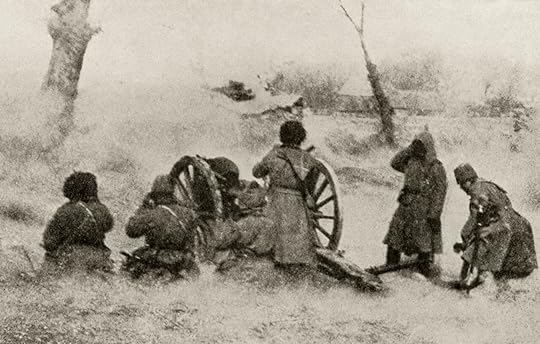
Imperial Russian light field gun in action (1916).
My dead tree, format, hardback was a hefty of 642-pages which included: Illustrations, Maps, Glossary, Notes, Bibliography and Index. It had a UK 2024 copyright.
Nick Lloyd is a British historian and author of military and political history of the early 20th Century. He is the author of six (6) non-fiction books on WWI. This was the first book I’ve read by the author.
Firstly, this is an advanced/intermediate-level text on WWI. It would be very helpful for a reader to have a firm background in early-20th Century Military and Diplomatic history and WWI to fully appreciate this book. In particular, the period in eastern and central Europe should be well understood.
Secondly, this is the second book in a trilogy on WWI written by the author. The first book being The Western Front: A History of the First World War . I did not read that book. It may or may not be helpful? I also suspect some of the deficiencies I found in this book may have been addressed in that first book?
In addition, I recommend having a period atlas on-hand to reference the much-changed place names throughout.
TL;DR Synopsis
Lloyd’s narrative follows a traditional chronological account, of the First World War on the Eastern Front. He focuses on the Central Powers: Imperial Germany, the Austro-Hungarian Empire, and Bulgaria whilst almost completely ignoring the Ottoman Empire. The Allied Powers involved were: Imperial Russia, Serbia, Italy, Romania and Greece with frequent references to France and Imperial Britain.
The book captures most of the significant engagements, diplomatic and internal political events involving of the Eastern Front. Lloyd’s description of the theater wasn’t the typical historical geographical boundaries of the theater of operations. The Italian front historically is separate from the Eastern. In addition, Lloyd's absent Ottoman Empire is historically included in the Front. Military campaigns concentrated on the operational-level. Strategic level of analysis was a bit vague. The see-sawing of advantage on the front during the conflict was well-covered.
The majority and best part of the narrative is the struggle of Russia with the Germans, Austro-Hungarian’s and their internal politics, including those with its revolutionary self. Italy’s war with the Austro-Hungarian’s, its internal politics and the Austro-Hungarian war with the Imperial Russians and its diplomacy and internal politics, particularly of its contentious alliance with Imperial Germany followed in the book’s best work. However, there has a peculiarly, uneven character to the narrative of the members of the military coalitions in conflict. The Imperial German’s received only a minimal amount of attention. Almost none of the narrative covers internal Imperial German internal politics, although military-political decisions are well-covered. Also, the complicated, Austro-Hungarian internal politics were only scantly covered.
Lloyd reaches the currently accepted conclusion to the war. The being, while the war was militarily lost by the Central powers on the Western Front, the post-war collapse of empires on the Eastern Front’s geography, and the formation of the new, imperfect states of central and eastern Europe was the war’s most significant result.
The Review
The book’s writing was very much in the new style of wartime histories. That is, take the reader into the story, develop historical characters, tell a narrative, and in the process point out the larger issues that may not be obvious. Lloyd did well here with that.
However, there were some things that were less-well done. Lloyd had a peculiar definition of The Eastern Front. It was not that used by most historians. He excluded the Ottoman Empire and included the Italian Front in his Theater. I also found the content to be uneven. Significant wartime events and topics found in Eastern Front histories were missing, although others previously unknown were uncovered. Also, Lloyd played favorites. The Russian-related narrative was near-complete. The German much less so.
Lloyd is a writer with good technique. The narrative was clear and factual. My American purchased copy was also written in Americanized English. The book was professionally edited. I found no mistakes in the text, a tribute to the Viking/Penguin publishers. The general tenor of the book was measured and only vaguely academic.
The book assumed an understanding of early 20th Century military history. This may have been an implicit assumption that the author’s previous book, The Western Front: A History of the First World War had been read? It could be technically dense in places. It was assumed the reader was familiar with military terms. For example, “counter battery fire” and “military crest” were used without explanation. Likewise, period tactics, techniques and procedures were discussed with only a hint of "how to". Although, the Close Assault techniques developed to break the stalemate of trench warfare were adequately described.
The presentation was only somewhat even throughout in its level-of-detail. The book followed a chronological order. It started with the assassination of Franz Ferdinand in 1914 and ended with the Austro-Hungarian Armistice of 1918. The book was separated into three parts, each with about eight Chapters. The chapters were obscurely titled after quotes from historical figures taken from within the chapter. Within a chapter, between two and three Theaters of Operations (TO) within the Eastern Theater discussed for the interval of time. Typically this was one to several months. The chapters would focus on the historical theater’s commander. For example, Ludendorff and Hindenburg in East Prussia and Conrad in Galicia. The change in theaters within a chapter could be abrupt. It was only demarked by a line of whitespace.
The book included 16 maps. This at first appeared generous, but the main area of operations was 1,600 kilometres (990 mi) long north to south. Use of maps was barely adequate. It could have been greatly improved. The maps were commercially sourced, “line maps”. Graphically, they were “good looking”. Unfortunately, their presentation and annotation poorly supported the narrative. They did not include enough of the important topographical features. Many of the place names found in the narrative were not found on the maps. I also would have liked standard military symbology to have been used on the maps.
Related to maps, I thought the book would have benefitted from a greater discussion of the varied geographies and the weather of the TOs. For example, the course and importance of the Danube in the Balkans, and the Dniester on the Ukrainian plain. The weather on the Eastern Front was also quite different from western Europe. Temperatures and precipitation were more extreme. This directly affected operations. In addition, a focused discussion of the important rail and road nets in the underdeveloped theater was neglected.
There were 12 pages of B/W photographs, and no diagrams. This was a generous amount for military histories. The photos were period photos of the historical figures mentioned and some location shots. The pictures were a good addition.
Chart and graph usage was non-existent. Their usage would have benefited the reader, in particular given the frequent use of manpower metrics that appeared in the narrative related to engagements. I noted by eyeballing the deployments and casualties that the attacker to defender ratios in many engagements was low, compared to the Western Front. This likely explained the high casualty rates reported?
As promised in the Prologue the Bibliography contained many contemporary works, as well as many old chestnuts. I note that Stone’s, The Eastern Front 1914-1917 (1975 and 1998) was mentioned in the Prologue. This was the goto single volume on the WWI Eastern Front. I noted, my copy is 330 pages compared to this book’s 642.
Most military and diplomatic histories, tell a story of: men, machines and organizations in contention. Lloyd had mixed success with this.
With historical figures introduced in the narrative, Lloyd did a good job fleshing them out. Individuals mentioned were more likely to be mentioned in the context of command in military operations. However, he expected the reader to already have a passing familiarity with the key military and political figures in WWI: Kaiser Friedrich Wilhelm Hohenzollern, Marshal Joseph Jacques Joffre, Herbert Asquith, Emperor Franz Joseph Habsburg-Lorraine, and Tsar Nikolai Alexandrovich Romanov,Et al.. I suspect these historical figures were introduced in his previous Western Front book? Still, I noted some Allied and Central Power political figures did not receive the attention typically given them. In particular: Italian, Greek, Bulgarian, Romanian, and some Austro-Hungarian politicians and royalty. For example, Count István Tisza, the Dual Monarchy’s Hungarian Prime Minister comes off as sounding like a pacifist, who came to a tragic end. Several histories, blame his Hungarian Ultra-Nationalism to have been to the detriment of the Empire’s preparedness for the war.
In general, Lloyd did not describe the technology of the early 20th Century and its war machines or their application and evolution during the war. No army or navy during WWI fought the war they prepared for. Machine guns, steam locomotive railways, long-range heavy artillery, wireless radio, aircraft, and cars and lorries changed the battlefield. Technology should also be seen to include Signals Intelligence, espionage, and code breaking. This includes developing new techniques for dealing with information differently than before the war. In addition, technology was transferred between the allies of the two coalitions. Lloyd only mentioned leaps in technology and their usage, particularly how they differed in the Eastern from the Western Front in passing.
Technology related, was He also neglected to discuss ‘feeding the war machine’. There was only one brief sentence on the Materialschlacht a key factor in the Allied victory. In the mid-war environment of scarcity (labor, time, food and materials) there was a lot of internal Central Power contention between priorities (civilian vs. military). The discussion of the Eastern Front’s resources, their development and expropriation was severely neglected. For example, petroleum was in short supply with the Central Powers from the beginning of the war. Austro-Hungary’s sole source of petroleum was in Galicia was destroyed in the Russian scorched earth retreat in 1915. This went unmentioned. However, the British destruction of the Romanian oilfields 1916 by British engineers was.
Organizationally, the book focused mainly on the military commanders (Falkenhayn, Conrad, Grand Duke Nikolai Romanov, Cadorna et al) shown to be in contention with their governments, and their own service’s organization. Interestingly, the Russians, Italians and Austro-Hungarians armies had the same problem. They were incapable of executing the strategy of their governments. Cadorna and Conrad were similar in both being incapable of recognizing that and rectifying that.
Organizationally, the armies of all sides, except perhaps the Germans, had the wrong doctrine for warfighting with 1914’s technology. The horrific casualties on both sides show this was only slowly changed. A description of the organization of each powers armies, armaments and doctrine going into the war would have been appreciated.
Also organizationally, Lloyd explored the Russian internal politics very well. Frankly, Russia in the WW1 appeared to be the book he wanted to write. Italian, Greek, Romanian, and Serbian came next in order. They were adequately explored.
Notably missing was a deeper understanding of the politics of Austro-Hungary. I thought that the author’s analysis into Austria-Hungary was incorrect. The organizational problems of the Austria-Hungarian Empire were large. The shambolic, dual-state nature of the Empire could not operate in crisis. Count István Tisza, the Hungarian prime minister, politicked to put Magyar interests ahead of the Empire’s. (Austrian PMs hewed more closely to the Empire's interests.) Tisza came out looking like a tragic-figure of a pacifist in the narrative. As a result the Hungarian Magyars were amongst the last in the Empire to starve, to the detriment of the Empire as a whole. The Austro-Hungarian army in almost all respects was likewise hamstrung by the politics of the dual monarchy. In particular, funding and ethnic divisions severely degraded its effectiveness. In addition, the Austro-Hungarian war leader, Fieldmarshal Franz Conrad von Hötzendorf was a liability. It’s unexplained, why he lasted so long? None of his campaigns during the war were successful. That he hung-on, in a command position, until the end of the war was a striking example of the military/political bureaucracy's malfunction. (The Italians had a similar problem with Marshal of Italy Luigi Cadorna.) This book would have been worth reading just for the explanation of Austro-Hungarian politics to the same level Lloyd described Russian politics.
There was no exploration of Imperial German political organization. Kaiser Wilhelm implementing "personal rule" over Germany was not discussed. The strong arming of the Empire by the German’s was the exception to this. Although, that was communicated from the Austro-Hungarian narrative, not the decision making in Berlin.
Finally, there were two glaring omissions from this book—The Ottoman Empire and the Naval War.
Traditionally, the Ottoman Empire was considered part of the Eastern Front. Lloyd barely mentions the Ottomans. The Gallipoli campaign, the Russian Caucasus campaign, the first was significant to the course of the war, the second significant to the post war period. This was a gross omission that was not accounted for.
Secondly, the WWI naval war is scarcely mentioned. References are restricted to the unrestricted U-boat campaign to blockade Britain. Missing are the naval campaigns in the: Baltic Sea, Black Sea, Adriatic, Aegean, and Mediterranean. Russia and Germany had long coastlines on the Baltic. The German and Russian navies essentially mined the Baltic into two parts giving Germany the use of the western portion and unmolested access to Scandinavian raw materials. Russia and the unmentioned Ottoman Empire had long coastlines on the Black Sea. Defeat of the Russian Navy the Black Sea into an Ottoman lake. There was an extended riverine campaign on the Danube. Clearing the Romanian mouth of the Danube allowed the waterborne supply of the Ottomans from Central Europe. Austro-Hungary and the Italians contested control of the Adriatic. Both Austro-Hungarian and later German U-boats based their interdicted Allied commerce and military supply in the Aegean and Mediterranean.
Summary
I felt this was very lumpy book. Parts of it, particularly the discussion of Russia in the theater were very good. However, other parts that have traditionally been considered historically significant either received short-shrift or went unmentioned. There was too much missing, or unwritten in this book.
From a military history standpoint, most of the narrative was at the operational-level. This was very good. The military commanders were well done. However, a focused discussion of the high-level strategy of the powers and the effect of geography, weather, the tightening of resources was missing.
The diplomatic/political history was mixed. The Russian diplomatic/political history was excellent. The diplomatic/political machinations was of the Germans was almost a black box. The politics and diplomacy of the other combatants widely ranged in-between. For example, I can’t recall any discussion of German political decisiones to the level at which the French and British PMs were discussed.
The omission of the Ottoman Empire from the narrative was bizarre.
Another stark omission was the campaigns of the naval war was ill covered.
This book was a good operational military history, on which subject the author does a good job. It’s a better military and diplomatic history, if you’re most interested in the Russian involvement in WWI’s Eastern Front. However, it goes downhill from there. The diplomatic and internal politics of the remaining combatants is very uneven.
This would be a worthy read if you’re interested in flags waving, guns firing, and bugles blowing on the Eastern Front. However, what was unwritten about the non-Russian combatants, internal politics and diplomacy over staying in-the-war was more important. And, it wasn't there.
Readers may want to read The Eastern Front 1914-1917 by Norman Stone (my review) before reading this.
Imperial Russian light field gun in action (1916).
My dead tree, format, hardback was a hefty of 642-pages which included: Illustrations, Maps, Glossary, Notes, Bibliography and Index. It had a UK 2024 copyright.
Nick Lloyd is a British historian and author of military and political history of the early 20th Century. He is the author of six (6) non-fiction books on WWI. This was the first book I’ve read by the author.
Firstly, this is an advanced/intermediate-level text on WWI. It would be very helpful for a reader to have a firm background in early-20th Century Military and Diplomatic history and WWI to fully appreciate this book. In particular, the period in eastern and central Europe should be well understood.
Secondly, this is the second book in a trilogy on WWI written by the author. The first book being The Western Front: A History of the First World War . I did not read that book. It may or may not be helpful? I also suspect some of the deficiencies I found in this book may have been addressed in that first book?
In addition, I recommend having a period atlas on-hand to reference the much-changed place names throughout.
TL;DR Synopsis
Lloyd’s narrative follows a traditional chronological account, of the First World War on the Eastern Front. He focuses on the Central Powers: Imperial Germany, the Austro-Hungarian Empire, and Bulgaria whilst almost completely ignoring the Ottoman Empire. The Allied Powers involved were: Imperial Russia, Serbia, Italy, Romania and Greece with frequent references to France and Imperial Britain.
The book captures most of the significant engagements, diplomatic and internal political events involving of the Eastern Front. Lloyd’s description of the theater wasn’t the typical historical geographical boundaries of the theater of operations. The Italian front historically is separate from the Eastern. In addition, Lloyd's absent Ottoman Empire is historically included in the Front. Military campaigns concentrated on the operational-level. Strategic level of analysis was a bit vague. The see-sawing of advantage on the front during the conflict was well-covered.
The majority and best part of the narrative is the struggle of Russia with the Germans, Austro-Hungarian’s and their internal politics, including those with its revolutionary self. Italy’s war with the Austro-Hungarian’s, its internal politics and the Austro-Hungarian war with the Imperial Russians and its diplomacy and internal politics, particularly of its contentious alliance with Imperial Germany followed in the book’s best work. However, there has a peculiarly, uneven character to the narrative of the members of the military coalitions in conflict. The Imperial German’s received only a minimal amount of attention. Almost none of the narrative covers internal Imperial German internal politics, although military-political decisions are well-covered. Also, the complicated, Austro-Hungarian internal politics were only scantly covered.
Lloyd reaches the currently accepted conclusion to the war. The being, while the war was militarily lost by the Central powers on the Western Front, the post-war collapse of empires on the Eastern Front’s geography, and the formation of the new, imperfect states of central and eastern Europe was the war’s most significant result.
The Review
"This book deals with what might be termed the 'greater' Eastern Front and includes the fighting in the Balkans, Italy and Macedonia. Although, these campaigns usually took a back seat to the drama unfolding in Poland and Galicia (at least until 1916), they should be understood as part of one great struggle that stretched from the Baltic to the Alps, from the Carpathians to the shores of the Aegean."I’m well read on the First World War, with a particular interest in the Eastern Front. (I fancy myself and armchair general.) The Prologue of this book caused me great excitement. However, in the end I came away disappointed. Frankly, it was not the military and diplomatic history I anticipated.
The book’s writing was very much in the new style of wartime histories. That is, take the reader into the story, develop historical characters, tell a narrative, and in the process point out the larger issues that may not be obvious. Lloyd did well here with that.
However, there were some things that were less-well done. Lloyd had a peculiar definition of The Eastern Front. It was not that used by most historians. He excluded the Ottoman Empire and included the Italian Front in his Theater. I also found the content to be uneven. Significant wartime events and topics found in Eastern Front histories were missing, although others previously unknown were uncovered. Also, Lloyd played favorites. The Russian-related narrative was near-complete. The German much less so.
Lloyd is a writer with good technique. The narrative was clear and factual. My American purchased copy was also written in Americanized English. The book was professionally edited. I found no mistakes in the text, a tribute to the Viking/Penguin publishers. The general tenor of the book was measured and only vaguely academic.
The book assumed an understanding of early 20th Century military history. This may have been an implicit assumption that the author’s previous book, The Western Front: A History of the First World War had been read? It could be technically dense in places. It was assumed the reader was familiar with military terms. For example, “counter battery fire” and “military crest” were used without explanation. Likewise, period tactics, techniques and procedures were discussed with only a hint of "how to". Although, the Close Assault techniques developed to break the stalemate of trench warfare were adequately described.
The presentation was only somewhat even throughout in its level-of-detail. The book followed a chronological order. It started with the assassination of Franz Ferdinand in 1914 and ended with the Austro-Hungarian Armistice of 1918. The book was separated into three parts, each with about eight Chapters. The chapters were obscurely titled after quotes from historical figures taken from within the chapter. Within a chapter, between two and three Theaters of Operations (TO) within the Eastern Theater discussed for the interval of time. Typically this was one to several months. The chapters would focus on the historical theater’s commander. For example, Ludendorff and Hindenburg in East Prussia and Conrad in Galicia. The change in theaters within a chapter could be abrupt. It was only demarked by a line of whitespace.
The book included 16 maps. This at first appeared generous, but the main area of operations was 1,600 kilometres (990 mi) long north to south. Use of maps was barely adequate. It could have been greatly improved. The maps were commercially sourced, “line maps”. Graphically, they were “good looking”. Unfortunately, their presentation and annotation poorly supported the narrative. They did not include enough of the important topographical features. Many of the place names found in the narrative were not found on the maps. I also would have liked standard military symbology to have been used on the maps.
Related to maps, I thought the book would have benefitted from a greater discussion of the varied geographies and the weather of the TOs. For example, the course and importance of the Danube in the Balkans, and the Dniester on the Ukrainian plain. The weather on the Eastern Front was also quite different from western Europe. Temperatures and precipitation were more extreme. This directly affected operations. In addition, a focused discussion of the important rail and road nets in the underdeveloped theater was neglected.
There were 12 pages of B/W photographs, and no diagrams. This was a generous amount for military histories. The photos were period photos of the historical figures mentioned and some location shots. The pictures were a good addition.
Chart and graph usage was non-existent. Their usage would have benefited the reader, in particular given the frequent use of manpower metrics that appeared in the narrative related to engagements. I noted by eyeballing the deployments and casualties that the attacker to defender ratios in many engagements was low, compared to the Western Front. This likely explained the high casualty rates reported?
As promised in the Prologue the Bibliography contained many contemporary works, as well as many old chestnuts. I note that Stone’s, The Eastern Front 1914-1917 (1975 and 1998) was mentioned in the Prologue. This was the goto single volume on the WWI Eastern Front. I noted, my copy is 330 pages compared to this book’s 642.
Most military and diplomatic histories, tell a story of: men, machines and organizations in contention. Lloyd had mixed success with this.
With historical figures introduced in the narrative, Lloyd did a good job fleshing them out. Individuals mentioned were more likely to be mentioned in the context of command in military operations. However, he expected the reader to already have a passing familiarity with the key military and political figures in WWI: Kaiser Friedrich Wilhelm Hohenzollern, Marshal Joseph Jacques Joffre, Herbert Asquith, Emperor Franz Joseph Habsburg-Lorraine, and Tsar Nikolai Alexandrovich Romanov,Et al.. I suspect these historical figures were introduced in his previous Western Front book? Still, I noted some Allied and Central Power political figures did not receive the attention typically given them. In particular: Italian, Greek, Bulgarian, Romanian, and some Austro-Hungarian politicians and royalty. For example, Count István Tisza, the Dual Monarchy’s Hungarian Prime Minister comes off as sounding like a pacifist, who came to a tragic end. Several histories, blame his Hungarian Ultra-Nationalism to have been to the detriment of the Empire’s preparedness for the war.
In general, Lloyd did not describe the technology of the early 20th Century and its war machines or their application and evolution during the war. No army or navy during WWI fought the war they prepared for. Machine guns, steam locomotive railways, long-range heavy artillery, wireless radio, aircraft, and cars and lorries changed the battlefield. Technology should also be seen to include Signals Intelligence, espionage, and code breaking. This includes developing new techniques for dealing with information differently than before the war. In addition, technology was transferred between the allies of the two coalitions. Lloyd only mentioned leaps in technology and their usage, particularly how they differed in the Eastern from the Western Front in passing.
Technology related, was He also neglected to discuss ‘feeding the war machine’. There was only one brief sentence on the Materialschlacht a key factor in the Allied victory. In the mid-war environment of scarcity (labor, time, food and materials) there was a lot of internal Central Power contention between priorities (civilian vs. military). The discussion of the Eastern Front’s resources, their development and expropriation was severely neglected. For example, petroleum was in short supply with the Central Powers from the beginning of the war. Austro-Hungary’s sole source of petroleum was in Galicia was destroyed in the Russian scorched earth retreat in 1915. This went unmentioned. However, the British destruction of the Romanian oilfields 1916 by British engineers was.
Organizationally, the book focused mainly on the military commanders (Falkenhayn, Conrad, Grand Duke Nikolai Romanov, Cadorna et al) shown to be in contention with their governments, and their own service’s organization. Interestingly, the Russians, Italians and Austro-Hungarians armies had the same problem. They were incapable of executing the strategy of their governments. Cadorna and Conrad were similar in both being incapable of recognizing that and rectifying that.
Organizationally, the armies of all sides, except perhaps the Germans, had the wrong doctrine for warfighting with 1914’s technology. The horrific casualties on both sides show this was only slowly changed. A description of the organization of each powers armies, armaments and doctrine going into the war would have been appreciated.
Also organizationally, Lloyd explored the Russian internal politics very well. Frankly, Russia in the WW1 appeared to be the book he wanted to write. Italian, Greek, Romanian, and Serbian came next in order. They were adequately explored.
Notably missing was a deeper understanding of the politics of Austro-Hungary. I thought that the author’s analysis into Austria-Hungary was incorrect. The organizational problems of the Austria-Hungarian Empire were large. The shambolic, dual-state nature of the Empire could not operate in crisis. Count István Tisza, the Hungarian prime minister, politicked to put Magyar interests ahead of the Empire’s. (Austrian PMs hewed more closely to the Empire's interests.) Tisza came out looking like a tragic-figure of a pacifist in the narrative. As a result the Hungarian Magyars were amongst the last in the Empire to starve, to the detriment of the Empire as a whole. The Austro-Hungarian army in almost all respects was likewise hamstrung by the politics of the dual monarchy. In particular, funding and ethnic divisions severely degraded its effectiveness. In addition, the Austro-Hungarian war leader, Fieldmarshal Franz Conrad von Hötzendorf was a liability. It’s unexplained, why he lasted so long? None of his campaigns during the war were successful. That he hung-on, in a command position, until the end of the war was a striking example of the military/political bureaucracy's malfunction. (The Italians had a similar problem with Marshal of Italy Luigi Cadorna.) This book would have been worth reading just for the explanation of Austro-Hungarian politics to the same level Lloyd described Russian politics.
There was no exploration of Imperial German political organization. Kaiser Wilhelm implementing "personal rule" over Germany was not discussed. The strong arming of the Empire by the German’s was the exception to this. Although, that was communicated from the Austro-Hungarian narrative, not the decision making in Berlin.
Finally, there were two glaring omissions from this book—The Ottoman Empire and the Naval War.
Traditionally, the Ottoman Empire was considered part of the Eastern Front. Lloyd barely mentions the Ottomans. The Gallipoli campaign, the Russian Caucasus campaign, the first was significant to the course of the war, the second significant to the post war period. This was a gross omission that was not accounted for.
Secondly, the WWI naval war is scarcely mentioned. References are restricted to the unrestricted U-boat campaign to blockade Britain. Missing are the naval campaigns in the: Baltic Sea, Black Sea, Adriatic, Aegean, and Mediterranean. Russia and Germany had long coastlines on the Baltic. The German and Russian navies essentially mined the Baltic into two parts giving Germany the use of the western portion and unmolested access to Scandinavian raw materials. Russia and the unmentioned Ottoman Empire had long coastlines on the Black Sea. Defeat of the Russian Navy the Black Sea into an Ottoman lake. There was an extended riverine campaign on the Danube. Clearing the Romanian mouth of the Danube allowed the waterborne supply of the Ottomans from Central Europe. Austro-Hungary and the Italians contested control of the Adriatic. Both Austro-Hungarian and later German U-boats based their interdicted Allied commerce and military supply in the Aegean and Mediterranean.
Summary
I felt this was very lumpy book. Parts of it, particularly the discussion of Russia in the theater were very good. However, other parts that have traditionally been considered historically significant either received short-shrift or went unmentioned. There was too much missing, or unwritten in this book.
From a military history standpoint, most of the narrative was at the operational-level. This was very good. The military commanders were well done. However, a focused discussion of the high-level strategy of the powers and the effect of geography, weather, the tightening of resources was missing.
The diplomatic/political history was mixed. The Russian diplomatic/political history was excellent. The diplomatic/political machinations was of the Germans was almost a black box. The politics and diplomacy of the other combatants widely ranged in-between. For example, I can’t recall any discussion of German political decisiones to the level at which the French and British PMs were discussed.
The omission of the Ottoman Empire from the narrative was bizarre.
Another stark omission was the campaigns of the naval war was ill covered.
This book was a good operational military history, on which subject the author does a good job. It’s a better military and diplomatic history, if you’re most interested in the Russian involvement in WWI’s Eastern Front. However, it goes downhill from there. The diplomatic and internal politics of the remaining combatants is very uneven.
This would be a worthy read if you’re interested in flags waving, guns firing, and bugles blowing on the Eastern Front. However, what was unwritten about the non-Russian combatants, internal politics and diplomacy over staying in-the-war was more important. And, it wasn't there.
Readers may want to read The Eastern Front 1914-1917 by Norman Stone (my review) before reading this.

August 26, 2024
Upwards of 2.3 million Russian soldiers were killed in their doomed struggle against the Central Powers. Their opponents, the Austro-Hungarian Empire, lost between 1.1 and 1.2 million men, only then to collapse in 1918, with the disintegration of both empires creating a human catastrophe of almost unimaginable proportions.
Covering Eastern Europe (including the Balkans) and the Italian Front, The Eastern Front is a straight retelling of events, done competently and with (just) enough novelty to make it worthwhile.
The Eastern Front is mainly told from the operational level mixed with some interesting strategic insights as to the capabilities and performance of the nations at war. Lloyd is not overly descriptive with his writing but he “gets the job” done in terms of explaining what happened. While he is not the first to comment on the incoherence of Austro-Hungary’s war plans, that issue links nicely into the conduct of the war as a whole. Further, Austro-Hungary’s degradation into a client state of Imperial Germany forced the former to fight long after it had wished to exit the war.
The Eastern Front benefits from that theatre being far more amenable to a war of movement (other than the twelve battles for Isonzo, which I guess provides a point of contrast). The geographical features are also easier to visualise, particularly the Carpathians and the rivers like the Niemen. There are plenty of maps which mostly assist (though occasionally exclude important towns featured in the narrative).
In terms of criticism, the naval aspects of the Eastern Front are ignored. I accept it is a matter of setting the scope but the interaction of naval and land forces (such as during the German advance up the Baltics) would have added a noteworthy element. It’s also a very breezy read that I wouldn’t lean on to give too much of an opinion on anything – that isn’t a serious critique but a warning that this is an introduction to the various campaigns and not a definitive overview.
‘Sire, against whom are you raising your hand?’ he asked. “You are the supreme arbiter, and who is to judge you in the event of failure? How can you place yourself in such a position and forsake the capital at such a time? In case of misfortune, you yourself, Sire, and the whole dynasty may be in danger.’
The Tsar shrugged. ‘I know,’ he replied sadly, staring out of the high windows of his office. ‘I may perish, but I will save Russia.’
Well worth a read to understand the movements in the east, and how they impacted on (and were impacted by) the west. I would say nothing in it is particularly novel (particularly how Hindenburg and Ludendorff distorted Germany's strategy), but it is good to have it all in one place.
Covering Eastern Europe (including the Balkans) and the Italian Front, The Eastern Front is a straight retelling of events, done competently and with (just) enough novelty to make it worthwhile.
The Eastern Front is mainly told from the operational level mixed with some interesting strategic insights as to the capabilities and performance of the nations at war. Lloyd is not overly descriptive with his writing but he “gets the job” done in terms of explaining what happened. While he is not the first to comment on the incoherence of Austro-Hungary’s war plans, that issue links nicely into the conduct of the war as a whole. Further, Austro-Hungary’s degradation into a client state of Imperial Germany forced the former to fight long after it had wished to exit the war.
The Eastern Front benefits from that theatre being far more amenable to a war of movement (other than the twelve battles for Isonzo, which I guess provides a point of contrast). The geographical features are also easier to visualise, particularly the Carpathians and the rivers like the Niemen. There are plenty of maps which mostly assist (though occasionally exclude important towns featured in the narrative).
In terms of criticism, the naval aspects of the Eastern Front are ignored. I accept it is a matter of setting the scope but the interaction of naval and land forces (such as during the German advance up the Baltics) would have added a noteworthy element. It’s also a very breezy read that I wouldn’t lean on to give too much of an opinion on anything – that isn’t a serious critique but a warning that this is an introduction to the various campaigns and not a definitive overview.
‘Sire, against whom are you raising your hand?’ he asked. “You are the supreme arbiter, and who is to judge you in the event of failure? How can you place yourself in such a position and forsake the capital at such a time? In case of misfortune, you yourself, Sire, and the whole dynasty may be in danger.’
The Tsar shrugged. ‘I know,’ he replied sadly, staring out of the high windows of his office. ‘I may perish, but I will save Russia.’
Well worth a read to understand the movements in the east, and how they impacted on (and were impacted by) the west. I would say nothing in it is particularly novel (particularly how Hindenburg and Ludendorff distorted Germany's strategy), but it is good to have it all in one place.

April 11, 2024
This is a well-written and fluent narrative of the battles of the First World War campaigns involving the Central Powers and the Entente Powers in Central and Eastern Europe. It covers the Russian, Italian, Serbian and Bulgarian fronts. The reader gets a real sense of the scale and horror of these conflicts that in many ways define the First World War as much as the trenches of the Western Front in France and Belgium.
Nick Lloyd does not get into the underlying political, strategic or economic factors that drove the war on the Eastern Front but plunges straight into the fighting after the assassinations in Sarajevo. The reader will need to explore the many other histories, such as the work of Dominic Lieven, to get those perspectives. Yet with its extensive use of primary sources and the masterly way in which Lloyd is able to shift the focus from one field to another, this is a good overview of the course of the fighting which is strongly recommended.
Nick Lloyd does not get into the underlying political, strategic or economic factors that drove the war on the Eastern Front but plunges straight into the fighting after the assassinations in Sarajevo. The reader will need to explore the many other histories, such as the work of Dominic Lieven, to get those perspectives. Yet with its extensive use of primary sources and the masterly way in which Lloyd is able to shift the focus from one field to another, this is a good overview of the course of the fighting which is strongly recommended.

Read
September 15, 2026The history of the First World War can be so reduced in American culture that it morphs into the mythical narrative of a heavyweight brawl, whistled into action by an assassination, fought in northern France, and lasting four years until the Americans rescued the British and French. Naturally, there are variations to this basic thematic structure. But then there is the complex historical record, one that has little to do with our popular distillation. This survey of the war’s Eastern Front sheds important light and understanding on events far removed from our decaying simplism. Oddly, I can imagine a convincing counterargument regarding the war’s end that, taken together, the battles fought outside the borders of France and Belgium were at least as significant as those fought inside those borders. This was a war of attrition – see the Twelve Battles of the Isonzo, the famous Battle of Caporetto being the last, for example – and the calculation of the effects of that attrition ebbed and flowed with time and place. So at one moment, the Serbs or the Italians are routed, and at another, they march to victory, each in their own way. Or, to the contrary, the Austro-Hungarians or the Russians march to victory, and in another moment, they are routed.
I have previously read about Russia’s involvement in the First World War, but little about the encounters in Italy, Galicia, the Balkans, Greece, or Romania. And speaking of Romania, that government committed one of the greatest strategic blunders of the war. Prime Minister Ionel Bratianu, cajoled by the Allies with implied French and Russian field support, and seeing the effects of the successful Brusilov Offensive, declared war against Austria–Hungary on 27 August 1916. The Romanians coveted several regions within the Dual Monarchy, most significantly Transylvania. Left alone, Romania may well have succeeded in their objectives, following her war plan, “Hypothesis Z.” But the Germans sent significant forces, as they did repeatedly across many Austro-Hungarian theaters on the Eastern Front – more broadly, the Germans were known to provide Korsettstangen (corset stays) to their inconsistent ally. General Erich Falkenhayn, recently relieved of his role as the German Chief of the General Staff, led the combined counterattack. His troops occupied Bucharest on 6 December 1916, mere months after the Romanian declaration of war. For those who think of the First World War as an interminable stalemate, Falkenhayn’s success offers a modest reconsideration. His reward for this stunning effort was the insult of knowing that his colleague, Field Marshal Mackensen, and his new commander, Chief of the General Staff Hindenburg, both received the Grand Cross of the Iron Cross while he was ignored.
I am drawn to study this era because I imagine it to be a significant inflection point in our social progress, from a world of perceived rational order – albeit one on shaky ground – to a world of questionable institutional motivations. Never again would governments rule with the same infallible credibility in the minds of their citizens – how could they after this colossal betrayal of their peoples by their lords, elected or royal. Many wars would from this point forward be fought on massive scales with numbers of wounded, killed, and displaced, numbered at times in the millions or tens of millions. The rise of the security state, with its predictable cycles of popular scares, and the rise of the military-industrial complex, indeed the concept of the war economy, both began with this era, as did modern genocide. And the shame of it all is that this war did not need to happen, and once it did happen, it need not have continued all the way to catastrophe for so many. For this, there is no rational explanation. We have only jaw-dropping disbelief in answer for this war – as well as for its reprise.
I have previously read about Russia’s involvement in the First World War, but little about the encounters in Italy, Galicia, the Balkans, Greece, or Romania. And speaking of Romania, that government committed one of the greatest strategic blunders of the war. Prime Minister Ionel Bratianu, cajoled by the Allies with implied French and Russian field support, and seeing the effects of the successful Brusilov Offensive, declared war against Austria–Hungary on 27 August 1916. The Romanians coveted several regions within the Dual Monarchy, most significantly Transylvania. Left alone, Romania may well have succeeded in their objectives, following her war plan, “Hypothesis Z.” But the Germans sent significant forces, as they did repeatedly across many Austro-Hungarian theaters on the Eastern Front – more broadly, the Germans were known to provide Korsettstangen (corset stays) to their inconsistent ally. General Erich Falkenhayn, recently relieved of his role as the German Chief of the General Staff, led the combined counterattack. His troops occupied Bucharest on 6 December 1916, mere months after the Romanian declaration of war. For those who think of the First World War as an interminable stalemate, Falkenhayn’s success offers a modest reconsideration. His reward for this stunning effort was the insult of knowing that his colleague, Field Marshal Mackensen, and his new commander, Chief of the General Staff Hindenburg, both received the Grand Cross of the Iron Cross while he was ignored.
I am drawn to study this era because I imagine it to be a significant inflection point in our social progress, from a world of perceived rational order – albeit one on shaky ground – to a world of questionable institutional motivations. Never again would governments rule with the same infallible credibility in the minds of their citizens – how could they after this colossal betrayal of their peoples by their lords, elected or royal. Many wars would from this point forward be fought on massive scales with numbers of wounded, killed, and displaced, numbered at times in the millions or tens of millions. The rise of the security state, with its predictable cycles of popular scares, and the rise of the military-industrial complex, indeed the concept of the war economy, both began with this era, as did modern genocide. And the shame of it all is that this war did not need to happen, and once it did happen, it need not have continued all the way to catastrophe for so many. For this, there is no rational explanation. We have only jaw-dropping disbelief in answer for this war – as well as for its reprise.

June 4, 2024
A complement to Nick Lloyd's already-published "The Western Front," "The Eastern Front" is a remarkable achievement in military history: a thorough unearthing of the war in Eastern Europe, Italy, and the Balkans between Germany, Austria-Hungary, Russia, Romania, Bulgaria, Serbia, and the Western Entente Powers. Lloyd convincingly demonstrates the superiority of the German tactics in Russia, highlighted by the victory in Tannenberg in 1914, as well as the deplorable state of the Austria-Hungarian Army and the awful repetitiveness of the Isonzo Front in Italy. The military leaders, from Hotzendorf to Hindenburg, are brought to life in this narrative, offering an enticing hypothetical as to if Germany, and Austria-Hungary, had been able to halt the war after their many gains in the East from 1914 through 1917. There are few accessible narrative histories of the Eastern Front of the First World War in English, but Lloyd makes this volume the definitive history for the foreseeable future.
May 8, 2024
One of the greatest books I’ve ever read. I didn’t catch even the slightest hint of bias on a single page and the book never devolved into unfollowable autistic military details as many books of this type do. Incredible work, 100/100, immediately ordered his 1st book in the trilogy ‘The Western Front’ before I’d even reached page 100. Looking forward to his final entry in a few years too!

April 3, 2024
Incredibly well written and researched book, in an area untouched by the majority of historians, at least in the sense of compiling all the major battles of the Eastern Front in one complete volume. Aims to inform the reader at a strategic and operational level compared to at a tactical level, which is detailed by the author in the prologue, and definitely accomplishes this aim. Therefore if you intend on looking at the battles from a tactical viewpoint, with more first hand accounts from the soldiers themselves, it is probably best to get books going more in depth on the individual battles. Looking forward to the final book of the trilogy due in 2027. Would throughly recommend.

October 16, 2024
A comprehensive and enjoyable history of the Eastern Front. For his trilogy’s sake, he also includes the story of the Balkan and Italian fronts.
Loyd does a great job describing the personalities and decisions of statesmen and generals, and the sheer scale of the fighting and casualties, showing the sheer size of giant armies moving over such wide theaters. He also notes that both sides failed to achieve truly decisive victories on this front. He shifts smoothly between the big picture of the war and human experience of soldiers caught up in it. He also notes that the Eastern Front would see the first use of gas warfare, and notes that civilians suffered more on the Eastern Front than they did in the west. His portrait of Emperor Karl is interesting and less dismissive than some other accounts. The narrative moves along at a fluid pace.
Some more detailed maps may have helped. There is little on events in the Baltic.These maps generally show the entire front, rather than specific battles and campaigns. Also, the book is focused mostly on battlefields, so you’ll have to look elsewhere for events on the combatants’ home fronts, people’s morale, or subjects like wartime propaganda.
A well-researched and well-written work.
Loyd does a great job describing the personalities and decisions of statesmen and generals, and the sheer scale of the fighting and casualties, showing the sheer size of giant armies moving over such wide theaters. He also notes that both sides failed to achieve truly decisive victories on this front. He shifts smoothly between the big picture of the war and human experience of soldiers caught up in it. He also notes that the Eastern Front would see the first use of gas warfare, and notes that civilians suffered more on the Eastern Front than they did in the west. His portrait of Emperor Karl is interesting and less dismissive than some other accounts. The narrative moves along at a fluid pace.
Some more detailed maps may have helped. There is little on events in the Baltic.These maps generally show the entire front, rather than specific battles and campaigns. Also, the book is focused mostly on battlefields, so you’ll have to look elsewhere for events on the combatants’ home fronts, people’s morale, or subjects like wartime propaganda.
A well-researched and well-written work.

November 9, 2024
Including the Italian front in an Eastern front book was a bold choice but it makes sense in this context given the Austro-Hungarian connective tissue. This is a big picture book so you will get all the strategic maneuvers and behind the scenes diplomacy but it will be somewhat light on the tactical side of the field engagements.

January 29, 2026
El escritor británico y profesor del King’s College de Londres Nick Lloyd, nos trae un maravilloso e impresionante libro sobre el -muchas veces olvidado- Frente Oriental de la Primera Guerra Mundial. “The Eastern Front” lleva al lector al sector opuesto de la guerra – lejos de las archifamosas trincheras de Francia y Bélgica – donde el frente ruso, Polonia, los Balcanes, Italia, Macedonia, Salónica, Rumania y Bulgaria serán los campos de batalla en los que se despliega la impresionante narrativa del autor. Mientras la guerra en el oeste se enredaba entre lodazales, alambre de púas y trincheras, el Frente Oriental ofreció una guerra mucho más dinámica y móvil, con un frente que era por lo menos tan largo como el doble de Francia; los relatos del oeste llenos de claustrofobia e inmovilidad, aquí dan paso a cargas de caballería y grandes maniobras ideadas por maestros de la táctica como Brusilov, Von Mackensen o Falkenhayn. Sin embargo, la picadora de carne también cobró su cuota, con 2.3 millones de soldados rusos muertos mientras 1.2 millones de soldados al servicio del multiétnico Imperio Austrohúngaro, perecieron. Eso sin hablar de la caída de tres imperios - el ruso, el alemán y el Austrohúngaro-, así como el fin de la monarquía en Montenegro.
El Frente Oriental también fue testigo de los avances tecnológicos al servicio de la guerra y la matanza. El primer uso de agentes químicos en la guerra ocurrió en enero de 1915 cuando se dispararon cartuchos de gas lacrimógeno hacia la villa de Bolimov, en la rusia polaca. Fue igualmente en la batalla de Riga en septiembre de 1917, donde el ejército alemán empleó por primera vez las tácticas de infiltración mediante el uso de tropas de choque (Sturmtruppen) para penetrar las defensas rusas sin ser detectadas, saltándose puntos fuertes para atacar artillería y cuarteles generales en la retaguardia, rompiendo el frente y facilitando la captura de la ciudad. Desde el Báltico hasta los Alpes Julianos; desde los picos de los Cárpatos hasta las costas del Mar Egeo; Lloyd logra con una narrativa ágil y erudita, combinar los distintos teatros de guerra del Frente Oriental y a sus protagonistas para mostrar el horror, la crueldad y a la vez el coraje y la resiliencia de todos aquellos que tomaron parte de las hostilidad, incluidos aquellos civiles que sufrieron directa o indirectamente la infamia de la guerra.
Libro que resulta imprescindible para todo aquel que desee conocer y estudiar a fondo la Primera Guerra Mundial en su Frente Oriental, teniendo en cuenta además que el último estudio sobre este tema en inglés, data de 1975 con “The Eastern Front” del profesor Norman Stone. El libro de Lloyd se erige como un imprescindible en el tema.
El Frente Oriental también fue testigo de los avances tecnológicos al servicio de la guerra y la matanza. El primer uso de agentes químicos en la guerra ocurrió en enero de 1915 cuando se dispararon cartuchos de gas lacrimógeno hacia la villa de Bolimov, en la rusia polaca. Fue igualmente en la batalla de Riga en septiembre de 1917, donde el ejército alemán empleó por primera vez las tácticas de infiltración mediante el uso de tropas de choque (Sturmtruppen) para penetrar las defensas rusas sin ser detectadas, saltándose puntos fuertes para atacar artillería y cuarteles generales en la retaguardia, rompiendo el frente y facilitando la captura de la ciudad. Desde el Báltico hasta los Alpes Julianos; desde los picos de los Cárpatos hasta las costas del Mar Egeo; Lloyd logra con una narrativa ágil y erudita, combinar los distintos teatros de guerra del Frente Oriental y a sus protagonistas para mostrar el horror, la crueldad y a la vez el coraje y la resiliencia de todos aquellos que tomaron parte de las hostilidad, incluidos aquellos civiles que sufrieron directa o indirectamente la infamia de la guerra.
Libro que resulta imprescindible para todo aquel que desee conocer y estudiar a fondo la Primera Guerra Mundial en su Frente Oriental, teniendo en cuenta además que el último estudio sobre este tema en inglés, data de 1975 con “The Eastern Front” del profesor Norman Stone. El libro de Lloyd se erige como un imprescindible en el tema.

January 25, 2025
Awesome. Superb. Would give 6 stars.

February 11, 2026
"When I order my men to attack, how many death sentences am I handing to them?... Like so many of the strong, fresh-faced young men who marched past me on their way to the front yesterday and today, in just a few days they will be lying on the battlefield, condemned to their final resting place or destined for the infirmary. So many of those pairs of bright eyes that have met mine will close for the last time; so many of the mouths that paraded cheerily past my window with our glorious marching songs on their lips will fall silent, never to sing again..."

September 24, 2025
Excellent if a little dense at points. You definitely need to have an understanding of Eastern European geography, and knowing absolutely nothing about WWI’s Eastern Front I felt quite lost at times. This is well written however, and a fabulous tour-de-force of a very underrepresented side of the conflict.

August 11, 2025
Amazing

September 2, 2024
I read Norman Stone’s The Eastern Front some years ago, and while decent enough it was never meaty enough to remain the standard work on the Eastern Front even though it has remained so for fifty years.
I presume the subject matter is a barrier to its replacement. The First World War may have begun in little Serbia but it ended on the Western Front. Certain places may sound familiar: Sarajevo, Warsaw, Vienna, Minsk, St. Petersburg, Bucharest, but Przemysl, and Salonika most likely do not.
The focus is not on Britain, France or Germany (though Hindenburg and Ludendorff are import figures) but rather Austro-Hungary, Serbia, Romania, Bulgaria, and Russia- nations that either do not exist any longer or exist in far different forms. It is an alien setting in the Anglophone world. Historically, it’s very important. It deserves greater attention and in theory if anyone could write a replacement Nick Lloyd would be the man. His books on the Hundred Days Battles and Third Ypres are really excellent. His book on the Western Front was adequate, but the Western Front has been trod over so often it’s hard to stand out. The Eastern Front was not bad, but it wasn’t great. I had the hope that this would finally supplant Stone’s work but, it seems that that venerable book will remain on my shelf still. Lloyd draws heavily on Stone’s work and his book reads like an expanded edition of Stone’s book rather than its own appraisal. The expanded portions are not always good additions though. Lloyd’s inclusion of the Italian Front for example is a mistake. Organizationally, I can see the logic of including the Italian Front since Austro-Hungary figures prominently on the Eastern Front and the Italian Front. There’s also relatively little to say. Unlike the Western Front with its fighting ranging from Flanders to the border of Switzerland the Italian Front can be succinctly summed up as eleven battles of Isonzo, three battles for Monte Grappe, Caporetto, Vittorio-Veneto, the Punitive Expedition by Austro-Hungary, and two battles of the Piave. It’s all hemmed in geographically, and as far as high explosive and shrapnel is concerned quite dull. Yet it is a different theater, it’s where Austro-Hungary disintegrated, and is extremely important concerning Italy’s subsequent descent into fascism. Ultimately, it warrants its own volume. In place of the Italian Front Lloyd should have covered the Russian Civil War, or at least the Allied Intervention.
Lloyd also included some errors worth mentioning. Lloyd claims that Lenin ordered the execution of the Romanovs which he didn’t. Less than a page later Lloyd walks back on this claim “No direct orders…were ever found.” He condemns Lenin solely on Lenin’s hatred of the Romanovs as if that was a unique position. Lenin didn’t order the execution, yet he was supportive of it. I personally agree. The Romanovs were a liability, and they got what was coming to them. Wherever they were they’d be a potent symbol for counterrevolutionaries. They couldn’t be tried since by trying them that would raise the possibility, however slim, that they’d be found ‘not guilty’ which would then delegitimize the revolution proper. They couldn’t be exiled since no one wanted them. Executing them might sound callous, but the Romanovs were not nice people. Hollywood has made them into warm hearted, beloved rulers prone to bursting into song. In actuality they sanctioned pograms, fired on unarmed supporters(!) of the crown, resisted even tepid reforms, and were embarrassingly out of touch with reality. Lloyd isn’t uncritical of the Czar yet he is far more critical of the revolutionaries than the ancien regime. In one particular instance of condemning the Bolsheviks he writes “Upwards of 15,000 people would be killed in July and August [1918] alone.” during the Red Terror. Curiously, Lloyd doesn’t mention the White Terror which not only began before the Red Terror but would kill some 300,000 people including targeted pograms of the Jewish population.
In short, this book is nothing more than adequate. It’s decently written, and a good introduction if nothing else. If you have Lloyd’s book on The Western Front, you’re already in for a penny, and you may as well add it since it looks good on the shelf.
I presume the subject matter is a barrier to its replacement. The First World War may have begun in little Serbia but it ended on the Western Front. Certain places may sound familiar: Sarajevo, Warsaw, Vienna, Minsk, St. Petersburg, Bucharest, but Przemysl, and Salonika most likely do not.
The focus is not on Britain, France or Germany (though Hindenburg and Ludendorff are import figures) but rather Austro-Hungary, Serbia, Romania, Bulgaria, and Russia- nations that either do not exist any longer or exist in far different forms. It is an alien setting in the Anglophone world. Historically, it’s very important. It deserves greater attention and in theory if anyone could write a replacement Nick Lloyd would be the man. His books on the Hundred Days Battles and Third Ypres are really excellent. His book on the Western Front was adequate, but the Western Front has been trod over so often it’s hard to stand out. The Eastern Front was not bad, but it wasn’t great. I had the hope that this would finally supplant Stone’s work but, it seems that that venerable book will remain on my shelf still. Lloyd draws heavily on Stone’s work and his book reads like an expanded edition of Stone’s book rather than its own appraisal. The expanded portions are not always good additions though. Lloyd’s inclusion of the Italian Front for example is a mistake. Organizationally, I can see the logic of including the Italian Front since Austro-Hungary figures prominently on the Eastern Front and the Italian Front. There’s also relatively little to say. Unlike the Western Front with its fighting ranging from Flanders to the border of Switzerland the Italian Front can be succinctly summed up as eleven battles of Isonzo, three battles for Monte Grappe, Caporetto, Vittorio-Veneto, the Punitive Expedition by Austro-Hungary, and two battles of the Piave. It’s all hemmed in geographically, and as far as high explosive and shrapnel is concerned quite dull. Yet it is a different theater, it’s where Austro-Hungary disintegrated, and is extremely important concerning Italy’s subsequent descent into fascism. Ultimately, it warrants its own volume. In place of the Italian Front Lloyd should have covered the Russian Civil War, or at least the Allied Intervention.
Lloyd also included some errors worth mentioning. Lloyd claims that Lenin ordered the execution of the Romanovs which he didn’t. Less than a page later Lloyd walks back on this claim “No direct orders…were ever found.” He condemns Lenin solely on Lenin’s hatred of the Romanovs as if that was a unique position. Lenin didn’t order the execution, yet he was supportive of it. I personally agree. The Romanovs were a liability, and they got what was coming to them. Wherever they were they’d be a potent symbol for counterrevolutionaries. They couldn’t be tried since by trying them that would raise the possibility, however slim, that they’d be found ‘not guilty’ which would then delegitimize the revolution proper. They couldn’t be exiled since no one wanted them. Executing them might sound callous, but the Romanovs were not nice people. Hollywood has made them into warm hearted, beloved rulers prone to bursting into song. In actuality they sanctioned pograms, fired on unarmed supporters(!) of the crown, resisted even tepid reforms, and were embarrassingly out of touch with reality. Lloyd isn’t uncritical of the Czar yet he is far more critical of the revolutionaries than the ancien regime. In one particular instance of condemning the Bolsheviks he writes “Upwards of 15,000 people would be killed in July and August [1918] alone.” during the Red Terror. Curiously, Lloyd doesn’t mention the White Terror which not only began before the Red Terror but would kill some 300,000 people including targeted pograms of the Jewish population.
In short, this book is nothing more than adequate. It’s decently written, and a good introduction if nothing else. If you have Lloyd’s book on The Western Front, you’re already in for a penny, and you may as well add it since it looks good on the shelf.

October 28, 2024
A very in-depth historical look at the eastern front of WWI, from both the military and political aspects. Obviously very well researched and informative, but a bit tough to get through at times due to a lot of the battles running together. Quite interesting and I liked learning the political movements, and enjoyed the focus on reflections from historians/soldiers who were participants in the theaters.
December 14, 2024
Peak goonslop..
Operational level history works really well at getting a slice of all levels of the military experience, the eastern front is significantly more interesting to me than the western, so this book by Lloyd tickled me more. These two (and the future third book in the series due in 2027) provide a fantastic and thorough narrative of the fighting, it's very fun to read this sort of thing when you're a little ill
Operational level history works really well at getting a slice of all levels of the military experience, the eastern front is significantly more interesting to me than the western, so this book by Lloyd tickled me more. These two (and the future third book in the series due in 2027) provide a fantastic and thorough narrative of the fighting, it's very fun to read this sort of thing when you're a little ill
February 28, 2025
This book is exactly what the title says. If you like the subject you'll like it, if not, you probably won't. It's an excellent summary of the eastern front and most importantly, is paced perfectly. Also contains some interesting revisionist takes on much maligned Generals like Hotzendorf and Cadorna and essentially argues that they were indeed incompetent but there were circumstantial reasons. Little too much time spent on the Russian revolution is my only criticism.

June 17, 2025
For me it was average.
I can't say I enjoyed it as much as Alexander Watson's "Ring of Steel" that won the Wolfson History Prize in 2015
I can't say I enjoyed it as much as Alexander Watson's "Ring of Steel" that won the Wolfson History Prize in 2015

June 22, 2026
For a Western European, the default image of WWI is inevitably that of the Western Front, a largely static front running from Switzerland to the sea, with bloody offensives and little movement. This book shows us that that is a biased image, and a different war was going on in the east. A war that also featured trenches, barbed wire, machine guns, heavy artillery, and heavy loss of life; but that was neither static nor inconclusive, and had a spectacularly large impact on the future of the people who lived there. Both the Russia of the Romanovs and the Austria-Hungary of the Habsburgs collapsed, in different ways and with very different consequences. The war in the East was extremely important, but was largely forgotten. So yes, another book on WWI was justified.
And perhaps these experiences explain why, when another world war started in 1939, the French and British on one side and the Germans on the other had different tactical, operational and strategic expectations. As the author notes, the Germans won their war in the East, although in the end it did them no good, not in 1918 and not in 1941.
This is, deliberately, a history of the commanders, of generals and politicians. Probably it was necessary, to keep the scope of the book manageable. But it feels uncomfortable at times. We encounter generals sitting behind their desks, writing letters home to their wives, congratulating themselves on their successes — and it is uneasy to remember what terrible price was paid for these successes. Or the failures. For we are also presented with numerous bad decisions that had fatal consequences for millions, and yet the suffering becomes only a statistic.
However, the focus on the command narrative has the advantage that it allows a reasonably lucid description of events. I would recommend taking some time to study a map, because this is a history in which geography matters a lot. But with that precaution, the flow can be understood.
This is a framework, a necessary context — it is not and could not be a complete story. But it a very useful foundation to build on.
And perhaps these experiences explain why, when another world war started in 1939, the French and British on one side and the Germans on the other had different tactical, operational and strategic expectations. As the author notes, the Germans won their war in the East, although in the end it did them no good, not in 1918 and not in 1941.
This is, deliberately, a history of the commanders, of generals and politicians. Probably it was necessary, to keep the scope of the book manageable. But it feels uncomfortable at times. We encounter generals sitting behind their desks, writing letters home to their wives, congratulating themselves on their successes — and it is uneasy to remember what terrible price was paid for these successes. Or the failures. For we are also presented with numerous bad decisions that had fatal consequences for millions, and yet the suffering becomes only a statistic.
However, the focus on the command narrative has the advantage that it allows a reasonably lucid description of events. I would recommend taking some time to study a map, because this is a history in which geography matters a lot. But with that precaution, the flow can be understood.
This is a framework, a necessary context — it is not and could not be a complete story. But it a very useful foundation to build on.
May 15, 2026
This book may be appropriately summarized as “a History of the European Great War in All Fronts Except the Western One.” It delves into not just the front that faced the Russian, German and Austrian Empires but also the Balkan front (Serbia, Greece, Bulgaria, Romania etc.) and the Italian front as well. I can sense that the author wanted wanted to write solely on the Eastern Front initially, putting emphasis on Austria-Hungary’s perspective of the war, but then felt that these other fronts were too crucial to the narrative and wider strategy of the eastern war to neglect in his account. I am not entirely opposed to this, but I do think that a more focused account of the Eastern War could’ve been possible.
Other than that, the book does make me feel more sympathetic to Austria-Hungary, particularly its final emperor Karl I. Austria did much to start the war, but I don’t think it ever wanted the world war that eventually came. Realizing that the monarchy had plummeted itself into a devastating conflict of major losses and few victories, Karl did what little countries tried to do seriously and tried to orchestrate a serious peace deal and a withdrawal from the war. Unfortunately, Austria’s closeness to Germany with its determination to achieve ultimate victory, circumstances on the front as well as the introduction of the USA whose stated goals included the dissolution of the monarchy and the institution of national determination all played in the failure of Karl’s attempts at peace. Still, I think through this book that there may have been a window between 1916-1917 where Austria could’ve altered history and signed a peace deal that retained the monarchy. But that is just a hypothetical.
Other than that, the book does make me feel more sympathetic to Austria-Hungary, particularly its final emperor Karl I. Austria did much to start the war, but I don’t think it ever wanted the world war that eventually came. Realizing that the monarchy had plummeted itself into a devastating conflict of major losses and few victories, Karl did what little countries tried to do seriously and tried to orchestrate a serious peace deal and a withdrawal from the war. Unfortunately, Austria’s closeness to Germany with its determination to achieve ultimate victory, circumstances on the front as well as the introduction of the USA whose stated goals included the dissolution of the monarchy and the institution of national determination all played in the failure of Karl’s attempts at peace. Still, I think through this book that there may have been a window between 1916-1917 where Austria could’ve altered history and signed a peace deal that retained the monarchy. But that is just a hypothetical.
December 15, 2025
The scale of the devastation and calamity in Eastern Europe throughout the 20th century is appalling. Beginning with the First World war and ending with the second, near 30 years of war sucked the life from modern Germany, Austria, Russia, and so many more countries and their peoples. Nick Lloyd's account of the beginning of this deluge manages to recount the immense scale, political machinations, and the personal relationships of the Eastern Front with near surgical precision. Lloyd shines when detailing the hopes, fears, and motivations of the various generals in each army. Each character can be glimpsed in remarkable detail. The innumerable battles and miasmic political maneuvering are kept at a brisk pace, which helps to keep the narrative interesting and avoids the pitfalls of other military histories. However, access to either an extremely detailed map or google is almost essential if the reader wishes to keep a good idea of where exactly the action is occuring as there are too many place names to remember and not enough maps to help (to make matters worse, much of the names have since changed). Nonetheless, this books is a great summary of a titanic war that shines in its personal character moments with commanding generals and harrowing descriptions of the realities of a modern war.
Themes: men lead by men, artillery! artillery! artillery!, unified command, expectations and reality, casualties.
Themes: men lead by men, artillery! artillery! artillery!, unified command, expectations and reality, casualties.

March 12, 2025
This book was a stupendous account of bringing you into the Eastern Front in World War I. The author does an excellent job of bringing all the characters to life from Germany, Austria-Hungary, and Russia. Then he adds in the other players like Italy, Serbia, Greece, Bulgaria, and Romania. The Generals were a fascinating group and how they dealt with adversity was, in many cases, just astounding. This was positive and negative on many levels. Especially with the casualties of each battle they were and still are unbelievable. This is a well researched and fast paced military history that will teach you much about Eastern Europe and Mother Russia. Nick Lloyd did an incredible job with historical accuracy illuminating key decisions for each army at their critical inflection points. I thoroughly enjoyed this book. Additionally, this will give many people a better foundation of understanding modern European views vis a vis Russia. A well crafted narrative of a not too distant war! A big thank you and well done to Mr. Lloyd.

May 19, 2026
I thoroughly enjoyed this book. It’s just what I want in a military history book: chronological recounting the military conflict, descriptions of the primary individuals involved, and a couple of opinions on why things worked out the way they did.
Lloyd’s writing is great, flows very easily. The amount of research he must have done to include such detail in this book is staggering.
The only reason this book gets 4 stars instead of 5 is due not to any deficiency of Lloyd’s but to the fact that there was no real climax on the Eastern Front. Russia’s revolution meant that no dramatic victory would decide the outcome on the front, and that while the fighting remained substantial and violent in the east, the battles that would determine the outcome of the war would be fought in the west.
Overall, it’s a great book. Definitely worth the read. I learned a ton. The eastern front doesn’t get enough attention. Would highly recommend.
Lloyd’s writing is great, flows very easily. The amount of research he must have done to include such detail in this book is staggering.
The only reason this book gets 4 stars instead of 5 is due not to any deficiency of Lloyd’s but to the fact that there was no real climax on the Eastern Front. Russia’s revolution meant that no dramatic victory would decide the outcome on the front, and that while the fighting remained substantial and violent in the east, the battles that would determine the outcome of the war would be fought in the west.
Overall, it’s a great book. Definitely worth the read. I learned a ton. The eastern front doesn’t get enough attention. Would highly recommend.

February 16, 2026
The eastern front always manages to be the worst. The struggles between Austria-Hungary and Tsarist Russia are immensely depressing. Both countries managed to lose the war and accumulated some of the worst casualties compared to other fronts. Not to mention the dozen battles of the Isonzo fought by the Italians that make the slaughter of the western front seem pedestrian. The repetition of battles without the changing of strategy is one of the oddest parts of reading about ww1. The eastern front ends in a sputter that without the context of the west makes the result of the war utterly confusing. Understanding the eastern front has certainly helped provide context for the rise of fascism than anything else I have read on the pre WW2 era. The book is split into digestible sections and even if you don’t understand much about ww1 it’s not difficult to grasp what’s happening.

January 18, 2025
Arguably World War One could have been averted if it were not for the impetuous absolute Monarchs of Europe.
Austrian Emperor Franz Joseph ascended the Throne in 1848; Kaiser Wilhelm II of Germany ascended the Throne in 1888; and Czar Nicholas II of Russia ascended the Throne in 1894. They were all cousins, and related to Queen Victoria by either blood or marriage.
Mr. Lloyd has written a superbly, well researched account of World War I on the Eastern Front. According to Winston Churchill "the First World War on the Eastern Front was incomparably the greatest war in history."
Eye witness accounts, diaries and memoirs were at Mr. Lloyd's disposal while writing this incredible book.
Any student of history, especially of the First World War, would greatly benefit by reading this book.
Austrian Emperor Franz Joseph ascended the Throne in 1848; Kaiser Wilhelm II of Germany ascended the Throne in 1888; and Czar Nicholas II of Russia ascended the Throne in 1894. They were all cousins, and related to Queen Victoria by either blood or marriage.
Mr. Lloyd has written a superbly, well researched account of World War I on the Eastern Front. According to Winston Churchill "the First World War on the Eastern Front was incomparably the greatest war in history."
Eye witness accounts, diaries and memoirs were at Mr. Lloyd's disposal while writing this incredible book.
Any student of history, especially of the First World War, would greatly benefit by reading this book.

September 15, 2025
Highly recommended
The Eastern Front of WWI might be the most fascinating front in all wars. Gigantic armies just demolishing each other. The parts about Russia being taken over by Lenin is also gripping.
The Eastern Front of WWI might be the most fascinating front in all wars. Gigantic armies just demolishing each other. The parts about Russia being taken over by Lenin is also gripping.
December 8, 2024
Man Austria-Hungary was a real empire lol
This entire review has been hidden because of spoilers.

June 19, 2025
The Eastern Front: A History of the First World War by Nick Lloyd:
World War I remains largely forgotten in many ways as it was later overshadowed by World War II. This sentiment is especially true in the United States, which didn't partake in hostilities until the latter third of the conflict. In a more narrow sense, the Eastern Front of World War I is largely forgotten and understudied in Western Europe and the United States, as scholarship has largely been focused on the Western Front. This makes sense, as the bulk of the fighting done by the principal Allied Powers was of course conducted in France and Belgium.
Regardless of the above, the Eastern Front is an incredibly interesting and important portion of the conflict that should be studied and understood better. Luckily, Nick Lloyd's recent book has provided the English speaking world with a history of that side of the conflict, the first in a generation. The forgotten war's forgotten front is no longer forgotten, at least by me and others who are interested in this sort of thing.
I've read many books on World War I, probably more than I can count at this point. I also took a class on the subject in college, which was one of my favorites. Still, my knowledge of the Eastern Front was not up to par until now, and I'm a bit ashamed of that. I knew about the famous German victories in the opening days of the war, Tannenburg and Masurian Lakes, which destroyed the Russians and propelled the careers of Hindenburg and Ludendorff. I knew quite a bit about the Russian Revolution, which is another topic that interests me. But, I knew almost nothing about the battles in the Balkans, Italy, Greece, and elsewhere.
This is a straightforward approach to a heavy subject. The reader must have some knowledge of the conflict and geography before going in, but it's approachable and at 500 pages, pretty short for a book in its class. Llyod lays it out in a precise manner, sometimes getting bogged down with too many quotes on endless battles in Italy, but overall, his work is exemplary.
On the Eastern Front, you had the Germans and Austria-Hungary in the Central Powers vs. the Serbians and Russians in the Allied Powers. Later, the Italians, Romanians, and Greeks would join the Allies, while the Bulgarians would join the Central Powers. French and British troops would wind up in Salonika, Greece to fight and get bogged down there with the Serbs and Russians. That would be the only place where all the Allies (until America joined) would fight together. The other fronts included the Italians and Austrians in the Alps, the Germans and Austrians against the Russians in Galicia, the Austrians vs. the Serbians in the Balkans, as well as fronts in Romania and Bulgaria.
In summary, this was a war where everyone lost. The Central Powers lost the war and their emperors lost their crowns. Germany was brutally punished and was ultimately put on the path that led to Hitler. Once mighty Austria-Hungary collapsed into nothingness. Serbia was completely wiped out and had the highest percentage of deaths in the war, the Italians were bogged down and bled white in the Alps, and of course Russia. Russia, that tragic nation. Russia would descend into a terrible civil war which led to the rise of Lenin and the Soviet Union. Russians lost millions of men in the war, only to lose millions more after in their civil war and trade the despotic Czar for the Communists, who were unimaginably worse. Even the countries that "won" like Romania and even countries that would rise from the ashes of empires like Poland, Czechoslovakia, and Hungary, would in a generation be devasted by World War II and then spend decades under the brutal rule of the Communists.
Henry Kissinger believed that the World Wars were really the second Thirty Years War in Europe, with only a brief respite in between. World War I's resolution didn't really resolve anything, it just led to grievances which allowed people like Hitler and Mussolini to rise to power. I would add an addendum to Kissinger's statement and say that the Eastern Front's war didn't end until 1991 when the Soviet Union collapsed. One could go even further and say that it's not really ended in at least one area, Ukraine. Ukraine declared independence during World War I and was soon brutally suppressed by Lenin and the Communists. Ukraine has once again been an independent nation since the 1990s, but a terrible war continues over old grievances once more.
With that, the Eastern Front is a window into the past but also a mirror of the present day. One can see the parallels and the origins of modern conflict by understanding more of the backstory. This book is essential for understanding the 20th Century and gaining a strong grasp of current and more recent geopolitical tensions.
World War I remains largely forgotten in many ways as it was later overshadowed by World War II. This sentiment is especially true in the United States, which didn't partake in hostilities until the latter third of the conflict. In a more narrow sense, the Eastern Front of World War I is largely forgotten and understudied in Western Europe and the United States, as scholarship has largely been focused on the Western Front. This makes sense, as the bulk of the fighting done by the principal Allied Powers was of course conducted in France and Belgium.
Regardless of the above, the Eastern Front is an incredibly interesting and important portion of the conflict that should be studied and understood better. Luckily, Nick Lloyd's recent book has provided the English speaking world with a history of that side of the conflict, the first in a generation. The forgotten war's forgotten front is no longer forgotten, at least by me and others who are interested in this sort of thing.
I've read many books on World War I, probably more than I can count at this point. I also took a class on the subject in college, which was one of my favorites. Still, my knowledge of the Eastern Front was not up to par until now, and I'm a bit ashamed of that. I knew about the famous German victories in the opening days of the war, Tannenburg and Masurian Lakes, which destroyed the Russians and propelled the careers of Hindenburg and Ludendorff. I knew quite a bit about the Russian Revolution, which is another topic that interests me. But, I knew almost nothing about the battles in the Balkans, Italy, Greece, and elsewhere.
This is a straightforward approach to a heavy subject. The reader must have some knowledge of the conflict and geography before going in, but it's approachable and at 500 pages, pretty short for a book in its class. Llyod lays it out in a precise manner, sometimes getting bogged down with too many quotes on endless battles in Italy, but overall, his work is exemplary.
On the Eastern Front, you had the Germans and Austria-Hungary in the Central Powers vs. the Serbians and Russians in the Allied Powers. Later, the Italians, Romanians, and Greeks would join the Allies, while the Bulgarians would join the Central Powers. French and British troops would wind up in Salonika, Greece to fight and get bogged down there with the Serbs and Russians. That would be the only place where all the Allies (until America joined) would fight together. The other fronts included the Italians and Austrians in the Alps, the Germans and Austrians against the Russians in Galicia, the Austrians vs. the Serbians in the Balkans, as well as fronts in Romania and Bulgaria.
In summary, this was a war where everyone lost. The Central Powers lost the war and their emperors lost their crowns. Germany was brutally punished and was ultimately put on the path that led to Hitler. Once mighty Austria-Hungary collapsed into nothingness. Serbia was completely wiped out and had the highest percentage of deaths in the war, the Italians were bogged down and bled white in the Alps, and of course Russia. Russia, that tragic nation. Russia would descend into a terrible civil war which led to the rise of Lenin and the Soviet Union. Russians lost millions of men in the war, only to lose millions more after in their civil war and trade the despotic Czar for the Communists, who were unimaginably worse. Even the countries that "won" like Romania and even countries that would rise from the ashes of empires like Poland, Czechoslovakia, and Hungary, would in a generation be devasted by World War II and then spend decades under the brutal rule of the Communists.
Henry Kissinger believed that the World Wars were really the second Thirty Years War in Europe, with only a brief respite in between. World War I's resolution didn't really resolve anything, it just led to grievances which allowed people like Hitler and Mussolini to rise to power. I would add an addendum to Kissinger's statement and say that the Eastern Front's war didn't end until 1991 when the Soviet Union collapsed. One could go even further and say that it's not really ended in at least one area, Ukraine. Ukraine declared independence during World War I and was soon brutally suppressed by Lenin and the Communists. Ukraine has once again been an independent nation since the 1990s, but a terrible war continues over old grievances once more.
With that, the Eastern Front is a window into the past but also a mirror of the present day. One can see the parallels and the origins of modern conflict by understanding more of the backstory. This book is essential for understanding the 20th Century and gaining a strong grasp of current and more recent geopolitical tensions.
Displaying 1 - 30 of 126 reviews