Jump to ratings and reviews
Rate this book

Nuclear War: A Scenario

Rate this book
Nuclear war begins with a blip on a radar screen. This is a minute-by-minute account of what comes next. It has to be read to be believed. There is only one scenario other than an asteroid strike that could end the world as we know it in a matter of hours: nuclear war. Until now, no one outside official circles has known exactly what would happen if a rogue state launched a nuclear missile at the Pentagon. Second by second and minute by minute, these are the real-life protocols that choreograph the end of civilization as we know it.

Decisions that affect hundreds of millions of lives need to be made within six minutes, based on partial information, in the knowledge that once launched, nothing is capable of halting the destruction. Based on dozens of new interviews with military and civilian experts who have built the weapons, been privy to the response plans, and taken responsibility for crucial decisions, this is the only account of what a nuclear exchange would look like. Nuclear War is at once a compulsive non-fiction thriller and a powerful argument that we must rid ourselves of these world-ending weapons for ever.

Nuclear War: A Scenario is a 2024 non-fiction book by Pulitzer Prize–nominated American journalist Annie Jacobsen, published by Dutton and Transworld. Jacobsen presents a forward-looking scenario grounded in contemporary military capabilities and protocols. The book combines historical analysis of U.S. nuclear war planning with a minute-by-minute account of a hypothetical first strike by North Korea against the United States, showing how the conflict escalates to global thermonuclear war within 72 minutes, leading to nuclear winter and 5 billion deaths. The work examines both the historical development of American nuclear doctrine since the 1960s and contemporary protocols that would govern U.S. response to a nuclear attack.
.

400 pages, Hardcover

First published March 28, 2024

6262 people are currently reading
82093 people want to read

About the author

Annie Jacobsen

13 books3,575 followers
ANNIE JACOBSEN is a Pulitzer Prize finalist and New York Times bestselling author. Her books include: AREA 51; OPERATION PAPERCLIP; THE PENTAGON’S BRAIN; PHENOMENA; SURPRISE, KILL VANISH; and FIRST PLATOON.

Her newest book, NUCLEAR WAR: A SCENARIO, is an international bestseller.

Jacobsen’s books have been named Best of the Year and Most Anticipated by outlets including The Washington Post, USA Today, The Boston Globe, Vanity Fair, Apple, and Amazon. She has appeared on countless TV programs and media platforms—from PBS Newshour to Joe Rogan—discussing war, weapons, government secrecy, and national security.

She also writes and produces TV, including Tom Clancy’s JACK RYAN.

Jacobsen graduated from Princeton University where she was Captain of the Women’s Ice Hockey Team. She lives in Los Angeles with her husband Kevin and their two sons.

Ratings & Reviews

What do you think?
Rate this book

Friends & Following

Create a free account to discover what your friends think of this book!

Community Reviews

5 stars
24,016 (54%)
4 stars
14,654 (33%)
3 stars
4,421 (9%)
2 stars
995 (2%)
1 star
316 (<1%)
Displaying 1 - 30 of 7,802 reviews
Profile Image for Annie Jacobsen.
Author 13 books3,575 followers
February 10, 2024
This book terrified me—and I wrote it.

As an investigative journalist, I've previously written 6 books about military and intelligence programs designed to prevent, or deter, Nuclear World War III. Along the way, I've often wondered: what would happen if deterrence failed? In NUCLEAR WAR: A SCENARIO, I take the reader through the shocking, systematic reality of it all—from nuclear launch to nuclear winter. Based on dozens of exclusive new interviews with military and civilian experts who built the weapons, were privy to the response plans, and were responsible for the decisions should they needed to be made, in this new book I take readers behind the curtain with never-before publicly reported details.

The premise of using nuclear weapons is madness. It is irrational. And yet here we are. Russian president Vladimir Putin recently said that he is “not bluffing” about the possibility of using weapons of mass destruction. North Korea recently accused the U.S. of having “a sinister intention to provoke a nuclear war.” We all sit on the razor’s edge. What if deterrence fails? “Humanity is just one misunderstanding, one ­ miscalculation away from nuclear annihilation,” United Nations Secretary-General António Guterres recently warned the world. “This is madness,” he says. “We must reverse course.” How true.

The fundamental idea behind this book is to demonstrate, in appalling detail, just how horrifying nuclear war would be. Join the conversation. Read NUCLEAR WAR: A SCENARIO.
Profile Image for Jordan (Jordy’s Book Club).
414 reviews30.1k followers
December 14, 2023
QUICK TAKE: here's what you need to know: THIS IS THE SCARIEST BOOK I HAVE EVER READ IN MY ENTIRE LIFE AND I HAVE THOUGHT ABOUT IT EVERY NIGHT SINCE I READ IT A FEW MONTHS AGO. YOU WILL NEVER BE THE SAME AFTER YOU READ THIS. GOOD LUCK.
Profile Image for Maureen .
1,712 reviews7,497 followers
January 29, 2024
*4.5 stars*

I have to admit to harbouring some serious doubts about requesting this particular title, but in the end, the desire to know what would happen behind the scenes, got the better of me.

Based on interviews with both military and civilian experts, ‘Nuclear War’ A Scenario is hugely informative, and details minute by minute how a nuclear attack on the United States by North Korea, might play out, and what would happen to the target areas and the people and establishments within it - and importantly, the response to these attacks.

I was astounded to learn about various countries’ nuclear capacities, all of them meant to act as a deterrent, but in reality just waiting to be unleashed in a moment of madness by some rogue leader.

The results of a nuclear war are so terrifying and utterly devastating, that surely only a madman would be evil enough to launch insanely dangerous nuclear missiles, given that a nuclear response of immense proportions from their adversaries would be the only outcome.

NO ONE would win this particular war! One nuclear missile will provoke two dozen in return - this is not a movie, there will be no superhero to save the world. The entire conflict bringing about Armageddon would last for an hour, yes just 1 HOUR!

Exceptionally well researched, the author’s sources are impeccable, ably supported by technical information. This is obviously frightening stuff, but it’s a hugely powerful, sobering and compelling read. Highly recommended.

*Thank you to Netgalley and Random House UK, Transworld Publishers for an ARC in exchange for an honest unbiased review *
Profile Image for Matt.
1,052 reviews31.1k followers
May 11, 2024
“A 1-megaton thermonuclear weapon detonation begins with a flash of light and heat so tremendous it is impossible for the human mind to comprehend… In the first fraction of a millisecond after this thermonuclear bomb strikes the Pentagon outside Washington, D.C., there is light. Soft x-ray light with a very short wavelength. The light superheats the surrounding air to millions of degrees, creating a massive fireball that expands at millions of miles per hour. Within a few seconds, this fireball increases to a diameter of a little more than a mile…its light and heat so intense that concrete surfaces explode, metal objects melt or evaporate, stone shatters, humans instantaneously convert into combusting carbon…”
- Annie Jacobsen, Nuclear War: A Scenario

In Nuclear War, Annie Jacobsen attempts to imagine an event that has never happened, but that could happen, and that if it does happen, will only happen once: the doomsday of a full-scale nuclear exchange.

There is a robust genre of post-apocalyptic books, movies, video games, and television shows dwelling on the aftermath of a war waged with atomic weapons. In Nuclear War, Jacobsen goes a different route, envisaging how the war itself would unfold. As such, this is a tough title to classify. Though it is deeply researched, it is also speculative, meaning it is not true nonfiction. At the same time, while the central event is – thankfully – fictional, this is not truly a novel, though there is some rather cheesy dialogue and characterizations that distract from Nuclear War’s potency.

Ultimately, the best category in which to place Nuclear War is horror. Pure, unadulterated horror.

***

Without giving away too much, the “scenario” presented by Jacobsen begins with a limited nuclear attack on the United States, which then escalates due to retaliatory measures. Unless you literally do not know what happens when an atomic bomb explodes – in which case, I don’t know what to tell ya – it’s not a spoiler to say that everything ends with the world’s great cities in irradiated ruins, and five-thousand years of recorded history given its final, glowing period.

***

To tell this tale of mercilessly splitting atoms, Jacobsen divides Nuclear War into four separate sections. The first section is entirely factual, and gives an extremely brief primer on how we began the twentieth century moving about on horses, and started the twenty-first with nine separate nations stockpiling enough thermonuclear weaponry to take the world all the way back to the original dawn.

Unfortunately, this opening showcases all of Jacobsen’s worst traits as a writer, including disorganization, reductionism, and a tendency to highlight her own journalistic efforts within the text, at the cost of smooth storytelling.

Beyond that, part one is almost useless contextually, and serves mostly as a scattershot critique of America’s nuclear posture, filled with heightened rhetoric that includes comparing the United States’s single integrated operational plan (SIOP) to the Final Solution. There are trenchant points to be made about Cold War-era nuclear planning – in the U.S., and elsewhere – but Jacobsen does not make them. Additionally, she entirely fails to realistically describe why her imagined war began in the first place.

***

Thankfully, the rest of Nuclear War is better constructed, more focused, and effectively terrifying. Sections two, three, and four are broken into twenty-four minute increments that describe the initial 1.2 hours of Armageddon. With a galloping pace, frequent place-stamped changes in location, and the recitation of hardware specifications reminiscent of the techno-thrillers of Tom Clancy, Larry Bond, and Ian Slater, Jacobsen takes us from the first warning of launch, to the last explosions caused by multiple independently targetable reentry vehicles.

The time-sensitive nature of Nuclear War initially felt gimmicky, especially when Jacobsen is narrating from second to second. Eventually, though, her purpose becomes clear. Though much is automated, with early-warning satellites detecting the launch, radar stations projecting missile routes, and computers calculating the time-on-target – the big, fateful decisions are still made by human beings. As Jacobsen forcefully demonstrates, it’s asking a lot of a man or woman to decide the fate of the world in a time-frame measured in minutes, all while knowing that you, your family, and several million of your neighbors will soon be dead.

***

Interspersed throughout the imagined scenario are a series of “history lessons” that are offset in grayscale, and which tackle various subjects that don’t fit comfortably within the main narrative. This proved to be my favorite part of Nuclear War, and I wish there’d been more of them, because they are absolutely fascinating.

For example, one lesson discusses the origin of the infamous “nuclear football” that is always at the president’s side. Another describes the workings of an intercontinental ballistic missile (ICBM). Once an ICBM gets going, they can’t be withdrawn, and there is no real way to stop them. Due to this, Jacobsen describes how two experts proposed putting a Reaper drone into the air twenty-four hours a day off the coast of North Korea, ready to take out a missile just after launch, the only time they’re vulnerable. A third subsection discusses the role of submarines, and how they dramatically cutdown on the available time to respond – or escape – from a missile barrage.

***

As Jacobsen notes – more than a bit ruefully – the United States has spent trillions of dollars preparing for the unpreparable. This includes the development, construction, and upkeep of the actual weapons, the bases and manpower devoted to servicing them, and a constellation of classified sites dedicated to detecting launches against North America. According to Jacobsen, much of this money is squandered. In particular, she comes close to ridiculing the Missile Defense Agency, and its forty-four – forty four! – interceptors, which don’t really work anyway.

***

This is the third book I’ve read by Jacobsen, even though I’ve never been impressed with her style. In my experience, she has incredible premises marred by so-so execution. Here, the kindest thing I can say about the writing is that it’s not distracting most of the time.

That said, it is distracting some of the time. Partly this is a result of Jacobsen’s insistence that we be impressed with her effort. While most authors put their endnotes at the end, one of the first things you come across upon opening Nuclear War is a list of interview subjects. Throughout the book, she will often let you know – awkwardly – that she talked to an important person in order to get a certain opinion or piece of information.

Beyond this, Jacobsen occasionally relies on portentous, overheated prose, which undercuts the tension and dread her material otherwise evokes. For some reason, Jacobsen seems to think that you – yes, you, dear reader – might believe that hundreds of H-bombs dropping like rain isn’t that big of a deal. So, she keeps reminding you, over and over – as though it’s a secret she uncovered in the archives – that it’s actually a bad thing.

***

Despite these flaws, Jacobsen makes plenty of good points. Some insist you ponder big ethical decisions, such as the so-called “launch on warning” strategy, which calls for a retaliatory nuclear strike once sensors have determined that the enemy has sent forth its missiles. Based on the premise that a first-strike is going to target your own stockpile, “launch on warning” decrees that you gotta use ‘em or lose ‘em. The problem – of course – is that sensors can be wrong, meaning that your “retaliatory” strike is actually a “first strike” that is going to end mankind.

Some of Jacobsen’s other points are just going to keep you up at night. Having trouble sleeping? Well, add to your worries the likelihood that every U.S. state has at least one spot whose coordinates have been typed into a Russian ICBM topped by a multi-megaton MIRV. You might also toss-and-turn thinking about the effects of an electromagnetic pulse erasing time’s progress, or the out-of-control forest fires that burn as a side-effect, or the worldwide famine, or the reality that you probably won’t see any of that, because it’ll all be over if you’re anywhere near a population center.

***

The whole point of a book like Nuclear War is to serve as a warning. Thus, it belongs on a continuum of media that includes the novel On the Beach and the television movie The Day After, which purportedly changed Ronald Reagan’s geopolitical outlook.

In terms of messaging, Nuclear War does not really contain a coherent call to action. At least, there are no pragmatic suggestions for making everyone safer from a radioactive nightmare. Jacobsen definitely makes a meal out of American nuclear stockpiles, American strategic plans, and American dollars spent, implying this is a problem with a unilateral fix. But it isn’t.

If the United States got rid of everything tomorrow – detached all the warheads, brought all the subs to port, turned all the ICBM silos into homes for mad-eyed preppers – nothing will have changed. Russia – which has the largest nuke force to begin with – isn’t getting rid of theirs. North Korea – which has starved its own people and stolen from others to create an armament – isn’t getting rid of theirs. China – which is massively increasing their atomic weaponry – isn’t getting rid of theirs. India and Pakistan – tensely facing off since the Partition – aren’t getting rid of theirs. Israel – which believes itself to exist under a continuing existential threat – isn’t getting rid of theirs.

The harsh reality is that “mutually assured destruction” is the only practical deterrence. Part of that deterrence rests on the understanding that once those missiles are let loose upon the world, most of that world will end. It is in evoking the beyond-grim results of such a conflict that Nuclear War is most effective. The message is to get leaders to see what they’ve done, before they do it.
Profile Image for Nick.
578 reviews28 followers
July 1, 2024
Annie Jacobsen is a deeply unserious writer writing about serious things, and I have a problem with it.

As a reminder, this is the author who wrote a dry-to-the-point-of-boring history of Nellis Air Force Base (Area 51) which announces in its final chapter that she's gotten to the bottom of the base's secret history. On the basis of a single unattributed interview she states that Area 51 is where the government took the Roswell UFO after the crash. It wasn't an alien ship, mind you: it was a Soviet aircraft built out of unknown technology by a pair of Nazi rocket scientist brothers, manned by a tiny child surgically altered by other Nazi mad scientists to look like an alien, with the goal of terrifying the U.S. government into submission. The base has since been used by the U.S. for its own experiments in making tiny child aliens with genetic engineering ("Mr. President, we cannot allow a tiny child alien gap!")

Serious journalist Annie Jacobsen now brings us her description of a scenario whereby the U.S. is attacked, setting off a global nuclear war and wiping out civilization as we know it. The scenario as presented makes about as much sense as the 1984 film "Red Dawn," where the filmmakers wanted to contrive a way to get the Soviet Union to invade the U.S. without NATO or anyone else complaining. In Jacobsen's scenario, North Korea decides to commit national suicide by attacking the U.S. with a number of nuclear weapons sufficient to demonstrate their belligerence without coming close to being enough for a plausible decapitation strike. No explanation is ever offered for why any nation might do this: Jacobsen explicitly hand-waves this away and tells us we'll never understand why a mad despot does what he does. In the words of Napoleon, she tells us, "après moi, le déluge."Of course, Napoleon didn't say that. Louis the XV did. That's serious journalist Annie Jacobsen and her crack research prowess for you.

North Korea launching nukes would be bad enough, but when the U.S. shoots back, Russia assumes we're firing at them, and they don't believe us when we tell them we're not because...the Russian government choose to ignore multiple calls from the U.S. government for reasons which Jacobsen never even ATTEMPTS to discuss because ultimately she just wants to talk about people's skin melting off and pat herself on the back for acknowledging that nuclear war is kind of a bummer. When the war really kicks off, North Korea gets their final revenge on the Great Satan America by detonating a super secret space weapon that instantly destroys all technology in North America--which raises the question of why they didn't lead with that, rather than letting the U.S. launch a massive, nation-destroying counterattack. Après moi, le déluge, as some old French guy once said.

Jacobsen's general process for writing these books seems to be to recruit a bunch of people with good credentials and to transcribe what they tell her with little skepticism or confirmatory research. Some of the people she talks to are indeed very smart and very accomplished, but she doesn't restrict herself to their fields of competency. At one point she quotes a physicist for his analysis of why authoritarian leaders behave the way they do, which is a curious choice when she could presumably have reached out to someone who studies the behavior of authoritarian leaders. Several of her named sources are people she interviewed for her book on Area 51, so there's a reasonably good chance that this book too is based on the ramblings of a guy who believes in Nazi flying saucers and tiny child aliens.

The writing is also remarkably poor from a technical standpoint. Jacobsen never met a sentence fragment she didn't like. It's hard for me to even parody it because writing a sentence without a subject and verb is so foreign to me. A surprise no editor ever caught it (see, I got there eventually). I stopped counting after about a dozen, but special notice goes to one fragment that's clearly meant to modify the previous sentence, but which has received a paragraph break and so is floating alone in space. The prose is so purple Prince would blush. I understand that this is meant to be popular press stuff, but Eric Schlosser's "Command and Control" was enormously accessible and read a lot less like it was written by a child.

Jacobsen harps on the fact that most Americans don't know anything about this stuff, and that's true, but hardly surprising: most Americans are pretty thoughtless and ignorant of the world around them in general. But this is a topic about which I consider myself a moderately educated layman, and I feel comfortable saying that Annie Jacobsen is a dilettante. She has made no effort to learn this material and it shows. The most powerful example of this comes at the end of the book, when Jacobsen declares categorically that the use of nuclear weapons is madness and everyone knows it. To which I ask: if a mugger points a gun at you and you respond by handing over your wallet, hasn't he "used" the gun even if he never fired it? Because the reality is that using nuclear weapons, in the sense of having them to use as a threat, can be perfectly rational. Putin "uses" nuclear weapons when he threatens to use tactical nukes against Western forces who intercede in Ukraine. Kim Jong Un "uses" nuclear weapons when he wards off any attempt at regime change by threatening to launch nuclear-armed ICBMs. Serious people who think about the topic of nuclear disarmament understand this, but Annie Jacobsen isn't serious. She just figured she could make a buck churning out trash that sells in airports, and judging by the success she was right (see again my point above about the intelligence and awareness of most Americans).

There's absolutely zero reason to read this book in a world where you can read Jeffrey Lewis's "The 2020 Commission Report on the North Korean Nuclear Attacks Against the United States," which is far more competently written and shows a much clearer understanding of the issues at stake.
Profile Image for Paul Bryant.
2,408 reviews12.6k followers
January 11, 2025
The survivors will envy the dead.

- Nikita Khrushchev

This book is terrifying and tedious at the same time. In fact, I might say it’s borderline unreadable – not because of the ghastly scenario it spells out but because of the horrible uncontrolled gushings of military acronyms falling like fallout on each and every page

SIOP
NORTHCOM
STRATCOM
SBIRS
FEMA
COOP
SLBM
The Football
The Black Book
SecDef
KNEECAP

And so on, but also because of the inevitable GIGANTISM of everything being described here : because everything concerning nuclear war is extreme ! The power of the bombs, the vastnesses of the military bases, the complexities of the delivery systems, the silos, the subs, the casualties, the deaths, the deaths. I must say that Annie Jacobsen appears to be obsessed with the size of everything :

The Ivy Mike prototype bomb weighed around 80 tons (160,000 pounds), an instrument of destruction itself so physically enormous it had to be constructed inside a corrugated aluminium building eighty-eight feet long and forty-six feet wide.

The underground Battle Deck, a 1000 square foot, concrete-walled room

Some 720 million gallons of sewer-infested waters flooding the base, ruining 137 buildings and destroying 1 million square feet of workspace, including 118,000 square feet of Sensitive Compartmented Information Facility space (also known as SCIF space)

With its 16 petaflops of speed and 236 petabytes of storage capacity

This one-of-a-kind, stadium-sized, seagoing, self-propelled radar station weighs 50,000 tons, requires 1.9 million gallons of gas to run, can withstand 30-foot-tall waves, is larger than a football field, requires 86 crew members


CUT TO THE CHASE! WHAT HAPPENS ?

Annie imagines the following possibility :

1. North Korea fires a missile towards the USA, targeted on the Pentagon. This is spotted quickly but the Americans can’t tell what’s in the warhead – could be a dummy, could be biological or nuclear weapon. Might have been fired accidentally. The Americans try to shoot it down and don’t succeed, because, as the quote on p 73 says, it’s “akin to shooting a bullet with a bullet”. But I did not really understand this bit – as luck would have it, I’m writing this on 14 April 2024. Overnight, Iran sent around 300 drones and missiles towards Israel, and “almost all” of them were intercepted and shot down. Probably it’s because drones are easier to hit because they’re slower than an ICBM? But also they’re smaller! So I don’t know.

2. 17 minutes later, a second missile, fired from a Korean submarine off the coast of California, aimed at the Diablo Canyon Power Plant, a nuclear plant. This second one detonates first.

3. Americans retaliate with 50 missiles aimed at N Korea. Because of limitations of range, these missiles have to go over the North Pole. Because of the known inadequacies of the Russian detection system (Tundra) they can’t tell the destination of over-the-pole missiles, so they could easily think it was Russia under attack, and that is what happens in this scenario. Because of the chaos of the NK attack, the Americans have not been able to get in touch with the Russian president. The whole thing from beginning to end has only taken 34 minutes.

4. The first missile hits the Pentagon; Washington DC is eliminated from American geography.

5. After that, things go downhill rapidly.

THE FOURTH WORLD WAR

Everybody knows it will be fought with bows and arrows, in about ten thousand years from now. The first chapters of Annie Jacobsen’s horrifying book are the best, dealing with the way the American military has successively considered the way a nuclear war should be conducted, exactly how many millions would die, how many cities should be deemed expendable and so forth. Because they were “governed by disciplined, meticulous and energetically mindless groupthink” they just got on with the assigned task, they never refused to contemplate the uncontemplatable. Everybody should read this part. This is where we are right now, flinging lighted matches around in a leaking gasoline storage depot.

The worst part of Annie’s book, which I would be most surprised if she doesn’t now regret, is the reason for the initial North Korean missile strike. Kim Jong Un, it seems, harboured a very deep grudge about photos released by Western sources showing satellite images of the Korean peninsula at night. The south was awash with bright electric light, the north was dark, and North Korea was ridiculed as “electricity poor”. To a mad king, this comparing image was like a poke in the eye…. What happens next is revenge for that insult.

Really, this is very bad! I hope no copies of this book end up in Pyongyang.
Profile Image for Jack H.
112 reviews7 followers
May 2, 2025
Absolutely bizarre book to be climbing best-seller lists right now. 400 pages of a geopolitcally nonsensical scenario with a heavy focus on describing mass death and destruction in the United States. There are some interesting pieces of information in here, but it's layered between pages of Jacobsen describing people's skin peeling off. I can see what she was attempting here, but when no solutions are proposed for disarmament I see this as a completely pointless book that almost seems to enjoy imagining a nuclear holocaust. (There's an entire chapter devoted to descibing animals in the National Zoo being burned alive by a nuclear bomb. It's ridiculous.) It's ironic to describe the horror of the United States being nuked by North Korea when we are the only nation to ever use these weapons on people. It seems disingenious to spend so much time and energy researching what would happen when we know what would happen, because we've done it, and we got away with it.
Profile Image for Jenna ❤ ❀  ❤.
893 reviews1,840 followers
May 28, 2024
Terrifying, alarming, riveting, ghastly, horrific, anxiety-inducing, chilling..... there are many adjectives I can think of for a book about nuclear war. "Boring" wasn't one of them, until I read this book.

I love facts. I can read an encyclopedia and be happy. So when I say this book was dry, I'm talking about Mars-if-it-doesn't-have-ice-at-its-poles dry.

The details!!! Of course, had they been interesting details, I might have been happy. But they weren't and I wasn't.

The author gives a minute-by-minute, present tense account of an imagined nuclear war. The present tense was perhaps to give it a sense of urgency, but the only urgency I felt was to get done with the book asap

We go through just about every person who would have anything to do with deciding what needed to be done - their thoughts, what they'd perhaps say, every little thing they would do, etc.

First the United Statians response to North Korea's having launched two nuclear bombs (ICBMs) at the US, and then the Russians' reactions when they see the US has launched them as well. The Russians, not communicating with the United Statians, assumed the missiles were meant for them, rather than flying over their country to North Korea.

About the only thing not described were the people's nose picking habits.

Kudos to the author for doing her homework, I guess. Some people might enjoy all the minutiae and perhaps I would have if I was a military person. Instead, I can't even tell you who ranks highest out of a sergeant, a major, and a corporal. 

It is very America-centric though this can be excused in light of the US having started all this mess in the first place, building and stockpiling thousands and thousands of nuclear bombs when just one could kill untold numbers of people:

"For all these years, since the end of World War II, the U.S. government has been preparing for, and rehearsing plans for, a General Nuclear War. A nuclear World War III that is guaranteed to leave, at minimum, 2 billion dead." 

At its high point, the US had a remarkable 31,255 of them.

I had mainly been interested in reading what the after effects of a nuclear war would be. Unfortunately, that made up only the last 15 pages of the book. 

I did find a little of the history interesting, and it was terrifying to learn how many countries could currently launch many species into extinction (the United States, Russia, France, China, the United Kingdom, Pakistan, India, Israel, and North Korea). However, I could have easily skipped the rest of the book.
Profile Image for Meike.
Author 1 book4,943 followers
May 26, 2024
Whether you'll appreciate this book or not will depend on you expectations: Jacobsen is here to convey what is probably going to happen once a nuclear war starts - fortunately, we don't know for sure, because so far, deterrence has worked. What she does not (want to) provide is an analysis of geopolitcs, the role of diplomacy in the field of deterrence, or a prognosis of the future of nuclear weapons, because let's face it: They will not go anywhere. We can all cry that we want less military spending, but looking at Russia, try telling that to, let's say, a Ukrainian or a Polish person without feeling ashamed for your pious statements while they are facing a war at (Poland) and behind (Ukraine) their borders. The reality is that those weapons will persist, and they threaten people at the frontline of global conflict every single day. In fact, they also threaten us, we simply can afford to push it away as long as the conflict does not happen in front of our windows.

So while I personally find the questions the book does not aim to ponder more interesting regarding nuclear warfare, what Jacobsen does do, namely illuminating a detailed scenario of what nuclear war would probably be like, is excellently done. I learnt a lot of new things and was seriously terrified, which, make no mistake, is an important effect on readers, because the emotional understanding of abstract concepts can be a vital part of deterrence. Unfortunately, though, the text describes a global threat from an US-centric perspective, which tends to undermine the whole moral point.

That's how we all might die. Read it and cry.
Profile Image for Matt Kresling.
8 reviews2 followers
March 27, 2024
Funny that media from the only country that has ever used nuclear weapons typically imagines that a nuclear holocaust will be started by someone else.
Profile Image for Abbie.
152 reviews33 followers
April 13, 2024
For most of my reading time I thought this would merit two stars for being reasonably informative and at times suitably chilling, despite Jacobsen's eye-rolling use of the DPRK boogeyman—she openly admits there is absolutely no reason why North Korea would launch a first nuclear strike on America, only to handwave it away because sometimes crazy people do crazy things (to illustrate this, she misattributes the most famous thing ever said by Louis XV to fucking Napoleon—speaks real strongly to the fact-checking process this book must have gone through).

But in the final act, this racist fantasy of a crazed Eastern assault—which has already severely undermined the credibility of Jacobsen's project—turns openly lurid and frothing in a way that has to be read to be believed. The DPRK has struck the United States not just to show their might, but in a deliberate attempt to end the world. Their motivations snap from lamely unknowable to insanely petty—"the mad king" is peeved that American photos show North Korea as having no light at night compared to the constellations of the South, and so decides to rob America of electricity forever. It's the kind of stuff that you'd roll your eyes at in a comic-book villain, a snide impotent fury of the kind that's only ever described when it's being projected. In an "isn't this a shame?" tone that thinly veils her enjoyment at the "irony," Jacobsen writes of how the rest of the world will be reduced to foraging for roots and insects to eat once nuclear winter hits—just like Koreans are right now! Jesus fucking wept.

It's especially galling that this kind of persecution fantasy—in which America only commits the great sin of initiating nuclear armageddon because the oriental strongman made them—arrives in readers' hands at a time in which the international community is the closest it's been to World War III in over half a century, not because of aggression on the part of North Korea, or Iran, or any number of other trumped-up monsters in America's closet, but because Israel has embarked upon a genocidal project of singular insanity—and has been backed by America every step of the way. Even when disaster is staring us right in the face, we'll deny it right to the end—much better to shift responsibility to the other hemisphere, whose denizens have all the reason in the world to attack us and yet have kept their fingers off the triggers. If the world somehow averts an ending by fire, it will never, ever be our doing.
Profile Image for Traci Thomas.
870 reviews13.3k followers
May 4, 2024
This book starts out pretty amazing but fizzles out. Because this is a hypothetical scenario it reads a lot like fiction and allows the author to fill in the gaps as she pleases. I know this is all likely and possible but the sheer scope of devastation feels a bit numbing and by the end I was ready for the book to be over. Also, she completely ignores Africa and South America in book which I hated because in a nuclear WW3 scenario those people and places would be impacted as well.
Profile Image for Alexandru.
436 reviews38 followers
April 10, 2024
This was an absolutely terrifying book to read. This was my fourth book from Annie Jacobsen, she is a fantastic journalist and writes excellent history books.

In Nuclear War she tackles what would happen to the world if a nuclear war broke out and the answer is pretty much the end of civilisation. She narrates minute by minute what would happen in the US if a North Korean nuclear attack was launched, how the US would react and how Russia would react. After that she explaims what would happen to the US civilian population, how the emergency services would react, how all of the electricity, water, internet would be cut off. Many of the scenarios have been simulated and played out numerous times by specialists and the results have always been terrible.

Annie Jacobsen interviewed lots of generals, scientists, diplomats and former security officials that were part of the US nuclear response apparatus. One of the scientists she interviewed was known as the trigger man because he personally triggered the detonators for many nuclear bombs during tests.

A few things I learned:

- Once a country launches a nuclear missile it is very likely that it will result in all out nuclear war
- The US has a launch on warning policy, this means that they will launch a retaliatory strike as soon as they receive a warning that an enemy missile has been launched. They will not wait to absorb the impact
- Due the Earth's curvature and the positioning if the US launches nuclear missiles against North Korea they will have to fly over Russia. This means Russia will need to decide if those missiles are actually meant for them or the Koreas. As such, any missile attack by North Korea and counter-attack by the US will likely result in nuclear war with Russia too
- North Korea actually has quite a large submarine fleet, they are old and have old technology but at least one is capable of carrying nuclear missiles
- submarine launched balistic missiles are the most scary because they can be launched from close proximity without being detected
- The US has only about 40 missiles capable of intercepting an ICBM, Russia has over 1,000 ICBMs and SLBMs, China has hundreds
- North Korea, Russia and China have truck mounted nuclear missiles which can be moved around, the US does not have this because the population does not like nuclear weapons being driven around the country
- due to the danger associated with misinterpreting a nuclear launch the US, Russia and China maintain open channels of communication and announce each other of nuclear tests, this continues even after the 2022 Ukraine invasion and worsening of relations. North Korea does not notify the US of the nuclear tests it does
- North Korea has a network of tunnels and nuclear bunkers designed for the leadership to survive a nuclear war
- During a nuclear war there will be several sources of death: radiation, massive fire, disease caused by all the dead bodies and finally nuclear winter caused by the nuclear clouds covering the sky and blocking the sun

After reading this book I realise even more the madness of Russia threatening the use of nuclear weapons. These sort of threats have never before been made even in the depths of the cold war because everyone knew a nuclear war meant the end of the world, the end of civilisation and of humanity.
Profile Image for Will Byrnes.
1,372 reviews121k followers
November 27, 2025
We are one misunderstanding, one miscalculation away from nuclear Armageddon. No matter how nuclear war starts, it ends with everyone dead. - from Lex Fridman podcast #420
--------------------------------------
a nuclear strike against a nuclear reactor, guarantees a nuclear core collapse, also known as a nuclear core materials meltdown.
Seventy-two minutes. Not really enough time to watch a movie. What might you do in seventy-two minutes? A gym workout? A daily commute (when I lived in NYC, sadly, mine took longer), ordering and eating a meal at a nice restaurant, maybe attending a lecture at a university or a museum, writing a diary entry, maybe an activity of a more personal nature. You know what else might take seventy-two minutes? Armageddon.


description
Annie Jacobsen - Image from Penguin Random House – shot by Hilary Jones

Armageddon, of course, is one of the more popular science fiction tropes that have been extant since Hiroshima and Nagasaki. There have been plenty of imaginative scenarios offered portraying life on Earth while or after it all goes to shit. Some are satirical, others are deadly serious. Damned few of them have worked through the details. Notable exceptions include Threads and The Day After.


description
Doctor Strangelove
- image from Wiki

Annie Jacobsen has written a minute-by-minute account of what might happen were a single nuclear bomb to be launched at the United States. Is this fiction? Only partly. The fiction element here is the specific scenario portrayed, namely that North Korea begins the process by launching a single nuclear missile toward Washington D.C. What is non-fiction is the portrayal of all the steps that would follow were that to happen.

Questions abound. How do we know that the incoming is real? (- there have been false positives in the past) There are systems involved that check on this, from space, and on the ground. Once we know it is real, do we know it is intentional, an act of national assault rather than the mad decision of an off-his-meds field commander? When does word of this event make its way up the chain of command? How long does it take for a missile to reach its target? How far along in this process is the president informed? How long does he or she have in which to decide whether to launch a counterattack or not, and if so, against whom? Can anyone else give the order? How long does it take for such an order, if given, to be put into effect?

description
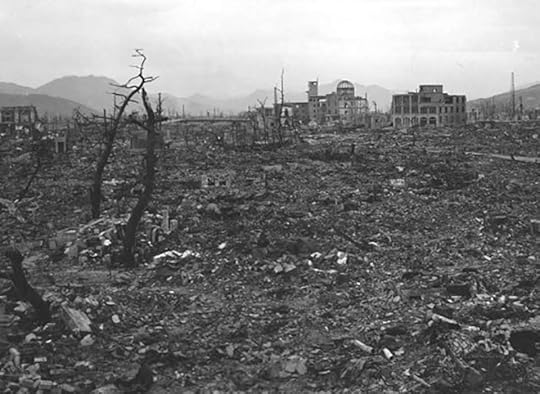
Hiroshima after being hit with a 15 kiloton nuclear bomb - image from Wikimedia – Weapons deployed today can be hundreds of times larger

What plans are in effect for shooting down potential incomings? How many anti-ballistic missiles can be launched against the threat? What is their success rate? What if they miss?

What plans are there to preserve command and control, to preserve national leadership in the case of an attack? What are the timelines involved in moving people to places?

What happens on the ground when a nuclear bomb hits? How far from that ground zero will the effects be felt? What will those effects be? What impact might there be from an EMP (Electro-Magnetic Pulse) bomb set off high over the USA?

Are there other scenarios in which nuclear bombs are used that might not result in global conflagration? Probably. I could see the use of tactical nukes in limited areas failing to bring on the end of all things. But that is hardly a risk that seems worth taking. The presumption of the presented scenario is a war beginning with the action of a madman. What if deterrence, the basis of our national nuclear policy, fails? Considering the cast of characters in the world today (2025) with their fingers on the nuclear button, how confident are you that Kim Jung Un, Vladimir Putin, Chairman Xi, Donald Trump, Benjamin Netanyahu, Mohandra Modi, Sherbaz Sharif, and who knows in the years ahead, can all be counted on to make the right decision when confronted with the opportunity? Me neither.

description
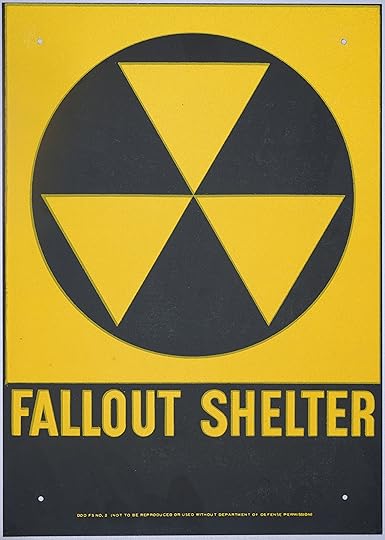
Signs like these were common in the 1960s - image from Wiki

In 2025 a film was released that seemed almost a direct adaptation of the book. So far as I can tell it was not. House of Dynamite, directed by Kathryn Bigelow, written by Noah Oppenheim, follows a very similar path. A nuke has been launched, not sure by whom, heading for an American city. The film faithfully illustrates the steps involved in the decision-making process, the time-line stresses on the officials involved. The specifics in the book are deeper and more numerous, but the film captures the essence of the peril. Must-see stuff!

description
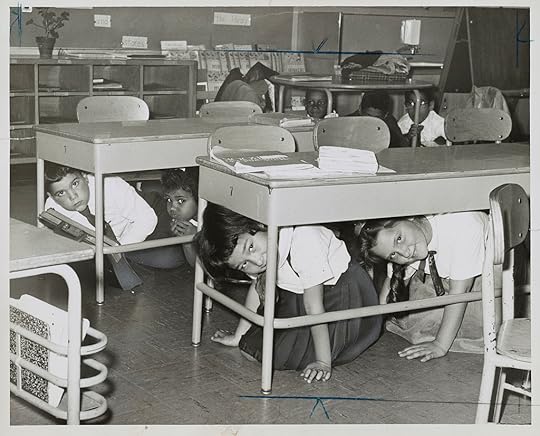
Duck and Cover in Brooklyn in 1962 - image from Wikimedia

If you are in the habit of getting full nights of restful sleep, say goodbye to that. There is no horror book, no fictional tale that can compare with the real-life terror that is nuclear war. Become informed. Learn what is truly at stake. Most of you did not live through the duck-and-cover of my childhood, Cold War prime, when the threat of annihilation was quite real, when JFK and Khruschev played atomic chicken. Nuclear war may seem remote, unimaginable, the subject of sci-fi novels and films. It was not, during my childhood in one of the presumed top target cities. It is not now. Consider this a call to Wake TF Up! This threat is real and it affects all of us. You need to know what is at stake. Please, please, please read this book. Tick tock.
After 10,000 years of planting and harvesting, humans return to a hunter-gatherer state.
Review posted - 11/20/25

Publication dates
----------Hardcover - 03/28/24
----------Trade Paperback – 03/03/25

I received an ePub of Nuclear War: A Scenario from my wife, who raved about it.


This review will soon be cross-posted on my site, Coot’s Reviews. Stop by and say Hi!

=============================EXTRA STUFF

Links to Jacobsen’s personal, FB, Instagram, and Twitter pages

Profile - from her site
ANNIE JACOBSEN is a Pulitzer Prize finalist and New York Times bestselling author. Her books include: AREA 51; OPERATION PAPERCLIP; THE PENTAGON’S BRAIN; PHENOMENA; SURPRISE, KILL VANISH, and FIRST PLATOON.
Her newest book, NUCLEAR WAR: A SCENARIO, is an international bestseller.
Jacobsen’s books have been named Best of the Year and Most Anticipated by outlets including The Washington Post, USA Today, The Boston Globe, Vanity Fair, Apple, and Amazon. She has appeared on countless TV programs and media platforms—from PBS Newshour to Joe Rogan—discussing war, weapons, government secrecy, and national security. Audiences have ranged from The Vatican to The United Nations.
She also writes and produces TV, including Tom Clancy’s JACK RYAN.

Interviews
-----Joe Rogan - Author Annie Jacobsen Describes What Nuclear War Would Look Like - video – 14:47
----- Annie Jacobsen: Nuclear War, CIA, KGB, Aliens, Area 51, Roswell & Secrecy | Lex Fridman Podcast #420 - 3:07:26 - If you can manage the time, watch this one
----- -Lex Fridman Podcast - Transcript for above podcast

Films of Interest
-----A House of Dynamite
-----The Day After - notable post-Apocalypse film from 1983
-----Threads - notable post-Apocalypse film from 1984
-----Doctor Strangelove

Items of Interest
-----Fallout Shelter
-----Ivy Mike - first fusion bomb
-----Duck and Cover
-----Arms Control Association - Nuclear False Warnings and the Risk of Catastrophe
Profile Image for Noah.
114 reviews
August 5, 2024
Warning: this is going to be my most negative Goodreads review I’ve ever written, probably because I actually have some real expertise on the subject.

I don’t even know where to begin with this thing, but if I had to pick a jumping-off point, it’s that calling this book nonfiction is stretching the limits of credulity. Jacobsen’s ridiculous, far-fetched “scenario” is written like a cheap disaster novel and is predicated on some of the most outlandish geopolitical leaps flights of fancy ever put to paper. The DPRK nuking the U.S. and committing national suicide because a photo of it from space at night made it look bad? Russia not picking up the phone during said nuclear attack and more or less randomly deciding to join the party and yeet some ICBMs at the U.S. itself? The Secret Service packing parachutes with which the president can bail out of Marine One like it’s a WWII fighter plane? Really?! What nonsense for a “seasoned national security reporter.” She also regularly falls into a weird state of moralizing on nuclear weapons while doggedly providing no real solutions to the issues they present. HOT TAKE ALERT: we know nuclear weapons are bad, but what do you suggest we do about them? It’s certainly a choice to write an entire book about nukes while making almost zero mention of arms control.

Not only is the underlying premise of the book basically counterfactual, it’s poorly written. About 85% of Jacobsen’s narrative and argumentation relies on a small handful of primary sources, all while presenting exactly no analyses of alternatives to their conclusions — that’s just lazy reporting. The aforementioned narrative is written in a fashion more or less parallel to the way a five year-old tells a make-believe story — “and then, and then, and then…” — and it just. Doesn’t. Let up. If that’s not enough, it’s wildly repetitive; on multiple occasions as I listened to the audiobook, I found myself jumping around because I thought I’d already heard a certain part. Nope! Jacobsen was simply repeating, almost word-for-word, previous passages. How many times are we going to listen to the Pentagon blow up, Annie?

That leads me to another point: her descriptions of a nuclear attack go so far into the weeds that they feel like sick disaster/gore porn. They were too much for me, and that’s saying something as someone who has seen some sh*t while working for the U.S. military.

Finally, some miscellaneous criticisms:
-The audiobook sucks; Jacobsen reads at a snail’s pace and intonates so strangely that I thought it was read by AI. The book crawls even at 1.2x speed.
-Take a shot every time she says the following phrases: nose cone, unimaginable, nose cone, highly classified, EEEE-EEEE, fireball, nose cone, decapitation, bolt out of the blue, nose cone.
-No submariner in history has ever called their boat “the handmaiden of the apocalypse.”


Thank you for coming to my TEDTalk.
1 review
April 11, 2024
It reads like an unnecessarily hyped miniseries by the History Channel.
Profile Image for Clay Davis.
Author 4 books165 followers
November 17, 2024
The repeated use of mulitple phrases in many of the chapters is amateurish. Some of the charts are difficult to read. The last chapter is very speculative.
Profile Image for Booksblabbering || Cait❣️.
2,024 reviews792 followers
November 5, 2024
First of all, this being marketed as non-fiction is slightly misleading in my opinion. It is based on a MADE-UP scenario and basically runs through everything that happens. North Korea sets off nuclear missile against the USA which basically causes the end of the world.

Scary, but realistic. Especially with North Korea’s very real regularity in running tests in Japanese water and not alerting anyone like every other country is required to do to avoid WW3.

I think my main problem was the narrator. She sounded like a robot. It was too monotone for me so that nothing went in. I retained barely anything despite trying to concentrate. I listen to A LOT of audiobooks and rarely have this issue.

And I am sorry, but I know I will not enjoy reading non-fiction with my eyes. If that makes sense.

Not counting this towards my reading goal because I got to 70% and then skipped to 92% because I wanted to know how it ended.
My buddy reader dropped out at 50% and we had very similar feelings unfortunately.
Profile Image for Henk.
1,195 reviews304 followers
July 3, 2025
Nuclear war in all its horrors and irrationality are spelled out in meticulously detail in this book. I admire the passion for the subject but at times this felt repetitive
A nuclear war must not be fought and cannot be won

A sobering read that starts of as a pageturner, featuring a North Korean attack on the Pentagon escalating into full blown nuclear war and eventually World War Three and destruction of the northern hemisphere and quite potentially the whole of the human race. This features 3.000+ warheads being exchanged and after a while you just grow desensitised for the 100 mile wide firestorms, x-ray burst blinding everyone in a 13 mile radius and people, animals and natural environment on fire.

More thoughts to follow. Honestly, the historical interludes on the madness of the military thinking they could win a nuclear war are fascinating, but overall a 3.5 stars read, rounded down.
Profile Image for Wick Welker.
Author 9 books695 followers
November 26, 2024
No hyperbole is enough to describe the threat of nuclear war.

This is the worst book I’ve ever read and I mean that as a compliment to the author because it means she did her job. This book was not entertaining, it was not fetishizing some sort of post-apocalyptic fantasy and it did nothing to bolster the utility of deterrence. No, this book had one job and one job only: to emphasize the utter disaster of nuclear proliferation and the ever present threat of near-total human extinction. Since the inception of a nuclear bomb, humanity has always been at grave risk of annihilation. It could happen next week, tomorrow or while you finish this sentence. And that’s what this book is about: a possible scenario in which most of the world is engulfed in a conflagration of nuclear fire and fallout.

The author gives a specific scenario and works with it through the whole book while she teaches you about the major players: the US, Russia and North Korea. Granted that Israel, France, UK, India and Pakistan also have nuclear weapons, it’s the other 3 that would probably start a nuclear war including perhaps China. The scenario here is North Korea attacks the US out of nowhere with an ICBM warhead alongside a nuclear attack from one of its old submarines that has sneaked down the Alaska coast and down to California which it could do undetected. The two strikes here are a decapitation strike at the Pentagon and the other is a nuclear facility in California. The ICBMs would be detected by the US. After this detection, the US President would have about 6 minutes to decide what retaliatory action would be taken. 6 minutes. A ludicrous amount of time. The US cannot stop an ICBM nuclear warhead. Yeah, apparently there are like 40+ anti-ICBM along the Pacific coast but they work like half the time and both N Korea and Russia easily have enough ICBM to overwhelm this defense. Let me repeat: there is no US defense against impending nuclear attack. If Russia or N Korea want to drop a bomb, they will and it will explode over the target of their choosing.

In this scenario, the US knows the ICBMs are coming from N Korea and the retaliatory US strike takes the form of a trident: ICBM from nuclear bases, Ohio class submarine nuclear strike, or warheads from a plane. These strikes can come from the US or from UN bases in Europe. In the scenario in the book, the US retaliates with a bunch of ICBM aimed at N Korea. DC and its surrounding areas are destroyed, the President is dead or lost, and Russia now believes the US is attacking it so it releases an ICBM strike against the US and UN bases in Europe. Whoever is still in charge in the US would then strike Russia. And that’s the ballgame. Not only would the initial blasts kill hundreds of millions, but the nuclear fallout and winter would in total kill BILLIONS of people and usher in the end of modern civilization and possibly extinction.

This is not fiction. It could happen tomorrow. All it would take is one misunderstanding and we’re all dead. Deterrence works until it doesn’t and then the world is on fire. It is utter lunacy and madness that this is the underpinning of the global world order.
Profile Image for Mircea Petcu.
211 reviews40 followers
November 30, 2025
Războiul nuclear începe cu un bip pe un ecran. Sateliții cu infraroșu din rețeaua SBIRS au identificat amprenta unei rachete balistice intercontinentale nord-coreene. Datele brute sunt transmise de la sateliți la Unitatea de Date Aerospațiale din Colorado, unde sunt prelucrate. De aici sunt trimise la Pentagon. Racheta se îndreaptă rapid spre Coasta de Est a Statelor Unite. E timpul ca președintele să fie contactat. în caz de atac nuclear, președintele SUA are doar șase minute să se hotărască în privința contraatacului: "șase minute ca să răspunzi unui bip și să hotărăști dacă să dezlănțui Armagedonul" după cum scria Ronald Reagan în memoriile sale.

Președintele SUA e mereu însoțit de un aghioatant care cară Mingea de Fotbal (servieta), ce conține Cartea Neagră (o listă de ținte) din care președintele alege câteva ținte sau pe toate. În servieta se mai află și "biscuitele", cardul laminat cu codurile de lansare pe care presedintele trebuie să le transmită comandantului STRATCOM (Comandamentul Strategic al SUA), aflat în buncărul de sub Baza Aeriană Offutt din orașul Omaha, Nebraska. Comandantul STRATCOM inițiază contraatacul. Acesta are la dispoziție triada nucleară: pe uscat (400 de rachete balistice intercontinentale aflate în silozuri); în aer (66 de bombardiere strategice B-52 și B-2); pe mare (14 submarine cu propulsie nucleară din clasa Ohio).

Președintele trebuie evacuat cu elicopterul Marine One deoarece buncărul de sub Casa Albă nu poate rezista unei explozii nucleare (a fost proiectat în perioada interbelică, înainte de apariția bombelor atomice). Destinația firească a președintelui este Locul R (Raven Rock Mountain) din Munții Apalași.
Statele Unite mai dețin alte 44 de rachete balistice interceptoare, majoritatea fiind poziționate strategic la Fort Greely, în centrul Alaskăi. Eficiența acestor rachete este considerată de experți atăt de redusă, încât au comparat-o cu lovirea "unui glonț cu alt glonț". Și cu siguranță nu poate bloca un atac al Rusiei, care deține peste 1600 de focoase active, la care se adaugă alte câteva mii aflate în rezervă.

Recomand
Profile Image for Matt.
4,812 reviews13.1k followers
April 17, 2025
For readers like myself, the hunger to learn and the nagging poke of curiosity is never sated. Annie Jacobsen is a great author to help with this, as she never fails to offer up some great insights into scientific events through a historical lens. This tome explores nuclear war and how it could occur, as well as the international actors involved in the process. A brilliant read and so full of educational moments!

While the world has long had an obsession with end of time scenarios on television and in movies, there is a real-life possibility of it happening. As Annie Jacobsen bluntly explains, save for an asteroid hurtling towards the planet, nuclear war is the most likely thing to decimate everything, leaving few on Earth with little from which to rebuild.

Jacobsen uses her intuitive abilities to explore the nuclear military establishment of the United States, permitting the reader to understand many of the actors involved in the process of activating nuclear launches, as well as some generic protocols around preparing for a launch. She lists the steps taken and those who hold power without any filters or limitations. As the reader delves a little deeper, they can panic knowing who sits in the Oval Office and how dictators tend to have little to no stop-gap capabilities.

Jacobsen also examines some other actors on the international scene who have possession of nuclear weapons and how they use that power. Enlightening is that all countries, no matter their political temperature, share testing dates and times ahead of time to prevent nuclear armament, save North Korea. It would seem the Hermit Kingdom is happy to surprise everyone with their testing and scare tactics.

Embedded into the narrative throughout is a scenario of plausible nuclear launch and a minute-by-minute exploration of how it would play out around the world, with real-time events and likely actors, as well as their actions. This is both sobering and highly impactful to see just how troubling things could be with no time to synthesise.

Throughout the book, Jacobsen delivers detailed research and explanations of how a nuclear build-up and attack might work. The unbelievable antics cannot be fabricated, as one might think fill the pages of a piece of fiction. This is alarming and highly entertaining, allowing the reader to shake their head about how swiftly things change. Staying on the ball is essential and knowing the importance of the power in their hands cannot be dismissed. Yet, world leaders with such power cannot always be trusted.

Filled with great ideas and nuggets of information, Annie Jacobsen delivers a chilling look at a potential nuclear war. That it would be catastrophic is not diluted at any point, though she makes sure to explore the inner workings of events and how the various actors play their own roles. Chapters are filled with insight and serve to awaken the reader on the subject matter, choosing to be blunt and honest, over candy coating situations to soften the blow. The subtle undertone throughout remains that those in positions of power have unfettered access to highly destructive weapons. This poses significant problems for America over the next few years, as they are led by someone who knows as much as the goats on the Bikini Atoll during nuclear testing in the 1940s/50s. Scary, to say the least!

Kudos, Madam Jacobsen, for an enthralling piece, as always!

Love/hate the review? An ever-growing collection of others appears at:
http://pecheyponderings.wordpress.com/
Profile Image for Chris.
127 reviews6 followers
January 27, 2024
As someone who loves a process document, I was immediately smitten with Annie Jacobsen’s Nuclear War from its cold, step-by-step detailing of what begins to unfold across the US government when North Korea launches an ICBM at us.

Even the frequent use and defining of acronyms (which, who uses acronyms more than the US military?) it felt like what I’ve done for the past 5 years, if my job entailed documenting Nuclear Armageddon.

Because, in this scenario, it is Armageddon, minus Bruce Willis sacrificing himself for the benefit of Liv Tyler and…mankind.

This is a disaster movie more along the lines of Deep Impact, or recently Don’t Look Up. Our heroes—and us—likely aren’t making it out of this one alive.

While I never need to hear the phrase “Handmaidens of the Apocalypse” again, or the descriptor “carbonized,” I appreciate what Jacobsen is trying to do here: scare some sense into people by painting the reality of what US military process is in Nuclear War—and how instability of foreign leadership could literally end civilization in less than two hours.

The key takeaway, which I won’t spoil: there are like 3 countries that’ll probably come out of it all largely unscathed. And now I’m researching citizenship requirements for each of these.

I’ll also never judge a prepper again.

Short chapters that made it easy to blast through, with a disaster-movie feel that had me wide-eyed and wanting popcorn, I’d recommend this to folks who want to know the realities of our current nuclear situation and what could happen if Mutually-Assured Destruction (MAD) no longer holds. If you find yourself frequently awake at 3am with worst-case scenario anxiety, do not read this.

Thank you to NetGalley and Penguin Group Dutton for the advanced copy!

Read with: 📱 ebook

Recommended to fans of:

-disaster movies
-military process
-military technology
-nuclear disarmament
Profile Image for Mervyn Whyte.
Author 1 book31 followers
April 17, 2024
A book you can read in one sitting. If you've got the time. And the stomach. The scenario itself might seem a little farfetched (with nukes in the air would the Russians really refuse to take a call from the Americans, whoever was on the other end of the line?), but not as farfetched as the consequences. Yet if the former was to happen, the latter would inevitably follow. The complete and utter destruction of human civilisation. Maybe even the total extinction of humankind. In a little over one hour. There is no such thing as a limited nuclear war, Jacobsen tells us. Or a winnable one. One misunderstanding. One malfunction. One madman. One mistake. And that would be it. Once started, nuclear war is difficult (maybe impossible) to stop. Jacobsen should know. It seems like she's spoken to many of the leading authorities and read just about all the relevant documents. And then woven them into a readable narrative that is both fast-moving and highly detailed. Un-put-downable and terrifying at the same time, it's the literary equivalent of the worst car crash you can imagine.
Profile Image for James S. .
1,431 reviews16 followers
April 18, 2024
The author attempts to make her book exciting, almost novelistic, by using short sentences, sentence fragments, flashbacks, and other tricks. I found this condescending and distracting. The prospect of nuclear war doesn't need to be jazzed up to be made interesting.

And yet somehow her portrayal of a nuclear attack manages to be dull. I think this is partly because most of the book is a recitation of facts: this would happen in an attack, then this would happen, then this would happen, and on and on. There's very little analysis or context. For instance, there's no discussion (that I saw, at least) of how likely this scenario is, or if the response could be modulated, etc.

Essentially, this an unnecessarily dramatized yet strangely dull account of a nuclear attack that adds almost nothing to what most people already know: i.e., nuclear weapons are extraordinarily powerful and dangerous. Did we need a new book telling us this?
Profile Image for Jakob J. &#x1f383;.
275 reviews116 followers
Want to read
November 12, 2024
Preparing to shit bricks for 400 pages. I’ve already listened to Annie Jacobsen on several podcasts and it is always intensely sobering.

I, like many others, went through a phase of torpefying fear when considering nuclear war. I had frequent nightmares of creeping flames encroaching on my childhood home like a Lovecraftian monstrosity, driving along and suddenly a flash of searing light on the horizon. What would I do? What could I do? I bought many books on the subject and watched many videos of detonations as a way to sate the anxiety, to familiarize myself with the potentiality.

It’s always been the sense of displacement that would occur under this kind of scenario that stultifies my senses. I’d almost want the missile to fall directly on my head rather than experience any of the fallout, or feel even a nanosecond of the incinerating heat. I’ve come to terms with the horror, insofar as anyone is capable, but I’m in for a harrowing week when I get to this one.
Profile Image for Trevor Abbott.
335 reviews39 followers
April 10, 2024
It takes only one hour for the world to end
Profile Image for Reilly Zimbric.
296 reviews21 followers
May 9, 2024
DNF
I should have minded my business
Profile Image for Ginger.
993 reviews574 followers
July 19, 2025
"Today, humanity is just one misunderstanding, one miscalculation away from nuclear annihilation." - United Nations’ secretary general, António Guterres

Content: 5 stars
Narration of audiobook: Couldn't stand it.


I think the author, Annie Jacobsen narrates the book with a monotone voice to give the facts in a scientific way.
Right?! Or was this AI?

If I don't know which one it is, I'm going to struggle with it. I should have just read this because it's gripping and horrifying with how the end of civilization can happen in moments.

Nuclear War: A Scenario goes into minute-by-minute when one nuclear missile is released and is heading towards the United States. It shows how this moment would play out in the United States and around the world.

The content of this book is eye opening, thought provoking and tough material to take in.

It's worth noting that having steady hands and a clear head from our world leaders is a necessity between the act of living and the actual end of civilization.

"A nuclear crisis is not a worst-case scenario, it is the worst-case scenario." - Annie Jacobsen
Displaying 1 - 30 of 7,802 reviews

Can't find what you're looking for?

Get help and learn more about the design.