

What do you think?

Universal Monsters (Image Comics)
Universal Monsters: Dracula
“The Dracula comic I’ve wanted all my life.” __—ROBERT KIRKMAN (INVINCIBLE, THE WALKING DEAD)
THE DEPARTMENT OF TRUTH creators JAMES TYNION IV (W0RLDTR33, Something is Killing the Children) and MARTIN SIMMONDS re-team to tell a new tale of the monster who started it all!?
When Dr. John Seward admits a strange new patient named Renfield into his asylum, the madman tells stories of a demon who has taken residence next door. But as Dr. Seward attempts to apply logic to the impossible…his daughter falls under the spell of the twisted Count Dracula! ?
Featuring a Direct Market Exclusive cover by STEPHANIE PEPPER that will only be printed once.
Collects UNIVERSAL DRACULA #1-4
THE DEPARTMENT OF TRUTH creators JAMES TYNION IV (W0RLDTR33, Something is Killing the Children) and MARTIN SIMMONDS re-team to tell a new tale of the monster who started it all!?
When Dr. John Seward admits a strange new patient named Renfield into his asylum, the madman tells stories of a demon who has taken residence next door. But as Dr. Seward attempts to apply logic to the impossible…his daughter falls under the spell of the twisted Count Dracula! ?
Featuring a Direct Market Exclusive cover by STEPHANIE PEPPER that will only be printed once.
Collects UNIVERSAL DRACULA #1-4
128 pages, Kindle Edition
First published May 14, 2024
About the author
James Tynion IV
1,691 books2,205 followersPrior to his first professional work, Tynion was a student of Scott Snyder's at Sarah Lawrence College. A few years later, he worked as for Vertigo as Fables editor Shelly Bond's intern. In late 2011, with DC deciding to give Batman (written by Snyder) a back up feature, Tynion was brought in by request of Snyder to script the back ups he had plotted. Tynion would later do the same with the Batman Annual #1, which was also co-plotted by Snyder. Beginning in September 2012, with DC's 0 issue month for the New 52, Tynion will be writing Talon, with art by Guillem March. In early 2013 it was announced that he'd take over writing duties for Red Hood and the Outlaws in April.
Tynion is also currently one of the writers in a rotating team in the weekly Batman Eternal series.
Tynion is also currently one of the writers in a rotating team in the weekly Batman Eternal series.
Ratings & Reviews
Friends & Following
Create a free account to discover what your friends think of this book!
Community Reviews
Displaying 1 - 30 of 304 reviews
![Profile Image for s.penkevich [hiatus-will return-miss you all].](https://i.gr-assets.com/images/S/compressed.photo.goodreads.com/users/1735525095i/6431467._UX200_CR0,11,200,200_.jpg)
June 21, 2024
Classic horror comes alive sharp and bloodsoaked in this new graphic novel adaptation of Dracula, written by horror veteran James Tynion IV and spectacularly illustrated by Martin Simmonds for some truly visceral visual terror. Dread descends upon a dreary London in an adaptation that zooms in on the local intrigue around Renfield as he confounds doctors at the sanatorium with his ravings and ravenous blood disorder, presenting a more intimate narrative of this piece of the larger story that gives more spotlight to smaller characters like Renfield and Lucy others like Johnathan Harker move around their peripheries. Those who have a particular adherence to a purity of plot in Bram Stoker orignal may find themselves frustrated that this deviates in many ways, yet this shuffled remix gives Tynion IV fresh space to explore the symbolism of Dracula for a modern audience and the artwork is so unsettlingly brilliant that one will hardly mind while being so devilishly dazzled. A bit short with a rather rushed ending, this first, full installment of the upcoming Universal Monsters series is a strong start that brings us back to the monster who has been terrorizing the imagination for hundreds of years.
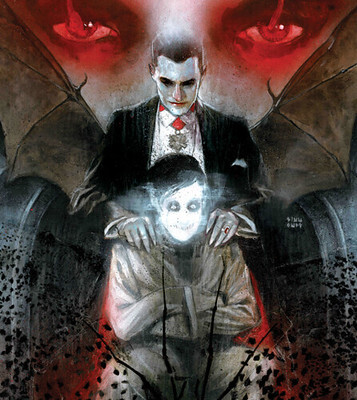
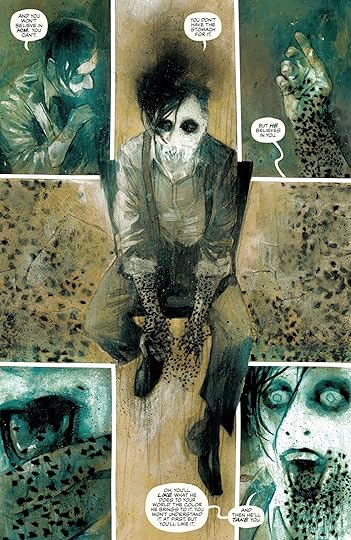
Truthfully, when I first saw there was a suspiciously slim, new graphic novel of Dracula I thought “do we really need another version?” Though upon looking at the writing and art team, I suddenly realizes that it’s me, I’m the one who wants and needs another version if it means Tynion IV is behind it. This was an eerie stunner of a work that rides high on its astonishingly engaging artwork. I mean, look at this:
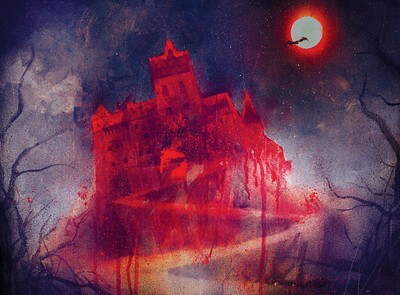
The colors, the blood, the moon shining pure dread into reader’s hearts. Simmonds went off on this one and we are all better for it. And perhaps all a little more scared… It brings this story to life and the monsters so boldly into our minds, playing well into Renfield’s own words about his ‘master’ that ‘you’ll like what he does to your world. The color he brings to it.’ Because the dark and drab streets of London depicted in the book with somber, earthy colors
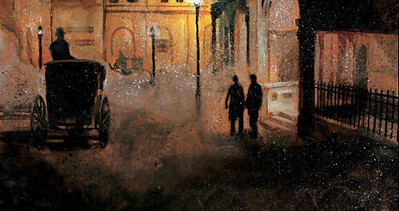
Comes blazing into violence in terms of both casualties and color when the Transylvanian Count appears
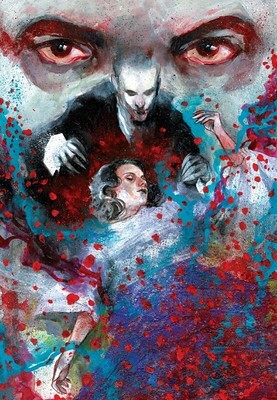
LOOK AT THAT THOUGH
‘Hell is closing in on you from every corner, and you still refuse to see it.’
This is a rather truncated story, though the intimacy with the sections it portrays bring a lot of intrigue. Drawing less from the Bram Stoker novel and more from the 1931 film adaptation staring Bela Lugosi, which itself drew primarily upon a stage adaptation, both making fairly significant changes to Stoker’s plot and characters. The film and it’s variant of the Dracula narrative would largely influence many of the other Dracula medias to follow, with Lugosi having a rather lasting cultural presence as the image of Dracula himself. Those who have a particular adherence to a purity of plot in Stoker’s image may find themselves frustrated that this graphic novel adaptation deviates in many ways, but I rather enjoyed what Tynion IV does with it. Van Helsing’s speech on Dracula capitalizing on ‘rot’ in London and that ‘the city has invited this darkness upon it’ is a universal fear during any hard times, especially when, say, rampant culture wars and divisive rhetoric with accusations on morality are common. Tynion depicts Dracula as symbolic of the dark urges in humankind and tempts us to embrace our vileness as a source of strength. Or to follow him because, as Renfield states ‘he would give me purpose, he would give me power’
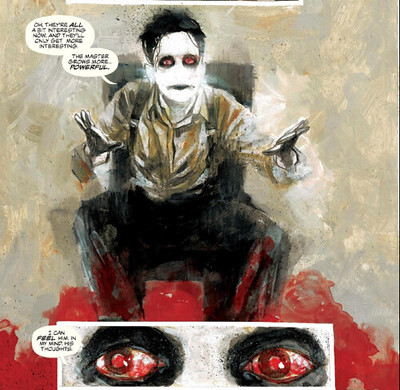
‘The Master makes me more powerful…’
Simmond’s Renfield—who usurps not only Harker’s Transylvannia narrative (in keeping with the 1931 film) but also space in the story itself—is wonderfully disquieting, looking a bit like he walked off the stage at a My Chemical Romance show, but also has a visual fluidity that descends into the abstract in times of high emotion, particularly when his master’s will over him is challenged. It works well to show the fleeting power that ends up just a thirst for blood that never serves our best interests, only the symbol of evil who would discard us anyways.Yet, ultimately, this adaptation also centers on a hope that compassion and love reside in us too and can overcome such darkness. It looks at the dualities of people, accepts us as a mixture of dark and light, and pleas that we do not let our darkness snuff out our light.
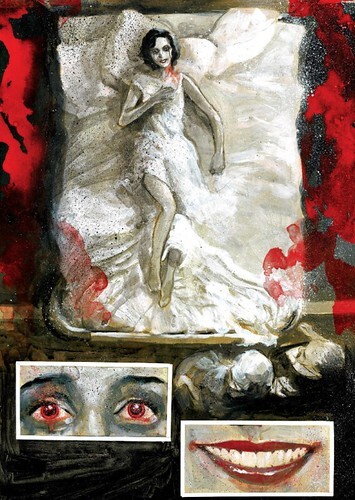
‘The fear is not that the world has gone mad around me. It’s that all this strangeness has peeled back the skin of London and revealed the true madness lurking just under the surface.’
Really my only gripe, and a small one at that, is this could have easily been expanded to its benefit. The scenes could breathe more and the last quarter moves too quickly before ending rather abruptly (while also using callbacks as evidence without having let the reader be present for those moments). Still, this is a fun and frighteningly gorgeous graphic adaptation and is definitely worth the read.
4.5/5
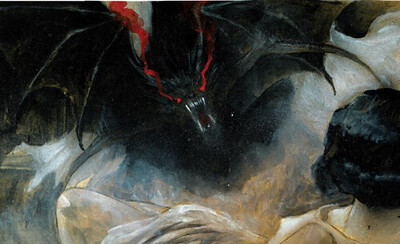
Truthfully, when I first saw there was a suspiciously slim, new graphic novel of Dracula I thought “do we really need another version?” Though upon looking at the writing and art team, I suddenly realizes that it’s me, I’m the one who wants and needs another version if it means Tynion IV is behind it. This was an eerie stunner of a work that rides high on its astonishingly engaging artwork. I mean, look at this:
The colors, the blood, the moon shining pure dread into reader’s hearts. Simmonds went off on this one and we are all better for it. And perhaps all a little more scared… It brings this story to life and the monsters so boldly into our minds, playing well into Renfield’s own words about his ‘master’ that ‘you’ll like what he does to your world. The color he brings to it.’ Because the dark and drab streets of London depicted in the book with somber, earthy colors
Comes blazing into violence in terms of both casualties and color when the Transylvanian Count appears
LOOK AT THAT THOUGH
‘Hell is closing in on you from every corner, and you still refuse to see it.’
This is a rather truncated story, though the intimacy with the sections it portrays bring a lot of intrigue. Drawing less from the Bram Stoker novel and more from the 1931 film adaptation staring Bela Lugosi, which itself drew primarily upon a stage adaptation, both making fairly significant changes to Stoker’s plot and characters. The film and it’s variant of the Dracula narrative would largely influence many of the other Dracula medias to follow, with Lugosi having a rather lasting cultural presence as the image of Dracula himself. Those who have a particular adherence to a purity of plot in Stoker’s image may find themselves frustrated that this graphic novel adaptation deviates in many ways, but I rather enjoyed what Tynion IV does with it. Van Helsing’s speech on Dracula capitalizing on ‘rot’ in London and that ‘the city has invited this darkness upon it’ is a universal fear during any hard times, especially when, say, rampant culture wars and divisive rhetoric with accusations on morality are common. Tynion depicts Dracula as symbolic of the dark urges in humankind and tempts us to embrace our vileness as a source of strength. Or to follow him because, as Renfield states ‘he would give me purpose, he would give me power’
‘The Master makes me more powerful…’
Simmond’s Renfield—who usurps not only Harker’s Transylvannia narrative (in keeping with the 1931 film) but also space in the story itself—is wonderfully disquieting, looking a bit like he walked off the stage at a My Chemical Romance show, but also has a visual fluidity that descends into the abstract in times of high emotion, particularly when his master’s will over him is challenged. It works well to show the fleeting power that ends up just a thirst for blood that never serves our best interests, only the symbol of evil who would discard us anyways.Yet, ultimately, this adaptation also centers on a hope that compassion and love reside in us too and can overcome such darkness. It looks at the dualities of people, accepts us as a mixture of dark and light, and pleas that we do not let our darkness snuff out our light.
‘The fear is not that the world has gone mad around me. It’s that all this strangeness has peeled back the skin of London and revealed the true madness lurking just under the surface.’
Really my only gripe, and a small one at that, is this could have easily been expanded to its benefit. The scenes could breathe more and the last quarter moves too quickly before ending rather abruptly (while also using callbacks as evidence without having let the reader be present for those moments). Still, this is a fun and frighteningly gorgeous graphic adaptation and is definitely worth the read.
4.5/5

April 9, 2024
this is the most gorgeous art i’ve ever seen in a comic

November 10, 2024
8'5/10 🌟🌟🌟🌟🌟
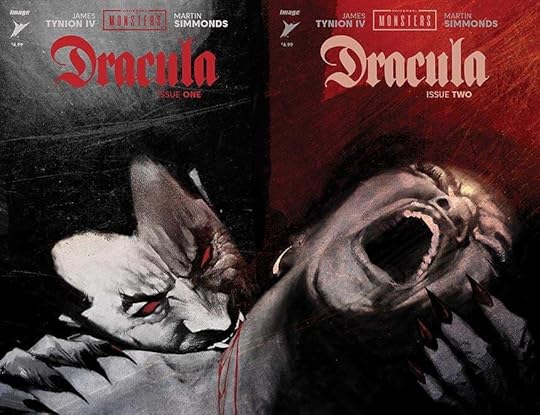
James Tynion IV adapta un clásico de la Universal, que a su vez es una adaptación literaria, dando el protagonismo a Renfield. La obra que todos conocemos desde el punto de vista del siervo de Drácula, que permanece en el manicomio alimentándose de moscas y arañas a la espera de recibir un poder mayor por parte del amo. Consigue resumirla, en 128 páginas, sin que parezca un "copia y pega" de la obra original.
Pero el punto fuerte es el arte de Martin Simmonds, donde consigue dibujar un terror abstracto, sin forma definida, utilizando el rojo para los momentos de máximo apogeo.
Entre los diálogos de Tynion y los dibujos de Simmonds consiguen crear esa presencia omnipresente de Drácula, tan bien conseguida en la obra original de Stoker. Imprescindible para fans de Drácula y del noveno arte.
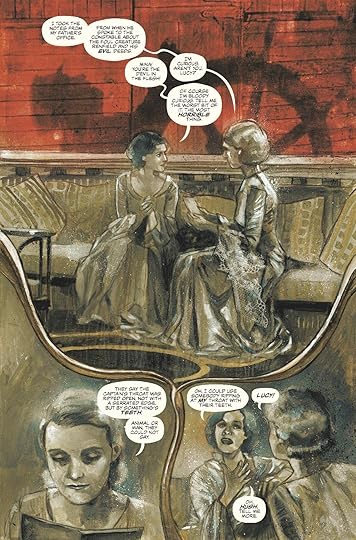
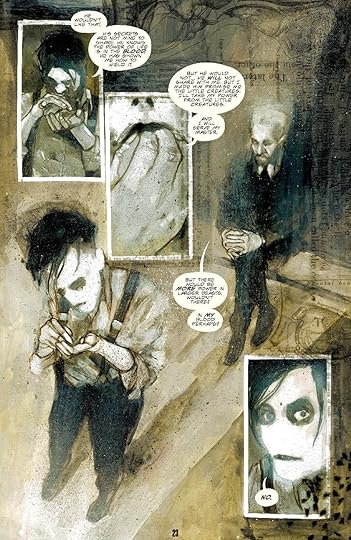
James Tynion IV adapta un clásico de la Universal, que a su vez es una adaptación literaria, dando el protagonismo a Renfield. La obra que todos conocemos desde el punto de vista del siervo de Drácula, que permanece en el manicomio alimentándose de moscas y arañas a la espera de recibir un poder mayor por parte del amo. Consigue resumirla, en 128 páginas, sin que parezca un "copia y pega" de la obra original.
Pero el punto fuerte es el arte de Martin Simmonds, donde consigue dibujar un terror abstracto, sin forma definida, utilizando el rojo para los momentos de máximo apogeo.
Entre los diálogos de Tynion y los dibujos de Simmonds consiguen crear esa presencia omnipresente de Drácula, tan bien conseguida en la obra original de Stoker. Imprescindible para fans de Drácula y del noveno arte.

May 26, 2024
3.5 stars. A really solid adaptation of the OG Dracula with some absolutely incredible artwork. I don’t know if this hits as well as it does without Martin Simmonds.

November 1, 2025
PT Já todos conhecemos a história do Drácula de Bram Stoker. Existem inúmeras adaptações feitas por autores diferentes, e por isso, quando pegamos nesta obra, sabemos à partida que, em termos narrativos, nada nos vai realmente surpreender — o caminho é o mesmo que já conhecemos.
A questão que se impõe é: o que é que esta nova adaptação tem de diferente para oferecer? Normalmente, nestes casos, o que mais se destaca é a componente artística — e, nesse aspeto, Martin Simmonds faz um trabalho notável, aplicando um estilo visual surreal que nos faz sentir como se estivéssemos a viver um pesadelo.
A narrativa decorre inteiramente em Inglaterra; não viajamos para mais lado nenhum, embora haja referências a acontecimentos noutros locais.
Pessoalmente, continuo a considerar a adaptação de Georges Bess a melhor que li até hoje. Ainda assim, esta oferece uma boa experiência. James Tynion IV optou por se cingir ao essencial da história — e faz sentido, já que a maioria dos leitores conhece bem a trama, tornando desnecessário prolongar a mesma narrativa de sempre. Nesse sentido, creio que ele fez o que era possível dentro dessas limitações.
Gostava, no entanto, que houvesse algo de novo, algo surpreendente. Esta adaptação parecia pedir uma ousadia maior — mas compreendo que tentar alterar ou acrescentar algo a uma obra tão clássica e admirada é sempre um risco considerável.
--
EN We all know the story of Dracula by Bram Stoker. There are countless adaptations by different authors, so when we approach this work, we already know that, narratively speaking, nothing will truly surprise us — the path is one we’re already familiar with.
The real question is: what does this new adaptation have to offer that’s different? Usually, what stands out most in this kind of project is the artistic direction — and in that regard, Martin Simmonds does an outstanding job, using a surreal visual style that makes us feel as if we’re living inside a nightmare.
The story takes place entirely in England; we don’t travel anywhere else, although there are references to events happening in other places.
Personally, I still consider Georges Bess’s adaptation the best one I’ve read so far. Even so, this one delivers a solid experience. James Tynion IV chose to stick to the essential elements of the story — and that makes sense, since most readers already know it well, making it pointless to drag out the same tale once again. In that sense, I think he did what could reasonably be done within those boundaries.
Still, I would have liked to see something new, something surprising. This adaptation seemed to call for a bit more boldness — but I understand that trying to change or add to such a beloved and classic work is always a considerable risk.
A questão que se impõe é: o que é que esta nova adaptação tem de diferente para oferecer? Normalmente, nestes casos, o que mais se destaca é a componente artística — e, nesse aspeto, Martin Simmonds faz um trabalho notável, aplicando um estilo visual surreal que nos faz sentir como se estivéssemos a viver um pesadelo.
A narrativa decorre inteiramente em Inglaterra; não viajamos para mais lado nenhum, embora haja referências a acontecimentos noutros locais.
Pessoalmente, continuo a considerar a adaptação de Georges Bess a melhor que li até hoje. Ainda assim, esta oferece uma boa experiência. James Tynion IV optou por se cingir ao essencial da história — e faz sentido, já que a maioria dos leitores conhece bem a trama, tornando desnecessário prolongar a mesma narrativa de sempre. Nesse sentido, creio que ele fez o que era possível dentro dessas limitações.
Gostava, no entanto, que houvesse algo de novo, algo surpreendente. Esta adaptação parecia pedir uma ousadia maior — mas compreendo que tentar alterar ou acrescentar algo a uma obra tão clássica e admirada é sempre um risco considerável.
--
EN We all know the story of Dracula by Bram Stoker. There are countless adaptations by different authors, so when we approach this work, we already know that, narratively speaking, nothing will truly surprise us — the path is one we’re already familiar with.
The real question is: what does this new adaptation have to offer that’s different? Usually, what stands out most in this kind of project is the artistic direction — and in that regard, Martin Simmonds does an outstanding job, using a surreal visual style that makes us feel as if we’re living inside a nightmare.
The story takes place entirely in England; we don’t travel anywhere else, although there are references to events happening in other places.
Personally, I still consider Georges Bess’s adaptation the best one I’ve read so far. Even so, this one delivers a solid experience. James Tynion IV chose to stick to the essential elements of the story — and that makes sense, since most readers already know it well, making it pointless to drag out the same tale once again. In that sense, I think he did what could reasonably be done within those boundaries.
Still, I would have liked to see something new, something surprising. This adaptation seemed to call for a bit more boldness — but I understand that trying to change or add to such a beloved and classic work is always a considerable risk.

December 8, 2024
I am not at ALL a fan of James Tynion's writing, but this hit a sweet spot for me. Be warned: This book takes place between various scenes of Bela Lugosi's DRACULA, so some parts might not make sense if you haven't seen that film.
July 2, 2026
Historia, którą znamy wszyscy. Ale jak to jest narysowane ❤️

November 27, 2024
The second book I've read in the Universal Monsters/Image Comics mashup. While The Creature from the Black Lagoon Lives! was a sequel to the original film, this is a retelling of "Dracula", taking inspiration from the original 1931 film but not a direct adaptation.
It also reminds me of that one Christopher Lee Dracula film where he hated the script so much he simply refused to use any dialogue, because Dracula doesn't speak in this book, all his dialogue happens off screen so he really becomes this otherworldly creature.
It's a clever way to approach a story that's been told so many times. Although possibly not the best introduction to the character for the few who don't know the story.
Martin Simmonds illustrates and it might be the best art for a Dracula/vampire story I've ever seen. It's beautiful and ghastly at the same time, it has the perfect gothic atmosphere where it feels like this is all some strange dream. I've been enjoying his work in "The Department of Truth" but this is something else.
It also reminds me of that one Christopher Lee Dracula film where he hated the script so much he simply refused to use any dialogue, because Dracula doesn't speak in this book, all his dialogue happens off screen so he really becomes this otherworldly creature.
It's a clever way to approach a story that's been told so many times. Although possibly not the best introduction to the character for the few who don't know the story.
Martin Simmonds illustrates and it might be the best art for a Dracula/vampire story I've ever seen. It's beautiful and ghastly at the same time, it has the perfect gothic atmosphere where it feels like this is all some strange dream. I've been enjoying his work in "The Department of Truth" but this is something else.
August 20, 2024
A solid take on Dracula.
Renfield is really the star here. He got a lot of time to develop and I actually cared what might happen to him. Also the art is excellent at points, some really creepy imagery and stunning wideshots. And while the pacing was well done I didn't get attached to any characters outside of little Renny. Overall a solid 3 out of 5.
Renfield is really the star here. He got a lot of time to develop and I actually cared what might happen to him. Also the art is excellent at points, some really creepy imagery and stunning wideshots. And while the pacing was well done I didn't get attached to any characters outside of little Renny. Overall a solid 3 out of 5.

June 9, 2024
I’d say I am a bit surprised I did not like it more, storywise. I mean, 4 issues are not a lot, but I can imagine more could be done. What really stood out was the artwork. Renfield’s panels were absolute horror and I loved it.

May 25, 2024
I KID YOU NOT PEOPLE
THIS IS SOME OF THE MOST STUNNING ARTWORK I HAVE EVER SEEN IN A COMIC BOOK
and Tynion's writing is as solid as ever <3
Can't recommend this book enough!
THIS IS SOME OF THE MOST STUNNING ARTWORK I HAVE EVER SEEN IN A COMIC BOOK
and Tynion's writing is as solid as ever <3
Can't recommend this book enough!

June 13, 2024
DRACULA has been done to death, but incredible art and interesting focal points as the original story unfolds make this version truly haunting.

June 16, 2024
Sensacional.
Adoro els monstres de la Universal, i no sé d'on surt aquest corrent reivindicatiu en format de jocs de taula, de figures d'acció i ara de còmics, però bé que ho celebro.
El Dràcula de Tod Browning és una icona pop, però com a pel·li a i em sembla una mica avorrida (n'entenc el context i l'aprecio, però). Així que no sabia què esperar d'aquesta adaptació al còmic. De fet, esperava una c0sa cutre i fidel fil per randa del film.
La sorpresa ha estat majúscula. Adapta la història del Dràcula de Lugosi però des de punt de vista de Reinfield. El text dede Tynion és collonut i li dona una solidesa important, però és que l'art de Simmonds és una meravella. Quina cosa més bonica. Quin us dels colors. M'ha deixat hipnotitzadíssim, i tornaré una vegada i una altra només per veure'n les il·lustracions.
PD. Com ja he llegit en algun comentari, sembla que es devia eliminar una escena important en l'edició final del còmic, i cap al final s'hi fa referència i queda estrany.
Adoro els monstres de la Universal, i no sé d'on surt aquest corrent reivindicatiu en format de jocs de taula, de figures d'acció i ara de còmics, però bé que ho celebro.
El Dràcula de Tod Browning és una icona pop, però com a pel·li a i em sembla una mica avorrida (n'entenc el context i l'aprecio, però). Així que no sabia què esperar d'aquesta adaptació al còmic. De fet, esperava una c0sa cutre i fidel fil per randa del film.
La sorpresa ha estat majúscula. Adapta la història del Dràcula de Lugosi però des de punt de vista de Reinfield. El text dede Tynion és collonut i li dona una solidesa important, però és que l'art de Simmonds és una meravella. Quina cosa més bonica. Quin us dels colors. M'ha deixat hipnotitzadíssim, i tornaré una vegada i una altra només per veure'n les il·lustracions.
PD. Com ja he llegit en algun comentari, sembla que es devia eliminar una escena important en l'edició final del còmic, i cap al final s'hi fa referència i queda estrany.

January 2, 2026
Considering I've already invested in THE CREATURE FROM THE BLACK LAGOON, FRANKENSTEIN, and THE MUMMY in this series, I sure hope it's uphill from here.
The art is not bad most of the time, but it can get awfully muddy on occasion, but it's the story we come for right?
This is a rather disappointing, watered down, weakly rewritten story based on the original. Sure, Dracula is a menacing presence in the background, and he tends to get all the best artwork, but the other characters, aside from Lucy and Renfield are quite dull and interchangeable. Lucy's scandalously fun, but she's dispatched quickly. Renfield starts out fun, but the schtick gets old and grating fairly quickly.
And ultimately, this likely should have been title RENFIELD, instead of DRACULA, as it's much more (too much more, to be honest) his story.
The art is not bad most of the time, but it can get awfully muddy on occasion, but it's the story we come for right?
This is a rather disappointing, watered down, weakly rewritten story based on the original. Sure, Dracula is a menacing presence in the background, and he tends to get all the best artwork, but the other characters, aside from Lucy and Renfield are quite dull and interchangeable. Lucy's scandalously fun, but she's dispatched quickly. Renfield starts out fun, but the schtick gets old and grating fairly quickly.
And ultimately, this likely should have been title RENFIELD, instead of DRACULA, as it's much more (too much more, to be honest) his story.
February 5, 2024
This was truly excellent. I read this in single issues, waiting until they all arrived before bingeing them all last night. Tynion's horror sensibilities add something new and interesting to a familiar story. The highlight here, though, is Simmonds' artwork, which is incredible. It would already be a solid 4/4.5 rating, but the artwork truly takes this to another level. Simmonds' exploration of Dracula's various transformations in particular standout. There also were scenes in which Dracula's presence to a character was truly startling - while that's easy to do in cinema, it's hard to do in a comic (and Simmonds knocks it out of the park).
I would highly recommend this to fans of horror comics. It's well worth it.
I would highly recommend this to fans of horror comics. It's well worth it.
October 25, 2024
A beautifully written and illustrated take on Stoker’s Dracula and the classic Bela Lugosi film, interestingly the Count is presented here as an eldritch, otherworldly presence more than as a suave continental newcomer to London.

August 26, 2024
"The master grows more powerful. I can feel him. In my mind. His thoughts."
Dracula has been a story that completely enraptured me from a young age. I remember when I first saw Dracula. He had my heart from then on.
This was a fantastic addition to the Dracula collection. The story was great and each page had amazing artwork. The art was eye-catching and the coloring added that extra pop of intensity. It was all exceptional.
Dracula has been a story that completely enraptured me from a young age. I remember when I first saw Dracula. He had my heart from then on.
This was a fantastic addition to the Dracula collection. The story was great and each page had amazing artwork. The art was eye-catching and the coloring added that extra pop of intensity. It was all exceptional.
March 15, 2026
I've read, watched and listening to as much Dracula as I could fit onto my life, as it is right up there in the top 10 books of my life ( so much so, I have two tattoos dedicated to it).
But the artwork here? Nothing short of fabulous. I feel it captures the pure evil nature of Dracula without all the romance that has been added. This graphic novel will be living on my Dracula shelf.
But the artwork here? Nothing short of fabulous. I feel it captures the pure evil nature of Dracula without all the romance that has been added. This graphic novel will be living on my Dracula shelf.

October 25, 2024
Brillant hommage à l'œuvre fondatrice de Bram Stoker, ce Dracula est un petit tour de force graphique et narratif, une oeuvre à part entière, mais qui peut aussi, pour les amateur du genre, s'inscrire comme un brillant complément au film de 1931 (on y reconnaitra notamment les traits des acteurs de l'époque), en cela que cette BD met l'accent sur ce que le film ne montre pas.
À lire pour les fans, mais aussi bonne introduction pour ceux qui souhaiteraient découvrir l'œuvre cinématographique par la suite.
On aime !
À lire pour les fans, mais aussi bonne introduction pour ceux qui souhaiteraient découvrir l'œuvre cinématographique par la suite.
On aime !

Read
July 4, 2024As part of Universal's continuing efforts to drain some more juice from their monster library, they've now done a licensing deal for comics from Image, which makes me slightly uneasy (weren't creator-owned titles the whole point of the publisher?), but is at least a better creative bet than another Tom Cruise film. There's already a Black Lagoon miniseries underway, but first up was this, Department Of Truth placed on hold for a while so its creators could have a go on the head of the horror family.
My first impression was disappointment that it's a retelling; unlike Dracula, I have a limited span on this Earth, and I feel as if a fair chunk of it has already been taken up with versions of this same story. But Simmonds' art ensures that it's extremely pretty (for a swirling, nightmarish value of the word), and it isn't like they're stretching it out. Indeed, they've slimmed it right down; the trip to Transylvania, transferred from Harker to Renfield in the film, is excised. The setting is still period, but the dialogue isn't, quite, though it does bring the subtext to the fore in a way a certain other horror writer would doubtless endorse: "He's been waiting for you, Dr. Seward. You and men like you. You don't believe in anything that matters anymore. Not anything that could harm him. You only believe in yourselves. As he believes in himself." This line delivered by Renfield or, as he's more than once described, "this Renfield character", a phrase I can only hear in the voice of Matt Berry. With Harker pretty much a nonentity, van Helsing drunk and the Count largely kept to the shadows (most of Lugosi's memorable lines are absent), Renfield - looking remarkably like Conrad Veidt in Caligari - becomes the de facto protagonist, though a far more tragic figure than in his recent film outing. Which is, I suppose, just enough of a twist to make the story feel new-ish, though it remains entirely inessential. Still, Simmonds really does make it look wonderful, all stiff English gentlemen, shadowed halls and swooping, feral darkness.
My first impression was disappointment that it's a retelling; unlike Dracula, I have a limited span on this Earth, and I feel as if a fair chunk of it has already been taken up with versions of this same story. But Simmonds' art ensures that it's extremely pretty (for a swirling, nightmarish value of the word), and it isn't like they're stretching it out. Indeed, they've slimmed it right down; the trip to Transylvania, transferred from Harker to Renfield in the film, is excised. The setting is still period, but the dialogue isn't, quite, though it does bring the subtext to the fore in a way a certain other horror writer would doubtless endorse: "He's been waiting for you, Dr. Seward. You and men like you. You don't believe in anything that matters anymore. Not anything that could harm him. You only believe in yourselves. As he believes in himself." This line delivered by Renfield or, as he's more than once described, "this Renfield character", a phrase I can only hear in the voice of Matt Berry. With Harker pretty much a nonentity, van Helsing drunk and the Count largely kept to the shadows (most of Lugosi's memorable lines are absent), Renfield - looking remarkably like Conrad Veidt in Caligari - becomes the de facto protagonist, though a far more tragic figure than in his recent film outing. Which is, I suppose, just enough of a twist to make the story feel new-ish, though it remains entirely inessential. Still, Simmonds really does make it look wonderful, all stiff English gentlemen, shadowed halls and swooping, feral darkness.

August 5, 2025
Um novo paciente chega ao asilo do Dr. John Seward. Renfield tem alguns surtos psicóticos, falando de uma figura que ele idolatra e que está assombrando a cidade. Ao mesmo tempo, muitas pessoas aparecem m0rtas com dois furos no pescoço.
Enquanto Seward faz de tudo para curar Renfield, o enigmático Conde Drácula intriga as pessoas da cidade, e atrai os olhos de Lucy e Mina.
John fica relutante com a chegada de Van Helsing, mas após ver a vida de sua filha em risco, se vê na obrigação de deixar suas crenças de lado para fazer o que o professor pede.
Uma coisa que queria falar antes, que vi algumas pessoas reclamando, mas é algo que acontece no livro: o Drácula não é o protagonista aqui. Se ele aparece 10 vezes em todo a HQ, é muito. Isso é algo que pode frustrar algumas pessoas que não conhecem a história.
Pelo que entendi da leitura, a HQ adapta momentos do filme Drácula (1931), com Bela Lugosi. A única adaptação de Drácula que assisti foi a de 1958, então isso me atrapalhou um pouco no começo da leitura. Talvez para quem já tenha assistido ao filme de 1931 antes, vá aproveitar melhor as cenas. (Agora me sinto na obrigação de ver também)
Também achei que faltou adaptar algumas cenas que aprofundam em detalhes outros momentos dos personagens apresentados. Essa história é dividida em 4 issues, o que é pouco para adaptar de forma mais completa toda a complexidade da trama.
Mesmo assim, consegui aproveitar o que é apresentado.
Gostei da ideia de trazer o Renfield praticamente como protagonista. O foco na loucura, na forma como Drácula trabalha essa submissão nele foi muito bem apresentada. Também gostei do conflito que o personagem tem em certo ponto, diante da decisão controversa do Conde.
Mas o que mais me encantou aqui foi a arte. Martin Simmonds captura muito bem toda essa essência de terror que o roteiro quer apresentar. Os traços dele são hipnotizantes, dá vontade de digitalizar tudo e colar na parede, mas tem cenas que são perturbadoras demais para isso.
Essa edição da Darkside também conta com um bônus inédito de Dacre C. Stoker, sobrinho-bisneto de Bram Stoker. Que fala em um texto bem breve como a figura do Drácula virou um sucesso desde o começo, conquistando tantas adaptações e ganhando relevância no mundo pop. Mas, principalmente, fala sobre Bela Lugosi, que foi o primeiro Drácula dos cinemas.
Essa é uma HQ perfeita para quem gosta do personagem, mas que também adora a adaptação de 1931. Recomendo que vejam ela antes para ter uma experiência melhor de leitura, mas só pela arte já compensa demais ter na estante!
Enquanto Seward faz de tudo para curar Renfield, o enigmático Conde Drácula intriga as pessoas da cidade, e atrai os olhos de Lucy e Mina.
John fica relutante com a chegada de Van Helsing, mas após ver a vida de sua filha em risco, se vê na obrigação de deixar suas crenças de lado para fazer o que o professor pede.
Uma coisa que queria falar antes, que vi algumas pessoas reclamando, mas é algo que acontece no livro: o Drácula não é o protagonista aqui. Se ele aparece 10 vezes em todo a HQ, é muito. Isso é algo que pode frustrar algumas pessoas que não conhecem a história.
Pelo que entendi da leitura, a HQ adapta momentos do filme Drácula (1931), com Bela Lugosi. A única adaptação de Drácula que assisti foi a de 1958, então isso me atrapalhou um pouco no começo da leitura. Talvez para quem já tenha assistido ao filme de 1931 antes, vá aproveitar melhor as cenas. (Agora me sinto na obrigação de ver também)
Também achei que faltou adaptar algumas cenas que aprofundam em detalhes outros momentos dos personagens apresentados. Essa história é dividida em 4 issues, o que é pouco para adaptar de forma mais completa toda a complexidade da trama.
Mesmo assim, consegui aproveitar o que é apresentado.
Gostei da ideia de trazer o Renfield praticamente como protagonista. O foco na loucura, na forma como Drácula trabalha essa submissão nele foi muito bem apresentada. Também gostei do conflito que o personagem tem em certo ponto, diante da decisão controversa do Conde.
Mas o que mais me encantou aqui foi a arte. Martin Simmonds captura muito bem toda essa essência de terror que o roteiro quer apresentar. Os traços dele são hipnotizantes, dá vontade de digitalizar tudo e colar na parede, mas tem cenas que são perturbadoras demais para isso.
Essa edição da Darkside também conta com um bônus inédito de Dacre C. Stoker, sobrinho-bisneto de Bram Stoker. Que fala em um texto bem breve como a figura do Drácula virou um sucesso desde o começo, conquistando tantas adaptações e ganhando relevância no mundo pop. Mas, principalmente, fala sobre Bela Lugosi, que foi o primeiro Drácula dos cinemas.
Essa é uma HQ perfeita para quem gosta do personagem, mas que também adora a adaptação de 1931. Recomendo que vejam ela antes para ter uma experiência melhor de leitura, mas só pela arte já compensa demais ter na estante!

September 30, 2024
There’s a large amount of focus on Renfield, Dracula’s minion, across all four issues of this series. You might get the impression that this mini-series is about him, but you’d be wrong about that.
After all the iterations of the Dracula legend in film and comics, by focusing on the point-of-view of Renfield writer Tyrion injects new blood (ahem) into this genre.
In the text afterword to Issue #1 Tynion explains that he prefers to work with his own creations, but accepted the assignment to write an adaptation of the Universal film version of Dracula because it made a lasting impression on his young developing mind.
While this new series respectfully recreates the feel and look (thanks to amazing Simmonds art) of that film, Tyrion’s script is a breath of fresh (not foul) air. He’s really bringing this legendary icon to new life and anyone who is a fan of the film, the novel, or the vampire genre should be checking this series out.
As he did so well on the DEPARTMENT OF TRUTH series, Simmonds again both illustrates, inks and colors his work in a painted style that bring more clarity than I’ve ever seen from him before. The images are incredible. Tynion wisely hasn’t scripted one word of dialogue for Dracula, just letting the visuals communicate the power and menace behind the character. Also, I’ve never seen Renfield imagined and portrayed as creepy as he is here.
The introduction of the main characters (Harkness, Van Helsing, etc) and build up to the first victim to mingle blood with Dracula (Lucy) is dramatized perfectly.
The ending is inevitable but satisfying. I could have been fine with two more issues.This book is a winner.
After all the iterations of the Dracula legend in film and comics, by focusing on the point-of-view of Renfield writer Tyrion injects new blood (ahem) into this genre.
In the text afterword to Issue #1 Tynion explains that he prefers to work with his own creations, but accepted the assignment to write an adaptation of the Universal film version of Dracula because it made a lasting impression on his young developing mind.
While this new series respectfully recreates the feel and look (thanks to amazing Simmonds art) of that film, Tyrion’s script is a breath of fresh (not foul) air. He’s really bringing this legendary icon to new life and anyone who is a fan of the film, the novel, or the vampire genre should be checking this series out.
As he did so well on the DEPARTMENT OF TRUTH series, Simmonds again both illustrates, inks and colors his work in a painted style that bring more clarity than I’ve ever seen from him before. The images are incredible. Tynion wisely hasn’t scripted one word of dialogue for Dracula, just letting the visuals communicate the power and menace behind the character. Also, I’ve never seen Renfield imagined and portrayed as creepy as he is here.
The introduction of the main characters (Harkness, Van Helsing, etc) and build up to the first victim to mingle blood with Dracula (Lucy) is dramatized perfectly.
The ending is inevitable but satisfying. I could have been fine with two more issues.This book is a winner.

March 7, 2026
Gorgeously painted story that takes place around the events of Tod Browning's 1931 Dracula movie. A couple of the film's scenes are reproduced, but mostly the comic gives extra attention to Dr Seward and his patient Renfield. Since Seward is also Mina's father in the movie, this version of the character struggles a lot with what's happening to her and how much to trust the strange Van Helsing. Tynion and Simmonds make sure we get to see all that.
They also highlight Renfield's struggle to retain his own humanity under Dracula's influence. And in the process, they provide some insight into just how Dracula's influence works and why it's so seductive, tapping into common human fears.
Simmonds' character designs look enough like the actors to be recognizable without just copying them. Van Helsing gets a cool handle-bar mustache, for instance. And Dracula is especially thin and terrifying. But my favorite depiction is Renfield, who looks pale and disturbed, as much like Conrad Veidt in The Cabinet of Dr Caligari as Dwight Frye in Dracula.
They also highlight Renfield's struggle to retain his own humanity under Dracula's influence. And in the process, they provide some insight into just how Dracula's influence works and why it's so seductive, tapping into common human fears.
Simmonds' character designs look enough like the actors to be recognizable without just copying them. Van Helsing gets a cool handle-bar mustache, for instance. And Dracula is especially thin and terrifying. But my favorite depiction is Renfield, who looks pale and disturbed, as much like Conrad Veidt in The Cabinet of Dr Caligari as Dwight Frye in Dracula.

June 3, 2024
Dracula by Universal Monsters was a great comic to look at but the plot was not as exciting as I had imagined. The story was quite simple and it was not thrilling in the horror or suspense aspect, It's only the art by Martin Simmonds which was outstanding making it a work that fans of horror and comic art should not miss. Renfield and Dracula were painted beautifully creepy; the vivid colours and imagery were amazing to look at thus making it a four-star comic overall. However, if I were to rate the story alone, I would give it 3 out of 5 stars because it fell short of the anticipated atmospheric and chilling view and at some points, it felt like the storytelling was rushed; however, the visuals with their stunning, movie-like scenery and the gothic horror atmosphere were depicted impressively. In the end, it was the outstanding artwork from Simmonds that made this a fairly enjoyable read given the somewhat weak plot.

January 17, 2025
Alright, Nosferatu was a great movie. Robert Eggers is an amazing modern director - a king at capturing atmosphere. He basically took the nearly 100 year old movie and made it modern using beautiful camera techniques and exquisite actors.
Now this story does a great job at exploring the lesser seen Renfield and making him a much more tragic character. The spell of Dracula absorbs and controls him to the point where he simply is a shell or a body being controlled from beyond. The atmospheric drawings by Simmonds look great and totally capture that candle lit nighttime London of yore. If you like Dracula stories this is a good one, but if you are kind of over them this doesn’t add much more to the mythos or the dozens of other versions you’ve seen or read. I still fuck with JT4 heavy (not to be confused with the GOAT JTT- Jonathon Taylor Thomas)
Now this story does a great job at exploring the lesser seen Renfield and making him a much more tragic character. The spell of Dracula absorbs and controls him to the point where he simply is a shell or a body being controlled from beyond. The atmospheric drawings by Simmonds look great and totally capture that candle lit nighttime London of yore. If you like Dracula stories this is a good one, but if you are kind of over them this doesn’t add much more to the mythos or the dozens of other versions you’ve seen or read. I still fuck with JT4 heavy (not to be confused with the GOAT JTT- Jonathon Taylor Thomas)

December 18, 2025
Graphic novel adaptation of the 1931 Bela Lugosi talkie.
Adheres fairly closely to the film source and contains no real surprises. It's solid but unspectacular.
Where the book stands out is the splendid illustration. Sepia and gray tones evoke the classic setting. Most of the characters are drawn with a mix of artfully unfocused panels and realistic, detailed face and dress. Bizarre white, featureless faces set Dracula's minions apart from the rest of humanity, and infrequent red washes and accents bring the Count himself to--well, to life, as it were. Big, gorgeous, semi-abstract and alarmingly bright splash pages give the violent scenes energy and immediacy.
Tynion does a perfectly fine job translating the movie to print but UM:D is a win thanks to Simmonds' illustration work.
Adheres fairly closely to the film source and contains no real surprises. It's solid but unspectacular.
Where the book stands out is the splendid illustration. Sepia and gray tones evoke the classic setting. Most of the characters are drawn with a mix of artfully unfocused panels and realistic, detailed face and dress. Bizarre white, featureless faces set Dracula's minions apart from the rest of humanity, and infrequent red washes and accents bring the Count himself to--well, to life, as it were. Big, gorgeous, semi-abstract and alarmingly bright splash pages give the violent scenes energy and immediacy.
Tynion does a perfectly fine job translating the movie to print but UM:D is a win thanks to Simmonds' illustration work.

April 7, 2026
Okay so I read this while in the middle of reading the Dracula the novel and maybe that contributed to why I did not like this graphic novel. I was expecting a cool gothic comic about Dracula and instead I got a companion comic to the movie Renfield.
The graphic novel focuses so much on Renfield that Dracula becomes a background character that barely has any dialogue and only appears so he can be killed immediately. Dracula should a powerful, commanding, and terrifying presence and that is just not conveyed in this comic.
Also, the artwork while haunting and unique did not work for me. Why does Renfield looks like Gerard Way from my chemical romance during the early 2000s?? google the video for welcome to the black parade and tell me I'm wrong lol.
The graphic novel focuses so much on Renfield that Dracula becomes a background character that barely has any dialogue and only appears so he can be killed immediately. Dracula should a powerful, commanding, and terrifying presence and that is just not conveyed in this comic.
Also, the artwork while haunting and unique did not work for me. Why does Renfield looks like Gerard Way from my chemical romance during the early 2000s?? google the video for welcome to the black parade and tell me I'm wrong lol.
February 7, 2025
I feel like this is giving “eh” energy🤷♀️ the art style was interesting in some cases, but the gutting of basically all the build up and dialogue really took all of the stakes (pun not intended) out of the story😕 Even Lucy’s death and Mina’s enthrallment were anticlimactic😐

January 26, 2026
Reinfeld é o novo paciente do asilo do Doutor Steward e tem recebido comunicações que acredita serem sobrenaturais de seu mestre, que encontrou em uma viagem aos Cárpatos. Reinfield diz receber moscas, baratas e ratos para se alimentar, vindas de seu mestre, para lhe dar poder. As alucinações do paciente chamam a atenção de uma certa Mina Harker e sua irmã e de um certo especialista chamado Van Helsing. Tudo isso levará a uma confrontação destas figuras quando encontrarem com a fonte de toda essa ladainha: o Conde Vlad Drácula. James Tynion IV desenvolve uma boa releitura do mito do principal Monstro da Universal ao lado de Martin Simmonds. Este último vem da escola de Dave McKean e de Bill Sienkiewicz aplicando um laboratório de técnicas de artes plásticas, como a colagem, para conduzir narrativamente a arte desta minissérie homenageando Drácula, o rei dos vampiros. Uma boa edição tanto em arte quanto em roteiro, que não subestima e nem superestima o trabalho de Bram Stoker.

May 17, 2026
Absolutely brilliant! I really enjoyed this. I felt that the writing and art worked perfectly together and Tynion did a fantastic job pulling together the Dracula story he wanted to tell, but still managed to keep those classic elements that we all love (and fear).
What I loved most about this book is how well the relationships between the non Dracula characters are developed and given dramatic focus. I've never before in my life considered Renfield a sympathetic character, but I'm totally convinced now. It's hard job selling a traditionally scummy character and shows just how talented this team was with their ability to breath some new life and empathy into them. I'm super impressed.
The end came ripping which might annoy some people, but I actually thought it was a perfect tribute to the universal style of movie ending where the villains usually come all undone very suddenly and all in the last 3 minutes of the movie.
This is a book I can totally see myself rereading and I can't wait to see what the other Universal Monster titles are like!
What I loved most about this book is how well the relationships between the non Dracula characters are developed and given dramatic focus. I've never before in my life considered Renfield a sympathetic character, but I'm totally convinced now. It's hard job selling a traditionally scummy character and shows just how talented this team was with their ability to breath some new life and empathy into them. I'm super impressed.
The end came ripping which might annoy some people, but I actually thought it was a perfect tribute to the universal style of movie ending where the villains usually come all undone very suddenly and all in the last 3 minutes of the movie.
This is a book I can totally see myself rereading and I can't wait to see what the other Universal Monster titles are like!
Displaying 1 - 30 of 304 reviews