Jump to ratings and reviews
Rate this book

Alien Earths: Planet Hunting in the Cosmos

Rate this book
For thousands of years, humans have wondered whether we're alone in the cosmos. Now, for the first time, we have the technology to investigate. The question should have an obvious answer: yes or no. But once you try to find life elsewhere, you realize it is not so simple. How do you find it over cosmic distances? What actually is life?

Astronomer Lisa Kaltenegger works from Carl Sagan’s former office at Cornell University, where she built a team of tenacious scientists from many disciplines to find life on faraway worlds, using Earth’s diverse biosphere and its history as a Rosetta Stone. With infectious enthusiasm, she provides an eye-opening insider’s guide to the most unusual exoplanets that have shaken our worldview – planets covered in oceans of lava, lonely wanderers lost in space, and others with more than one sun in their sky – as well as the best contenders for Alien Earths. She also shows how close imagined scifi worlds come to reality.

We live in an incredible new epoch of exploration. As our witty and knowledgeable tour guide, Professor Kaltenegger shows how we discover not merely new continents, like the explorers of old, but whole new worlds circling other stars – and how we could spot life there. Worlds from where aliens may even be gazing back at us. What if we're not alone?

288 pages, Hardcover

First published April 16, 2024

204 people are currently reading
10284 people want to read

About the author

Lisa Kaltenegger

4 books98 followers
Lisa Kaltenegger is the Director of the Carl Sagan Institute to Search for Life in the Cosmos at Cornell and Associate Professor in Astronomy. She is a pioneer and world-leading expert in modeling potential habitable worlds and their detectable spectral fingerprint. Kaltenegger serves on the National Science Foundation's Astronomy and Astrophysics Advisory Committee (AAAC), and on NASA senior review of operating missions. She is a Science Team Member of NASA's TESS Mission as well as the NIRISS instrument on James Webb Space Telescope. Kaltenegger was named one of America’s Young Innovators by Smithsonian Magazine, an Innovator to Watch by TIME Magazine. She appears in the IMAX 3D movie "The Search for Life in Space" and speaks frequently, including at Aspen Ideas Festival, TED Youth, World Science Festival and the Kavli Foundation lecture at the Adler Planetarium which was live-streamed to six continents.

Ratings & Reviews

What do you think?
Rate this book

Friends & Following

Create a free account to discover what your friends think of this book!

Community Reviews

5 stars
429 (29%)
4 stars
671 (45%)
3 stars
308 (20%)
2 stars
50 (3%)
1 star
10 (<1%)
Displaying 1 - 30 of 300 reviews
Profile Image for Nataliya.
985 reviews16.1k followers
April 21, 2024
“So yes, Luke Skywalker could have enjoyed a warm day under two suns—but I always wondered where his second shadow was.”

Looking for potentially habitable planets has different meanings to different people. It can be a way to satisfy intellectual curiosity, or desire to find other life so that we know we are not alone, or a way to spread humanity across the universe (whether the universe needs it or not remains quite debatable), or a way for us to have a Plan B in case our wonderful and perfectly suited for life as we know it Plan A of Planet Earth becomes less human life-friendly. Whatever is the reason, the search for potentially habitable exoplanets quickly went from the realm of science fiction to the realm of science.

And the potential for habitable planets is quite impressive. They seem to be pretty much everywhere, apparently. And Lisa Kaltenegger is beyond excited about them.
“We have no photo of the two hundred billion stars in our Milky Way—and we won’t have one for a long while. To fit the entire Milky Way in a photo, a spacecraft must fly far away from Earth, and far above the plane of our spiral galaxy. And no spacecraft has even made it to the next star over yet. The Earth is like a piece of pepperoni on a pizza trying to imagine the whole pizza’s shape. One of the main differences between us and the questioning pepperoni is that we have figured out what our galaxy looks like.”

It’s a very accessible read that can serve as an easy primer on a fascinating subject. Kaltenegger - despite the serious title of the director of Cornell University's Carl Sagan Institute - keeps it simple and clear, with the end result of it being interesting and comprehensible to pretty much anyone with zero science background. Not to mention extra nerd points for referencing a few science fiction books and films (I like Andy Weir too, Lisa!). It’s a great book to get people interested in the topic without getting bogged down too much in hard science behind it.

3.5 stars that I’m happy to round up.
——————

Thanks to NetGalley and St. Martin’s Press for providing me with a digital ARC in exchange for an honest review.

——————

Also posted on my blog.
Profile Image for Will Byrnes.
1,372 reviews121k followers
January 5, 2025
Before I started searching for life in the cosmos, I just assumed scientists knew how it started on Earth. We don’t.
--------------------------------------
…it is sobering to realize that for most of Earth’s history, humans would not have been able to survive on this planet. If we could rewind Earth’s history and start again, it seems unlikely that Earth would produce humans again. A planet with different starting conditions and paths of evolution has no obligation to support life similar to Earth’s, let alone curious humans.
The truth is out there.
Are we alone in the cosmos? The question should have an obvious answer: yes or no. But once you try to find life somewhere else, you realize it is not so straightforward.
At least until the age of permanent haze across the planet, we have always had the stars in our consciousness. Since the second century AD we have had stories about alien worlds. Since Galileo we have been able to see other worlds in the cosmos. A 1792 novel by Voltaire tells of an alien encounter. Concern about extraterrestrial locales has been a part of human consciousness ever since. The concern is certainly fed by the history of strange human invaders helping themselves to land distant from their home soil.
description
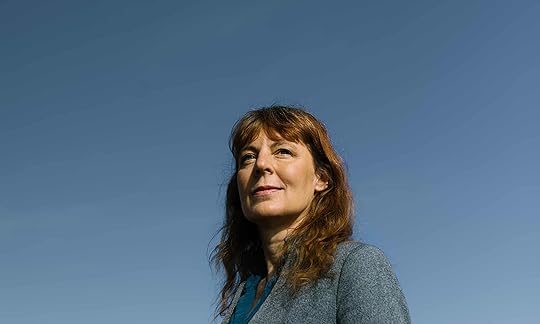
Lisa Kaltenegger - image from The Guardian - shot by Naomi Haussmann/The Observer

The interest in things alien certainly kicked up in the twentieth century. Many of us grew up in the space age, witness to the first “Beep-Beep” from orbit, the first peopled orbiters, rapt in front of our televisions when mankind first set foot on the moon. Part of this experience is to be awash in the science fiction of our own and earlier ages, dreaming of strange other-world societies, fearful of invasion, eager to learn the lessons of advanced technology. Some were even impressed and excited enough by the technology and the optimism of the age to begin college careers with the dream of becoming aeronautical engineers, and designing some of the hardware of the future.

description
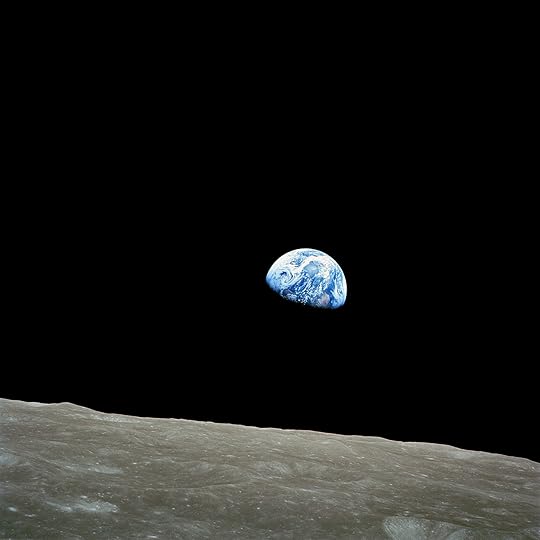
Earthrise - image from Wikipedia

But so much of this was based on fantasy, (including that engineering thing) limited to imagining what might exist out there. Even the early observations of other planets in the solar system generated fantasies in addition to scientific elucidation. But in 1995 scientists discovered the first two exoplanets, and new discoveries are now a nearly daily event. Today, because of the major advances that we have made in telescope technology, we are able to see to the far ends of the universe. Enter Lisa Kaltenegger, founder and head of the Carl Sagan Institute at Cornell University
I spend my days trying to figure out how to find life on alien worlds, working with teams of tenacious scientists who, with much creativity and enthusiasm and, often, little sleep but lots of coffee, are building the uniquely specialized toolkit for our search.
In studying what we have seen, it has become possible to detect stars that have planets around them. In fact, most stars have company. The way this is detected is to measure “wobble” in the light being observed from distant places. As if you were looking at a bright light and someone threw a ball across your field of view. The measured light would change and you could tell that something had been there. Keep looking to see if it repeats. If it does, then you probably have a planet orbiting that star. (or an annoying neighbor tossing something back and forth in front of you) Keep pointing the James Webb Space Telescope (the state of the art in telescopy today) to more and more locations in space. And discover more and more planets.
description
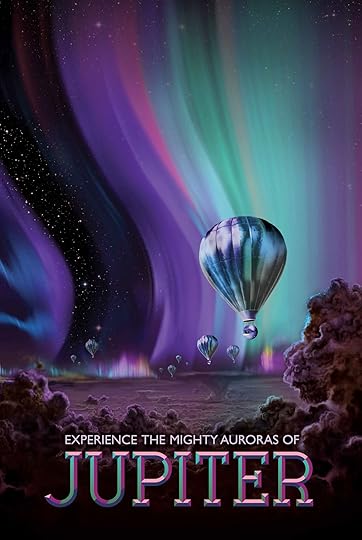
Jupiter - image from Exoplanet Travel Bureau – NASA

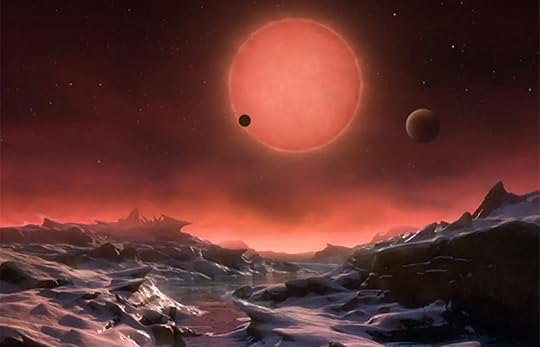
Kaltenegger has been looking into the reality of other worlds her entire career, and in doing so, has advanced our knowledge base considerably. She begins this book with a brief visit to an other planet, one that is very different from ours, a star-facing world that has portions in eternal day, night, and dusk, and local life adapted to the local venues, just to get things started on what we might expect out there, just to challenge our assumptions.

description
HD 40307g – A Super Earth - image from Exoplanet Travel Bureau – NASA

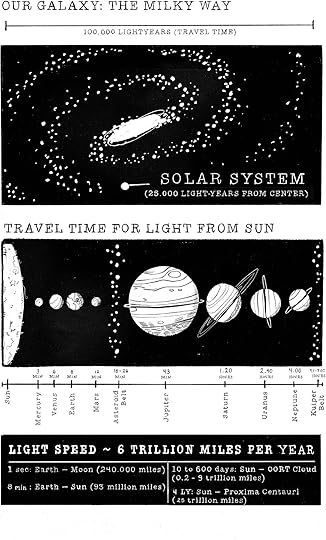
She follows with a history of Mother Earth, noting major stops along the evolution of our favorite place. She notes how life might have formed, when, and how that event altered the atmosphere and even the color of our atmosphere. The sequence is important, as her discussion of our exoplanet dreams demonstrates that we are a prisoner of time. What we see with our telescopes (and eyes) arrived here on light, and light must travel at or below the universal speed limit. (a leisurely 186,282 miles per second) So, whatever we see from even a nearby star/planet system originated tens or hundreds of years go, or even billions for our more distant neighbors. Anything residents of out there might have seen of us (really only since we started sending signals into the ether maybe a hundred years ago) is quite dated relative to who and what we are today. Absent the invention of a Warp Drive of some sort, we are doomed to be always too far away in years and miles from other intelligent species. Well, maybe.

description
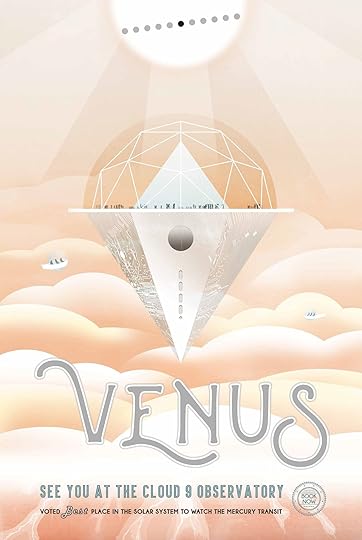
Venus - image from Exoplanet Travel Bureau – NASA

It is possible, I suppose, for a civilization with massive resources to send a desperate one-way mission to save their species from hundreds of light years away. It is unlikely that any visitors from such distant realms would be making reports home. But this need not necessarily apply to all possible visitors. It appears that there are plenty of possible planets within a few light years of us that might present some interplanetary possibilities.

description
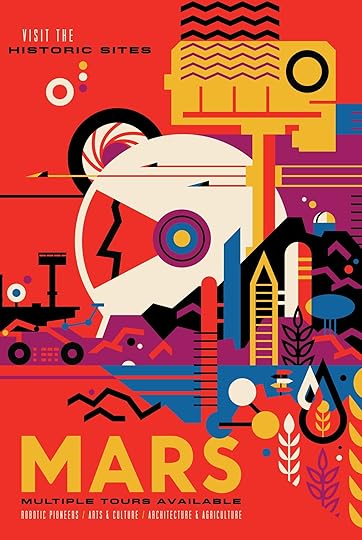
Mars - image from Exoplanet Travel Bureau – NASA

Kaltenegger delves into the nearer-earth planets, looks at their characteristics, and offers explanations as to their suitability for life. She looks at probable communication issues should we ever come across an ET, suggesting it might be the equivalent of humans attempting to communicate with a jellyfish

description
Grand Tour - image from Exoplanet Travel Bureau – NASA

Kaltenegger and her team design computer simulations, based on the hard work of examining concrete materials, inert and biologic, and putting that intel into a database. Check the signature spectrum of every new world and compare it with the growing list of catalogued items.
Today, solving the puzzle of these new worlds requires using a wide range of tools like cultivating colorful biota in my biology lab, melting and tracing the glow from tiny lava worlds in my geology lab, developing strings of codes on my computer, and reaching back into the long history of Earth’s evolution for clues on what to search for. With our own Earth as our laboratory, we can test new ideas and counter challenges with data, inspired curiosity, and vision. This interaction between radiant photons, swirling gas, clouds, and dynamic surfaces driven by the strings of code within my computer, creates a symphony of possible worlds—some vibrant with a vast diversity of life, others desolate and barren.
She notes the core need of life-sustaining planets is to be rocky. Sorry, Jupiter, no gas giants need apply (but their moons might). They also need to be within a certain range of the stars they circle, the so-called “Goldilocks Zone,” not so close as to be too hot nor so distant as to be too cold, and they need to show the presence of key life-sustaining elements.

description
Europa - image from Exoplanet Travel Bureau – NASA

Kaltenegger offers readers info on some topics likely to be new to most of us, Stellar Corpses, for example, warm ice, the Fermi Paradox, the Drake Equation, the Great Silence, tardigraves, and plenty more. All of these are explained clearly and simply. It is as if the author is telling us: This is what we have learned. This is what we expect. This is how we go about gathering information, fusing our fields of expertise, learning more, solving the mysteries that the data present. This is our understanding of what is possible. This is our plan for looking further and farther.

description
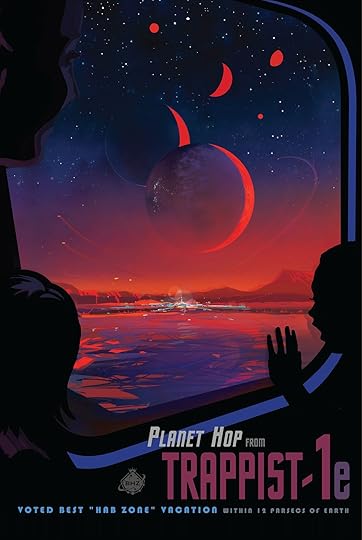
Trappist - image from Exoplanet Travel Bureau – NASA

Alien Earths may not point to an actual catalog of life-sustaining exoplanets, but it does offer an accessible pop-science portrait of the current state of the art in the search. This galactic age of exploration has been ongoing for some time, getting a jolt from the discovery of other worlds. It has advanced to where we are now looking for (and expecting to find) evidence of life on other planets. It is likely that what we find will be pretty basic, single-cell critters, maybe even plant life. And it will probably take a good long time before we can move up to the final phase of the game, finding intelligent life. The time scale for any potential interaction is likely to be considerable, but who knows? The universe is full of surprises among its billions and billions of stars.
So far, despite wild claims to the contrary, we have not found any definitive proof of life on other planets. Until we do, we will continue to improve our toolkit and look for signs of alien life the hard way: searching planet by planet and moon by moon.
Review posted - 09/27/24

Publication date – 04/16/24


I received an ARE of Alien Earths from St. Martin’s Press in return for a fair review. Thanks, folks, and thanks to NetGalley for facilitating.


This review will soon be cross-posted on my site, Coot’s Reviews. Stop by and say Hi!

=============================EXTRA STUFF

Links to the author’s personal, FB, Instagram, and Twitter pages

Interviews
-----We live in a golden time of exploration’: astronomer Lisa Kaltenegger on the hunt for signs of extraterrestrial life by Emma Beddington
-----Chris Evans Breakfast Show - Lisa Kaltenegger: Is There Alien Life? - Video – 25:39
-----StarTalk - Distant Aliens and Space Dinosaurs - with Neil DeGrasse Tyson – audio – 50:03
-----StarTalk - Astrophysicists Discuss Whether JWST Discovered Alien Exoplanets - Neil DeGrasse Tyson - video – 48:58

Item of Interest from the author
-----Lisa Kaltenegger. On Looking for Signs of life - Video – 10:36

Items of Interest
-----NASA - Jet Propulsion Laboratory – Visions of the Future
-----The Carl Sagan Institute
-----Unilad.com - NASA discovered -planet bigger than Earth with a 'gas that is only produced by life'

Song
-----Monty Python’s Galaxy Song
Profile Image for Brian Clegg.
Author 162 books3,173 followers
May 8, 2024
After an introduction to exoplanets - planets orbiting stars other than the Sun - Alien Earths concentrates on the theory of and the search for life on these planets. Written by astronomy professor Lisa Kaltenegger, who runs the Carl Sagan Institute for the Search for Life in the Cosmos at Cornell University, it's a gentle guide to one of the most imaginative aspects of astronomy.

A fair amount of the content looks at what makes a habitable planet (which is not always an Earth-like situation), what life is and how we may be able to detect it a great distance. There are some good details here, though I would have appreciated more depth. Given this is such a speculative subject, there is also relatively little questioning of assumptions. For example, there's a description of the gold records sent out on Voyager 1 and 2, with detail of how to put a time interval across to aliens. 'The team [behind the records] solved this problem by using a time constant that any spacefaring civilisation should understand.' This involves the hyperfine transition 'spin flip' of hydrogen - but I've never met a human who could interpret the vague visual supposed to illustrate this, so I'm not sure how any alien could

Kaltenegger's style is chatty - if anything, for me, it tries too hard in this respect. Each chapter starts with a fairly hefty chunk of supposedly engaging fluff. For example, the first proper chapter begins 'The foam on my Portuguese espresso tastes a little bitter, but I hardly notice. For the past hour, I've been staring at images on my computer screen, a live feed from NASA's recently launched James Webb Space Telescope (JWST).' Rather than make me feel warm and fuzzy, this just puts my back up a bit - I really don't care about someone else's coffee. A couple of paragraphs later, when she is watching the launch, we are told 'I kept reminding myself to breathe - in and out, in and out.' I think a little study of biology would suggest that no reminding is necessary with autonomous biological systems. It's just a bit overblown.

The other issue I have is about how speculative much of the theorising about alien life inevitably has to be. I appreciate we can't wait for flying saucers over Washington before we give any serious thought to what's out there, but I prefer my science to be more grounded in evidence. Nonetheless, lots of people do like a good dose of speculation (many science magazines thrive on it), so I appreciate that for others this is great fun.

All in all, Kaltenegger does a good job of making the topic approachable and interesting. It's not really for me (and if I were thinking only for myself I'd give it three stars), but for the right audience it does an excellent job.
6,202 reviews80 followers
January 4, 2024
I won this book in a goodreads drawing.

This book details the science of hunting for life on other planets. Nothing conspiratorial or outre. Very interesting.

Personally, I think our best bet for finding other life in our solar system would be the watery moons of Jupiter and Saturn, like Europa, but there are other options, including asteroids.

Highly recommended.
Profile Image for Trish.
2,390 reviews3,745 followers
August 9, 2024
I am a little nerd. Always have been. Thus, even as a kid, I loved reading about astronomy and I still freak out (in the best of ways) when there are new discoveries and / or inventions. Such as the James Webb Space Telescope (JWST for short).
I updated y'all here, here, here and here.

So when I saw that a book was about to be published by the founding director of Cornell University's Carl Sagan Institute and it being about how we can detect life on other planets, OF COURSE I had to get it!

Lisa Kaltenegger is an astrophysicist and very enthusiastic about her work. She's gushing about childhood favorites and books she's still re-readering over and over again and infecting you with her love for everything extra-terrestial.

First, we go through the forms of life that are possible, what we're looking for, the "rules" that tell us where it is most likely we're gonna find signs of life. Then, we talk about slight complications such as time dilation and nice little theories like the Fermi Paradox or the Dark Forest Theory. Naturally, we also go into what our Solar System is like, how it is that only Earth hosts life (supposedly).


Like I said in one of my status updates, we ufortunately only got a glimpse. We scratched the surface and did pose some interesting questions. Definitely a nice way to wet one's appetite, but it left me feeling slightly peckish.

Nevertheless, the author knows her stuff (duh) and one can tell that she's a teacher / professor because how she breaks down even the most complex subject matters was pretty cool (I always agreed with the saying that if you can't explain something complicated in a simple way, it means you didn't understand it yourself). I would have loved attending at least one of her lectures and hope her students know just how lucky they are.

This book gives a great overview on the topic and absolutely smashes recommendations for further literature so I think it's a fantastic starting point for anyone interested in astronomy or someone who already is well-versed in the topic but wants a different angle.
Profile Image for Rachel (TheShadesofOrange).
2,887 reviews4,799 followers
May 6, 2024
4.0 Stars
This was an interesting non fiction book that discussed the search of life in our galaxy.

Some of the information I knew before but other information was new to me. The information was interesting but I would suggest that it is written for an audience that is already interested in these topics. The author wasn't afraid to dive into some basic science and assume the reader is education on the foundations of these topics.

This was a reasonably short book which felt just right for the topic discussed. I would recommend this to readers who like to learn through their reading time.

Disclaimer I received a copy of this book from the publisher.
Profile Image for bird.
400 reviews111 followers
May 12, 2025
i love having the cosmos overexplained to me by an impassioned and detail-oriented scientist. learned a lot of crazy facts in this one, to the point where my wife said "what the hell are you reading???" bestie it was this.

in the acks she thanks "everyone who has ever said something positive to me" obsessed
Profile Image for Emma Deplores Goodreads Censorship.
1,419 reviews2,012 followers
October 13, 2025
I am not the best reviewer for an astronomy book due to limited knowledge of the field, but found this one educational, accessible and often fascinating. Lisa Kaltenegger seems to be a rock-star astronomer, whose work revolves around searching for other planets that could contain life, and comes across as excited about her work and sharing it with the reader. Some especially fun or mind-blowing facts:

- Dating the Earth: since everything in the solar system is presumed to have coalesced from the same cosmic cloud of rocks and other matter, we estimate its age based on the age of meteorites that strike the surface—all of which are around 4.5 billion years old. We can tell from the rate of decay of radioactive substances they contain.

- Life had sufficiently terraformed the Earth such that an observer from space could have recognized its presence simply from the planet’s reflected light for about the last 2 billion years. (Life is much older than that, the oldest evidence is more like 3.5 billion, but it hadn’t yet changed the color of the planet.)

- Finding other planets is a chancy business, since they don’t give off light of their own. So far there are two methods. One is seeing a star “wobble” (meaning a slight blue- and red-shift in its light), which mostly applies when it’s circled by a huge and nearby planet—this has helped scientists find lots of gas giants so close to their suns that their atmospheres are being burned away, and lava planets where rocks evaporate and then rain from the sky.

- The other method is looking for stars whose light varies, when it’s briefly eclipsed by a planet passing between us and the star. This tends to result in finding planets circling smaller, less bright red stars, since the change in light is more discernible. In some solar systems, several rocky planets circle their red suns in the “Goldilocks” zone where life could theoretically exist—their entire years often transpiring in a few days to weeks by Earth reckoning.

- Neither of these methods, though, seems conducive to finding a planet like ours, quite small in comparison to its large, yellow star. Alien observers’ chances of even seeing that our planet exists would depend on where they are and what millennium they were looking in.

- But meanwhile, our radio signals have reached all the nearest solar systems by now, never mind that we’re a very long way from getting there ourselves.

- Would life on other planets look anything like ours? It’s hard to say, but carbon and water are extremely useful elements conducive to the formation of life. Alien life would also face some of the same physical challenges as life on Earth—for instance, how to protect itself from solar radiation. (Being underwater is good for this, as is having an atmosphere, though the later was created by life rather than vice versa.) The concept of the “Goldilocks” zone is based on the right temperature for water to be liquid, but that doesn’t stop us from looking for it other places, such as frozen moons in our own solar system.

- We can’t see all the stars in space, because even given all the time since their formation (or the formation of the universe), it still hasn’t been long enough for some of that light to reach us!

Meanwhile Kaltenegger is a great guide through all this information, making it digestible and offering relevant comparisons for scale. I also enjoyed her enthusiasm and some of the more personal sections. Here’s a quote that encapsulates her approach (and that I feel compelled to share on a book site given how many novelists have the opposite impression):

“Research is often thought of as stuffy and rigid, but imagination and creativity are the backbone of science. Scientists are adventurers, exploring the frontiers of the unknown, trying to determine how things work in unexplored realms. Imagine finding a dinosaur bone and figuring out from there that it meant colossal creatures once walked the Earth. Imagine discovering that the universe was born in an unimaginably hot and dense Bing Bang or that another sun wobbles just the right way every four and a half days to show you the first new world circling another star. Asking questions is what becoming a scientist is about. And some of the answers are written in the night sky.”

Well, this was a very engaging tour through the questions and answers we have so far. Being short, it doesn’t require any great commitment, and is a good choice for expanding your mind a little.
Profile Image for TL *Humaning the Best She Can*.
2,341 reviews166 followers
June 17, 2024
*libby app, Overdrive was better *

Narration: Cassandra Campbell: Excellent as usual 👏 👌.

I had to keep rewinding cause my brain has trouble focusing sometimes but I really enjoyed it:).

It makes you think, especially when it comes to the age and expanse (right word?) of it all.

New for me info about the Big Bang too.. my jaw dropped. Could almost picture it my mind too.. all that nothingness that existed, hard to wrap your mind around (before and after).

Would highly recommend! Hoping to add this to my shelves someday soonish (when I can make a trip to make sure it isn't small/tiny print).
Profile Image for Miranda.
270 reviews39 followers
March 30, 2024
I think I would have liked Alien Earths a lot better if I hadn’t read three other books about exoplanets. It’s not the author’s fault that she’s writing for a general audience and I’m getting bored because I already know how this goes. However, the unfortunate thing is, if a member of that general audience asked me for a fun book about exoplanets I’m not sure this one would make the list. The author is Austrian, and I presume, therefore, her primary language is German, and while the writing is not bad (and for sure, far far far better than anything I would write in any other language), it is at times stilted and not as smooth as I’d like. Ultimately, I think this book is just fine, but there are better books out there on exoplanets.

Where this book truly shines is in the tantalizing and fleeting descriptions of the author’s own laboratory work. I want more details about how they use lasers and microscope parts to generate spectrographs of lava planets. I want to know how she grows a rainbow of mold in petri dishes to get color fingerprints of different kinds of life. I think the time would have been far better spent giving more detail there instead of going over the same broad outlines of the hunt for exoplanets that I’ve read before.

I received an advance reader copy in exchange for this honest review.
Profile Image for Kara Babcock.
2,110 reviews1,595 followers
April 10, 2025
Space is so cool, and I love reading books that explain how we learn the stuff we know about space. That’s exactly what Dr. Lisa Kaltenegger delivers in Alien Earths. This is the story of how we look for exoplanets—worlds orbiting stars other than our own Sun—and specifically, how we might determine whether those exoplanets can support life similar life on Earth. Along the way we learn, as Kaltenegger did, so much more about life on Earth, its possible origins, and what makes our great blue marble so special. I received a review copy from NetGalley and St. Martin’s Press.

Kaltenegger takes us through the steps required to understand the science she does. She starts with essential questions, like the conditions required for a planet to be habitable, to the very concept of “what is life?” She explains some of the basics of merely locating exoplanets, but what this book provides in more detail is the trickier project of ascertaining those planets’ habitability. For this, Kaltenegger dives into the science of simulations and describes how she and her interdisciplinary team built physical labs to test and simulate different phenomena. These phenomena are often coincident with life, and by understanding how they occur and what signs—like spectra—they give, Kaltenegger and her team could build computer simulations to help them understand how planets like Earth might appear to a telescope dozens if not hundreds of light-years away.

Kaltenegger herself is interesting. An astrophysicist and engineer, she brings a unique perspective that is only enhanced by her natural appreciation for the contributions of other branches of science. Her work requires knowledge of geology and geochemistry, of physics and mathematics and computational methods, of environmental science. I admire her willingness to collaborate and cooperate, and one of the most consistent themes to emerge from Alien Earths is the importance of science as a collaborative effort.

The writing and storytelling are serviceable—Kaltenegger tries her best to weave some of her personal life throughout the book, a way of creating a human connection to this cosmic story. It’s neat, and I especially hope that younger women and girls who read this are inspired by her story. However, if you are looking for a gripping narrative to go with your pop science, you won’t find it here: Alien Earths is much more descriptive and expository. That’s not a bad thing!

Indeed, my favourite thing about this book is just how enthusiastic Kaltenegger is about life her on Earth! Whether we’re talking the extremophiles who live around the smoke-stack like vents on the ocean floor to the tardigrades all the way to extinct megafauna and everything in between, Kaltenegger is here for it. Her enthusiasm is infectious and demonstrates how important this science is: by looking for life out there, we better understand the story of life here.

I’m a smart cookie, yet frankly, I’m not sure I could ever be an astronomer or astrophysicist. It is miraculous to me that someone can stare at data coming in from a telescope, at the wobbling of a blurry little point of light or spectral lines, etc., and conclude, “Planet.” Let alone the follow-up conclusion of “could be Earth-like!” Like, wow. Honestly, the things that scientists can do these days—not just with our technology but with our sheer imaginative design of experiments … it’s staggering. And humbling.

Alien Earths is more than informative; it is a reminder of the value of science, collaboration, and deep thought. It is a love letter to life here on Earth in all its diversity, and it’s a thoughtful exploration of the question we’ve been asking since we could ask questions: are we alone?

Originally posted on Kara.Reviews.

Creative Commons BY-NC License
Profile Image for Allison.
227 reviews32 followers
May 23, 2024
I LOVE LEARNING ABOUT SPACE!!!!

Books like this remind me how cool our world is. Science fiction is fun and all, but it's truly so amazing to think that it might not all be fiction after all?

In her book, Dr. Lisa Kaltenegger's big discussion topics is the search for new planets in our universe. There are so many, I finished this a while ago, but I'm only now getting to review it so some of the details of it are lost to me (oops), but the sheer number of planets and galaxies and stars that are present in space is mind-boggling. Dr. Kaltenegger states several times in here that it would be wildly arrogant of us to presume that we're the only intelligent beings in this entire, seemingly endless world. An opinion which I'd have to agree with. This audiobook was narrated flawlessly and full of vast information. I tend to prefer more study about the theoretical physics/astrophysics/quantum gravity type subjects like Dr. Carlo Rovelli's work, but this was close enough that I was entranced the whole time. Truly a spectacular piece of work!
Profile Image for Brendan (History Nerds United).
797 reviews688 followers
February 9, 2024
There is no thinner line than the one between talking down to people about science and explaining it in a way that everyone can understand. Lisa Kaltenegger wonderfully stays on the latter side in her book, Alien Earths. It is also possible that I am the lowest common denominator and it's impossible to insult my intelligence when it comes to science. No matter!

Kaltenegger tells an engaging story which revolves around a basic idea. Is there any earths out there like ours? Her answer: maybe! So what do we need the book for? Well, Kaltenegger to take the next steps to explain what are the conditions needed for those earths, what would it be like on those planets, and do we even have any indication they exist. Along the way, she gets in some good jokes and her love for this subject truly shines through.

Depending on your love of science, you may find this to be a must read or it may lose some steam by the end. While I enjoyed all of it, the concluding chapters start to feel a bit repetitive. There are also some memoir type tangents that range from perfectly placed to completely misplaced. These are small issues and the good of the book well outweighs any faults.

(This book was provided as an advance copy by Netgalley and St. Martin's Press.)
Profile Image for Jessica Mae Stover.
Author 5 books194 followers
April 15, 2025
Continues the work of Carl Sagan and Ann Druyan, bringing Cosmos up to date with new missions and discoveries, such as the JWST. For those already familiar with this material, the audiobook is a cozy way to revisit these ideas in new context.

I observed NASA building the JWST at the massive cleanroom at Goddard while researching and writing the scifi novel Astral Fall (and I have to say: it was amazing), so on a personal note I enjoyed hearing about the telescope’s launch from the author’s point of view.

I write this at a time of overt, rising fascism in the US, and thus a time of distress for US federal institutions and research, including NASA. I’m not sure if now I would be able to obtain that same artistic observation and research time at NASA and other agencies that influences the science in my novels: I doubt it. It seems obvious at this point that NASA will become less accessible as the maga regime stresses and eliminates NASA’s resources. Listening to this audiobook was a brief, daily escape from current news headlines about the oppression of US science.

Note: Audiobook

2025

🌌
Author 5 books46 followers
April 28, 2024
It's time for me to break up with space, it's giving me a headache trying to understand it. I only read this as a Flat Earther trying to understand the Satanists better, anyway.
Profile Image for Jon.
72 reviews
November 26, 2023
*This ARC of the e-book was provided by Netgalley and the publisher.

This book reads as somewhat of a summary or primer in the subject. I enjoyed the portions that spoke to the early solar system as a way to get my mindset back to thinking in terms of the understood timelines and origins as we know them.

I like how each chapter was somewhat split, but I feel like that derailed me a few times when I had to set the book down and picked it back up days later. That said, this honestly read more like Dr. Kaltenegger was talking to you about the subject rather than reading a book on it, so I really enjoyed the splitting from that aspect. There is one section that I believe my daughter would benefit from reading through regarding the discrimination that women in STEM fields faced not all that long ago. It’s not a lengthy dissertation on the subject, but it adds some understanding and the mindset one had to get into.

I’m always interested in hearing how teams are able to pull off all of the planning and execution of these large-scale projects, but a nice touch was how some of the events just serendipitously lined up at the right times. Overall, I really enjoyed this book. I wish it went more technically into hunting for biomarkers through spectroscopy, but I definitely understand that would have led into a rather dry section of an otherwise approachable book.
Profile Image for Sheila.
3,088 reviews123 followers
October 23, 2023
I received a free copy of, Alien Earths, by Dr. Lisa Kaltenegger , from the publisher and Netgalley in exchange for an honest review. Space has always fascinated me, how we are not alone in this vast universe of ours. This is an enjoyable read about earth and the other planets.
Profile Image for Oleksandra Kryvonos.
126 reviews9 followers
October 2, 2025
Що таке життя і як його впізнати на планеті за сотні світлових років?
Ліза Калтнеггер, астрофізикиня й директорка Інституту Карла Сагана при Корнельському університеті, пише про пошук інших світів — планет, схожих на нашу. Але ще більше ця книжка про те, чому ми взагалі шукаємо й що це відкриває нам про самих себе.

📖 Мені сподобалося, що Калтнеггер пише максимально доступно. Це можна порівняти з екскурсією: як ми взагалі знаходимо екзопланети(будь-яка планета за межами Сонячної системи), як визначаємо, чи вони можуть бути придатними для життя, які інструменти й симуляції для цього потрібні. Вона пояснює навіть складні речі так, що зрозуміє будь-хто, навіть без наукової підготовки.

✍️ Стиль у книжки легкий: авторка вплітає у виклад шматочки власних спогадів, дрібні деталі з життя — наприклад, хвилювання перед запуском телескопа. Це створює відчуття живої присутності.

🌍 Але найважливіше — ця книжка не тільки про космос. Вона про любов до життя на Землі. Калтнеггер із дитячим захопленням пише і про екстремофілів, і про тихоходів і про те, як дослідження далекого допомагає краще зрозуміти найближче.

💡 Ще одна річ, яка мені дуже сподобалася в Екзопланетах, — нагадування, що наука тримається не лише на знаннях, а й на фантазії. Нові ідеї часто народжуються в розмовах між науковцями, коли вони кидають одне одному “а що як?”, сперечаються, тестують, перевіряють.

⚡️ Warning: у книзі багато спекуляцій — про те, як ми могли б спілкуватися з іншими цивілізаціями, які сигнали життя можна вловити за сотні світлових років.

Але в ній також повно вау-фактів, якими хочеться ділитися. Вони настільки захоплюють, що деякі вечори ми проводили сім’єю за обговореннями. Я, наприклад, загадувала дітям: чому марсоходи такі повільні? І вони накидали свої ідеї, намагалися знайти пояснення. Це було дуже весело.

🔭 Насправді ця книга не про далекі планети, а про нашу власну цікавість.
Більше відгуків https://t.me/knygonos
Profile Image for Mary Paradise.
96 reviews4 followers
September 23, 2025
This book was a great mix of personal stories and science. It was well structured, and the chapters flowed in a good order. I only did the Audiobook, but the narrator was pleasant and was easy to listen to at quicker speeds.
52 reviews2 followers
May 3, 2024
Really approachable if you don't have much space knowledge. Makes me want to pay more attention in the space section of the Natural History Museum
Profile Image for Jackie Sunday.
822 reviews55 followers
October 27, 2023
It’s one big mystery: life on other planets. Lisa Kaltenegger gives us a fascinating and comprehensible look at unexpected discoveries in the universe. For anyone that thinks this is a “stuffy and rigid” subject, she will prove you wrong with all sorts of ways astronomers are exploring new planets with advanced technology.

She explained how Earth has changed from a billion years ago. Kaltenegger makes comparisons that are simple to understand. Who would have ever thought about raisin bread and the big bang explosion? She said at first the raisins are close together. Then when dough rises, the raisins spread out just like the stars in the universe. This made me smile.

This book engages readers to learn and understand more about Earth, Jupiter, Saturn, the Moon and Sun along with other surrounding planets outside of our solar system. She answers questions like: What is the meaning of tardigrades on the moon? How does one search for life in the cosmos? What is the significance of posters at an international collaboration with scientists? Why is it impossible for humans to live on almost all other planets?

Kaltenegger talks about her work as the Director at the Carl Sagan Institute at Cornell. She says it wasn’t easy as a female to advance with this type of career. However, at 46 years old, her accomplishments are impressive. She hopes that someday there will be a way of space traveling safely to areas where we can only dream about now.

This is an easy-to-read, interesting book. The only thing missing is the visual look at what she’s describing which is why she has a big following at live presentations. I love her comments about science fiction books and movies. While there hasn’t been proof yet of other types of life, she notes that with 200 billion stars in our galaxy, it’s just a matter of time when it happens.

My thanks to St. Martin’s Press and NetGalley for providing me with an advanced copy of this book with an expected release date of April 16, 2024.
Profile Image for Kendra.
1,221 reviews11 followers
November 27, 2023
Has this book been through copyedit yet? I ask because there are so many grammar errors starting on page 1 that I think I must be reading something quite unfinished. The writing, when adhering to grammatical rules, is boring and sometimes condescending. The author rambles and the text could be tightened up for significant clarity of meaning. There are a lot of very long sentences that should be broken up for clarity as well, and the personal anecdotes about the author's students could be pared down significantly to make a much more readable text.
Profile Image for Peter Tillman.
4,038 reviews476 followers
August 19, 2024
A good introduction, but I'm not her intended audience, as I'm pretty familiar with the topic already. The review here to read is Brian Clegg's: https://www.goodreads.com/review/show...

I agree with his comments and criticisms. I picked up enough interesting stuff to make my read worthwhile, and Kaltenegger's enthusiasm is appealing. If you are new to the topic, this would be a good choice. And the book is short. Cautiously recommended.

Here's a good full review at Science: https://www.science.org/doi/10.1126/s...
Profile Image for Panda .
866 reviews45 followers
July 19, 2024
Audiobook (9 hours) narrated by Cassandra Campbell, with a message directly from the author, Lisa Kaltenegger

The overall narration was good.
While Cassandra Campbell does a good job of narrating in an exciting and interested way that is inspiring to listen too and not at all boring, this is a book of science and while I am unsure of the reasoning behind the edits, I could guess at accuracy, details, and perhaps pronunciation being extremely important.
There are several edits. They are minor edits, usually just a few words, that seem to fall in clusters. The edits, however, are obvious. The pacing in the edits are off, usually the new or added content is spoken faster than the surrounding narration. That narrator in some of the edits is obviously closer and then on others further from the mic.
Although the edits are obvious, the narration remains clear throughout. The volume is sometimes a bit off, due to mic distancing, but not enough to require adjusting of the volume or to worry that the narration will become too loud or too soft to hear.
Throughout the narration, including the edits, there is no erroneous noises.
Dr. Lisa Kaltenegger narrates the Epilogue herself. Her narration is flawless and actually beautiful. I swear that I can feel her smiling and her excitement to teach. I wish she had narrated the entire book, but as busy as a woman as she is, I would guess that she didn't have the time to sit and narrate for the extended amount of time needed for the book. Our loss!

Alien Earths: The New Science of Planet Hunting in the Cosmos is clearly a work of love. Dr. Lisa Kaltenegger writes from a place of knowledge, passion, and the love of passing on the information that she has learned over her lifetime.

This isn't just a flat book of information. This book is written as if a good friend sat down with me and started talking about the thing that she loved, in detail, with emotion, in words I can understand without talking down to me, and with very visual examples.

Early in the book Dr. Kaltenegger speaks about the sun. While explaining about the sun she mentions that the sun loses 5 million tons of mass per second. She goes on the tell me that blue whales weigh approximately 100 tons each. That means that the sun loses the mass of 50,000 adult blue whales each second.

Now that's a visual!!

The entire book is written just like that, with exciting explanations and clear examples that paint pictures in space like I have never imagined.

When Dr. Kaltenegger speaks of planets and locations, she speaks of well known and loved TV shows like Star Wars, Star Trek and Dr. Who, as well as books like one that I just read and loved, Project Hail Mary.

The next time I watch Star Wars and see Luke on Tatooine, I am both going to think about the fact that scientists discovered a planet with two suns like Tattoine, years after Star Wars was written, and the fact that Luke should have two shadows.

I love science. I love space. I am not, however, an astronomer or an astrophysicist, and while I enjoy learning about all sorts of things, I have never heard space and planets explained to me the way that Dr. Kaltenegger did in this book.

Extraordinary!

As I stated in my description of the narration, at the beginning of this review, that the author narrated the epilogue herself. I was curious is she was smiling as she talked, as her narration just oozed so much love, knowledge and power, I had to know! Obviously, I went to YouTube and lookie what treats I found!

Planet hunting in the cosmos - with Lisa Kaltenegger
https://youtu.be/xXdShwCS8t0?si=Fb1Rc...

Do you hear, see, and feel what I do?!

I haven't yet watched the whole thing, I am planning to do that in just a bit after I finish this review and prepare something to eat. I cannot wait!


At the end of the book, as promised by the author in the Introduction, there is an added section that gives a list of everything on The Golden Record Playlist followed by the time of each recording.
Note (quoted from wikipedia):
"The Voyager Golden Records are two identical phonograph records which were included aboard the two Voyager spacecraft launched in 1977. The records contain sounds and images selected to portray the diversity of life and culture on Earth, and are intended for any intelligent extraterrestrial life form who may find them. The records are a time capsule."

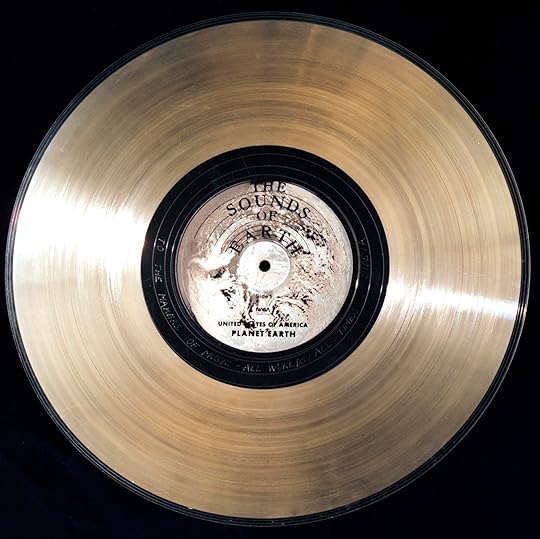
The Golden Record Playlist starts out with a recording of a 43 second greeting from Kurt Waldheim. Kurt's wikipedia page

While I am not going to type out the entire playlist, I do have some awesome links that I enjoyed and I think that you will too!

https://voyager.jpl.nasa.gov/golden-r...
cover The actual golden record
This is NASA's own information on The Golden Record.
There are lots of pictures, diagrams, and information on the creation of the cover, the record itself, as well as complete descriptions of the recording process and everything on the record. There is a lot of clicking involved.
Go explore this one! It is totally worth the time!

Soundclouds Golden Record: Sounds of Earth
https://soundcloud.com/nasa/sets/gold...

Spotify's Playlist: Voyager Golden Record
https://open.spotify.com/playlist/6pc...

YouTubes Windham-Campbell Prizes and Literary Festival channel
Darran Anderson guides the Golden Record onboard the Voyager spacecraft
https://youtu.be/GwBFUfcaJic?si=3PlgB...

RECOMMEND!
Profile Image for Shannon.
1,078 reviews17 followers
March 31, 2024
I was provided both an audio and print ARC of this book via Netgalley, all opinions are my own.

Cassandra Campbell is a fabulous narrator, and is one of my favorites. This is my first experience with her narrating a non-fiction audiobook. I'm used to her voicing several different characters within a sci-fi or fantasy book, however she takes great care in ensuring the scientific words are pronounced clearly and correctly and if there is a non-English name or phrase it is also pronounced correctly.

This was a great non-fiction book for anyone interested in science of discovering new planets and the investigation of space. The author does a great job of mixing science, personal, experience, and pop culture in to the book without getting overly scientific. She uses real world examples from her own teaching experience and research and references movies and books that readers may be familiar to explain her points about how scientists go about trying to determine if there might be life on other planets. I felt like it was written as if she was having a conversation with you about her favorite topic which made if very approachable and easy to consume. I've read other books on the topic and it can get very technical and overwhelming very quickly depending on how the science is presented. You can tell the author loves her work and tries to make it fun and wants everyone to see the majesty in the cosmos as she does.

I appreciated that the author took the time to write about her life and accomplishments. She notes that it was not always easy being a woman in STEM, but because she had supportive parents and mentors she has had an impressive career. This book would be the perfect gift for an aspiring young lady taking an interest in a STEM career.

I would have appreciated pictures of some of the things Dr. Kaltenegger was referencing at times or links to Hubble images, as I was following along in the ebook. The cover is fantastic, and I hope the final version that comes out in a few weeks does have images, but the ARC does not.

Overall this is a great, easy to digest look at scientific approach to looking for habitable planets and potential life in the universe.
Profile Image for James.
608 reviews43 followers
July 3, 2024
A thorough look at Earth’s place in the solar system and our galaxy with a main focus on the methods we use to detect planets orbiting other stars, told in such a simple way that I mercifully did not have to strain my brain to understand anything at all.

It’s also full of interesting little tidbits, one of my favorites was a survey of various planets in science fiction and how plausible they are (Tatooine’s two suns? Why not!) as well as talking about the actual stars used as the setting for Avatar and Foundation and whether there are planets we’ve detected around them (spoiler alert, there are!)
Profile Image for Risha.
83 reviews1 follower
July 14, 2024
This book literally left me in (happy!!) tears 🥹🥹

What a wonderful book about our planet and discovering exoplanets. I am someone who tuned out of science lessons in high school (so much regret now), but Kaltenegger writes in an incredibly accessible way. I really appreciated how she broke down terms/theories in ways that were easy to understand (gravitational pull, the birth of our planet like literally everything).

I loved that she touched on our planet, the need for us to shed 'Earth centric' ideas of other planets but also to use our knowledge of Earth to find other planets. She probably has the coolest job in the world. I finished the book feeling a new love and understanding of our planet and its place (and in extension, our place) in the universe.

I'm going to reread this next year because I feel like it'll be a book you can return to and be like 'Oh my goodness, I forgot about that fact!'. Big recommend if you want a solid non fiction read.
Profile Image for Amy.
563 reviews
January 20, 2024
Great science book on the search for extraterrestrial planets and the possibilities of life on those planets. Easy to read and understand even if you don't know much about astronomy. Ms. Kaltenegger uses simple concepts to explain the science behind the search. Absolutely fascinating read. I received an arc from Netgalley but the opinions expressed are solely my own.
Profile Image for Meg.
2,051 reviews91 followers
March 31, 2024
Narrated by Cassandra Campbell, with prologue and epilogue narrated by the author
Genre: nonfiction

Astronomer and director of the Carl Sagan Institute at Cornell University, Lisa Kaltnegger uses Alien Earths to detail the scientific search for life on other planets. Lots of excellent science fiction and pop culture references, but this is real science- multidisciplinary astronomy, geology, biology, chemistry, engineering and more! - combined in Dr Kaltenegger's pursuit of defining and finding life on planets in other solar systems.

There is some technical information, but she writes clearly enough for someone with basic astronomical knowledge to understand (i.e. if you've been to a planetarium at least once or took a middle school science class, you'll probably be ok!). She poses a lot of interesting questions for us about the universe, and tests the limits of what we might be able to find. Alien Earths manages to gracefully walk the fine line between pop science writing and the technical components of the field, but it’s clear that her goal is to get more amateur scientists and astronomers and the general public invested in this search for life elsewhere.

The audiobook is a good way to connect with Alien Earths, and I never felt lost listening to too many facts. It’s a good blend of interesting scientific discoveries, natural history about the evolution of life on our planet, and Dr Katlenegger’s personal experiences with her field, teaching, and being a woman in science.

Pick this up if you’re a science fiction lover who also likes to think about life on other worlds in our own universe. Pick it up if you want to think about how much life on our own planet is such a tiny sliver of possibility of what’s out there in the universe.

Thank you to MacMillan Audio and NetGalley for an ALC for review. Alien Earths is out 4/16/24.
Displaying 1 - 30 of 300 reviews

Can't find what you're looking for?

Get help and learn more about the design.