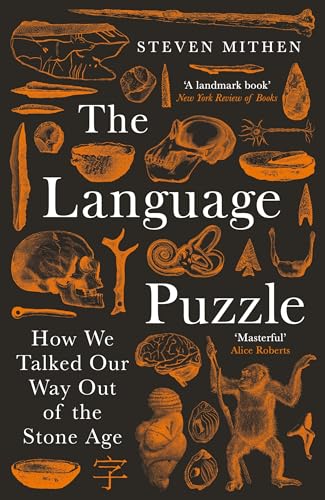
This is one of the most difficult books I’ve ever read in the sense of its intellectual challenge. The author is by academic background an archaeologist, but in order to write this book he clearly had to immerse himself in the fields of genetics, linguistics, neuroscience, psychology, computer science and biology, though I suspect that the modern archaeologist has to be well-versed in many of those areas anyway. By piecing together the knowledge from these multifarious fields he investigates and constructs a story of the development of human language over a period of 6 million years since homo sapiens diverged from its most recent living relatives, the chimpanzee and bonobo.
In the first chapter the author states that he will present the story as a jigsaw puzzle, with the elements which define the frame being the first to be put in place, then the centre being completed piecemeal, and with a final chapter describing the final picture that has emerged. The first and last chapters are the most accessible, with the ones in between varying in their complexity and accessibility.
I found it hard not to zone out sometimes when reading long explanations which included passages such as "Each agent has their own matrix with its rows corresponding to every possible symbol within the meaning-strings and its columns to every possible symbol in the signal-strings. Each cell of the matrix has a number that defines the strength of the association between the two symbols.". That raises the question as to whether the book is aimed at academics, or at least students, or at the general public, because it seems to try and embrace both. It generally, though not invariably, succeeds.
Two factors made the book for me as a general reader. The first was that in each section of the jigsaw he took the same approach as he did with book overall, namely explaining the approach, then going into the detailed and complex explanations, and finally describing the conclusion. Even when ploughing through the ultra-complex sections in which my understanding faded, I therefore always knew that at the end of the chapter full accessibility would be restored.
The second factor was that the book is utterly fascinating. It is fascinating when it comes to the detail, with almost every page containing insights such as “languages spoken in warmer climates have relatively more vowels and those in colder climates have relatively more consonants. This has been explained by a higher frequency of outdoor communication in warmer climates where speakers and hearers are more often separated by greater distances than in the more frequent indoor settings of colder climates. Vowels have higher levels of sonority than consonants – they are louder and can be heard over greater distances."
It is also fascinating when it comes to the big picture of the development of the species over a period of 6 million years. The time scales are mind-boggling. The idea that hominids were using stone tools 2 million years ago is extraordinary, as is the idea that they were making their own stone tools 500,000 years ago, with the relevant technology remaining unchanged for 300,000 years. To put that into perspective, the Great Pyramid of Giza is 4,000 years old. Even the size and shape of the trachea changed during the development of the species, improving our ability to speak. The idea that this happened over millions of years through natural selection, meaning that people whose physical characteristics gave them a marginally better ability to communicate also gave them a marginally greater likelihood of surviving and breeding, is hard to comprehend.
That’s perhaps the most intriguing thing about this book for me. Although ostensibly about language and the development of language, what I found more interesting was its insight into the development of humans in general, of which language is only a part, though arguably the most important part. Somewhere in the recesses of my mind I probably knew how long the stone age had lasted and that the development of humans from chimpanzees had happened through natural selection, but this book brought it to the forefront. Fascinating and rewarding, but a very difficult read. My overwhelming feeling on finishing it was one of relief, but I think that it’s a book that will stay with me a lot longer and more deeply-rooted than most.