Jump to ratings and reviews
Rate this book

Shadows of the Apt #10

Seal of the Worm

Rate this book
The concluding novel in the Shadows of the Apt series.

The Empire stands victorious over its enemies at last. With her chief rival cast into the abyss, Empress Seda now faces the truth of what she has cost the world in order to win the war. The Seal has been shattered, and the Worm stirs towards the light for the first time in a thousand years. Already it is striking at the surface, voraciously consuming everything its questing tendrils touch.

Faced with destruction, Seda knows that only the most extreme of solutions can lock the Worm back in the dark once again. But if she will go to such appalling lengths to save the world from the Worm, then who will save the world from her?

618 pages, Paperback

First published July 1, 2014

105 people are currently reading
2550 people want to read

About the author

Adrian Tchaikovsky

188 books17.2k followers
ADRIAN TCHAIKOVSKY was born in Lincolnshire and studied zoology and psychology at Reading, before practising law in Leeds. He is a keen live role-player and occasional amateur actor and is trained in stage-fighting. His literary influences include Gene Wolfe, Mervyn Peake, China Miéville, Mary Gently, Steven Erikson, Naomi Novak, Scott Lynch and Alan Campbell.

Ratings & Reviews

What do you think?
Rate this book

Friends & Following

Create a free account to discover what your friends think of this book!

Community Reviews

5 stars
1,284 (55%)
4 stars
748 (32%)
3 stars
242 (10%)
2 stars
30 (1%)
1 star
4 (<1%)
Displaying 1 - 30 of 180 reviews
Profile Image for Metodi Markov.
1,721 reviews426 followers
May 6, 2025
Затворих последната страница на финалната книга от декалогията "Сянката на умелите" с автор Ейдрън Чайковски!

И сигурно много хора биха си казали - стигнахме края, най-сетне! А всъщност, аз бих продължил с най-голямо удоволствие да съпреживявам фантастичния свят изграден от писателя, без паралел в творчеството на който и да е друг фентъзи творец, четен от мен до сега!

Прави чест на Чайковски, че се е побрал точно в предвидените десет книги - имал е възможност да удължи историята, но не се е възползвал и от това фентъзния му епос само печели.

Развръзката беше ясна, но това не ми попречи да се насладя на майсторския завършек на тази така интригуваща история.

Разделих се с герои, с които изминахме хиляди километри заедно, преживяхме десетки премеждия, споделихме опасности и тревоги, успяха да ми станат близки и обични. Към момента има издадени и три сборника с разкази в тази вселена и с нетърпение очаквам да се срещна с любимците си отново!

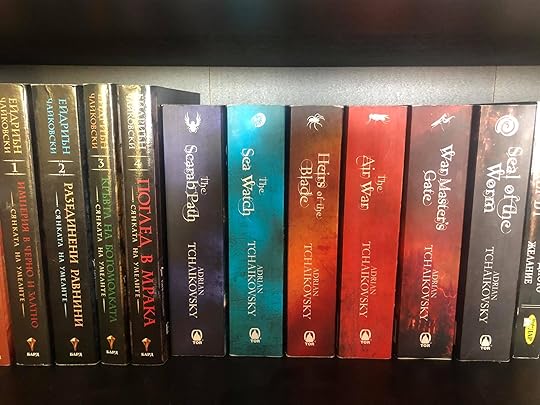
P.S. Ето ги, закротени на видно място в библиотеката ми - четири на български и шест на английски! Защото естествено, издателство "Бард" успяха да съсипят издаването и на тази чудесна поредица на български. :(

Profile Image for Phil.
2,417 reviews237 followers
May 23, 2025
Reread comments: amazing series by Tchaikovsky and yes, the ending is Apt!

Well, Tchaikovsky wraps this series up with a bow in the final installment! We ended the last volume with Che and friends plunged into the 'Worm hole' by Seda, and the seal of the worm shattered. The wasp army was ensconced in Collegium and Sarn being threatened by the same in the lowlands. Lets just say that this was an ending that felt right.

As far as the series, this is really a stupendous achievement by Tchaikovsky. I do not know if he plotted the entire series from the get go, but it felt like it. In the end, we the initial characters all played a role, at least those still alive; in a way, it felt like the series came a full circle. The indomitable Cheerwell Maker (Che) still struggling to do what is right, but wizened due her harsh experiences along the way. Thalric, the ex-spy wasp, was also cast down the 'worm hole' with Che and that world beneath, the 'jail' of the Worm, was scary and a true feat of imagination. Che's sister Tynisa, still wounded from the Commonweal, also follows Che to the 'Worm hole', and mild spoiler, Totho eventually finds his way there as well.

This featured, or at least included, most of the players/characters from the previous novels in the series, including the Sea-Kinden; no small feat itself given the wide array of characters developed along the way. It still astounds me that he wrote the entire series in only 4 years or so, especially given that they were all 600+ page doorstops.

Just a few wrap up notes. Tchaikovsky suffered a bit with pacing issues throughout the series, including the last volume, and included a number of subplots/story arcs that really did not add much to the story. Pretty easy to over look these issues, however, given the exciting action sequences and tension that he managed to build over the entire series as well. Another strong point involves the varied narrative techniques Tchaikovsky developed over the series. Some of the novels were very focused upon just a few characters, and others a very wide cast, with lots of shifting POVs. Also, I saw several literary tropes he developed here playing a role in his later science fiction works.

If you are looking for an exciting, absorbing and decidedly different fantasy series, the Shadows of the Apt fits the fill nicely. I loved all the various Kinden, from the patriarchal, war-like wasps to the industrious beetles, to the Mantids and their bizarre 'civilization'. Epic is too small a word. 4.5 strong stars for the series and for the last volume. Amazing he can write a 10 volume epic with no real duds along the way, and make it seem fresh and lively along the way.
Profile Image for Algernon (Darth Anyan).
1,829 reviews1,155 followers
August 21, 2014

Overall rating for the whole series [9/10], plus one spot in my top ten all time favorite fantasy realms.

Here is the finished line of the long journey into the realms of the insect kinden, into the world of Apt and Inapt civilizations, of those technologically proficient and those still believing in magic and the supernatural. Nations and cultures in conflict, a war that started centuries, even millenia ago. A war that seems doomed to continue indefinitely in the future. Unless somebody makes a stand and says enough is enough. Some heroes are sorely needed to pull the world back from the brink of utter destruction.

If I were to choose only one word to describe the Shadows of the Apt series I would pick EPIC. I know the term has been overused and applied indiscriminately to all kinds of subjects, but in here I found all the original grandeur, the scope of vision and the mix between individual destiny and national upheaval that I associated with works like War and Peace, Les Miserables or Gone With the Wind. I admit, the writing and the characterization is not quite at the same level as the masterpieces I mention, but the story itself and the thrill of exploring imaginary lands and cultures grabbed me right from the start and kept me buying each new issue on publication date. I am grateful in particular for the productivity of the author, who managed to put out sometime two novels in one year instead of making me wait 5 or 6, as some other big names in fantasy that I don't really need to mention here.

This is the endgame, with the whole world, aggressors and defenders alike, Apt and Inapt indiscriminately, threatened by an elemental, atavistic, irrational Force released from millenia of imprisonment in the previous volume. It is collectively known as the Worm, and it knows only to feed and to remake the world in its own image, enslaving and brainwashing every intelligent being that crosses its path:

A world without artifice or magic, that's the Worm's world. A world without anything of the human mind.

The Worm is a Force of Nature, a God feeding on the subconscious mind, a product of our own inhumanity to our fellow men (or kinden) when persecution and opression breed resentment and hate from one generation to another until atrocities are comitted in the name of freedom. The Worm's metaphysical aspect helps in moderating my discomfiture at the choice of the author to go for his final battle to the tried and tested fantasy trope of the Ultimate Evil Overlord who wants to swallow the whole world:

The Worm is inside all of us.

Since this is the final book in the series, I will continue to be vague about the actual developments in the final battle, and try to address my remarks to the series as a whole.

Strengths: character driven, superb action scenes from individual duels to whole armies clashing, incredible and original worldbuilding using insect physical characteristics to reflect on the psychology and abilities/aptitudes of each kinden, good balance between technology (one of the few fantasy series to use modern warfare machines) and magic (mysterious, elusive, unpredictable, dangerous)

Possible shortcomings: the technological advance is too accelerated, going from swords, bows and arrows, chainmail and walled cities, to fighter or bomber planes, tanks and computer controlled artillery, submarine and railguns in only two decades. One argument in favour of the author's choices is that war has been known to introduce rapid technological developments. Still, the described devices and machines would be very difficult to built and to operate with the parameters mentioned in the text (clockwork airplanes? hand-pump air-pressure machine-guns? tanks with walking feet instead of tracks? etc.) It was difficult at times to suspend disbelief, like accepting that the Inapt cannot operate even a simple door handle.

War forges a people, or breaks them, and you see the quality of their metal when you bring it under the hammer.

Sometimes the plot is predictable and despite the originality of the setting, the characters feel wooden and the dialogue forced. I believe this was an issue especially in the first and second volume, and that Tchaikovsky greatly improved in the later books.

And finally, for a long time the odds favoured escalation of the conflict, with the 'bad' guys repeatedly getting the upper hand and the odds of victory getting smaller and smaller. It's another tried and abused technique to keep the adrenaline flowing and to induce sympathy for the underdogs, but here I also feel the need to praise the author for evading the trap of making the adversaries unbeatable or giving his heroes superpowers. I am thinking here of Codex Alera, where the escalation of odds and the mechanical nature of the magic system translated in the last books of the series to ludicrous armies of millions and a hero who levelled up to 100 to wield magic bolts able to slay those millions singlehandedly. In the Apt universe, no warrior escapes unscathed, not even the Ninja Master Tysamon, and no magic wielder, not even Elder Gods, can weave offensive spells by clicking his/her fingers or raising an ironic eyebrow.

Here's a portrait of Totho close to the end of his journey, one of the characters introduced in the first book that has been illustrative of the style of presentation for many other actors: one of the good guys in the beginning, full of resentment and perceived persecutions later on, annoying then pityful, vengeful and/or confused later, arrogant and reborn in the metal forge of the war industry still later, on the brink of becoming a war criminal then finally able for some introspection and honest self evaluation:

"Sitting there in full armour, his helm in his hands, the snapbow leaning beside him like a lance, he could not know how he looked: exactly like some storybook warrior defeated in his last battle, scorched and bruised and alive beyond his time."

Like him, most of the other actors revealed surprising character motivations and changes of heart, acquired wisdom or decided to give up the fight. I followed the fate of big players and small players on both sides of the conflict, the small ones getting pushed to the top, usually unwillingly, the big ones being brought down by their own ambition or pride. I laughed with them, I marvelled at the sights they saw, I suffered by their side, I even cried when one of my favorites was cut down in his prime, and now I look back fondly at all the adventures we had together and I feel sad to let them go. I hope the survivors have learned from the past and will not let their world descend again in the chaos and destruction their generation had to deal with. The most emotional aspect in the book for me

I still have a couple of quotes saved, a couple of points I wanted to make (or repeat), so bear with me a while longer. I've been warned several times that all engineers like to brag about their profession, and that I should be more discreet. But I think one reason I enjoyed the series is the prominent role played by technicians and inventors all through the epic. There's even one volume (Sea Watch) that pays homage to my favorite childhood writer, Jules Verne, with an extended section describing an underwater world. Here's one quote from Varsec, one of the books engineers, to make my point:

Progress is what an engineer should wish for. If a thing does not work, you redesign it until it does. If a thing could work 'better', it's the same. And if you do not advance in this way, if you become fond of yesterday's designs even tough they no longer function, then you will fail. Only by changing and bettering ourselves can we survive.

The second quote is a bit meta, and refers to the most elusive, yet persuasive, forms of magic encountered in the book: storyteller magic. Metyssa is a halfbreed kinden, hiding in a conquered city and raising the morale of the subjugated population with improbable stories of insurgency and fighting back by the common people. Later she is in an extermination camp, awaiting the 'final solution' and she eases the hearts of her fellow inmates with a different kind of story:

She told them how it came to pass: how the great imperial war machine came to be dismantled; how peace came to all the lands of the kinden. She told it as though it was some fable from long ago, just the sort of story the Inapt grew up on. No rooftop chases or derring-do now, but a gentle story of a world grown sane. A story where soldiers put away the toys of war and went home to their wives and mothers and lovers."

In order to built a better world for us to live in, we first need to know how we want it to look like, what kind of people will live in it, what their dreams will be like. And it is the storytellers, the poets and the dreamers who makes it possible. Think how the French revolution started with the Illuminists declaring the Human Rights, or how the Russian Revolution started after Marx wrote that workers have power to take their destiny into their own hands. How the groundwork for the Civil War may be traced, in part, to a book named "Uncle Tom's Cabin". So the writer does more than entertain or investigate, he dreams us into a better future. My final word on the epic becomes thus a grateful thank you for a more optimistic ending than the previous unfortunate events led me to expect. This is the end, but it is also a new beginning.

I read somewhere that next year Adrian Tchaikovsky will publish the first book in a new SF setting. I will be in line to get it as soon as it hits the shelves.
Profile Image for Jason.
1,179 reviews286 followers
July 12, 2015
5 Stars 

Well it is finally over. 10 books of epic fantasy. Seal of the Worm is an incredible Swan Song to one of the greatest series ever written. Adrian Tchaikovsky has truly created something special with this The Shadows of the Apt series. It will be considered a classic. In the age of massively long ongoing series and in the Shadows of the greatest such as Robert Jordan's Wheel of Time, George R.R. Martin's Game of Thrones, and Steven Erikson's The Malazan Book of the Fallen; Tchaikovsky has gone ahead and created something different, memorable, and amazing.

There are far too many reasons why I feel that this is not only a must read series, it is simply among the best ever written. A few reasons why before I go into this book, the final installment in the series.

First, it is unique in that this series is about the Apt. They are the technologically advanced people. They are modern and pretty much shun and balk at the thought of magic or the supernatural. This is ironic since all of the people of this series each belong to a different Kinden. There many different Kinden, such as the soldier-like Ant Kinden, the evil Empire of the Wasp Kinden, the intellectual Beetle Kinden, and many more like the Mantis, the Moth, the Dragonfly...These Kinden are all unique in that because they are Apt, they draw upon their insect Kinden for their own way of life. It is simply an incredibly imaginative world that had me captured from the get go. How freaking cool is it, a world where people draw their ‘Art’ from their archetype insect Kinden…

Second great thing about this series is that is that Adrian Tchaikovsky does not always stick to conventional ways of story telling. For a book that centers on technology and science, there is no math lesson to be had, or physics to figure out. There is not really a lot of backstory on the science of the world that looks a lot like a steampunk alternate reality. Also, as for the Inapt and the magic, Tchaikovsky spends little to no time explaining it, or making it work. A bold contrast to the great lengths that most authors of these epic series go through to make them real. (Robert Jordan, All books by Brandon Sanderson, Steven Erikson, and many more). This works because of how it fits into the world. Tchaikovsky also goes boldly where most authors shy away from in that he is not afraid to kill off any main character. Also worth a note that Tchaikovsky is brave and never once stays with the tried and true in that he makes each book stand out quite unique from the last.

Finally, Adrian Tchaikovsky has created a bunch of characters that I basically fell in love with. Tough to write much more than say that they are exceptional. Che, Thalric, Tynisa, Stenwold, Maure, Totho, Seda, Tsiammon…and so many more. Che is my clear favorite with her sister being my second. They are very memorable characters that you will believe in, care about, and also hate.

The Seal of the Worm turned out to have one of the narrowest scopes of the whole series. Without any spoilers this worked. I was so glad when one of my favorite characters from the first four books makes a return in big fashion in this one. The worm was awesome. The conclusion was worthy of the series as a read. The outcome was just. The best part to me was the fact that the Apt people and the Inapt people so desperately wanted to be right, and you know what, they were. I LOVED IT!!!!


The worm:


"And Che beheld the Worm.
She forced herself to stare at it, to encompass it within her understanding, to reduce it to something she could name. Just a centipede, she told herself desperately, but how far from the truth! It was a wrong made physical. It was a devouring tear in the substance of the world, a writhing, many-legged door to somewhere that made this cavern world seem verdant and filled with life in comparison.”

Also:
"But he was already speaking over her. ‘Che, I was brought up to expect the world to act in rational ways. I learned calculus and basic principles of artifice. I’m no engineer but I know machines – I know that they work, and they make sense. And here, and when those things were after us . . . it was gone, Che. There was a hole in my head, and everything I thought I understood just fell out. It was as if I’d learned nothing . . . no, it was as if everything I’d learned had been a lie.’”
My feelings on Che paralleled that of Thalrics.

"‘The thing is,’ Thalric went on, ‘she changed. I didn’t realize it at the time, but I was watching her at the very point as she . . . grew up.’ At Tynisa’s derisive snort he added defensively, ‘I don’t mean it like that. I mean like . . . larva to insect. She was growing, right then. I saw her become something new, and suddenly it wasn’t me rescuing her but me following her. By the time she found you in the Commonweal, she was almost there.’"

An epic fantasy to every degree that deserves to be ranked up there with the very best. I loved it and hope that all with any interest in this will run out and start with book one….

AMAZING!


Profile Image for Liviu.
2,517 reviews705 followers
July 8, 2014
After 10 epic volumes, the saga started 6 years ago in Empire in Black and Gold ends extremely satisfying with a book that grabs one from the first page and never lets go until the final epilogue set a few years later which itself has a superb conclusion; there is so much to cover and so many subplots to follow that the novel doesn't feel long, maybe it actually could have had a couple hundred more pages for more detail here and there, but overall I think the balance between action and world building holds well and there is enough of the later even though not everything is spelled out

we meet again pretty much all the surviving important characters including quite a few that have not appeared in several books, though obviously the most pages are dedicated to the two subplots that dominated books 8 and 9 - the Collegium and the fates of those on both (or maybe many) sides involved there and life in the Worm domain where Che and her companions where thrown at the end of the last volume and where they have a stark choice - try and engineer a revolt and overthrow the Worm or die together with their world; things happen, twists, turns and non-stop action while as mentioned the ending is excellent - among the best wrap up of a long series I've ever read and one that can stand as an example for how to do it - enough conclusion, enough openness for more later (as far as I know more kinden books are planned though most likely they will take place in a different time with different characters), tragedy and triumph, things to do later etc; many important characters die (another book that kills them in droves like Salute the Dark) but many survive and even thrive including some that became big time favorites of mine as the series went on

Overall just great stuff and another top 5 of mine for the year
Profile Image for John McDermott.
489 reviews88 followers
February 18, 2024
A triumphant conclusion to what's been, mostly, an amazing series. All the various kinden that have played a role in this ten book series are featured here in an almighty dust-up.
I was more than happy with the conclusion to each of the characters' story arcs. In particular, Stenwold Makers, I found poignant and touching.
The introduction of The Worm , who poses a threat to the whole world, added a real sense of jeopardy and the ending, outside the walls of Capitas gave me chills.
As a whole, The Shadows of the Apt series has been an absolute must-read for any Fantasy fan.
Profile Image for Janny.
Author 105 books1,926 followers
Read
July 10, 2022
Fine finish to a stunning series - excels on every front.

Don't be put off by the cover or the bugs - this is a human story in every way, with deep complexity, heartbreak and triumph with all the feels, well drawn characters and some of the best military action (and setbacks) ever written in the genre. Misfits and scumbags, gangsters and intellectuals, snotty aristocrats, rampant greed, ambition, hubris and downright wild invention - all ten volumes kept me entertained and better: guessing.

I will be reading more Adrian Tchaikovsky hereforward and wish I had discovered his work sooner!
Profile Image for Gabi.
729 reviews162 followers
November 21, 2021
If I'm not mistaken this is the first time that I actually finished an SFF series. That alone says something about the quality of it.

Even though I am a great fan of Adrian Tchaikovsky's writing it took me several years to finally tackle his debut books. I'm not the biggest fan of Fantasy series, I usually space out when battles are described and I dearly love works that manage to get their idea across in one single volume. Yet, since I nearly have read everything else by this author it was time to get to his roots. The fact that the series got a republication including an audiobook version seemed to be the perfect moment for me getting myself acquainted with it. I've listened to the whole series on audio in the narration of Ben Allen whose voice acting is a force on its own. I highly recommend the audiobooks.

The series can be divided into an arc over the first 4 books, then some books with nearly standalone character regarding the main plot bridgeing to the 3 book finale which in essence is one gigantic war story. So good news for readers who are not sure if they want to dedicate themselves to 10 large volumes: the first four work perfectly as a series on their own.

Even though the series is in essence indeed one long story of war and steampunk invention of technical vehicles there is so much else in there that even a most unlikely reader like I am was hit, hooked and speared by the emotional grandeur of it.

First of all: the characters. To get me to go on with a Fantasy series I need to get a deep emotional connection with some of the characters. Because, let's be honest, there is not so much different in longer Fantasy series that the plot itself would get me flabbergasted. This is the first point, Tchaikovsky did marvellously right. Already in book one I got intrigued with several of the protagonists and the more I was following their journey through the war, the more I cared for them. Some of them died which threw me and had me in tears, some of my absolute favourites actually survived - which had me in tears again - this time out of gratitude. All of them were created as realistic, flawed, sometimes even treacherous, very distinct human beings, some of them suffering from trauma of the war in a very authentic way. None a superhero to save the day, no chosen one. Every step of the way is a team effort.
Tchaikovsky even managed to do something right that I usually despise: bringing in a whole new bunch of characters in the last meters of the race and concentrate on them instead of my longstanding beloved ones. In the last three books he introduces a couple of students who start a revolt in their occupied home town which invokes images of Les Misérables - and after half a book I was nail-biting for them in the same way as for my actual favourites from the seven books before. No small deed.

Then the typical Tchaikovsky trademark: the worldbuilding. He loves worldbuilding and that shows. We don't have the typical humans/elves/dwarfs against orcs/trollocs/dragons in a typical medieval Europe feeling setting, but a whole world of kinden; different human (and not so human) peoples who have abilities and characteristics of various arthropode classes. For example the wasp kinden are an imperialistic war loving kind who can shoot fire, the beetle kinden have a democratic society with scholars and artificers, the spider kinden are a beautiful people, always spinning their webs of social intricacies, etc. This makes for a very interesting and refreshingly unique world.

Another strong point of the series is the juxtaposition of technical experience (the apt) and magical skills (the inapt). At the beginning of the book the technical world is dominating and magic is something that's often believed to be a fairy tale, but the more we get into the story the more the magic awakes again and this leads to fascinating plot twists and encounters. None is superior to the other, both are essential to the finale.

What also stands out is the versatility of the books. Multi-POV books with all encompassing grand scale warfare by land, sea and air where it sometimes needs all the attention to keep track of the names and settings alternate with books that emphasize on a few main characters on a much more intimate journey. Yet everything follows one golden thread, adds to the story. There are near to no filling scenes (with the exception of one book perhaps), the pace is most of the time on the breathtaking side. Never does the reader get the feeling a book could have been shorter than it was. Everything always moves towards the grand finale.

This is high level Fantasy writing with some of the best characters I have so far encountered in this genre. Since it is the first series I finished it feels wrong to say it is the best one, for this to determine I have to come back to it in some years when I will eventually have managed to finished some of the others.

In recent years I have started more Fantasy series then I can count on my fingers and toes and with the exception of one as of yet unfinished one, none made me pick up all the books with such enthusiasm as The Shadows of the Apt did. Whatever else I read, I think I can savely say that this series will be in my all-time top three. It is way too little known and deserves so much more recognition in the genre!

A sparkling gem, heartwrenching fates - a labour of true love and passion.
Profile Image for aria ✧.
919 reviews153 followers
February 18, 2023
‘You think they’re Inapt,’ she noted. ‘They’re not. They don’t believe in my magic, any more than you do. Less than you do, perhaps. They don’t even tell each other stories of when the magic was. But they’re not Apt, either. They don’t believe in your gears and machines. And when they get close, they can stop you believing, too. A world without artifice or magic, that’s the Worm’s world. A world without anything of the human mind.’
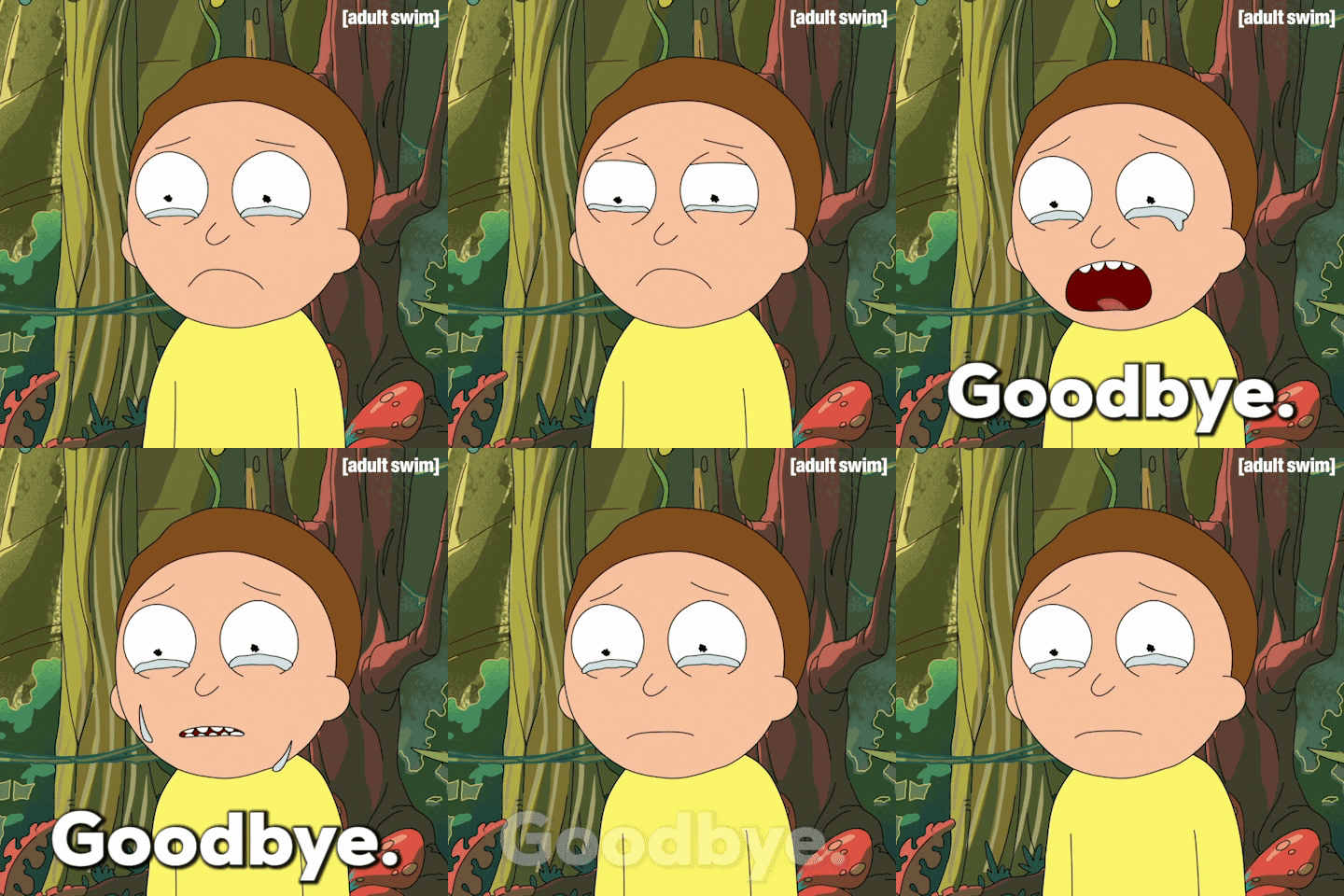

“Seal of the Worm” is the tenth and final book of the much underrated Shadows of the Apt series.

Collegium has fallen. The empire is victorious and our remaining characters struggle to survive. I started this series this year and here I am, on the 31st of December, finally completing it. It’s been an amazing, wild ride and I’m so sad to leave this world. Now excuse me as I go cry.

description
Profile Image for David Firmage.
223 reviews65 followers
November 14, 2022
Good conclusion. The series has been rather hit and miss, with the world being far more interesting than most of the characters.
Profile Image for Patremagne.
273 reviews91 followers
April 25, 2018
The journey I began more than five years ago has finally come to a close. From the gates of Myna to the lair of the Worm, Tchaikovsky has spun a tale in which the word epic hardly scratches the surface. What starts as, on the surface, a standard-feeling plot with a big bad empire invading progresses into a world war - and even further into a war of the worlds. Themes such as the impact of technological advance on less technologically apt civilizations and the effect that war has on the lives of everyone involved are explored in a meaningful, important way that doesn't meander or ramble and cause the reader to lose interest like Steven Erikson's work often does for me.

I can't recommend this series enough. A unique setting in a cross between steampunk, magic, and sword-wielding soldiers, a new take on race seen in the very distinctive Kinden families, and an outstanding take on magic vs tech in Aptitude.
Profile Image for Eric.
179 reviews67 followers
July 16, 2018
4.5 Stars

A satisfying ending to a genuinely unique series, Seal of the Worm capped off an epic 10 book journey.

While the war between the Wasp Empire and the Lowlands continues, the hidden danger of the Worm and its hordes of mindless kinden lurk beneath the surface. Empress Seda hurries to fulfill her mad plan to stave off the horror of the Worm, while Che and the others stuck within the Worm’s realm try to rally their meager forces to survive and escape. Meanwhile, the war between the Lowlands and the Wasps reaches the end as the battle shifts from the Lowlands further east, into the heart of the Wasp Empire.

Tchaikovsky manages to wrap up a 10 book series with skill, providing closure to the various loose threads of the story in a satisfying way. I wouldn’t have minded a bit more time spent on the conclusion, but I enjoyed the sendoff given to the surviving characters.

I’m going to spend the rest of this review talking about the series as a whole, because it truly is one of the more different and interesting series I’ve read. First, the world building. With the various kinden who possess certain traits from the insects who gave them their name, Tchaikovsky started with an incredibly unique premise. I was a little uncertain about it at first, picturing books about human sized bugs walking around, but I was quickly hooked by the compelling variety of the different kinden.

Each kinden also has its own distinct culture, from warlike and aggressive Wasps to cunning and manipulative Spiders to reliable and hardworking Beetles. Each book shined a light on a new aspect of this fascinating world, exploring a new culture that felt realistic and fully developed.

Then there is the technology. I’ve never read steampunk and have always been leery of technology in my fantasy books, but here it is handled incredibly well, with a realistic portrayal of how war drove innovation and how quickly new technology shifted the balance of power. It helped create some incredible battle scenes, something that the author wrote extremely well.

The characters were another strength. Interesting and diverse, Tchaikovsky particularly excelled in creating memorable secondary characters in a short amount of time. Thalric, Stenwold, Tisamon, and Che were all memorable characters that’ll stay with me after the series is done. Che in particular went from someone I disliked to a great character, highlighting the growth that occurred in each person. No one ended the series the same as they started it.

It’s not a perfect series, and there were some books that I liked less than others as the narrative pace dipped from time to time. While never overly grim, the action can be brutal at times, with many characters not making it to the end and a bit of a melancholy streak throughout the story. This is also a series that while I thoroughly enjoyed, didn’t provoke the same strength of emotional response as some of my absolute favorite series. Still, Shadows of the Apt is a series I’d encourage any fantasy fan to try. 10 books is a long series, and a big time commitment. If the length of the series is off putting, the first four books complete an initial story arc, meaning that a new reader can try the books without committing to a full 10. I’ve got a lot of respect for the author and what he accomplished in this series, and I hope others give it a try and enjoy it as well.
Profile Image for Pranav Prabhu.
207 reviews77 followers
June 26, 2025
Really really great ending to all of it. Tchaikovsky dealt with both the recently introduced apocalyptic threat and the long-running imperial conflict in satisfying ways, ensuring that the former did not overshadow the latter in any way, since that's what we've been following for so many books now. One of my new favourite series.
Profile Image for Tom Maguire.
99 reviews11 followers
February 21, 2023
Probably my least favorite of the Series, everything gets wrapped up, makes sense and is in keeping with the rest of the series, and I still enjoyed the read, but I just wasn't as engrossed as I had been in some of the other installments.
Profile Image for Emiliya Bozhilova.
1,900 reviews377 followers
August 18, 2022
Дълъг път извървяхме с Чайковски и неговите девет от общо десет романа от поредицата ”Сянката на умелите”. Шестия го пропуснах без никакви угризения като най-малко свързан, и досега няма странични ефекти.

Краят заслужава искрена похвала, тъй като е доста логичен и същевременно с пристрастяваща доза неочакваност. Разделителните линии от сорта на “добрите биха лошите, любовта победи и всички заживяха щастливо” в голяма степен липсват, което е силно освежаващо. Както винаги, всички “гранични”, даже “зли” образи са истинска наслада за четене и изнасят целия сюжет. Опитът за добри и чистички протагонисти е пълен провал. Чайковски просто не умее да описва убедително добри хора без сериозни недостатъци, които същевременно да карат света да играе по свирката им (т.е. по висшите им ценности), или поне да ги слуша. Добре, че сюжетно са подобаващо размесени - за по-основните, или с лекота се прескачат - за второстепенните (вкарани напълно излишно от осма книга нататък да покажат някои аспекти от действието).

А действие има доволно много, макар на места да буксува. Че и компания се озовават в подземния свят, където изскачат куп мрачни (в буквалния смисъл, там светлина няма) изненади. Морскородните, като същи американци, се намесват най-сетне в този фентъзи вариант на втората световна война. Осородните, като истински немци, се чудят дали да се хванат сериозно за гушите и за коя гуша точно, докато междувременно водят война на всички фронтове, а им предстоят и подземни изненади. И да, императрица Седа се захваща да гради концентрационни лагери, докато един крайно неординарен мравкороден военноначалник взема мярката на империята и.

Светостроенето е плътно, увлекателно, на моменти чак задушаващо детайлно. Повечето герои вероятно са включени като клинични случаи в учебниците по психология. Единственият недостатък е голямото изобилие от характери. Там, където други фентъзи автори копаят на едно място, Чайковски е изкопал поне десет различни дупки, от които минимум три са напълно излишни, но него не го е грижа, и си ги украсява с герои и действие, пропускайки да доукраси останалите седем.

Но това не повлиява на изхода на събитията. Умират някои неочаквани герои, други неочаквано остават живи да дерзаят върху руините на следвоенния свят и на собствените си грехове. Доволна съм, с две малки изключения. Милус, за когото ми се щеше да науча доста, доста повече. И Тиниса, която в цялата поредица остана с нереализиран потенциал като образ. Както и цялата банда излишни колегиумци второ поколение - загуба на хартия.

Размислите технология - магия, война - политика, ценности и възможности - избор, също са от силните страни на сюжета. Като въздействие първите пет части бяха доста хомогенни и ударни. Седма и осма част спокойно биха могли да са една книга, ако се изрежат скучните второстепенни образи и описанията на всяка отделна битка. Девета и десета част до голяма степен наваксват.

Ще се радвам да видя още книги на чичо Ейдриън, но се радвам, че такива дълги истории повече не е писал. Все пак, ако НВО иска нов сериозен фентъзи сериал (доста надхвърлящ известния “Игра на тронове”), това е кандидатът. Но предвид, че ще се иска малко повече задълбоченост, не храня особени надежди.
Profile Image for Christopher.
1,587 reviews43 followers
July 19, 2014
Seal of the Worm is the tenth book in the Shallows of the Apt series! :D The book continues straight after the events of the previous book The Air War! The Wasp Empire is starting to feel stress all its conquest and a rest ended, the Empress Seda has broken the seals that keep the Worm separate from the normal world! :D

Seal of the Worm finds all the characters spread over much of the world and the book covers all these characters as well as the shifting events at a frenetic brilliant pace! Che and Thalric who are trapped in the realm of the Worm launched a rebellion against them as the Worm are consuming their slaves in an attempt to take over the above world of the Inapt and Apt! :D They along with the other characters there are trapped with get a lot of character development and we get to see the bond between Che and Thalric that have been developing throughout the series and this gives a great tone too many of events that take place in the book! :D

We also get to see the heroic return of Stenwold Maker and his return with the Sea Kinden! This leads to one of the biggest battles of the book's so far and continues the running battle that takes place right to the end of the book! During the course of this battle many things happen to great deal of the main and ancillary characters so you will find yourself turning the pages to find your jaw constantly hanging slack as more and more things happen! :D

The way that the Wasps and other people's start to form a new form of government in its all this crisis is also part of the actual happy ending the characters in the book get! :D Indeed many other things the characters go through make it that they deserve to see the fruits of their labours! Many of the characters introduced the last few books also grow and step up to the most senior roles at this also as a tone to the book we see the return of Cheerwell Maker and Thalric to the streets of Collegium! :D

Characterisation is spot on and there are many clever twists throughout the book and some characters returning indeed the scene with Stenwold Maker and Tisamon harkens back to the earlier books! :D Taki and Tynisa also get but their efforts in reminding us of events from their perspectives! We want to get sees things in the Wasp army perspective and see that even they have a point where they were not cross which adds to the feel of collaboration that we see between many the characters! :D Plus there are lighter thing int there amongst the destruction as well such as a Imperial Republic! :D The epilogue at the end of the book really also adds another times the book with a meeting of minds of all the different people at Collegium and also sets things up potentially more events e.g. sequels! :D

Seal of the Worm is brilliant, fast-paced, and will have you guessing as to what will happen as the plot takes many twisting turns! Exactly and highly recommended! :D

Also note for your health the amount George R R Martin syndrome running around in it! :D
This entire review has been hidden because of spoilers.
Profile Image for Kaushal.
102 reviews26 followers
July 7, 2014
The Seal of the Worm is book ten of the Shadows of the Apt series. I was eagerly awaiting it, and it more or less lived up to my expectations.

SPOILERS FOR THOSE WHO HAVE NOT READ BOOK NINE AND EARLIER

War Master's Gate ended with the titular seal of the Worm broken, and the wasp Empire poised to crush the Lowlands. There was a lot of build-up to this book, a lot of subplots to be taken care of, and then the entire crisis of the Worms emergence to be handled and resolved. Given all this, the book seems a bit short. It's not actually short - at almost 500 pages, but it does feel that way, because there is not a single dull page. The action takes a while to build up and grip you - like a lot the series' books - but once it does it will not let you go. But the sheer complexity of the story means at times not enough words are given to some of the plotlines and characters. Stenwold Maker in particular had almost a guest appearance.

The resolution of the main and side plots is mostly satisfying, though feeling a bit too serendipitous. Especially in case of the Worm. Also a bit unsatisfying for me was that we find out precious little new about the worm, which left me feeling a little cheated after such a long time of burning curiosity. And yet I've given the book five stars. Because it is not a stand-alone book, and viewed together with its parts, it is absolutely awesome. The series had its ups and downs for me, but if this was not a high point, neither was it a low one. And for the sheer freshness of it, for moving away from dragons and dwarves and all that, and creating a fantasy world that feels at once possible and yet utterly alien, I feel justified in my rating.

So I you have been following the series, you've got a good end to look forward to, and if you haven't, then you should, because this is a real gem.
Profile Image for Madhurabharatula Pranav Rohit Kasinath.
360 reviews23 followers
December 29, 2015
This is a review of the entire series - there are NO spoilers.

When I look back at the Shadows of the Apt, what strikes me at first might seem incongruous to most.

There are no unnecessary descriptions of food.

None at all.

10 books, each of them 400 to 700 pages in length - covering battles, history and multiple points of view - and not a single one of them had any descriptions of food.

Or sex, clothing, family crests, whores or incest.

And I loved it.

Not a single wasted line.

There may be many reasons why the Shadows of the Apt is a success, why you SHOULD read these books no matter how difficult it may get at times. If I had to choose one, however, its this - Tchaikovsky doesn't waste a single page, character or event in his storytelling - the march of story is relentless through thousands of pages, culminating in a satisfying finale.

The World in which the Shadows of the Apt (SOTA) is set is astonishing in its originality. There are no elves, trolls, orcs or dwarves - instead, Tchaikovsky populates this world with Insect Kinden - human beings of different races who derive their primary characteristics from insects. Beetle kinden are slow, plodding, hardworking and intelligent with a flair for statesmanship. The Ant Kinden are warlike and live in each other's heads, attempting to work towards the betterment of the Ant city - a frightening and at the same time amusing allegory for communism. The Mantis Kinden live in the woods, are excellent fighters and are generally rooted in arcane magic and rituals - individualists who are dying out due to adherence to traditions which have lost all meaning. There are Spiders, Moths, Thorn Bugs and Flies each with their own definite characteristics that would require an encyclopedia to cover in entirety. At someone's last count there were close to thirty distinct kinden introduced in the series and I belive that must just be scratching the surface.

Another important differentiating factor amongst the people of this world is Aptitude. The Apt are those who are skilled in the art of artifice, and mechanics. They are scientists, using the laws of nature to change the world around them. Crossbows, artillery and even primitive air power all based on the principles of clockwork make their appearance in the early pages of the series. On the other end of the spectrum however, are the Inapt - the erstwhile rulers of the world to whom the apt were but slaves until a long ago revolution altered the power structure forever. The Inapt live in a world of magic, intuition and prophecy - incapable of so much as unlatching a door, their minds unable to comprehend the machine world in form or function.

This status quo is under threat from the Wasp Kinden of the north - a ferocious warlike race which has come into its own and seeks to conquer the world. While this might sound like a cliche far too common to all fantasy fiction there is an important difference - the Wasps aren't inherently evil. The initial stand off is more one of culture and ideology than of good and evil. Two of my favourite characters are, in fact, Wasps. The only people who are aware of the threat the Wasps pose to the world are the beetle Stenwold Maker, a master in Collegium and his Mantis friend Tisamon. As the series begins Stenwold sends his niece Che, his adopted daughter Tynisa, a spider and his halfbreed student Totho and the dragonfly prince Salme Dien to the factory city of Helleron for espionage against the Wasp empire. Having turned its eyes towards the university city of Collegium, a beacon of enlightenment and artifice in the Lowlands, the Wasps are determined to stop Stenwold Maker at any cost.

Anymore would give away the joy of experiencing the plot for yourself. Rest assured, things get complicated very quickly, alliances shift and change, people die and before you know you might find yourself rooting for a villain. Over ten books we are treated to multiple detailed accounts of various battles, war movements and deaths. The narrative moves effortlessly between personal accounts of war and one on one battles. There is a very real sense of forward progression in the book with characters always changing, finding their ideals and comfort zone being challenged on a regular basis and reacting to the world in new ways. These interactions might not always be pleasant and not everyone might walk away from them alive - however, it is wonderful to see such attention to character progression. No one walks out of this book unscathed or unchanged. Some change for the better, some for the worse - but all changes seem normal, organic and make sense. This series capitalises on this characterisation to make things all the more gripping.

SOTA cannot be labelled as grimdark fantasy either. There is war, death, murder, rape and cruelty. There are slave camps, dying civilisations and loss. A large chunk of characters are dead towards the end of the book. However, there is a resilience to all the characters that makes it possible to believe they will eventually find a way out. It might be because the author is British but all the characters have a stoic, stiff upper lip approach to situations which makes even the darkest segments of the book immensely enjoyable. The dialogue is witty, snappy and fluid - more importantly, it's distinctive in a sense and tailor made to each character. Atrocities, when they are committed are mentioned but not described in detail. This seems to be a more effective method of conveying the horrors of war. I have seen fantasy where rape and murder are described to a distasteful degree under the excuse of realism. Tchaikovsky actually doesn't indulge in voyeurism which significantly increased the emotional impact when bad things eventually DID happen. (Basically books 4 and 10)

A standard fantasy talks about heroism in the face of darkness with a well demarcated line between good and evil. SOTA takes a different tack. While set in a fictional world the themes are often all too relevant. The novels are given over to varied themes - whether duty to oneself comes over and above duty to the city state, are we willing to enslave others so that we may be free, the struggle between the old world and new, between science and superstition. There are also deeper questions about the creation of weapons of war and deterrents- does an inventor take pride in a weapon that has been created solely for killing, and if he is horrified what mental toll does this take? The stark contrast between killing a person yourself and ordering the deaths of hundreds in a mechanised attack is also touched upon. The question asked of a lot of the artificers in this series is whether they feel war has allowed them progress and innovation and whether, coming on the heel of the human cost, this innovation is worth it. A lot of the characters might answer yes. The beauty in Tchaikovsky's characters lies in how easy it is to understand if not exactly sympathise this point of view.

Over the course of the series, we are also treated to innovation and how it can change the face of war. Ranged weapons are deployed against an unarmed infantry, submersibles are invented out of necessity and there is an entire book devoted to an Air War that brings to mind the Battle of Britain and the RAF during World War II. This mechanical progress is a plot point which drives the book forward. The enemy improvising and modifying weapons while the defenders need to think on their feet to win the war and vice versa.

The only criticism I might want to level against this series is that it seems a little too dry at times.Tchaikovsky's prose is fluid, and wonderful on page. However, at times, it fails to convey the images necessary to visualise the world around. I am an extremely visual reader, by which I mean that I enjoy building the environment around me. Tchaikovsky was adequate to this task but I wanted more. However, I choose not to reduce any points for this - This is Tchaikovsky's first work. A ten volume series which serves as a nuanced account of the wages of war in a fantasy world. It is rare for anyone to get something THIS RIGHT on the first round and I am sure he will only get better as he continues to write more.

The SOTA is unlike any fantasy I have read in a long long time - nuanced, with wonderful characterisation, multiple plot threads and points of view and absolutely no narrative drag. It begins, builds to a crescendo and ends almost perfectly. I don't recommend this to just lovers of fantasy but to all lovers of good literature. Don't turn your nose down on this, you won't be disappointed.
Profile Image for Josh.
1,730 reviews173 followers
December 9, 2014
The Shadows of the Apt series as a whole has been one of the most inventive and utterly unique series I've had the pleasure of reading - and - despite SEAL OF THE WORM being book 10 (and the final) there was well enough content and stories to warrant further installments. This is both a sign of quality writing, engaging plotting, and conceptually brilliant world building.

Unlike my reviews for other books in the series I won't focus on the plot as I'm likely to give something away but I will say that SEAL OF THE WORM concludes The Shadows of the Apt in the best way possible. All the plot threads converge and seamlessly intertwine culminating in a tense and action packed conclusion.

There is capacity for author Adrian Tchaikovsky to explore events such as the Twelve Year war and numerous threads post SEAL OF THE WORM which could lead to a new chapter in the epic saga that is Shadows of the Apt - here's hoping.

In a word: Exceptional, I can't recommend SEAL OF THE WORM and the 9 books preceding enough - they are simply a must read for fans of fantasy fiction.

This review first appeared on my blog: http://justaguythatlikes2read.blogspo...
Profile Image for Benghis Kahn.
342 reviews214 followers
May 20, 2022
What a tremendous finale to now one of my top-5 favorite series of all time. Every chapter, every page had me gripped and in suspense, and the resolutions were satisfying on all accounts. You know a series was meant for you when you are just wishing that you had more books to go after turning the final page (and luckily I do with the short story collections!). The story feels complete but I just wanted to spend more time in the world, and I guess as consolation I get to move on to the rest of Tchaikovsky's oeuvre to discover more great stories.

I got a little emotional near the end as well, and given how rare that is when I read, it's a big sign that the story was truly a special one for me.

70 reviews9 followers
February 4, 2024
What a fantastic series this has been. It is so difficult to describe it to someone who hasn't read it and try to explain why this is so unique and awesome. I just wish more people would give it a try and not be discouraged by the fact that it's ten chonkers, or by the fact that two of the books dip somewhat in quality (still not bad books by ANY means, just not as good).

Also, Tchaikovsky sticks the landing. This last book was straight up 5/5 for me.
Profile Image for Larry.
14 reviews1 follower
November 26, 2024
A great and satisfying ending to one of the most unique fantasy worlds I’ve seen.
Profile Image for Alytha.
279 reviews59 followers
August 30, 2014
Warning: contains spoilers for totally unrelated stuff in the spoiler tags!

So here we are, at the end of Shadows of the Apt. Having read Salute the Dark, I knew that it was going to be bloody, and I was not disappointed. The author said that the characters have to deserve their happy ending (such as it is), which I agree with, and which is something that I resent the end of Wheel of Time for.

Anyway, back to this series's deaths. I was pretty sure at some point near the end that Thalric was toast, and I'm glad I was wrong about that, because I can't resist a redeemed charismatic baddie.
I was pretty certain that Che was going to survive though, as she is in a way THE protagonist and reader identification character in the series. Was a bit disappointed that there wasn't a little beetle-wasp at the end. Although maybe that would be overly cute?

But the others...Sten, ok, he had a good death scene, and Tisamon finally found his peace. Poor Tynisa though. She's been a bit underused in the series, being mainly the somewhat mentally broken muscle. Also, Bergild and Aagen. That was sad, them being the nicest wasps around. :(

In terms of plot, you kinda have to admire Seda's character trying to do the right thing, but coming at it from a 180° different morality than you'd expect. Those concentration camp scenes were truly horrific.

In terms of criticsm, I admit that I didn't like the direction the series took with book 8 very much, with the endless battle scenes, somewat confusing political stuff, and a lot of new characters I couldn't really warm up to. But maybe that's just me. Book 9 was getting better about that, and in this last one, it's mainly all good, but I still got confused about characters and troop movements from time to time. Bit of fluff there, in my opinion.

In any case though, a very good ending to a very very good series. Now I want to reread all of them ;)
This entire review has been hidden because of spoilers.
Profile Image for Trent.
431 reviews49 followers
January 30, 2023
This will be a review not only of this single novel, but of Shadows of the Apt as a complete series. I have been living in this world for over two years now, as the audiobooks have been released here in the US, and what a journey it has been. Not perfect, but wonderful and worth the time of any Fantasy fan.

The series is really divided into three Arcs:
- The first Lowland War (Books 1-4)
- The Standalones (Books 5-7)
- The second Lowland War (Books 8-10)

If pressed, I would say that the final arc, including this book, was probably my least favorite. Although it has incredible action and tension, it also introduced quite a few new characters that I was less attached to, and pushed a few other characters that I didn't really like into MUCH more prominent roles.

Ultimately, though, the main attraction of this book and series is the stunningly realized world. And it truly gets better and more interesting with every entry into the series. Tchaikovsky consistently blew me away with his cleverness and imagination.

This final book does a decent job answering the questions and giving all of the characters their moment of closure. I was happy with it, but also sort of happy it was over.

I give it 5 Stars, but that is more representative of my feelings for the series as a whole.

Either way, I absolutely recommend this book and series. It is criminally underrated and underread.
Profile Image for Anitha.
177 reviews50 followers
September 21, 2022
I was little worried how Tchaikovsky is going to end all plot lines. But he managed it and did it with style. A fitting end to the series.
Profile Image for Marilyn.
748 reviews54 followers
September 18, 2024
2.5
I was disappointed in this book. I suppose I shouldn’t have been. The structure of the story was the same as most of the other books. The first half was getting people and places ready for the ultimate battle. Even new kinden were introduced in this book. I was quite frustrated that my favorite characters weren’t given much screen time. So I was quite dissatisfied with many of the plot points.
I so disliked the whole concept of the Worm. It’s whole existence wasn’t really well explained. Where did it come from? It was just a mindless horror and killing machine. It didn’t make sense to me.
Many of my favorite characters weren’t given as much screen time here. I really hoped to see them more often. There wasn’t enough action for the sea-kinden, who had a great book all about them. There also was a good duel between two beloved characters that was expected and well done. Another character didn’t get to interact with his original companions at all, but had quite the explosive ending. Another one I had no idea what happened and then was left confused as to how his end came about. In addition, even though I saw Eujen’s future, I never took to him. I wanted to see Che cast him out.
So although there were some chapters that I enjoyed, overall I wasn’t satisfied with the direction of the characters and expected a much better and grander ending for all the main characters who were left by the end of this book.
Profile Image for Kazima.
295 reviews42 followers
September 25, 2021
Starting this final book, I could not imagine how it was all going to come together/to conclusion in just one more book. With about 100 pages left, I still couldn't see it. It did however have a very satisfying ending and a great conclusion to the series as a whole.

Highly recommended! Tchaikovsky is a great writer and I thoroughly enjoyed this series!

Give up on A Song of Ice and Fire - read this instead.
Profile Image for Blaise.
467 reviews138 followers
January 4, 2022

https://undertheradarsffbooks.com/202...

We have reached the final volume in the under appreciated Shadows of the Apt series. If you have been following my reviews from the beginning you will already know how special this series is to me and one of the primary reasons for starting my blog just over a year ago. This series has withstood the test of time and I would put it up against any big time Epic fantasy series on the market today. The ending is both shocking and poetic in how it brings all the story lines to a gratifying conclusion. What more can I say but lets get into it. This will be a spoiler free review but I will be talking about events in the previous novels.

Empress Seda has broken the Seal of the Worm and the ancient evil has been unleashed on the world once again. Secluded to her palace, Seda is dealing with uprisings across the empire while dealing with the long forgotten centipede kinden rising up through the earth. Seda realizes that she has made a terrible mistake and will need to find a solution fast. Her choices will be bloody and unforgiving. Che, Thalric, Tynisa, and Eskmail have been transferred to the world below following Seda’s actions. Here they are on the run from the worm as its influence and reach are vast. Long forgotten people still reside here and are used as tools and sacrifices to feed the worms hunger. Che realizes that the worm must be destroyed before it can reach the surface and she may need the help of her mortal enemy to accomplish this feat.

Collegium has been taken by the Empire, but a resistance has been started to take back the city. Taki and her soldiers must move swiftly since Stenwold Maker has disappeared into the sea. All the while Totho is being hunted by the empire for his involvement in creating the Bee Killer toxin and the empire wants this resource. When Totho discovers the fate of Che, he will do his duty to find her even if it is for the wrong reasons.

At this point you are probably aware that Adrian can be viscous to his characters and Seal of the Worm is no different. Not every character will have the conclusion you will be hoping for and some of the moments will be crushing. With all of that being said, I couldn’t have asked for a more rewarding conclusion for our beloved characters. Seal of the Worm also does a deep dive into the vast history of this world and the kinden over that time frame. Past events will come full circle and the cycle needs to be broken in order to ensure a better tomorrow, but this will cause turmoil and pain.

To sum this long winded review up, Shadows of the Apt sticks the landing big time. With this being my first of many rereads for the series, it remains cemented in my Top 5 all time series and that will never change. Readers and bloggers are now starting to flock towards this series and that brings much joy to my heart. If you are an audiobook fan, Ben Allen should be given an award for his performance and I look forward to his future works as a narrator. The fantasy world is a better place with this series in it, all you have to do is open up the first page and experience the wonder.

Cheers!
Profile Image for Kathi.
1,056 reviews77 followers
February 20, 2025
10/10
It’s challenging to effectively wrap up a 10 book series, but Adrian Tchaikovsky does so in a very satisfying fashion in Seal of the Worm, book 10 in the Shadows of the Apt series. It’s not tied up with a fancy bow—there are untidy ends here and there, but that just makes it more realistic and fitting in a world as complex as this one, populated with so many kinden, both Apt and Inapt.

Strengths: Tchaikovsky does not shy away from death, both the multitudes who die in battles or other mass events and the individual deaths of major and secondary characters. Some are grubby deaths, some are noble, and some just are deaths.

Over the span of 10 books, the author not only shows us the changes that come to the worlds of the Inapt (who struggle against them) and the Apt (who embrace and nurture them), but also the changes in ideas and style as leadership passes from one generation to the next.

The world-building is first-rate, and overall, the characters are fascinating, complex, utterly human as well as incredibly alien.

Weaknesses: I did find some of the secondary plot lines to be less interesting. One example—Milus’s (and Lazlo’s) obsession with Lissart, whose only significance as a character seemed to be as the object of obsession and, eventually, an agent of revenge.

The pacing was somewhat uneven, not just in this book, but across the series.

And having so many characters, so many plot lines, and such a wide world—it meant that the reader is pulled from one storyline to another, sometimes within the same chapter. I was occasionally jolted out of the story while I tried to remember what had been happening last time we were with these characters (and just who are they again?). Just about the time I would be settling in to that storyline, whoosh! off we went someplace else. I understand the necessity, especially at this point in the series, but it still made the overall story a bit choppy.

A lingering question—

I plan to read the short story collections and hope that they will provide a bit of insight.
Profile Image for Orestes.
14 reviews
August 5, 2015
So, here I am, 10 books, a few short stories and a little more than a year later, completing this amazing journey that has been the Shadows of the Apt.

What is there to write, what is there to feel about this wonderful epic? I won't try to compose a comprehensive review of the whole series, or even Seal of the Worm. I have read many others that reflect the way I feel. I just want to make a few remarks for the current book. Of funny moments, irritating ones, profound, or moments that have really touched a chord.

<-- heavy spoilers ahead, remarks on loose order of appearance -->

» Throughout the series I really despised Drephos. I despised him for what he stood for. He was brilliant, there's no doubt about it, but I despised the way he wanted progress for progress' sake (even though I sound like Dolores Umbridge). He was, after all, nothing less than a warmonger. How can you condone such "progress"? His death, though, really touched me. The Empire considered him a liability, and as such he was taken care of. Simple as that. I felt this was unfair. Like he was ganged up against and then desposed of. Like gum from a shoe. This is no way for a man of such calibre to go.

» On the other hand I sincerely hated Totho, almost from the start. I hoped, book by book, to see something, anything, to make me change my mind, but on the contrary, his attitude towards Maure, his characterization of Achaios (one of my favourite characters) as "that boy", his peculiar relationship with Che and his total disbelief and (rude) dismissal of magic and the beliefs of the Inapt, only made me hate him more. Even when he started descending underground.

» The Worm as a god. Hmm...

» Wine tasting! A really funny scene, amidst the abysmal dread that is the realm of the Worm. Also, Thalric's snide commentary throughout the book was an unexpected delight. I often found myself laughing out loud!

» I wound up understanding Seda and even liking her at some point. And then her plan started taking shape. Its true purpose and scope managed to shock me. I was in awe. It was something momentous and hideous and despicable, so much so, that you couldn't avert your eyes from it.

» But even so, despite Seda's full-blown megalomania, relentlessness and in a way brutality, I still understood her. As she herself was saying, the world would despise her, but it was the only way. And she really made me to rationalise her actions and agree with her.

» Stenwold stepping on the pier. How momentous! Even though I often found him obstinate and tiring, this was a moment where I felt my chest puff up a little.

» Sartea te Mosca's capture and impending fate at the death pits. Introduced just two books before, I really cared for her. She was presented as a bit aloof and became strong and fierce in her own way.

» I'm a bit divided about Milus' personality. He was very interesting for an Ant, with evident illusions of grandeur (eg. becoming the next King). So, I understand where he is going to, but I don't understand where he comes from. Maybe it's the same place. I would like, nevertheless, a bit of a back story. How, and most importantly why, did he start and then manage to be able to function as a "non Ant"? By the end it seems not as an act, but almost as normal behaviour.

» Laszlo was brilliant in the Sea Watch. Less so in the Air War. And quite irritating here. All because of Lissart. They became almost one-note. He searching her, and she always manipulative and always running away.

» Stenwold and Tisamon coming full circle indeed. In Myna. Where else but Myna?

» Seda and Che's standoff was a bit "same old, same old". A hysterical Seda trying to kill poor Che. I understand that Seda felt betrayed, but this seemed to me as a 180° turn. I don't know what I was expecting exactly, but this was not it. It felt like a somewhat safe and obvious outcome.

» Even though Totho was the hero of the hour against the Worm, I still disliked him. Only at the very end, did he redeem himself in my eyes, even if just a little.

» Poor, poor, poor Tynisa. Her death was the most devastating one in the book. She was the one that I, in a way, grieved. Not because she was "Tynisa, the protagonist, present from book #1". Lost, in Heirs of the Blade, she ended up in the Commonweal. She remained lost for a long time after arriving there. And before leaving she was maimed. Broken. Outside, as well as in. She followed Che on to new -grim- adventures. And at the very end, she didn't get a chance to go back home. To rest. To live however she'd like to live. That was the most cruel and unfair death of all. It broke my heart and left a void behind. (And writing this review 10 days after I finished the book, tears well up). Oh, poor Tynisa.

» The mural at the very end was a very heart wrenching moment. Averic, who I liked so much. And Gerethwy. So many people, dead or alive, depicted in it or not. So much loss.

» The epilogues were a nice touch. Such a vast cast, and no one's ending was left out. Even if it was only one paragraph, three years later. It was enough. It was all that mattered. They were home.

The last one is more of a mini analysis, than a simple remark.

» The Worm as a god. Hmm... At first it struck me as odd, out of place. For 9 books we have established a world with its own set of rules, its magic and Aptitude - or lack thereof - and suddenly we have priests and a god. Excellent! It sounds completely outlandish, unbelievable. It breaks the suspension of disbelief. But isn't this always the case when there is a kind of meta-reference to the world, a more abstract view? Doesn't this also feel familiar? In Harry Potter, we liked Hogwarts and magic and spells. Then the Deathly Hallows appeared, and Death among them, and suddenly the story seems a bit too far-fetched. We need to take a bigger leap of faith to encompass the new information in the story and in our minds. The same goes, in a way, for the Others and R'hllor, the one true God, in Game of Thrones. We only have to stretch our imagination a little bit more and everything will fit right in! Then again, is this really necessary? In this particular instance, I think it's not! There's a simpler explanation, and it's given throughout the books. In the Shadows of the Apt world gigantic insects exist. We have already seen Beetles carrying wagons, Mantises in the forests and wild Hornets attacking Orthopters. It was these insects that people started to imitate and thus the Kinden, and each Kinden's special attributes and abilities, were formed. Going one step further, philosophically, there is an insect of each type, which embodies all the virtues of its namesake Kinden. It's the ultimate form. Such an insect does not really exist. Except for the Centipede-kinden, who have found the Worm.


I really enjoyed the book, and the whole series. Maybe I didn't like every character, couldn't understand each of their actions, or always reason with their motives. I didn't want many of the characters to die and others to just walk away free of consequences. But, as in every novel, the real question isn't whether you like something or not, but if that something makes sense. If it is plausible. And Adrian Tchaikovsky has proved time and again that his heroes have ideas, motives, feelings and desires. And in the end, everything makes perfect sense.
This entire review has been hidden because of spoilers.
Displaying 1 - 30 of 180 reviews

Can't find what you're looking for?

Get help and learn more about the design.