

What do you think?

Gin: The Much Lamented Death of Madam Geneva - The Eighteenth Century Gin Craze
During the early eighteenth century, gin-drinking reached epidemic proportions in the slums of London. The spirit was sold from shops and market stalls, from basements and barrows in the streets, until every Londoner was averaging two pints of gin a week.
Early eighteenth-century London was a violent and insecure town. Reformers blamed ‘Madam Geneva’ for everything from social decay to rising crime and passed eight major acts in an attempt to control it. When prohibition was attempted, it was greeted with popular riots and the explosion of a bomb in Westminster Hall. With arguments about gin drawing in writers such as Daniel Defoe and Henry Fielding, the campaign for reform reached its climax with the unforgettable image of Hogarth’s ‘Gin Lane’.
This is the story of the rise and fall of ‘Madam Geneva’. Gin-drinkers and sellers, politicians and distillers all add their voices to Patrick Dillon’s vivid account of London’s first drug craze, and the ultimately successful attempts to control it.
‘Excellent.’ - Andrew Marr
‘Patrick Dillon has gathered together some marvellous tales here… This book is as crowded with sensational incident as an 18th-century newspaper… With its manic tempo, Dillon’s prose embodies the relentless energy of the time… the city’s infinite variety is also successfully invoked. He has, too, a gift for simplifying complex issues.’ - Daily Telegraph
‘A crisp, fast-paced account… Dillon paints a vivid picture of hard-drinking London, high on spirits and speculation… Dillon’s book offers a fascinating tale, ringing with authentic voices.’ - Sunday Times
Early eighteenth-century London was a violent and insecure town. Reformers blamed ‘Madam Geneva’ for everything from social decay to rising crime and passed eight major acts in an attempt to control it. When prohibition was attempted, it was greeted with popular riots and the explosion of a bomb in Westminster Hall. With arguments about gin drawing in writers such as Daniel Defoe and Henry Fielding, the campaign for reform reached its climax with the unforgettable image of Hogarth’s ‘Gin Lane’.
This is the story of the rise and fall of ‘Madam Geneva’. Gin-drinkers and sellers, politicians and distillers all add their voices to Patrick Dillon’s vivid account of London’s first drug craze, and the ultimately successful attempts to control it.
‘Excellent.’ - Andrew Marr
‘Patrick Dillon has gathered together some marvellous tales here… This book is as crowded with sensational incident as an 18th-century newspaper… With its manic tempo, Dillon’s prose embodies the relentless energy of the time… the city’s infinite variety is also successfully invoked. He has, too, a gift for simplifying complex issues.’ - Daily Telegraph
‘A crisp, fast-paced account… Dillon paints a vivid picture of hard-drinking London, high on spirits and speculation… Dillon’s book offers a fascinating tale, ringing with authentic voices.’ - Sunday Times
227 pages, Kindle Edition
First published January 1, 2002
About the author
Patrick Dillon
6 books5 followersThere is more than one author with this name
Patrick Dillon lives in Kennington, where he runs a successful architectural practice. His first novel Truth was followed by Lies published by Michael Joseph.
Patrick Dillon lives in Kennington, where he runs a successful architectural practice. His first novel Truth was followed by Lies published by Michael Joseph.
Ratings & Reviews
Friends & Following
Create a free account to discover what your friends think of this book!
Community Reviews
Displaying 1 - 27 of 27 reviews

May 19, 2021
This is an exhaustively researched book about the history of Gin, the drink that almost immobilized England in the eighteenth-century. It’s also a history of why people took so quickly to the distilled spirit as the days of rural ways were exchanged for the big migration to London. There’s also an overall lesson for any addictive substance, in that governments that try to curtail usage via legal means will only increase usage from resentful citizens.
Concocted from juniper berries, the original name for the new liquor was Jenever, as it was a Dutch alcoholic drink. Upon its introduction to England in the 1600s, it became better known as “Madame Geneva”, which eventually became “Gin”. Taken as a medicine for coughs and colds, it quickly became the go-to drink for the lower classes due to its relatively cheap purchase price. It was also the perfect drink for a land vigorously devoted to Protestantism. William III’s Glorious Revolution made the Dutch drink even more popular especially for its calming effects before battle (aka “Dutch Courage”). Gin was the Protestant drink from a Protestant land brought to popularity by the new Protestant king. It would also become the Protestant evil after heavy taxes were imposed upon imports of Catholic spirits such as brandy.
At the time of its arrival on British shores, London was becoming the metropolis of the world. Thousands were leaving the countryside to flock to the big city where they hoped for a chance to better their lives. It was a crowded and filthy place where the poor needed to be placated and Gin proved to be the tonic (excuse the pun). From 1695-1735, thousands of gin-shops were opened to take advantage of the government allowing unlicensed production of lower quality liquors. This also provided the opportunity for the use of poor-quality barley, which could not be used for brewing beer. Soon, Gin was being flavored with cheap turpentine and a quaint drink became a raging societal addiction. Madame Geneva was not quite such a good Protestant citizen anymore as famously drawn in William Hogarth’s Gin Lane.
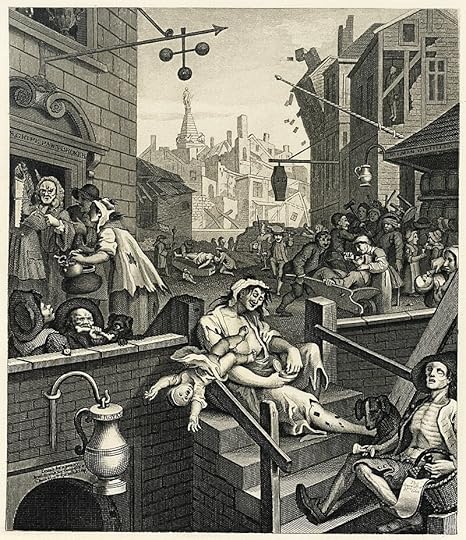
The stories of addiction outraged an increasingly middle-class nation. Mothers would trade their babies for a shot of gin. One nurse was so besotted that she forgot where she had placed her employer’s child. She had actually placed it behind the fire in the fireplace and the baby was no more. Another woman, Judith DeFour, left her daughter to die in a freezing ditch after taking the child’s clothes to sell for a dram of Gin. Society was outraged. The upper-class had their brandy, the middle-class their beer, but the poor were going out of their minds on Gin. Something needed to be done and that something was a form of prohibition, better known as The Gin Act of 1736. If the government thought the law would curtail the drinking of Gin, it was sadly mistaken.
Londoners took to prohibition like ducks to water.
One reason the law didn’t work was because of resentment. The poor saw the rich still knocking back their illegally smuggled brandy, so the Gin Act was seen as an attack by the rich upon the poor. Rioting took place and society seemed on the verge of dissolving. The government stepped in and abolished the law in 1742, but they still understood there was a need for a way to lessen the evils of Gin. The Gin Act of 1751 was the result. Instead of prohibiting the drinking of Gin, it forced distillers to sell only to licensed retailers. By doing this, the supply of cheap and easy Gin went away and the mass addiction became better controlled.
This was a fascinating read as I had little knowledge of anything to do with Gin. The nearest I have ever come to a Gin & Tonic is to drink the tonic as a way to get quinine for a fever. That’s it. The fact that an entire nation was practically enslaved to Gin was beyond my thinking. To this day, Gin still has a bad name, implying dive bars and poisonous drinks. One hears of gin joints and gin mills and gin soaked. If you’ve heard of mother’s ruin…that came from the Gin Craze. The drink is enjoying a new popularity in the current century as producers come up with new gin-based products using different ingredients such as rhubarb and blood orange.
The book is filled with research galore, which made it slower reading for me as I tried to grasp just how deadly Gin had been to English, and especially London, society. One factoid that stood out was the way the Gin Craze stabilized the surging population of London, thus providing one silver lining for that era. The last chapter deals with the dangers of enforcing any type of law, using the American Prohibition of the 1920s as a prime example. As with the original Gin Act, the American law came from people fearful of change as the United States moved from an Anglo-Saxon Protestant rural land to an immigrant-driven Catholic urban society. Prohibition was meant to be a way to get back to the Old Ways but had the opposite effect. Crime flourished as did speakeasies and the rich still had access to banned alcohol. As with England, Prohibition proved to be an act against the lower classes and could not withstand the Great Depression. It’s a lesson to be remembered as the 1980s “War On Drugs” also showed. If you tell someone they can’t have something, they will go out and get that something. I’ll just stick with my tonic water and a slice of lime, thank you.
Book Season = Autumn (special alchemy)
Concocted from juniper berries, the original name for the new liquor was Jenever, as it was a Dutch alcoholic drink. Upon its introduction to England in the 1600s, it became better known as “Madame Geneva”, which eventually became “Gin”. Taken as a medicine for coughs and colds, it quickly became the go-to drink for the lower classes due to its relatively cheap purchase price. It was also the perfect drink for a land vigorously devoted to Protestantism. William III’s Glorious Revolution made the Dutch drink even more popular especially for its calming effects before battle (aka “Dutch Courage”). Gin was the Protestant drink from a Protestant land brought to popularity by the new Protestant king. It would also become the Protestant evil after heavy taxes were imposed upon imports of Catholic spirits such as brandy.
At the time of its arrival on British shores, London was becoming the metropolis of the world. Thousands were leaving the countryside to flock to the big city where they hoped for a chance to better their lives. It was a crowded and filthy place where the poor needed to be placated and Gin proved to be the tonic (excuse the pun). From 1695-1735, thousands of gin-shops were opened to take advantage of the government allowing unlicensed production of lower quality liquors. This also provided the opportunity for the use of poor-quality barley, which could not be used for brewing beer. Soon, Gin was being flavored with cheap turpentine and a quaint drink became a raging societal addiction. Madame Geneva was not quite such a good Protestant citizen anymore as famously drawn in William Hogarth’s Gin Lane.
The stories of addiction outraged an increasingly middle-class nation. Mothers would trade their babies for a shot of gin. One nurse was so besotted that she forgot where she had placed her employer’s child. She had actually placed it behind the fire in the fireplace and the baby was no more. Another woman, Judith DeFour, left her daughter to die in a freezing ditch after taking the child’s clothes to sell for a dram of Gin. Society was outraged. The upper-class had their brandy, the middle-class their beer, but the poor were going out of their minds on Gin. Something needed to be done and that something was a form of prohibition, better known as The Gin Act of 1736. If the government thought the law would curtail the drinking of Gin, it was sadly mistaken.
Londoners took to prohibition like ducks to water.
One reason the law didn’t work was because of resentment. The poor saw the rich still knocking back their illegally smuggled brandy, so the Gin Act was seen as an attack by the rich upon the poor. Rioting took place and society seemed on the verge of dissolving. The government stepped in and abolished the law in 1742, but they still understood there was a need for a way to lessen the evils of Gin. The Gin Act of 1751 was the result. Instead of prohibiting the drinking of Gin, it forced distillers to sell only to licensed retailers. By doing this, the supply of cheap and easy Gin went away and the mass addiction became better controlled.
This was a fascinating read as I had little knowledge of anything to do with Gin. The nearest I have ever come to a Gin & Tonic is to drink the tonic as a way to get quinine for a fever. That’s it. The fact that an entire nation was practically enslaved to Gin was beyond my thinking. To this day, Gin still has a bad name, implying dive bars and poisonous drinks. One hears of gin joints and gin mills and gin soaked. If you’ve heard of mother’s ruin…that came from the Gin Craze. The drink is enjoying a new popularity in the current century as producers come up with new gin-based products using different ingredients such as rhubarb and blood orange.
The book is filled with research galore, which made it slower reading for me as I tried to grasp just how deadly Gin had been to English, and especially London, society. One factoid that stood out was the way the Gin Craze stabilized the surging population of London, thus providing one silver lining for that era. The last chapter deals with the dangers of enforcing any type of law, using the American Prohibition of the 1920s as a prime example. As with the original Gin Act, the American law came from people fearful of change as the United States moved from an Anglo-Saxon Protestant rural land to an immigrant-driven Catholic urban society. Prohibition was meant to be a way to get back to the Old Ways but had the opposite effect. Crime flourished as did speakeasies and the rich still had access to banned alcohol. As with England, Prohibition proved to be an act against the lower classes and could not withstand the Great Depression. It’s a lesson to be remembered as the 1980s “War On Drugs” also showed. If you tell someone they can’t have something, they will go out and get that something. I’ll just stick with my tonic water and a slice of lime, thank you.
Book Season = Autumn (special alchemy)

April 4, 2010
This is an entertaining look at the gin craze of the 1800s, which remains the greatest drug epidemic to ever hit the British Isles.
In 1723 each man, woman and child in London was getting through something like a pint of gin a week.
It was just after the South Sea Bubble burst, an age of gambling, and what higher stakes were there than sinking your money into a whole load of cheap hooch in an establishment which provided its own straw for you to pass out on? Of course this led to a fair degree of chaos, with the great men of the capital looking around and seeing the poor people gin-sodden, neglecting their jobs and committing acts of violence. Swiftly campaign groups formed to stamp out this wanton drunkenness, and after a circuitous route through parliament the reformers did manage to ban the drink know as Madam Geneva.
However in 1743 – at the height of prohibition – each man, woman and child in London was drinking two pints of the stuff a week.
Eventually the ban was repealed and gin legalised again, although with greater regulation. But it was the emergence of the aspirational middle classes – creating a kind of proto-Victorian age with cricket matches, Wesleyan church meetings and tea parties to while away the time – which stopped the trend for being blotto at all hours on the streets. And it was many years later in the Victorian age itself – when London had mushroomed in size – before gin production reached anything near the levels they’d reached in Georgian times.
And then, of course, London had itself a new gin epidemic.
Dillon relates this tale with great vim and vigour, expertly conjuring the world of Defoe and Hogarth and bringing to life the exuberant squalor of the London streets.
The epilogue shows how this tale was first echoed in America’s prohibition, and again with the hard drug policies introduced worldwide in the early 1970s. I don’t know what the answer is, but the 18th century gin craze proves that just banning something you don’t like is not necessarily the answer.
In 1723 each man, woman and child in London was getting through something like a pint of gin a week.
It was just after the South Sea Bubble burst, an age of gambling, and what higher stakes were there than sinking your money into a whole load of cheap hooch in an establishment which provided its own straw for you to pass out on? Of course this led to a fair degree of chaos, with the great men of the capital looking around and seeing the poor people gin-sodden, neglecting their jobs and committing acts of violence. Swiftly campaign groups formed to stamp out this wanton drunkenness, and after a circuitous route through parliament the reformers did manage to ban the drink know as Madam Geneva.
However in 1743 – at the height of prohibition – each man, woman and child in London was drinking two pints of the stuff a week.
Eventually the ban was repealed and gin legalised again, although with greater regulation. But it was the emergence of the aspirational middle classes – creating a kind of proto-Victorian age with cricket matches, Wesleyan church meetings and tea parties to while away the time – which stopped the trend for being blotto at all hours on the streets. And it was many years later in the Victorian age itself – when London had mushroomed in size – before gin production reached anything near the levels they’d reached in Georgian times.
And then, of course, London had itself a new gin epidemic.
Dillon relates this tale with great vim and vigour, expertly conjuring the world of Defoe and Hogarth and bringing to life the exuberant squalor of the London streets.
The epilogue shows how this tale was first echoed in America’s prohibition, and again with the hard drug policies introduced worldwide in the early 1970s. I don’t know what the answer is, but the 18th century gin craze proves that just banning something you don’t like is not necessarily the answer.

October 12, 2024
das braucht wirklich keiner, so gut über eine Periode der englischen Gesellschaft Bescheid zu wissen, aber es ist dafür noch halbwegs unterhaltsam deswegen 2 Sterne

January 13, 2010
The problem with this book is that it's uneven, in both its content and its writing style. Writing about Gin in the 1700s, Dillon does an excellent job of finding and presenting the sources that reveal both the origins of gin, reasons for its initial growth and popularity, the successive attempts and prohibition and the eventual compromise of restriction but acceptance. Unfortunately, while belaboring some of this information, he expects and doesn't explain some of the more unusual aspects of eighteenth century England, such as exactly what magistrates were and how much power they wielded. It would have been useful, as well, when he was connecting the government's policies regarding gin to the greater politics of monarchical succession and conflicts between England and Spain to have given a small primer in both. Instead, you have to figure a lot of this extra knowledge by simply having been familiar with these topics prior to reading this book, by referencing other works to fill in the gaps, or attempting to understand these issues by reading between the lines. Ultimately, this was very frustrating.
And that's too bad, because Dillon's topic and argument is timely and interesting. Although he has an epilogue that underscores this point, Dillon's depiction of England's dance with Madame Geneva is unmistakeably an object lesson that has already been ignored once by the United States, during the 1920s, and is being ignored once again today in the War on Drugs. Truly, those who ignore history are doomed to repeat it, and this is history that has been ignored so long that it is forgotten. There are reasons for it, for the forces of moralism and sobriety, driven by their fundamentalist doctrine, have not given up their battle against intoxicating substances no matter the pragmatical realities and lessons of the past. We can only hope that, like England's Gin Act of 1751 and the repeal of prohibition in the U.S. in 1929, there will be a future day where an armistice is declared and we can take control of the drug trade, and, ultimately, attack the root causes that drive people to abuse substances.
And that's too bad, because Dillon's topic and argument is timely and interesting. Although he has an epilogue that underscores this point, Dillon's depiction of England's dance with Madame Geneva is unmistakeably an object lesson that has already been ignored once by the United States, during the 1920s, and is being ignored once again today in the War on Drugs. Truly, those who ignore history are doomed to repeat it, and this is history that has been ignored so long that it is forgotten. There are reasons for it, for the forces of moralism and sobriety, driven by their fundamentalist doctrine, have not given up their battle against intoxicating substances no matter the pragmatical realities and lessons of the past. We can only hope that, like England's Gin Act of 1751 and the repeal of prohibition in the U.S. in 1929, there will be a future day where an armistice is declared and we can take control of the drug trade, and, ultimately, attack the root causes that drive people to abuse substances.

January 22, 2018
Excellent book on the rise and fall of gin (principally) in London during the 18th century.
The parallels between this period and the war on drugs are very easy to spot. And the methods used then are the ones not working now!
Interesting, erudite, and entertaining.
The parallels between this period and the war on drugs are very easy to spot. And the methods used then are the ones not working now!
Interesting, erudite, and entertaining.

October 27, 2024
Irgendwas mit sirs und earls die gin trinken oder Gin doof finden oder beides

March 22, 2011
Not gonna lie, I got pretty well acquainted with Madam Geneva when I was in high school and stayed in touch with her all throughout college. Anywho, this is a very entertaining overview of the Gin Panic which swept England in ye olde 18th century and bore a slew of striking similarities to American Prohibition and our current (un-winnable) war on drugs. Maybe it's a European thing, or maybe I'm just seeing too much irony in it, but I got a kick out of how British authorities were all, "Gin and spirituous liquors are the greatest evil mankind has ever faced and result in nothing less then murder, lassitude, rape, necrophilia, profanity and more. Why oh why can't people just be happy with beer and wine?"

April 13, 2018
A very interesting book that looks at the Gin craze of the 1700s then, towards the end, ties it up with the prohibition of alcohol in America during the 1920s and the drug trade of modern times. It shares some fascinating stories and characters although at times it can be a bit repetitive.

September 16, 2020
A very informative and easy read about the gin craze that ruined so many until it was tamed.

January 2, 2022
easy to read. covered a lot of history from a period that i am not overly familiar with. The more things change the more they stay the same
January 26, 2024
Got boring after an early good start
February 15, 2024
A fascinating account of a particular historical phenomenon, but a bit repetitive towards the end.

June 21, 2021
Started out fascinating. Got totally lost in its attempted forensic analysis of the intricacies of the war on gun during the 17th century, unfortunately to the point of utter tedium. And then covered the 19th century to the present day in about 3 pages. There's really good stuff in here but it got lost.

June 28, 2016
A very readable book on the rise of gin production and consumption in Great Britain, leading to the "Gin Craze" and various Gin Acts in the 18th Century. The author deals with the social, economic and political factors for- and against prohibition. Before reading this book I was aware of the expansion of gin consumption in that period and that there were Gin Acts, but was unaware that HMG attempted prohibition (in their case, limited to malt-derived liquors) almost 2 centuries before the US did - and with almost exactly the same dismal results.

April 3, 2013
I wasn't sure what I was expecting with this, but the cover was intriguing.
The writing was great -- informative, flowing, and even funny at times. I felt like I learned a lot about a time in history I knew very little about.
There were a few points where the information got repetitive -- like a middle school essay where the author doesn't have anything else to say but hasn't hit their word count. This happened enough to take off a star, but it didn't happen all that much.
The writing was great -- informative, flowing, and even funny at times. I felt like I learned a lot about a time in history I knew very little about.
There were a few points where the information got repetitive -- like a middle school essay where the author doesn't have anything else to say but hasn't hit their word count. This happened enough to take off a star, but it didn't happen all that much.

January 12, 2008
Another great single-topic history. This was the crack epidemic of the 18th century. There really wasn't anything stronger than wine available up to this time, and this was dirt cheap and marketed straight to the poor of London. Crazyness ensues. Good stuff.

December 22, 2013
It slips down very easily which makes me question the proof. Certainly not as complex in flavour as I would have liked, I suspect watering down somewhere. Still, a pleasant tipple and not a tiresome way to spend the night.

April 28, 2014
The epilogue points the moral rather heavy-handedly that the attempts to control the Gin Craze in the 17th century looks quite a lot like the War on Drugs of the 20th, but it's an interesting account. We've all seen Hogarth's Gin Lane, but this book gives it some context..

October 9, 2007
If you love gin and love history....
October 25, 2007
a gift from Jack Chatterton on the occasion of my 2007 birthday

December 6, 2007
A touch dry at times - bad pun I know - but otherwise a good read.
Currently Reading
December 30, 2007Just ordered this one from B&N. I love gin.
November 24, 2009
The tag says "read", but in truth I didn't finish it. I just couldn't get through. Too much pop, not enough history.

February 26, 2011
Kinda dry....badoom-boom
January 11, 2016
illuminating book, much to learn here.
February 22, 2016
I enjoyed the history, but the book was rather repetitive...could have been half as long, and I like some long books.

April 3, 2012
A study of the Gin Craze that swept through London in the first half of the 18th century
Displaying 1 - 27 of 27 reviews