

What do you think?
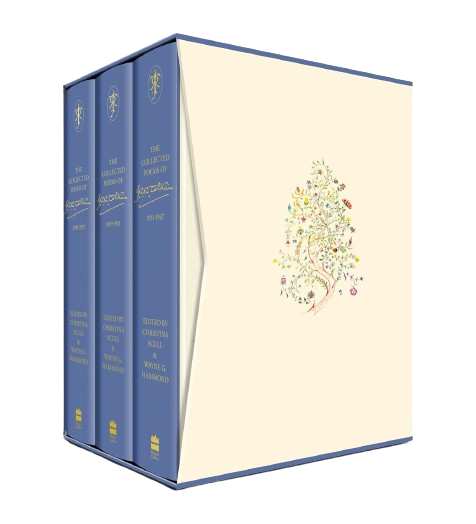
The Collected Poems of J.R.R. Tolkien
J.R.R. Tolkien aspired to be a poet in the first instance, and poetry was part of his creative life no less than his prose, his languages, and his art. Within his larger works of fiction, poems help to establish character and place as well as further the story; as individual works, they delight with words and rhyme. They express his love of nature and the seasons, of landscape and music, and of words. They convey his humour and his sense of wonder.
The earliest work in this collection, written for his beloved, is dated to 1910, when Tolkien was eighteen. More poems would follow during his years at Oxford, some of them very elaborate and eccentric. Those he composed during the First World War, in which he served in France, tend to be concerned not with trenches and battle, but with life, loss, faith, and friendship, his longing for England, and the wife he left behind. Beginning in 1914, elements of his legendarium, ‘The Silmarillion’, began to appear, and the ‘Matter of Middle-earth’ would inspire much of Tolkien’s verse for the rest of his life.
Within The Collected Poems of J.R.R. Tolkien almost 250 works are presented across three volumes, including more than 70 that have never before been seen. The poems are deftly woven together with commentary and notes by Tolkien scholars Christina Scull & Wayne G. Hammond, placing them in the context of Tolkien’s life and literary accomplishments and creating a poetical biography that is a unique and revealing celebration of J.R.R. Tolkien.
The earliest work in this collection, written for his beloved, is dated to 1910, when Tolkien was eighteen. More poems would follow during his years at Oxford, some of them very elaborate and eccentric. Those he composed during the First World War, in which he served in France, tend to be concerned not with trenches and battle, but with life, loss, faith, and friendship, his longing for England, and the wife he left behind. Beginning in 1914, elements of his legendarium, ‘The Silmarillion’, began to appear, and the ‘Matter of Middle-earth’ would inspire much of Tolkien’s verse for the rest of his life.
Within The Collected Poems of J.R.R. Tolkien almost 250 works are presented across three volumes, including more than 70 that have never before been seen. The poems are deftly woven together with commentary and notes by Tolkien scholars Christina Scull & Wayne G. Hammond, placing them in the context of Tolkien’s life and literary accomplishments and creating a poetical biography that is a unique and revealing celebration of J.R.R. Tolkien.
1728 pages, Hardcover
First published September 1, 2024
About the author
J.R.R. Tolkien
789 books80k followersJohn Ronald Reuel Tolkien: writer, artist, scholar, linguist. Known to millions around the world as the author of The Lord of the Rings, Tolkien spent most of his life teaching at the University of Oxford where he was a distinguished academic in the fields of Old and Middle English and Old Norse. His creativity, confined to his spare time, found its outlet in fantasy works, stories for children, poetry, illustration and invented languages and alphabets.
Tolkien’s most popular works, The Hobbit and The Lord of the Rings are set in Middle-earth, an imagined world with strangely familiar settings inhabited by ancient and extraordinary peoples. Through this secondary world Tolkien writes perceptively of universal human concerns – love and loss, courage and betrayal, humility and pride – giving his books a wide and enduring appeal.
Tolkien was an accomplished amateur artist who painted for pleasure and relaxation. He excelled at landscapes and often drew inspiration from his own stories. He illustrated many scenes from The Silmarillion, The Hobbit and The Lord of the Rings, sometimes drawing or painting as he was writing in order to visualize the imagined scene more clearly.
Tolkien was a professor at the Universities of Leeds and Oxford for almost forty years, teaching Old and Middle English, as well as Old Norse and Gothic. His illuminating lectures on works such as the Old English epic poem, Beowulf, illustrate his deep knowledge of ancient languages and at the same time provide new insights into peoples and legends from a remote past.
Tolkien was born in Bloemfontein, South Africa, in 1892 to English parents. He came to England aged three and was brought up in and around Birmingham. He graduated from the University of Oxford in 1915 and saw active service in France during the First World War before being invalided home. After the war he pursued an academic career teaching Old and Middle English. Alongside his professional work, he invented his own languages and began to create what he called a mythology for England; it was this ‘legendarium’ that he would work on throughout his life. But his literary work did not start and end with Middle-earth, he also wrote poetry, children’s stories and fairy tales for adults. He died in 1973 and is buried in Oxford where he spent most of his adult life.
Tolkien’s most popular works, The Hobbit and The Lord of the Rings are set in Middle-earth, an imagined world with strangely familiar settings inhabited by ancient and extraordinary peoples. Through this secondary world Tolkien writes perceptively of universal human concerns – love and loss, courage and betrayal, humility and pride – giving his books a wide and enduring appeal.
Tolkien was an accomplished amateur artist who painted for pleasure and relaxation. He excelled at landscapes and often drew inspiration from his own stories. He illustrated many scenes from The Silmarillion, The Hobbit and The Lord of the Rings, sometimes drawing or painting as he was writing in order to visualize the imagined scene more clearly.
Tolkien was a professor at the Universities of Leeds and Oxford for almost forty years, teaching Old and Middle English, as well as Old Norse and Gothic. His illuminating lectures on works such as the Old English epic poem, Beowulf, illustrate his deep knowledge of ancient languages and at the same time provide new insights into peoples and legends from a remote past.
Tolkien was born in Bloemfontein, South Africa, in 1892 to English parents. He came to England aged three and was brought up in and around Birmingham. He graduated from the University of Oxford in 1915 and saw active service in France during the First World War before being invalided home. After the war he pursued an academic career teaching Old and Middle English. Alongside his professional work, he invented his own languages and began to create what he called a mythology for England; it was this ‘legendarium’ that he would work on throughout his life. But his literary work did not start and end with Middle-earth, he also wrote poetry, children’s stories and fairy tales for adults. He died in 1973 and is buried in Oxford where he spent most of his adult life.
Ratings & Reviews
Friends & Following
Create a free account to discover what your friends think of this book!
Community Reviews
Displaying 1 - 20 of 20 reviews

January 9, 2025
The collection is absolutely wonderful for anyone who loves Tolkien, or poetry, or more particularly, both. The editors have enjoyed extensive access to Tolkien’s papers and notes, so they include a variety of versions and edits for the majority of the poems. This offers wonderful insight into how Tolkien developed as a writer, linguist, and poet.
It’s a heavily academic text that isn’t accessible to all readers, but as a thorough collection of Tolkien’s poetic works it can’t be beat.
It’s a heavily academic text that isn’t accessible to all readers, but as a thorough collection of Tolkien’s poetic works it can’t be beat.

June 2, 2025
I've been agitating for years for a collection of Tolkien's poems, so I'm glad to see that Harper Collins listened, though a bit surprised and disheartened not to see my name in the acknowledgements... Nevertheless, I really enjoyed reading this throughout the month, though sometimes I was confused as to what made the editors print several almost identical versions of the same poem, I feel like in honor of Tolkien's love of trees we could have kept the tiny variations in the notes and not wasted so much paper.
4.1
4.1
December 26, 2024
I have NOT finished reading this so-far wonderful book; I have hardly begun. This GOODREADS site seems to be balkier each time I access it.
But while I'm here - the book is wonderful. I was worried about the typeface because of my old eyes, but the text is clear and set on fine, cream-colored paper. I love the introduction and the very professional critical apparatus. Scull, Hammon, and William Morrow / Collins have given the world a treasure. Thank you!
Now if only GOODREADS would work on accessibility and clarity of usage....
11 January 2025
I finished a careful reading of the first volume of Tolkien’s Collected Poems, and, as with most of my books, will look into it again.
The Collected Poems of J. R. R. Tolkien in three volumes is a gift to us all (tho’ mind that you must pay a bookseller for it!). Editors Christina Scull and Wayne Hammond and all associated with this accessible yet scholarly project are owed our thanks.
The volumes are nicely but not sumptuously bound, and the cream-colored paper is easy on the eyes, as is the typeface.
The publishers have made clear that this work does not include all of Tolkien’s poems, which would require more volumes and more expense, but rarer and many unpublished pieces as well as a good sampling from Tolkien’s commonly available works.
Some criticism has been made about the many scholarly notes and the publication of many variants, but this critical apparatus, as C. S. Lewis would say, is most useful and adaptable. Those who want to read the poems simpliciter can easily do so; those who want to compare the variants and access the notes have them to hand in the text. A solution for me was to consider which among the variants of a given poem was the latest as far a can be determined, and to skim the notes looking for points that I might want to read more carefully, which was often. The notes, the variants, and the fragments make this brilliant work even better.
Even Tolkien’s adolescent poems are brilliant in themselves, and it is interesting and useful to follow along as his usages and structures and images and themes mature. Toward the end of the first volume not even Tolkien can keep The War from finding its way into his poems, but his skillful handling of dark themes – which we find in The Hobbit and especially in The Lord of the Rings – is enriching.
During the busy Christmastide and Epiphany I was able to read only in those short periods of time, often only minutes, between necessary chores. I had no difficulty in slipping in and out of the poems. In the past few days I have been blessed with long afternoon hours and more uninterrupted time as a welcome visitor in Tolkien’s Faerie. It has been so far, a joyful and even therapeutic experience.
The price of this book has dropped somewhat since its publication last year, and although the purchase might require some work with the budget, it is a worthy lifetime purchase to be read and shelved with Milton, Spenser, Lewis, Chaucer, Shakespeare, any edition of The Oxford Book of English Verse, and, as Detective Sergeant Hathaway says in an episode of Inspector Lewis, “The guys in the band.”
As a Texan I add Lonesome Dove. Feel free to disagree about McMurtry’s take on the Diogenes Akrites theme of Byzantine border wars (but I’m right).
1 March 2025. Today I finished this book while sitting outside on a warm, false-spring day with Luna-Dog and her tormentor Tuxedo-Cat circling each other. I have no modifications to make to my review.
But while I'm here - the book is wonderful. I was worried about the typeface because of my old eyes, but the text is clear and set on fine, cream-colored paper. I love the introduction and the very professional critical apparatus. Scull, Hammon, and William Morrow / Collins have given the world a treasure. Thank you!
Now if only GOODREADS would work on accessibility and clarity of usage....
11 January 2025
I finished a careful reading of the first volume of Tolkien’s Collected Poems, and, as with most of my books, will look into it again.
The Collected Poems of J. R. R. Tolkien in three volumes is a gift to us all (tho’ mind that you must pay a bookseller for it!). Editors Christina Scull and Wayne Hammond and all associated with this accessible yet scholarly project are owed our thanks.
The volumes are nicely but not sumptuously bound, and the cream-colored paper is easy on the eyes, as is the typeface.
The publishers have made clear that this work does not include all of Tolkien’s poems, which would require more volumes and more expense, but rarer and many unpublished pieces as well as a good sampling from Tolkien’s commonly available works.
Some criticism has been made about the many scholarly notes and the publication of many variants, but this critical apparatus, as C. S. Lewis would say, is most useful and adaptable. Those who want to read the poems simpliciter can easily do so; those who want to compare the variants and access the notes have them to hand in the text. A solution for me was to consider which among the variants of a given poem was the latest as far a can be determined, and to skim the notes looking for points that I might want to read more carefully, which was often. The notes, the variants, and the fragments make this brilliant work even better.
Even Tolkien’s adolescent poems are brilliant in themselves, and it is interesting and useful to follow along as his usages and structures and images and themes mature. Toward the end of the first volume not even Tolkien can keep The War from finding its way into his poems, but his skillful handling of dark themes – which we find in The Hobbit and especially in The Lord of the Rings – is enriching.
During the busy Christmastide and Epiphany I was able to read only in those short periods of time, often only minutes, between necessary chores. I had no difficulty in slipping in and out of the poems. In the past few days I have been blessed with long afternoon hours and more uninterrupted time as a welcome visitor in Tolkien’s Faerie. It has been so far, a joyful and even therapeutic experience.
The price of this book has dropped somewhat since its publication last year, and although the purchase might require some work with the budget, it is a worthy lifetime purchase to be read and shelved with Milton, Spenser, Lewis, Chaucer, Shakespeare, any edition of The Oxford Book of English Verse, and, as Detective Sergeant Hathaway says in an episode of Inspector Lewis, “The guys in the band.”
As a Texan I add Lonesome Dove. Feel free to disagree about McMurtry’s take on the Diogenes Akrites theme of Byzantine border wars (but I’m right).
1 March 2025. Today I finished this book while sitting outside on a warm, false-spring day with Luna-Dog and her tormentor Tuxedo-Cat circling each other. I have no modifications to make to my review.
May 1, 2026
I won't lie, I skimmed a lot of this because I just wanted to get to the poems written about Middle-Earth. I read a good chunk of his earlier ones, but my attention was mostly fixed on his own world. Fantastic stuff all around, though.

October 14, 2025
A mind-boggling level of scholarship, and a set of books not for the intellectually faint-of-heart. There are two types of people who would enjoy this series: poets and scholars. The scholars might be of a few flavors, from the study of creativity to English. The poets will be very concerned with detail and the evolution of poems over time. It should go without saying that this book is likely only interesting to those with a previous love of Tolkien and his creations. Each section presents a poem and its development over time, with careful commentary from Tolkien scholars. There is little conjecture, but when it is presented, it is always clear, well-supported, and thoughtful. Truly a gem in the crown of Tolkien-studies.

April 2, 2025
[Spoilered while in draft]
Poetry | Editorial content | Presentation
The thing that most appeals to me in The Lord of the Rings is not the grand, sweeping plot; it's not the interesting, relatable, well-developed characters; it's not the complex themes, or the epic feel (which is indeed a major part of its appeal), or the various bits of wisdom contained therein. It is, quite simply, the prose. When I happen to glance at a page, for instance when someone else has left the book open, and read a sentence or two, I feel instantly drawn to keep reading. I've read this before! Several times! And yet I want to know what happens; I'm almost immediately sucked into the world and want to stay there. Few other books have ever given me this experience so reliably.
His poetry, however, scattered through the book, has never appealed to me as much. Sometimes it's entertaining, but other times, it's just…fine. I kind of skim over it.
Part of the reason for that is that I've just never gotten into poetry. Poetry was not really part of my upbringing or education, and I've never been able to get much out of it, with few exceptions.
I'd like to say that this book has changed all that. But…no. I've probably read more poems in this book than I previously had in my entire life. And it's definitely given me some new perspective on both poetry and Tolkien. But it still isn't capturing me in anything like the way Tolkien's prose can.
-
Boy, you had better like poems. And it would help if you were really interested in the specifics of their creation and editing, across several drafts, with notes such as '"the" was changed to "and" in line 12.'
I'm a Tolkien fan, no doubt, and the Middle-Earth poems here range from intriguing to fascinating. But the rest are incredibly spotty, with some quite interesting, others largely pointless, and a few incomprehensible, at least to me (and don't get me started on the poems not in English, whether in Old English, Middle English, Latin, or Elvish. At least there are translations). Nor am I at all fascinated by the miniscule details of creation and modification of poetry. Perhaps if I were an aspiring poet myself it would be different. Or even just was more familiar with poetry in general. But as it is, much of this ponderous work is something of a slog. I find myself trying to get through it just to say I've read it, which is not how I read things.
The tome is immensely scholarly, which is both a blessing and a curse. A blessing, because the editors have an amazing attention to detail and accuracy; everything's relentlessly thorough, and errors are extremely few and, when found, corrected in their Addenda and Corrigenda. They have gone above and beyond on ensuring that all possible poems have been uncovered and placed in proper context, and their judgment as to just what versions of which poems to put where, and which edits to include when they do so, is impeccable so far as I can tell.
But on the other hand, the scholarly nature of the presentation sometimes—often—gives the feeling of an actual academic work, which is a lot less fun to read than, you know, cool stuff about, or set in, Middle-Earth. To say that it occasionally approaches stuffiness would be an understatement.
And yet with all the bulk of this work, and the intense scholarliness in which it is written, few of the poems get much in the way of explanation or interpretation. Context, yes, plenty of that, and discussion of any peculiarities, rare words, points of confusion, but often figuring out what the poem is about is left to the reader. That's not necessarily a bad thing, but with a work this size I'm still—not being in any sense an expert on poetry–left wishing for a companion volume to help me parse what I'm reading.
As for the poetry itself—well, some of it's quite good. The Middle-Earth stuff in particular tends to be enjoyable. The Lay of Lethian, for instance, I could use a lot more of (only snippets of this and other long poems are included in this work. For the full text of the Lay, I'll have to pick up The Lays of Beleriand).
But—many of the poems just seem kind of pointless. I understand larks, of course, and when the poem in question is just a snippet of doggerel scribbled on a napkin or something (I'm barely exaggerating. There have been no actual napkins so far, but Tolkien would write on any spare slip of paper he had laying around, if it had any blank space), I have no complaints—it's in here for completeness's sake.
But when the doggerel in question is 100+ lines long, and went through several drafts, and is still kind of a pointless lark, with no message, no meaning, and not even very much humor, I begin to wonder: Why am I reading this? It's like pouring over the charts and graphs of a brilliant mathematician analyzing how often he blew his nose. Like…why? Didn't he have better things to do with his time? And if he didn't—don't I?
On the other hand, I'm learning all sorts of delicious new words, and lots of interesting tidbits about Tolkien's life.
But I end up feeling that I have to read this whole thing again, after taking a poetry appreciation class, and after reading HOME and a few other things, just to feel like I've gotten enough out of this to make it worthwhile.
In the final analysis—I dunno. Tolkien was brilliant, right? There's no denying this. The Lord of the Rings is one of the great works of English literature. But—with a couple of exceptions—these poems aren't brilliant. I feel like—with all of the effort he clearly put into them—he didn't put much thought into them. Take "Errantry," poem number 128. (This poem has many versions, so let's focus on C, as he published that one.) The problem isn't that it's silly; it's that it feels gratuitously silly. The silliness doesn't hang together, doesn't build into some larger thing, either inside the poem or as a whole. And that can be done! I've seen silliness done so well you end up marvelling at its genius! But Tolkien couldn't be bothered to put that much skull sweat into it.[^1] And as for the overarching work itself—I would have vastly preferred a presentation of only the final versions of these poems, with perhaps earlier drafts when they differ significantly and importantly, along with historical notes, information on how they fit into, or influenced, his legendarium, and analyses of the poems themselves. These detailed accounts of the evolution of each poem, down to discussions of whether something is an intended comma or a stray mark on the page (no exaggeration) are valuable to Tolkien scholars, I'm sure, but not so much to the general reading public, and so should be relegated to papers and scholarly works, not beautifully presented de luxe boxed sets offered to a popular audience. In short, much of this work is damn boring and a slog to get through, and on top of that my lack of deep knowledge of both the background of Tolkien's legendarium and of poetry limit what I'm getting out of the actual meat of the work—the poetry itself. There's no excuse for this in a 1600-page work with fewer than 200 almost-entirely-short poems.
[^1]: Specifically, the bit where the protagonist tries to get a butterfly to marry him. That's cute! That's original! It feels like a 300-year-old fairy tale or nursery rhyme! But he doesn't do anything with it. He just flirts around with it for a bit, then moves on. It's almost clever. Which, coming from Tolkien, is really disappointing. And he rarely even gets to "almost" clever.
Poetry | Editorial content | Presentation
The thing that most appeals to me in The Lord of the Rings is not the grand, sweeping plot; it's not the interesting, relatable, well-developed characters; it's not the complex themes, or the epic feel (which is indeed a major part of its appeal), or the various bits of wisdom contained therein. It is, quite simply, the prose. When I happen to glance at a page, for instance when someone else has left the book open, and read a sentence or two, I feel instantly drawn to keep reading. I've read this before! Several times! And yet I want to know what happens; I'm almost immediately sucked into the world and want to stay there. Few other books have ever given me this experience so reliably.
His poetry, however, scattered through the book, has never appealed to me as much. Sometimes it's entertaining, but other times, it's just…fine. I kind of skim over it.
Part of the reason for that is that I've just never gotten into poetry. Poetry was not really part of my upbringing or education, and I've never been able to get much out of it, with few exceptions.
I'd like to say that this book has changed all that. But…no. I've probably read more poems in this book than I previously had in my entire life. And it's definitely given me some new perspective on both poetry and Tolkien. But it still isn't capturing me in anything like the way Tolkien's prose can.
-
Boy, you had better like poems. And it would help if you were really interested in the specifics of their creation and editing, across several drafts, with notes such as '"the" was changed to "and" in line 12.'
I'm a Tolkien fan, no doubt, and the Middle-Earth poems here range from intriguing to fascinating. But the rest are incredibly spotty, with some quite interesting, others largely pointless, and a few incomprehensible, at least to me (and don't get me started on the poems not in English, whether in Old English, Middle English, Latin, or Elvish. At least there are translations). Nor am I at all fascinated by the miniscule details of creation and modification of poetry. Perhaps if I were an aspiring poet myself it would be different. Or even just was more familiar with poetry in general. But as it is, much of this ponderous work is something of a slog. I find myself trying to get through it just to say I've read it, which is not how I read things.
The tome is immensely scholarly, which is both a blessing and a curse. A blessing, because the editors have an amazing attention to detail and accuracy; everything's relentlessly thorough, and errors are extremely few and, when found, corrected in their Addenda and Corrigenda. They have gone above and beyond on ensuring that all possible poems have been uncovered and placed in proper context, and their judgment as to just what versions of which poems to put where, and which edits to include when they do so, is impeccable so far as I can tell.
But on the other hand, the scholarly nature of the presentation sometimes—often—gives the feeling of an actual academic work, which is a lot less fun to read than, you know, cool stuff about, or set in, Middle-Earth. To say that it occasionally approaches stuffiness would be an understatement.
And yet with all the bulk of this work, and the intense scholarliness in which it is written, few of the poems get much in the way of explanation or interpretation. Context, yes, plenty of that, and discussion of any peculiarities, rare words, points of confusion, but often figuring out what the poem is about is left to the reader. That's not necessarily a bad thing, but with a work this size I'm still—not being in any sense an expert on poetry–left wishing for a companion volume to help me parse what I'm reading.
As for the poetry itself—well, some of it's quite good. The Middle-Earth stuff in particular tends to be enjoyable. The Lay of Lethian, for instance, I could use a lot more of (only snippets of this and other long poems are included in this work. For the full text of the Lay, I'll have to pick up The Lays of Beleriand).
But—many of the poems just seem kind of pointless. I understand larks, of course, and when the poem in question is just a snippet of doggerel scribbled on a napkin or something (I'm barely exaggerating. There have been no actual napkins so far, but Tolkien would write on any spare slip of paper he had laying around, if it had any blank space), I have no complaints—it's in here for completeness's sake.
But when the doggerel in question is 100+ lines long, and went through several drafts, and is still kind of a pointless lark, with no message, no meaning, and not even very much humor, I begin to wonder: Why am I reading this? It's like pouring over the charts and graphs of a brilliant mathematician analyzing how often he blew his nose. Like…why? Didn't he have better things to do with his time? And if he didn't—don't I?
On the other hand, I'm learning all sorts of delicious new words, and lots of interesting tidbits about Tolkien's life.
But I end up feeling that I have to read this whole thing again, after taking a poetry appreciation class, and after reading HOME and a few other things, just to feel like I've gotten enough out of this to make it worthwhile.
In the final analysis—I dunno. Tolkien was brilliant, right? There's no denying this. The Lord of the Rings is one of the great works of English literature. But—with a couple of exceptions—these poems aren't brilliant. I feel like—with all of the effort he clearly put into them—he didn't put much thought into them. Take "Errantry," poem number 128. (This poem has many versions, so let's focus on C, as he published that one.) The problem isn't that it's silly; it's that it feels gratuitously silly. The silliness doesn't hang together, doesn't build into some larger thing, either inside the poem or as a whole. And that can be done! I've seen silliness done so well you end up marvelling at its genius! But Tolkien couldn't be bothered to put that much skull sweat into it.[^1] And as for the overarching work itself—I would have vastly preferred a presentation of only the final versions of these poems, with perhaps earlier drafts when they differ significantly and importantly, along with historical notes, information on how they fit into, or influenced, his legendarium, and analyses of the poems themselves. These detailed accounts of the evolution of each poem, down to discussions of whether something is an intended comma or a stray mark on the page (no exaggeration) are valuable to Tolkien scholars, I'm sure, but not so much to the general reading public, and so should be relegated to papers and scholarly works, not beautifully presented de luxe boxed sets offered to a popular audience. In short, much of this work is damn boring and a slog to get through, and on top of that my lack of deep knowledge of both the background of Tolkien's legendarium and of poetry limit what I'm getting out of the actual meat of the work—the poetry itself. There's no excuse for this in a 1600-page work with fewer than 200 almost-entirely-short poems.
[^1]: Specifically, the bit where the protagonist tries to get a butterfly to marry him. That's cute! That's original! It feels like a 300-year-old fairy tale or nursery rhyme! But he doesn't do anything with it. He just flirts around with it for a bit, then moves on. It's almost clever. Which, coming from Tolkien, is really disappointing. And he rarely even gets to "almost" clever.
This entire review has been hidden because of spoilers.

July 11, 2025
I liked many of the poems, though I've encountered many of them already in reading Tolkien. I skipped large sections of the book, including many of the early versions of the poems and many of the editors' explanations. The book is unlikely to appeal to anyone other than Tolkien fans and possibly poetry fans.
The book doesn't include all Tolkien's poems, but includes at least 240. For almost all poems there are several versions included, showing how Tolkien changed it over time. Each poem also includes the editors' notes about its context, content, and inspiration.
The book includes many poems from The Hobbit and Lord of the Rings, but also excludes many. It also excludes a few shorter poems from The Silmarillion.
Of the longer poems, it includes only extracts. It excludes the majority of poems composed in languages other than Modern English, other than a few in Old and Middle English, Latin, Gothic, Quenya, and Sindarin.
Notes
Tolkien said he didn't use Arthurian legend as a basis for his mythology because it was "associated with the soil of Britain but not with English," "its 'faerie' is too lavish, and fantastical, incoherent and repetitive," and it "explicitly contains the Christian religion."
Favorites
12 Sunset in a Town
18 The Bidding of the Minstrel
40 The Trees of Kortirion
50 The Forest Walker
60 The Man in the Moon Stayed Up Too Late
66 The Lay of the Fall of Gondolin
92 Lay of Leithian
108 Chip the Glasses and Crack the Plates!
109 Far over the Misty Mountains Cold
110 The Wind Was on the Withered Heath
112 Under the Mountain Dark and Tall
113 O Where Are You Going · The Dragon Is Withered
115 Roads Go Ever Ever On · The Road Goes Ever On and On
121 The Adventures of Tom Bombadil
122 Monday Morning
127 Bilbo’s Last Song (at the Grey Havens)
128 Errantry · Eärendil Was a Mariner · The Short Lay of Earendel: Earendillínwë
130 The Children of Húrin
131 The New Lay of the Völsungs · The New Lay of Gudrún
136 Mythopoeia
146 King Sheave
149 Three Rings for the Elven-kings under the Sky
150 Upon the Hearth the Fire Is Red
153 Farewell We Call to Hearth and Hall
156 All That Is Gold Does Not Glitter
157 Gil-galad Was an Elven-king
158 I Sit beside the Fire and Think
159 The World Was Young, the Mountains Green
160 An Elven-maid There Was of Old
161 Galadriel’s Song
162 Namárië
163 Through Rohan over Fen and Field
164 In the Willow-Meads of Tasarinan I Walked in the Spring
165 When Spring Unfolds the Beechen Leaf
166 Where Now the Horse and the Rider?
171 In Western Lands beneath the Sun
173 Sir Orfeo
175 Imram
178 Wilt Thou Learn the Lore
192 My Heart Is Not in This Land Where I Live
The book doesn't include all Tolkien's poems, but includes at least 240. For almost all poems there are several versions included, showing how Tolkien changed it over time. Each poem also includes the editors' notes about its context, content, and inspiration.
The book includes many poems from The Hobbit and Lord of the Rings, but also excludes many. It also excludes a few shorter poems from The Silmarillion.
Of the longer poems, it includes only extracts. It excludes the majority of poems composed in languages other than Modern English, other than a few in Old and Middle English, Latin, Gothic, Quenya, and Sindarin.
Notes
Tolkien said he didn't use Arthurian legend as a basis for his mythology because it was "associated with the soil of Britain but not with English," "its 'faerie' is too lavish, and fantastical, incoherent and repetitive," and it "explicitly contains the Christian religion."
Favorites
12 Sunset in a Town
18 The Bidding of the Minstrel
40 The Trees of Kortirion
50 The Forest Walker
60 The Man in the Moon Stayed Up Too Late
66 The Lay of the Fall of Gondolin
92 Lay of Leithian
108 Chip the Glasses and Crack the Plates!
109 Far over the Misty Mountains Cold
110 The Wind Was on the Withered Heath
112 Under the Mountain Dark and Tall
113 O Where Are You Going · The Dragon Is Withered
115 Roads Go Ever Ever On · The Road Goes Ever On and On
121 The Adventures of Tom Bombadil
122 Monday Morning
127 Bilbo’s Last Song (at the Grey Havens)
128 Errantry · Eärendil Was a Mariner · The Short Lay of Earendel: Earendillínwë
130 The Children of Húrin
131 The New Lay of the Völsungs · The New Lay of Gudrún
136 Mythopoeia
146 King Sheave
149 Three Rings for the Elven-kings under the Sky
150 Upon the Hearth the Fire Is Red
153 Farewell We Call to Hearth and Hall
156 All That Is Gold Does Not Glitter
157 Gil-galad Was an Elven-king
158 I Sit beside the Fire and Think
159 The World Was Young, the Mountains Green
160 An Elven-maid There Was of Old
161 Galadriel’s Song
162 Namárië
163 Through Rohan over Fen and Field
164 In the Willow-Meads of Tasarinan I Walked in the Spring
165 When Spring Unfolds the Beechen Leaf
166 Where Now the Horse and the Rider?
171 In Western Lands beneath the Sun
173 Sir Orfeo
175 Imram
178 Wilt Thou Learn the Lore
192 My Heart Is Not in This Land Where I Live

December 18, 2025
What a TOME this was. I wasn't expecting this to read like a HoMe book, but it was a lot more academic than I was expecting (which is OK since I love Tolkien scholarship). I was consistently impressed by the wide variety of secondary sources used throughout the work, and Hammond/Scull thoroughly (and impressively) underscore the MANY arguments made about Tolkien's poetry over the years. Furthermore, there were some real gems in here that I had never read (nor heard of) before: "The Horns of the Host of Doriath", "Scatha the Worm", and (especially) "The Complaint of Mim the Dwarf" were just some of the notable standouts. It's always a treat to read new Tolkien material! My only big criticism is how needlessly repetitive the collection can feel at times, with Hammond and Scull showing *every draft* of *every poem.* Guys, it's OK to give us the gist sometimes, I promise!

September 17, 2026
Finally finished after spending a year and a half reading through all 3 volumes of poetry. And yet I still feel as though I rushed through it. My admiration for Hammond & Scull knows no bounds for their work in compiling what must’ve been a massively daunting task even with the help of Christopher Tolkien.

March 3, 2025
At long last, I’ve finished reading The Collected Poems of JRR Tolkien. This was wondrous. What more can you say about Tolkien’s writing? What’s most phenomenal to me in reading these hundreds of poems is not just the quality and breadth of tone and subject matter, but also the added detail about each of the poems presented. There’s multiple drafts, commentary, insight about Tolkien’s personal state of mind when the poem was written, history on the subject matter, or who it may have been read or delivered to. All this makes for The Collected Poems of JRR Tolkien as a work of artistic and of research. And of course, I have to cite my personal favorite poems which I’ve listed below.
The Sirens Feast - (1910?)
A Fragment of an Epic - (1911-14)
Darkness on the Road - (1911-15)
The Grimness of the Sea (1912-17)
The Voyage of Éarendel the Evening Star (1914)
The Story of Kullervo (1914)
Dark (1914)
Goblin Feet (1915-1923)
The Lay of the Fall of Gondolin (1921-1925)
Fastitocalon (1927-1961 or 62)
The Hills are Old (1928)
Chip the Glasses and Crack the Plates! (C. 1929)
Far over the Misty Mountains Cold (c. 1929)
The Wind was on the Withered Heath (c. 1929)
Down the Swift Dark Stream You Go (c. 1928)
Under the Mountain Dark and Talk (c. 1929)
Roads Go Ever On (c. 1928)
The Lay of Beowulf (c. 1930)
The Adventures of Tom Bombadil (c. 1931)
Earendel at the Helm (1931)
The Children of Húrin (1931)
Bleak Heave the Billows (c. 1932)
Quare Fremunt Omnes Gentes (1932)
The Shadow Man (1936)
Three Rings for the Elven-kings under the Sky (1938-54)
Upon the Hearth the Fire is Red (1938-54)
Sing Hey! for the Bath at Close of Day (1938-54)
All That Is Gold Does Not Glitter (1938-54)
Gil-galad Was an Elven-king (1938-54)
I Sit beside the Fire and Think (1938-54)
In the Willow-Meads of Tasarinan I Walked in the Spring (1938-54)
When Spring Unfolds the Beechen Leaf (1938-54)
Out of the Mountain Shall They Come Their Tryst Keeping (1938-54)
I Sit Upon the Stones Alone (1938-54)
Scatha the Worm (c. 1954)
Cat (1956)
Though All Things Fail and Come to Naught (1964)
For W.H.A. (1967)
The Sirens Feast - (1910?)
A Fragment of an Epic - (1911-14)
Darkness on the Road - (1911-15)
The Grimness of the Sea (1912-17)
The Voyage of Éarendel the Evening Star (1914)
The Story of Kullervo (1914)
Dark (1914)
Goblin Feet (1915-1923)
The Lay of the Fall of Gondolin (1921-1925)
Fastitocalon (1927-1961 or 62)
The Hills are Old (1928)
Chip the Glasses and Crack the Plates! (C. 1929)
Far over the Misty Mountains Cold (c. 1929)
The Wind was on the Withered Heath (c. 1929)
Down the Swift Dark Stream You Go (c. 1928)
Under the Mountain Dark and Talk (c. 1929)
Roads Go Ever On (c. 1928)
The Lay of Beowulf (c. 1930)
The Adventures of Tom Bombadil (c. 1931)
Earendel at the Helm (1931)
The Children of Húrin (1931)
Bleak Heave the Billows (c. 1932)
Quare Fremunt Omnes Gentes (1932)
The Shadow Man (1936)
Three Rings for the Elven-kings under the Sky (1938-54)
Upon the Hearth the Fire is Red (1938-54)
Sing Hey! for the Bath at Close of Day (1938-54)
All That Is Gold Does Not Glitter (1938-54)
Gil-galad Was an Elven-king (1938-54)
I Sit beside the Fire and Think (1938-54)
In the Willow-Meads of Tasarinan I Walked in the Spring (1938-54)
When Spring Unfolds the Beechen Leaf (1938-54)
Out of the Mountain Shall They Come Their Tryst Keeping (1938-54)
I Sit Upon the Stones Alone (1938-54)
Scatha the Worm (c. 1954)
Cat (1956)
Though All Things Fail and Come to Naught (1964)
For W.H.A. (1967)

May 23, 2025
This is likely the last collection of J.R.R. Tolkien (JRRT)'s work to be edited with the permission of, and, while he lived, the co-operation of and supervision of, Christopher Tolkien (CJRT). It nominally collects 195 poems by JRRT; in reality, it collects rather more, for several reasons.
First, and most obviously, there are multiple versions of some poems, some of which change so much that the final product is, to all intents and purposes, a different poem than the first.
Also, in a few of the 195 "chapters," Scull & Hammond include one or more poems which seem related but which are definitely not in any sense "the same poem."
Finally, in three of the five appendices, there are additional poems, much lighter than even the lightest of the official 195. These include limericks and clerihews (App. I), short poems that begin with Latin adages and go in odd directions from there (App. II) and ... well, that would actually constitute a significant spoiler (App. V).
About the main 195, it is hard to make any kind of
summation. A significant number of them have been published
elsewhere, either in JRRT's published books ( The
Hobbit , The Lord of the Rings , and
The Adventures of Tom Bombadil ), his
posthumous books ( The Silmarillion , The History of Middle-earth , etc.), or elsewhere (various magazines, a few anthologies of poetry for children, etc.) They range from grumbles at the horrors of modern (for him) life (e.g., #63, "The Motor-cyclists" and #103-107, a sequence about a fictional seaside town called Bibmble Bay), to meditations on his life as a soldier in WWI (e.g. #35 "Thoughts on Parade/The Swallow and the Traveller on the Plains" and #47 "Two-Lieut"), to expressions of his personal feelings (passim, but especially in Volume 1), to poems related to the matter of "the Silmarillion," poems published as part of The Hobbit and LotR , scholarly play, translation from and into, and original works in, Anglo-Saxon, poems from personal correspondence, wordplay, melancolic reminicence, and so much more that I give up trying to list it. Oh, and: representative excerpts from some very long poems that have been published in the half-century since JRRT went to his long home.
Make no mistake: the book is daunting. Given the work that went into his vast corpus of prose, the sheer quantity here is nothing short of amazing. It runs to 1411 pages, including those Appendices, but not including fifty or so pages of Introduction, and another ninety of Glossary, Bibliography, and Index -- this last three I merely skimmed, as they are not really "reading matter" in any sane sense. Even allowing for that, it took me four and a half months, twenty to sixty minutes each evening, for me to read through it.
Daunting.
But, for me at least, well worth it. The Collected Poems clearly establishes JRRT as what, at least in his youthful dreams as a member of the TCBS, he most wished to become: a notable, if not quite a great, poet.
Or, perhaps, a great one after all. There are passages, and whole poems, herein that I would not hesitate to call "great poetry." Even the greatest poets had off-days. "Shakespeare sometimes nods."
Would I put JRRT beside Shakespeare? Certainly not. Nor Chaucer, Dickinson, Eliot, or almost any other major poet; but then, I would not put any of them beside any other, either. A truly great poet is sui generis, and I cheerfully submit that JRRT as a poet was, indeed, sui generis.
First, and most obviously, there are multiple versions of some poems, some of which change so much that the final product is, to all intents and purposes, a different poem than the first.
Also, in a few of the 195 "chapters," Scull & Hammond include one or more poems which seem related but which are definitely not in any sense "the same poem."
Finally, in three of the five appendices, there are additional poems, much lighter than even the lightest of the official 195. These include limericks and clerihews (App. I), short poems that begin with Latin adages and go in odd directions from there (App. II) and ... well, that would actually constitute a significant spoiler (App. V).
About the main 195, it is hard to make any kind of
summation. A significant number of them have been published
elsewhere, either in JRRT's published books ( The
Hobbit , The Lord of the Rings , and
The Adventures of Tom Bombadil ), his
posthumous books ( The Silmarillion , The History of Middle-earth , etc.), or elsewhere (various magazines, a few anthologies of poetry for children, etc.) They range from grumbles at the horrors of modern (for him) life (e.g., #63, "The Motor-cyclists" and #103-107, a sequence about a fictional seaside town called Bibmble Bay), to meditations on his life as a soldier in WWI (e.g. #35 "Thoughts on Parade/The Swallow and the Traveller on the Plains" and #47 "Two-Lieut"), to expressions of his personal feelings (passim, but especially in Volume 1), to poems related to the matter of "the Silmarillion," poems published as part of The Hobbit and LotR , scholarly play, translation from and into, and original works in, Anglo-Saxon, poems from personal correspondence, wordplay, melancolic reminicence, and so much more that I give up trying to list it. Oh, and: representative excerpts from some very long poems that have been published in the half-century since JRRT went to his long home.
Make no mistake: the book is daunting. Given the work that went into his vast corpus of prose, the sheer quantity here is nothing short of amazing. It runs to 1411 pages, including those Appendices, but not including fifty or so pages of Introduction, and another ninety of Glossary, Bibliography, and Index -- this last three I merely skimmed, as they are not really "reading matter" in any sane sense. Even allowing for that, it took me four and a half months, twenty to sixty minutes each evening, for me to read through it.
Daunting.
But, for me at least, well worth it. The Collected Poems clearly establishes JRRT as what, at least in his youthful dreams as a member of the TCBS, he most wished to become: a notable, if not quite a great, poet.
Or, perhaps, a great one after all. There are passages, and whole poems, herein that I would not hesitate to call "great poetry." Even the greatest poets had off-days. "Shakespeare sometimes nods."
Would I put JRRT beside Shakespeare? Certainly not. Nor Chaucer, Dickinson, Eliot, or almost any other major poet; but then, I would not put any of them beside any other, either. A truly great poet is sui generis, and I cheerfully submit that JRRT as a poet was, indeed, sui generis.

June 22, 2025
I found this three-volume set absolutely fascinating reading, both to see how Tolkien developed the concepts of what would become the Legendarium in some of his early verse, and to see how he developed and reworked individual poems over time. For instance, the name "Feanor" first appears in a poem as that of an elf fighting alongside Finrod, and only later becomes the name of the elven-smith who created the Silmarils and whose determination to recover them set off the War of the Great Jewels, with all its heroism and atrocities. And several poems that were to appear in the Tom Bombadil collection of poetry feigned to be of Hobbitish origin and found in the Red Book, were originally more mundane poems.
However, I am a writer, and I have a strong literature background (BA, Russian Language and Literature, UIUC, 1989), so my impression may not reflect the experience of the general reading public. My husband, whose background is more technical (retired IT for the state of IN), found it very heavy going, and decided not to go beyond the first volume.
If you're uncertain whether this book is for you, I'd strongly suggest borrowing it from the library if you have that option. If you really want a copy to read whenever, or to add to your "specials" shelf, you'll know you won't regret the expense.
However, I am a writer, and I have a strong literature background (BA, Russian Language and Literature, UIUC, 1989), so my impression may not reflect the experience of the general reading public. My husband, whose background is more technical (retired IT for the state of IN), found it very heavy going, and decided not to go beyond the first volume.
If you're uncertain whether this book is for you, I'd strongly suggest borrowing it from the library if you have that option. If you really want a copy to read whenever, or to add to your "specials" shelf, you'll know you won't regret the expense.

May 11, 2026
This 3-volume set is a beautiful piece of literature and scholarship. It is not a collection of poems in the normal sense of the word; rather, it does for Tolkien's poems what Christopher Tolkien's History of Middle Earth does for his father's prose works. That is, it gives background information and footnotes and multiple variations and editions (where applicable) for 195 of Tolkien's poems. There are also several appendices. The books design and covers are also beautiful but, buyer/reader beware!, the ink on the cover will wear off where your hands meet it while reading. Very disappointing! After noticing this tendency after finishing book one, I took to covering the cover with paper while reading it and then removing the paper cover when finished; thus preserving the cover ink undiminished.

July 12, 2025
I have only read the first volume of the three collected books that make up this box sex for the collected poetry of J.R.R.Tolkien. The first book spans the years between 1910-1919. The commentary by the editors shows how Tolkien's strength as a poet grew throughout his academic career while he was also writing the stories for Middle-earth and creating the languages for his mythology. It was quite sobering to read some of the poems that he wrote before and after he suffered the hellish trauma of World War I. My favorite poem from this particular volume is the one called "Goblin Feet" that Tolkien wrote for his beloved Edith published in Oxford Poetry in 1915. I am very excited about the reading the other two volumes of poetry in this box set collection.

Want to Read
March 15, 2026Volume One: I started reading the first volume in January 2025, and finished it today, March 15th, 2026. To say Tolkien was a skilled poet is a wild understatement! His command of language is astonishing, and he wrote a majority of his early poems with elements that seem out of fashion now: meter, rhyme, alliteration, etc. Not all of these poems are great--some are fragments, some are quite maudlin, some are a bit too florid for my tastes, but it is fascinating to read along with Tollers as he hones his skills as a poet. In some of these poems, the reader can see the earliest hints of his emerging mythology (Esbereth, Erendil the Mariner, lost Gondolin). This is the most academic volume of poetry I've ever read, and I certainly took my time doing so! On to volume two.

August 12, 2025
Előrendelője voltam ennek a monumentális, háromkötetes kiadásnak. Tolkien összegyűjtött életművéből mindezidáig hiányzott egy ilyen kollekció, ami nem csak kívülről impozáns, hanem belülről is.
Nem egy szokásos gyűjteményt találunk itt, hanem mindegyik költeményének a keletkezéséről, korai vázlatairól is olvashatunk, egy kis elemzéssel vegyítve. Méltó dísze lesz ez a polcomnak és biztosan elő fogom még venni, ha jobban háborog a lelkem és megnyugvást keresek.
Nem egy szokásos gyűjteményt találunk itt, hanem mindegyik költeményének a keletkezéséről, korai vázlatairól is olvashatunk, egy kis elemzéssel vegyítve. Méltó dísze lesz ez a polcomnak és biztosan elő fogom még venni, ha jobban háborog a lelkem és megnyugvást keresek.

September 22, 2024
These books were just released and they are a beautiful set.
June 14, 2025
A Review in Verse
Five Stars for the Poet, sub-creating Middle Earth,
Four for William Morrow, publishing these tomes,
Three for Chris Executor, finding hidden gems of worth,
Two Stars for Scull and Hammond on their editorial thrones
With unwanted comments to expand the volumes’ girth.
Two Stars for all the rough drafts, Two Stars for the truncations,
Two Stars for over-analysis and pretentious bloviation
With unwanted comments to expand the volumes’ girth.
Or in plain prose: Tolkien’s poetry is worth reading, but the commentary (which I am pretty sure takes up well over half the book) is mostly rubbish unless you are primarily interested in Tolkien’s writing process and the editors’ editorial process. Be aware that this is by no means a “complete works.” Most of his longer poems are represented by relatively short excerpts, and only about half of the poems from The Hobbit and LOTR are included. Maybe if they hadn’t spent so much space pontificating and printing rough drafts we could have gotten more actual poetry!
Five Stars for the Poet, sub-creating Middle Earth,
Four for William Morrow, publishing these tomes,
Three for Chris Executor, finding hidden gems of worth,
Two Stars for Scull and Hammond on their editorial thrones
With unwanted comments to expand the volumes’ girth.
Two Stars for all the rough drafts, Two Stars for the truncations,
Two Stars for over-analysis and pretentious bloviation
With unwanted comments to expand the volumes’ girth.
Or in plain prose: Tolkien’s poetry is worth reading, but the commentary (which I am pretty sure takes up well over half the book) is mostly rubbish unless you are primarily interested in Tolkien’s writing process and the editors’ editorial process. Be aware that this is by no means a “complete works.” Most of his longer poems are represented by relatively short excerpts, and only about half of the poems from The Hobbit and LOTR are included. Maybe if they hadn’t spent so much space pontificating and printing rough drafts we could have gotten more actual poetry!
July 23, 2025
Vol. I: 4 stars.
Read
April 30, 2026The Collected Poems of J.R.R. Tolkien three-volume boxed set
Displaying 1 - 20 of 20 reviews