Jump to ratings and reviews
Rate this book

Richard Rogers Architecture A Modern View /anglais

Rate this book
HardCover. Pub Date :2013-07-22 64 English Thames Hudson The crisis of modern architecture is part of a much larger crisis involving the whole question of the way we live and how we use the resources of our planet . Poor design. monotony. and inhuman scale are the results not of lack of talent nor the failures of the Modern Movement. but of a surrender to selfish interests and short-sighted economies. Richard Rogers. perhaps the most original and inventive architect at work today. is a frequent commentator on the contemporary scene. In this book. available again after some years out of print. it is especially valuable to have his philosophy of design so succinctly summarized. As a practising architect. he is in the best possible position to appreciate how economic forces can create or frustrate good design. His book is illustrated largely by examp...

64 pages, Hardcover

First published February 11, 1991

2 people are currently reading
29 people want to read

About the author

Ratings & Reviews

What do you think?
Rate this book

Friends & Following

Create a free account to discover what your friends think of this book!

Community Reviews

5 stars
4 (21%)
4 stars
8 (42%)
3 stars
7 (36%)
2 stars
0 (0%)
1 star
0 (0%)
Displaying 1 of 1 review
Profile Image for cardulelia carduelis.
677 reviews37 followers
September 25, 2017
The latest stage of capitalism, as exemplified by Margaret Thatcher and Ronal Reagan, confesses that money and profit are ends in themselves and no longer a means to achieve an end.
This argument is based on the principle that financial wealth, once established among the rich, will trickle down and generally benefit all classes. Personally I see no sign of this; on the contrary, Thatcherism seems a confirmation of the 'deluge up' rather than the 'trickle down' theory.

Despite its very brief 65 pages, many of which are full-page photographs or concept drawings, Rogers' concise lecture is packed with content - much of which feels relevant in 2017. He vocalises disgust at the growing separation between the most rich and the most poor, at output rate and quantity over carefully considered quality, at the the tentative nature of the English city planners with respect to their european counterparts. In some ways this is kind of a depressing read, because Rogers had so much hope for the future and the field's increasing interest in renewable materials and environmental design. He seemed so sure in his writing that we would figure it out and get back on the right track. Here we are, decades later, and the poverty gap feels greater, the UK is even further alienated (is any more even possible?) from the EU, and environmental disaster is only a season away. I wonder what he would make of these topics now. Since, however, even at the ripe age of 84 he's still publicly debating Prince Charles he doesn't appear to have lost any of his fire!

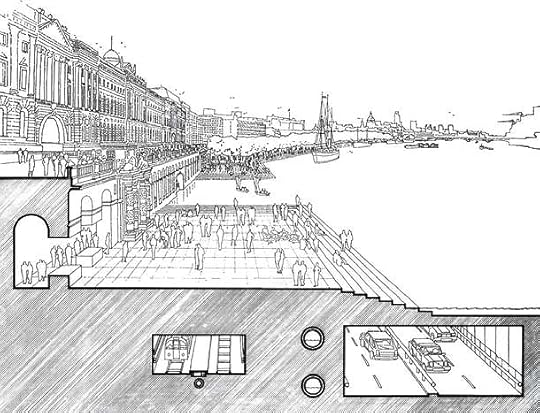
This book was published over 25 years ago, a few years after the reopening of Rogers' epic Lloyd's building in London. Whilst some space is dedicated to that design, much more is said on urban planning and development. Rogers' vision for the South Bank and Watergate is stunning and reminds me of large parts of Stockholm where much of the transport was moved underground to allow the waterfront to be pedestrian-only. I am a little surprised that an architect would spend so much effort on city planning - but it seems the two overlap more than I thought.

This is a surprisingly good read for its slim, picture-filled entirety and feels as fresh today as it did 25 years ago (apart from, perhaps, the robotic future ;) ).

https://i.pinimg.com/originals/69/f0/73/69f073d506436a3166fae06d77fb8c24.gif
Displaying 1 of 1 review

Can't find what you're looking for?

Get help and learn more about the design.