Jump to ratings and reviews
Rate this book

Nemo Trilogy #2

Nemo: Roses of Berlin (League of Extraordinary Gentlemen

Rate this book
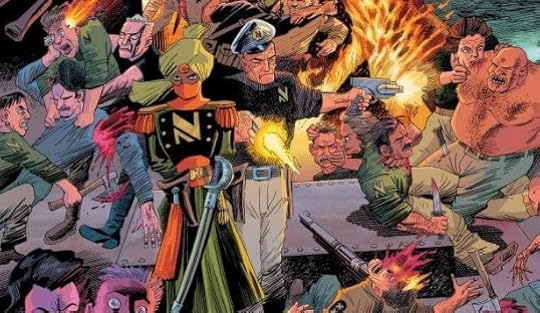
From The League of Extraordinary Gentlemen… Sixteen years ago, notorious science-brigand Janni Nemo journeyed into the frozen reaches of Antarctica to resolve her father's weighty legacy in a storm of madness and loss, barely escaping with her Nautilus and her life.

Now it is 1941, and with her daughter strategically married into the family of aerial warlord Jean Robur, Janni's raiders have only limited contact with the military might of the clownish German-Tomanian dictator Adenoid Hynkel. But when the pirate queen learns that her loved ones are held hostage in the nightmarish Berlin, she has no choice save to intervene directly, travelling with her ageing lover Broad Arrow Jack into the belly of the beastly metropolis. Within that alienated city await monsters, criminals and legends, including the remaining vestiges of Germany’s notorious ‘Twilight Heroes’, a dark Teutonic counterpart to Mina Murray’s League of Extraordinary Gentlemen. And waiting at the far end of this gauntlet of alarming adversaries there is something much, much worse.

Continuing in the thrilling tradition of Heart of Ice, Alan Moore and Kevin O’Neill rampage through twentieth-century culture in a blazing new adventure, set in a city of totalitarian shadows and mechanical nightmares. Cultures clash and lives are lost in the explosive collision of four unforgettable women, lost in the black and bloody alleyways where thrive THE ROSES OF BERLIN.

52 pages, Kindle Edition

First published March 1, 2014

16 people are currently reading
857 people want to read

About the author

Alan Moore

1,576 books21.7k followers
Alan Moore is an English writer most famous for his influential work in comics, including the acclaimed graphic novels Watchmen, V for Vendetta and From Hell. He has also written a novel, Voice of the Fire, and performs "workings" (one-off performance art/spoken word pieces) with The Moon and Serpent Grand Egyptian Theatre of Marvels, some of which have been released on CD.

As a comics writer, Moore is notable for being one of the first writers to apply literary and formalist sensibilities to the mainstream of the medium. As well as including challenging subject matter and adult themes, he brings a wide range of influences to his work, from the literary–authors such as William S. Burroughs, Thomas Pynchon, Robert Anton Wilson and Iain Sinclair; New Wave science fiction writers such as Michael Moorcock; horror writers such as Clive Barker; to the cinematic–filmmakers such as Nicolas Roeg. Influences within comics include Will Eisner, Harvey Kurtzman, Jack Kirby and Bryan Talbot.

Ratings & Reviews

What do you think?
Rate this book

Friends & Following

Create a free account to discover what your friends think of this book!

Community Reviews

5 stars
268 (15%)
4 stars
618 (36%)
3 stars
593 (35%)
2 stars
182 (10%)
1 star
28 (1%)
Displaying 1 - 30 of 180 reviews
Profile Image for Alejandro.
1,314 reviews3,780 followers
July 8, 2016
Iron action!


This is the second book in the “Nemo Trilogy”


Creative Team:

Writer: Alan Moore

Illustrator: Kevin O’Neill

Letterer: Todd Klein


VISIT BERLIN, METROPOLIS OF GERMANY

It’s the year 1941…

Janni Dakkar, daughter of the original Captain Nemo, follows the legacy and she continues as the second Captain Nemo commanding the incredible submarine Nautilus.

Janni fell in love with Broad Arrow Jack (from old British penny dreadful novelletes) that he is part of her crew. They had a daughter, Hira, that now she is fifteen years old (and since at those old times, it was usual to be married quite young), Hira is married to Armand Robur (from Jules Verne’s Robur the Conqueror).

The Earth is suffering with the Second World War but you can guess that in a planet devised by Alan Moore, even the WWII won’t occur as it was in our own Earth, specially if he has the entire old films and classic literature at his hands…

…the Nazi Party is lead by Adenoid Hynkel!!! (Charles Chaplin’s version of Hitler in The Great Dictator).

But that’s not all!

Berlin, under the supervised work of C.A. Rotwang (from Fritz Lang’s Metropolis), it’s now a futuristic-look city, with vast technological advances, and thanks to Dr. Caligari (from Robert Wiene’s film The Cabinet of Dr. Caligari) now they have trustful Sleep Troopers (hypnotized sleepwalking soldiers). Even Berlin’s criminal underground is managed by Dr. Mabuse (from Norbert Jacques’s Dr. Mabuse, the Gambler).

Watch out, Allied Forces!!!

Good thing that Janni and the Nautilus, along with Hira and Robur and their mighty “lighter-than-air” ship The Terror, are fighthing against Nazi forces.

However, Ayesha (from H. Rider Haggard’s She), the enigmatic African Queen, is still pissed off about that Janni’s crew robbed some of her valuable stuff, sixteen years ago. And since Hynkel needs an influence in Africa, to secure Nazi settlement there. Well, it’s easy to know what are Ayesha’s demands to help the Nazis that suits them just fine since they’d need to deal with the Nautilus and The Terror eventually. So, why delaying the fun?

Berlin, the new metropolis never was more dangerous!!! The worse place to fall in a deadly trap!!!

And I didn’t approach about the deadliest menace there!!!


AUFMERKSAMKEIT LESER

An interesting thing is that when German people talks in their native language, well, you read German language! Of course, I hadn’t the slightest idea what the heck the characters were saying, (while my international favorite soccer club is Bayern Munich and my favorite national team (besides obviously the one of my own country, Costa Rica) is the German National Soccer Team), still I don’t know much German language, but it’s not vital to understand the story.

I think that it was cool detail, but not unusual in Moore’s work, since in From Hell you found some pages in German language too.

In my humble opinion, Moore’s intention is to celebrate German culture and to make people to remember that Germany has a lot of wonderful things to offer to humanity, that they are more than just the Nazi era, that they have contribute a lot, before and after that time.

And in this book, The Roses of Berlin, there are even some dialogues in French.

So, if you don’t know German or French, you’ll deal with the same language barriers that you may face, if you were in same situation of the heroes of the story.

But again, don’t worry about it, since you will be able to understand what is going on, in the adventure, since English is still the main language used in the book.


Profile Image for Lyn.
2,010 reviews17.7k followers
April 10, 2019
I could not decide which was more impressive – Alan Moore’s swaggeringly clever narrative streaming multiple literary and historic references together or Kevin O’Neill’s brilliant illustrations.

The collaboration is good enough for comparisons to songwriting teams like Lennon – McCartney and Elton John - Bernie Taupin, or a middle infield team of Dave Concepcion and Joe Morgan turning balletic double plays. Each alone is extraordinarily talented, but what they accomplish together is phenomenal.

This time around, Moore and O’Neill continue where they left off in 2013's Nemo: Heart of Ice (not Heart of Glass for all of us Blondie fans in the house) though many years have gone by and now the world is gripped in the second world war. Of course, this is Alan Moore after all and this alternate history is deliciously deco, with Berlin seen as a twisted metropolis. O’Neill’s artwork is spot on and just cool to look at.

The pirate princess and her crew from Lincoln Island are tear assing through the German navy supply line when the Airship Terror is felled and their daughter and son-in-law are in danger. Might as well go straight to Berlin to kick ass and chew gum – and of course they’re all out of gum.

Fun, fun, fun; not just for Moore fans or even for graphic novel fans, if you love Victorian, steam punk, penny dreadful or pulp fantasy, check this out.

description
Profile Image for Sam Quixote.
4,811 reviews13.4k followers
April 27, 2014
I should’ve stopped after the first page which warned me this book was another episode in Alan Moore’s Journey Up His Own Backside because the first page is written entirely in German. Untranslated German. And not just the odd word like “ja” or “guten tag”, but packed panels of dialogue which non-German readers - ie. most people picking up this ENGLISH version of the book - won’t be able read unless they pull out their English/German dictionaries or type all the dialogue into Google Translate - none of which I did because why should I? That’s not isolated to the opening page either, several pages throughout this brief book have lots of untranslated German dialogue.

So it’s 1941 and Janni’s 15 year old daughter’s blimp has been shot down over Germany and she and her husband (who, by the way, looks to be in his late 30s) have been taken prisoner. Janni and her husband journey deep into the underground heart of the weirdly mechanised German regime to rescue them.

I’ve read all three parts of the Nemo series and have to wonder what the point of it all is. Book 1 - Janni leaves her dad to work in a brothel, then decides to burn half of London; Book 2 - Janni goes to Antarctica where Moore writes a terrible parody of HP Lovecraft’s At the Mountains of Madness; Book 3 - Moore gets Kevin O’Neill to draw boobs amidst lots of imagery taken from Fritz Lang’s Metropolis. Why? And why is the League of Extraordinary Gentlemen still continuing with a character who wasn’t even in the League?!

Janni’s not a particularly interesting character - she’s monotone, competent, and more-or-less personality free. Her story has been unnecessary and, for the most part, unimaginative. All Moore seems to be doing is referencing other, better works of art in his increasingly pointless comics, but so what - who reads a book for the references over the story? This entire book - which, at roughly 50 pages, is more of an extended single issue than a book - is a straightforward action montage of characters firing guns or sword-fighting with explosions going on in the background. That’s it?!

I read this because, as some of you may know, Moore is a very vocal critic of contemporary comics and I wanted to see what his comics were like - you know, see how to do comics “right”. And what did I read? Contrived scenes with forgettable action, trite dialogue (those that I could read that is), stiff, two-dimensional characters, and an unengaging, paper-thin “story”.

Alan, I think you need to start taking a look at your own work before you blanket-assess the rest of the comics world with your uninformed, derogatory opinions.
Profile Image for Shawn.
952 reviews226 followers
May 11, 2015
You have to love Alan Moore - keeps putting out the quality work and keeps getting reductive, surface readings from smart, usually younger critics/readers who get to posture and pout as they 'take down the out-of-touch old man' with their 'superior' wit and skills. Hilarious. Dare they stop and think about what they've read - not the surface, but the resonant themes and images (since, as I keep saying and as The League of Extraordinary Gentlemen: Black Dossier made apparent, the series is NOT taking place in a 'real world', nor some 'alternate earth' where characters from literature live - but something far more fascinating)? Dare they spend even a moment to consider how it relates to what has come before - both for the specific character and the other preceding series set in the 20th Century? Of course not, that would take time and they need to dismiss it and move on to the next thing as quickly as they can - there are apps to download, after all. And yet they still continue to buy them, it seems, always ready to be disappointed over and over again . I wonder why that is? Probably a creative artist of Moore's skill and talent could tell me, if he really felt it was worth conjuring on. But it really isn't, he's got heartfelt, resonant adventure stories to tell. So if you didn't like this, or the preceding book, or any of CENTURY, or THE BLACK DOSSIER - you really should just stop reading them by this point. And stop reading this review as well...

Still with me? Let's have some fun! Simple plot first - In 1941, Janni, daughter of Captain Nemo, and her lover/first mate Broad Arrow Jack, launch a two-person rescue mission into Germany/Tomania's technologically advanced Metropolis to retrieve their daughter, Hira, and son-in-law (notorious air-pirate Jean Robur) from captivity. But it's a trap, paying due on a debt from the preceding book (Nemo: Heart of Ice)

It's always one of my benchmarks that a creator is doing something right if most of the dualistic factions are complaining (re: blinkered critics of The League of Extraordinary Gentlemen: Century 1969 and their uncharming online whining that Moore was an aging hippie who was too teary-eyed and nostalgic for his precious psychedelic age, while others complained just as loudly that he obviously *hated* the era of peace and love, because he chose to show its dark side) and so Moore seems to be continuing to do things right. It has always been an easy, dismissive reduction that the LOEG books are now just excuses at loading up references for pop-cultural train-spotters, so it comes as no surprise that one can now find complaints that there weren't *enough* pop-culture shout-outs in ROSES OF BERLIN. *Sigh* - so it goes. (Those of you holding the latter view might note that the always reliable Jess Nevins and his band of annotating madmen have not identified - or even acknowledged - the fussy little midget parading around in the brothel with his electrically-charged penis sign - so there you go, you don't need to be outside of the fun circle of cool kids anymore - have at it! And tell me who Hynkel's second-in-command is, while you're at it!). Yes, long gone are the days of breathlessly looking forward to maybe watching (deep breath - this is always my favorite part) Lordy Snooty and His Pals taking down Dr. Quartz while JimGrim looks on. Instead, we get something a little deeper. Oh, and one last thing for the complainers - yes, there are panels and a few whole pages in German, a language I believe some people in the world still speak, as frustrating as that may be for you. You can find translations of those pages at the preceding link - yes, I imagine if you took this book with you to bed, to the bathroom or on vacation, where you had no recourse to the internet, this might be vexing. Please lay it aside until you have such access or, maybe, teach yourself German as an alternative!

I had some theories as to what the underlying themes of the NEMO series were going to be (because, yes, I do believe there are themes to these books, and a point to it all, as I've said - even if some can't see it) and I reservedly expressed some of those in my review of Nemo: Heart of Ice. But it really took a second volume for these theories to clarify, and so here we go.

The NEMO books are intended as a counterpoint to the LOEG: CENTURY books, on at least two levels. CENTURY was a mad spin through the highs and lows of the 20th Century accompanied by adventurous and immortal figures and it was, at least in part, about how progress and advancement had made the 20th Century a giddy whirl, and how being immortal and living through that could be both fascinating and damaging. The NEMO series is the flip side of that. Instead of immortals, we get real humans who can be wounded and die easily. Instead of grand gestures on a broad scale (saving the world from the Anti-Christ, say), we get small skirmishes, the emotional dangers of trying to live up to larger-than-life forebears who have passed on and trying to live in a world of larger-than-life forces, whether they be monetary (Charles Foster Kane), despotic (Hynkel) or cosmic (The Great Old Ones). It is no surprise that the inherently anarchistic pirate lifestyle of Janni comes into conflict with both unchecked Capitalism (the preceding volume) and Totalitarian control (here). The previous volume showed us Janni coming up against those who had bastardized her father's "heroic" science into mere perverse Gadgetry (Tom Swift and his ilk) and in ROSES she sees these technological advances (presented as all whizz-bang rocketry in BLACK DOSSIER), with their dark underbelly of social control, militarization and enslavement exposed. (In the end, you see Maria the Automaton cut down by "friendly fire" - uncomprehending and remote-controlled by no one). As I said in my HEART OF ICE review - Janni learned there that the grand exploring adventure of the 20th Century was a trip into her own humanity, her heart, her emotions - the real unexplored country that the 20th Century opened up for all people. Here, we see her advanced in that - a lover killed, a beloved daughter threatened, a lifestyle renounced.

And then there's immortality as the second theme. CENTURY showed us the problems of living as an Immortal - becoming outmoded and re-addicted in an age of addictions (the 20th Century in a nutshell) like Quatermain, or desperately chasing youth culture while never dealing with your internal damage (again, the 20th Century in a nutshell) like Mina, or the endless chasing down of stimulation while never being satisfied and just plain bored with it all (the 20th Century in a... well, you get my point) like Orlando. The pain of immortality is great. And despite all that, CENTURY shows us, you can still be a hero.

And in Janni's series, as I said above, we see the dangers of being human in a world of vast powers - the dangers of NOT being immortal. Grand forces plot their plots and scheme their schemes and you scrabble for survival, dying every moment, dodging the grinding gears of systems you don't believe in, while those around you - comrades and loved ones - drop away or are chewed up as you try to live by a code that you can *live* with... until you die. And despite all that, NEMO shows us, you can still be a hero.

Janni, in these books, is the Anti-Mina Murray. Ayesha here embodies all that's wrong with immortality - the dwindling telescoping of compassion over vast stretches of time, the cold hubris, the disconnect from humanity, the inability to recognize love, honor and humanity (how fitting she dies with the name of Janni's love on her lips). Immortality can easily make you a monster - better to be human, as painful as that is.

The journalistic article at the back, just as last time, features some quality stylistic writing while filling in gaps. Pirate utopias, Godzilla and Robur's struggles in Vietnam. Fascinating for the larger resonant picture.

Regrets? I have a very few. Part of me feels like I would have liked to have seen one full scene with Hynkel being crazy - but then I figure if anyone has gotten his duly undue exposure in popular culture it is Der Fuhrer and who really needs to see the clown dance one more time? Besides, since the next (and last) Nemo book takes place in South America in the 1970s, perhaps we will yet again see Herr Hynkel one last time... as a raving head in a jar?

A selfish part of me wanted more Caligari and Mabuse - but, I will say that the two character's brief scenes of dialogue are masterfully done and satisfying if examined for details: Here we have two very intelligent, if evil, men who both seem aware that they have hitched their wagons to an unstable star due to fall very soon - Mabuse perhaps a bit more aware than Caligari, or perhaps that's just because the Gambler has always been an arch-schemer and manipulator ("To crime" he toasts Janni, in one of those wonderful details of dialogue - and he even acknowledges that the sleep-commandos deaths are no different than anyone's, while also noting there are thousands more to be procured from the concentration camps). So, yeah, I can't say I wasn't satisfied.

I would have liked a bit more of Robur - but again we have a small line of dialogue that speaks volumes, as he apologizes for Hira's presumed death, giving us a glimpse of the odd nobility and honor of the pirate code.

All in all, a thoroughly satisfying read - full of depth and charm - for those who can look with the right eyes, of course. And now, on to RIVER OF GHOSTS, sure to cause continued wailing and gnashing of teeth!
Profile Image for Patrick.
Author 58 books243k followers
May 2, 2014

I found this book fairly disappointing.

For one, it was short. Very short. I don't mind a brief, tight story. but this was about 45 pages long. Given that I was dropped into the middle of the story without much context, by the time I kinda figured out what was going on, things were 3/4 over with.

There's just not enough room for complex story and good characterization in 45 pages.

In all fairness, this is written in the style of the 30's and 40's pulps. Short, action-packed stories. That isn't a genre I read, so it might be a great example of the type, simply not my flavor.

The other thing I didn't care for was the fact that there were entire pages where all the dialogue was German.

Did it make sense in terms of the plot? Well... sure. In a way. They were raiding a Germain city. It only stands to reason that when the Point of View shifts to the baddies, that they'd be talking in German.

I can even appreciate the use of opaque languages from a storytelling perspective. That sort of thing can create tension in the reader....

But here's the thing, it only creates tension in the reader if our confusion and lack of understanding mirrors that of the protagonist. "Fuck!" we could think to ourselves. "We broke into their base and we can hear them planning Nazi shit, but we don't know what's going to happen!"

But that's not what's going on here. For one, the protagonists *do* speak German. For another thing, the protagonists aren't *in* these scenes. They're scenes we cut away to...

This means the scene is being shown only to the reader. But the reader can't, y'know, read the language.

I could take some of this in the story. Hell, I'd *salute* some of this. Because when I first hit it, I found myself thinking, "If I wasn't such a fucking painfully monolingual American, I'd know enough German to figure some of this out...."

And you know what? That's not a bad thing for the audience to think.

But there are three full pages of this in the book. In a 45 page book. That means nearly 10% of the book.

For me, that crosses the line between daring narrative choice/social commentary and literary faffery.

So... yeah. Pretty indifferent to this. I don't think I'll grab the next one.

Profile Image for Chad.
10.4k reviews1,061 followers
February 15, 2022
I was very confused by this book. There were several pages entirely in German with no translation. It's not up to par with Alan Moore's other work.
Profile Image for Drew Canole.
3,189 reviews44 followers
February 25, 2024
Janni Nemo in the 40s battling science-fiction Nazis in Berlin. The dictator Hynkel has some of Nemo's family held hostage. There's some pretty cool fighting with some wonderful drawings by O'Neill. Somehow it does get bogged down by Moore. There's lots of pages with German dialogue, that I'm unsure if Moore expected me to translate or just go with the flow. I feel like it's trying to do too much with too few pages. But still, there's something here that I really like and it's a series I'd re-read again in the future.
Profile Image for Gianfranco Mancini.
2,342 reviews1,075 followers
March 22, 2016


Ok, this was really too short and all the untraslated german dialogues were a pain in the ass...

but

I think that Moore just wanted to put the reader in the pow of the main characters:
They not understand German? So you too.

And

The story is so awesome that you can just forgive that and enjoy.


Damn. Alan Moore is a fuckin'genius!!!


Standing ovation.
Profile Image for Daniel.
812 reviews74 followers
July 19, 2016
E ovo mi je do sada najzabavnija prica, i najlaksa za pracenje. Malo kratko ali kombinacija Hinkela (Caplijev Hitler :) ) i Metropolisa daje dosta interesantnu postavku. Obog puta nemamo cudovista ali zato interesantan futuristicki Berlin.

Jedini minus je da 50 strana suvise malo. Da je barem jos 100.
Profile Image for Dan.
3,216 reviews10.8k followers
June 7, 2023
Janni Nemo and her husband go to Germany to rescue their daughter and son in law. Things do not go well.

Now this was one gorgeous book. The Germany of the League of Extraordinary Gentlemen universe is based on Fritz Lang's Metropolis. It's a retro-futuristic dark nightmare and Kevin O'Neil draws the fuck out of it. The only thing I didn't like about it was that half of the panels were in German.

I like what Alan Moore is doing with these Nemo books, balls to the wall adventure with enough breathing room for Kevin O'Neil to strut his stuff.
Profile Image for BrokenTune.
756 reviews224 followers
June 28, 2014
Review first posted on BookLikes: http://brokentune.booklikes.com/post/...

For my latest reading adventure, I've picked up a couple of graphic novels - a genre I have largely neglected to explore so far.

Captain Nemo is one of my favourite Jules Verne characters. So, it is no surprise that I'm intrigued by any story that uses the theme of the rogue captain.

This particular treatment was interesting as Nemo here has no similarity with Verne's character - except from having access to a submarine. Btw, this is not a bad thing and I'm not holding it against the book. On the contrary, I like that the LoG Nemo is a standalone character because it makes the original sub-aquatic adventure very distinct from this story - which is rather dull and so laden with cliches that I caught myself thinking "Oh, what tosh!" nearly every three pages.

What I loved about this book: the illustrations are fantastic!
Profile Image for Lost Planet Airman.
1,283 reviews90 followers
February 11, 2017
As much as I have liked Alan Moore's work in the past, this collection grated on me. I suppose he has an artistic vision, and a grand map of the development of the "League of Extraordinary Gentlemen" universe. But the vision and tne map are not making it onto paper for the general populace.

In this collection, the Nemo Dynasty of piracy moves the adventure from the sea, and into Berlin, in the late 1930s. For some reason, Adolf Hitler is renamed "Adenoid Hynkel" (and perhaps we are supposed to know why, and what literary reference gives us this rewickering of history). But all is not as we might expect it, as several aged villains and ageless monarchs are the powers behind the rise of Berlin, and this is a trap for Janni Nemo.

Brush up your German, or download the latest, biggest Google Translate, because there are several complex pages in that language, and the pictures don't really help with the big words, like "Sleep-Commandos".
Profile Image for Rod Brown.
7,419 reviews286 followers
November 29, 2024
Janni Dakkar -- the second Captain Nemo of Jule Verne's Nautilus -- undertakes a rescue mission in Berlin during World War II when her daughter's pirate aircraft is downed by German forces. This pretext gives Alan Moore a chance to play around with characters from classic films about or produced in Germany -- The Great Dictator, Metropolis, The Cabinet of Dr. Caligari -- as well as the usual public domain novels that inspired Moore's League of Extraordinary Gentlemen.

It's all very clever and violent, even if it seems a bit shallow for Moore. But it's fun to search for all the references and Easter eggs. You'll also need to search for a translation of all the passages in German that crop up throughout the story without any spoonfeeding.

I have the third book of the trilogy on hand from the library, and I'm curious to see how it wraps up.
Profile Image for Rory.
89 reviews
March 10, 2014
Right off the bat, I like Alan Moore's writing a lot, and I love the League of Extraordinary Gentlemen series. It's one of my favourite things in all of comics. That said, this latest instalment/spin-off was a little underwhelming. I'm really torn about how I feel about it. On the one hand, the art by Kevin O'Neill is stunning as ever, and the story is fast-paced and exciting in this attractive but slender hardcover.

Where I have a problem with the book is that a) it's very short, as with Nemo: Heart of Ice before it, and b) the decision to include large chunks of untranslated German dialogue will most likely alienate some readers. Unless you either speak German or have the patience to translate as you go through, I recommend the annotations by Jess Nevins which, as with the other volumes of the series, explain a lot of the references you might have missed, but also include full translations of all the German and the little bit of French that's in the book. http://jessnevins.com/annotations/ros...

Overall I did find it enjoyable, once I had Nevins to help me out, but I think it's one of the weaker points of the series.
Profile Image for Wreade1872.
817 reviews232 followers
December 21, 2024
In english an ok read but still feels quite short, the relative time involved only being a matter of hours, at least the previous entry in the Nemo saga felt like it took place over a few weeks.
However i still can't forgive Moore for leaving so much of it in untranslated german and french.
Profile Image for Mark Schlatter.
1,253 reviews15 followers
March 28, 2014
This is a short tale in the League of Extraordinary Gentlemen universe, following the daughter of the original Captain Nemo as she and her husband attempt to save the lives of their daughter and son-in-law in the midst of a fictional 1930's Berlin. It's a good tale, but the impact comes from the stunning artwork of Kevin O'Neill. Alan Moore decided that his Berlin should be designed after the images in Fritz Lang's Metropolis and gave O'Neill several splash pages to convey the effect. The result is staggering --- it's as if O'Neill (who always does great stuff) was given an even freer reign and went berserk with frightening fascist design aesthetics (and quite a bit of violence). Took me back to the wonders of the Marshall Law series.

Warning: Moore is happy to give us several pages of untranslated German and a bit of untranslated French. I felt like an ugly American.
Profile Image for Leonardo.
781 reviews46 followers
October 6, 2023
The Roses of Berlin is a mixture of the best and worst elements of the League of Extraordinary Gentlemen saga: it is equal parts a highly entertaining adventure comic and pedantic literary namedropping. It's 1938 and Princess Dakkar, the second Captain Nemo, is on a mission of revenge (and bit of piracy and ransacking) against the Nazi-like regime of Adenoid Hynkel (yes, The Great Dictator himself) and an assorted gang of villains from German expressionist films. Visually, this volume achieves its greatest triumphs with its hommage to Metropolis and its highly cinematic battles (both at the human and vessels levels). However, the plot itself seems quite dull and predictable and the dialogue is uncharacteristically flat for Alan Moore. There is almost no character development or sense of actual danger (despite the very tangible pain and loss that the protagonists undergo). Some readers have also complained about the high percentage of untranslated German dialogue and I'm in two minds about it: it's a choice that certainly adds flavor, but also leaves one feeling like something might be missing. However, the appendix more than makes up for these shortcomings and it certainly brings back memories of the appendixes in the early LoEG volumes -- the prose is witty and the references are clever, but not obtuse and it is delightful to actually catch a reference close to one's heart (in my case, the Moomins and Godzilla).
Profile Image for Dave Schaafsma.
Author 6 books32.2k followers
August 9, 2015
The first volume, Heart of Ice, owes much to H.P. Lovecraft's At the Mountains of Madness, set in 1925, in Antarctica, featuring Jules Verne's Captain Nemo, only as a woman. This one owes much to Frtiz Lang's Metropoils, and Dr. Mabuse and Caligula make their evil appearances, set in 1941 Nazi Berlin, where pirate Queen Janni goes, after Jack is gone, to rescue her daughter Hira, with husband Robur, an aerial warlord. There she face, among other foes, Ayesha and a mechanized Man-Machine that may be a woman.

My problem with the first volume is that it was stiff, dull, all talk and back stories. Supposed to be a tale of terror, and that didn't work out. Not disturbing. Pretty boring, mainly because we have a main character Janni, who is dull and largely uninteresting at the center. And anti-hero who is pretty boring.

The second volume is almost all action, lost of swords and pistols, visually more interesting. But the main character remains, and she's just not that engaging, and the homage to Metropolis is interesting but doesn't go anywhere new with it, really. And then there are pages of untranslated German (and one of French) for no particular reason I can see. Sure, some German, but in this English version, why so much?
Profile Image for Calista.
5,434 reviews31.3k followers
September 15, 2017
Wow, this is Alan Moore and this is pretty bland. What happened?? Nothing new here and no new perspectives and the art is not anything special. It's not very original either. I won't be don't more Nemo comics. I can't give this very many stars.
Profile Image for Variaciones Enrojo.
4,158 reviews51 followers
January 13, 2015
Reseña de Mariano Abrach para Zona Negativa:
http://www.zonanegativa.com/the-leagu...

Con el paso de los años y las sucesivas publicaciones, el universo ficcional de la Liga de los Caballeros Extraordinarios se ha expandido hasta abarcar todo el planeta (y un poco más allá también) en diferentes épocas de la historia, todo esto elaborado a partir de las producciones culturales de cada momento, basando sus personajes y escenarios en los diversos trabajos de ficción. Todo comenzó con los dos primeros volúmenes situados en el siglo XIX de la Era Victoriana inglesa, para luego expandirse hacia el siglo XX y XXI con el Dossier Negro y el tercer volumen titulado Century, y llegar hasta esta trilogía que retira el foco de atención del grupo que conformara la Liga para concentrarse en la historia de de la Capitán Nemo, Janni Dakar, hija del Capitán Nemo original. De este modo, Alan Moore y Kevin O’Neill siguen desarollando y ampliando el mundo de ficción con el que comenzaran a trabajar hace ya 15 años.
La primera historia de Nemo, Corazón de Hielo, nos ubicaba en el año 1925 en una expedición a la Antártida. Esta segunda entrega de la saga propia de este personaje ocurre 16 años después, en 1941; es decir, en plena Segunda Guerra Mundial. Como se dice desde el título, el sitio de esta historia es Berlín, una Berlín diseñada por O’Neill y Moore en base principalmente a la Metrópolis de Fritz Lang.
Janni y Broad Arrow Jack llegarán a esta ciudad luego de recibir la noticia de que su hija, Hira, ha sido capturada allí luego de que destruyeran la nave de su pareja, Armand Robur. En su misión de rescate, se verán envueltos en los conflictos del poder de esta Alemania gobernada por Adenoid Hynkel (el Hitler de Chaplin en El Gran Dictador) y la versión alemana de la Liga, Die Zwielichthelden integrada por un personaje del citado filme Metrópolis así como el Dr. Caligari de El Gabinete del Dr. Caligari y el Dr. Mabuse de la película y novela homónima. Todos ellos y sus ejércitos, por una razón inicialmente desconocida, se empeñan en capturar y asesinar a Janni y Jack generando una trama de acción casi constante, exceptuando las escenas en que se explican aquellos motivos que resultarán el pilar en donde se apoya el hilo narrativo entre los dos volúmenes publicados de esta trilogía de Nemo.

Como en la primera historia de esta saga, nos encontramos con un guión de Alan Moore completamente lineal sin complejidades en la narrativa, que va de un punto a otro planteando interrogantes y resolviéndolos, guiado por el tono de acción y aventura que ya tuviera también Corazón de Hielo. En donde sí encontramos dificultades para seguir a Moore es en su decisión de utilizar el idioma original de los personajes, lo cual redunda en muchas importantes líneas de diálogo íntegramente escritas en alemán sin traducirse (al menos en la edición en inglés que se utiliza para esta reseña). Para quienes no dominen esta lengua y no quieran valerse de un traductor automático, se recomienda acudir a anotaciones (por ejemplo, en este enlace). Estas notas también pueden ser de importancia para aquellos que no tengan presente o no recuerden detalles del volumen Century y del Dossier Negro, dado que muchos personajes vienen de esos títulos previos y hará que no se comprenda en su totalidad lo que aquí se lee.

Por su parte, las complejidades del dibujo de Kevin O’Neill suman en lugar de restar, dado que estas se transforman en diseños detallados de la ciudad, las naves y maquinarias, así como en incontables guiños a referencias literarias, cinematográficas y culturales en general de este momento histórico particular. Si bien el logro de plasmar esto en dibujos es de O’Neill, conociendo la manera de escribir de Moore indudablemente también ha tenido su parte en este aspecto del cómic. Aparte del buen trabajo de diseño, el dibujante también es un excelente narrador que pone la misma atención detallada a la composición y encuadre de sus páginas, guiando perfectamente la historia en su secuencialidad.
En pocas palabras, Rosas de Berlín es una historia más de este universo, que viene a aportar a su desarrollo en espacio y tiempo, así como a la vida de varios personajes de importancia (esencialmente, los descendientes del Capitán Nemo). Y por sobre todas las cosas, se trata de Alan Moore y Kevin O’Neill disfrutando de jugar con estos juguetes que han dispuesto hace tiempo y con los cuales se nota que disfrutan y, a su vez, hacen disfrutar a sus seguidores obligándolos al placer de la relectura, de los nuevos cómics y de los ya leídos, lo cual no es poca cosa. La próxima parada será el año 1975, en una historia en el Amazonas, que se publicará en marzo próximo en los Estados Unidos bajo el título River of Ghosts y de la que podría esperarse su edición en español para dentro de un año teniendo en cuenta las fechas de publicación los dos primeros volúmenes. Me cuento entre los que allí estaremos para seguir viajando por este universo.
Profile Image for Marc Pastor.
Author 18 books453 followers
January 26, 2018
Bé. Potser la història queda fins i tot massa curta. Minimalisme argumental com a excusa per fer referències a Metròpolis, al Doctor Mabuse, al Doctor Caligari i, fins i tot, al Gran Dictador. Però no és per flipar.
Profile Image for Artur Coelho.
2,606 reviews74 followers
March 4, 2014
Sendo fã quer de Moore quer desta série a minha opinião é à partida suspeita. Estou predisposto para apreciar a continuidade das aventuras de Moore e O'Neill neste mundo enciclopédico de referências à ficção fantástica popular. Este The Roses of Berlin não desilude e consegue continuar a manter muito elevada a fasquia da série.

Moore pega-nos pela mão e mergulha-nos numa Berlim onde colidem as iconografias artísticas populares e eruditas da primeira metade do século XX. Há traços de Weimar, com Kevin O'Neill a canalizar na perfeição o estilo obsceno de consciência social de George Grosz em vinhetas que replicam os seus quadros marcantes. Mas o foco é Berlim, não como cidade ficcional imperialista ao estilo de Albert Speer mas antes como pesadelo expressionista onde a multiplicidade de planos do filme Dr. Caligari irrompe no tecnicismo de Metropolis. É nesta cidade de pesadelo, hino aos sonhos perversos do industrialismo, que reina o ditador tomaniano que unificou as alemanhas e se lançou numa guerra pela conquista da Europa. Heil Hynkel!

Estas são as referências mais óbvias. Berlim é de facto representada como a Metropolis do filme homónimo de Lang, os sonâmbulos controlados pelo Dr. Caligari foram promovidos a stormtroopers implacáveis de baba a escorrer pelos lábios, o Dr. Mabuse continua a gostar de elaborados jogos de decepção criminal, e se Rotwang faleceu a andróide Maria defende Hynkel com todos os seus poderes de homem-máquina. Adenoid Hynkel, se bem se recordam, é a genial caricatura feita por Chaplin a Hitler no filme O Grande Ditador. A perversa Ayesha de She faz uma última aparição, Robur o conquistador aliou o Terror, a sua temerosa aeronave, aos serviços do governo francês no exílio após o blitzkrieg germano-tomaniano, e num combate final de enorme espectacularidade gráfica aparecem homens-foguete que suspeito inspirarem-se no Rocketeer de Dave Stewart. Sendo Moore uma enciclopédia ambulante e O'Neill o seu canal gráfico de eleição haverá certamente mais referências que me escapam, mas a que certamente Jess Nevins e os seus comparsas já estão a dar caça.

A história é de uma simplicidade extrema. Robur é capturado pelas forças de Hynkel e Janni Nemo, com o seu intrépido marido, ataca Berlim para salvar a sua filha, que faz parte da tripulação da nave de Robur. A acção é uma armadilha montada pela homem-máquina ao serviço de Hynkel que, para se aliar a Ayesha, tem de capturar Janni Nemo. O reusltado é um confronto entre Nemo e os envelhecidos homens misteriosos germânicos, que termina com a cidade de Berilm/Metropolis arrasada pelos aeronautas do Terror. Um argumento simples, e compreende-se. O objectivo de Moore é homenagear a tradição fantástica do cinema expressionista alemão, e fá-lo com a sua habitual mestria. Uma delícia para os fãs da série, e uma profunda homenagem aos filmes intemporais que saíram do extraordinário cadinho criativo germânico dos anos 20 e 30 do século XX.
Profile Image for Online Eccentric Librarian.
3,400 reviews5 followers
August 7, 2014

More reviews at the Online Eccentric Librarian http://surrealtalvi.wordpress.com/

More reviews (and no fluff) on the blog http://surrealtalvi.wordpress.com/

I've greatly enjoyed the character of Janni - the daughter of Captain Nemo and the terrible burden she bears as a result of that legacy. In these three books featuring her, she's stormed her way through all kinds of era references, From Mountains of Madness to going up against H. Rider Haggard's Ayesha. But this latest in the series is a bit of an exception - very short even by standards of the previous books and with large chunks of untranslated German or French. I was left wondering at this point if Alan Moore was really interested in telling a story or was so obsessed with his readers/critics that he's too busy devising ways to flip them off.

Story: Janni's daughter and son in law have been captured by Nazi Germany. Along with husband Jack, she will infiltrate a fantastical underground lair in the search for her daughter. But she may no longer be alive and the whole situation could very well be a trap.

Janni, as a character, is a realist - one of the worst personality traits to befall a character in an Alan Moore book (e.g., Mina Harker). It means life will constantly spit on her in order to make the point that life kind of sucks and is unfair. The happiest an Alan Moore character can get is to be completely deluded or utterly self centered. I can't fault any of Moore's books for their strong heroines but ultimately it tends to mean we're going to have to watch the physical and emotional torture of Janni Dakkar. A lot.

I think what I most enjoy in the League stories are the constant cultural references. In Roses of Berlin, it's German (and some American) cinema. Drawing mostly upon Fritz Lang's Metropolis, but also liberally sprinkling in German 1920s horror such as the Cabinet of Dr. Caligari and Dr. Mabuse and Charlie Chaplin's The Great Dictator, it's always fascinating to see how Moore will use these references.

As well, I didn't love Kevin O'Neill's angular art initially but I'd really grown to love it by the second League book. He definitely has such a distinct style that still manages to translate emotional content. Janni has aged through the three books perfectly - I did believe we were looking at a 40ish woman in the Roses of Berlin.

Why three stars? These books are getting shorter and shorter. And now we have the untranslated languages in there as well (might as well make the next book with Sanskrit to really annoy readers who can't just Google translate as easily). I wish Moore would be less concerned with reactionary tactics/obsession with his readership/critics in his books and just stick with the story.

So while I enjoyed The Roses of Berlin, especially since it is very much a story about strong women, I was also left feeling that there was so much more to the story that was untold or untranslated.
Profile Image for Сергей Бережной.
Author 12 books31 followers
September 24, 2014
Как и в предыдущей трилогии "Столетие", генеральная тема трилогии "Немо" проявится вполне только после выхода последней части. Пока же имеет смысл сосредоточиться не столько на теме, сколько на методе, который Мур и О'Нил взяли на вооружение при работе над этим подциклом.

Если первая часть трилогии была постмодернистской игрой на тему "герои dime novels против чудовищ Лавкрафта", то вторая часть замешивает крутой коктейль из немецкого фантастического экспрессионизма ("Кабинет доктора Калигари", "Доктор Мабузе", "Метрополис") и чаплинского "Великого диктатора". Сюжет "Берлинских Роз" скуп, антураж и культурные ссылки выглядят гораздо богаче - есть ощущение, что именно их хитросплетение и является основным содержанием новелы. Это ни в коем случае не недостаток, однако у меня есть серьёзные сомнения, что у "Роз Берлина" наберется достаточно читателей, которые успели предварительно проштудировать труды Зигфрида Кракауэра и Лотте Эйснер. Алан Мур, впрочем, никогда такими мелочами не озадачивался, а вменяемый читатель его книг обязан (именно обязан) считать себя предупреждённым о том, что он обязан (снова обязан, и это важно) быть качественно подкован по темам как снисходительной массовой культуры, так и безжалостного художественного авангарда. К чтению даже проходных вещей Мура следует приступать как к экзамену, и тогда оценка, которую выставляет книге читатель, парадоксально становится оценкой его собственным знаниям.
Profile Image for Jeff.
311 reviews
April 24, 2014
Most of it is in German. I marvelled at (what I assume is) the correct spelling. The art is the same as the previous books; full of detail and at the same time hard to discern those details on the pages. The appendix is a lenghty interview some years after the events described in the book, which I noted and ignored. One day I will find this book on the shelf here at home and forget I had read it. And this review will be repeated after I do.
Profile Image for Gabriel Wallis.
564 reviews4 followers
June 23, 2014
One of the worst graphic novels of all time. I really did not enjoy The League of Extraordinary Gentlemen: Nemo: The Roses of Berlin (special volume #3) at all. The art was interesting, but I didn't enjoy all the unnecessary nudity; the writing wasn't bad either, but I didn't enjoy half of the graphic novel being in German and French. I don't recommend this graphic novel. A waste of time.
Profile Image for Fugo Feedback.
5,105 reviews173 followers
April 15, 2022
La trilogía dedicada a Janni Nemo es quizás menos sólida que la serie principal de LoEG, pero igual de disfrutable.
Profile Image for Alan.
2,050 reviews16 followers
March 5, 2018
Out of the Nemo trilogy it feels like this installment was filler, just a little bit mind you, but filler nonetheless. That, and damn how old are they going to allow Janni Dakkar aka Nemo get? We've gone from her appearance in Century, to post WWI, now an AU WWII Germany.

I like Janni. I like how she believes she needs to, and wants to, not be her father. The question is how much is her being drawn into violent conflicts beyond her control?

A trap is laid for Janni and her husband Broad Arrow Jack when their daughter and son-in-law are presumed captured and/or dead because of Robur's raiding of Germany's assets in a world on the brink of war. In the hope of finding Hira alive Janni leads an assault into the enemy's lair.

There are not quite as many easter eggs to look for here as in other LOEG books, but the nod to the hinted at German version of the LOEG was fun.

Well paced, and nothing like seeing criminals decide to work together and damn their governments and politics (small spoiler there).
Displaying 1 - 30 of 180 reviews

Can't find what you're looking for?

Get help and learn more about the design.