In the early and mid-twentieth century, Joseph Fielding Smith’s (1876–1972) life as a public historian and theologian shaped the religious worldview of generations of Latter-day Saints. Matthew Bowman examines Smith’s ideas and his place in American religious history. Smith achieved position and influence at a young age, while his theories about the age of the earth and the falseness of evolutionary theory brought fame and controversy. As Bowman shows, Smith’s strong identity as a Saint influenced how he blended Protestant fundamentalist thought into his distinctly LDS theological views. Bowman also goes beyond Smith’s well-known conservatism to reveal him as an important thinker engaged with the major religious questions of his time. Incisive and illuminating, Joseph Fielding Smith examines the worldview and development of an influential theologian and his place in American religious and intellectual history.
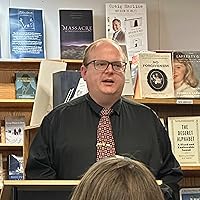
Matthew Bowman teaches American religious history at Hampden-Sydney College, and serves as associate editor of Dialogue: A Journal of Mormon thought. He’s interested in evangelicalism, fundamentalism, religion and American culture and occasionally dabbles in Mormon history, noir, and the movies. He’s published in Religion and American Culture: a Journal of Interpretation, The Journal of Mormon History, the John Whitmer Journal, and the Journal of the Early Republic.
I remember a conversation with an institute teacher that I was particularly close to while I was attending college. I was in his office and noticed a framed sketch that included important intellectuals and writers in Latter-day Saint history. While I liked most of them, I pointed out that I didn’t care for Joseph Fielding Smith and Bruce R. McConkie and the perspectives they held. The institute teacher then said, “I agree, but can you deny that they belong there because of the impact they had?” Joseph Fielding Smith: A Mormon Theologian, by Matthew Bowman is an impressive glimpse into the world and thought of one of the most influential writers and theologians in the world of 20th century Latter-day Saints. Joseph Fielding Smith was the son of Joseph F. Smith and grandson of Hyrum Smith who served as an influential and dogmatic theologian and high-ranking church leader for over sixty years. He published numerous articles and books, as well as many talks and discourses over the course of his long life, advocating for a position that had some similarities to fundamentalist Protestant thought.
In this book, Matthew Bowman takes Joseph Fielding Smith seriously and works to contextualize his worldview. My experience is that Joseph Fielding Smith is often oversimplified into an anti-intellectual and racist crank who did more harm than good in the Church through insisting on his brand of orthodoxy. While there is some truth to that, Bowman digs into the complexities beyond that oversimplification: “[Joseph] Fielding Smith, and those like him, must be taken seriously. Not simply throwbacks or cranks, they are modern people in their own way and thus reveal the composite and contradictory nature of the world they have left to us” (p. 90).
For example, Bowman goes into detail into why Joseph Fielding Smith didn’t believe in progress (using Joseph Fielding Smith’s statements that humans would never land on the moon as a launching point). In direct opposition to a liberal Protestant view, Joseph Fielding Smith saw history as cyclical and that while modern humanity had different technology than in the past, “not only did he deny the idea that human beings were the product of a long process of biological development; he denied also the idea that human cultures and civilizations were likewise the product of centuries of historical development” (p. 42). Part of why Smith believed so strongly in enforcing orthodoxy was because belief shapes action, and he thought that beliefs like societal evolution encouraged types of competition and destruction that weakened society.
The book follows the standard format for the series of an introductory chapter that offers a brief biographical sketch, three body chapters that focus on major themes in the figure’s thought (in this case, chapters on how Joseph Fielding Smith approached texts like the scriptures; his views on progress; and why he valued orthodox beliefs), and a short concluding chapter that provides a reader’s guide or a bibliographic essay that introduces readers to the figure’s most important works. In doing so, it provides a very accessible introduction to a key figure in 20th century Latter-day Saint history.
This is another excellent addition to the Introductions to Mormon Thought series, edited by Joseph Spencer and the book’s author Matthew Bowman. Readers should note this particular volume emphasizes the thought over the biography even more than others in the series. With that in mind it does begin noting that Fielding Smith “remembered well his anger at those who persecuted his church and drove his parents away” (1). Bowman notes multiple times in the volume the many times Fielding Smith spoke on the martyrdom of his grandfather Hyrum Smith, and great uncle Joseph Smith Junior. This righteous anger Bowman argues creates a binary in Fielding Smith’s thinking that permeated his thought.
Bowman explains clearly throughout the volume the intellectual foundations of Fielding Smith’s thinking. As a reader I particularly enjoyed the way Bowman framed Fielding Smith’s contestations with the more liberal apostles of his time, explaining that it was Fielding Smith not “blind” to the premises of McMurrin and Snell, he just disagreed with them. Bowman goes on to argue that Fielding Smith’s combatants failed to “engage” with the assumptions, instead dismissing them out of hand (82). I found this a more novel analysis than the more typical framing in Mormon Studies of orthodox apostles as bad guys and liberal interrogators as good guys. Bowman demonstrates that Fielding Smith, rather that defenders of liberal religion, were more willing to acknowledge the intellectual assumptions of their beliefs.
Bowman presents an excellent analysis of Fielding Smith’s opposition to the theory of evolution as an outgrowth of his deep seated theological beliefs against moral progress, arguing that the gospel know to Adam is the same one presented to Joseph Smith. Bowman explains that Fielding Smith maintained a “cyclical” order of the universe (43).
Fielding Smith is well known for his defense of the Church of Jesus Christ of Latter-day Saints’ ban on priesthood privileges and temple ordinances for Black Latter-day Saints. Bowman doesn’t hesitate to acknowledge this as racism, but in my opinion doesn’t devote enough time to exploring the contradictions generated by this belief and how it aligns or doesn’t with his other ideological commitments.
As someone whose primary interest in Latter-day Saint history began with the 20th century, I loved this book and the appreciation it begins to show to show to the direction of individual thinkers in the 20th century church, steering clear of overly tread hagiography or polemics vindicating the orthodox, while at the same time not castigating orthodox thinkers as simple. It is a much needed advance and corrective in Mormon studies.
Several different ways a review of this book could go. The simplest summary is to say Joseph Fielding Smith was dogmatic. I found myself feeling a bit sorry for him, as not only have his rigid opinions not aged well, but I also don’t think they were very well received by many at the time. I wonder how many close friends he had.
Having also read the excellent biography of Fielding Smith’s father by Stephen Taysom (Like A Fiery Meteor), I can’t help but suppose that some of Joseph F. Smith’s temperament had to have rubbed off on his son, Joseph Fielding Smith. (Sorry to confuse any non-Mormons reading this; both father and son had the same names, but the son didn’t go by junior—Fielding Smith’s son did.)
This book was another reminder that in the history of the Mormon church, nearly every president has held viewpoints that seemed permanently etched in the doctrine during their tenure, but whose emphasis has faded or even been forgotten in following generations. I can’t remember ever discussing evolution in a Sunday School class in my lifetime. I do remember my parents talking to me about it in the 80s. They came of age when Fielding Smith was in his anti-science advocacy prime.
It was interesting to read of Fielding Smith’s clashes with esteemed Mormon scientist Henry Eyring. Fielding Smith probably rolled over in his grave when Eyring’s son was called to the 12 and First Presidency.
At just under 100 pages, this is a short but useful overview of the impact of Joseph Fielding Smith in LDS church history, with chapters focusing on his intellectual life, texts, his ideas on progress, and orthodoxy. Particularly useful by contextualizing Joseph Fielding Smith by situating him within the historical events and intellectual currents that influenced him.
Joseph Fielding Smith's anti-intellectual and fundamentalist tendencies have unfortunately had lasting effects on the LDS Church; while reading this book in 2024, with the further scientific progress and the continued evolution of the LDS Church, it is clear how wrong Fielding Smith was on so many matters. I'm reminded of Mormon's admonition to "condemn me not because of mine imperfections... but rather give thanks unto God that he hath made manifest unto you our imperfections, that ye may learn to be more wise than we have been" (Mormon 9:31). To a significant degree, Fielding Smith's example certainly calls on us to be wiser.
This book looks at Joseph Fielding Smith as a theologian. As a biography, I wanted to hear more beyond his relationship with doctrine. However, if you want to understand why Fielding Smith is considered one of the most important 20th century intellectuals within the LDS Church, this book is very effective, particularly at understanding his relationships with other Mormon intellectuals, with other Christianities, and with modernity.
This is a really well written short biography of one of the most important thinkers in Mormon history. Coming to the subject with.no previous knowledge, I learned a lot from this book, and especially enjoyed how Bowman contextualized Fielding's life by sketching fundamentalism and other historical currents that intersected with it. Anyone interested in Mormon history will enjoy this.
A very good balanced history of JFS giving it context of the times. It helped explain some of the "why" of the actions he took that now look quite odd.
A good summary of Fielding Smith's views on history & theology - with some indication of his motives and his significant impact on Mormon thought in the 20th century.
Well researched book on the theology and leadership development of a complicated man. I highly recommend reading this book after reading "Like a Fiery Meteor" by Stephen Taysom.