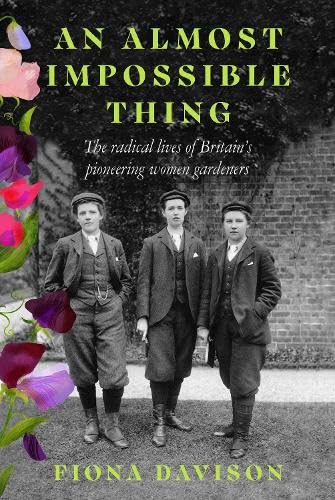
While working as Head of Libraries and Exhibitions at the Royal Horticultural Society, Fiona Davison came across a cache of letters from a young gardener who was denied a scholarship by the RHS on the grounds that she was female. Intrigued by what happened to young Olive, Fiona began to research the wider story of early female professional gardeners and discovered a group of pioneers who battled derision and prejudice to change expectations of what women gardeners could do.
An Almost Impossible Thing follows six women gardeners in the years before the First World War, and examines their lives in the context of suffragism, collectivism and Empire. Although gardens are often seen as a refuge, a place to escape from the troubles of the modern world, this book reminds us of a period when British gardens were an arena for radical and far-reaching experiments. A time when a group of convention-busting women were gardening with purpose and quietly changing the world.
I sourced this book after hearing the author interviewed on a podcast and I’ve really enjoyed it. As with other non-fiction titles, I’ve read it in tandem with my fiction reads to give balance. It’s not heavy going though and while well researched and factual is still a relaxed read helped in part by the author’s writing style and her concentration on some central characters that she returns to throughout the book. I’m fascinated by the period end 19th/early 20th century and how women were fighting to be recognised in all sort of areas of life and loving gardening too, it was an ideal read.
Yet another example of how women had to fight to be able to pursue their chosen career in horticulture. It’s unbelievable to this generation to read that men genuinely thought women couldn’t handle a spade in the garden.
A well-researched and well-written account of the lives of six ordinary women who wanted to work as gardeners in the late 1800s and the challenges and obstacles they had to overcome to achieve their goal. As well as tracing the backgrounds, education and subsequent careers of these women, Davison considers their lives within the wider context of attitudes to women at the time, and specifically, attitudes to women in the workplace. In an era when 'respectable' working women were limited to roles such as companions or governesses, it was shocking to think of employing a female gardener. Today, it is hard for us to understand just how ground-breaking (unintentional pun!) these women were.
My only complaint about Davison's previous book, on working class gardeners, was that due to the paucity of information about her subjects, she had to provide a lot of 'padding' about life in general during the 1800s. 'An Almost Impossible Thing' is much more focussed on its subjects (presumably due to the more plentiful source material available). When Davison does move on to more general information about the era, it is still relevant to her topic, as she portrays the background against which these women were seeking to build careers.
Highly recommended to anyone with an interest in horticultural history or the history of women's rights in the UK. And if you are a woman who works, or has ever worked, in horticulture, it should be required reading - we still have a long way to go before women are automatically treated as equals in many horticultural settings, but the progress that has been made is largely due to the courage and tenacity of these pioneers. We owe a great debt to Ada Brown, Isobel Turner, Edith Bradley, Olive Cockerell, Madeline Agar, Gertrude Cope and their contemporaries. Their names should not be forgotten.
Well researched compelling read. Opened my eyes to what it was like for women trying to enter the horticultural industry and the challenges they faced. I liked how it followed various women through their lives and also related to wider historical movements at the time in particular the connections between gardening and the suffragist and suffragettes movements. One to recommend for friends interesting in gardening.
Took me a chapter to get into this but once the stories of individual women, who were among the first to begin gardening professionally during the Victorian era, gathered pace I found the whole book both informative and interesting. Some of the stories were so personal and gave such an insight into the times they lived in.
Exceptional history of an issue that never occurred to me--that women were not "allowed" to be gardeners. Extremely well researched and an interesting read--not just a bunch of facts (as the number of footnotes might suggest), but a thoroughly engaging book.
11/19/25 I thoroughly enjoyed the portions that pertained to gardening. Then the emphasis shifted to suffrage - heavily. On and on it goes ad infinitum. This book could easily have been separated into two books - one dealing with pioneering women gardeners and the other dealing with the suffrage movement. The content skips around a lot, in my opinion. The last ten pages or so of text attempt to bring things together somewhat. Would I recommend this book? No.
A very well-researched and compelling, multifaceted story of the first professional women gardeners and their attempts to achieve recognition as serious horticulturalists, and through this trade gain some semblance of social and political independence, in the beginning of the 20th century, in Britain. Excellent!