

What do you think?

Les Deux Visages du monde
" L'un des écrivains les plus marquants de sa génération. " François Busnel
Après quelques années passées à Atlanta, Toya Gardner, une jeune artiste afro-américaine, revient dans la petite ville des montagnes de Caroline du Nord d'où sa famille est originaire. Déterminée à dénoncer l'histoire esclavagiste de la région, elle ne tarde pas à s'y livrer à quelques actions d'éclat, provoquant de violentes tensions dans la communauté. Au même moment, Ernie, un policier du comté, arrête un mystérieux voyageur qui se révèle être un suprémaciste blanc. Celui-ci a en sa possession un carnet dans lequel figurent les noms de notables de la région. Bien décidé à creuser l'affaire, Ernie se heurte à sa hiérarchie. Quelques semaines plus tard, deux crimes viennent endeuiller la région. Chacun va alors devoir faire face à des secrets enfouis depuis trop longtemps, à des mensonges entretenus parfois depuis plusieurs générations.
David Joy ne cesse de nous surprendre avec ce récit qui creuse à l'os l'histoire d'une petite communauté de Caroline du Nord où toutes les apparences entretenues depuis des décennies se fissurent. Il y confirme avec maestria son immense talent et nous donne avec ce livre, sans doute son plus ambitieux, l'un des romans les plus marquants de ces dernières années.
" David Joy est le digne héritier de Ron Rash, son mentor. "
Lire
" En moins d'une décennie, David Joy a bâti une œuvre d'une tendresse déchirante sur les vies déchues et les espoirs perdus. "
Le Monde des livres
" Joy ne cesse de se placer à deux têtes au-dessus de ses congénères, tant par ses histoires que par son écriture. "
Libération
Kindle Edition
First published August 1, 2023
About the author
David Joy
9 books2,088 followersDavid Joy is the author of the Edgar nominated novel Where All Light Tends to Go (Putnam, 2015), as well as the novels The Weight Of This World (Putnam, 2017), The Line That Held Us (Putnam, 2018), and When These Mountains Burn (Putnam, 2020). His memoir, Growing Gills: A Fly Fisherman's Journey (Bright Mountain Books, 2011), was a finalist for the Reed Environmental Writing Award and the Ragan Old North State Award for Creative Nonfiction. His latest stories and essays have appeared in The New York Times Magazine, Garden & Gun, and The Bitter Southerner. He is the recipient of an artist fellowship from the North Carolina Arts Council. His work is represented by Julia Kenny of Dunow, Carlson & Lerner Literary Agency. He lives in Jackson County, North Carolina.
Ratings & Reviews
Friends & Following
Create a free account to discover what your friends think of this book!
Community Reviews
Displaying 1 - 30 of 724 reviews

June 28, 2023
It’s said that an image is worth a thousand words. So, when Toya, a young graduate student returns to her ancestral home and encounters the monument of a Confederate soldier in the town square, she feels smacked upside the side of the head. She’s an artist, a situation artist if you will, and has already done one piece in town to confront a past injustice.
Meanwhile, sheriff’s deputies find a man sleeping in his station wagon. A search of the car uncovers his Klan uniform and a notebook with a list of names.
As the town veers towards a confrontation, the title comes into play. This is a town where many families go back generations, but do they really know each other? “The line in the sand was drawn and both sides were chomping at the bit.”
The writing is truly atmospheric, the town and surrounding area are just as much characters as the individuals portrayed. The first section sets up the situation and from there it moves at a fast pace. I can typically gauge how well written a book is by the number of phrases I highlight. Let me just say, I was highlighting a lot of this book.
What I loved about this book is the layers of the fight. At one level, it’s white robes, protests and “fighting over a piece of granite”. At another, it’s business suits and political landscapes. But it’s also those who don’t even think of themselves as having a racist bone in their body. Joy’s writing is not at all didactic. It’s clear as day, but definitely shows, not tells us. It raises questions that will have many readers doing some serious reflection. I will admit to being one of those readers.
The book is perfect for those that want a deeper murder mystery.
My thanks to Netgalley and GP Putnam & Sons for an advance copy of this book.
Update - there was an article in The NY Times about the importance of books that are uncomfortable. This one fits the bill. Wonder how long before some southern governor tries to ban it.
Meanwhile, sheriff’s deputies find a man sleeping in his station wagon. A search of the car uncovers his Klan uniform and a notebook with a list of names.
As the town veers towards a confrontation, the title comes into play. This is a town where many families go back generations, but do they really know each other? “The line in the sand was drawn and both sides were chomping at the bit.”
The writing is truly atmospheric, the town and surrounding area are just as much characters as the individuals portrayed. The first section sets up the situation and from there it moves at a fast pace. I can typically gauge how well written a book is by the number of phrases I highlight. Let me just say, I was highlighting a lot of this book.
What I loved about this book is the layers of the fight. At one level, it’s white robes, protests and “fighting over a piece of granite”. At another, it’s business suits and political landscapes. But it’s also those who don’t even think of themselves as having a racist bone in their body. Joy’s writing is not at all didactic. It’s clear as day, but definitely shows, not tells us. It raises questions that will have many readers doing some serious reflection. I will admit to being one of those readers.
The book is perfect for those that want a deeper murder mystery.
My thanks to Netgalley and GP Putnam & Sons for an advance copy of this book.
Update - there was an article in The NY Times about the importance of books that are uncomfortable. This one fits the bill. Wonder how long before some southern governor tries to ban it.

August 10, 2023
In a Nutshell: A literary fiction combining a crime investigation with a social issue. Powerful in prose, impactful in intent. A must-read for those who like deeper fictional content representing today’s world.
Story Synopsis:
Bookish Yays:
✔ Excellent setting, making perfect use of the author’s local knowledge of the N. Carolina mountains and the town of Sylva.
✔ Character-oriented storytelling at its finest, without ever slacking the pace.
✔ Impeccably-sketched characters, many of whom make your question the assumptions you might make about people. It’s not just that the characters were morally gray, but they are ordinary people with hackneyed thinking – the kind who don’t allow society to be anything other than what they want it to be.
✔ While I could guess the identity of the perpetrator, it did not, in any way, take away from my experience of the story. The reveal is hinted at multiple times and though we don’t want to accept it, we are forced to open our eyes to the hidden truth, both fictional and factual.
✔ Through Toya’s pov, we get to see some amazing revelations about modern art. I am not really a fan of what passes as “art” in the contemporary world, but her thoughts made tremendous sense to me.
✔ So many brilliant lines that made me pause and ponder! One of my favourites was, “Keeping your mouth shut is the same thing as nodding your head.”
✔ Love the title - so suitable and so significant! It’s applicable beyond political and geographical boundaries.
✔ Quite a few amazing themes, including but not limited to intergenerational trauma, racial prejudice, gender discrimination, entitlement, and judgemental thinking. Also brings up a few points about some key problem areas in US history such as the slavery of Blacks, the confederacy, and the KKK.
✔ Despite the pertinent issues, the writing doesn’t bulldoze us with edifying warnings. The themes are raised through the unfurling events than through spoonfeeding or forcefeeding.
✔ I was so sure this brilliant work was by a Black writer, not because of its writing or of its social relevance but because of the perspective it provided on racist issues. Reading the author’s bio after completing the book gave me a pleasant surprise. This faulty perception of mine also indicates how conditioned we are to jump to stereotypical conclusions based on half-baked assumptions. I love it when a book makes me rectify my erroneous opinions. Respect to the author for writing a book with such an impartial view!
Bookish Nays:
No major ‘Bookish Nays’ at all. The only thing that was a tad annoying to me was the tendency to use the word ‘barefooted’ in many characters’ initial description. I guess we Indians are barefoot so many times at home that this isn’t even a stand-out character trait to me. To see the word pop up thirteen times in a single book was weird!
All in all, I loved this rural noir that offered me so much to reflect upon. It shines a harsh light on contemporary society, and I am sure the life lessons included (without being in-your-face about it) are relevant much beyond those sylvan mountains.
Strongly recommended to all those who read literary crime stories with a focus on significant social matters.
4.5 stars, rounding up without hesitation.
My thanks to Penguin Group, G.P. Putnam's Sons, and NetGalley for the DRC of “Those We Thought We Knew”. This review is voluntary and contains my honest opinion about the book.
~~~~~~~~~~~~~~~~~~~~~~~~~~~~~
Connect with me through:
My Blog | The StoryGraph | Instagram | Facebook | Twitter
Story Synopsis:
Twenty-four-year-old Toya is an artist with a strong social bone. When she returns to her ancestral home in the mountains of North Carolina to complete her graduate thesis (connected to her family history), she is gobsmacked to find a Confederate monument standing in the heart of the town.
When local deputies get reports of a strange man sleeping in the back of a station wagon, they are stunned to find a white KKK robe & hood in his car, and a notebook containing the names of several high-ranking officials.
Soon, there are two horrendous crimes in the county. And we, just like the characters, are forced to wonder if we ever know “those we thought we knew.”
The story comes to us in a limited third person perspective of some of the key characters.
Bookish Yays:
✔ Excellent setting, making perfect use of the author’s local knowledge of the N. Carolina mountains and the town of Sylva.
✔ Character-oriented storytelling at its finest, without ever slacking the pace.
✔ Impeccably-sketched characters, many of whom make your question the assumptions you might make about people. It’s not just that the characters were morally gray, but they are ordinary people with hackneyed thinking – the kind who don’t allow society to be anything other than what they want it to be.
✔ While I could guess the identity of the perpetrator, it did not, in any way, take away from my experience of the story. The reveal is hinted at multiple times and though we don’t want to accept it, we are forced to open our eyes to the hidden truth, both fictional and factual.
✔ Through Toya’s pov, we get to see some amazing revelations about modern art. I am not really a fan of what passes as “art” in the contemporary world, but her thoughts made tremendous sense to me.
✔ So many brilliant lines that made me pause and ponder! One of my favourites was, “Keeping your mouth shut is the same thing as nodding your head.”
✔ Love the title - so suitable and so significant! It’s applicable beyond political and geographical boundaries.
✔ Quite a few amazing themes, including but not limited to intergenerational trauma, racial prejudice, gender discrimination, entitlement, and judgemental thinking. Also brings up a few points about some key problem areas in US history such as the slavery of Blacks, the confederacy, and the KKK.
✔ Despite the pertinent issues, the writing doesn’t bulldoze us with edifying warnings. The themes are raised through the unfurling events than through spoonfeeding or forcefeeding.
✔ I was so sure this brilliant work was by a Black writer, not because of its writing or of its social relevance but because of the perspective it provided on racist issues. Reading the author’s bio after completing the book gave me a pleasant surprise. This faulty perception of mine also indicates how conditioned we are to jump to stereotypical conclusions based on half-baked assumptions. I love it when a book makes me rectify my erroneous opinions. Respect to the author for writing a book with such an impartial view!
Bookish Nays:
No major ‘Bookish Nays’ at all. The only thing that was a tad annoying to me was the tendency to use the word ‘barefooted’ in many characters’ initial description. I guess we Indians are barefoot so many times at home that this isn’t even a stand-out character trait to me. To see the word pop up thirteen times in a single book was weird!
All in all, I loved this rural noir that offered me so much to reflect upon. It shines a harsh light on contemporary society, and I am sure the life lessons included (without being in-your-face about it) are relevant much beyond those sylvan mountains.
Strongly recommended to all those who read literary crime stories with a focus on significant social matters.
4.5 stars, rounding up without hesitation.
My thanks to Penguin Group, G.P. Putnam's Sons, and NetGalley for the DRC of “Those We Thought We Knew”. This review is voluntary and contains my honest opinion about the book.
~~~~~~~~~~~~~~~~~~~~~~~~~~~~~
Connect with me through:
My Blog | The StoryGraph | Instagram | Facebook | Twitter
September 10, 2023
North Carolina. Discrimination and racism deep seeded in many parts of this state. Generations upon generations. Breeding new haters. Done so subtlety you wouldn’t even notice it was there, unless you did. Small towns, small minds. People who you think you know are not who they are.
Two heinous crimes committed in this community that divides it. Not the typical Black and white- but the grey. The quiet racists. The ones we wouldn't expect to be.
There is no Joy in this one. This borders on the fringe of reality. Raw and real. Close enough to make you uncomfortable - whether it’s your own thoughts or the ones close around you. Racism hasn't gone away....it just sits quietly on the surface. Not as easy to detect. But when push comes to shove, that ugliness becomes apparent.
4.25⭐️
Two heinous crimes committed in this community that divides it. Not the typical Black and white- but the grey. The quiet racists. The ones we wouldn't expect to be.
There is no Joy in this one. This borders on the fringe of reality. Raw and real. Close enough to make you uncomfortable - whether it’s your own thoughts or the ones close around you. Racism hasn't gone away....it just sits quietly on the surface. Not as easy to detect. But when push comes to shove, that ugliness becomes apparent.
4.25⭐️

April 28, 2023
FLOAT FOR PUB DAY!
“You know, it’s like that old saying goes. Evil triumphs when good men do nothing, or something along them lines.”
I have been putting off writing this review for pert near two months now simply because I can’t find the words to do it justice. I’m also afraid that when this book gets released there will be backlash that David Joy wasn’t the right person to be telling this story. If that’s your opinion, go ahead and preemptively block me because I’m telling you I’m not sure anyone other than David Joy could write this novel. I’m going to go on record and say he’s one of the greatest authors of this generation, right up there with a Dennis Lehane whose latest release I’m currently flying through. And he writes about the South like Lehane writes about Southie. Not only are the people fully fleshed out, but the place itself is a viable character and you can feel his connection to where he’s from . . . warts and all.
Joy’s story of race relations in the present South is one that has its finger directly on the pulse of our nation. This upcoming release tackles the goings on in America more so than any corrupt windbag who sits in the Capital Building or well-intentioned social justice warrioring keyboard commando could dream of doing.
As I said, I don’t really have the words to do this novel justice. Hell, I didn’t even bother writing up a synopsis, so you’ll have to go read the one the publisher provided. All you need to know really is this is part whodunnit/part social commentary and 100% brilliant. Oh, and he also doesn't think his audience is full of dummies either and gladly provides you the who of the dunnit if you just pay attention.
I logged on to Instagram today and saw a post from David Joy (one of only a handful of authors I follow) expressing his appreciation to those who help spread the word about his stuff since you most likely won’t ever see his face on a Times Square billboard and I thought it was about time I got off my butt and typed something. Here it is. Take my opinion with as many grains of salt as you see fit – just know that if you aren’t familiar with me 5 Stars is a mighty feat when it comes to my stingy ass and he generally gets every single one of them.
ARC provided by NetGalley in exchange for an honest review. Thank you, NetGalley!
“You know, it’s like that old saying goes. Evil triumphs when good men do nothing, or something along them lines.”
I have been putting off writing this review for pert near two months now simply because I can’t find the words to do it justice. I’m also afraid that when this book gets released there will be backlash that David Joy wasn’t the right person to be telling this story. If that’s your opinion, go ahead and preemptively block me because I’m telling you I’m not sure anyone other than David Joy could write this novel. I’m going to go on record and say he’s one of the greatest authors of this generation, right up there with a Dennis Lehane whose latest release I’m currently flying through. And he writes about the South like Lehane writes about Southie. Not only are the people fully fleshed out, but the place itself is a viable character and you can feel his connection to where he’s from . . . warts and all.
Joy’s story of race relations in the present South is one that has its finger directly on the pulse of our nation. This upcoming release tackles the goings on in America more so than any corrupt windbag who sits in the Capital Building or well-intentioned social justice warrioring keyboard commando could dream of doing.
As I said, I don’t really have the words to do this novel justice. Hell, I didn’t even bother writing up a synopsis, so you’ll have to go read the one the publisher provided. All you need to know really is this is part whodunnit/part social commentary and 100% brilliant. Oh, and he also doesn't think his audience is full of dummies either and gladly provides you the who of the dunnit if you just pay attention.
I logged on to Instagram today and saw a post from David Joy (one of only a handful of authors I follow) expressing his appreciation to those who help spread the word about his stuff since you most likely won’t ever see his face on a Times Square billboard and I thought it was about time I got off my butt and typed something. Here it is. Take my opinion with as many grains of salt as you see fit – just know that if you aren’t familiar with me 5 Stars is a mighty feat when it comes to my stingy ass and he generally gets every single one of them.
ARC provided by NetGalley in exchange for an honest review. Thank you, NetGalley!
August 3, 2023
Two horrific and shocking crimes, a community torn and the realization that you might not really know the people in your life.
Talk about a thought-provoking book. Whew!
Toya Gardner, a black artist from Atlanta has come home to North Carolina to complete her thesis. She is staying with her grandmother, Vess, while she is in town. She decides to use her artistic skills to protest a confederate statue in town. Not everyone will be pleased with her actions.
Local deputies will find a man asleep in his car believing that he is just passing through. He happens to be a ranking Klan member who has a notebook full of names that if revealed with affect the whole community. One deputy will question what he sees, not everyone will be pleased with his actions.
This is a powerhouse of a book that starts slowly as readers are introduced to characters and situations that will propel the book through to the ending. David Joy writes gritty and raw books and with Those We Thought We Knew he has written a thought provoking book full of mystery and social commentary.
How well do you know people in your lives? You have grown up with people, broken bread with them, attended religious services, parties, befriended them, known their families, and loved them. Generations have lived in this town. Families have tight bonds and connections that go back for years. Do you really know your neighbors, your friends, your family members? How well do you know yourself?
This book would make a great book club selection as there is a lot of food for thought in this book. It is beautifully written, thought provoking, and compelling. Readers may feel uneasy reading this book as it deals with very relevant issues. Generational trauma and generational racism are shown in this book. There are those in town who view the confederate statue and confederate flag as a symbol of their southern roots and southern pride. There are those who view the confederate statue as a symbol of oppression, suffering, racism, and a painful connection to slavery and the civil war.
The characters are fully fleshed out and I thought David Joy did a great job providing readers with many things to ponder. I loved the part where Vess discusses that just because you can't see something doesn't mean it is not there.
David Joy is a gifted writer and storyteller. He has such beautiful passages that I found myself going back and reading. He has created atmosphere, tension, and unease beautifully in this book. He depicts loss, grief, anger, love, ignorance, and pain beautifully. I love books that evoke feelings and are thought provoking and this book was both. It will have readers not only reading the book but taking a hard look at their own thoughts as we read about the thoughts and actions of the characters.
The mystery of the crimes committed and the investigation that ensues was gripping and had me doing my own detective work while reading. After the halfway mark, I had my sights set on one character and learned I was right at the end.
Well written, thought provoking, raw, and timely.
*This book does depict racism, the Klan, and murder
4.5 stars
#ThoseWeThoughtWeKnew #NetGalley #DavidJoy #PenguinGroup
Thank you to PENGUIN GROUP Putnam, G.P. Putnam's Sons and NetGalley who provided me with a copy of this book in exchange for an honest review. All the thoughts and opinions are my own.
Read more of my reviews at www.openbookposts.com
Talk about a thought-provoking book. Whew!
Toya Gardner, a black artist from Atlanta has come home to North Carolina to complete her thesis. She is staying with her grandmother, Vess, while she is in town. She decides to use her artistic skills to protest a confederate statue in town. Not everyone will be pleased with her actions.
Local deputies will find a man asleep in his car believing that he is just passing through. He happens to be a ranking Klan member who has a notebook full of names that if revealed with affect the whole community. One deputy will question what he sees, not everyone will be pleased with his actions.
This is a powerhouse of a book that starts slowly as readers are introduced to characters and situations that will propel the book through to the ending. David Joy writes gritty and raw books and with Those We Thought We Knew he has written a thought provoking book full of mystery and social commentary.
How well do you know people in your lives? You have grown up with people, broken bread with them, attended religious services, parties, befriended them, known their families, and loved them. Generations have lived in this town. Families have tight bonds and connections that go back for years. Do you really know your neighbors, your friends, your family members? How well do you know yourself?
This book would make a great book club selection as there is a lot of food for thought in this book. It is beautifully written, thought provoking, and compelling. Readers may feel uneasy reading this book as it deals with very relevant issues. Generational trauma and generational racism are shown in this book. There are those in town who view the confederate statue and confederate flag as a symbol of their southern roots and southern pride. There are those who view the confederate statue as a symbol of oppression, suffering, racism, and a painful connection to slavery and the civil war.
The characters are fully fleshed out and I thought David Joy did a great job providing readers with many things to ponder. I loved the part where Vess discusses that just because you can't see something doesn't mean it is not there.
David Joy is a gifted writer and storyteller. He has such beautiful passages that I found myself going back and reading. He has created atmosphere, tension, and unease beautifully in this book. He depicts loss, grief, anger, love, ignorance, and pain beautifully. I love books that evoke feelings and are thought provoking and this book was both. It will have readers not only reading the book but taking a hard look at their own thoughts as we read about the thoughts and actions of the characters.
The mystery of the crimes committed and the investigation that ensues was gripping and had me doing my own detective work while reading. After the halfway mark, I had my sights set on one character and learned I was right at the end.
Well written, thought provoking, raw, and timely.
*This book does depict racism, the Klan, and murder
4.5 stars
#ThoseWeThoughtWeKnew #NetGalley #DavidJoy #PenguinGroup
Thank you to PENGUIN GROUP Putnam, G.P. Putnam's Sons and NetGalley who provided me with a copy of this book in exchange for an honest review. All the thoughts and opinions are my own.
Read more of my reviews at www.openbookposts.com

June 3, 2023
Two horrific crimes take place in the mountains of a small North Carolina town.
Racism.. Klan involement, and finding that some of the worst actions and thoughts come from those we least expect.
Fast moving, short chapters.
Love this author, this is the third book that I’ve read of his!
Thank you to Netgalley and Putman Books for the ARC!
Racism.. Klan involement, and finding that some of the worst actions and thoughts come from those we least expect.
Fast moving, short chapters.
Love this author, this is the third book that I’ve read of his!
Thank you to Netgalley and Putman Books for the ARC!

August 13, 2023
Set in North Carolina in 2019, this is the story of a town that is forced to face some truths that they would prefer not to see. Toya Gardner is a 24 year old Black artist who is spending time with her grandmother Vessa while she completes her master’s thesis. Toya is from Atlanta, and has not spent much time at the ancestral home. What she sees in this small town jars her. And she has not been raised to turn away from conflict. Her first act of defiance is to create an art installation, drawing attention to the fact that a college had moved the buried remains of African and Native Americans to make room for a new college hall. “They bulldozed a Cherokee mound and razed a Black church. Those are the things that school chose to move.” Toya’s second conflict comes when she defaces a Confederate monument. Drawing the ire of many who refuse to acknowledge its racist significance.
Around the same time as Toya’s arrival, William Dean Cawthorn is arrested for sleeping one off in his car. Cawthorn is a member of the KKK from Mississippi, who has arrived armed and carrying a list of Klan members, including prominent members of this town. One of these citizens is Slade Ashe, who tells Cawthorn that “white power’s not just some catchphrase, son, some hollow slogan you get tattooed on your back. No, it’s as real a thing as the shine on these boots.” (Boots he has just had shined by a young woman from Senegal who has been imported to town for the summer, purportedly to “build a little job experience”.) Cawthorn is way too crude for Ashe. The new KKK has “traded our robes for business suits” (although the robes still come out when a statement needs to be made.) Deputy Ernie Allison wants to delve further into Cawthorn’s list, but it suspiciously disappears after the arrest.
This book had wonderful, complex characters and a plot that kept me constantly engaged. The author did not shy away from presenting different points of view. The book went in a direction that I was not expecting. I was completely shocked at the end of Part I of the book. I thought that it was slightly disingenuous that so many didn’t notice the Klan (or at least their beliefs) in their midst. But that was sort of the point of the book. You don’t see what is right in front of your face until you are forced to, even when you are extremely close to someone.
I love this author so much. I recommend every book I’ve read by him. I listened to the audiobook narrated by Macleod Andrews. He did an excellent job.
I received a free copy of this book from the publisher.
Around the same time as Toya’s arrival, William Dean Cawthorn is arrested for sleeping one off in his car. Cawthorn is a member of the KKK from Mississippi, who has arrived armed and carrying a list of Klan members, including prominent members of this town. One of these citizens is Slade Ashe, who tells Cawthorn that “white power’s not just some catchphrase, son, some hollow slogan you get tattooed on your back. No, it’s as real a thing as the shine on these boots.” (Boots he has just had shined by a young woman from Senegal who has been imported to town for the summer, purportedly to “build a little job experience”.) Cawthorn is way too crude for Ashe. The new KKK has “traded our robes for business suits” (although the robes still come out when a statement needs to be made.) Deputy Ernie Allison wants to delve further into Cawthorn’s list, but it suspiciously disappears after the arrest.
This book had wonderful, complex characters and a plot that kept me constantly engaged. The author did not shy away from presenting different points of view. The book went in a direction that I was not expecting. I was completely shocked at the end of Part I of the book. I thought that it was slightly disingenuous that so many didn’t notice the Klan (or at least their beliefs) in their midst. But that was sort of the point of the book. You don’t see what is right in front of your face until you are forced to, even when you are extremely close to someone.
I love this author so much. I recommend every book I’ve read by him. I listened to the audiobook narrated by Macleod Andrews. He did an excellent job.
I received a free copy of this book from the publisher.

October 14, 2023
This book explores race relations in a modern southern town, and the rising animus that leads to tragedy.
*****
The town of Sylva, North Carolina is relatively serene until African-American college student Toya Gardner, who lives in Atlanta, arrives to spend the summer with her grandmother Vess Jones.

Toya is a visual artist working on her senior project, which involves making casts of the faces of her female ancestors.

Toya takes umbrage at the fact that a local university relocated a Black church and cemetery, actually digging up and moving coffins, to build a student dormitory.....but left all the 'White' structures intact. So Toya organizes an 'art installation' which involves digging 'graves' on the campus and decorating them with white stones.

As it happens Sylva Sheriff John Coggins, who's White, is a longtime friend of the Jones family.

Coggins and Toya's (now deceased) grandfather were best pals since childhood, and fished and hunted together all their lives. Coggins has no choice but to arrest Toya, but the university doesn't press charges because of the bad optics.
Toya isn't finished with her protests however, and goes on to pour red paint, symbolizing blood, on a statue commemorating a Confederate officer. Coggins has to arrest Toya again, but a local sympathizer raises money to bail her out.

Many of the Sylva townsfolk, however, are furious, and Coggins is disturbed as well. The majority of White people in the area - including the sheriff - claim the Confederate statue represents the proud history of the South, and has nothing to do with slavery.
Coggins attempts to explain his point of view to Tyra and her grandmother Vess - with whom Coggins is very close - but Tyra isn't having it.

Coincidentally with the Tyra brouhaha, a drunk vagrant named William Dean Cawthorn, who drove to Sylva from Mississippi, is rousted by the local police.

When Deputy Sheriff Ernie Allison and Police Officer Tim McMahan search Cawthorn's dirty cluttered car.....

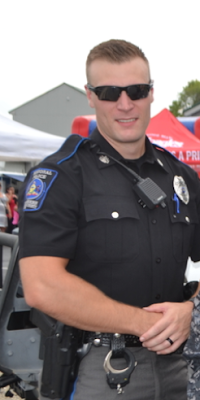
.....they find a gun, Ku Klux Klan robes, Swastika symbols, and a little black book.

The black journal contains the names of Sylva residents - including the Police Chief, politicians, judges, business leaders and other pillars of the community - who (secretly) belong to the Klan.
Ernie takes Cawthorn to the clink to sleep it off, then goes back to Cawthorn's auto to get the little black book, so he can show it to Sheriff Coggins. But the book is gone. Moreover, Officer Tim McMahan, who searched the car with Ernie, claims he never even saw the book.
The turmoil stirred up by Tyra's actions result in demonstrations, with pro-Confederacy demonstrators on one side......

.....and anti-Confederacy protestors on the other side.

In addition, KKK member Cawthorn purposely stirs up extra trouble, which adds to the mayhem.
All this results in an assault as well as a murder. It falls to Sheriff Coggins to look into the assault and to Detective Leah Green to investigate the murder. Green thinks the two crimes may be related, and investigates from that point of view.

Meanwhile, Cawthorn - who has an arrest warrant in Mississippi - tries to get help from a businessman in Sylva, whose name was in the little black book. However the businessman gives Cawthorn short shrift.

The business executive/clandestine Klansman says the tactics of the KKK have changed. Instead of burning crosses and the like, the KKK will achieve its goals by infiltrating politics, entering law enforcement, becoming judges, and so on. Then they'll get their way using legislative maneuvers. (To me, this brought to mind Florida Governor Ron DeSantis.)

The criminal perpetrators in Sylva come to light in the end, and it's a sad commentary all around.
The author does a fine job combining a social treatise with a mystery thriller. This is a very good book, highly recommended.
You can follow my reviews at https://reviewsbybarbsaffer.blogspot.com

July 31, 2023
For years I've been reading friends' reviews of David Joy's works. He's been lauded and praised and built up to mythic proportions, so I was thrilled to be approved by the publisher to have early access to his latest book. Perhaps my expectations were too high, but I felt let down.
There's a very, VERY slow build up. I had trouble staying focused, and the temptation to skim was strong. Things begin to happen at the 40% mark, and suddenly there are two crimes to solve. There's a strong conclusion that I won't soon forget, so I'll give this one four stars.
But I won't be building any David Joy shrines in the basement any time soon.
Thanks to the publisher and NetGalley for the opportunity to read this.
There's a very, VERY slow build up. I had trouble staying focused, and the temptation to skim was strong. Things begin to happen at the 40% mark, and suddenly there are two crimes to solve. There's a strong conclusion that I won't soon forget, so I'll give this one four stars.
But I won't be building any David Joy shrines in the basement any time soon.
Thanks to the publisher and NetGalley for the opportunity to read this.
September 25, 2023
5✚ 🗽🗽🗽🗽🗽
Joy’s newest is a departure from his earlier, darker offerings. As he himself has said, they’re not for everyone (I agree) but I think this one is and his best work so far.
The setting will be familiar to his fans but there the similarity ends. A small town crime novel packing quite the punch and dropping the reader into the thick of it asking difficult questions. I could not put it down and it will not be forgotten. The journey it takes you on will continue after the last page.
As Tony LeBlanc wrote in Southern Review of Books
“The culprit in this whodunit… is us.”
Joy’s newest is a departure from his earlier, darker offerings. As he himself has said, they’re not for everyone (I agree) but I think this one is and his best work so far.
The setting will be familiar to his fans but there the similarity ends. A small town crime novel packing quite the punch and dropping the reader into the thick of it asking difficult questions. I could not put it down and it will not be forgotten. The journey it takes you on will continue after the last page.
As Tony LeBlanc wrote in Southern Review of Books
“The culprit in this whodunit… is us.”

October 9, 2023
4 stars
The Klan, racism, crooked cops, death and destruction - all placed in the rural south. That is Joys current book. Although not my favorite David Joy book, it is a good one. A community still fighting the confederacy, influential people hiding secrets, and people harassed because they look guilty. There are unexpected happenings in a number of places throughout this story, making you wonder, 'where is this going next'?
The Klan, racism, crooked cops, death and destruction - all placed in the rural south. That is Joys current book. Although not my favorite David Joy book, it is a good one. A community still fighting the confederacy, influential people hiding secrets, and people harassed because they look guilty. There are unexpected happenings in a number of places throughout this story, making you wonder, 'where is this going next'?

July 2, 2023
This review can also be found at https://carolesrandomlife.com/
This was fantastic! I finished this book a couple of days ago and can’t seem to get it out of my mind. David Joy is an exceptional storyteller and I feel that this is a perfect example of his work. If you haven’t read David Joy yet, do yourself a favor and move his books to the top of your tbr! He writes beautifully about critical social issues and does it in a way that really makes you feel something.
The characters in this story came alive on the page and the small town setting felt very authentic. This book made me feel uncomfortable at times because of how poignantly the topic of racism is addressed. At the heart of this story is Toya, a young black woman staying with her grandmother while finishing college. Toya is vocal and speaks out against the racism that has always been a part of the area’s history. She is killed after a protest and the hunt is on to find her killer. In a town where law enforcement often looks the other way when the Klan is involved, it may prove difficult to find justice for Toya.
The mystery in this novel was incredibly well done but it is the frank discussions about race that will stick with me for a very long time. The town sheriff doesn’t believe that there are any racial issues in his small town. The sheriff has known Toya’s grandmother, Tess, for a very long time and considered himself to be good friends with her late husband. When he seeks Tess’s opinion on the racial issues in their North Carolina town, he doesn’t expect the response he gets.
I listened to the audiobook and thought that MacLeod Andrews did a phenomenal job with the story. I believe that the voices he used helped to bring the cast of characters to life. He added just the right amount of emotion to his reading. I found his voice to be very pleasant which only added to my overall enjoyment.
I highly recommend this book to others. I don’t feel like I can write a review that will do this book justice. It’s just that good. David Joy is an incredibly talented author that more people really should be reading. If you take any of my recommendations, make it this one and get your hands on one of David Joy’s books just as soon as you can.
I received a digital review copy of this book from G.P Putnam’s Sons and Penguin Random House Audio.
This was fantastic! I finished this book a couple of days ago and can’t seem to get it out of my mind. David Joy is an exceptional storyteller and I feel that this is a perfect example of his work. If you haven’t read David Joy yet, do yourself a favor and move his books to the top of your tbr! He writes beautifully about critical social issues and does it in a way that really makes you feel something.
The characters in this story came alive on the page and the small town setting felt very authentic. This book made me feel uncomfortable at times because of how poignantly the topic of racism is addressed. At the heart of this story is Toya, a young black woman staying with her grandmother while finishing college. Toya is vocal and speaks out against the racism that has always been a part of the area’s history. She is killed after a protest and the hunt is on to find her killer. In a town where law enforcement often looks the other way when the Klan is involved, it may prove difficult to find justice for Toya.
The mystery in this novel was incredibly well done but it is the frank discussions about race that will stick with me for a very long time. The town sheriff doesn’t believe that there are any racial issues in his small town. The sheriff has known Toya’s grandmother, Tess, for a very long time and considered himself to be good friends with her late husband. When he seeks Tess’s opinion on the racial issues in their North Carolina town, he doesn’t expect the response he gets.
I listened to the audiobook and thought that MacLeod Andrews did a phenomenal job with the story. I believe that the voices he used helped to bring the cast of characters to life. He added just the right amount of emotion to his reading. I found his voice to be very pleasant which only added to my overall enjoyment.
I highly recommend this book to others. I don’t feel like I can write a review that will do this book justice. It’s just that good. David Joy is an incredibly talented author that more people really should be reading. If you take any of my recommendations, make it this one and get your hands on one of David Joy’s books just as soon as you can.
I received a digital review copy of this book from G.P Putnam’s Sons and Penguin Random House Audio.
July 29, 2023
Another book set in the American South dealing with deeply-ingrained racism. I've read a couple of books by authors recently who are examining that issue in the light of the pride of heritage versus the shame of slavery. The title of this new novel zeroes in on how little we can know others, what evil may be hidden away, disguised by smiles.
David Joy writes a compelling crime story with realistic characters and thought-provoking discussions of tough issues. I'd like to read more from this author; he has important things to say.
I received an arc of this novel from the author and publisher via NetGalley. Many thanks! My review is voluntary and the opinions expressed are my own.
David Joy writes a compelling crime story with realistic characters and thought-provoking discussions of tough issues. I'd like to read more from this author; he has important things to say.
I received an arc of this novel from the author and publisher via NetGalley. Many thanks! My review is voluntary and the opinions expressed are my own.
December 27, 2023
Rating: 3.25
I found this on the new fiction shelf at the library and after reading the liner notes decided to take a chance. Well paced, David Joy is an accomplished storyteller who sets the stage for yet another racially driven mystery.
The story takes place in Sylva, GA a typical small town in the south. A couple of Jackson County deputies arrive at a local convenience store where a beat up Chevy station wagon sits, its driver, William Dean Cawthorn from MS, passed out in the back. Ernie Allison and Tim McMahan had grown up together and while one was questioning the driver, the other rifled through his belongings and stumbles across a notebook filled with names and a KKK outfit. The deputies didn't like what they found nor Cawthorn's attitude so he was arrested for vagrancy. When the deputies arrived with their prisoner, Sheriff John Coggins looked at the report, checked the evidence but the notebook seemed to have disappeared.
Soon after the first event, deputies show up at Vess Jones' farm on the outskirts of town wanting to speak with her granddaughter, Toya Gardner about the 'stunt' she pulled on campus graveyards. Coggins had known Vess and her husband for decades and wasn't aware Toya had returned home. A black rights activist and respected artist, Toya had opened a wound by digging symbolic graves for murdered slaves who'd been treated like animals. A town that still flew the Confederate flag, yet fully integrated, the town's residents were a mixed bag of rednecks and 'normal folk'.
Toya worked diligently on her art and her friend Brad's studio who understood the black perspective and supported her wholeheartedly. With a protest march staged in the upcoming weeks, her stunt had drawn media attention causing many of the close minded residents to resist. On the day of the protest, Vess does her best to understand Toya's need to protest and has concerns about how others will react. When she's dropped off at the protest site by Sheriff Coggins, the anger in the air is stifling. Hours later Toya's body is found in a ditch on the outskirts of town and an investigation launches immediately.
The deputies are rednecks, while the sheriff straddling both sides of the issue though he's clearly upset by what Toya created. The B plot if you could call it that is centered around a severe beating Ernie was given in the nearby hills at the base of a giant cross. The story toggles back and forth between the deputy beating, Toya's murder and the appearance of Leah Green, a newly appointed Jackson County detective assigned to the investigation.
The author an unexpected curve ball in the final chapters, though the story is predictable as are the characters. Having read numerous racially driven stories by Cosby, Eskens and others, this one is mediocre at best. Its saving grace is how a southern white author has a grip on a black person's perspective. Beyond that, its generic and nothing unusual.
I found this on the new fiction shelf at the library and after reading the liner notes decided to take a chance. Well paced, David Joy is an accomplished storyteller who sets the stage for yet another racially driven mystery.
The story takes place in Sylva, GA a typical small town in the south. A couple of Jackson County deputies arrive at a local convenience store where a beat up Chevy station wagon sits, its driver, William Dean Cawthorn from MS, passed out in the back. Ernie Allison and Tim McMahan had grown up together and while one was questioning the driver, the other rifled through his belongings and stumbles across a notebook filled with names and a KKK outfit. The deputies didn't like what they found nor Cawthorn's attitude so he was arrested for vagrancy. When the deputies arrived with their prisoner, Sheriff John Coggins looked at the report, checked the evidence but the notebook seemed to have disappeared.
Soon after the first event, deputies show up at Vess Jones' farm on the outskirts of town wanting to speak with her granddaughter, Toya Gardner about the 'stunt' she pulled on campus graveyards. Coggins had known Vess and her husband for decades and wasn't aware Toya had returned home. A black rights activist and respected artist, Toya had opened a wound by digging symbolic graves for murdered slaves who'd been treated like animals. A town that still flew the Confederate flag, yet fully integrated, the town's residents were a mixed bag of rednecks and 'normal folk'.
Toya worked diligently on her art and her friend Brad's studio who understood the black perspective and supported her wholeheartedly. With a protest march staged in the upcoming weeks, her stunt had drawn media attention causing many of the close minded residents to resist. On the day of the protest, Vess does her best to understand Toya's need to protest and has concerns about how others will react. When she's dropped off at the protest site by Sheriff Coggins, the anger in the air is stifling. Hours later Toya's body is found in a ditch on the outskirts of town and an investigation launches immediately.
The deputies are rednecks, while the sheriff straddling both sides of the issue though he's clearly upset by what Toya created. The B plot if you could call it that is centered around a severe beating Ernie was given in the nearby hills at the base of a giant cross. The story toggles back and forth between the deputy beating, Toya's murder and the appearance of Leah Green, a newly appointed Jackson County detective assigned to the investigation.
The author an unexpected curve ball in the final chapters, though the story is predictable as are the characters. Having read numerous racially driven stories by Cosby, Eskens and others, this one is mediocre at best. Its saving grace is how a southern white author has a grip on a black person's perspective. Beyond that, its generic and nothing unusual.

September 9, 2023
This will be just a brief review of this topical, stunning novel. Well written and suspenseful, Joy has written a propulsive crime novel with a contemporary theme about how a black artist disrupts a community with her reactive art about a civil war statue.
Those We Thought We Knew was read as a member of Goodreads’ On the Southern Literary Trail, a group that continues to delight me with the quality of their monthly choices. Many thanks owing to them, and you don’t have to be from the South (or even the US) to be a member.
MacLeod Andrews gave a fabulous narration in the audiobook, making it highly listenable — to invent a word. He is an amazing actor and I will meed to find his other narrated audiobooks. This narrator also gets five stars.
Those We Thought We Knew was read as a member of Goodreads’ On the Southern Literary Trail, a group that continues to delight me with the quality of their monthly choices. Many thanks owing to them, and you don’t have to be from the South (or even the US) to be a member.
MacLeod Andrews gave a fabulous narration in the audiobook, making it highly listenable — to invent a word. He is an amazing actor and I will meed to find his other narrated audiobooks. This narrator also gets five stars.
September 19, 2025
I loved it. The storytelling, the rich characterization, the honest telling of the roots of racism and how privilege can keep us blind to its effects even in our own communities. Narration by MacLeod Andrews was sublime.
Standout quotes:
In an old black and white photograph, "Her third great-grandmother had a white knitted shawl draped over her shoulders, a wide brimmed black hat propped high on her head. In the woman's face the girl could see her mother, traits that had carried down and were still traveling."
"The history of all places was a story of displacement."
I love to seek out graffiti or street art wherever I am in the world, so this definition excited me - "Graffiti philosophically is this sort of idea of putting art directly in places where it isn't allowed to exist."
I have a passion for pottery so I was delighted to learn that "Potters usually fell into three groups: there were the 'Mudders' who loved to get their hands dirty [...] then, there were the 'Pyros' who were all about the firing process - soda firing, pit firing, sawdust, Raku." Finally, there were the 'Chemists' who are "obsessed with glazes and learning how different chemicals reacted to heat."
"He sucked that first [beer] down as if he'd just spent forty years walking the desert with Moses."
I chuckled at the conversation between Detective Leah Green and Curtis Darnell, he talks around the houses and then some - "Trying to keep Curtis Darnell in a straight line was like talking to someone from another planet. She just kept waiting for the antennae to come poking up out the top of his head."
I loved this description - "Her typical thick skin had been worn soft as suede."
"How could she know what anyone truly believed if they wouldn't come out and say it? How could she know what anyone was truly capable of? People like Cawthorn were the easy ones but it was the ones we thought we knew, those were the ones that broke our hearts."
Another great description - "The room was small and muggy and the air smelled like mop water."
Referring to a grandmother's mean words due to Alzheimer's - "When her mind went back it was like all the sugar had been licked off the candy."
Losing a child - "There was only time and learning how to manage it because a loss like this was a life sentence."
Note: The author references Andy Goldsworthy, so I looked him up online to discover that he is an English sculptor, photographer, and environmentalist who produces site-specific sculptures and land art situated in natural or urban settings.
Standout quotes:
In an old black and white photograph, "Her third great-grandmother had a white knitted shawl draped over her shoulders, a wide brimmed black hat propped high on her head. In the woman's face the girl could see her mother, traits that had carried down and were still traveling."
"The history of all places was a story of displacement."
I love to seek out graffiti or street art wherever I am in the world, so this definition excited me - "Graffiti philosophically is this sort of idea of putting art directly in places where it isn't allowed to exist."
I have a passion for pottery so I was delighted to learn that "Potters usually fell into three groups: there were the 'Mudders' who loved to get their hands dirty [...] then, there were the 'Pyros' who were all about the firing process - soda firing, pit firing, sawdust, Raku." Finally, there were the 'Chemists' who are "obsessed with glazes and learning how different chemicals reacted to heat."
"He sucked that first [beer] down as if he'd just spent forty years walking the desert with Moses."
I chuckled at the conversation between Detective Leah Green and Curtis Darnell, he talks around the houses and then some - "Trying to keep Curtis Darnell in a straight line was like talking to someone from another planet. She just kept waiting for the antennae to come poking up out the top of his head."
I loved this description - "Her typical thick skin had been worn soft as suede."
"How could she know what anyone truly believed if they wouldn't come out and say it? How could she know what anyone was truly capable of? People like Cawthorn were the easy ones but it was the ones we thought we knew, those were the ones that broke our hearts."
Another great description - "The room was small and muggy and the air smelled like mop water."
Referring to a grandmother's mean words due to Alzheimer's - "When her mind went back it was like all the sugar had been licked off the candy."
Losing a child - "There was only time and learning how to manage it because a loss like this was a life sentence."
Note: The author references Andy Goldsworthy, so I looked him up online to discover that he is an English sculptor, photographer, and environmentalist who produces site-specific sculptures and land art situated in natural or urban settings.

May 13, 2023
After reading David Joy’s new novel Those We Thought We Knew, to describe the contents using terms most often associated when describing dark tales of the rural South would be an inadequate disservice.
The novel is written with lush descriptions of people, life, nature, and of topics of such complexity and nuance, a mere encapsulation of what is contained between the covers is very difficult to do in an adequate manner.
As of yet, Those We Thought We Knew is one of the most challenging books I have reviewed. Not because of the lofty and troubled heady subject matter, but because adequate words for a review even closely worthy of the novel's content have been hard to come by.
Though the novel deals with serious crimes and dark aspects of American history and culture, it is not necessarily a depressing novel. For most, it should create an internal debate within one’s mind, resulting in thought-provoking examinations of what it means to be an American and how our history impacts us all and will continue to do so within the future of this divided nation.
Joy’s novel examines today’s continuously evolving opinions of social and cultural issues regarding race, slavery, heritage, symbols, and the Confederacy, and in a way that illuminates ghosts of our past to be visible to all, while colliding with contemporary culture and society.
The main human characters within the novel include Toya Gardner, her grandmother Vess Jones and Sheriff John Coggins.
Toya Gardner is a young Black female artist of renowned talent with a very promising future and has returned home to stay with her Grandmother in rural North Carolina while completing university coursework.
While back home, Toya orchestrates and participates in acts of civil disobedience that ignite a regional fire that brings national attention to the region. These acts, justified by some and vilified by others, bring racial and historical matters of the past to the forefront of current times and the future.
While many residents in the novel believe it is more than time for this to happen, there are also those that feel otherwise and blame Toya for creating the turmoil in their opinion that did not have to happen.
Vess Jones, Toya’s grandmother, is a longtime friend of Sheriff John Coggins, an older white man on the edge of retirement. Coggins and Vess’s deceased husband, Lonnie, were best friends from childhood and until his death, enjoyed many, many times together.
Coggins, mistakenly believes loving relationships are more than enough to exist in a world of latent divides, but soon is forced to realize that just because certain things are not talked about, even among friends, does not mean they do not exist.
During all of this, two deputies have come across a man thought to be a passing-through transient sleeping in his car. In searching the vehicle, troubling items are discovered in the man’s possession. These items include a white hood, bed sheet, firearm, and a spiral notebook containing names and telephone numbers of powerful and prominent people in the region. This discovery leads to further crimes and turmoil, further exposing ancient divides within the area that has for too long existed and have been hidden for several reasons.
In Those We Thought We Knew, Joy again brings forth ideas, concepts, and beliefs that upon first reading are camouflaged and are more powerfully revealed with one’s deeper thinking and study. To some, such things are readily apparent, but to others, ignorance may just bring forth a sense of unwarranted bliss.
Those We Thought We Knew is highly recommended to those readers that do enjoy dark tales of the South, but also to readers that enjoy being pushed into thinking about difficult topics captured in a book where beauty and nuance are further realized the more one thinks about them.
Netgalley provided a copy of Those We Thought We Knew in return for a fair review and it is set to be published in August of 2023.
The novel is written with lush descriptions of people, life, nature, and of topics of such complexity and nuance, a mere encapsulation of what is contained between the covers is very difficult to do in an adequate manner.
As of yet, Those We Thought We Knew is one of the most challenging books I have reviewed. Not because of the lofty and troubled heady subject matter, but because adequate words for a review even closely worthy of the novel's content have been hard to come by.
Though the novel deals with serious crimes and dark aspects of American history and culture, it is not necessarily a depressing novel. For most, it should create an internal debate within one’s mind, resulting in thought-provoking examinations of what it means to be an American and how our history impacts us all and will continue to do so within the future of this divided nation.
Joy’s novel examines today’s continuously evolving opinions of social and cultural issues regarding race, slavery, heritage, symbols, and the Confederacy, and in a way that illuminates ghosts of our past to be visible to all, while colliding with contemporary culture and society.
The main human characters within the novel include Toya Gardner, her grandmother Vess Jones and Sheriff John Coggins.
Toya Gardner is a young Black female artist of renowned talent with a very promising future and has returned home to stay with her Grandmother in rural North Carolina while completing university coursework.
While back home, Toya orchestrates and participates in acts of civil disobedience that ignite a regional fire that brings national attention to the region. These acts, justified by some and vilified by others, bring racial and historical matters of the past to the forefront of current times and the future.
While many residents in the novel believe it is more than time for this to happen, there are also those that feel otherwise and blame Toya for creating the turmoil in their opinion that did not have to happen.
Vess Jones, Toya’s grandmother, is a longtime friend of Sheriff John Coggins, an older white man on the edge of retirement. Coggins and Vess’s deceased husband, Lonnie, were best friends from childhood and until his death, enjoyed many, many times together.
Coggins, mistakenly believes loving relationships are more than enough to exist in a world of latent divides, but soon is forced to realize that just because certain things are not talked about, even among friends, does not mean they do not exist.
During all of this, two deputies have come across a man thought to be a passing-through transient sleeping in his car. In searching the vehicle, troubling items are discovered in the man’s possession. These items include a white hood, bed sheet, firearm, and a spiral notebook containing names and telephone numbers of powerful and prominent people in the region. This discovery leads to further crimes and turmoil, further exposing ancient divides within the area that has for too long existed and have been hidden for several reasons.
In Those We Thought We Knew, Joy again brings forth ideas, concepts, and beliefs that upon first reading are camouflaged and are more powerfully revealed with one’s deeper thinking and study. To some, such things are readily apparent, but to others, ignorance may just bring forth a sense of unwarranted bliss.
Those We Thought We Knew is highly recommended to those readers that do enjoy dark tales of the South, but also to readers that enjoy being pushed into thinking about difficult topics captured in a book where beauty and nuance are further realized the more one thinks about them.
Netgalley provided a copy of Those We Thought We Knew in return for a fair review and it is set to be published in August of 2023.

August 5, 2026
I'm sure I'm the outlier on this one. I love gritty reads. I've read another by Joy and really enjoyed it. Something about this one just had me going back and forth between love and eh, is it over. The title is perfect for this read. Audio was pretty good. Perhaps it's suffering from me reading some amazing books recently and the one you read next just doesn't compare. I'm not done with Joy, will certainly be reading more of his works.

March 3, 2025
4.5, rounded up
It can be difficult to strike a balance between a good story plot and a "message", but this one seems to walk that tightrope with confidence, never letting you get so lost in the who-done-it that you miss the darkness trying to hide in the corners.
This small town experiences new trauma, causing all kinds of ugly to ooze from the depths out into the open. It pits the idealistic against the traditionalists, the young against the old, the bigoted against the hopeful, the truth against pretense. In that way, it mirrors much of what plays out across divided cultures. I especially appreciated the moments in the story that represented well the power divide that leaves so many ripples through relationships and experiences, resulting in differences in perception that might never be fully understood.
Vivid characters (they might be a bit stereotypical, but it's done with effect) and a terrific narration on the audio version.
It can be difficult to strike a balance between a good story plot and a "message", but this one seems to walk that tightrope with confidence, never letting you get so lost in the who-done-it that you miss the darkness trying to hide in the corners.
This small town experiences new trauma, causing all kinds of ugly to ooze from the depths out into the open. It pits the idealistic against the traditionalists, the young against the old, the bigoted against the hopeful, the truth against pretense. In that way, it mirrors much of what plays out across divided cultures. I especially appreciated the moments in the story that represented well the power divide that leaves so many ripples through relationships and experiences, resulting in differences in perception that might never be fully understood.
Vivid characters (they might be a bit stereotypical, but it's done with effect) and a terrific narration on the audio version.

October 13, 2023
5 +++ Stars
March 6, 2023
This was a fantastic read! It’s a unique blend of mystery and searing social commentary which I LOVED.
I loved Toya’s larger than life character who uses both her artistic talents and her intellect to get the white folks around her to question what they thought they knew about racism.
The truth of this passage in particular stuck with me:
“The tree with the deepest roots in this country is a tree of White supremacy. And the thing is, you don’t have to be the one who planted that tree or even the one who kept it watered or trimmed the branches to be someone who directly benefits from the shade it provides. There’s a whole lot of people sitting comfortably under that tree, and some of them recognize where they’re sitting and just won’t do anything about it because they like where they’re sitting, and then there are some of them who won’t even acknowledge that the tree’s there at all. Maybe they don’t acknowledge it because they can’t see it, or maybe they just don’t want to see it, but in the end none of that matters because they’re all benefiting from the same thing.”
The book is not *just* about racism.
It’s wonderfully constructed fiction that leads you through a fascinating storyline about murder…while also forcing you to reckon with real world events that you deal with outside the context of the book.
I thought it was a masterful juxtaposition and a really wonderful book. Thank you to #netgalley for this ARC of #thosewethoughtweknew
I loved Toya’s larger than life character who uses both her artistic talents and her intellect to get the white folks around her to question what they thought they knew about racism.
The truth of this passage in particular stuck with me:
“The tree with the deepest roots in this country is a tree of White supremacy. And the thing is, you don’t have to be the one who planted that tree or even the one who kept it watered or trimmed the branches to be someone who directly benefits from the shade it provides. There’s a whole lot of people sitting comfortably under that tree, and some of them recognize where they’re sitting and just won’t do anything about it because they like where they’re sitting, and then there are some of them who won’t even acknowledge that the tree’s there at all. Maybe they don’t acknowledge it because they can’t see it, or maybe they just don’t want to see it, but in the end none of that matters because they’re all benefiting from the same thing.”
The book is not *just* about racism.
It’s wonderfully constructed fiction that leads you through a fascinating storyline about murder…while also forcing you to reckon with real world events that you deal with outside the context of the book.
I thought it was a masterful juxtaposition and a really wonderful book. Thank you to #netgalley for this ARC of #thosewethoughtweknew
August 12, 2023
Well this one ended up being very different than what I was expecting. I thought the premise sounded so good. Don't get me wrong , it was a good story… it was descriptive and atmospheric, but I really struggled with the pacing. It was quite slow, and predictable.
Toya Gardner is a young Black artist from Atlanta who returns to her ancestral home in North Carolina to trace her family history. While there, she sees a Confederate monument and then vows to do something about it. Meanwhile , deputies find a man sleeping in his station wagon and upon further search of his vehicle find out that he is a high ranking member of the Klan. He also has a notebook with locals names in it which could threaten the community.
I think that Joy has gift for writing but this one just wasn't my favorite. I feel like this was maybe too cliche, like a story that has been told many times over.
Thank you to the publisher and netgalley for the gifted copy. All opinions are my own.
Toya Gardner is a young Black artist from Atlanta who returns to her ancestral home in North Carolina to trace her family history. While there, she sees a Confederate monument and then vows to do something about it. Meanwhile , deputies find a man sleeping in his station wagon and upon further search of his vehicle find out that he is a high ranking member of the Klan. He also has a notebook with locals names in it which could threaten the community.
I think that Joy has gift for writing but this one just wasn't my favorite. I feel like this was maybe too cliche, like a story that has been told many times over.
Thank you to the publisher and netgalley for the gifted copy. All opinions are my own.
February 24, 2024
Really liked this book. A psychological crime case involving race, love, friends, power and control.

October 25, 2023
Fantastic writing. First book of his I've read and it's powerful, thought provoking and unputdownable. Great story.
I'm reminded of Walt Kelly's quote, "We have met the enemy. And he is us."
I'm reminded of Walt Kelly's quote, "We have met the enemy. And he is us."

July 28, 2023
Master southern storyteller David Joy (fav author) returns following When These Mountains Burn (2020) with his fifth novel and masterpiece, THOSE WE THOUGHT WE KNEW —lyrical and powerful, a gripping murder mystery unraveling of the dark underbelly and racist history of a North Carolina rural town.
In the summer of 2019, Toya Gardner, a young 24-year-old Black talented female artist, returns to rural North Carolina (Jackson County) to visit with her grandmother, Vess Jones, while completing her college work.
In Atlanta, where Toya lives, she actively participates in organizations to bring attention to racial injustice, among other causes. Some believe this is creating disturbance and turmoil.
Vess Jones is a longtime friend of Sheriff John Coggins, an older white man that was best friends with Vess' deceased husband. Coggins is near retirement.
In the meantime, two deputies discover a man sleeping in his car. (William Dean Cawthorn, Klansman). While searching the vehicle, they come across disturbing items, including a white bedsheet (hood) firearm, and a notebook containing names and numbers of influential people from the region.
Toya does not like some things happening in the area. Cawthorn and some white supremacists cause a riot (due to the Confederate statute) where anti-racists are protesting, including Toya. Toya winds up dead later on.
Also, Coggins' deputy is badly beaten by the Klan. Detective Leah Green is working on the case. There are two horrific crimes. Some consider themselves non-racists, but are they?
Words cannot adequately convey in a simple review the importance of this book and its impact. David is a gifted storyteller, taking readers back in history to different generations from both sides of the fence. Joy's writing is lush, vivid, raw, and atmospheric; as always, I highlighted multiple passages and enjoyed Toya's tenacious character and love of art.
THOSE WE THOUGHT WE KNEW is thought-provoking and compelling, with essential takeaways and a mix of riveting crime fiction. Joy masterfully explores generational racism and hatred as well as love and forgiveness.
The author confronts the racism embedded in the culture of the rural South. He forces his White characters to face the misplaced values they learned as children and to remember new episodes they have chosen to forget or ignore.
Check out this fascinating Q&A with David: Southern Storyteller Series feature: Salvation South: Make You Look: "The Award-Winning North Carolina writer David Joy's new novel forces white characters into difficult conversations about race—and white readers to look harder at themselves."
As an NC native, it is disturbing our Southern dark history and the many injustices of slavery and beyond. Books like this are essential to capture these timely issues and how they affect others and future generations. Joy fans will devour —for fans of authors Ron Rash and Dennis Lehane and those who enjoy Southern dark mysteries. Highly recommend!
Thanks to #partner PENGUIN GROUP, G.P. Putnam's Sons, for a gifted ARC via NetGalley for my honest opinion. I also pre-ordered the audiobook narrated by a favorite, MacLeod Andrews.
Blog Review posted @
JudithDCollins.com
@JudithDCollins | #JDCMustReadBooks
Pub Date: Aug 1, 2023
My Rating: 5 Stars
Aug 2023 Must-Read Books
In the summer of 2019, Toya Gardner, a young 24-year-old Black talented female artist, returns to rural North Carolina (Jackson County) to visit with her grandmother, Vess Jones, while completing her college work.
In Atlanta, where Toya lives, she actively participates in organizations to bring attention to racial injustice, among other causes. Some believe this is creating disturbance and turmoil.
Vess Jones is a longtime friend of Sheriff John Coggins, an older white man that was best friends with Vess' deceased husband. Coggins is near retirement.
In the meantime, two deputies discover a man sleeping in his car. (William Dean Cawthorn, Klansman). While searching the vehicle, they come across disturbing items, including a white bedsheet (hood) firearm, and a notebook containing names and numbers of influential people from the region.
Toya does not like some things happening in the area. Cawthorn and some white supremacists cause a riot (due to the Confederate statute) where anti-racists are protesting, including Toya. Toya winds up dead later on.
Also, Coggins' deputy is badly beaten by the Klan. Detective Leah Green is working on the case. There are two horrific crimes. Some consider themselves non-racists, but are they?
Words cannot adequately convey in a simple review the importance of this book and its impact. David is a gifted storyteller, taking readers back in history to different generations from both sides of the fence. Joy's writing is lush, vivid, raw, and atmospheric; as always, I highlighted multiple passages and enjoyed Toya's tenacious character and love of art.
THOSE WE THOUGHT WE KNEW is thought-provoking and compelling, with essential takeaways and a mix of riveting crime fiction. Joy masterfully explores generational racism and hatred as well as love and forgiveness.
The author confronts the racism embedded in the culture of the rural South. He forces his White characters to face the misplaced values they learned as children and to remember new episodes they have chosen to forget or ignore.
Check out this fascinating Q&A with David: Southern Storyteller Series feature: Salvation South: Make You Look: "The Award-Winning North Carolina writer David Joy's new novel forces white characters into difficult conversations about race—and white readers to look harder at themselves."
As an NC native, it is disturbing our Southern dark history and the many injustices of slavery and beyond. Books like this are essential to capture these timely issues and how they affect others and future generations. Joy fans will devour —for fans of authors Ron Rash and Dennis Lehane and those who enjoy Southern dark mysteries. Highly recommend!
Thanks to #partner PENGUIN GROUP, G.P. Putnam's Sons, for a gifted ARC via NetGalley for my honest opinion. I also pre-ordered the audiobook narrated by a favorite, MacLeod Andrews.
Blog Review posted @
JudithDCollins.com
@JudithDCollins | #JDCMustReadBooks
Pub Date: Aug 1, 2023
My Rating: 5 Stars
Aug 2023 Must-Read Books

August 30, 2023
Gut wrenching and his best yet.

August 7, 2023
David Joy doesn’t disappoint. Those We Thought We Knew is a bit different than his other books - but no less powerful. I found myself loving and hating and hoping for each of these characters. I was disappointed, and profoundly sad, and I was everything this book is trying to make the reader feel.

September 25, 2023
This is the third book I've read by David Joy and, by far, my favorite. Where his previous works focused on ordinary Joes who struggled with, or had family members who struggled with, drug addiction, Joy made a big switch her and decided to target racism and The Lost Cause the "pseudohistorical negationist myth that claims the cause of the Confederate States during the American Civil War was just, heroic, and not centered on slavery".
As he has always done, Joy takes pains to add dimension to his characters and make them much more interesting that one would expect from, say, an aging long-term white southern small-town sheriff. John Coggins deeply mourns the death of his best friend and hunting buddy, the grandfather of Toya Gardner, the young Black artist from Atlanta who has returned home North Carolina mountains and begun stirring up trouble by using her art to dredge up unpleasant truths from the past, truths whose dormancy have allowed Jackson County to remain the largely peaceful backwater county that Sheriff Coggins has enjoyed for so many years.
Joy uses Toya to pose questions about the nature and meaning of art. While this may sound boring, it becomes less so when one asks which is a better example of art, a bronze statue of a confederate soldier, or that same statue painted to show it with bloodstained hands. (I, for one, support Bertolt Brecht's assertion that "Art is not a mirror held up to reality but a hammer with which to shape it.") Needless to say, things in Jackson County start to heat up quickly.
I highly recommend this book.
My thanks to the late Mike Sullivan, aka Lawyer, and all the folks at the On the Southern Literary Trail group for giving me the opportunity to read and discuss this and many other fine books.
As he has always done, Joy takes pains to add dimension to his characters and make them much more interesting that one would expect from, say, an aging long-term white southern small-town sheriff. John Coggins deeply mourns the death of his best friend and hunting buddy, the grandfather of Toya Gardner, the young Black artist from Atlanta who has returned home North Carolina mountains and begun stirring up trouble by using her art to dredge up unpleasant truths from the past, truths whose dormancy have allowed Jackson County to remain the largely peaceful backwater county that Sheriff Coggins has enjoyed for so many years.
Joy uses Toya to pose questions about the nature and meaning of art. While this may sound boring, it becomes less so when one asks which is a better example of art, a bronze statue of a confederate soldier, or that same statue painted to show it with bloodstained hands. (I, for one, support Bertolt Brecht's assertion that "Art is not a mirror held up to reality but a hammer with which to shape it.") Needless to say, things in Jackson County start to heat up quickly.
I highly recommend this book.
My thanks to the late Mike Sullivan, aka Lawyer, and all the folks at the On the Southern Literary Trail group for giving me the opportunity to read and discuss this and many other fine books.
August 6, 2023
Please read the wonderful reviews written by Kelly(and the Book Boar) and Shelby*trains flying monkeys*
PS Mr Joy, "please don't ever stop writing." (Swiped directly from Shelby's review)

August 9, 2023
Those We Thought We Knew is a rather slow book, although the beginning’s build is critical. We need to get to know these characters. We need to know what they’re all about. Joy created tension by simply allowing his characters to do their thing, as we can clearly recognize the unfair danger that certain individuals are bound to face because of their actions.
The book shines with its important, thought provoking observations. Joy did not simply cover overt racism, but that which is hidden in our everyday expressions and, in some cases, acts of so called patriotism. It is a commendable tackling of distressing, controversial, and realistic subject matter and it stirs emotion as it digs into loss.
I really wish I had liked it more.
Unfortunately, despite all of the wonderful things it addressed, I found the book rather dull. I had to continuously go back to reread whole paragraphs because my mind kept wandering. The narrative failed to fully engage me.
There was also an air of familiarity about it. I’m not saying that this exact story has already been told, but it followed a formula that lacked originality, right down to the big reveal of the lone culprit for the murder case.
Obviously, I don’t think this will be everyone’s experience with it, but the writing style and the delivery failed to truly captivate me. I do believe it will foster important discussions and that matters more than my perspective on the way the story was told.
I am immensely grateful to G.P. Putnam’s Sons and NetGalley for my copy. All opinions are my own.
The book shines with its important, thought provoking observations. Joy did not simply cover overt racism, but that which is hidden in our everyday expressions and, in some cases, acts of so called patriotism. It is a commendable tackling of distressing, controversial, and realistic subject matter and it stirs emotion as it digs into loss.
I really wish I had liked it more.
Unfortunately, despite all of the wonderful things it addressed, I found the book rather dull. I had to continuously go back to reread whole paragraphs because my mind kept wandering. The narrative failed to fully engage me.
There was also an air of familiarity about it. I’m not saying that this exact story has already been told, but it followed a formula that lacked originality, right down to the big reveal of the lone culprit for the murder case.
Obviously, I don’t think this will be everyone’s experience with it, but the writing style and the delivery failed to truly captivate me. I do believe it will foster important discussions and that matters more than my perspective on the way the story was told.
I am immensely grateful to G.P. Putnam’s Sons and NetGalley for my copy. All opinions are my own.
Displaying 1 - 30 of 724 reviews