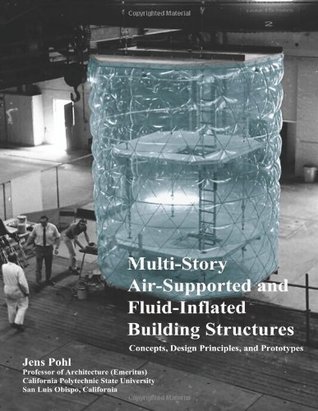
This book is about a very different kind of architecture than the buildings we see around us at the beginning of the 21st Century. It explores the use of air and liquid pressure as the principal structural element of multi-story buildings. Several variants of such building structures are examined in detail. In multi-story air-supported buildings the internal building environment is maintained at a pressure that normally does not exceed twice atmospheric pressure, so that the physiological impact of a hyperbaric environment are minimized. The entire building acts as a column with a circular cross-section and a lightweight flexible membrane wall that is surrounded by a network of diagonal and horizontal cables. Floors are suspended from the roof, which is directly supported by the ambient internal air pressure. The structural design, fire protection, water and sanitary services implications, airlock entrance and exit facilities, thermal characteristics, construction sequence, comparison with orthodox building costs, and general safety considerations are discussed. A prototype multi-story air-supported building constructed as a student project by the author at the University of New South Wales in Sydney, Australia is described in detail. A less revolutionary structural alternative consists of one or more columns that are internally pressurized with water, air, or a granular material. Typically composed of a thin metal wall such thin-walled cylindrical shell structures (i.e., monocoque cylinders) have received a great deal of attention from mechanical and aeronautical engineers due to their wide-spread application in aircraft, missiles, and rockets for space travel. The application of such pressurized columns in multi-story building structures is examined both from the point of view of providing vertical support for suspended floor systems, as well as serving as the horizontal compression counterpart of suspension cables in lightweight floor systems. A prototype building supported by an internally pressurized central column that acts not only as the vertical support element but also as a store for solar heat collected at roof level is described. The book also includes a comprehensive historical review, structural design analysis, behavior under wind loads, examination of thermal characteristics, and material requirements of single-story air-buildings in two appendices. Such buildings have been in common use for mostly large-span applications since the 1940s. Those sections are included for the sake of completeness, since these more common air-buildings are part of the field of fluid-supported structures.