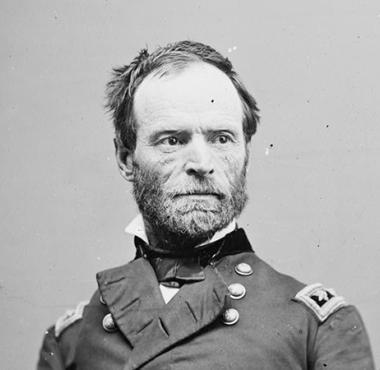
Some men panic in the face of war, others embrace its horrific challenges. But none embraced war as ferociously or with as much cold calculation as William Tecumseh Sherman. It was Sherman who both articulated and practiced the relentless scorched-earth policy that broke the heart of the Confederacy. Sherman succeeded in large measure because, better than any other Union general, he fully grasped the essence of psychological warfare and could enact his own deep-rooted rage with ruthless clarity.
This biography is much broader than an analysis of Sherman's wartime genius, however. Michael Fellman seeks to illuminate the emotional as well as the intellectual, ideological, and occupational lives of this extraordinary, but at the same time representative, Victorian American.
Save maybe Lee and Grant, no other Civil War general has been the subject of so many biographies. Of course Sherman was important, but his life was varied and full, warranting the attention. He was a lawyer, banker, college president, railroad engineer, and of course a famous soldier. He wrote a lot, is infinitely quotable, and a complex and volatile figure who battled mental illness. Love him or hate him, there is never a dull moment.
Fellman's work is a bit unusual in the genre. He does not recount military campaigns in detail, but rather Sherman's personal struggles and reactions. The longest section of the book deals with Sherman after 1865, a rather unusual approach for most Civil War biographies. Sherman's relationship to his family and Grant is treated in detail with nuance. If I can complain in this regard, there was not enough about John Sherman, George Thomas, and some other figures for whom Sherman had a tangled relationship. Also the name does not make sense, unless Fellman was going for the whole Rosebud angle (which he does in one part of the book briefly).
Fellman's work is also controversial, for he never spared a moment to discuss Sherman's anti-democratic instincts and prejudices (he to varying degrees in his life disliked or hated Catholics, Jews, blacks, white Southerners, Mexicans, Indians, Egyptians, immigrants from eastern and southern Europe, and for good measure the French and Germans too). The book was also the first I believe to discuss in detail Sherman's affairs. For many it was considered too much, but I do not think the work is a true hatchet job. Fellman finds Sherman compelling and sympathetic, he just did not shy away from the aspects of his personality that were controversial, then and now. Such fairness makes for a great biography, but in a subject where mortals are made into heroes or fools, being fair can draw fire from both sides.
Seventy-eight pages into this, I gave up. One of the below reviewers is spot-on: "pyschobabble." Sherman was a loquacious writer and author Fellman makes use of his letters, and little else, to examine the man's, well, psyche. If that is what interests you, and little else, here is heaven. Any number of other biographies (Lewis' and Marszalek's, for example) will give you more of the man and his deeds or misdeeds, and Marszalek revealed enough of Sherman's feelings (shoot, even Lloyd Lewis did) to satisfy many readers.
Tecumseh Sherman. His "adoptive" parents had him baptized in the Catholic faith. They thought the name Tecumseh some what inappropriate for a civilized young boy.It happened to be Saint William Day on his baptism, so the priest chose to name him William. Sherman's father had died and left a widow and children behind. His mother parceled them out to different friends who agreed to take them. (Sherman's father had named his third son in honor of Tecumseh, a great warrior Indian chief in the war of 1812. He was admired as well as feared by the whites in the Great Lakes region.) Ironic since later after the civil war General Sherman led the fight against the Native Americans in the West and considered them "savage, less then human". He would not have minded a war of "extermination", but knew those peoples in the east "the do-gooders" would not like that.
I certainly had read about Sherman and the march through the South during the Civil War. In his memoirs written in 1875 Sherman said "My aim then was to whip the rebels, to humble their pride, to follow them to their inmost recesses, and make them fear and dread us." His march to the sea during that summer of 1864 ravaged Georgia and the Carolinas. North Carolina was spared some of the harsher decimation that had been wrought on South Carolina. He reserved the worst "ravaging" for South Carolina. The author states in the preface: "For rage, ruthlessness, cold psychological calculation, and clarity of expression, no American military figure has equaled Sherman's statement." "This was a warrior, and his enemies knew it. This was not merely powerful rhetoric, but deeply felt and intentionally expressed anger."
Sherman started his march to the sea with no communication by wire or rail. He set his 65,000 men over a "sixty mile-wide- front and swept southward, his troops stealing and burning as much as they could. Intent on inflicting the greatest possible destruction on the Confederate countryside," "they became an "antilaw" unto themselves".
"He had calibrated the effects of his policy depending on where he was marching, limiting arson and pillage in Georgia, increasing them dramatically in South Carolina, pulling them back in North Carolina. This last phase of "terror" through the south "demonstrated that his had been an intentional policy and not just a lack of control. It also indicated that should the South not quit, he could do even more than he already had. His specially attuned sensibility , his ability to deflect his real sensitivity and to orchestrate his equally authentic rage, gave him great insight into a war of mass terror, a war that proved effective. Inside the hearts of Southerners, he was, as he remains in folk memory the most feared and hated conqueror of the American Civil War".
Millions of dollars worth of damage to railroads, buildings destroyed in the South. Sherman took the war to the civilian population. "Sherman's men had minimized their own losses while maximizing those of their enemy. That was a standard rule of war, except for the point that these enemy losses were nearly all suffered by civilians rather than by Confederate soldiers. Sherman was gratified by this outcome. He did not disguise that he had shifted his military intentions toward civilians after beginning the march to the sea, but, rather, advertised it. "
Many letters of Union soldiers during the march to the sea confirm the pillage and killing of civilians. Sgt. Rufus Mead of Connecticut wrote home, " We had a glorious tramp right through the heart of the state, rioted
and feasted on the contry, destroyed all the RR. In short found a rich and overflowing contry filled with cattle hogs sheep & fowls, corn sweet potatoes & syrup, but left a barren waste for miles on either side of the road, burn millions of dollars worth of property, wasted & destroyed all the eatables we couldn't carry off and brought the war to the doors of central Georgians so effectually I guess they will long remember the Yankees raid. I enjoyed it all the time."
There were also letters written by Union soldiers that did not agree and felt the savaging of the states of Georgia and especially South Carolina "morally wrong, civilians left starving'.
This book did a wonderful job of allowing the reader to get to know Sherman through his letters which were many during his life. He had a very bitter, unhappy marriage. He was a pure racist who felt the "Negroes" were not worthy to vote and certainly not serve in the Union army. He defied the order of President Abraham Lincoln to use black men as soldiers in his army. His army would not soldier beside the "beast". In later years right before his death, Sherman softened his racist thinking.
I highly recommend this book. The author did a great job of describing the times that Sherman lived in. Got more than just the military side of Sherman. Great overview of the political and social mores of the 1800's.
This was an effort to get through. The book is divided into three chronological sections: Humiliation, Transformation, and Fame, which correspond to the pre-war, wartime, and post-war periods of Sherman’s life.
Within each of the three sections, Fellman frequently skips about in time, relating events out of chronological sequence resulting in an often confusing or misleading narrative. I suppose from the title I should have expected some playing about with the time sequence, but, unlike Welles’ fictional Kane, we don’t get to see Sherman in a series of reminiscences by his various acquaintances. I can’t say why the author decided to break apart various events in the way he did except in the final section, where each chapter is a discussion of some aspect of Sherman’s post-war life, including his marriage and extra-marital relationships, his relationship with his oldest surviving son, and his journalistic feuds with other generals about aspects of the war and his command.
Here are three examples of places where I found this relating of events out of sequence particularly annoying: • We learn about much of Sherman’s 1864 campaign of destruction through the Confederate heartland, up to his capture of Savannah at year’s end, which he termed Lincoln’s “Christmas present”; only after this does Fellman tell of the emotionally devastating death of Sherman’s young son Willy in October of 1863. • After the war, Sherman made a trip to Europe in 1872; only several chapters after this is described is it revealed that Sherman made the trip without his wife and family. • Also from the 1870s, Fellman describes a Congressional committee which considered the establishment of a peacetime standing army; pages later we learn that the reason for this unusual move in what was then a largely anti-militaristic nation was the first nationwide railroad strike and the consideration that an existing force of Federal troops might be used in putting down subsequent labor actions.
A chronological presentation of a life like Sherman’s seems particularly important to me as the General underwent some significant shift in behavior and opinion in a sometimes short period. He started the war, like McClellan, determined to win Southern hearts and minds by considerate treatment of civilians and respect for private property and the institution of slavery. Within two years, however, his name was a byword for indiscriminate destruction of property, civilian and military, and he was leaving a wide and visible path of devastation across the South. Immediately after the war, Sherman’s political opinions were largely in agreement with those of the men he had just defeated, taking a white supremacist stance in being firmly against Negro suffrage; but by the end of his life he was advocating Federal intervention and, if necessary, military force, to protect the franchise of African-Americans in the South.
I also found Fellman’s style often rough and inelegant. Though he frequently presents Sherman’s opinions and experiences in his subject’s own words, his use of those words is rather clumsy, using short passages of direct quotation interspersed with equally brief paraphrases.
On the positive side, I did learn a large number of things about Sherman that I never knew before and came away with a much better idea of the man and his life story than I previously possessed. I also appreciated that Fellman devoted a good deal of space to Sherman’s post-war life. Writers of military lives tend to concentrate on how the man contributed to making the war, but what the war made of the man is also historically relevant, if less obviously so, and interesting in itself as a human story.
Writing these reviews, I often have to be careful to review the book, not the subject.
I found the book well organized and well written. The author gives us enough context to make sense of Sherman's words and deeds. I don't know enough about Sherman to say whether this book is even-handed or not. It's certainly not a hagiography. It passes my minimal test that it is a scholarly work - it has source notes, a bibliography, an index, and a number of photos.
It does not go into the Civil War battles in any detail - this is a biography, not a history of that war.
As to the subject, I'm tempted to sum him up with the words, "Christ, what an asshole." I always make the effort (though not always successfully) to judge historical figures based on the times they lived in. If the entire society one lived in had certain ideas we find repulsive today, I don't think it's fair to overly criticize them for holding those ideas. Rather, I try to compare them to their peers. Were they relatively enlightened?
Sherman, I think, after reading this book, was definitely not enlightened. He didn't like democracy and thought a military dictatorship would be an improvement. He was racist compared even to slave-holding Confederates. I know that we react today in very different ways to many phrases than we would have before those phrases acquired their charged natures, but reading about Sherman's ideas on the "final solution to the Indian problem" was off-putting.
I was hesitant to read this book due to its very average rating and most recent reviews. However as I owned this in hardback I decided to forge ahead. This book is very well researched and written. It is very readable and I would have given it a 4 1/2 stars but that's not how the system works. Most biographies are about the events of the subject. In this case this is about the person and the events he caused. If you are a student of the Civil War then this is a must read. If you enjoy a good book on the personality of the subject you will also enjoy this book. If you are looking for a book on military strategy and armies then you will be disappointed. The title is actually very telling "Citizen Sherman." And that's what you get.
This is not a page turner. It is a character study with many conclusions drawn that may or may not be accurate. Nevertheless I certainly learned a lot about Sherman that I did not know before. Fellman presents a thorough overview of what he learned from Sherman's voluminous correspondence. It shows a troubled man who fought many insecurities since childhood and became a resoundingly victorius general and a beloved figure in our country. I was disappointed there was not more information presented on his civil war tactics and battles but I certainly know more about what drove him to be Grant's trusted conqueror of the south.
This biography is really more of a psychological study of Sherman than a typical biography. The author presents a very insightful, nuanced portrait of Sherman but at times it can get repetitive and be a hard slog.
Sherman's father died when he was young and Sherman was sent to live with Thomas Ewing, a prominant legal figure in Ohio. Ewing was distant and Sherman felt torn between his need to establish himself as his own person and his need for approval from Ewing and others. Fear of failure and abandonment were real issues for Sherman.
Sherman married Ellen Ewing, his step-sister. Ellen was a devout Roman Catholic and very devoted to her father. She and Sherman spent much of their married life apart. They also battled constantly over Ellen's wanting Sherman to become a Roman Catholic. They did love each other but they also battled constantly, in person or by letter. After awhile you just want to say "I get it. They had a bad marriage. Move on already." One of Sherman's sons, Thomas, abandoned being a lawyer like Sherman wanted to become a Roman Catholic priest. That really set Sherman off.
Sherman suffered from depression. He might even have been bipolar because he did exhibit some manic behaviors.
Sherman was a racist. He was insubordinate during the Civil War when he defied orders to recruit soldiers from the escaped slaves who flocked to his army during his March to the Sea. Lincoln and Stanton turned a blind eye to this because of Sherman's successes.
There is a chapter about Sherman and the press. He despised them but he courted publicity when it suited his purposes. He also craved fame & attention. Another chapter dealt with Sherman's feuds with Stanton, Halleck and other generals on both sides, before and after the war. Especially after the Civil War when many old soldiers re-fought their battles in their memoirs, speeches and magazine articles to save or rebuild their reputations--often at the expense of others.
There's another chapter about Sherman having several affairs after the Civil War. He and Ellen separated for a time. Sherman was pretty well known as being a womanizer.
At the end of the book the author talks about Sherman being able to reconcile some of his feuds. Other feuds were never settled. Late in life, Sherman did an about fact about giving former slaves voting rights. This was in response to his growing alarm about former Confederates in the South regaining control of the Democratic Party and becoming a political threat to all that Sherman achieved during the Civil War. But Sherman was still a bigot when it came to Native Americans, Jews, Mexicans and other European immigrants.
Sherman was nothing if not candid. He didn't hold back, which often makes him very interesting. But he had plenty of faults.
I came away from reading this book with a much better understanding of Sherman, but I can't say that I admire him.
Sherman is a really maddening person. First read of him when I was a preteen when he was the villain in Gone with the Wind. Recently read "The March" by Doctorow in which he is less of one. (I'm now a 60 year old). Quite apart from the psychohistory, I could hardly read the book because he made me so angry. I realize I am judging him from an anachronistic standpoint, but some of his contemporaries could fight against Mexicans and Native Americans without regarding them as subhumans. And although he fought on the northern side, he thought black people were subhuman as well, and didn't want them to serve as union soldiers. One can understand why his son Tom refused his plans for him, though he ambivalently idolized his old Dad. It all seems to go back to his stepfather not accepting him as a son, blah, blah, blah.
Everyone knows Sherman took Atlanta and marched to the sea. I found this book interesting because I hadn't known much of what his life was like before and after, and in that sense the book was successful. to my mind, however, the writing was overdone, as was the psychological analysis. I'm not arguing whether the author is right or wrong, just that I find it offputting.
Interesting because it's less about Sherman's military campaigns (which have already been covered ad nauseam) but about his personality, racism, politics, his marital and filial relationships, and his postwar career as head of the Army.