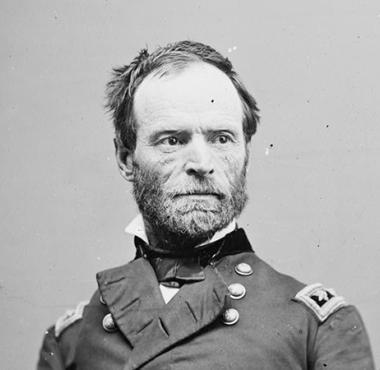
Tecumseh Sherman. His "adoptive" parents had him baptized in the Catholic faith. They thought the name Tecumseh some what inappropriate for a civilized young boy.It happened to be Saint William Day on his baptism, so the priest chose to name him William. Sherman's father had died and left a widow and children behind. His mother parceled them out to different friends who agreed to take them. (Sherman's father had named his third son in honor of Tecumseh, a great warrior Indian chief in the war of 1812. He was admired as well as feared by the whites in the Great Lakes region.) Ironic since later after the civil war General Sherman led the fight against the Native Americans in the West and considered them "savage, less then human". He would not have minded a war of "extermination", but knew those peoples in the east "the do-gooders" would not like that.
I certainly had read about Sherman and the march through the South during the Civil War. In his memoirs written in 1875 Sherman said "My aim then was to whip the rebels, to humble their pride, to follow them to their inmost recesses, and make them fear and dread us." His march to the sea during that summer of 1864 ravaged Georgia and the Carolinas. North Carolina was spared some of the harsher decimation that had been wrought on South Carolina. He reserved the worst "ravaging" for South Carolina. The author states in the preface: "For rage, ruthlessness, cold psychological calculation, and clarity of expression, no American military figure has equaled Sherman's statement." "This was a warrior, and his enemies knew it. This was not merely powerful rhetoric, but deeply felt and intentionally expressed anger."
Sherman started his march to the sea with no communication by wire or rail. He set his 65,000 men over a "sixty mile-wide- front and swept southward, his troops stealing and burning as much as they could. Intent on inflicting the greatest possible destruction on the Confederate countryside," "they became an "antilaw" unto themselves".
"He had calibrated the effects of his policy depending on where he was marching, limiting arson and pillage in Georgia, increasing them dramatically in South Carolina, pulling them back in North Carolina. This last phase of "terror" through the south "demonstrated that his had been an intentional policy and not just a lack of control. It also indicated that should the South not quit, he could do even more than he already had. His specially attuned sensibility , his ability to deflect his real sensitivity and to orchestrate his equally authentic rage, gave him great insight into a war of mass terror, a war that proved effective. Inside the hearts of Southerners, he was, as he remains in folk memory the most feared and hated conqueror of the American Civil War".
Millions of dollars worth of damage to railroads, buildings destroyed in the South. Sherman took the war to the civilian population. "Sherman's men had minimized their own losses while maximizing those of their enemy. That was a standard rule of war, except for the point that these enemy losses were nearly all suffered by civilians rather than by Confederate soldiers. Sherman was gratified by this outcome. He did not disguise that he had shifted his military intentions toward civilians after beginning the march to the sea, but, rather, advertised it. "
Many letters of Union soldiers during the march to the sea confirm the pillage and killing of civilians. Sgt. Rufus Mead of Connecticut wrote home, " We had a glorious tramp right through the heart of the state, rioted
and feasted on the contry, destroyed all the RR. In short found a rich and overflowing contry filled with cattle hogs sheep & fowls, corn sweet potatoes & syrup, but left a barren waste for miles on either side of the road, burn millions of dollars worth of property, wasted & destroyed all the eatables we couldn't carry off and brought the war to the doors of central Georgians so effectually I guess they will long remember the Yankees raid. I enjoyed it all the time."
There were also letters written by Union soldiers that did not agree and felt the savaging of the states of Georgia and especially South Carolina "morally wrong, civilians left starving'.
This book did a wonderful job of allowing the reader to get to know Sherman through his letters which were many during his life. He had a very bitter, unhappy marriage. He was a pure racist who felt the "Negroes" were not worthy to vote and certainly not serve in the Union army. He defied the order of President Abraham Lincoln to use black men as soldiers in his army. His army would not soldier beside the "beast". In later years right before his death, Sherman softened his racist thinking.
I highly recommend this book. The author did a great job of describing the times that Sherman lived in. Got more than just the military side of Sherman. Great overview of the political and social mores of the 1800's.