Jump to ratings and reviews
Rate this book

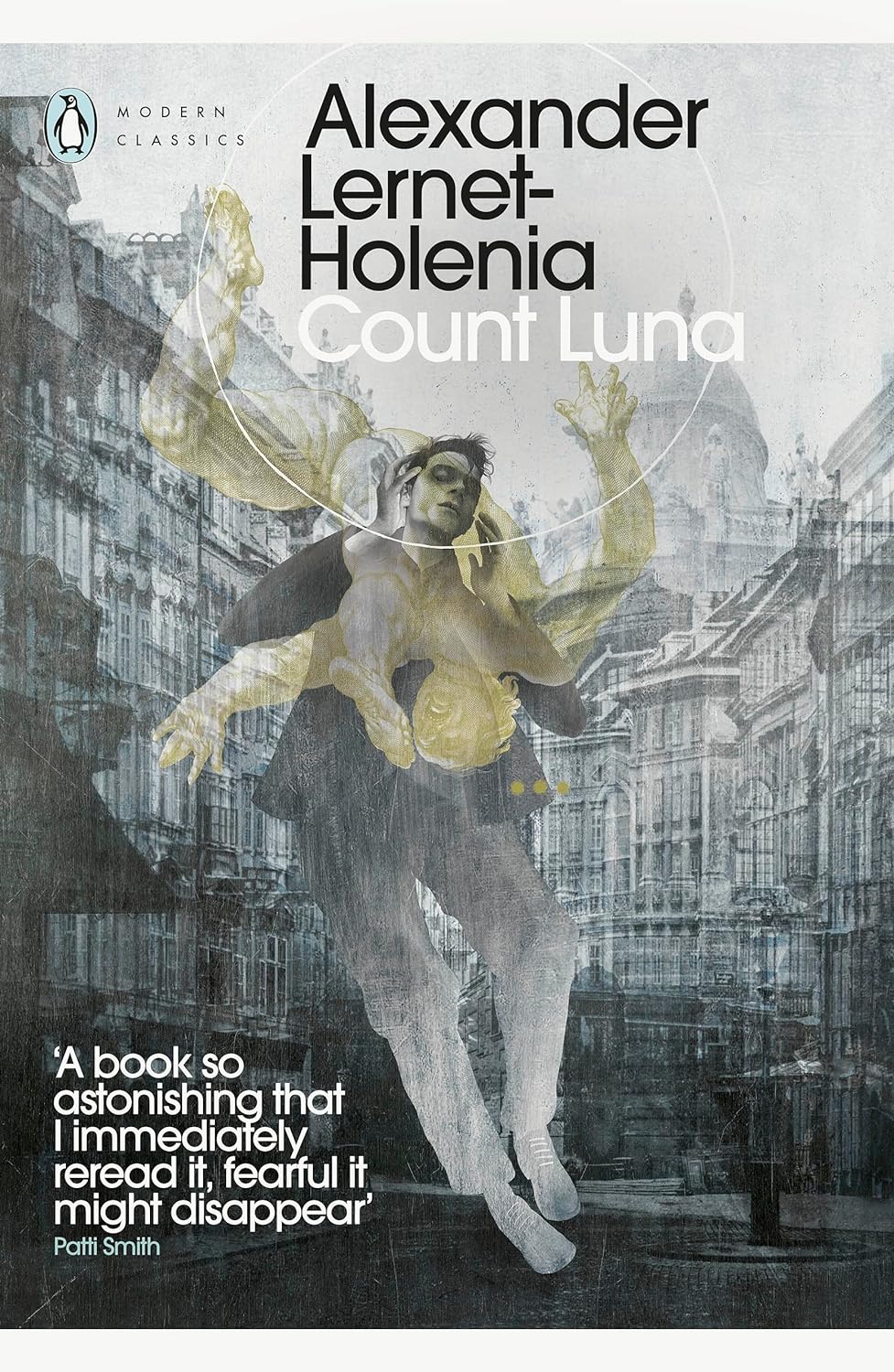
Count Luna

Rate this book
The war is over but Alexander Jessiersky, a wealthy Austrian aristocrat and industrialist, is haunted by guilt over the neighbour he inadvertently sent to a concentration camp, Count Luna. What's more, he is convinced that Luna survived—and is out to get his revenge.

So begins a wild, weird cat-and-mouse chase that takes him and his shadowy nemesis through windswept valleys, eerie houses and, eventually, Rome's catacombs, as an increasingly paranoid Jessiersky asks himself: will Luna stop at nothing to exact his bloody vengeance?

Crazed, raging and darkly comic, Count Luna is a reckoning with postwar guilt, and an irresistible tale of the uncanny.

160 pages, Paperback

First published January 1, 1955

23 people are currently reading
1615 people want to read

About the author

Alexander Lernet-Holenia

54 books46 followers
Alexander Lernet-Holenia (1897 — 1976) was an Austrian poet, novelist, dramaturgist and writer of screenplays and historical studies who produced a heterogeneous literary opus that included poetry, psychological novels describing the intrusion of otherworldly or unreal experiences into reality, and recreational films. He was born and died in Vienna.

Ratings & Reviews

What do you think?
Rate this book

Friends & Following

Create a free account to discover what your friends think of this book!

Community Reviews

5 stars
79 (13%)
4 stars
235 (40%)
3 stars
188 (32%)
2 stars
69 (11%)
1 star
15 (2%)
Displaying 1 - 30 of 91 reviews
Profile Image for Vit Babenco.
1,779 reviews5,768 followers
March 12, 2025
Count Luna is a dark satire adorned with madness.
The novel begins with the hero of the story disappearing in the catacombs of Rome…
The structure of the Roman catacombs is in itself very simple. It consists of narrow passages, the lateral walls of which are lined with several tiers of hollow niches, one above another, designed to receive the bodies. Tablets of marble or terra cotta, bearing inscriptions, close up the niches. But with more and more dead to be interred, more and more passages had to be excavated, and thus there came into being those many-storied, labyrinthine structures…

A certain retreat into the past… It turns out that during the wartime count Luna accidentally fell an inadvertent victim to the main hero’s business… The protagonist becomes obsessed with helping the count… But even when the war is over he can’t locate count Luna… But in the process of searching his attitude to Luna gradually starts changing… He imagines that the count secretly pursues him… Lurks in shadows… Wishes to do him harm and revenge…
Just as the moon was supposed to influence the weather, so Luna undoubtedly had an influence upon the climate of events! And there must be times, so Jessiersky came to feel, when Luna’s command over the forces which enabled him to deceive, to inflict harm, perhaps even to kill, was greater than usual, and times when he was practically powerless.

His life turns more and more strained… His consciousness is ruled by suspiciousness… 
The countless motorcycles, in particular, made him feel as though he were surrounded with a buzzing swarm of unearthly insects. The people on the motorcycles, ostensibly quite harmless businessmen, engineers, and workmen, were like spies in disguise who kept circling about him.

Insanity turns an individual into the man in the moon.
Profile Image for Alwynne.
936 reviews1,595 followers
April 5, 2024
Alexander Lernet-Holenia’s hallucinatory, post-WW2 novel revolves around Alexander Jessiersky, an affluent man who’s somehow survived wartime Vienna unscathed. His wealth and social status even enabled him to avoid the ravages of battle. Yet when Lernet-Holenia’s narrative opens Jessiersky is about to do something inexplicable, he’s insisting on exploring labyrinthine Roman catacombs in pursuit of two long-lost priests who entered but never returned. The question of why Jessiersky has decided to do something so foolhardy frames the story that follows, as Lernet-Holenia reaches back through time to Jessiersky’s ancestors in Poland, then to Jessiersky’s birth and subsequent experiences.

Jessiersky’s oddly detached, cynical even. He’s married with children but regards his family as little more than social necessity, an extension of his property. He’s disdainful of everyone around him except for one man Count Luna, someone he’s never met yet considers a deadly foe. Falsely accused of treachery during the war, Luna was sent to Mauthausen concentration camp, all because he refused to sell his land to Jessiersky’s company. The war’s over, Luna’s almost certainly dead but Jessiersky is unable to believe it. Jessiersky’s convinced Luna survived and is in pursuit, intent on a terrible revenge - although Jessiersky refuses to take actual responsibility for Luna’s imprisonment. As days, weeks, then months pass, Jessiersky’s increasingly obsessed, imagining Luna always just out of sight, poised to attack. His feelings of persecution gradually turn Jessiersky’s life into a fever dream. "Know your enemy," becomes his mantra. He researches into Luna’s past, fixating on apparent similarities between them. Gradually Luna begins to seem part elemental force akin to the moon itself, part doppelganger – echoing aspects of Luna’s namesake from Verdi’s opera. Suspicions that drive Jessiersky to commit a series of desperate, murderous crimes.

Lernet-Holenia’s restless narrative shifts between noir-ish thriller, dry comedy, and surreal twist on a gothic, ghost story - Joseph Roth meets Poe meets Kafka. Along the way, Lernet-Holenia delves into issues of heritage and rootlessness which he links to the collapse of the Austro-Hungarian Empire, paving the way for disorder. Jessiersky’s is a world after the fall, in which the old ways, the old hierarchies no longer hold. Pragmatism rules: the “liberating” allies are morally suspect; ordinary Austrians adopt whatever political stance seems the safest bet; and even faithful servants might kill you while you sleep. Only money, more precisely capitalism, retains its force: despite his lack of effort, Jessiersky’s fortune steadily increases. It’s a world in which guilt can be avoided by recasting the war’s victims like Luna, as villains – like the Jewish survivors attempting to reclaim the homes "requisitioned" during their absence. Jessiersky’s predicament seems symptomatic of a wider, postwar existential crisis. Jessiersky’s compulsive thoughts about Luna mirror his growing sense of dislocation, trauma and an awareness of the fragility of his society. Despite some slightly static passages, this was unexpectedly gripping, a wildly unpredictable, intense vision of postwar Austria. Translated by Jane B. Greene.

Thanks to Netgalley and publisher Penguin Classics for an ARC

Rating: 3.5
Profile Image for Hux.
393 reviews113 followers
June 6, 2024
One of the more disturbing books I've read in recent years. Beautiful but harrowing, entertaining but hideous. In terms of atmosphere, it reminded me of The Tenant, The Green Face, and even a little of Dream Story. Suffice it to say, the book is a nightmare come to life.

Alexander Jessiersky (a name very similar to The Tenant's Trelkovsky) is an Austrian businessman who, during the events of the Nazi regime, has a company that wants to take over the estate of a man named Count Luna. Since Luna rejects this offer, Jessiersky's directors (using their influence) have Luna arrested and sent to a concentration camp in order to get their way. Though not involved in this decision, Jessiersky inevitably comes to feel responsible for what has happened to Count Luna. He regularly visits his family to ensure that they understand it was not his doing, he sends food parcels to the concentration camp, he feels guilty.

When the war ends, nothing is known of Count Luna's fate but his family have concluded that he must have died. Jessiersky finds this hard to believe (even convincing himself that the family are lying to him). His guilt now deforms itself into paranoia, and it spirals ever deeper into his psychological status, overwhelming him entirely. Soon, after an event where a man gave some sweets to his daughter in the park and she falls ill, he becomes convinced that Count Luna is seeking revenge, that he intends to do harm to his family. He hears footsteps in the house and believes they are Count Luna's; he goes to his country estate where he once again feels certain that Count Luna is following him. He abandons his wife, his children, commits terrible acts, loses all perspective, and eventually intends to fake his own death to throw Count Luna (a man he has never actually met) off the scent for good. It's here, at the end of this awful tether, when the very moon itself has become his enemy, that we get a bleak and somewhat terrifying conclusion.

The book is genuinely quite unsettling, this man's obsession, his guilt and paranoia, an all consuming and entirely destructive nightmare. Of course Lernet-Holenia is talking about the guilt of Austria, of everyone who sat back and watched the events of the war and the holocaust unfold. It's extremely effective. I don't think I've read a book that was quite as disturbing as this.

It's also written in a style that I love, where Lernet-Holenia tells the story rather than shows it (show don't tell is for cinema, kids, not literature), narrating the whole thing in a way that allows it to be expressed in beautiful and fluid prose, a sweeping tale of metaphor and simile, of meandering thought and lyrical observation. This means he occasionally includes more than he has to (the details of Jessiersky's ancestors for example) even though that does come back again at the end. And what an ending. Heartbreaking. Sad. Terrifying. Horrific.
Profile Image for Chequers.
597 reviews35 followers
February 19, 2023
Quattro stelle ben meritate per le pagine finali, per le atmosfere fumose, surreali, per questa caccia cosi' serrata ad un uomo, il Conte Luna, cosi' sfuggente.
Questo libro e' aperto a diverse interpretazioni se lo volete analizzare, altrimenti...ve lo godete e basta, come ho fatto io ;)
Profile Image for Matthew Ted.
1,005 reviews1,035 followers
June 5, 2024
59th book of 2024.

Very good. In the vein of Kafka, Camus, Handke, Dostoyevsky, a man named Jessiersky inadvertently leads another man to a concentration camp. Then, post-war, he believes that the man he sent away, Count Luna, is after him. What's more, as the novel becomes more and more surreal and violent, that Count Luna is somehow connected to the moon itself, his namesake, and gains power from it, like Sir Gawain gains power from the sun and its position. The climax of the novel becomes a trip like the end of Hesse's Steppenwolf. It contains longwinded asides, some philosophical ruminations, and above all the book, rather than about revenge, National Socialist Germany, or whatever else this bizarre book has to offer, contains an overwhelming sense of thanatophobia. Perhaps it attempts to cure us of that, assuming we, the reader (granted we are not insane), also suffer from this affliction.
Profile Image for Andy.
1,174 reviews220 followers
April 21, 2024
Take Franz Kafka, Albert Camus, Thomas Mann, and Jorge Luis Borges and pop them all in a blender, and you might get something like Alexander Lerner Holenia. I’ll be honest this was heading for a four star, but it had such a strong ending, I’m giving it a five.

Reading ALH is like walking in a dream state, everything is weird and wonderful. I can’t even begin to explain. If you’ve never read him maybe maybe start with Baron Bagge, which I think is better, and is certainly shorter. Because whilst I loved this book, there is just too much extraneous detail. Still pretty extraordinary stuff.
Profile Image for Andrew H.
581 reviews22 followers
August 6, 2024
Count Luna is a perplexing novella. It starts off with the main character's suicide: a symbolical act in which Alexander Jessiersky enters Rome's catacombs knowing he will never escape. The remainder of the novella explains why this action came about. In some ways, Count Luna reads like a modern version of the Book of Job in which Count Luna parallels Job's satanic adversary. It is a post-war study of obsession, paranoia, and illusion, in which Jessiersky's actions lead to multiple murders and social destruction, all of which are carried through with equanimity. So many genres are crossed by the novella it is hard to know what it is supposed to be -- maybe, a Lucian for the twentieth century, a fabulous tale in which philosophy and surrealism combine.
Profile Image for Adam Nissen Feldt.
56 reviews7 followers
November 25, 2017
On paper this one is just my thing. Odd classic, pan European setting, unreliable main character, post war mystery. Had it not been for an annoyingly eclectic third person narrator fluctuating between sharing and mocking his objects pathology, I probably would. A bit more focus and the truly awesome plot would have carried this book to a higher rating.
Profile Image for Tittirossa.
1,062 reviews333 followers
December 28, 2022
Letto per un GdL. Interessante but not my piece of cake.
La narrazione tra l’onirico e lo spiritato della caccia che l’ex nobile oggi facoltoso Jessiersky fa al Conte Luna mette insieme un caleidoscopio di informazioni a tratti ipnotiche. Come gli alberi genealogici dei due, che tessono una trama che ricopre tutta l’Europa e si spinge ad Est.
A un certo punto ho dovuto controllare l’anno in cui è ambientato, dopo la seconda guerra mondiale, perché le atmosfere erano decisamente di inizio secolo, e a quel punto si insinua il dubbio di una doppia lettura, il Conte Luna è di origine ebraica, J è stato più o meno connivente col nazismo. Ma no, la metafora del senso di colpa sarebbe troppo grossolana per un tessitore così raffinato.
O forse Luna e J. sono la stessa persona? Il labirinto evocato più volte dalla descrizione delle labirintiche catacombe, in cui entrambi si perdono, forse è un labirinto mentale? J proietta se stesso in un alter ego e si annulla perdendosi in una realtà fantastica….
Mah, chissà
Profile Image for Bahram.
63 reviews6 followers
June 2, 2024
I was expecting fiction; it started well; however, it didn’t turn out the suspense, thriller or a crime novel I was expecting. By the last chapters it was nothing but a tour guide of Ancient Rome: pages and pages of descriptive text like a travel guide, totally irrelevant to the story. Was this magic realism?
Profile Image for Helen.
625 reviews131 followers
April 2, 2024
What a strange book this is! I enjoyed it, but I’m not sure I fully understood everything the author was trying to say. It’s the first book I’ve read by Alexander Lernet-Holenia and I’m definitely now interested in reading more.

Count Luna was first published in German in 1955 (Lernet-Holenia was an Austrian author) and appeared in an English translation by Jane B. Greene a year later. It has recently been published in a new edition by Penguin Classics.

The novel begins with Alexander Jessiersky, an Austrian aristocrat, entering the Catacombs of Praetextatus in Rome, apparently in search of two French priests believed to have vanished somewhere in the underground passageways. When Jessiersky himself also fails to emerge from the catacombs, his disappearance is reported to the police, who link him with a series of incidents which occurred in Austria and are still under investigation. The rest of the book is presented as an account of Jessiersky’s life leading up to the disappearance, based on reports by the Italian and Austrian authorities.

We learn that at the start of World War II, Jessiersky is the head of a large Viennese transport company. When the company tries to purchase some land belonging to Count Luna, who refuses to sell, the board of directors come up with a plan to confiscate the land and have Luna sent to a Nazi concentration camp. Jessiersky himself is not involved in this, but does nothing to prevent it from happening – and so, when the war is over, he begins to worry that Luna has survived the camp and is coming back to take his revenge.

On one level, Count Luna could be described as a psychological thriller; told mainly from Jessiersky’s perspective, there’s a growing sense of paranoia and fear as he becomes convinced that Count Luna is following him around Vienna, watching from the shadows, breaking into his house and even trying to poison his children. Whether any of these things are true or only exist in Jessiersky’s imagination I’ll leave you to discover for yourself. The atmosphere becomes very dark and the feeling of tension increases as the novel heads towards its conclusion and Jessiersky enters the catacombs – and from this point the story becomes quite bizarre and even more nightmarish.

At 160 pages, Count Luna is a short novel, but took longer than I expected to read as there are some long, detailed digressions into subjects such as the lineage of the Jessiersky family, which need some concentration from the reader (and don’t really add a lot to the story as a whole). Apart from the references to the war, it felt more like a book written in the 19th century than one written in the 1950s. The war is a crucial part of the story, however, and I’ve seen reviews suggesting that Lernet-Holenia was drawing parallels between Jessiersky’s guilt over Luna’s fate and Austria’s own post-war guilt, which does make a lot of sense. I also think the name Luna (the moon) is no coincidence, as Jessiersky discovers that trying to escape from Luna – and therefore from his guilt – is as useless as trying to escape from the moon.

Although I didn’t love this book as much as I thought I was going to at the beginning, I did find it completely fascinating and it left me with a lot to think about.
980 reviews16 followers
February 21, 2022
A descent to madness done step by step, starting with guilt and becoming guilty. I guess fleeing the moon will do this to you.
Profile Image for Deryn.
134 reviews2 followers
September 30, 2025
Ho iniziato 𝘐𝘭 𝘊𝘰𝘯𝘵𝘦 𝘓𝘶𝘯𝘢 aspettandomi una storia occulta, una trama onirica e visionaria, in cui il mistero annunciato nella sua premessa si sarebbe svelato attraverso la lenta (de)costruzione della psiche del suo personaggio protagonista.

Forse ho declinato le mie previsioni in una direzione errata, tanto che ciò che ho letto mi ha dir poco lasciata affranta e confusa. La prosa dell'autore è stata spesso macchinosa, labirintica (e non nel senso positivo del termine!) e per lo più confusionaria. L'azione si trovava costantemente intervallata da parentesi di dubbia utilità al lettore, che hanno creato un flusso disorganico e — mi duole ammetterlo — persino noioso in molte fasi della lettura.

Ho afferrato forse uno spiraglio di ciò che lo scrittore ha voluto trasmettere attraverso la sua storia: un racconto che riflette sulla natura dell'umano, in cui il fantasma del Conte Luna diviene lo specchio dell'inconscio per il lato più oscuro e viscerale di Jessiersky, il protagonista; una riflessione metafisica sulla morte, sul senso di essa in contrapposizione alla vita stessa, in un circolo esistenziale che si passa di generazione in generazione, al pari di una maledizione.
Tuttavia, si tratta di sottotesti difficili da decifrare, attraverso una storia che si perde a più riprese lasciando il lettore spesso in balia di turbinii di parole tremendamente ostici, al limite del manualistico.

La presenza dei personaggi femminili inoltre è da definire più che marginale: sono figure superficiali, funzioni narrative che non esprimono complessità o 𝘢𝘨𝘦𝘯𝘤𝘺, e non contribuiscono minimamente a creare un quadro o un contesto più intrigante nella storia del personaggio.

Sebbene quindi il libro sfiori tematiche profondamente interessanti, mi ha dato l'impressione di non centrare mai davvero il punto — un vuoto in cui la catabasi finale all'interno delle catacombe diviene un riflesso smorto e nebuloso di ciò che avrebbe davvero potuto rappresentare, e che invece di sondare le vere interiorità dei suoi personaggi si perde su una superficie che ricalca solamente se stessa.
Profile Image for Inge Janse.
308 reviews80 followers
December 3, 2024
Dit is absoluut een gek boek. Het begint geweldig. Gekte, dramatische keuzes, mysterie, alles.

En dan start het lunapark (haha, dit was niet eens intentioneel, ik zocht dit woord echt). Heel veel is onnavolgbaar. De familielijn van Alexander Jessiersky, de veranderingen in de baan van de maan ten opzichte van de zon, de achtergrond van count Luna: not. a. fucking. clue. Ook de stijl verspringt soms compleet, zoals als Lernet-Holenia uitwijdt over de heuvels in Rome, en een heel ander boek lijkt te schrijven (als het al geen Wikipediapagina is).

Het gebrek aan dialoog is ook een zeer lastige. Het boek blijft daardoor op grote afstand van me. Dingen gebeuren, maar niet echt. Het is bijna onmogelijk om me echt te verhouden tot de gebeurtenissen.

Wat dan weer wél werkt, is de gekte van Alexander. Ja, het is veelgevraagd, maar het boek is suuuuper consequent daarin. Op geen enkel moment dacht ik: die gast is nog te redden. Koekoek, compleet, geen twijfel over mogelijk. Da's heerlijk. Het kon niet gekker worden, of ik geloofde het nog, tot aan het einde aan toe.

Zonder dat dat goed of slecht is, moest ik onbewust denken aan Sandor Marais Gloed (vanwege die bizarre gekte die een niet-bestaand (of wel?) persoon veroorzaakt), Mervyn Peaks Gormenghast (vanwege de symbolisch-belangwekkende rol van de bibliotheek) en de gekke geestenwereld (of eigenlijk de wereld van geesten in de onze) van Susanna Clarkes Jonathan Strange & Mr Norrell. Eigenlijk is dat heel goed, nu ik er zo over nadenk, dat het associaties oproept met andere boeken, blijkbaar gebeurde er iets. Maar wat? Geen idee.

Een mysterieus boek dus, terwijl ik me afvraag of dat überhaupt de bedoeling was. Goed zou ik het niet noemen. Fascinerend absoluut.
Profile Image for Valeria.
129 reviews5 followers
March 31, 2025
È molto difficile che libri con queste atmosfere non mi piacciano, eppure, nonostante abbia trovato la storia estremamente affascinante, purtroppo credo ci fosse qualcosa che avrei dovuto cogliere che invece non ho colto.
Profile Image for Katia.
180 reviews
May 6, 2024
Dostoevsky’s been real quiet ever since this book came out. A spiral to insanity in 160 pages, with hallucinations and ridiculous tangents, it’s a story of a man’s guilt. What ‘Crime and Punishment’ says in 700 pages, this one says in much less, but in a much more absurd manner. Nothing makes sense, and my brain lagged reading paragraphs, but it’s very entertaining, and annoyingly profound.
33 reviews1 follower
January 9, 2025
A strange and unique book. I quite enjoyed - though probably more a 3.75 as there were some long passages that felt just little much for all the detail…
Profile Image for Stefanie.
152 reviews5 followers
March 27, 2024
Starting the story with Jessiersky entering the catacombs was intriguing and hooked me instantly. What followed were four chapters (1/3 of the book) of info dumping about family trees and heritage that took me out of the story and made me lose my momentum until the very end.
The decent into madness and the different situations that ended up with the perishing of characters was fascinating to read and the historical context of the story was very interesting but the narrator made the reader always step back and full pause throughout the whole book by pages and pages of information that didn’t really add anything to what was actually happening. Therefore my enjoyment dwindled the more I read. I would’ve dnf‘d if the book wasn’t only 160 pages long.

Thanks to Netgalley and Penguin for this arc in exchange of an honest review.
Profile Image for Caroline.
29 reviews
November 17, 2025
"the northern part is filled with the busy of the present; the southern part, mourning amidst its ruins, seems still to the fruitless memories of the irretrievable past"

"What is God?//Again just a man as he sees himself"

Quite a strange little novel; at times i felt that this was written in the 19 century, seeing many parallels to Dorian Gray (the devaluation in paranoia and the murders committed)
the depiction of city vs country life is also evocative of gothic literature, with Vienna reminding me much of how certain victorian writers would depict London

nevertheless, this novel was produced in 1955 by an austrian writer, a fact explains much of the paranoia/guilt experienced by the main character - this guilt is not just Alexander's, it is the guilt of a nation

furthermore, i found it quite interesting the importance placed on family lineage - Alexander's family but also Luna's respectively
Profile Image for MRS C J FIELDS.
56 reviews3 followers
April 2, 2024
The protagonist allows a man, Count Luna to be sent to a concentration camp. Although his lack of empathy is seen throughout the book (for his wife and children for example), his guilt sends him spiralling into obsessive madness, convinced that Luna is stalking him and his family to get revenge.
I found this a strange book. I quite liked the fact that sections felt like a history or science lesson, but there are other sections that dragged and I found myself losing focus on the plot. The ending was wierd and wonderful though and a great wrap up for this unusual story.
Thank you netgalley for this ARC
#NetGalley
#CountLuna
Profile Image for MRS C J FIELDS.
56 reviews3 followers
April 2, 2024
The protagonist allows a man, Count Luna to be sent to a concentration camp. Although his lack of empathy is seen throughout the book (for his wife and children for example), his guilt sends him spiralling into obsessive madness, convinced that Luna is stalking him and his family to get revenge.
I found this a strange book. I quite liked the fact that sections felt like a history or science lesson, but there are other sections that dragged and I found myself losing focus on the plot. The ending was wierd and wonderful though and a great wrap up for this unusual story.
Thank you netgalley for this ARC
#NetGalley
#CountLuna
Profile Image for Dan.
500 reviews3 followers
April 19, 2024
I thought this was going to be right up my street (whoever wrote the blurb for this new Penguin edition needs a pay rise), but the reality proved to be a little disappointing. There are a few too many longueurs and digressions for a short book, but fundamentally it’s just not as weird as I was hoping and expecting. There is a nice vein of pitch black comedy throughout, which helps, but ultimately I wanted something more fantastical.
17 reviews
November 6, 2025
One of the most unusual books I’ve ever read. The unreliable narrator and uncanny atmosphere feel so characteristic of Central European modernists like Kafka, but it’s set post-WWII. Only addresses the Nazis obliquely but the influence is palpable throughout. Lapses into very expressive stretches, too, above all the ending which is just brilliant. LOVE
Profile Image for Merl Fluin.
Author 6 books59 followers
July 13, 2024
He lived entirely in a world of his own, though what kind of a world it was, no one – probably not even he himself – really knew.
A description of the protagonist that also applies to the book as a whole. I don't know what kind of a book it was, even though I read it avidly and immediately went back and reread the beginning as soon as I'd finished the ending.

What the hell even is this story? I'm too dazed by it to answer. I could tell you it reminded me of a mash-up of Kafka and James Hogg, but that's hardly helping, is it?

No, I can't tell you what it is or was. I can only tell you to read the bloody incredible thing. Mind-blowing.

Profile Image for Victoria.
110 reviews35 followers
August 18, 2024
A really interesting premise and the main character’s descent into insanity and guilt were so intriguing to read, but some of the tangents the author went into were too much for me
Displaying 1 - 30 of 91 reviews

Can't find what you're looking for?

Get help and learn more about the design.